1. Introduction
Notions of what it means for practitioners to engage in researching teaching and learning are changing rapidly, impacting on the related fields of Applied Linguistics and Language Education. Calls abound for research which is reflexive and responsive to context (e.g. Zeichner & Noffke, Reference Zeichner, Noffke and Richardson2001; Wedell & Malderez, Reference Wedell and Malderez2013). Proposals are made for the involvement of practitioners in theorizing their own practice (Yoshida et al., Reference Yoshida, Imai, Nakata, Tajino, Takeuchi and Tamai2009; Johnson & Golombek, Reference Johnson and Golombek2011; Mann & Walsh, Reference Mann and Walsh2017). Teachers are encouraged to position themselves as researchers in their own right (Cochran-Smith & Lytle, Reference Cochran-Smith and Lytle2009; Borg, Reference Borg2013), with valuable insights to offer. The paradigms of research and pedagogy are subtly shifting as practitioners actualize their skills, expertise and insights as researchers. However, as Kuhn notes: ‘novelty emerges only with difficulty, manifested by resistance’ (Reference Kuhn1962/1996, p. 64) and too often this can be seen as practitioners are marginalized (Johnson & Golombek, Reference Johnson and Golombek2002) in the field. The field is defined as the mesh between Applied Linguistics and Language Education. This article traces the intricacies of this mesh, concurrently highlighting interdisciplinary connections, in order to explore empirical and theoretical developments in/from praxis.
An innovative form of practitioner research, Exploratory Practice (Allwright, Reference Allwright2003; Allwright & Hanks, Reference Allwright and Hanks2009), proposes a fully inclusive approach whereby learners are seen as key developing practitioners; co-researchers alongside their teachers. EP promotes principles of puzzling, working for understanding, and quality of life (QoL); it prioritizes practitioners working together for mutual development, and knits research with pedagogy, in the search for deep and relevant understandings of praxis. An organic framework (Hanks, Reference Hanks2017a), EP has developed quickly, aiming to utilize everyday pedagogic practices as multimodal methodological tools for investigation. Crucially, EP's involvement of learners, working as researchers of their own practice alongside teachers, teacher educators, psychologists, and curriculum designers, means that rather than separating research and pedagogy, they are united. This nexus of theory and practice has the potential to enrich our understandings of culture and wellbeing in language learning/teaching. Until recently, though, discussions about practitioner research have tended to focus on internal arguments, and a lack of awareness of interdisciplinary connections means that debate has been limited.
This article is a meta-analysis which goes beyond systematically reviewing the literature to consider implications of established and emergent themes and contested ideas from/for different perspectives. It addresses the following questions:
1. What, if any, is the impact of EP in terms of (a) global reach; (b) global uptake; (c) implementation in different contexts (e.g. primary, secondary, tertiary education)?
2. What are the theoretical themes and insights emerging from the literature?
3. What are the (epistemological, methodological, pedagogical) affordances and/or constraints of enacting EP?
4. How do the conceptual and theoretical developments in EP relate to Applied Linguistics, Language Education and beyond?
Despite the wealth of material available, EP has frequently been downplayed. Critics assert: (1) EP only takes place in limited, privileged contexts, (2) there is not enough published work to warrant attention, or (3) the work lacks theoretical heft. Typical comments include: ‘it lacks global reach’, ‘it exists in small, isolated geographical/institutional areas’, ‘it's just another name for action research/reflective practice/teacher research’, ‘it's ephemeral, just a flash-in-the-pan’. This article provides a comprehensive review of the EP literature which (1) sets it in geographical, historical, theoretical context; (2) shows the development of the EP framework; (3) critically examines developments in theory, methodology and practice; and (4) discusses the affordances of such work in language teaching and beyond. This is timely because it chimes with recent currents of debate focusing on agency, identity, interculturality, trust and wellbeing as key concepts for theory-building. The article aims first to dispel common misconceptions, then to discuss EP as a vibrant area of creative research and pedagogy.
2. Method
Criteria for the review began with work in the public domain. I surveyed a range of international journals using key words such as ‘exploratory practice’, ‘integrating research and pedagogy’, ‘understanding’, ‘collegiality’, ‘quality of life’ (i.e. the EP principles – see Section 6). The search was refined by adding synonyms or related terms (e.g. ‘wellbeing’). I also selected ten journals in which work on EP might be published and searched these manually. I examined international publications: Applied Linguistics, ELT Journal, Innovations in Education and Teaching International, Journal of EAP, Language Teaching, Language Teaching Research, Modern Language Journal, System, Teacher Education, TESOL Quarterly and monographs, chapters, edited volumes, all of which are subject to rigorous peer-review processes. I included doctoral theses, since these are exemplars of cutting-edge work in research methods with novel theoretical insights, whose peer-review processes (i.e. examination criteria) are as robust as those for publication. I deliberately included publications in languages other than English, notably Portuguese.
Related areas where there are already comprehensive reviews, such as teacher research (TR) (Borg, Reference Borg2009, Reference Borg2013), action research (AR) (Burns, Reference Burns2005, Reference Burns2010), and reflective practice (RP) (Edge, Reference Edge2011; Mann & Walsh, Reference Mann and Walsh2017), were excluded from the search parameters. They informed the analysis but as they do not address EP directly they are not the locus for discussion. Newsletter articles and Masters’ dissertations/theses were also not included, as the level of the peer-review process is not comparable. However, a rich corpus is available at https://www.maxwell.vrac.puc-rio.br/menu_etds.php for future analysis.
The survey went beyond settings of English language teaching (ELT), English as a foreign language (EFL), and teaching English to speakers of other languages (TESOL). It included second language acquisition (SLA), teaching ‘other’ languages, i.e. modern foreign languages (MFL), English for academic purposes (EAP), and language teacher education (LTE). The discussion then connects these areas with developments in general education, professional development and healthcare.
Before continuing, a note regarding the epistemology of writing. As a member of the EP network, with extensive access to EP publications, I bring a wealth of insights and a comprehensive overview of global activity in this arena. I am, inevitably, an advocate and a presence in the writing, yet this does not preclude a critical, rigorous approach. In presenting a transparent account of the analytical work, I break here with the tradition of a third-party stance (see Clark & Ivanič, Reference Clark and Ivanič1997; Holliday, Reference Holliday2002, for critique). Instead, I take a dialogic (Bakhtin, Reference Bakhtin1986) approach. I contacted authors of doctoral theses directly and engaged in conversations with key figures across continents. Moreover, I aligned myself with Breen (Reference Breen, Gieve and Miller2006) and Gieve and Miller (Reference Gieve, Miller, Gieve and Miller2006a), positing that practitioners are actors with agency. Therefore I acknowledged narratives/case studies written by teachers and learners and represented them as authors alongside more recognized researchers. This contributes to robust, creative theory-building and exemplifies developing theory-in-dialogue with those at the forefront of research and practice.
3. EP: Global reach, uptake and contexts
I analysed 97 articles, chapters and books published over 27 years. Each text focused on EP, either giving an account of empirical research, or exemplifying and developing the conceptual framework.
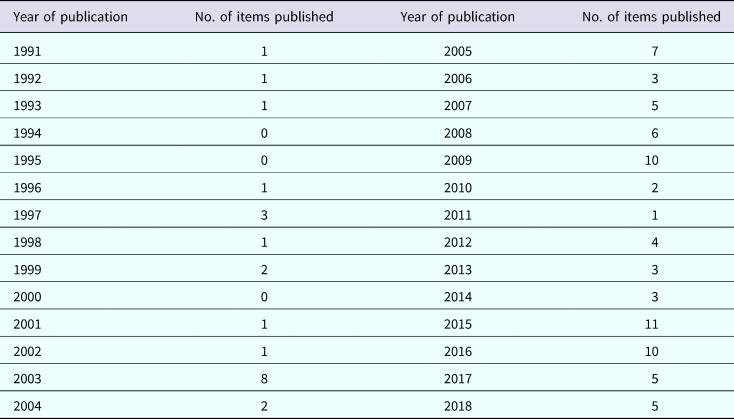
As Table 1 demonstrates, EP grew from small beginnings in the 1990s (first mention is ‘Exploratory Teaching’ in Allwright & Bailey, Reference Allwright and Bailey1991), with the bulk of publications appearing from 2003 onwards. The corpus includes two books focusing on conceptual developments of the EP framework (Allwright & Hanks, Reference Allwright and Hanks2009; Hanks, Reference Hanks2017a), and five further volumes, engaging in theory-building rooted in praxis (Gieve & Miller, Reference Gieve and Miller2006b; Gunn, Reference Gunn2009a; Tarone & Swierzbin, Reference Tarone and Swierzbin2009; Dikilitaş & Hanks, Reference Dikilitaş and Hanks2018; Slimani-Rolls & Kiely, Reference Slimani-Rolls and Kiely2018). With a recent surge of publications, EP is entering a new phase, demonstrating the impact of the framework across the field.
Chronological list of EP publications

The numbers in Table 1 alone do not convey the full impact of EP, however. Key critical questions remain:
• What is the global reach of EP?
• How much uptake of EP has there been globally?
• In which contexts has EP been implemented?
Table 2 summarizes 94 empirical studies according to country, context and focus. There is demonstrable global uptake, crossing 17 countries: Australia, Brazil, China, Finland, Italy, Israel, Japan, Jordan, Northern Cyprus, Oman, Singapore, Taiwan, Thailand, Turkey, United Arab Emirates (UAE), United Kingdom (UK), United States of America (USA). However, I was unable to find any articles about EP in Russia, Canada or countries in Africa and found few from the Indian subcontinent. Moreover, although EP is well established in Rio de Janeiro, it does not appear to have had the same uptake elsewhere in Brazil or South America.
Exploratory Practice: Empirical studies showing country, author/date, context and focus

Note: Studies are presented by country and in chronological order. Not included in this table are publications which focus more on theory-building and establishing the conceptual framework such as Allwright and Hanks (Reference Allwright and Hanks2009), Hanks (Reference Hanks2017a).
Contexts where EP has been implemented go beyond the geographical, as Table 2 shows. EP has taken place in state schools,Footnote 1 universities and private language schools. Educational contexts included:
• Primary (learners aged approximately 6–11 years)
• Secondary (learners aged approximately 11+ years)
• Tertiary (learners aged 18+ years)
○ Pre-sessional students
○ Undergraduate students
○ Post-graduate students
• Private language schools and institutions.
The resistance EP shows to superficial groupings is noteworthy. With an emphasis on collegial, multidisciplinary work, the boundaries between roles and contexts become porous. For example, Dalsky and Garant (Reference Braga, Allwright and Hanks2016) described their experience of EP with learners in Finland and Japan, focusing on intercultural issues emerging from an attempt at international learning collaboration in cyberspace. It could not therefore be assigned to one country or another (it is flagged as Japan/Finland in Table 2, but this should not be taken as an indication of the primacy of either country). Hanks (Reference Hanks, Yoshida, Imai, Nakata, Tajino, Takeuchi and Tamai2009a) investigated collegiality through case studies from Brazil and Turkey as teachers and learners incorporated EP in state schools, while Rose (Reference Rose2007) elucidated EP at a special needs institution in Finland. Moreover, Miller et al. (Reference Miller, Barreto, Kuschnir, Sette, Bezerra, Cunha, Braga, Gil and Vieira-Abrahão2008) exemplified the collegiality principle, by not only researching jointly but also co-writing about their experiences as language teachers (Braga), teacher educators (Barreto, Cunha, Kuschnir), student-teacher (Bezerra). They wove Sette's experience as a psychoanalyst into their multi-voiced account of researching their learning/teaching practice in state schools, university and private language institutions. Thus EP celebrates the dynamic complexity (Tudor, Reference Tudor2001, Reference Tudor2003; van Lier, Reference van Lier, Arnold and Murphey2013) of classroom language learning, defying casual categorizations. These interwoven strands exemplify the deliberate blurring of theory, practice, contexts and foci that Cochran-Smith and Lytle (Reference Cochran-Smith and Lytle2009) advocate for practitioner research.
A criticism is that EP only takes place in limited contexts, with adult learners in relatively small, well-resourced classes. But the literature contradicts this assumption. Table 2 shows a significant amount of EP work has been undertaken in different situations.
For example, in Brazil, Soares (Reference Soares2008) worked with her pupils to investigate the use of class blogs for language development and found mutual development in co-discovering technology for the classroom. Miller et al. (Reference Miller, Barreto, Kuschnir, Sette, Bezerra, Cunha, Braga, Gil and Vieira-Abrahão2008) brought together young learners, student teachers, teacher educators and teachers as they investigated their puzzles in state schools across Rio de Janeiro (hereafter Rio). This links to the theoretical work of Tarone and Swierzbin (Reference Tarone and Swierzbin2009) which focused on EP in SLA, investigating key issues such as interlanguage, learner developmental sequences, lexical complexity, scaffolding, strategies for communication and treatment of error. The work encompasses different categories in applied linguistics rooted in the USA. The work of practitioners, positioned as co-researchers unpacked issues central to SLA such as learner agency, anxiety, motivation.
In Thailand, Gunn (Reference Gunn2001, Reference Gunn2003) worked with EFL young learners to investigate notions of communicative competence via EP. Gunn (Reference Gunn2009a) also worked with 22 teachers in various educational institutions in Jordan, Oman, Saudi Arabia, UAE. Studies included: involving learners puzzling about student/teacher perspectives on ‘native-speakerism/non-native-speakerism’ (McLaren, Reference McLaren and Gunn2009); writing-tutor training (Ronesi, Reference Ronesi and Gunn2009); studies investigating the use of ‘webquests’ (Al Zieni, Reference Al Zieni and Gunn2009; Jawabreh, Reference Jawabreh and Gunn2009) and on-line discussion (Gunn, Reference Gunn and Gunn2009b). At primary level, pupils puzzled using pictures and role plays (Al Falasi, Reference Al Falasi and Gunn2009; Naqi, Reference Naqi and Gunn2009), while at secondary school level, teachers worked with their young learners to explore attitudes to textbooks or authentic materials (Sabbagh, Reference Sabbagh and Gunn2009; Thabit, Reference Thabit and Gunn2009), plagiarism (Bou-Mehdi, Reference Bou-Mehdi and Gunn2009) and oral communication skills (Salari, Reference Salari and Gunn2009). University students also joined their teachers in exploring student needs (Campa, Reference Campa and Gunn2009; Hejjawi, Reference Hejjawi and Gunn2009; Saeed, Reference Saeed and Gunn2009), use of portfolios (John, Reference John and Gunn2009), attitudes to communication (Malki, Reference Malki and Gunn2009), critical thinking (Maharaj & Rowe, Reference Maharaj, Rowe and Gunn2009) and learner autonomy (Raven, Reference Raven and Gunn2009; J. Ward, Reference Ward and Gunn2009), and perceptions of academic writing and plagiarism (Ahmed, Reference Ahmed and Gunn2009; Al Mazrooei, Reference Al Mazrooei and Gunn2009; A. Ward, Reference Ward and Gunn2009).
There is a proliferation of publications emanating from practitioner-researchers working in EAP in universities and colleges. This encompasses authors working on pre-sessional programmes, preparing students for undergraduate (UG) or postgraduate (PG) academic degrees, and in-sessional programmes for both UG and PG students.
For example, in Israel, Perpignan (Reference Perpignan2003) used EP principles to guide her investigation into written feedback with her students. In China, Zhang (Reference Zhang2004) investigated the challenges of group work with her students in extensive reading classes, while Li (Reference Li2006) problematized the notion of researching UG final-year student motivation(s), and Zheng (Reference Zheng2012) explored university student learning through peer-feedback on writing. In the USA, Best et al. (Reference Best, Jones-Katz, Smolarek, Stolzenburg and Williamson2015) also examined student attitudes to writing and peer feedback, and in the UAE, Gunn (Reference Gunn2005) analysed UG student perceptions of practitioner research. Meanwhile in Taiwan, Chu (Reference Chu2007) investigated student responses to empowerment, as they became decision-makers (rather than relying on the teacher) at a junior college, and Chen (Reference Chen2016) examined the developing understandings of email literacy of UG students at a technology university.
In Japan, Tajino and Smith (Reference Tajino and Smith2005) used soft systems methodology (see Section 7) as a lens alongside EP to investigate UG student attitudes to speaking practices. Later, Tajino (Reference Tajino, Yoshida, Imai, Nakata, Tajino, Takeuchi and Tamai2009) worked with his UG students to investigate their puzzles about language learning, while Smith (Reference Smith, Yoshida, Imai, Nakata, Tajino, Takeuchi and Tamai2009) investigated EAP curriculum design with his students. Nakamura (Reference Nakamura2008) focused on teacher/student talk inside and outside the classroom using conversational analysis as a tool to complement his EP work on developing understandings of student struggles with speaking. Pinner (Reference Pinner2016) used narratives to investigate student attitudes to self-assessment in speaking classes. Stewart, Croker, and Hanks (Reference Hanks, Chartrand, Brooks, Porter and Grogan2014) worked on a longitudinal study with UG students critically examining the EP conceptualization of ‘quality of life’, while Smithers (Reference Smithers2018) also investigated QoL, working with students ‘of the third age’ (post-retirement) in Japan to investigate puzzles about language learning.
The EP framework itself is the focus of investigations. In the UK, Hanks (Reference Hanks, Tarone and Soneson2012) interrogated the notion of collegiality when a teacher and her pre-sessional PG students preparing for Masters’ degrees in Business tried EP for the first time. Elsewhere, Dar (Reference Dar, Bullock and Smith2015) probed the principle of ‘involve everyone’ as she worked with her PG pre-sessional students to find out why they appeared reluctant to do their homework, and Bond (Reference Bond2017) worked with her students to understand their difficulties with English spelling. In two companion articles, Hanks (Reference Hanks2015a) invited UG pre-sessional learners to express their puzzles about language learning and analysed the perceptions of teachers (Hanks Reference Hanks2015b) puzzling about, then co-constructing the meaning(s) of their work with learners, using their normal pedagogic practices as investigative tools. She found that researching working for understanding excited much interest in practitioners. In a separate case study, Hanks (Reference Hanks2017b) probed the EP principle of integrating research and pedagogy while working on an intensive summer pre-sessional with PG students in a UK university.
In Northern Cyprus, Karanfil (Reference Karanfil, Dikilitaş and Hanks2018) examined his UG students’ reading activities, discovering that they were reading more literature (through on-line media), than he expected. Öncül and Webb (Reference Öncül, Webb, Dikilitaş and Hanks2018) worked to investigate their puzzle about the frequent use of unannounced tests with their students. In Turkey, student attitudes to oral presentations (Mumford Reference Mumford, Dikilitaş and Hanks2018) and reading comprehension (Ergünay Reference Ergünay, Dikilitaş and Hanks2018) were investigated, while Biçer (Reference Biçer, Dikilitaş and Hanks2018) and Doğdu and Arca (Reference Doğdu, Arca, Dikilitaş and Hanks2018) investigated curriculum design through EP with learners and teachers at their universities.
EP, then, is well represented in EAP. Arguably, it is even well suited to EAP because of the principle of integrating research and pedagogy.
Many EP studies are situated in LTE. Miller, for example, is prolific in publishing accounts in (1) initial LTE of students destined for the teaching profession; (2) in-service LTE involving both experienced and novice professionals; and (3) continuing professional development (CPD) in educational communities of practice (Lave & Wenger, Reference Lave and Wenger1991; Wenger, Reference Wenger1998). In a longitudinal study, Miller worked with three participants to investigate the dialogic processes of pre- and post-lesson consultations over several years (Miller, Reference Miller2003). In another longitudinal study of 22 student teachers (Miller, Reference Miller, Yoshida, Imai, Nakata, Tajino, Takeuchi and Tamai2009a, Reference Miller, Allwright and Hanks2009b) she advocated a ‘puzzle-driven syllabus’ as a productive way to inspire novice language teachers.
Working with colleagues and pre-service student teachers (e.g. Miller & Barreto, Reference Miller, Barreto, Meyer. and Albuquerque2015; Moraes Bezerra & Miller, Reference Moraes Bezerra and Miller2015), Miller and colleagues used journals, autobiographies, interviews, materials design and lesson-planning as potentially exploitable pedagogic activities (PEPAs – see Section 4). Miller analysed the written assignments (monographs) of 15 teachers, students and work colleagues which described their engagement with PEPAs and EP, concluding that we need to acknowledge the academic affordances of such work while also embracing a ‘meta-reflexiva’ (Miller, Reference Miller, Silva, Daniel, Kaneko-Marques and Salomão2012, p. 337) dimension to quotidian professional lives.
Wu (Reference Wu2004, Reference Wu2005, Reference Wu2006) investigated practitioner responses to the agentive possibilities of implementing curriculum change in LTE in China. His analysis merged activity theory, philosophy, narrative inquiry and critical realism through an EP lens. He probed the notions of language and understanding, concluding:
EP is essentially an ontological venture for the purpose of making a difference in teachers’ and learners’ lives, rather than for efficiency and effectiveness in passing words along. (Wu, Reference Wu2006, p. 347)
In considering the long-established tradition of ‘team-teaching’, Hiratsuka (Reference Hiratsuka2016) investigated the common (in Japan) practice of pairing American/British/Australian teachers with Japanese teachers, using EP as a lens. Noting the complexities involved, Hiratsuka found that EP contributed to successful team teaching, if both partners engaged in the questioning, researching process. Taking this further, Tajino et al. (Reference Tajino, Stewart and Dalsky2016) proposed an innovative shift: teachers as team learners. This has implications for LTE as well as teaching and learning more generally. As Tajino and Smith maintain: team learning incorporates all those involved in a lesson, as a ‘more collaborative and inclusive approach to classroom language teaching and learning’ (Reference Tajino, Smith, Tajino, Stewart and Dalsky2016, p. 12).
Confronting the spectre of professional burnout, Allwright and Miller described working with ‘several hundred public and private sector teachers’ (Reference Allwright, Miller, Soneson and Tarone2012, p. 105) in Rio engaging in EP over 20 years. They examined the incorporation of EP into a teaching practice course for learner-teachers and concluded that EP principles fortify ‘future teachers against the pressures of school life that threaten eventual burnout’ (Allwright & Miller, Reference Allwright, Miller, Soneson and Tarone2012, p. 110). Similarly, Miller et al. (Reference Miller, Côrtes, Oliveira, Braga, Bullock and Smith2015) examined PEPAs in action, as enacted by a teacher educator, novice teachers and the ‘home’ teacher with her pupils. More recently, Miller and Cunha (Reference Miller, Cunha and Dikilitaş2017) provided a critical analysis of EP with 21 students, 16 in-service teachers and 5 translators on a specialisation course. They expanded the idea of PEPAs into the notion of Potentially Exploitable Reflective Activities, or PERAs.
In Singapore, Silver adopted an EP stance to explore trainee teachers’ emotional and academic struggles, as well as their ‘perspectives on language teaching, subject teaching [e.g. mathematics, science] and the role of language in subject teaching’ (Silver, Reference Silver2008, p. 105) in primary classrooms. She highlighted the risks of positioning teachers and learners as objects of study and argued instead that EP affords opportunities for teachers and learner-teachers to actively co-construct their understandings. In the UAE, Gunn (Reference Gunn2010) discussed the engagement of her students (language teachers themselves) on an M.A. TESOL programme. She analysed student reluctance to engage in reflection by involving students in her EP puzzle and encouraged them to be critical in their reflective logs. She concluded that their frustration with a written reflection task framed in culturally specific terms was potentially a hindrance. But by grappling with these issues, through collaborative puzzling, they developed their understandings of their own teaching identities for the future.
Also working with language teachers, this time in Australia, Rowland (Reference Rowland2011) explored the potential of EP as a research method which acknowledges pre-existing teacher experience as a gateway to reading and critiquing research articles. He argued that EP, in challenging established hierarchies of academia, reminded these potentially disempowered professionals of their right to hold and express opinions, and to engage in research themselves, thus contributing to the development of the field.
In the USA, Crane (Reference Crane2015, Reference Crane and Hanks2017a) examined the affordances of EP as implemented in a ‘methods course’ to aid graduate student instructors to develop their teaching skills. Her critical analysis points to the need for more research into mentoring relationships between novice and experienced instructors. Here, the languages taught have shifted from English to German and Spanish, moving beyond EFL to encompass the teaching of MFL.
A rich research stream is emerging in MFL (though see Hanks, Reference Hanks2017a, p. 293 for the meta-puzzle ‘why the separation between MFL and EFL?’). For example, Slimani-Rolls (Reference Slimani-Rolls2003) worked with 2 teachers and 60 learners of business French at UG level in the UK and argued that collegial ways of working can enhance understandings and mutual development. She proceeded to examine notions of task-based learning in SLA (Slimani-Rolls, Reference Slimani-Rolls2005a, Reference Slimani-Rolls, Yoshida, Imai, Nakata, Tajino, Takeuchi and Tamai2009), finding that ‘separating language from its socio-cultural context will not bring us any closer to understanding language development in the classroom’ (Slimani-Rolls, Reference Slimani-Rolls, Yoshida, Imai, Nakata, Tajino, Takeuchi and Tamai2009, p. 68). This links with Tarone and Swierzbin's (Reference Tarone and Swierzbin2009) argument that SLA theories in abstraction risk losing impact; instead, rooting theory in classroom practice indicates a better route for development.
Bloom (Reference Bloom2007), working in the USA with UG and PG students on a Spanish-for-healthcare-professionals course, found that this type of non-traditional language classroom (i.e. focusing on Spanish for specialized purposes) exposed hidden tensions which needed attention. Elsewhere in the USA, Crane et al. (Reference Crane, Sadler, Ha, Ojiambo, Allen and Maxim2013) conducted a study of EP with graduate student instructors (GSIs) and experienced language teachers/programme directors of German, Japanese, Korean and Swahili. They highlighted the EP principles of puzzling and collaboratively investigating and noted an added benefit. The project had originally been set up to support GSIs and ‘served an important mentoring function’ (Crane et al., Reference Crane, Sadler, Ha, Ojiambo, Allen and Maxim2013, p. 123). An unexpected bonus was that the teachers, directors and facilitators began to scrutinize their assumptions about pedagogy and to learn from one another across departments. Crane (Reference Crane and Hanks2017b) provided further analysis of this reflexive approach, noting that as the GSIs investigated their puzzles and developed their understandings, she, the teacher supervisor, was also able to unpack her puzzle about motivating novice teachers.
Turning to consider work with experienced language teachers, EP has impacted in-service teacher education and CPD. Miller and Bannell (Reference Miller and Bannell1998) used narratives and Critical Discourse Analysis (Fairclough, Reference Fairclough1989) to gain understandings of classroom life as experienced by 20 in-service teachers of English, French and Portuguese in primary and secondary state schools in Brazil. Meanwhile, in Italy, Hanks (Reference Hanks1999) worked with a group of mid-to-late-career primary school teachers who were sent by their Ministry of Education to improve/update both English language and teaching methodology on a CPD course. From a disconsolate beginning, the teachers re-discovered their agency through puzzling together, and the teacher trainer/researcher gained deeper understanding of the obstacles they faced at work.
In Turkey, Özdeniz (Reference Özdeniz, Willis and Willis1996) suggested ways of using EP as a form of teacher development, Eken (Reference Eken1999) incorporated learners’ perspectives in teacher observation and Bartu (Reference Bartu2003) worked with experienced teachers incorporating EP as part of their CPD. More recently, Trotman (Reference Trotman, Dikilitaş and Hanks2018) worked to facilitate language teachers becoming practitioner-researchers on a university-based CPD programme and presented a critical analysis of EP and AR through his case studies, concluding that they can co-exist comfortably. Hanks and Dikilitaş (Reference Hanks, Dikilitaş, Dikilitaş and Hanks2018) discussed the mentoring process of working with experienced language professionals as they engaged in EP for the first time in sites in Turkey and Northern Cyprus. They concluded that mentoring through EP is ‘a form of collaborative learning based on socio-constructivist theory’ (Hanks & Dikilitaş, Reference Hanks, Dikilitaş, Dikilitaş and Hanks2018, p. 33) which ‘turns the “cascade training model” upside down’ (Reference Hanks, Dikilitaş, Dikilitaş and Hanks2018, p. 33).
In Australia, Benson et al. (Reference Benson, Chehade, Lara, Sayram and Speer2018) provided a multi-voiced account of their CPD as teachers and teacher educator working together, concluding that the flexibility of the EP framework provided both structure and scope for ‘sustained and meaningful reflection on practice’ (Benson et al., Reference Benson, Chehade, Lara, Sayram and Speer2018: 16). And in the UK, Slimani-Rolls and Kiely (Reference Slimani-Rolls and Kiely2014) reported on a project involving EP in CPD for eight teachers/lecturers in Languages, Business Management and Law in higher education. They argued that this work aided teachers in reflecting critically on their own practices, realizing only through data analysis that their beliefs about a learner-centred approach were not concomitant with their actions. Most recently, Slimani-Rolls and Kiely (Reference Slimani-Rolls and Kiely2018) discussed their CPD work with EAP and MFL practitioners, concurring with Allwright (Reference Allwright, Yoshida, Imai, Nakata, Tajino, Takeuchi and Tamai2009, Reference Allwright, Dikilitaş, Smith and Trotman2015, Reference Allwright, Tajino, Stewart and Dalsky2016) and Miller (Reference Miller, Giminez and Góes2010, Reference Miller, Silva, Daniel, Kaneko-Marques and Salomão2012) that EP offers a range of emerging possibilities for the field.
In sum, this survey indicates that distinctions between areas of activity are fluid (see Bauman, Reference Bauman2000/2012 on liquid modernity). Many of the studies above appear to be embedded in different settings and contexts (CPD, EAP, LTE, MFL, SLA), but these field-boundaries are dissolved by the agency potential of EP. The principle of involving everyone in the research process means both collapsing barriers and embracing complexity to bring research and practice together. Conceptual developments such as positioning learners and teachers as co-researchers and/or integrating research and pedagogy are challenging but worth investigating further.
4. Learners and teachers as co-researchers integrating research and pedagogy
The EP principle of integrating research and pedagogy proposes building research into teachers’ normal teaching practices rather than adding to an already heavy teaching load. This foregrounds the ethical stance of involving practitioners puzzling about their pedagogy (Allwright & Hanks, Reference Allwright and Hanks2009) and eschewing third-party research (Allwright, Reference Allwright2005a). However, Acknowledgement/Anonymity is an issue. Common ethical practice of assigning pseudonyms to practitioners becomes dubious, since this anonymization strips them of their agency. Even when acknowledged by name, practitioners are not normally identified as authors themselves in the broader literature. For example, Carvalho (Reference Carvalho, Allwright and Hanks2009), Dikilitaş (Reference Dikilitaş and Hanks2017), Goral (Reference Goral, Slimani-Rolls and Kiely2018), Houghton (Reference Houghton, Slimani-Rolls and Kiely2018), Lecumberri (Reference Lecumberri, Slimani-Rolls and Kiely2018), Rawson (Reference Rawson, Slimani-Rolls and Kiely2018), Salvi (Reference Salvi and Hanks2017a), Sena (Reference Sena, Allwright and Hanks2009), and Siqueiros (Reference Siqueiros, Allwright and Hanks2009) (teachers and teacher educators), Magno (Reference Magno, Braga, Allwright and Hanks2009), Santos (Reference Santos, Allwright and Hanks2009), and Souza (Reference Souza, Allwright and Hanks2009) (learners) contributed narratives in Allwright and Hanks (Reference Allwright and Hanks2009), Hanks (Reference Hanks2017a) or Slimani-Rolls and Kiely (Reference Slimani-Rolls and Kiely2018), but they do not appear in bibliographies/references reporting the work. This contributes to the myth that ‘teachers and learners don't do research’. A conscious, ethical decision must be made to acknowledge individuals for their work, and to indicate their authorship. Therefore Table 3 summarizes case studies and narratives of empirical EP work written by learners and teachers as co-researchers which provide useful indicators of emerging concepts and themes.
Embedded case studies, narratives and chapters from/by practitioners enacting Exploratory Practice

One might initially assume from Tables 2 and 3 that the instigators are (1) academic researchers guiding practitioners to develop better classroom practice, (2) academics using EP as a theoretical framework for their doctoral and M.A. studies, or (3) school/university teachers aiming to improve practice. However, a more critical eye observes that although published texts are assigned to academics (whose contracts oblige them to publish regularly), the original instigators frequently identify as teachers (Lyra, Fish Braga, & Braga, Reference Lyra, Fish Braga and Braga2003; Perpignan, Reference Perpignan, Allwright and Hanks2009a, Reference Perpignan, Allwright and Hanks2009b) or teacher educators (Miller & Moraes Bezerra, Reference Miller, Moraes Bezerra, Henriques and Simoes2005; Rowland, Reference Rowland2011; Crane, Reference Crane2015). In my case, I was a teacher and teacher educator when I began researching/publishing (Hanks Reference Hanks1999) as were Gunn (Reference Gunn2003), Miller (Reference Miller2003) and Wu (Reference Wu2004).
Naturally, much of the work discussed thus far has been conducted and reported by teachers, teacher educators, and researchers or academics working as consultants. But EP proponents also argue for the inclusion of learners as co-researchers – as key developing practitioners (Allwright & Hanks, Reference Allwright and Hanks2009) alongside their teachers in fully inclusive practitioner research.
At first glance, there are no studies initiated by learners – logically, if they have never heard of practitioner research, it is difficult to see how they could initiate any/them. However, in the UK, teachers reported that a learner, ‘Ted’, became excited by his EP work and inspired his classmates in another class to try EP (see Hanks, Reference Hanks2015a, Reference Hanks2017a). In Brazil, young learners (Santos, Reference Santos, Allwright and Hanks2009; Souza, Reference Souza, Allwright and Hanks2009) expressed their experiences of and intentions to continue EP. Another narrative (Simões, Braga, & Fish Braga, Reference Simões, Braga, Fish Braga, Allwright and Hanks2009) tells of a learner who transferred EP concepts to his new classmates when he moved to a new school. Evidently both learners and teachers can initiate EP themselves.
Central to EP is the idea of using pedagogic activities as tools for investigation. These potentially exploitable pedagogic activities (PEPAs) are defined as:
slightly adapted pedagogic activities that teachers and learners are familiar with […] tools to involve practitioners in the reflexive process. (Moraes Bezerra & Miller, Reference Moraes Bezerra and Miller2015, p. 105)
The latter provide examples from their work, including a teacher who investigated racist attitudes reflected in/through language use in classrooms as part of his EP work.
There are many instances of teachers and learners presenting their PEPAs. For example, Andrade (Reference Andrade, Allwright and Hanks2009) described the PEPA she and her students undertook investigating student drop-out. Dividing the class into groups, each with a different task to illuminate the same puzzling matter gave a range of perspectives which then coalesced as one research/pedagogy enterprise, affording a wealth of opportunities to practise both language and research. In Hong Kong, Chuk (Reference Chuk, Allwright and Hanks2009a, Reference Chuk, Allwright and Hanks2009b) used learner diaries, written self-reflection, questionnaires and social media with her students on a junior college EAP course. In the UK, Banister (Reference Banister, Slimani-Rolls and Kiely2018a, Reference Banister, Barkhuizen, Burns, Dikilitas and Wyatt2018b) discussed the questions he faced when initiating puzzling with learners in his EAP classes. He shared his worries (‘If learners initiate puzzles would he lose control? Would they have any puzzles?’) with disarming honesty. This is reminiscent of ‘Jenny’Footnote 2 and ‘Bella’ in Hanks (Reference Hanks2015b), or ‘John’ in Hanks (Reference Hanks2017b) who also worried about whether their students would create manageable, researchable questions, but reported that once they allowed learners to participate, student (and teacher) motivation levels increased.
With equal transparency, Andrade (Reference Andrade and Hanks2017) recounted her experiences with young learners in Rio who engaged in destructive behaviour in the classroom. She initially interpreted this as an expression of hostility (towards the language, the course book, or herself), but by sharing her puzzle, and inviting her students to investigate, a different picture emerged. She invited her pupils to investigate attitudes to English classes. They revised vocabulary for expressing likes/dislikes, wrote or drew examples on paper, and then worked together to make posters for a wall display. Consequently, she began to understand their struggles with not only language, or school discipline, but also their lives of proximity to criminal activity, deprivation and violence.
Braga (Reference Braga, Allwright and Hanks2009a) worked with learners aged 11–16 in Rio. She elicited their puzzles (‘Why do we only have English classes once a week?’) and facilitated their investigations as they interviewed the school principal, teachers and other learners. In a second narrative, Braga (Reference Braga, Allwright and Hanks2009b) described how her class of young learners went beyond the classroom to investigate the world of employment and find out if/how English is useful in professions as diverse as shopkeepers, porters and hotel staff – in other words, the mundane, unglamorous world of work, not usually considered in course books.
This transcendence of the institution to critically examine language learning experiences in everyday life has impacted elsewhere on the field. Parallels can be traced in Reinders and Benson's (Reference Reinders and Benson2017) article portraying language learning beyond the classroom, though sadly EP is missing from the discussion. Similarly, EP's explicit inclusion of young learners likely influenced Pinter, Matthew, and Smith's (Reference Pinter, Matthew and Smith2016) study of teachers and children co-researching their classrooms in primary schools in India. EP's reciprocal links with Dogme (see Thornbury, Reference Thornbury2000; Meddings & Thornbury, Reference Meddings and Thornbury2009; Thornbury Reference Thornbury and Simpson2011) are also clear.
Braga co-wrote two further narratives, encouraging her students to share their experiences of being EP learner-researchers. Their accounts of the struggles they faced encompass a range of emotions, identities and motivations. First, Magno and Braga (Reference Magno, Braga, Allwright and Hanks2009) provided a double-voiced narrative of a group of students investigating their puzzle ‘Why do we cheat?’ They posed critical questions about wider attitudes to cheating and exposed a world beyond the classroom, where corruption is accepted in the workplace, politics and government. Second, Silva and Braga (Reference Silva, Braga, Allwright and Hanks2009) told the interwoven story of teenaged learners puzzled about the high incidence of pregnancy among their classmates, despite the availability of information and protection. They spoke to family members and classmates to collect information and narratives, which they presented as a poster (see Allwright & Hanks, Reference Allwright and Hanks2009 for full accounts).
Those who assert that EP only takes place in privileged circumstances (i.e. universities) fail to note the extensive body of work emanating from more difficult situations. For obvious reasons, authors/practitioners have avoided positioning themselves as deprived, but careful reading reveals accounts alluding to struggles with poverty (Andrade, Reference Andrade, Allwright and Hanks2009; Braga, Reference Braga, Allwright and Hanks2009a, Reference Braga, Allwright and Hanks2009b; Barcellos & Miller, Reference Barcellos, Miller, Carvalho, Rocha and Vasconcellos2013), overwork (Lyra et al., Reference Lyra, Fish Braga and Braga2003; Santiago, Reference Santiago, Allwright and Hanks2009; Zheng & Hu, Reference Zheng, Hu and Hanks2017; Costantino, Reference Costantino, Slimani-Rolls and Kiely2018), racism (Moraes Bezerra & Miller, Reference Moraes Bezerra and Miller2015) or proximity to criminal activity (Silva & Braga, Reference Silva, Braga, Allwright and Hanks2009; Miller, Reference Miller, Giminez and Góes2010; Andrade, Reference Andrade and Hanks2017). Tales of resilience and resistance are emerging but continue to challenge the field for recognition.
The problem, then, is not that PEPAs are rare, but rather that the concept is so different from traditional understandings of research that they remain hidden in plain sight. Integrating research and pedagogy, using normal classroom activities as investigative tools, means that the epistemological challenges EP raises are not limited to roles/identities of learners or teachers, but extend to conceptions of researchers.
5. EP in relation to other forms of practitioner research
EP is clearly part of a long tradition of practitioner research, encompassing many different forms including AR and RP. All trace their heritage back to the work of Dewey (Reference Dewey1938, Reference Dewey1944), with influences from Freire (Reference Freire1972, Reference Freire1973), Lortie (Reference Lortie1975) and Stenhouse (Reference Stenhouse1975). They are influenced by Aristotelian thinking (see Howie, Reference Howie1968; Carr, Reference Carr1987, Reference Carr2004) and share characteristics of inquiry as stance (Cochran-Smith & Lytle, Reference Cochran-Smith and Lytle2009).
While acknowledging this shared heritage, it is important to clarify the links and the distinctions between EP and other forms of practitioner research. Although some writers are clear about the philosophical, theoretical, and practical distinctiveness of EP (e.g. Wright, Reference Wright2005; Breen, Reference Breen, Gieve and Miller2006; Tarone, Reference Tarone, Gieve and Miller2006; Wright, Reference Wright, Gieve and Miller2006), others have conflated EP with, variously, AR, RP or TR. For example, Borg acknowledges that EP is ‘a particular conceptualization of teacher research that merits attention’ (Borg, Reference Borg2013, p. 12) but asserts: ‘differences between EP and action research […] need not be overstated’ (Borg, Reference Borg2013, p. 13). However, since EP explicitly includes learners, teacher educators, administrators, psychologists, the label ‘teacher research’ is, by definition, inadequate.
Dörnyei, on the other hand, claims that ‘a more teacher-friendly version of action research [is] “exploratory practice”’ (Reference Dörnyei2007, p. 193) but goes no further. Confusion with AR or RP is understandable, particularly if only a few early EP texts are used (e.g. Allwright & Bailey, Reference Allwright and Bailey1991; Allwright, Reference Allwright, Edge and Richards1993, Reference Allwright1997b). Yet from 2001 onwards Allwright (Reference Allwright, Johnston and Irujo2001, Reference Allwright2003, Reference Allwright2005a) has painstakingly distinguished EP from AR.
AR focuses on action for change/improvement. As Burns notes: ‘action researchers use the findings from the investigations to deliberately change, modify and improve practices’ (Reference Burns2005, p. 60). It sits firmly within traditions of problematizing and problem-solving. The same can be said for RP, which also slips into the solution-seeking paradigm, with similar acceptance of the discourse of improvement. Yet RP has its own distinctive characteristics (Schön, Reference Schön1983, Reference Schön1987; Edge, Reference Edge2011). To the notions of reflections on action and reflections in action, Farrell (Reference Farrell2007) has added reflection for action, but the essential paradigm remains undisturbed: solutions to problems are still sought. Interestingly, Mann and Walsh have recently shifted ground to cite ‘enhancing understandings’ (Reference Mann and Walsh2017, p. 264) as an aim for RP – were they influenced by EP's principle of ‘working for understanding’, perhaps?
EP is often subsumed under AR (e.g. Dörnyei, Reference Dörnyei2007; Burns, Reference Burns2010; Borg, Reference Borg2013), while some proponents of RP have taken the simple expedient of ignoring EP altogether (e.g. Farrell & Ives, Reference Farrell and Ives2015). But if writers claim to be scientific, we need to incorporate scientific rigour into our thinking and naming systems. Creatures within the scientifically identified family of ‘cat’ share certain characteristics (claws, whiskers, configurations of teeth/eyes, behaviours). Yet no-one would call a lion a tiger, nor would they insist that a leopard is the same as a lynx. Scientific rigour requires scrutiny that goes beyond superficial characteristics, to systematically, accurately, identify different entities. These issues are discussed further in Wyatt, Burns, and Hanks (Reference Wyatt, Burns and Hanks2016), who conclude practitioner research of all kinds involves practitioners learning together, in an atmosphere of mutual respect.
Hanks (Reference Hanks, Dikilitaş, Wyatt, Hanks and Bullock2016, Reference Hanks2017a, Reference Hanks2018) has portrayed practitioner research as a human family, which allows for the incorporation of new arrivals, half-sisters, step-brothers, adopted siblings, cousins, foster siblings and visitors. This is particularly useful when considering more recent variations of AR such as collaborative research ‘CAR’ (Burns, Reference Burns1999), participatory research ‘PAR’ (Kemmis & McTaggart, Reference Kemmis, McTaggart, Denzin and Lincoln2003), and exploratory research ‘EAR’ (Smith, Reference Smith, Dikilitaş, Smith and Trotman2015; Wyatt & Pasamar Márquez, Reference Wyatt and Pasamar Márquez2016; Moran, Reference Moran2017). More recently, attention has returned to the notion of lesson study (LS) (Yoshida, Reference Yoshida, Tajino, Stewart and Dalsky2016), which is also part of the practitioner research ‘family’.
In Figure 1, I adapt my original ‘family tree’ to show EAR, CAR and PAR as offshoots of the AR branch, while RP, L S, and EP are, as yet, without subcategories. It is important to note the positioning: EP is ‘right in the middle between reflection for understanding [RP] and action for change [AR]. Exploratory Practice focuses on taking action for understanding’ (Allwright, Reference Allwright, Johnston and Irujo2001, p. 105).
Family tree of practitioner research (adapted from Hanks, Reference Hanks2017a, p. 30)

Arguably, AR, RP, LS and early EP studies are exemplars of research-as-practice. Recent EP work advocates the involvement of learners, alongside teachers, and others, as researchers integrating research and pedagogy, and prioritizes working for understanding before problem-solving; it traverses/transgresses cultural boundaries of research. EP, then, is more than a subset of AR/RP. In championing agency, EP engenders a challenging and complex approach to fully inclusive practitioner research: exploratory practice-as-research.
6. Developing EP principles
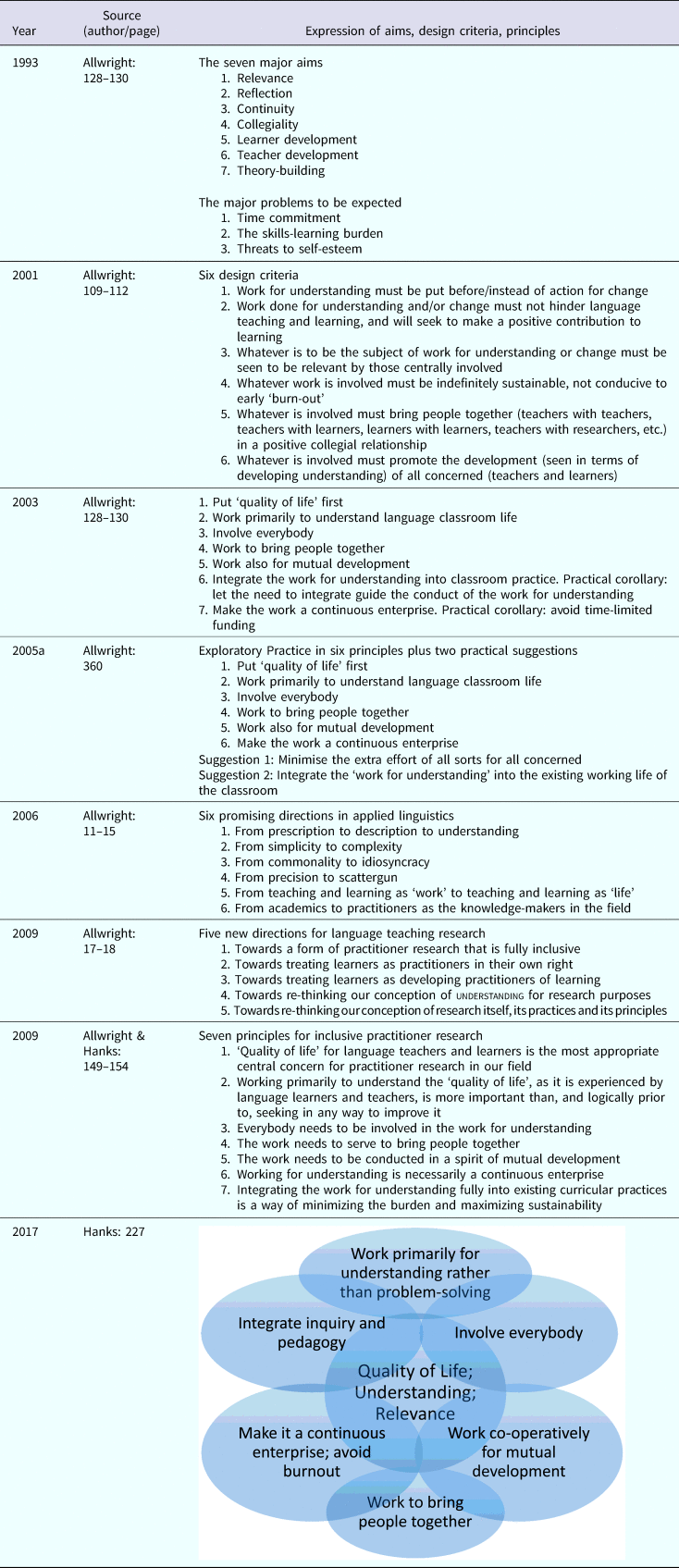
The significance and history of each EP principle requires attention if we are to understand the reasons for the insistence on EP's distinctiveness. The individual principles were developed with practitioners sharing their insights, concerns and discoveries to build the framework. This foundational work was first charted in a series of working papers (Allwright, Reference Allwright1991a, Reference Allwright1991b, Reference Allwright1991c, Reference Allwright1997a), which show early ideas and developments, e.g. ‘Exploratory Teaching’ becoming ‘Exploratory Practice’. The framework has variously presented six, seven or nine principles, sometimes with corollaries or suggestions, so it is worth examining the various iterations. Table 4 provides a series of ‘snapshots’ from publications over the years. It highlights the overlaps, offshoots and repetitions of this organic framework. Complex theoretical ideas are co-constructed and refined in these iterative processes.
Chronological development of the Exploratory Practice framework

Surface analysis highlights frequent use of the imperative, which gives the impression of injunctions or commandments. However, careful reading of the accompanying explanations shows a theoretically grounded, philosophically coherent stance, albeit one which runs counter to the popular discourses of deficit and improvement (see Breen, Reference Breen, Gieve and Miller2006; Candlin & Crichton, Reference Candlin and Crichton2011, Reference Candlin, Crichton, Candlin and Crichton2013a; Reference Candlin, Crichton, Arnold and Murphey2013b for critique of these discourses).
EP emerged in the 1990s (Allwright, Reference Allwright1992, Reference Allwright, Edge and Richards1993, Reference Allwright1997b; Allwright & Lenzuen, Reference Allwright and Lenzuen1997) partly as a reaction against assumptions about traditional (mainly positivist) approaches to research in Applied Linguistics. Allwright (Reference Allwright2005a) reiterates that the EP principles were generated in/through discussions with practitioners (i.e. teachers, teacher educators, and learners) in Rio de Janeiro, in Lancaster, and via the EPCentre website: http://www.letras.puc-rio.br/unidades&nucleos/epcentre/links.htm.
It is through this explicitly dialogic process that the principles of EP formed. Theorizing is rooted in classroom practice, thus ‘bottom-up’ rather than ‘top-down’. Reminiscent of Bourdieu's (Reference Bourdieu1991) contention that language is both social and political practice, the process of language learning, teaching and research, is seen as not merely individual or individualistic, but involves others in time-and-space continua (Wu, Reference Wu2004; Costantino, Reference Costantino, Slimani-Rolls and Kiely2018). Research, pedagogy and language combine as people engage in this social practice, e.g. Miller scrupulously includes learners as well as teachers (novice or experienced) in her publications (Miller et al., Reference Miller, Cunha, Allwright and Hanks2009; Miller et al., Reference Miller, Côrtes, Oliveira, Braga, Bullock and Smith2015). Crucially, EP is
a way of getting teaching and learning done so that the teachers and the learners simultaneously develop their own understandings of what they are doing as learners and teachers. (Allwright Reference Allwright, Gieve and Miller2006, p. 14, original emphases)
The EP framework developed further when Allwright and Hanks (Reference Miller, Silva, Daniel, Kaneko-Marques and Salomão2009) focused on learners as key developing practitioners and provided narratives from learners and teachers to elucidate EP principles. Later research and publications (outlined in Sections 4 and 5) examined one or more of the EP principles, to develop theory from practice. This culminated with Hanks (Reference Hanks2017a) positing a new configuration of an interconnected web instead of a list. She places principles of quality of life, understanding and relevance at the centre, and adds the principle of avoiding burnout to the framework. Arguing that the work of human understanding is always evolving, she contends that EP will continue to develop in creative ways, such as her notion of ‘meta-puzzling’.
A major EP principle is the need for practitioners to try to understand issues in learning/teaching before trying to solve problems. This concept seems difficult to grasp for those locked into finding quick solutions to complex problems. It is particularly challenging since the ‘lure of problems’ (Hanks, Reference Hanks2017a, p. 314) has such a strong societal pull.
But beyond the confines of our field, we see others have identified the flaws inherent in quickly reached solutions. Kahneman, discussing ‘fast’ vs ‘slow’ thinking argues: ‘System 1 provides the impressions that often turn into your beliefs […and…] is also the origin of many of the systematic errors in your thinking (Kahneman Reference Kahneman2012, p. 58).
He continues:
Conscious doubt is not in the repertoire of System 1; it requires maintaining incompatible interpretations in mind at the same time, which demands mental effort. Uncertainty and doubt are the domain of System 2. (Reference Kahneman2012, p. 80)
Like Kahneman's concept of ‘System 1’ (quick to leap to conclusions but prone to error) and ‘System 2’ (careful, analytical thinking but difficult to initiate and frustratingly slow), EP's promotion of puzzlement encourages researchers to think deeply. The insistence on puzzlement as a springboard for research both exposes cognitive dissonance (Festinger, Reference Festinger1957) and values uncertainty. It challenges assumptions that complex issues can be construed as problems, investigated, then solved and eliminated. Thus it is a way of activating Kahneman's (Reference Kahneman2012) ‘System 2’, with a view to scrutinizing speedily reached assumptions.
The emphasis on understanding is underpinned by the philosophical notion of Dasein (Heidegger Reference Heidegger1962), which Dreyfus interprets as ‘seeking to understand the understanding of our practices’ (Reference Dreyfus1991, p. 29). Flyvbjerg (Reference Flyvbjerg2001), citing Aristotle's phronesis, describes this as ethical, practical wisdom. It leads to Gadamer's (Reference Gadamer, Weinsheimer and Marshall.1975/2013) focus on deeper understanding(s) within/across time, place and person(s). This affords an intrinsically rewarding stance which challenges the deficit discourse (Breen, Reference Breen, Gieve and Miller2006; Candlin & Crichton, Reference Candlin and Crichton2011) across the field. Hanks's longstanding (Reference Hanks1999, Reference Hanks2017a) interest in curiosity draws on earlier work in psychology (e.g. Cecchin, Reference Cecchin1987), where curious investigation is seen as an essential component of psychological research-as-practice. An early example is ‘Why don't learners learn what teachers teach?’ (Allwright, Reference Allwright, Singleton and Little1984), and this thread of puzzling runs through EP. Thus EP asks ‘why’ (of the status quo), with the aim of understanding the contextual constraints, the people, and their practices in language learning/teaching and beyond.
Kahneman argues we need to step carefully through the ‘cognitive minefield, slow down, and ask for reinforcement from System 2’ (Reference Kahneman2012, p. 417). To this deliberate braking, EP adds another ethical dimension. The principle that we should involve everyone in the research/pedagogy process is proposed as a way of eliminating what Allwright (Reference Allwright2005a) calls the ‘parasitical’ element of many traditionally structured third-party-research projects. This recognition of the Other/others is a strong influence on the EP principles of collegiality and mutual development, seen as Gieve and Miller (Reference Gieve, Miller, Gieve and Miller2006a) draw on Bakhtin (Reference Bakhtin1986), noting the linguistic resonances echoing between people researching praxis. Similarly, the work of Freire (Reference Freire1972, Reference Freire1973), which positions learners as potent forces, remains relevant:
As opposed to the mythicizing practices of the dominant elites, dialogical theory requires that the world be unveiled. No one can, however, unveil the world for another.
(Freire, Reference Freire1972, p. 137, original emphasis)Freire illuminates the problem for outsider-researchers: despite their best efforts, they cannot do the work of understanding for others. The EP response to this dilemma is for all practitioners to engage in investigations of learning and teaching.
The EP principles of bringing people together and mutual development suggest a view of pedagogy (and research) as situated social practice. People are inextricable from social context, whether in classrooms or in society as a whole. For example, working with large classes in a Chinese university, Zhang (Reference Zhang2004) used EP as a way of investigating and organizing group work in her extensive reading classes. Later, Zheng (Reference Zheng2012) engaged in an ethnographic study using EP to focus on peer-feedback. Both studies indicated the importance of involving learners as well as teachers in research activity, and both document the insights they all gained as a result. In the USA, Best et al. (Reference Best, Jones-Katz, Smolarek, Stolzenburg and Williamson2015) emphasized the importance of listening to students, and discussed the ways in which EP facilitated comprehension of otherwise hidden student struggles with academic writing.
These EP principles were influenced by Prabhu's (Reference Prabhu1987) work with his colleagues Naidu et al. (Reference Naidu, Neeraja, Ramani, Shivakumar and Viswanatha1992) in India. They researched the pedagogic implications of teaching classes with 100+ students, as groups of teachers worked collaboratively to critically question approaches to teaching large classes at pre-university and at UG levels. They point to the powerful combination of knowledge, insight and skills of teachers-as-researchers, and argue that such research can ‘yield cognitive and social gains’ (Naidu et al., Reference Naidu, Neeraja, Ramani, Shivakumar and Viswanatha1992, p. 262) for individuals, groups and the field.
Examples of such gains are found in the work of Johnson (Reference Johnson, Johnson and Golombek2002), who identified the positive aspects of puzzling together. Likewise, Miller worked with others to investigate not only her puzzles, but also to facilitate practitioner research conducted by her colleagues (co-workers, learners and others) as exemplified in Miller and Bannell (Reference Miller and Bannell1998), Miller et al. (Reference Miller, Barreto, Kuschnir, Sette, Bezerra, Cunha, Braga, Gil and Vieira-Abrahão2008), Miller and Barreto (Reference Miller, Barreto, Meyer. and Albuquerque2015), and Miller et al. (Reference Miller, Cunha, Moraes Bezerra, Nóbrega, Ewald, Braga, Garton and Copland2018). Meanwhile, Silver (Reference Silver2008) involved trainee teachers in developing their understandings of the connections between content and language.
Exploring the fused elements of practice and theory through puzzling has been connected to a Vygotskyan approach. The Zone of Proximal Development (Vygotsky, Reference Vygotsky1978) was reconceived as a ‘Puzzlement Zone’ (Kuschnir & Machado, Reference Kuschnir and Machado2003, p. 174) activating practitioner curiosity. Positioning learners and teachers as co-researchers extends to include teacher educators (Miller, Reference Miller, Silva, Daniel, Kaneko-Marques and Salomão2012; Miller and Cunha, Reference Miller, Cunha and Dikilitaş2017) curriculum designers (Smith, Reference Smith, Yoshida, Imai, Nakata, Tajino, Takeuchi and Tamai2009; Biçer, Reference Biçer, Dikilitaş and Hanks2018; Doğdu & Arca, Reference Doğdu, Arca, Dikilitaş and Hanks2018) educational psychologists (Apolinário, Reference Apolinário2015, Reference Apolinário and Hanks2017), and family members (Silva & Braga, Reference Silva, Braga, Allwright and Hanks2009). Ensuring the relevance of the research agenda to the participants contributes to the sustainability of practitioner research, and hence pedagogy.
Essential to this is the principle of quality of life (QoL). In their analysis of this complex concept, Gieve and Miller (Reference Gieve, Miller, Gieve and Miller2006a, p. 41) argue that:
[t]hrough teachers and learners searching together for understandings and articulating them to each other they are developing an enriched ‘classroom awareness’ by which the nature of the experience of classroom life becomes qualitatively enhanced.
The principle had its beginnings in investigating burnout. Noting that teachers are exhausted by increasing demands to be (in neoliberal, technicist, terms) ‘efficient’ and ‘effective’, Allwright (Reference Allwright2003) argued for a shift of focus, to prioritize life as well as work in classrooms as an ethical principle. Likewise, Breen (Reference Breen, Gieve and Miller2006) highlighted the tension for teachers attending professional development sessions which position them as ‘novices’ despite their expertise in the classroom. Breen suggested that one major reason for teachers leaving the profession is the ‘intensification of workloads’ (Reference Breen, Gieve and Miller2006, p. 207) and (negative) judgments of teachers’ worth by government bodies. Such issues have been highlighted in psychology (e.g. Maslach & Leiter, Reference Maslach and Leiter2008) as professionals fall prey to burnout.
Consequently, QoL is suggested as one way of circumventing burnout. Connecting teacher and learner development, and challenging traditional views of the two as separate, Allwright argued for ‘an inextricably linked joint and mutual enterprise of working for understanding’ (Reference Allwright, Gil and Vieira-Abrahão2008, p. 144). This was influenced by Bannell (Reference Bannell, Field and Graham1997, Reference Bannell and Head1998) who posited the notion of developing teachers’ theorizing through praxis.
Many accounts indicate the positive effects of EP as learners and teachers (and others) engage in researching their practices. Miller (Reference Miller, Giminez and Góes2010, Reference Miller and Moita Lopes2013) maintained that EP enriches the lives of learners and teachers by activating their interest, and respecting their findings, in classroom-based research work. Hanks (Reference Hanks2017a, Reference Hanks2017b) found participants perceived time as well spent if practitioner research is relevant to learning and teaching. EP work contributes to wellbeing by reminding practitioners of their agency and thus re-motivates them.
Increased motivation (Li, Reference Li2006; Rose, Reference Rose2007; Hanks, Reference Hanks, Tarone and Soneson2012; Chen, Reference Chen2016), heightened awareness of pedagogy (Johnson, Reference Johnson, Johnson and Golombek2002; Slimani-Rolls, Reference Slimani-Rolls2005a, Reference Slimani-Rolls2005b; Hanks, Reference Hanks, Allwright and Hanks2009b, Reference Hanks, Chartrand, Brooks, Porter and Grogan2014; Crane, Reference Crane2015) and pleasure in learning and teaching (Zhang, Reference Zhang2004; Chu, Reference Chu2007; Rowland, Reference Rowland2011; Barreto, Miller & Góes, Reference Barreto, Miller, Góes, Bokel Reis, Baptista and Soares2015) are indicated as the results of engagement in EP. This points to recent developments in theories about motivation, with Ushioda (Reference Ushioda2016) highlighting the affordances of learners and teachers researching together, and Sahakyan, Lamb, and Chambers (Reference Sahakyan, Lamb, Chambers, Mercer and Kostoulas2018) noting the potential for learners to develop feasible selves by actively engaging in praxis.
Taking a more critical view, Stewart et al. (Reference Stewart, Croker, Hanks, Barfield and Minematsu2014) assessed the notion of QoL. They probed the concept, working together third and fourth year UG students to investigate their puzzles about language learning. In her thoroughly dialogic chapter, Stewart questioned the distinction between ‘life’ and ‘learning’ and asked if it is necessary to divide the two. Elsewhere, Allwright and Miller (Reference Miller, Silva, Daniel, Kaneko-Marques and Salomão2012) and Hanks (Reference Hanks, Yoshida, Imai, Nakata, Tajino, Takeuchi and Tamai2009a, Reference Hanks2017a) note that puzzling may be uncomfortable as it involves challenging previous assumptions about learning/teaching.
It is important to note, therefore, that QoL is not presented as unmitigated joy-in-a-bubble. As discussed above, EP is situated in a world where participants regularly confront social injustices. Arguably, EP's approach of inviting everyone to question socially situated practice(s) acknowledges these battles. The proposition is that whatever we do in our classrooms, whether teaching, learning or researching, all contributes to our QoL, our wellbeing. Research should help, not hinder, our developing understandings of praxis.
In sum, the EP framework positions QoL as positive and hopeful, while also recognizing the socio-cultural political world in which individuals and groups must negotiate complex issues. This is a multifaceted concept, which encompasses not only positive emotions such as joy, pleasure, intellectual stimulation, happiness but also the more difficult processes and struggles (anxiety, reluctance and resistance) which give depth and ‘bite’ to human existence.
7. Critical methodological analysis
Denzin and Lincoln argued that tensions in ‘messy, uncertain, multivoiced texts […] will become more common’ (Reference Denzin and Lincoln2003, p. 38) and EP exemplifies this. Although EP presents an innovative approach to research methods and pedagogy, the methodological contributions have yet to be foregrounded. Therefore this section critically examines methodology/ies with particular emphasis on case studies and doctoral work which push both theory and methodology forward.
Practitioner research has long been a major factor in the development of the field, but critics claim it is not rigorous enough, and some still seek to dismiss it. Burns skewers such ‘outsider’ arguments, stating that they misunderstand ‘the scope and complexity of the research approaches and methodologies that have emerged over the last two decades.’ (Reference Burns2005, p. 67). But more than a decade later, the debate continues. Capturing arguments, Borg concludes:
All criticisms of teacher research, of course, reflect particular views about the nature of research. […] The common criticism that teacher research is of poor quality, methodologically speaking, is also underpinned by conventional scientific notions (e.g. of large-scale replicable quantitative research). (Borg, Reference Borg2013, p. 19)
EP is just as vulnerable to these ‘particular views’ as AR, LS or RP, and the rebuffs given by Borg and Burns are equally valid here. It seems pointless, then, to engage further in a sterile debate. But questions do remain. What scope and complexity is there? Are there creative ways for practitioners to engage in conducting, presenting and disseminating their research?
Some have struggled to understand the originality potential of EP. For example, Dörnyei dismissed EP as falling ‘outside the remit of this book’ (Reference Dörnyei2007, p. 193) despite his claim to consider original approaches under the title of ‘Research Methods in Applied Linguistics’. Across the field, there is little cross-referencing of practitioner research articles, and even EP writers keep to a narrow scope. Partly this is due to the lack of awareness of existing work across the field (including inside the EP movement), which this article aims to address.
The innovation of EP is ethically rooted in the stance of gearing research towards, and integrating it into pedagogy, aiding learning and teaching rather than interrupting it. This is the move from research-as-practice to practice-as-research alluded to earlier. PEPAs avoid imposing unfamiliar techniques, since practitioners should use whatever is normally done in class. Using PEPAs as investigative instruments is a way of ensuring that time is well spent, yet the potential for creative research methodologies is often overlooked. For example, links between EP and soft systems methodology or SSM (Checkland 1981, cited in Tajino & Smith, Reference Tajino and Smith2005) need further attention. SSM ‘places priority on the process, rather than the product, by which all the participants in a given situation come to mutual understandings of the situation itself.’ (Tajino & Smith, Reference Tajino and Smith2005, p. 450) hence a holistic approach related to the EP framework. Uniting SSM and EP in their investigations into UG student interpersonal relations while learning English gave both insights into learner difficulties with making friends in class, and a broader understanding of SSM/EP potential as flexible and culturally sensitive approaches to research.
Surveying the corpus of EP publications, it is clear that much of the work is qualitative and sometimes radically so (e.g. Li, Reference Li2006; Miller et al., Reference Miller, Barreto, Kuschnir, Sette, Bezerra, Cunha, Braga, Gil and Vieira-Abrahão2008; Braga, Reference Braga, Allwright and Hanks2009a; Crane, Reference Crane2015; Hanks, Reference Hanks2017a; Benson et al., Reference Benson, Chehade, Lara, Sayram and Speer2018). Given EP's emphasis on empowerment, social relations, individual engagement, and on developing understanding, ideally in multi-directional ways (i.e. not just for individuals, but in communities of practice), this is unsurprising. The EP principles of insider-research based on observations/analysis of co-created classroom cultures, lend themselves to ethnography. Arguably many of the studies are more-or-less ethnographic in conception, with influences traceable to Hammersley and Atkinson (Reference Hammersley and Atkinson2009) or Watson-Gegeo (Reference Watson-Gegeo1988). Tables 2 and 3 show a preponderance of case studies, some of which are thematically or contextually linked, while others are stand-alone (see Stake, Reference Stake1995, Reference Stake, Denzin and Lincoln2003 for discussion of the importance of the unique case as well as the need to identify patterns). Likewise, many accounts are presented as narratives. Some operate specifically within the traditions of Narrative Inquiry (Clandinin & Connelly, Reference Clandinin and Connelly1995; Johnson & Golombek, Reference Johnson and Golombek2002; Clandinin, Reference Clandinin2007), while others are more loosely linked to this methodological approach. Understandably so, for, as Flyvbjerg (Reference Flyvbjerg2001) observes, clear, well-constructed narrative is an essential component of a good case study.
Only one study appears to have used a large-scale questionnaire-based survey (Gunn, Reference Gunn, Coombe and Barlow2007) to gather data. However, some studies (notably Zhang, Reference Zhang2004; Li Reference Li2006; Zheng, Reference Zheng2012) included classes of 60 or more students, and Lyra et al. (Reference Lyra, Fish Braga and Braga2003) analysed 88 puzzles emanating from a large group of teachers over several years. Thus although most of the work is fine-grained, there is a degree of breadth too.
In early studies, analytical techniques tended to stem from Grounded Theory (Glaser & Strauss, Reference Glaser and Strauss1967; Strauss & Corbin, Reference Strauss and Corbin1990; Glaser, Reference Glaser1992; Charmaz, Reference Charmaz, Denzin and Lincoln2003). However, in tune with developments across the field, this was superseded by coding according to theme (Richards, Reference Richards2003; Saldaña, Reference Saldaña2016). Critical Discourse Analysis (Fairclough, Reference Fairclough1989) and Template Analysis (King, Reference King, Symon and Cassell2012) have also been used to good effect. A caveat is that some writers are vague about numbers (e.g. ‘a class’ could mean 15 or 50 students) and hazy on data analysis techniques used. Future work needs to be more precise about methodology, and more explicit regarding methodological innovations.
Focusing solely on accepted research methods, though, risks missing the point. For if the radical move of integrating research and pedagogy is taken seriously, then the methodologies used are the normal pedagogic practices that teachers and learners use as part of their classroom language learning/teaching work. Hanks (Reference Hanks2017a) posits that the puzzles are forms of research questions and the innovation of PEPAs means teachers and learners using and adapting classroom activities as investigative (research) tools. Arguably, EP is becoming a new research method (e.g. Fay & Dawson, Reference Fay, Dawson and Hanks2017) as much as it is a form of pedagogy. Innovations can be seen most clearly in doctoral work.
Wu (Reference Wu2002) exemplified the EP approach in his Ph.D. thesis examining the responses and discourses of teachers engaging in curriculum change. He used Critical Discourse Analysis, Critical Realism and Narrative Inquiry, to analyse participants’ experiences in a reflexive account of their joint efforts to understand. He characterized his inclusive approach as promoting authentic teacher interaction and hence development. Concurrently, Miller (Reference Miller2001) engaged in a dialogic activity with her participants as she analysed teacher consultancy praxis, while Perpignan (Reference Perpignan2001) was equally dialogic in her examination of written feedback between teachers and learners. Later, Hanks (Reference Hanks2013) explicitly invited teachers and learners to puzzle together as co-researchers in her thesis examining challenges of implementing the principles of EP. Here, students created artefacts such as posters and essays charting the development of their understandings, and teachers started a trajectory towards conference presentations and publications of their EP explorations. The semiotics of the posters as indications of student and teacher beliefs about research remains an untapped area. Elsewhere, Pinner (Reference Pinner2017) used journals, creative writing and narratives as he engaged his learners in self-assessment, and Salvi (Reference Salvi2017b) investigated the connections between EP and Learner Autonomy. Their findings indicate the complexity of collegial working, highlighting paradoxes, probing criticality, and inviting further research.
Taking an ethical perspective, Dawson (Reference Dawson2016) problematized the notion of QoL. In her thoughtful analysis of work with language students and EP, she argued that QoL goes beyond the Aristotelian idea of phronesis (the combination of ethical and practical wisdom – as discussed in Carr, Reference Carr1987; Flyvbjerg, Reference Flyvbjerg2001; Carr, Reference Carr2004; Hanks, Reference Hanks2017a) to encompass Aristotle's equally powerful theme of eudaimonia. This, Dawson posits, is EP as the state of living well combined with the practice of living well (both being and doing) in the present. This again connects QoL with current interest in wellbeing across the field.
Elsewhere, the social consequences of teachers engaging in CPD (while their colleagues did not) were examined by Drijkoningen (Reference Drijkoningen2017). She used EP as her theoretical framework as she worked with teachers of Dutch as a second language on a professional development programme. A key finding (described as a result of the ‘wheels of change’ turning), is the neglected issue of disharmony. As the teachers went into their workplaces and tried out theories and techniques, their colleagues were not always welcoming. For when practitioners engage in questioning, puzzling, problematizing, they unsettle the status quo. This can be an issue for teachers unwilling to examine their pedagogy, likewise for established academics unwilling to critically question their assumptions about ways of doing research.
Radical innovations can be found in the work of Ewald (Reference Ewald2015), Mendes Moura (Reference Mendes Moura2016) and Apolinário (Reference Apolinário2015). Apolinário, an educational psychologist, brings together three related areas via language. She writes that the thesis is:
…an interface between three fields of knowledge intertwined with Language, Educational Psychology, Exploratory Practice and Interactional Sociolinguistics. [It] aims to investigate how the discursive practice between an educational psychologist, [children,] and the teachers involved can contribute to the understanding and the handling of socio-emotional hardship in the school scenario. (Apolinário, Reference Apolinário and Hanks2017: p.c.)
In other words, ‘involving everyone/working together’ has gone beyond the teachers and learners, to include an educational psychologist (Apolinário herself) and family members and colleagues in the school administration.
Ewald (Reference Ewald2015) worked with teachers and learners to investigate the (mutual) development of practitioner-researchers and began breaking down traditional assumptions about the form and shape of a Ph.D. At the annual Rio EP Event, in a highly creative approach, she transformed the pages of her thesis into a ‘dress’, which she wore to disseminate her work among the learners, teachers, learner-teachers, in an accessible, creative and playful approach.
Considering the thesis as an academic artefact itself, Mendes Moura (Reference Mendes Moura2016) involved her learners in the writing up as well as the researching of puzzles. She:
… transform[ed] the writing of [the] thesis into a Potentially Exploitable Pedagogic Activity by inviting her undergrad[uate] students and fellow teachers to come up with puzzles on the differences between common sense and academic knowledge. (Mendes Moura, 2017: p.c.)
Here, learners are re-positioned as co-authors as well as co-researchers, engaging in co-constructing meanings. They are beginning the understanding ‘journey’ through the entextualisation of academic knowledge. This supremely collaborative act brings ideological assumptions around assessment into sharp focus: can a thesis be co-created, and what are the implications for examiners?
Mendes Moura's (Reference Mendes Moura2016) account of mutual development is rarely seen in research. Usually the genre is set up to encourage third-party, hierarchical reporting (even if the research was non-hierarchical in intent). Consequently, authors seldom admit to developments in their own thinking/practice as a result of the research, though Benson et al. (Reference Benson, Chehade, Lara, Sayram and Speer2018) and Hanks and Dikilitaş (Reference Hanks, Dikilitaş, Dikilitaş and Hanks2018) provide exceptions. Most researchers prefer instead to focus on how practitioners’ learning/teaching is ‘improved’. It is through the work outlined here that we can observe teachers/learners in-the-process-of-becoming researchers and read their responses to this process.
8. Challenges
Time is frequently cited as a barrier to practitioner research. Yet EP studies rarely mention time as a constraint. They have varied in length, from as little as a week (Dar Reference Dar, Bullock and Smith2015, Reference Dar and Hanks2017) to several months (Hanks, Reference Hanks2015a, Reference Hanks2015b, Reference Hanks2017b; Dawson, Reference Dawson, Ihara, Zhang and Stewart2017; Dawson Ihara & Zhang, Reference Dawson, Ihara, Zhang and Stewart2017), a year (Miller, Reference Miller, Yoshida, Imai, Nakata, Tajino, Takeuchi and Tamai2009a; Barcellos & Miller, Reference Barcellos, Miller, Carvalho, Rocha and Vasconcellos2013; Crane, Reference Crane2015), two years (Wu, Reference Wu2004, Reference Wu2005; Stewart et al., Reference Stewart, Croker, Hanks, Barfield and Minematsu2014; Slimani-Rolls & Kiely, Reference Slimani-Rolls and Kiely2018), or three years and more (Miller, Reference Miller2003; Stewart, Reference Stewart and Hanks2017). The longest stretches over 20 years (the Rio EP Group started in the 1990s). Arguably, though, the time-span is immaterial; what is interesting is why people continue, and why they drop out. The motivation (or lack thereof) of practitioner-researchers requires attention.
The length of time that many practitioners need to reflect and marshal their thoughts for publication is noteworthy, however. Many practitioners report surprise at the effort involved. Hence for neophyte researchers, collaboration with mentors, as described in Dikilitaş and Hanks (Reference Hanks2018), or Slimani-Rolls and Kiely (Reference Slimani-Rolls and Kiely2018), may be helpful. Yet there are also examples (Crane, Reference Crane2015; Dar, Reference Dar, Bullock and Smith2015) of practitioners engaging in EP without a mentor. More research is needed to understand issues of mentoring.
A major challenge involves outlets for practitioner publications. Established academic journals are notably intolerant of alternative forms of reportage (see Seidlhofer's Reference Seidlhofer2011 critique), while many practitioners remain modest about their methodological or theoretical contributions. The recent emergence of on-line spaces such as the Learner Development Journal, Teacher Development Journal, TESL-EJ and English Language Teacher Education and Development as well as the Practitioner Research strand of Language Teaching Research, might encourage learners and teachers to publish their work in innovative, creative ways. The work of Johnson and Smith in establishing welcoming, yet rigorous, spaces for practitioners to disseminate their work is impactful here.
In sum, the principle of fully inclusive practitioner research challenges assumptions about who does what in learning/teaching/research inside (and outside) classrooms. Identities shift and re-form, cultures of research and pedagogy likewise. A consequent issue for the field is the question of how learners, learner-teachers, or teachers, can garner the acknowledgement they deserve. Honouring their work as well-informed language professionals with insights to offer, then, becomes essential. This ethical stance is important because their stories provide insights and analyses of issues in Language Education and Applied Linguistics from within. As with all practitioner research, championing is needed, alongside investment and belief in the contributions they make to developing theory as well as practice. Key people and institutions play a part in valuing and facilitating such work.
9. Implications
Throughout this article, I have surveyed the field of EP publications with a critical eye and identified threads in the intricate mesh connecting Applied Linguistics and Language Education. The meta-analysis extends beyond these intertwined fields to identify connections with developments in the fields of Education, Higher Education, Healthcare. At the end of the article a box summarizes Questions Arising and future directions for research.
Affinities between the EP framework and recent developments in SLA are clear. They can be seen, for example, in the interest in researching language learning anxiety (e.g. Gkonou, Daubney, & Dewaele, Reference Gkonou, Daubney and Dewaele2017) which shares the aim of promoting engaging and enjoyable language learning. When Lyra et al. (Reference Lyra, Fish Braga and Braga2003) analysed teacher puzzles, they found many themes of anxiety, worries about student behaviour, and disengagement. EP thus also connects with theories of motivation in language learning and teaching (Ushioda, Reference Ushioda2016; Lamb, Reference Lamb2017). Ushioda notes the potential EP offers for learners to be involved in ‘identifying “critical” events in a particular lesson’ (Reference Ushioda2016, p. 573) and calls for the research emanating from practitioners to be published in spaces such as this journal's ‘Research Agenda’ strand. Practical/physical/political factors such as classroom environment, lack of resources, and lack of respect for the work of teachers and learners affect the take-up of learning opportunities (Allwright, Reference Allwright2005b). Ushioda (Reference Ushioda2016) suggests this contributes to our understandings of learner anxiety, motivation, and, I would add, burnout. Zheng and Hu (Reference Zheng, Hu and Hanks2017) used the metaphor of burnt-out candles to graphically illustrate the struggles language teachers experience throughout their careers and argue that EP helped to reignite the flame of interest. The latest thinking is that motivation, and conversely, de-motivation (whether of teachers or learners) is intertwined with agency and affective factors such as empathy. Mercer (Reference Mercer, MacIntyre, Gregersen and Mercer2016) hints at this, when she argues for empathy as a ‘fundamental human social capacity that we need to succeed’ (Reference Mercer, MacIntyre, Gregersen and Mercer2016, p. 107) and which therefore requires further research. The EP principles resonate with work in MacIntyre, Gregersen, and Mercer (Reference MacIntyre, Gregersen and Mercer2016) investigating positive psychology (Seligman, Reference Seligman1991) and hence wellbeing in education.
EP's focus on mutual development and QoL aligns with current thinking in CPD. For example, Brown and Flood (Reference Brown and Flood2018) argue that if teachers are encouraged to be professionals, engaging in research-informed practice, it is necessary to engage in capacity-building and trust them to create independent ways of researching. This connects with Kelchtermans (Reference Kelchtermans, Day and Sachs2004, Reference Kelchtermans2009, Reference Kelchtermans, Zembylas and Schutz2016), who notes that teachers require professional support which goes beyond conveying content or pedagogic knowledge. He points to the complex cognitive and affective aspects of their work and suggests that professional development which allows for vulnerability and a deeper examination of the self can be beneficial for both teachers and learners. In this way, he argues:
genuine professional development becomes possible, allowing for professional learning, the generation of relevant knowledge and its application in practices that do justice to the educational needs of all learners – pupils, students and teachers. (Kelchtermans, Reference Kelchtermans, Day and Sachs2004, p. 234, original emphasis)
Johnson and Golombek (Reference Johnson and Golombek2011) argue for a Vygotskyan approach which enables visualization and also articulations of supportive interventions from teacher educators as essential to professional development. Parallels exist in Hanks and Dikilitaş (Reference Hanks, Dikilitaş, Dikilitaş and Hanks2018), Slimani-Rolls and Kiely (Reference Slimani-Rolls and Kiely2014, Reference Slimani-Rolls and Kiely2018), Tajino et al. (Reference Tajino, Stewart and Dalsky2016), and Trotman (Reference Trotman, Dikilitaş and Hanks2018). All enacted EP principles in mentoring, teacher education and CPD, and engaged in meaning-making with language professionals. Further work is now needed to understand the role EP could play in enhancing these experiences. This is particularly crucial at a time when, Kelchtermans argues, teachers (and educators) are battling with low attendance at CPD sessions and demotivation.
The EP principle of integrating research and pedagogy promises a rich stream for future research. It connects to current thinking in education more broadly, such as the twin notions of inquiry-based learning and research-based teaching (Healey, Reference Healey and Barnett2005; Healey, Flint, and Harrington, Reference Healey, Flint and Harrington2014). Although rooted in the problem-based paradigm, Healey notes that ‘[t]here are many pressures that are still pulling research and teaching apart’ (Reference Healey, Flint and Harrington2005, p. 73) and suggests that universities need to encourage students to engage with research. Identifying a common malaise of top-down transmission of knowledge via lecture and consequent lack of engagement from UG students, he argues:
Putting greater emphasis on actively engaging students with research suitably adapted to recognize the variation and complexity of constructing knowledge in different disciplines, is one way of re-linking them in the twenty-first century. (Healey, Reference Healey and Barnett2005, pp. 73–74)
Initial work to tease out the connections with Healey's notion of inquiry-based learning can be seen in Webb and Sarina (Reference Webb, Sarina, Dikilitaş and Hanks2018) who used EP as part of their inquiry-based learning with UG students in Australia and Northern Cyprus. Gunn has initiated similar work in the UAE (Gunn, Reference Gunn2009a; Al Nashash & Gunn, Reference Al Nashash and Gunn2016; Gouia & Gunn, Reference Gouia and Gunn2016). Concurrently, Hanks’ (Reference Hanks2015b, Reference Hanks2017b) inquiry-based pedagogy with PG and UG students and teachers in the UK suggests EP has hitherto untapped potential for inquiry-based learning, research-based teaching and scholarship.
Shulman (Reference Shulman1986, Reference Shulman2000) has long been a promoter of scholarship in higher education. He argues for the notion of understanding used strategically, and with professional expertise, to critically assess the commonly accepted rules of the field, adding:
[W]e bear the responsibilities of scholars – to discover, to connect, to apply and to teach. As scholars we take on the obligation to add to the core of understanding, skepticism, method and critique that defines our fields and their ever-changing borders. (Shulman, Reference Shulman2000, p. 49)
However, Shulman's notion of scholarship, which has been taken up by many institutions (it has even been inserted into teachers’ contracts) is frequently an add-on, rather than integral to the work of learning and teaching, thus adding significantly to workload. Since, as Johnson and Golombek (Reference Johnson and Golombek2011) argue, there is a deep interdependence between the content and delivery of teaching, and the shaping of learning, EP may offer one fruitful way for practitioners to engage in productive scholarship.
As mentioned earlier, a challenge for scholarship/research is to find ways for practitioners to publish their accounts. This requires a more open-minded approach to creative research methods and to innovative ways of disseminating research. Examples of this include Harvey's (Reference Harvey, Moore, Bradley and Simpsonforthcoming) work translating her thesis into theatrical performance, which is reminiscent of Ewald's (Reference Ewald2015) and Mendes Moura's (Reference Mendes Moura2016) performance-related disseminations outlined above. More radically, Fay and Dawson's (Reference Fay, Dawson and Hanks2017) ground-breaking work positions EP as research method within the project ‘Researching Multilingually at the Borders of Language, the Body, Law and the State’. (http://researching-multilingually-at-borders.com/)
Elsewhere, the example of Sousanis (Reference Sousanis2015) stands out. His well-argued, theoretically grounded thesis in graphic novel form inspires those who wish to take a more creative approach to dissemination. Sousanis’ work influenced, inter alia, Elliott (Reference Elliott2016, Reference Elliott and Hanks2017) who explored the potential of comic-book and narrative formats for reporting his classroom-based EP research. Creative approaches are also visible in the work of Bradley et al. (Reference Bradley, Moore, Simpson and Atkinson2017). Bradley's approach, using collage to convey participants’ understandings of linguistic landscapes in super-diverse settings, has connections with Hanks (Reference Hanks2013, Reference Hanks2015a), who analysed posters created by her students. Work on the semiotics of posters as representations of beliefs about research and pedagogy is beginning. These original moves are pregnant with possibility and beg further investigation.
The principles of EP resonate with Lefstein and Snell's work on teacher education in state schools in the UK. They critique the current vogue for best practice, noting that it ‘tends to iron out or overlook complexities’ (Lefstein & Snell, Reference Lefstein and Snell2014, p. 5) in learning/teaching, and propose instead a multifaceted ‘dialogic pedagogy’ (Lefstein & Snell, Reference Lefstein and Snell2014, p. 13) rooted in classroom practice. They also reject the idea of one-sized solutions, and argue for an attitude of inquiry, but they have not (yet) hit upon the notion of puzzlement (Hanks, Reference Hanks1999; Miller, Reference Miller, Yoshida, Imai, Nakata, Tajino, Takeuchi and Tamai2009a; Hanks, Reference Hanks2017a) for practitioners. Echoing the EP principles summarized in Table 4 above, Lefstein and Snell present their own, positing that teacher learning:
1. should be dialogic
2. thrives in a collaborative and supportive professional community
3. should be driven by evidence from the classroom
4. [and teachers] should be actively involved in interpreting and constructing knowledge
5. should be continuous and integrated into teachers’ work.
(Adapted from Lefstein & Snell, Reference Lefstein and Snell2014, pp. 175–176)
Notably absent is the EP notion of learners as co-researchers and equal partners in the co-construction of knowledge. Similarly, the idea that the process can be shared not only among teachers (novices or experts alike) but also with others (e.g. educational psychologists, teacher educators, managers, administrators, family members) is missing. Nevertheless, Lefstein and Snell's work maps onto the EP framework of collegiality, relevance, sustainability, and integrating research and pedagogy.
Research into the worlds contained in classrooms begins to loosen the bonds surrounding roles of learners, teachers, teacher educators, administrators and managers. EP surfaces theories and connections between Identity (Kramsch, Reference Kramsch2006, Reference Kramsch2009, Reference Kramsch2011; Norton, Reference Norton2013) and Interculturality (Holliday, Reference Holliday, Gieve and Miller2006; Holliday, Hyde, & Kullman, Reference Holliday, Hyde and Kullman2010; Holliday, Reference Holliday2013; Holmes & Dervin, Reference Holmes and Dervin2016). The EP framework enables classroom ‘insiders’ (teachers, learners, teacher educators) to illuminate classroom cultures and intercultural negotiations in language learning/teaching. EP plays with traditional assumptions about who does what in language learning, teaching, researching (Hanks, Reference Hanks2017a, Reference Hanksforthcoming) thus questioning fixed identities. This is rooted in the social-cultural realities of participants (Holliday, Reference Holliday2013) and it recognizes the individual histories, cultures and emotions (Kramsch, Reference Kramsch2009) of learners as well as teachers. The value of EP is that it facilitates the notion of teachers as people who are constantly learning, and that they, like researchers, may be learning from the learners (and vice versa). This is not uncomplicated, however. Shifting identities and interactions, slippery cultural and intercultural boundaries, and fluid social positioning require scrutiny. More research is needed to fully understand the symbolic dimensions (Kramsch, Reference Kramsch2011) involved. The EP framework offers a way of exploring learner and teacher identities, and the intercultural tensions generated in classroom cultures co-created in moments of space-time by practitioners working together.
The principles and concepts emerging from EP are consistent, too, with recent developments in the field of Healthcare. Here, Iedema, Mesman and Carroll argue:
In suggesting we need to collaborate with those who are the ‘subjects’ in our study, we advocate an axiology, an ethics, of relationships and collaboration. […] We do so also knowing that subjects’ involvement enriches research outcomes. (Iedema et al., Reference Iedema, Mesman and Carroll2013, p. 73, emphasis in original)
This collaborative approach, which re-positions ‘subjects’ as potent agents at the centre of the research enterprise, empowering them to wrest control from more rigid authoritative figures, is close to the ethical, collegial stance of EP.
When teachers, learners, teacher educators, and researchers, begin to play with different identities and cross intercultural boundaries, trust is an issue. Allwright and Hanks (Reference Allwright and Hanks2009), and Miller et al. (Reference Miller, Cunha, Allwright and Hanks2009) point to the need for trust to be engendered across the field, and Hanks (Reference Hanks2017a) argues that trust is a vital component for any kind of research to progress. This links with Candlin and Crichton's view (Reference Candlin, Crichton, Candlin and Crichton2013a, p. 9) that trust is a fluid, constantly renegotiated concept at once ‘situated and bound by context’ and at the same time ‘discursively constructed’ (Candlin & Crichton, Reference Candlin, Crichton, Candlin and Crichton2013a, p. 9). Likewise, Brown Daley and Liou (Reference Brown, Daley and Liou2016) conclude that trust is a form of social capital, which, allied with professional capital, is essential for learning. Arguably, then, a new discourse of trust is required to combat the ‘discourse of deficit’ which is demoralizing so many teachers and learners.
This comes with a warning, however. EP is based on an egalitarian approach which breaks down hierarchies. To impose EP from above as a requirement (in the way that AR has sometimes been imposed) would risk derailing the enterprise. EP would not work in a dogmatic, hierarchical system which insists on practitioners adding research to their already heavy workloads. Like all forms of practitioner research, it needs liberty, respect, and autonomy to thrive. An epistemological challenge, then, is for professional researchers/academics to relinquish their control of definitions of research/scholarship, and to trust the capability, seriousness and resourcefulness of practitioners as they engage in conducting and disseminating their research.
10. Conclusions
This article began with critical questions about EP and its significance for the field. The evidence is clear: there is impact in a wide range of contexts and settings. EP is enacted in schools, colleges, universities and private language schools. EP has reached across five continents and exists in both privileged and deprived contexts. Both teachers and learners have taken part, as have teacher educators, curriculum developers and educational psychologists/psychoanalysts, inside/outside the classroom with potential for more. Analysis of the principles in the framework indicates that EP is an entity in its own right, with its own characteristics, its own liquid identity. Emerging themes point towards the affordances of puzzling for deep understanding, as research and pedagogy are integrated.
Novel insights include questioning learner/teacher/researcher identity, agency and intercultural issues involved in integrating research and pedagogy. Thus EP has profound implications. It re-conceptualizes the epistemology of research itself as more than a search for solutions; EP reminds us of the human endeavour to understand (Heidegger, Reference Heidegger1962; Dreyfus, Reference Dreyfus1991) language, culture and education. But since ‘solutions are seductive’ (Hanks, Reference Hanks2017a, p. 297), we need to consciously interrupt that seduction with curiosity as we puzzle about the processes of learning and teaching.
The contribution of this meta-analysis indicates a re-definition of epistemological and ontological foundations of interdisciplinary research. What is needed now is the further surfacing of hitherto hidden links and connections across disciplines, with acknowledgement of the potency of practitioners researching. Herein lies the paradigm shift. But as Kuhn (Reference Kuhn1962/1996) noted, a paradigm shift is no easy matter. Here I have begun articulating the web of threads connecting different fields. Research-as-practice, in the form of practitioner research of all kinds, has been discussed. Exploring the nexus of theory and practice encapsulated in the notion of Practice-as-research in language teaching, and beyond, has just begun. When practitioners are recognized (recognize themselves) as valuable and powerful actors contributing to theory-building discourses across fields, society as a whole benefits.
Questions arising
1. Recent developments in Applied Linguistics and Language Education focus on anxiety, autonomy, burnout, (de-)motivation, and/or wellbeing. How might EP's theory-practice nexus contribute to investigations of these themes?
2. What factors affect interculturality and identity in the boundary-crossings/small-culture-creations generated in/by EP? What factors affect evolutions of teacher/learner/teacher educator/researcher identities?
3. Leadership in classrooms/programmes usually rests with teachers. What are the default roles of teachers and learners in classrooms? How do these affect agency, empowerment, transformation? If learner agency and transformation is to be achieved, then what strategies do teachers need to roll out? How accessible is EP to neophyte classroom teachers/researchers/learners?
4. How does EP's integration of research and pedagogy contribute to inquiry-based learning and research-based teaching in higher education? How does this link with research and scholarship in a discipline?
5. What is the impact that practitioner research, specifically EP, exerts on the people who do it and on those (e.g. policy-makers) who are exposed to the resulting insights and findings?
6. Which aspects of EP do practitioners find challenging and why? What aspects of classroom practice get explored?
7. How might EP help learners, teachers (etc.) change and develop? How can insights be reached, and understandings gained? How do insights developed through EP differ from/relate to those obtained through the other family members of practitioner research?
8. What further ethical dilemmas are raised by practitioner research (and specifically EP) for research methodology?
9. How might the field explore innovative methodologies and creative dissemination of findings and insights for practitioners of learning/teaching/research?
10. What theoretical and philosophical developments need further work? E.g. What are the differences between puzzling, problem-solving and the problem-solution paradigm? What are the affordances of puzzling, curiosity and Dasein? What are the contributions of EP to the growing discourse around trust and discourses of deficit?
Acknowledgements
I should like to thank Inés K. Miller for her suggestions regarding Portuguese texts, and all those who read and commented on drafts of this article.
Judith Hanks is Associate Professor at the School of Education, University of Leeds. She has been centrally involved in EP since 1997, working with international colleagues to develop a framework of principles for fully inclusive practitioner research. She is co-author of The developing language learner: An introduction to Exploratory Practice (Allwright & Hanks 2009) and single-author of Exploratory Practice in language teaching: Puzzling about principles and practices (Hanks 2017). She is co-convenor of the AILA Fully Inclusive Practitioner Research Network.