1. Introduction and background
East and Southeast Asia is the most linguistically diverse region on earth, with some 2,500 of the world's 6,700 languages being found in Asia (Lewis Reference Lewis2009). Given this diversity, it is not surprising that language education has been a key policy pre-occupation in East and Southeast Asia in the period following the Second World War. The post-war period, for many countries of the region, is the period in which they achieved independence from colonial governments. Independence has typically brought with it a focus on the development of national identities and economies which in turn has entailed modernisation and, more recently, integration into the global economy. Within this context, language has played an important role, both in terms of national consolidation through national languages and in terms of foreign language learning in the context of economic development and modernisation. For the countries of the region, English has played a particularly significant role as a foreign language in education.
While national languages have been strongly supported in education systems, there is concern, however, that many of the languages of the region are threatened as they, with few exceptions, are not included in schools’ curricula (e.g. Nolasco Reference Nolasco2008; Feng & Adamson Reference Feng, Adamson, Feng and Adamson2015). Instead, generally speaking, the nations of the region are promoting their respective national languages along with English. This means that English is the major ‘foreign’ language taught throughout the region and its inclusion in primary schools’ curricula is often at the expense of local languages (Coleman Reference Coleman2010; Hadisantosa Reference Hadisantosa and Johnstone2010; Kirkpatrick Reference Kirkpatrick2012).
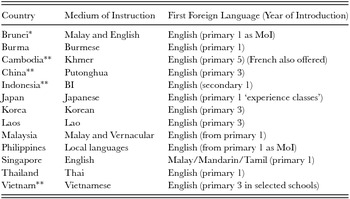
This article examines the language education polices of a selection of the nations of Southeast and East Asia by considering the countries that constitute the ASEAN + 3 forum. The majority of nations of East and Southeast Asia participate in this forum, which functions as a coordinator of co-operation between ASEANFootnote 1 and three East Asian nations: China, Japan and South Korea. The focus of the ASEAN + 3 forum is currently primarily economic, but ASEAN leaders have confirmed that politics, especially security, and socio-cultural issues will be an integral part of the planned ASEAN Community, established at the end of 2015 (ASEAN 2015). This regional grouping thus represents a key element of Asian collaboration and its member nations have many similarities that justify considering it as a grouping for discussing language education policy.
The purpose of this article is first to review the language education policies of these nations. As the total number of countries which comprise the region under review is 13, it will be impossible to provide a full review of the language education policies of each. Instead we will review the relevant policies of what we hope offers a representative cross-section of the countries, while noting that a common characteristic to almost all the countries here is one of their linguistic and cultural diversity. The countries to be treated in some depth are China, Indonesia, Japan, the Philippines and Vietnam. Reference to the other countries will be made where relevant. We shall also consider the potential impact of current language education policies upon the languages of the region. As will be noted, almost all these countries promote their respective national languages and prioritise English as the first ‘foreign’ language that students will learn in school. We will therefore address a number of questions including:
-
• will the implementation of such policies be likely to lead to a reduction in the number of Asians who are multilingual in Asian languages?
-
• will the diverse linguistic landscape of the region gradually be replaced by an increasing trend towards monolingualism in the national language for the majority and bilingualism in the national language and English for the elite?
-
• might the elite, in some cases, even develop English as their first language?
Language policy is an inherently ideological process (Liddicoat Reference Liddicoat2013) and a number of ideologies have shaped the existing language education policies of the East and Southeast Asian region. The nation-building practices of East and Southeast Asia have often been influenced by the one nation-one language ideology that developed alongside the rise of the nation-state in Europe in the 18th and 19th centuries. This ideology is an innovation of the European post-Enlightenment and historically linguistic uniformity was not considered as fundamental for the operation of a polity in Asia or elsewhere. As May notes, pre-enlightenment empires were not based on a requirement for linguistic uniformity but rather were ‘quite happy . . . to leave unmolested the plethora of cultures and languages subsumed within them – as long as taxes were paid’ (May Reference May2012: 6). While this perhaps simplifies an extremely complex situation, and elites would undoubtedly have been required to become literate in languages of power, the notion of one language for one nation would have been foreign. The one nation-one language ideology received impetus particularly from the rationalist nation-building agenda of the French Revolution, which argued for a single language for the French state in two ways. The first is a pragmatic rationale: a common language allows effective communication and access to state institutions and political functions. The second was symbolic: a single language creates and represents a single, unified identity. This ideology was exported from Europe to the rest of the world in the wake of European colonial expansion and had become established as a linguistic truism at the time of nation-state formation in Asia in the wake of decolonisation in the 20th century, although its influence can be traced to earlier periods, notably to the emergence of the Japanese nation-state in the Meiji period (Liddicoat & Heugh Reference Liddicoat, Heugh, Bigelow and Ennser-Kananen2014). One consequence of this has been that many Asian nation-states have opted for officially monolingual language policies, although some states such as Singapore and Malaysia have established multilingual policies. Even in these cases, however, as we shall show, the pragmatic rationale of the one nation-one language ideology has often led to one language being privileged over others for intranational communication.
The Asian region has also been influenced by a number of newer ideologies that relate more specifically to language education. In particular, there has been a prevailing ideology of pragmatism in the framing of the educative purpose of language education. Language learning is seen as being primarily for the purpose of economic development, often accompanied with agendas of modernisation and internationalisation. This ideological positioning of language learning favours an orientation to languages spoken outside the nation-state, especially those perceived as having a significant international role (Liddicoat Reference Liddicoat2013). In the Asian context, economic pragmatism as a rationale for language education has typically intersected with ideologies of English as the global language (Pennycook Reference Pennycook and Ricento2000). It is as if there is a belief, as articulated by Mizamura and cited by Yoshihari & Carpenter, that ‘the act of acquiring knowledge is wholly dependent on the language one knows. The less English one knows the less access one has to global knowledge’ (Yoshiri & Carpenter Reference Yoshihari, Carpenter and Mizamura2015: 4). It is also the case that English has come to be seen, at least in some countries, as a vehicle for disseminating one's own knowledge and world view internationally.
The focus on English in Asia is very apparent in the language policies of the ASEAN. The ten countries that comprise ASEAN signed the ASEAN Charter in 2009. The Charter privileges English by making it the sole working language of the community, but, in so doing, simply officially ratifies what had been common practice in the first 40 years of ASEAN's existence (Kirkpatrick Reference Kirkpatrick2010). Nevertheless, the official recognition of English as the sole working language will provide further impetus for the learning of English in the region's schools, and this, as we shall illustrate below, is already being seen by the earlier and earlier introduction of English into the curricula of almost all the member states. At the same time as privileging English, however, the Charter also seeks to inculcate ‘respect for the different cultures, languages and religions of the peoples of ASEAN while emphasising their common values in the spirit of unity in diversity’ (Article 2). As such, ASEAN represents a search for a new identity for which language education policy will need to play an essential role (Tochon Reference Tochon and Tochon2015). English is to play a vital role in the development of this ASEAN identity. As pointed out by the Secretary General of ASEAN himself, Le Luong Minh, ‘With the diversity in ASEAN reflected in our diverse histories, races, cultures and belief systems, English is an important and indispensable tool to bring our Community closer together’ (ASEAN 2013). We shall also therefore consider below the extent to which respect of different cultures, languages and religions, is reflected in language education polices and how this might be balanced against the promotion of English.
The one nation-one language ideology and the pragmatic rationale for language learning have combined in many Asian nations to exert a constraining pressure of language policy that has often conflicted with the multilingual realties of these nations. This, as we shall demonstrate, has led to the promotion of national languages across the region.
2. Language education policies: Country reviews
The most recent iteration of language education policies of each of the selected countries will be described and the impact and potential consequence of any changes will be critically considered. The countries whose language policies will be reviewed and considered in depth are China (including Hong Kong), Japan, Indonesia, the Philippines and Vietnam. These countries have been selected as they represent the diversity that can be found within the region. China provides a typical example of a country which is rigorously promoting the national language along with English at the expense of Chinese languages. Japan represents a country that has rigorously denied internal linguistic diversity in which English has been introduced alongside the national language. Indonesia is the only country of the region which has not made English a compulsory subject at primary school. Even though or, perhaps, because it is extremely linguistically diverse, with over 700 language spoken, Indonesia makes little attempt to introduce local languages as languages of education or as subjects, instead focusing on the promotion of the national lingua franca, Bahasa Indonesia. The Philippines, where more than 170 languages are spoken, represents a contrast in that it has recently abandoned its Bilingual Education Policy (BEP) which privileged English and Filipino as the two languages of instruction in schools and adopted a new policy of mother tongue-based multilingual education (MTB-MLE). Vietnam represents an example of a country where French functioned as the official language during the French colonial period. It has suffered many years of civil war followed by national partition, when different language policies were adopted in North and South Vietnam. The current situation is the consequence of the policies of the North being introduced to the whole country on reunification in 1975, but with the subsequent opening up of the country re-evaluating the importance of English, which has now become the first foreign language taught throughout the country.
The region under discussion (ASEAN + 3) is linguistically and culturally highly diverse but where a number of major languages are spoken by the majority of the population. This means that the great majority of the region's languages are spoken only by a small number of people. As such, it reflects the international situation where 94% of the world's population speak 6% of its languages while 6% speak 94% of its languages (Romaine Reference Romaine, Marten, Riessler, Saarikivi and Toivanen2015: 33). As Romaine points out, if education does not promote the study of a particular language, ‘the state in effect moves children from a minority to the dominant group’ (Reference Romaine, Marten, Riessler, Saarikivi and Toivanen2015: 33). Or, rather, this is the state's aim, even though it may not always be successful. The importance of including languages as languages of education is further stressed by Coleman (Reference Coleman2010), who notes that the removal of languages from the curriculum undermines their status as parents tend to urge their children to focus on the languages taught in the school at the expense of the home language. In our review and discussion of the language education policies, we shall keep these points in mind and consider the extent to which these policies may or may not be promoting languages and the possible implications of this for the languages in question. We shall also keep in mind the notion that ‘Historically, it is precisely the isolation and separation of minority communities that has most favoured the preservation of their languages’ (Anderson & Uribe-Jongbloed Reference Anderson, Uribe-Jongbloed, Heinrich and Ostler2015: 134). Does this mean that globalisation necessarily threatens the continued use of many of the world's minority languages? This is a further question we shall consider in the following review and discussion.
2.1 China
China has been involved in serious language reform since the dying days of the last imperial dynasty in the late 19th and early 20th centuries, and this reform has been continued under the rule of the Chinese Communist party since 1949. An early motivation for reform of the Chinese language was the desire to modernise. The difficulty of learning to write Chinese meant that only a small minority of people were literate. At the beginning of the 20th century, the newly established Education Ministry predicted that it would take many years to make ‘even 5% of the population literate’ (Woodside & Elman Reference Woodside, Elman, Elman and Woodside1994: 532). The fact that Japan had successfully modernised and was proving far stronger than China and that one reason for this success was linked to Japan's language reform – in particular the proposal to reduce the number of Chinese characters (kanji) and increase the use of kana – added further impetus to the Chinese desire for language reform. While some scholars, such as Qian Xuantong, went as far as calling for the abolition of the Chinese language (Ramsey Reference Ramsey1989: 3), in the event, language reform first adopted the vernacular style, bai hua, to replace the centuries old literary style wen yan. Over many decades, language reform also saw the simplification of several hundred Chinese characters – the traditional characters are still used in Hong Kong and Taiwan – and the development of an alphabetic script, pinyin. It should be stressed, however, that the pinyin script was never intended to replace the characters, but merely act as an aid for Chinese children learning to write Chinese (Pine & Yu Reference Pine and Yu2012).
The overall aim of these reforms was to create a national language that could be read by an increasing majority of the population. The Chinese Communist Party has also promoted the variety of spoken Chinese based on the Northern dialect, Mandarin, as the national or ‘common’ language, Putonghua. As is noted below, the ‘Chinese language’ comprises a number of varieties, many of which are mutually unintelligible. Promoting a variety of Chinese that could not only be read by the majority, but also understood by the majority became a key part of the government's language reform agenda. This aim is reflected in The National Language Law of China (Kirkpatrick & Xu Reference Kirkpatrick and Xu2001) (see also www.gov.cn/english/laws/2005-09/19/content64906.htm), as this proscribes the use of Chinese languages other than the national lingua franca, Putonghua Mandarin, as languages of education. This, in effect, means that other Chinese languages cannot be taught in schools. Even, therefore, in Guangdong province, which is the home of the Cantonese language, Cantonese cannot be taught in the school system, either as a medium of instruction (MoI), or as a subject. Hong Kong, which will be discussed separately below, remains, with the exception of neighbouring Macao, the only place where Cantonese is taught in the school system. To underline the significance of this, it is worth pointing out that Cantonese is one of the major Chinese languages of China. Chinese is a superordinate term and there are seven major Chinese language groups, all of which are further subdivided into lesser language or dialect groups (Ramsey Reference Ramsey1989). Mandarin is the most widely spoken since the government decided to promote it as the national language. Shanghainese (or Wu to give the language group its official name) has 77 million speakers and Cantonese (or Yue) has more than 56 million speakers (Ostler Reference Ostler2010: 227). The Min language group comprises Min Nan Hua (Southern Min, of which Hokien is a variety) and which is also the major language of Taiwan and spoken widely among the Chinese diaspora (Li Wei & Zhu Hua Reference Wei and Hua2010). The Xiang, Hakka and Gan languages make up the seven major groupings. It is important to underline that the spoken forms of these languages are mutually unintelligible. It is worth reiterating that none of these Chinese languages, with the exception of Mandarin, can be used, officially at any rate, as languages of education in China today.
In contrast, the languages spoken by the national minority groups in China – and, officially there are 55 of these, but in fact rather more than this – can be taught as MoI and subjects in schools. A recent major research project coordinated by Feng & Adamson (Reference Feng, Adamson, Feng and Adamson2015) has investigated how successfully trilingual education has been implemented in a cross-section of Chinese schools across the country. The aim, not always explicitly stated, is for ethnic minority Chinese to become trilingual and thus to be able to learn their first language, Putonghua and English. In fact, at least four different models of trilingual education were identified, namely the accretive model, the balanced model, the transitional model and the depreciative model (Adamson & Feng Reference Adamson, Feng, Feng and Adamson2015: 244ff.). The accretive model sees the teaching of the first language as the MoI for the first three years of primary school, and Putonghua and English taught as subjects. In primary 4, Putonghua takes over as the MoI and the first language remains taught as a subject. The balanced model is found in schools where there is an equal or significant proportion of ethnic minority students alongside Han Chinese students. Such schools may see two streams, with one using the ethnic language as the MoI and one using Putonghua as the MoI. Depending on the stream, Putonghua or the first language are taught as subjects as is English. The transitional model prioritises Chinese ahead of minority languages where ‘Chinese and, to a lesser extent, English, are viewed as key languages for the children's futures’ (Adamson & Feng Reference Adamson, Feng, Feng and Adamson2015: 248). Although these schools may use the first language as an MoI in the early years, Chinese takes over as the MoI from primary 3 and all subjects, other than English, are taught in Putonghua. The fourth model, the depreciative model, promotes bilingualism in Chinese and English and the outcome is ‘almost universally the loss of the minority language’ (Adamson & Feng Reference Adamson, Feng, Feng and Adamson2015: 250).
The accretive and balanced models tend to be found in more homogenous – and thus remote – areas, and the transitional and depreciative models in more heterogeneous areas, such as cities. But, as Feng & Adamson point out, many schools in ethnic minority regions actually teach only Chinese and, possibly, English. ‘The L1 is either inadequately incorporated or missing’ (Feng & Adamson Reference Feng, Adamson, Feng and Adamson2015: 10). These findings are supported by Ding (Reference Ding2015), whose study of Prinmi, a language spoken in Southwest China, concludes that children are being taught monolingually in Mandarin and that this ‘coupled with extensive use of Mandarin in broadcast media is undoubtedly responsible for the language attrition reported by these younger speakers of Prinmi’ (Ding Reference Ding2015: 25).
Where the languages are perceived to have an economic value, there is more success. Thus success is reported in the case of Korean and Mongolian, but in the cases of languages indigenous to China such as Zhuang and Yi, the success rate is much lower, to the extent that, for example, many Zhuang are now first language speakers of Putonghua (Feng & Adamson Reference Feng, Adamson, Feng and Adamson2015).
Alongside the promotion of Putonghua and the rather less successful promotion of trilingualism among the ethnic minorities, the Chinese government has strenuously promoted the teaching of English so that it is now a compulsory subject in all primary schools from Grade 3. In 2008 there were 163.71 million Grade 3 to undergraduate students learning English in China; this gives an idea of the extent of the policy, to say nothing of the numbers of English teachers required (Wen Reference Wen, Kirkpatrick and Sussex2012). There is no doubt that English has become China's second language of education, far outstripping any of the Chinese languages or languages of China. While this article will not consider the languages of higher education, it is worth noting that an increasing number of Chinese universities now offer courses through the medium of English. A list of these is provided at the Chinese Universities and Colleges Admissions System website (www.cucas.edu.cn/). And an insight into the attitudes of senior Chinese government officials can be gleaned from the remarks made by the then Premier, Zhu Rongji, when, in 2001, he visited his alma mater, the School of Economics and Management at Beijing's prestigious Tsinghua University. ‘I hope all classes will be taught in English. I don't worship foreign languages. But we need to exchange our ideas with the rest of the world’ (China Varsities to Teach in English 2001). This shows the prevalence of the ideology that English provides the global vehicle for knowledge exchange in thinking about English in China.
To conclude this short section on Chinese language education policy, the Chinese government has attempted to promote the languages of ethnic minority students, Putonghua as the national language and English as the first foreign language. But, as Feng & Adamson point out, these three policy strands have been implemented independently, with the result they ‘lack an underlying coherent theory of trilingual education’ (Reference Feng, Adamson, Feng and Adamson2015: 2). In effect, the National Language Law and the major impetus of the government's policy promote Putonghua as the national language. At the same time, English is the most learned ‘second’ language in China, as it is a compulsory component of the curriculum from Grade 3 of primary school. The evidence from research into trilingual education indicates that many of the minority languages are being lost, with only those which have a clear economic value, such as Korean and Mongolian, being successfully taught and learned. Other Chinese languages, such as Cantonese and Shanghainese are not being taught as languages of education and it will be interesting to see if demand for these languages starts to develop among the speakers of these languages, as recent demonstrations in Guangzhou for Cantonese suggest. However, we would conclude that the current language polices in China will lead inexorably to the further promotion of Putonghua and English at the expense of other Chinese languages and the majority of the ethnic languages.
2.1.1 Hong Kong
The language education policy in Hong Kong has a complex history stretching from colonial times to the present day. Bolton (Reference Bolton, Wee-Ling and Hashim2012) provides a recent and informative account of this history. Here we provide a brief summary before describing some current research into trilingual education in Hong Kong's schools (see also Wang & Kirkpatrick Reference Wang and Kirkpatrick2013).
In the early decades of British colonial rule, Hong Kong had adopted a laissez-faire approach to language policy in school education (Sweeting Reference Sweeting, Crawford and Hui1991; Poon, Lau & Chu Reference Poon, Lau and Chu2013) and this meant that the great majority of secondary schools chose to teach in English. Primary schools, on the other hand, adopted Chinese (Cantonese and standard written Chinese) as their MoI. With a few exceptions, Cantonese remains the MoI in Hong Kong's government primary schools.
Before the handover back to China in 1997, Chinese was the MoI in primary schools and English was the MoI in the great majority of secondary schools (Sweeting Reference Sweeting, Crawford and Hui1991; Poon Reference Poon, Li, Tsang and Lin2000). A major reason why parents wanted their children taught through English in secondary schools was that, with the exception of the Chinese University of Hong Kong, the tertiary institutions use English as a medium of instruction (EMI). This remains true today, as six of the eight government-funded tertiary institutions are English medium and even the Chinese University of Hong Kong has recently significantly expanded its English medium classes (Li Reference Li, Doiz, Lasagabaster and Sierra2013; Kirkpatrick Reference Kirkpatrick2014a). The Hong Kong Education University is the only government-funded tertiary institution that has adopted an official trilingual policy and is thus the only institution which has a policy that supports the government's current aim to make educated Hong Kong citizens trilingual in Cantonese, Putonghua and English, and biliterate in Chinese and English.
In the decades before the 1997 Handover, a number of government-initiated reports recommended the use of Chinese as the MoI. But it was not until the publication in 1973 of the Green Paper on the proposed expansion of secondary education (Board of Education 1973) that the government recommended the use of Chinese as an MoI in junior secondary schools. ‘Chinese should become the usual medium of instruction in lower forms of secondary schools; every effort should be made to develop good textbooks for all subjects written in Chinese, to train teachers capable of instructing through the medium of Chinese. . .’ (Government Secretariat 1981: 146). Parental pressure soon forced the government to change this position, however, (Sweeting Reference Sweeting, Crawford and Hui1991; Poon Reference Poon2010) so that the 1974 White paper: Secondary education in Hong Kong over the next decade (Board of Education 1974) declared that ‘individual school authorities should decide themselves whether the medium of instruction should be English or Chinese for any subject in junior secondary forms . . .’ (Government Secretariat 1981: 150). As a result, English remained the MoI in most secondary schools, although this was often more in name than in practice. Many schools adapted what has been called the textual translation method whereby classroom teaching involved the teachers translating the students’ English textbooks into Chinese (Luke & Richards Reference Luke and Richards1982).
Changes in policy were announced with the proclamation of the Sino-British Joint Declaration in 1984 (Bray & Koo Reference Bray, Koo, Bray and Koo2004: 144). For instance, the Report of the working group set up to review language improvement measures (Hong Kong Education Department 1989: 73–74) advised that: (1) ‘English or Chinese can be equally effectively used as a medium of instruction up to A level for students studying in the one language or the other’ and (2) ‘English and Chinese are taught as subjects as effectively as possible, bearing in mind their roles as actual or future mediums of instruction for different groups of students’. Despite this, however, before the 1997 Handover, some 90% of secondary schools remained EMI (Sweeting Reference Sweeting, Crawford and Hui1991; So Reference So, Dickson and Cumming1996). In colonial Hong Kong, therefore, Chinese (defined as spoken Cantonese and written standard Chinese) was the MoI in primary schools, and despite occasional government attempts to promote Chinese as a MoI in junior secondary schools, English was the major MoI in secondary schools.
After the handover in 1997, the Hong Kong government adopted the ‘biliterate and trilingual’ (兩文三語) policy. In 1999 Tung Chee Hua, the first Chief Secretary of the new Hong Kong Special Administrative Region (HKSAR), noted that ‘It is the SAR Government's goal to train our people to be truly biliterate and trilingual’ (Tung Reference Tung1999, para. 69). The school curriculum was revised in 1998 to make Putonghua a compulsory subject in all primary and secondary schools. In addition to Cantonese being the MoI in primary schools, the government also ruled that only secondary schools which met certain criteria would be allowed to use EMI. As a result, only some 25% of secondary schools were designated as EMI schools. This was extremely unpopular with parents and the persistent demand from parents to increase the number of EMI secondary schools forced the government to ‘fine-tune’ the policy (Kan et al. Reference Kan, Lai, Kirkpatrick and Law2011). As a consequence, from 2010, secondary schools have had the flexibility to choose which classes to teach in Chinese and which to teach in English (Kirkpatrick Reference Kirkpatrick2010). This has led to an increase in the number of EMI classes being taught in designated Chinese medium schools and a corresponding decrease in the number of classes taught through Chinese (Kan et al. Reference Kan, Lai, Kirkpatrick and Law2011).
As noted, since the 1997 Handover, the government has tried to promote a trilingual-biliterate policy and the use of Chinese as an MoI beyond the primary school. At the same time, Putonghua has been introduced as a subject in all schools; and a number of primary schools have adopted Putonghua as an MoI, in particular for the Chinese subject itself. However, the government has issued no guidelines for schools in how they might use the three languages in education to best achieve the aim of producing trilingual and biliterate students. It thus remains unclear how the trilingual and biliterate policy is being implemented in Hong Kong primary schools. Recent studies indicated that different schools are taking different approaches, but that there is no agreed model (Wang & Kirkpatrick Reference Wang and Kirkpatrick2013). What is clear is that the use of EMI in six of the eight government-funded tertiary institutions – along with the use of EMI in the private tertiary institutions – means that parents will continue to demand EMI secondary education. This illustrates the importance of ensuring that language policy is articulated across all levels of education, from primary to tertiary in order to ensure a coherent implementation of policy. As it is, parental demand for English, driven by the universities’ policy of EMI, along with the rising demand for Putonghua as the ‘national’ language is likely to weaken the roles and status of Cantonese in the longer term. Nevertheless, it should be stressed that Hong Kong still retains the mother tongue of the great majority of its citizens, Cantonese, as the MoI in government primary schools. As such, it is the only region within China apart from Macao that is using a Chinese language, other than Putonghua itself, as a language of education.
2.2 Japan
Japan's language education policy is set against a monoethnic myth of Japanese identity that derives largely from the emergence of the modern Japanese state in the Meiji period and which reinforces a monolingual, monocultural ideal of the Japanese state. The development of mass education in Japan involved processes of dialect levelling and the promotion of middle-class Tokyo Japanese as the standard national language (kokugo) (Calvetti 1992). Kokugo was mandated as the sole form of Japanese to be taught in schools in 1902 and its place has been maintained in contemporary Japanese education (Musha Doer Reference Musha Doer, Sato and Doerr2008). Japanese is the only recognised MoI in government schools and is also a requirement for the accreditation of private schools. Historically, Japanese universities have used other languages as MoI. During the Meiji period (1868–1912), university classes in ‘western subjects’, especially science and technology, were delivered in European languages (English, French or German) as a strategy to develop knowledge of western theories and practices by reading foreign language documents (Amano Reference Amano1990). However, with the emergence of Japanese as a victorious military power at the end of the 19th century, the impulse to westernise slowed down and a stronger nationalistic discourse emerged. Japan increasingly distanced itself from foreign language education in the period leading up to the Second World War as the dominant language taught, English, was increasingly perceived as an enemy language and therefore as a threat (Kitao & Kitao Reference Kitao and Kitao1995) and a greater emphasis was placed on the role of Japanese in education (Amano Reference Amano1990). Following the war, foreign language education at tertiary level was reinstated, but in 1991 its status was changed from a compulsory subject to an optional one and language enrolments subsequently decreased. This decrease affected English less than other languages, which are now mainly taught as second foreign languages to very small cohorts of students (Kakuharu Reference Kakuharu2007; Okada Reference Okada2007; Sugitani Reference Sugitani, Krumm, Fandrych, Hufeisen and Riemer2010; Koishi Reference Koishi2011). Most of the languages offered in addition to English are European languages such as French, German and Spanish, although some Chinese is also taught. Japanese remains the dominant language of instruction at tertiary level, but there has been some recent movement to English as an MoI, most notably the Global 30 project, which seeks to establish degree programmes taught in English as Japanese universities (Ota Reference Ota2011). The rationale for these programmes is, however, to recruit international students, and at many universities enrolment in the programmes is prohibited for Japanese nationals (Hashimoto Reference Hashimoto2013). The Global 30 Project proved unsuccessful with only 22,000 of an anticipated 300,000 international students enrolling in the programme and has consequently been replaced by the Super Global Universities Project through which 13 of Japan's top universities have been given additional funding to help them ‘internationalize’ (McKinley Reference McKinley2015). Yet, at tertiary level, in Japan, the policy remains predicated on a monolingual ideal, with some students acquiring a level of English, but where other languages, and especially languages of Asia, play a minimal role.
The myth of the monoethnic state meant that internal diversity within Japan was not recognised and education was seen as a mechanism to create a uniform Japanese identity. For indigenous linguistic minorities such as the Ainu and the Rykuyu Islanders, this meant assimilation into the dominant ethnic group and representing linguistic diversity as defective Japanese (Liddicoat Reference Liddicoat2013). This ideological position effectively excluded minority languages from educational provision and the education of indigenous minorities has been predicated on assimilation to Japanese norms. For immigrant groups, the monoethnic myth has also usually led to their exclusion from educational policy (Liddicoat Reference Liddicoat2013). The immigrant population of Japan is composed of two main groups: (1) those who arrived prior to the end of the Second World War and immigrated as subjects of the Japanese Empire (frequently referred to as oldcomers) and (2) those who migrated more recently, particularly after 1980 (newcomers) (Mori Reference Mori1997). The oldcomer population consists primarily of Koreans and Chinese, while the newcomer populations are predominantly people of originally Japanese origin who have migrated back to Japan from Latin America or Asia. Oldcomer populations have been resident in Japan since the colonial period but are not recognised as Japanese citizens. At the end of the Second World War, they were required to register as aliens and on the conclusion of the San Francisco Peace Treaty of 1951, which recognised the independence of former colonies, residents from those countries were considered to be foreigners (Chapman Reference Chapman2006). As foreigners, such people are technically outside the Japanese government's responsibility for education and there has been no specific policy relating to their education, although they are able to attend Japanese schools. While schools which offer education in Korean or Chinese to children of immigrants do exist, these schools are not accredited by the Ministry of Education and therefore lie outside accepted educational provision (Heinrich Reference Heinrich2012).
The beginning of return migration of ethnic Japanese from overseas has led to some consideration of the education of immigrants in Japan, but there are few policy documents for them and those that exist take the form of guidelines for educational provision for prefectural governments. In school education, educational policy is focused on programmes for Japanese as a second language. The Action plan on measures for foreign residents of Japanese descent (日系定住外国人施策に関する行動計画) (Council for the Promotion of Measures for Foreign Residents of Japanese Descent 2011) frames Japanese language education as an equity measure responding to the high drop-out rate of immigrant children from Japanese schools and their low levels of Japanese language acquisition. The original languages of immigrants are largely omitted from the discourse in these policies. The single exception is the teaching of Portuguese for students of Brazilian origin (Kojima Reference Kojima2013). These schools are operated by the Brazilian government and the Japanese government's role is that of facilitating their operation. Brazilian schools, like most other ethnic schools in Japan, are not accredited by the Japanese Ministry of Education as accreditation of private schools is based on their use of the Ministry's curriculum, which is predicated on Japanese as the language of instruction. This means that minority languages of Japan are essentially located outside the context of formal, recognised Japanese education and the education system itself is predicated on a national language with some study of a foreign language, almost exclusively English.
Foreign language education in schools has been a focus of Japanese language-in-education policy since the period following the Meiji restoration in 1868. In the 1890s, foreign language education was formally established for middle and higher secondary schools with English as the main foreign language. French and German were offered in high schools as a second foreign language.
The current middle school curriculum in Japan for foreign language education is constructed around the idea of internationalisation (国際化教育 kokusaikakyouiku ‘international education’). In policy discourses kokusaikakyouiku emphasises the development of western styles of communication, specifically communication in English (Kubota Reference Kubota, Block and Cameron2002; Liddicoat Reference Liddicoat2007a, Reference Liddicoat2007b, Reference Liddicoat2013). Although the choice of foreign language in middle school is theoretically open to a number of possible languages, policy documents (Monbusho 2002) explicitly state that foreign language should be normally understood as English. In the Japanese context, the development of communication in and through English is important and desirable for international objectives, but those objectives are envisaged in terms of the necessity for expressing Japanese identity and Japanese points of view in an international context (Hashimoto Reference Hashimoto2000). One important correlate of the need to articulate Japanese distinctiveness is that questions of self-expression in Japanese become closely integrated with policy about learning English. For example, in Education Minister Toyama's press release announcing the introduction of the new course of study, the intersection between using English and the expression of Japanese viewpoints is developed quite strongly: ‘また、同時に、英語の習得のためには、まず国語で自分の意思を明確に表現する能力を涵養する必要もあります’ (It is also necessary for Japanese to develop their ability to clearly express their own opinions in Japanese first in order to learn English) (Toyama Reference Toyama2002). Here, and in other cases reported by Kubota (Reference Kubota, Block and Cameron2002), language learning is subordinated to a form of clear thinking with a concern for Japanese people to be able to articulate Japanese viewpoints clearly in international contexts.
In senior high school, the curriculum was revised for implementation in 2013 (MEXT 2010). This new curriculum not only specifies the content for Japanese language instruction but also states that, in principle, English should be taught through the medium of English. This marks a movement away from older ways of teaching that emphasised the use of Japanese for instruction in foreign language classes in an attempt to increase the proficiency of high school graduates (Hashimoto Reference Hashimoto2013). This policy creates a conflict for many English teachers as the curriculum is predicated on a communicative approach to language teaching that emphasises fluency, while the assessment system privileges declarative knowledge about language and privileges accuracy in the application of grammatical rules. One consequence of this is that high school teachers may be reluctant to adopt teaching through English as they wish to continue to teach declarative knowledge, which cannot be comprehended by high school students when delivered in English (Glasgow Reference Glasgow2014).
As one strategy to attempt to increase levels of English language attainment, Japan has begun a policy of introducing English language study earlier and in 2008 produced a curriculum for ‘foreign language activities’ (MEXT 2008) in primary schools. The curriculum is intended for fifth and sixth grade students. The focus of these classes is not so much language learning as cultural understanding and the introduction of English in primary education was not intended to establish a pathway from primary schooling onwards, but rather to provide an initial experience of learning before real language learning began in middle school. The status of foreign language activities is therefore somewhat ambiguous as it aims to introduce English in primary school, but is not intended to be the beginning of a course of study in English (Hashimoto Reference Hashimoto2011).
Japanese language policy is fundamentally focused on the teaching and learning of the official standard language and this focus excludes minority languages from official educational contexts. The teaching and learning of minority languages usually occurs in unaccredited schools and outside state educational policy. Alongside the focus on standard Japanese, Japan has a focus on English as a foreign language, almost to the exclusion of other languages from the school and university curriculum. While English is strongly supported in policy, there is also a concern about the low levels of achievement of Japanese students in English. Government policy has sought to deal with this by introducing English into the primary school and by mandating English as the normal language of English teaching, especially at high school level. These two policy responses, however, are problematic as English in the primary school has an ambiguous position in English learning and the use of English in high school classes creates a conflict between the pedagogical aim and the realities of assessment.
Contemporary Japanese language policy ensures the acquisition of the national language for all those educated within the Japanese education system, together with widespread teaching of English in schools and at university, although as an option. It is questionable what level of English is actually acquired by the majority of Japanese students and this has become a policy problem, which to date seems to have defied solution. Few languages other than English are present at any level of Japanese education and enrolments are small. Very few Japanese are likely to become bilingual in Japanese and another Asian language as few study these languages other than heritage speakers, who are required to learn the language outside the official school system. The framing of Japan as a monoethnic state and the political discourses which accompany this would seem to provide a very difficult context in which to promote a policy discussion of linguistic diversity and even render problematic some aspects of foreign language teaching and learning. The focus of the education system is on the national language and English.
2.3 Vietnam
Vietnam's language policy since 1945 has largely focused on the rehabilitation of the Vietnamese language, which had been eclipsed under French colonialism, and the development of foreign language teaching that has focused on a limited number of languages that have changed in emphasis over time. During the French colonial period, French functioned as the official language of the colony. During this time the local languages of the country were subordinated to the colonial language. Vietnam claimed independence from France in 1945 but France reclaimed the colony soon after independence and remained until 1954. The period 1945–1954 was characterised by the return of French colonial control and Vietnamese resistance (Franco-Vietnamese war). In the French controlled urban areas, French was re-established as the language of government and schooling, while Vietnamese was promoted in Vietnamese-controlled remote and rural areas (Thinh Reference Thinh2006).
The end of the war saw the partition of Vietnam under the Geneva Accord and different language policies were adopted in the North and South. In the North, Vietnamese became the sole official language and the sole language of instruction at all levels. Russian, Chinese, French and English were taught as foreign languages. Of these, the languages associated with North Vietnam's political alliances (Russian and Chinese) predominated, although Chinese declined as the result of political tensions resulting from the Sino-Soviet split of the 1960s and ongoing tensions between China and Vietnam. The languages associated with colonialism and capitalism (French and English) played only a minor role (Nguyen Reference Nguyen2011, Reference Nguyen2012). One significant feature of language policy in North Vietnam following 1945 was the implementation of a wide-scale adult literacy campaign. Adult literacy had already been a part of the agenda of the Communist Party in the 1930s and mass literacy was seen by the party as a key element for both socialism and modernisation. The plan was implemented during the 1945–1954 war in areas held by the Communist resistance with some success and later throughout North Vietnam as part of the 1956–1958 three-year plan, at the end of which the government claimed that literacy levels had been raised to 93% (Malarney Reference Malarney, Maher, Dobovsek-Sethna and Duval2012). In the South, however, the introduction of Vietnamese as a language of government and schooling was slower and French was maintained until 1968, when the government established Vietnamese as the only language of instruction, although with exceptions for the teaching of sciences (De Francis Reference De Francis1977). French was taught as a foreign language alongside English and, although French was originally the stronger language, English increased in influence in the South as the result of American involvement and influence, a situation that was reinforced by the British Council and the Colombo Plan (Thinh Reference Thinh2006).
The reunification of Vietnam in 1975 extended the policy of the North to the whole country, with the teaching of Russian being extended into the South. French and English were eclipsed in the South as the languages of national and political enemies amid fears of political discrimination for those associated with these languages (Nguyen & Kendall Reference Nguyen and Kendall1981). Enrolments in English decreased dramatically with the University of Ho Chi Minh City teaching English to only 12 students by 1985 (Thinh Reference Thinh2006). This changed from 1986 when the Sixth National Congress of the Vietnamese Communist party introduced đổi mới (renovation), with an emphasis on expanding foreign relations and adopting a market-oriented economy. Prior to đổi mới, foreign language education had been largely restricted to the upper secondary level, but from 1986, it began to be introduced into lower secondary school education (Le & Do Reference Le, Do, Spolsky and Moon2012). In line with the economic aims of đổi mới, English came to be seen as indispensable for development of the country, although according to Decree 3521/DH of 1986, Russian was still to be the main foreign language to be taught (Thinh Reference Thinh2006). The texts of Vietnamese language policy documents have usually adopted a plurilingual focus on foreign language education. From the 1990s, however, English has come to be privileged as the main foreign language studied by Vietnamese students. For example, a Prime Ministerial order of 15 August 1994 requiring government officials to learn a foreign language stated that this language would normally be English (Thinh Reference Thinh2006). In 2010 the Ministry of Education and Training (MOET) listed English first on its list of six languages assessed in the high school graduation examinations and specified English as a requirement for graduation from colleges and universities (Nguyen Reference Nguyen2012). Given the focus on English outside education policy itself, English quickly became the predominant foreign language at all levels of education (Denham Reference Denham1992). By 1995 about three-quarters of all high school students studied English, with Russian as the next most studied language (16%) and negligible numbers of students studying Chinese or French (0.5% each) (Nguyen Reference Nguyen2012). By 2005 English accounted for 99% of the foreign language learning in Vietnamese junior secondary schools, with French, Russian and Chinese accounting for the remainder.
In 2008 the government introduced a plan for language education (Resolution 1400) for the period 2008–2020 (Government of Vietnam 2008). Resolution 1400 argued for increased learning of English in terms of the need for Vietnamese people to work in internationalised contexts and also of the importance of English for the country's modernisation and industrialisation. The Resolution was communicated to educational institutions through a circular on the enactment of the policy in the national education system (MOET 2014). This circular was intended as an initial step to implement the new policy by communicating it to institutions and teachers. However, Nguyen (Reference Nguyen2014) has found that few teachers have seen or are aware of the circular or the new policy.
Resolution 1400 promoted an earlier start for English, beginning from third grade. This decision institutionalised what was already becoming a common practice in many Vietnamese schools as a result of local pressure for English learning. English was made an optional subject in primary school from third grade in 1996 with an allocation of 80 minutes per week and, as a consequence, was adopted in many schools (Nguyen Reference Nguyen2011). In parts of Vietnam, especially in Ho Chi Minh City, many primary schools had begun teaching English from grade one by 1998, often without qualified teachers (Thuy Anh Reference Thuy Anh and Grassick2007). A curriculum for English in primary school was introduced in 2003, with a time allocation of 70 hours per year again from third grade (Nguyen Reference Nguyen2012). Compulsory primary school English was to be introduced progressively with targets of 20% of students studying English initially, increasing to 70% by 2015 and 100% by 2020. A similar system of staged targets has been created for tertiary level: 10% of the graduating cohort in 2010–2011; 60% in 2015–2016 and 100% in 2019–2020. Resolution 1400 also allows students to take an optional additional language from Grade 6 (Government of Vietnam 2008). The target of Resolution 1400 is therefore for all Vietnamese students to study English from Grade 3 to tertiary graduation by 2020.
Resolution 1400 also instituted the use of the Common European Framework of Reference (CEFR) as an element of Vietnamese foreign language education. In particular, the policy stated that students were to attain level A1 of the CEFR by the end of primary school and A2 at the end of secondary school. The implementation of the CEFR is, however, quite limited as the Vietnamese translation contains only the tables of the common reference levels, omitting the explanations of the levels and all of the pedagogical and explanatory material (Nguyen Reference Nguyen2014). Even with this limited version of the CEFR, Nguyen (Reference Nguyen2014) argues that there is an implied shift in language pedagogy from existing grammar-translation or audiolingual models to a more interculturally oriented programme if teachers are to teach the CEFR levels. There is also an explicit pedagogical change included in Resolution 1400 in the form of the introduction of content and language integrated learning (CLIL) (see Coyle, Hood & Marsh Reference Coyle, Hood and Marsh2010) as a language teaching methodology, with a specific emphasis on the teaching of mathematics and sciences (Government of Vietnam 2008).
Teacher supply has been an ongoing problem for the provision of English at all levels. In the 1970s, to address the shortage of qualified language teachers, people without teaching qualifications were accepted as teachers if they had knowledge of the language to be taught (Nguyen Reference Nguyen2012). Given the focus of foreign language learning at the time, the initiative largely affected teachers of Russian. The rapid escalation of English teaching and the commensurate decline in Russian left an oversupply of Russian teachers and an acute shortage of English teachers and a number of programmes were developed to retrain teachers of Russian as teachers of English, although the implementation of these was problematic (Le Reference Le, Spolsky and Choi2007). The teacher shortage has become particularly significant following the introduction of English into primary schools as few teachers have been educated as primary school language teachers. As a result, teachers in primary schools are either qualified to teach in secondary schools or are not qualified to teach English (Nguyen Reference Nguyen2011; Le & Do Reference Le, Do, Spolsky and Moon2012). The situation for primary school teachers of English is aggravated by contract-based employment practices and the lack of security in their positions (Nguyen Reference Nguyen2011). Nguyen Reference Nguyen2014 argues that the implied pedagogical shift in Resolution 1400 makes teacher quality increasingly problematic as few teachers are aware of, or have the knowledge base to implement, an interculturally oriented pedagogy. In an attempt to overcome the problem of teacher quality that has resulted from the use of unqualified or underqualified teachers in primary schools, the government has attempted to regulate the requirements for primary school teachers and now requires them to hold a tertiary degree in English language teaching and to have a level of proficiency at or above B2 on the CEFR (Nguyen Reference Nguyen2011). However, this requirement does not seem to be rigorously implemented. This is hardly surprising as, in tests conducted in 2013, 83% of primary school English teachers fell below the B1 level, 87% of lower secondary school English teachers fell below the B2 level and 92% of upper secondary school English teachers fell below the CI level (Dudzik & Nguyen Reference Dudzik, Nguyen, Stoupe and Kimura2015). This gives some idea of the immensity, if not impossibility, of the task facing Vietnam in its push to provide English across the school system.
Minority languages have been a focus of education in Vietnamese policy, although much of this policy has not been implemented. The 1946 Constitution recognised the right for minorities to be educated in their own languages (Kosonen Reference Kosonen, Benson and Kosonen2013). Kosonen argues that this inclusion of minority languages derives from the influence of language policy in the Soviet Union and also the linguistic and cultural diversity of the Communist Party in Vietnam. The constitution after 1946 included minority languages, but with weaker formulations than the 1946 Constitution, and none has recognised the right to education in a minority language although all, including the current constitution, recognise the right to use minority languages. The place of minority languages in education is, however, recognised in other policy documents. For example, the Vietnamese Education Law of 2005 recognises that ethnic minority children should be able to learn their languages in schools and that the use of minority languages would enable better access to knowledge (Kosonen Reference Kosonen, Benson and Kosonen2013). In spite of this relatively supportive policy, little has actually been done to include minority languages in education. A small number of minority languages have been included in pilot projects in which the languages are taught as a subject for a relatively restricted part of the school week (Kosonen Reference Kosonen and Cornish2006). These pilot projects are vulnerable as they depend on the funding allocated to the pilot project and are unlikely to be sustainable at the end of this funding. The Department of Ethnic Minority Education does little work in the area of education in minority languages, having as its main priority the improvement of Vietnamese language proficiency.
Vietnam's language education policy places literacy in Vietnamese language as the central policy objective for all students. This focus has been a constant of the country's policy from the reunification of the country and continues a policy that has existed from independence in the North and which had gradually become established in the South.
The focus on Vietnamese literacy has left little place in Vietnamese schools for the country's minority languages in education, in spite of policy documents that appear to be supportive of these languages. The foreign language curriculum of Vietnamese schools has moved from a Russian focus to an English focus in a relatively short period of time, as a response to the changing political and economic context. English is now the predominant foreign language taught and is being introduced earlier and earlier in Vietnamese schools. Other foreign languages exist in schools, and universities, but their teaching is now very restricted.
In the Vietnamese context, language policy has come increasingly to focus on the provision of the national language for all learners, with at best token programmes for local minority languages alongside the national language. The languages of Asia have not been much present although Chinese was originally available as the language of a fellow Communist power. The policy in Vietnam is currently open in which there is a bilingual objective that includes learning of Vietnamese and English, but with low level attainment in English and little evidence that English will be widely spoken at high levels of ability, except among a limited elite.
2.4 Indonesia
During most of the Dutch colonial period (1800–1942), education of local Indonesians was ad hoc. There were many local religious schools that focused on teaching Arabic, in the case of Islamic schools, and Sanskrit, in the case of Hindu schools. There were also various Christian missionary schools that mainly catered for Christian populations. Widespread education of the local population was not a priority of the colonial government, but there was recognition that an educated local group was needed to support administration. Where education was provided, the colonial government's educational policy was pluralistic and offered a European education to a small, local elite in Dutch, and, where education was provided to others, using local languages or Malay, with Dutch taught as a subject (Groeneboer Reference Groeneboer1998). The spread of Dutch language education was very limited and Groeneboer estimates that by 1940 only about two per cent of the population were competent in Dutch. On the eve of the Second World War, the Dutch had decided upon a policy in which the education of Indonesian locals would include instruction in both Dutch and Indonesian, but this policy was never implemented. During the Japanese occupation (1942–1945) Indonesian was instituted as the normal language of instruction. The choice of ‘Indonesian’ as the national language is itself worth noting as it was based on the Malay spoken only by a very small percentage of the population precisely because it would not advantage speakers of major language such as Javanese and was also seen to be a more democratic language than Javanese, a language in which hierarchy and status are linguistically signalled (Bernard Reference Bernard, Brown and Ganguly2003).
With the declaration of independence in 1945, Indonesian became the official language of schooling at all levels. However, during the early years of the Republic, education was severely disrupted by ongoing armed conflict between the Dutch and Indonesians, and it was not until the Dutch recognised Indonesian sovereignty in 1949 and withdrew their troops that Indonesia was able to implement its educational policy. A main educational priority of the post-independence government was to improve literacy, understood as literacy in Indonesian, from the very low levels that had pertained under the Dutch administration. The institution of Indonesian as the only language of instruction in schools precluded other local languages from the educational domain.
This does not mean that such languages were not used as often teachers resorted to use of these languages with children who did not speak Indonesian (Nababan Reference Nababan1991). This situation was recognised in Law 20/2003, which allowed some role for local languages at the initial level of instruction if they were necessary for student comprehension, but this was a pragmatic response to students arriving in schools with low levels of Indonesian rather than an opening of the school domain to these languages (Candraningrum Reference Candraningrum2008). Some regional languages, notably Javanese, have been included in the curriculum as local content subjects (mata pelajaran muatan lokal). These subjects have a limited space in the curriculum and, when introduced, were specifically intended to address local educational needs. Although the minimal provision of languages as local content subjects did not really address the needs of students who spoke these as first languages, they did provide a space in the curriculum where such languages were included. There is evidence of support for local languages in regional and provincial policies; for example, the Badung Regency has recently introduced a policy that Balinese will be used in schools in Bali every Friday (Canangkan ‘dina Mabasa Bali’ tiap Jumat 2016). Even so, the place of local languages in education remains limited.
The government began to establish departments of English at university level, beginning in 1949 at the Universitas Nasional Jakarta. English is typically a compulsory requirement in most university programmes. Before finishing higher education studies, from undergraduate to post-graduate degrees, students are required to take an English proficiency test, usually in the form of the Test of English as a Foreign Language (TOEFL). Other languages, notably French, Chinese and Japanese, are taught at tertiary level in Indonesia, but the number of institutions teaching these languages and the number of students studying them remains small (Sunendar Reference Sunendar2006; Darmojuwono Reference Darmojuwono, Krumm, Fandrych, Hufeisen and Riemer2010). Arabic is taught in Islamic universities, but mainly for students studying courses in religion and Islamic law.
English was firmly established in the curricula for junior and senior high schools in 1967 in a decree issued by the Ministry of Education and Culture (No. 096/1967), which declared English to be the first foreign language to be studied in Indonesian schools and defined the goals of English language teaching. Although English was given central importance, other European languages – French, German and Dutch – continued to be taught in senior high schools, usually in addition to English (Nababan Reference Nababan1991; Candraningrum Reference Candraningrum2008). In 1989 Law 2/1989 established English as a compulsory subject in secondary schooling, a policy change which effectively terminated the teaching of other foreign languages, although they had been gradually losing ground from the 1960s. The text of Law 20/2003 modifies this requirement, requiring a foreign language (Bahasa acing) as compulsory, but not specifying the language. However, as English was already strongly entrenched, this change in wording had little impact on practice. Nonetheless, some languages, notably Chinese, have begun to find a space in Indonesian schools, especially private schools, while Arabic has always had a role as a language of religion in Islamic schools. Although English was a compulsory subject, student achievement continued to be low and poor results for students in national examinations of English has long been the norm (Mistar Reference Mistar and Braine2005). The poor results are usually attributed to teacher quality, and there is significant evidence that Indonesian teachers of English frequently lack adequate proficiency in English and have limited professional knowledge as language teachers.
English has begun to challenge the place of Indonesian as the sole language of instruction in schools. Law 20/2003 introduced the concept of ‘International Standard Schools’ (Sekolah Bertaraf Internasional (SBI). The adoption of the International Standard School programme was driven by a demand for strong competitive skills in technology, management and human resources development in this era of globalisation (Haryanto Reference Haryanto2012). The law decreed that local governments were to organise at least one school at each level of education as an International Standard School. Decree 78/2009 required schools to develop two discipline areas – English and information communication technology – and to use EMI in science and mathematics. These schools therefore represented a movement away from the use of Indonesian as the normal MoI in schools. The use of English is also associated with elite education, and the SBI schools typically charge very high fees. This means this form of education is restricted to the wealthy (Coleman Reference Coleman2011b). In reality, however, the quality of education provided is highly varied and studies have shown that many teachers do not in fact have adequate English language levels to be able to teach or the pedagogical knowledge to be able to teach content in a foreign language (Coleman Reference Coleman2011b; Haryanto Reference Haryanto2012). The development of these SBIs was the end point of a process that had begun with Law 28/1990, which allowed for English to be used for the teaching of subjects such as science (Candraningrum Reference Candraningrum2008), but which had had little impact on actual educational practice. These schools proved unpopular as they were seen as privileging the wealthy elite; Coleman quotes a headmaster only half-jokingly, saying ‘our motto is berTARAF internasional and berTARIF internasional (international STANDARD and international FEES)’ (Coleman Reference Coleman2011b: 9). Indeed, these schools have now been ruled unconstitutional, but it is unclear whether the ruling will mean the end of these schools or whether they will be reinvented under a different name.
The official introduction of English into the national curriculum of primary schools is a much later development. In 1990 a Presidential decree (28/1990) allowed English to be taught from the fourth grade. This opened space in the curriculum for English, without making it a requirement or providing direction for its teaching. In 1993 the Ministry of Education and Culture issued a decree (No. 60/U/1993) that allowed English to be taught in primary schools from Grade 4 as an optional local content subject in cases where there was a demand for it in the local community and a qualified teacher was available. English as a local content subject has tended to displace local languages from schools (Hadisantosa Reference Hadisantosa and Johnstone2010) as schools can offer only a limited number of such subjects and English frequently takes the place of the local language.
The movement to include English in primary schools results from evidence that student English learning outcomes in secondary schools are limited and that an earlier start for learning would improve levels of attainment (Dardjowidjojo Reference Dardjowidjojo1998, Reference Dardjowidjojo2000; Sadtono Reference Sadtono, Choi and Spolsky2007). The status of English as local content was ratified in 2006 by a decree of the Ministry of National Education (Departemen Pendidikan Nasional) (22/2006). This decree also specified that English should be taught at least once a week and for 70 minutes. The decree also required that English be taught in alignment with a set of competency standards (Standar Kompetensi Lulusan) framed in terms of the four macro-skills (Departemen Pendidikan Nasional 2006). The development of competency standards for primary English creates a problem for understanding the nature and purpose of English as an optional local content subject. Essentially, these competencies have little meaning in the system as a whole as English language learning in junior secondary school presupposes no prior learning. The status and relevance of primary school English is therefore unclear in Indonesian policy.
Although Decree 22/2006 ties primary school English to competency statements, the government has issued no national curriculum for English primary school. The lack of a national curriculum is consistent with the status of English as a local content subject since curricula for such subjects are developed locally in response to local needs. There is, however, an expectation that regions and provinces will develop their own curricula, but to date only East Java Province has done so. As there is no centrally developed curriculum, responsibility for developing primary school curricula is often left to individual teachers in schools, and in the primary context this represents a significant problem as many English teachers are unqualified and do not have the requisite knowledge to develop their own curriculum (Hawanti 2015). This reflects an overall limited linguistic and professional competence among primary school teachers of English (Sikki et al. Reference Sikki, Rahman, Hamra and Noni2013), which in turn reflects an absence of education programmes to prepare such teachers and the widespread employment of teachers who are not qualified to teach English (Hawanti Reference Hawanti2013, Reference Hawanti2015). In the majority of government schools, English was taught for two periods a week as a ‘local content subject’. This is also, in the main, how local languages are taught. As these local content subjects are not examined at the national level, they are not treated very seriously by the teachers (Hawanti Reference Hawanti2013).
In late 2012, the Ministry of Education introduced a controversial educational policy proposal and announced that it was formulating a new curriculum to take effect in July 2013. The new curriculum for English is organised around a traditional macro-skills approach, but this structure occurs in a document that advocates the adoption of a scientific (or discovery) approach to learning. English is again treated as a local content subject, and is typically taught for two 35-minute periods a week. The lack of fit between the pedagogical recommendations and the macro-skills focus appears to be causing problems for teachers in understanding the implementation of the curriculum in junior and senior high schools (Hawanti Reference Hawanti2015). As Hawanti notes, a lack of resources and inadequately prepared/trained teachers has led to ‘a chaotic ad hoc relationship between the policy of introducing English in primary schools and the school system itself’ (Reference Hawanti2015: 169).
The 2013 curriculum removed English from its previous status as a local content subject to an extracurricular activity in primary schools, but there is little indication as yet what this means in practice, although there has been much opposition to the perceived downgrading of the language. The new Indonesian curriculum was implemented country-wide for just one semester (the first semester of the 2014–2015 school year) and then stopped. Following the change in policy, 6,500 schools were still ‘piloting’ the new curriculum, while the remaining 193,000 (approximately) schools returned to the previous curriculum. The selected 6,500 are the privileged schools which were also ‘piloting’ the same curriculum in 2013–2014 and some of them were also the former and now unconstitutional ‘international standard schools’. The current situation is that the elite state schools are using the new curriculum while the rest continue with the old curriculum. At the moment of writing, therefore, the policy position of English in the primary curriculum is unclear although English is still taught in most schools in much the way it was prior to the introduction of the new curriculum and the problems that existed prior to the introduction of the curriculum continue to exist. The implementation of the new curriculum recommenced in the 2015 school year, but many schools continue to use the previous curriculum. In any event, language education policy in Indonesia is promoting Indonesian as the national language with the probable consequence of a reduction in the numbers of speakers of many of the other languages of Indonesia and English remains the second language of education, even if it is not uniformly promoted through the primary system.
2.5 The Philippines
One country in the region under consideration that seems to be embracing multilingual education is the Philippines. The bilingual education policy (BEP) was introduced in 1974 and the revised version made EMI for science, maths and English, and the newly ‘created’ national language, Filipino, the MoI for the other subjects (Dekker & Young Reference Dekker and Young2005). This bilingual policy is worth particular discussion for two related reasons. First, the Philippines is a multilingual country with some 170 languages. Prior to the introduction of the BEP, vernacular languages had been allowed as MoI in the first two years of primary school, with English taking over in Grade 3. The second point worthy of mention is that Filipino, the national language, is, in fact derived heavily from Tagalog, the language spoken in and around the capital, Manila, and has some 4 million native speakers. This does not make it the language with the most native speakers in the Philippines – Cebuano has more than six million if all its dialects are included (Thompson Reference Thompson2003: 29). In order to make the national language look less like the regional language spoken in the capital, the National Language Institute (Komisyon sa Wikang Filipino) was commissioned to create a new language which would use Tagalog as the base language but would be formed ‘from all existing Philippine languages’ (Gonzalez Reference Gonzalez and Bautista Ma1996: 328; Kirkpatrick Reference Kirkpatrick2010: 37). In effect, Pilipino, rechristened Filipino to make it sound less Tagalog-like, as Tagalog does not have the F sound, remained Tagalog with extras. The BEP therefore meant that children who were not Tagalog speakers – and this included all who were not from the Manila region – went to primary school and had to learn in two new languages: English and Filipino. It has taken many years of lobbying by committed proponents of multilingual education for the policy to be revised. In 2009 the Department of Education issued the order ‘Institutionalising Mother Tongue-Based Multilingual Education’ (MTB-MLE) (http://mothertongue-based.blogspot.com/). Article 1 of this new policy avows ‘the superiority of the use of the learner's mother tongue or first language in improving outcomes. . .’
This move to MTB-MLE has recently been further strengthened by then President Benigno Aquino signing the Enhanced Basic Education Act in May 2013 (Republic of the Philippines 2013). This Act increases free education for Filipinos to 13 years, comprising one year of kindergarten and six years each of primary and secondary schooling. Section 4 of the Act reads, in part:
For kindergarten and the first three (3) years of elementary education, instruction, teaching materials and assessment shall be in the regional or native language of the learners. The Department of Education shall formulate a mother language transition program from Grade 4 to Grade 6 so that Filipino and English shall be gradually introduced as languages of instruction until such time when these two (2) languages can become the primary languages of instruction at the secondary level.
For the purposes of this Act, mother language or first language refers to language or languages first learned by a child, which he/she identifies with, is identified as a native language user of by others, which he/she knows best, or uses most. This includes Filipino sign language used by individuals with pertinent disabilities. The regional or native language refers to the traditional speech variety or variety of Filipino sign language existing in a region, area or place.
Despite the definitions of mother language or first language given above, 19 languages (originally there were 12) have been identified as languages of instruction. They are Tagalog, Kapampangan, Pangasinense, Ilocano, Bicol, Cebuano, Hiligaynon, Waray, Tausug, Maguindanaoan, Maranao, Chabacano, Ybanag, Ivatan, Sambal, Aklanon, Kinaray-a, Yakan and Surigaonon. These are mainly regional lingua francas, rather than mother tongues, but they have been identified, because they have a standardised orthography and can therefore be used as languages of education, although materials will have to be developed and teachers trained to teach in these languages. It seems unlikely, at this stage in any event, that many of the actual mother tongues and languages with which children may identify will be adopted as languages of instruction. The development of an orthography is an extremely painstaking and resource-demanding process. In their reports of their work on developing Lilubuguan, the language spoken by the Lubuguan people of the Northern Philippines, the scholars involved make clear that not only is time needed, but also that the active participation of the local community is essential (Dekker & Young Reference Dekker and Young2005). It took several years of work before the language was ready to be introduced an MoI and the materials developed (Dekker & Young Reference Dekker and Young2005). The effort was worth it, however, given that the children who were taught in Lilubuguan outperformed the children being taught through Filipino and English across the first three grades of primary school in all subjects, including Filipino and English (Walter & Dekker Reference Walter and Dekker2008).
Although the Enhanced Basic Education Act looks like a triumph for MTB-MLE, many proponents remain disappointed that it is restricted to the early years of primary school. In an open letter to the Philippines Senate, ten prominent supporters are pushing for the programme to be implemented across all six years of primary education. Ricardo Nolasco, who has been advocating for the adoption of full MTB-MLE for many years, has expressed uncertainty about the positive outcomes of the new policy. ‘The requisites for carrying out a strong version of MTB-MLE in our country are simply not there at present. I have predicted that it would take three to five years before the situation becomes better’ (p.c.). In an article to the Philippine Enquirer of 13 September 2013 (http://opinion.inquirer.net/61025/castrated-mtb-mle), Nolasco has also questioned the motives behind the recent addition of an introductory clause to the law which was absent in the original formulation. The additional clause reads, ‘The curriculum shall develop fluency in Filipino and English, provided that the learners’ first and dominant language shall serve as the fundamental language of education’. Nolasco argues that his new clause signals that the government's policy is MTB-MLE in name only, but a BEP in practice. What is clear, however, is that the Philippines government has officially recognised the value of local languages as languages of education and this represents a marked shift from the former BEP. Then President Aquino's hope was for Filipinos to ‘become trilingual as a country. Learn English well and connect to the world. Learn Filipino well and connect to your country. Retain your dialect and connect to your heritage’ (http://philbasiceducation.blogspot.co.uk/2013/10/languages-in-philippines-challenge-for.html). Nevertheless, the top-down approach, which required the new policy to be implemented immediately, raises serious doubts about whether it will be successful. As Nolasco pointed out in a further article to the Philippine Enquirer of 23 August 2015, English remains the MoI in many primary schools and teachers are being trained haphazardly, if at all, and that the materials are either non-existent or not up to standard. It remains to be seen, therefore, whether the MTB-MLE policy becomes nationally implemented and with what success, and whether the then President's hopes can be realised. A nation-wide scheme to evaluate the success of the MTB-MLE policy has recently been launched and its findings will be most informative (Metila & Pradilla Reference Metila and Padrilla2016).
2.6 Notes from other countries
As noted earlier, there is not enough space to give detailed accounts of the language education polices in the other countries of the region. Instead, here we note a few recent developments which we hope will be of interest and value to readers. One country which has seen a comparable shift of position to the one described above for the Philippines is Malaysia. Since independence in 1957, the government has commissioned various reports and adopted various measures generally aimed at strengthening the position of ethnic Malays and the Malay language itself. For example, the National Economic Policy, which was implemented after the serious race riots of 1969, saw the gradual implementation of Malay as the MoI in all schools (Kirkpatrick Reference Kirkpatrick2010). The policy was planned to articulate with the tertiary sector, as the first Malay medium university, Universtii Kebangsaan Malaysia (UKM), was established in 1970, while the other universities were required to shift to Malay medium instruction. The results of this promotion of Malay as the MoI were later judged to be unsatisfactory. As Gill (Reference Gill, Carli and Ammon2007) noted, many graduates from Malaysian universities were monolingual in Malay and thus unemployable outside government agencies. This led to the implementation of a new policy in 2002 whereby English was re-introduced as the MoI for maths and science from the first year of primary school. This, in turn, was judged to be unsuccessful as children from poorer and rural areas were found to be failing in maths and science, while, at the same time, teachers of maths and science with proficient enough English to teach these subjects through English proved hard to find (Gill Reference Gill, Kirkpatrick and Sussex2012). As a result, Malaysia saw a ‘re-reversal of language-in-education policy’ (Gill Reference Gill, Kirkpatrick and Sussex2012: 45). Bahasa Malaysia has now been reinstated as the MoI. Vernacular languages, which, in the Malaysian context means Chinese and Tamil, can also be used as MoI for those schools. The Malaysian government has therefore reinstated Malay, along with Chinese and Tamil, as languages of education and, in so doing, is adopting a policy that can be compared with the policies adopted in Hong Kong and the Philippines although, in the Philippines the situation is linguistically far more diverse and complex.
Most other states in the ASEAN + 3 group have a focus on the national language as the dominant language of education, along with English, as the only foreign language taught. In Thailand, Thai is the mandated language of education, with English taught as the exclusive foreign language. Thailand's minority languages are almost entirely excluded from education, except in a small number of pilot programmes funded by external agencies (Draper Reference Draper2013). The language policy of Laos is very similar, with English introduced from Grade 3, replacing French, the former colonial language (Kirkpatrick Reference Kirkpatrick2012). There is very limited teaching of minority languages, in spite of opposition to the Lao language among some minorities such as the Hmong (Kosonen Reference Kosonen, Benson and Kosonen2013). Cambodia has similarly replaced the colonial language, French, as the normal foreign language, and English is now taught from Grade 5 (Kirkpatrick Reference Kirkpatrick2012). Khmer is the main language of schooling but there are some mother-tongue education programmes, although these are mainly pilot programmes and cover only some minorities (Thomas Reference Thomas2002; Kosonen Reference Kosonen, Benson and Kosonen2013). Nevertheless a recent report (Kosonen Reference Kosonen2016) is optimistic, noting that a Multilingual Education National Action Plan was launched in 2015 with the express purpose of increasing the provision of mother tongue education. Myanmar is in the process of developing a new language education policy which may see the promotion of local languages as languages of education. A native speaker of Mon, Yen Snaing, reports that at school everything was done in the Myanmar language. He was only able to learn Mon secretly and unofficially in a local monastery, but he is not literate in Mon and feels orphaned from his mother tongue (Yen Reference Yen2015). At present, however, the focus is on the Myanmar language, the language of the majority, and on English, which is taught as a subject from the first year of primary school, as the MoI for maths and science in upper secondary school and as the MoI in tertiary education.
Brunei introduced a bilingual (dwibahasa) policy in 1984 which involves both standard Malay (the local vernacular is Brunei Malay) and English as MoI (Jones Reference Jones and Prescott2007). The subjects in which and the grades at which the two languages are used as languages of education have altered over the years. Initially, Malay was the MoI for the first three years of primary school and then English became the MoI for science, maths, geography, history and technical subjects. In 2011, however, in stark contrast to the new policy in Malaysia, English was introduced as the MoI for maths and science from primary 1. Generally speaking, Brunei's bilingual policy has probably been more successful than elsewhere in ASEAN even though remote areas have limited access to English (Martin & Abdullah Reference Martin and Abdullah2002).
Singapore also has a bilingual language education policy, although this is more accurately described as English + 1. English is the MoI for all schools and students also study their ‘mother tongue’ as a subject. ‘Mother tongue’ is in scare quotes, because the government has ruled that all ethnic Chinese, Indians and Malays – the major ethnic groups which make up the current population of Singapore – will study Mandarin, Tamil and Malay as designated mother tongues, whether or not these are in fact their home languages. These languages are also, along with English, the official languages of Singapore, with Malay being the national language (Kirkpatrick Reference Kirkpatrick2010, Reference Kirkpatrick2014b). While the language policy has been successful in regard to English, with more than half of primary children recently reporting that English was their main home language (Singapore Department of Statistics 2010), it has been less successful with regard to the other languages. For example, ethnic Chinese are having difficulty achieving high levels of literacy in Chinese (Goh Reference Goh and Ward2009).
Generally speaking, we argue that the regional trend is for the promotion of the national language and English at the expense of local languages. Table 1 summarises when English is introduced into the curriculum in the 13 countries under review and the extent to which local languages, other than the national language, are used as languages of education. We stress that the table necessarily simplifies diverse and complex contexts.
The National language and English in education in ASEAN + 3 (Updated from Kirkpatrick Reference Kirkpatrick2010: 63)

* The Arabic script, jawi, is introduced from primary 3.
** Some bilingual education for minority groups in early primary.
In the context of foreign language learning, there is little evidence of the learning of languages of Asian, other than official languages within the various countries in any of the ASEAN + 3 countries. A notable exception is Singapore, which promotes its Asian official languages, Mandarin, Malay and Tamil, designated as ‘mother tongues’ throughout the education system, although with evidence of decreasing levels of attainment in these languages and considerable evidence of shift especially from Chinese to English. The impact of globalisation and the emerging myth of English as the only viable language for international communication seem to have led to a situation where bi- or multilingualism in Asian languages is not a policy goal or seen as educationally or communicatively relevant. At the same time, most countries of the region report ongoing problems in levels of attainment in English which indicate that, in spite of widespread teaching of English, high-level attainment is restricted to a relatively small elite.
3. Conclusion and predictions
In this article we have reviewed current language education policies in a selection of countries in the ASEAN + 3 group. It has not been possible to give a detailed review of each country so we have chosen to discuss five in some depth in the hope that this gives a representative cross-section which illustrates the extraordinary diversity of the region. This diversity is, of itself, diverse, with, at one end of the diversity spectrum, Indonesia being home to some seven hundred languages and, at the other countries such as Korea and Japan which are linguistically more homogenous.
We have focused exclusively on state educational systems and have therefore not considered what is happening in the private sector. However, the trend there for the learning of English and the creation of EMI schools is even more marked. It is becoming increasingly common for the elite to choose an education through English rather than one in their own language. For example, the majority of students studying in schools comprising the Hong Kong's English Schools Foundation, which provide an EMI education and which were originally established to educate the children of expatriates, now come from local Hong Kong families. It's as if the parents are prepared to sacrifice fluency and high-level literacy in Chinese on the altar of English. As the one time vice-chancellor of the University Hong Kong and renowned historian of Asia has noted:
To actually forsake the public school system that teaches in your own language for the private one that teaches in English is an increasingly common phenomenon (Wang Reference Wang, Lee and Suryadinata2007: xiv).
There is little doubt that the language education polices of the region are creating a further divide between the privileged elite and the rest. There is a sad irony in this as those implementing policies prioritising English at the expense of local languages are doing so in the belief that they must offer English to all in order to give all an opportunity to participate in internationalisation and modernisation. In fact, however, as countless research studies have shown (see for example The UNESCO Report Education for All by 2015), the denial of local languages as languages of education creates fundamental obstacles against learning and progressing for students whose first language happens not to be the national language. Denial of these languages also increases the likelihood of such students dropping out of school (UNESCO 2007).
In this context, the dire shortage of human and material resources in the public systems in many countries should not be underestimated. Only a decade ago, Martin described the situation in schools in the rural Philippines as follows:
To this day only 66.07% of elementary and secondary schools have electricity. 13.3% have landline telephones. Only 2.9% have fax machines and 2% have internet access. In addition, 181,257 (out of roughly 450,000) public teachers reported they had to bring their own tables to school; roughly the same number brought their own chairs. A smaller number (9,292) reported that they brought desks and chairs for their students. (Martin Reference Martin, Dayag and Quakenbush2005: 274)
We have noted above that the early introduction of English into the primary curriculum along with the severe shortage of qualified English teachers, is leaving countless primary school children across the region to be taught English by unqualified teachers with little, or even no, proficiency in English. An attempt to address the divide between the urban middle-class ‘haves’ and the poorer, rural ‘have nots’ has been made by the Korean government with the introduction of the TaLK (Teach and Learn in Korea) programme. A major objective of the the TaLK programme is to lessen the divide in the provision of English language education between the urban rich and the rural poor. To do this, the programme employs native speakers of English to teach in rural schools across Korea where they teach alongside Korean assistant teachers. In a recent evaluation of the programme (Jeon, Lee & Lee Reference Jeon, Lee and Lee2015), however, the researchers found that the programme actually benefited the native English speakers more than the other participants, including the local students and teaching assistants.
We have shown that, despite the diversity and contextual complexities, two general trends can be identified, namely that (a) the respective national languages are heavily promoted within each nation and (b) that English is the first ‘foreign’ language introduced to the curricula, and for many students the only language that will be available to them. There are, however, exceptions to these trends. For example, Indonesia is the only country of the thirteen reviewed that does not make English a compulsory part of the primary school curriculum. This does not mean, however, that the languages of Indonesia are promoted as languages of education, as, in the great majority of cases, the national language, Bahasa Indonesia, is the sole language of education. The Philippines, with its recent adoption of a mother tongue-based multilingual education (MTB-MLE) policy in place of the earlier bilingual (Filipino and English) policy, represents a further example against the trend. However, there remain some doubts about whether the MTB-MLE will be successfully implemented nation-wide and whether the fact that the mother tongues – or the 19 specified languages – will become fundamental languages of education given that the policy only allows them as languages of education for the first three years of primary schooling, after which English and Filipino take over as the MoIs. Malaysia's re-adoption of Malay and vernacular languages as MoIs for maths and science subjects in place of English also represent a move against the general trend. Finally Hong Kong and China itself make a striking comparison. While Chinese robustly promotes the national language and English at the expense of other Chinese languages, Hong Kong retains Cantonese as the MoI in primary schools. However, as we saw above, the parental demand for English, fuelled in part by the great majority of Hong Kong's tertiary institutions being EMI institutions, means the demand for English at secondary level has proved irresistible.
Despite the efforts of the Philippines and, to a lesser extent Malaysia, and while countries such as Cambodia and Vietnam do offer some bilingual programmes to minority groups, very few of the region's local languages are being used as languages of education. At the beginning of this article we raised three questions, namely:
-
• will the implementation of regional language education policies be likely to lead to a reduction in the number of Asians who are multilingual in Asian languages?
-
• will the diverse linguistic landscape of the region gradually be replaced by an increasing trend towards monolingualism in the national language for the majority and bilingualism in the national language and English for the elite?
-
• might the elite, in some cases, even develop English as their first language?
In conclusion, our rather pessimistic predictions, given the implementation of the policies we have considered above are, generally speaking, that there will be a reduction in the number of Asians who are multilingual in Asian languages as there are few opportunities to learn Asian languages other than the official languages of the nation at any point in education. This has the potential to lead to an increase in the number of Asians monolingual in their respective national languages, with only members of the elite being bilingual in their respective national language and English. Even though most of the countries of the region teach English to all students, the low quality of programmes and the limited achievements of the majority of students mean that only the elite in most countries is likely to achieve high-level abilities in English. It appears also that some members of these elites in those countries where English is already playing an institutional role (Singapore and the Philippines, for example) are moving towards favouring English as their first language. We thus envisage a situation in which the majority are monolingual in the national language and an elite are bilingual in the national language, and English becoming the norm for East and Southeast Asia.
Andy Kirkpatrick is a Fellow of the Australian Academy of the Humanities and Professor in the Department of Languages and Linguistics at Griffith University, Brisbane, Australia. He has lived and worked in many countries in East and Southeast Asia, including China, Hong Kong, Malaysia, Myanmar and Singapore. He is the author of World Englishes: Implications for ELT and international communication (CUP) and English as a lingua franca in ASEAN: A multilingual model (Hong Kong University Press). He is the editor of the Routledge handbook of world Englishes. His most recent books are English as an Asian language: Implications for language education, co-edited with Roly Sussex and published by Springer, and Chinese rhetoric and writing, co-authored with Xu Zhichang and published by Parlor Press. He is founding and chief editor of the journal and book series, Multilingual education, published by Springer.
Anthony J. Liddicoat is Professor in the Centre for Applied Linguistics at the University of Warwick. His research interests include: language and intercultural issues in education, conversation analysis, and language policy and planning. In recent years his research has focused on ways on issues relating to the teaching and learning of culture through language study. He is currently co-convenor of the AILA Research Network Intercultural mediation in language and culture teaching and learning/La médiation interculturelle en didactique des langues et des cultures and executive editor of Current Issues in Language Planning. He is a former President of the Applied Linguistics Association of Australia and the Australian Federation of Modern Language Teachers Associations. His publications include Language-in-education policies: The discursive construction of intercultural relations (2013); Intercultural language teaching and learning (2013, with Angela Scarino); Linguistics and intercultural education in foreign language teaching and learning (2013, with Fred Dervin).