1. Introduction
Materials evaluation and design remains an under-explored area in the field of language teaching, with only a handful of books on the subject appearing in the last twenty-five years or so (e.g. Dubin & Olshtain Reference Dubin and Olshtain1986; Sheldon Reference Sheldon1987; McDonough & Shaw Reference McDonough and Shaw1993; Byrd Reference Byrd1995; Cunningsworth Reference Cunningsworth1995; Hidalgo, Hall & Jacobs Reference Hidalgo, Hall and Jacobs1995; Tomlinson Reference Tomlinson1998; McGrath Reference McGrath2002; Tomlinson Reference Tomlinson2003; Tomlinson Reference Tomlinson2008; Harwood Reference Harwood2010; Mishan & Chambers Reference Mishan and Chambers2010; Tomlinson Reference Tomlinson2011; Tomlinson & Masuhara Reference Tomlinson and Masuhara2011). Two of the volumes reviewed in this paper, McGrath (Reference McGrath2002) and Tomlinson (Reference Tomlinson2003), were first published almost a decade ago and therefore, in some respects, any direct comparisons with the other two, more recent, selections might be seen as unfair. However, they are included here because, in addition to their continued relevance, they offer very different perspectives on the subject and also help to show how the focus is beginning to shift away from the largely pragmatic concerns of classroom teachers and publishers towards a more theoretical stance. The wide range of views represented in the four books reflects the large number of possible stakeholders with an interest in materials design for language teaching (students, teachers, teacher trainers, professional material writers, publishers, applied linguistics researchers, administrators and governments) and highlights one of the central problems for this emerging field – how to incorporate the many disparate voices into a unified approach.
McGrath (Reference McGrath2002) offers teachers and teacher trainers a practical guide for materials evaluation, adaptation, supplementation or writing, with the author adopting a pro-textbook position, starting from the premise that ‘where a suitable coursebook is available, coursebook-based teaching makes sense’ (ibid.: 11). As a single-author volume, it does a better job of providing a coherent thesis than the other books reviewed here, moving systematically through the various stages necessary in order to maximize the effectiveness of materials and tasks used as classroom input – analysis of learning contexts and student/teacher needs; methods for impressionistic to in-depth evaluation of textbooks; adaption of textbooks through content selection, rejection or supplementation; systematization of the materials design process; and evaluation of the effects of materials on language learning.
Tomlinson (Reference Tomlinson2003) is an edited volume with contributions from both native and non-native speakers of English from twelve different countries. It aims to provide an overview of developments in materials design ‘through the eyes of developers and users of materials throughout the world’ (ibid.: ix) and thus places its primary emphasis on the practitioners’ knowledge base. The book is divided into five parts, dealing with evaluation and adaption of materials, principles underlying materials design, development of materials for specific groups (primarily lower proficiency levels), materials with a specific focus (skills, vocabulary, grammar, culture), and training in materials development.
Harwood (Reference Harwood2010) is another edited volume with 23 contributors, many of whom are internationally recognized experts, primarily from academic institutions in the USA, Britain and New Zealand. It therefore places more emphasis on insights from applied linguistics research and focuses largely on EAP or ESP contexts. Following an excellent and wide-ranging introduction by Nigel Harwood to contemporary issues in the field, the book is divided into three main sections, dealing with theories underlying materials development, teaching the ‘four skills’ or vocabulary, and designing materials for academic or specific purposes.
The final publication, Mishan & Chambers (Reference Mishan and Chambers2010), is also an edited volume with contributors mainly from the academy, and looks principally at two issues: the influences of technology on materials design and tailoring materials to specific groups of learners. Half of the chapters in the book are based on papers first presented at the Materials Development Association (MATSDA) conference in Ireland in 2008 and it therefore provides a useful snapshot of current areas of concern in the field.
Together, these books illustrate some of the complexity of the materials design process, which relies on an intimate knowledge of a wide range of interdependent concepts and processes, including:
(i) The nature of language and communication and how these vary across different modes and contexts (e.g. Biber Reference Biber1988);
(ii) Models of (intercultural) communicative competence and how the various components affect learners’ abilities to communicate successfully in a target speech community (e.g. Gilmore Reference Gilmore2011);
(iii) Theories on the cognitive or sociocultural processes involved in second language acquisition (e.g. Robinson Reference Robinson2001; Ellis Reference Ellis2008; Atkinson Reference Atkinson2011);
(iv) Categories of knowledge that underlie effective teaching (e.g. Shulman Reference Shulman1987; Harmer Reference Harmer2007);
(v) Choices with respect to task design or the media used to present language content (e.g. Willis Reference Willis1996; Bygate, Skehan & Swain Reference Bygate, Skehan and Swain2001);
(vi) The likely contexts of use for target materials and the ways teachers within those contexts typically mediate between the input and their learners.
2. Analysis and evaluation of the books
The next section of this review will attempt to explore some of the key characteristics of the four publications, by focusing on: i) how far the authors draw on theory or pedagogic knowledge to justify their claims; ii) which voices with a stake in the materials design process are represented; and iii) to what extent general principles of language learning materials development are offered.
2.1 Theoretical or practical perspectives on materials evaluation and design?
Effective materials evaluation or design relies on both theoretical insights from applied linguistics research and ‘the accumulated wisdom of best practices in the teaching profession’ (Dörnyei Reference Dörnyei2009: 267). These two approaches are complementary and interdependent, with research often providing the stimulus for innovation and change (Howatt Reference Howatt1984: 226) and the classroom acting as a solid testing ground for theories. And whilst empirical research maintains strong internal validity through careful control of experimental variables, classroom research has stronger external validity by more closely resembling the contexts it wishes to generalize to (Nunan Reference Nunan1992). Unfortunately, as has been often noted in the literature (for example, Clarke Reference Clarke1994), theory and practice do not always sit comfortably together – researchers and teachers often attend different conferences, publish in different journals and regard each other with a certain level of distrust. It would therefore be useful here to begin by assessing the extent to which theory and practice are brought together in the four books under review. One way to do this is by examining the number and type of citations included in each volume, and this information is summarized in Tables 1 and 2.
Summary of citation characteristics

Summary of most frequently cited journals or books

i Practical English Teaching, as the name suggests, focused on practical teaching ideas. It is no longer published.
ii IATEFL Issues (now IATEFL Voices) is a newsletter published by the International Association of Teachers of English as a Foreign Language (IATEFL).
The first column in Table 1 shows the average number of citations per page and this gives some indication of the frequency of references to other researchers’ work from the field. Although these figures do not support any qualitative claims – writing over-populated with irrelevant references is, after all, an unhelpful distraction – it suggests that Harwood (Reference Harwood2010) is the most grounded in the literature and McGrath (Reference McGrath2002) the least. The next three columns give an indication of the proportion of book to journal references, which shows a similar pattern to that mentioned above. However, it is clear that Tomlinson (Reference Tomlinson2003) relies more on citations from books than journals and Harwood (Reference Harwood2010) is heavily weighted towards journal references when compared to the other three publications. Part of the reason for these differences could be that there is, simply, a wider range of journal articles related to materials design available in the current research literature. This is supported by the final two columns of Table 1: the fifth column, which indicates the range of journals referenced, shows that Harwood (Reference Harwood2010) considers a much wider variety of journal titles than the other three books, covering areas such as applied linguistics, general education, educational technology, ESP and EAP. The final column shows the range of journals cited divided by the total number of journal references, which gives a further indication of the breadth of coverage of different types of journal (where the maximum value is one). This suggests that while Mishan & Chambers (Reference Mishan and Chambers2010) has fewer journal citations than Harwood (Reference Harwood2010) and Tomlinson (Reference Tomlinson2003), it does include a wide variety of journal types.
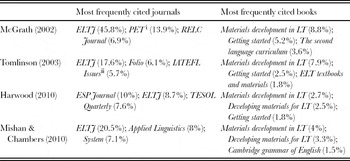
Table 2 summarizes the most frequently cited journals or books in each of the four publications, with percentages (in relation to total numbers) given in parentheses.
Column one, showing the journals most often referenced, suggests a more practical bias in McGrath (Reference McGrath2002) and Tomlinson (Reference Tomlinson2003), and a more theoretical bias in Harwood (Reference Harwood2010) and Mishan & Chambers (Reference Mishan and Chambers2010). McGrath (Reference McGrath2002) stands out as highly reliant on just three journal titles, whereas the other publications give space to a wider variety of perspectives from the literature. The second column, showing the top books referenced, indicates surprising similarities across the four publications, with just three titles commonly cropping up: Materials development in language teaching (Tomlinson Reference Tomlinson1998), Getting started: Materials writers on materials writing (Hidalgo, Hall & Jacobs Reference Hidalgo, Hall and Jacobs1995) and Developing materials for language teaching (Tomlinson Reference Tomlinson2003). This is perhaps symptomatic of the paucity of relevant publications in the field – itself a consequence of the assumption of triviality often ascribed to materials evaluation and design (Richards Reference Richards and Harwood2010: ix).
2.2 Which voices with a stake in the materials design process are represented?
McGrath (Reference McGrath2002) is primarily aimed at practising teachers who already have some classroom experience behind them. Its design, with interspersed reflective tasks, sample materials and answer keys, makes it ideal for use on M.A. modules dealing with materials evaluation and design, or by teachers working individually or collectively in their own educational contexts. Since the book emphasizes the selection or adaption of published textbooks, it is probably more suited to teachers in the earlier stages of their career, when more guidance is necessary. Once they are able to critically assess the quality of professionally produced coursebooks, they are in a better position to begin writing their own materials tailored to their specific teaching contexts. The focus on pre-, in- and post-use evaluations of published materials should also be of interest to educational administrators keen to improve the effectiveness of their courses, without committing the time and money necessary for the production of in-house materials. Unfortunately, it is often the case that very little effort is invested in the systematic choice or evaluation of input across English language programmes, and students receive a haphazard selection of materials ‘by lottery’ as they advance through the system. Of course, no programme will ever fully meet the communicative needs of all of its learners all of the time, but without a clear picture of what those needs are and the extent to which successive courses contribute to meeting them, administrators are working in the dark. McGrath has little to say himself on the empirical research underpinning the materials design process, referring instead to summaries in other work, such as McDonough & Shaw Reference McDonough and Shaw1993 (itself very dated, with an average publication year in the bibliography of 1988), so readers more interested the theoretical aspects of the area should look elsewhere.
Tomlinson (Reference Tomlinson2003) aims to inform working teachers or teachers in training of insights into materials development from developers and users throughout the world and therefore also has a strong practical bias. The variety of native and non-native voices from disparate teaching contexts (Singapore, Britain, Japan, Spain, the USA, the Philippines, Indonesia, Namibia, Turkey, Hong Kong, Argentina, Lebanon, Brazil, Hungary, Vietnam, New Zealand and Romania) certainly enriches the descriptions and is important, given the fact that the vast majority of English language teaching takes place outside ‘inner circle’ speech communities (Kachru Reference Kachru, Quirk and Widdowson1985). Bao Dat, for example, reminds us of the problems that slick internationally-marketed textbooks can cause at the local level: ‘One teacher at my institute in Vietnam reveals, “I hardly know what to do with this lesson that invites my students to talk about how to use parking meters or vending machines which they've never seen, which simply don't exist in our country”’ (Tomlinson Reference Tomlinson2003: 389). Of course, issues like these can be overcome with creative adaption: Vietnamese students could be encouraged to use clues from the L2 text to infer how to operate these machines, or to take a more critical stance by discussing how a society that uses parking meters and vending machines must differ from their own. Tomlinson, however, in this volume and elsewhere, sees the production of locally relevant materials as the way forward:
The hope, of course, lies with local, non-commercial materials which are not driven by the profit imperative and which are driven rather by considerations of the needs and wants of their target learners and by principles of language acquisition. (Tomlinson Reference Tomlinson2008: 9)
A number of authors in the book address this issue (see Chapters 8, 9, 18, 22, 30 and 31).
Another notable feature of Tomlinson (Reference Tomlinson2003) is its focus on materials development from the publisher's perspective (Chapters 2, 3, 7, 8 and 10), where ‘other forces than sound current pedagogy are at work’ (Mares, in Tomlinson Reference Tomlinson2003: 132): namely, acceptability, marketability and profit. This is illustrated by David Hill's interesting analysis of visual input in coursebooks (Chapter 10), where he estimates that around 55 per cent of illustrations in two well-known publications are purely decorative – an editorial decision motivated more, no doubt, by a desire for immediate market appeal during hurried selections between books (known as ‘flick-tests’) than long-term learning goals (Bell & Gower Reference Bell, Gower and Tomlinson1998: 125). According to Tomlinson (Reference Tomlinson2008: 7), this still holds true for more recent textbooks, where colourful photographs often adorn the top-right hand corners of right-hand pages to attract potential buyers making superficial comparisons between choices. The economic concerns of publishers can therefore often be seen as working against pedagogic interests or research-driven innovation, and it would be useful for users to carefully consider whether the advantages offered by global coursebooks, such as convenience and professional appearance, are outweighed by their disadvantages.
In terms of addressing the interests of applied linguistics researchers, the book is rather patchy. The editor notes that most materials writing is currently done largely intuitively and he supports a move towards a more principled approach, based on established findings from SLA research. This is an admirable position to begin from, and a step which, in my view, is essential to advance the field (see Tomlinson & Masuhara Reference Tomlinson and Masuhara2011 for efforts in this direction), but, unfortunately, the volume does not often live up to these lofty ideals. Tomlinson lists a number of ‘principles of SLA’ relevant to materials development (Tomlinson Reference Tomlinson2003: 20–22) but these are essentially a repetition of ideas from an earlier book (Tomlinson Reference Tomlinson1998), with no more than a token nod towards the research literature. Where SLA theory is referred to in the chapters, there is often an over-reliance on Krashen's out-dated models, which remain stubbornly popular in ELT literature despite their lack of empirical grounding or falsifiability (see, for example, Gregg Reference Gregg1984). Since the core target audience for the book is practising teachers, it could be argued that there is little appetite for empirical investigations, but surely it is the responsibility of writers on materials design to show how applied linguistics research is both relevant and useful to classroom practice – some authors in the volume, such as Nation (Chapter 23), do this more successfully than others.
Harwood (Reference Harwood2010), consisting of contributions from academics in the Anglophone world, naturally tends to foreground theoretical models pertinent to materials design. These cover a wide range of areas describing learners, language learning and language use in social contexts, including needs analysis (e.g. West Reference West1994), task design (e.g. Bygate, Skehan & Swain Reference Bygate, Skehan and Swain2001; Ellis Reference Ellis2003), vocabulary learning (e.g. Schmitt Reference Schmitt2000), cognitive approaches (e.g. Skehan Reference Skehan1998), metacognitive instruction (e.g. Vandergrift & Tafaghodtari Reference Vandergrift and Tafaghodtari2010), critical applied linguistics (e.g. Pennycook Reference Pennycook2001), genre analysis (e.g. Swales Reference Swales1990), interactional linguistics (e.g. Selting & Couper-Kuhlen Reference Selting and Couper-Kuhlen2001), specialized corpora (e.g. Connor & Upton Reference Connor and Upton2004) and community of practice approaches (e.g. Barton & Tusting Reference Barton and Tusting2005). Despite this emphasis on theoretical insights, the authors appearing in the book are careful to note their limitations: research results are often inconclusive and may, in any case, prove to be unhelpful when transposed into classroom contexts. There is also an awareness that applied linguistics researchers need to work harder not only to demonstrate the relevance of their work to practising teachers but also to test their theories through course design followed by ‘sustained course delivery’ (White Reference White2006: 250). The volume has a strong focus on English for specific or academic purposes, and is therefore likely to be of particular interest to material writers or practitioners involved in higher education, but many of the principles raised have broader relevance too. Each chapter in the book ends with discussion questions and tasks, making it useful for teacher education programmes or study groups, although there is an assumption of considerable background knowledge and experience which may ask too much of novice practitioners or material writers.
Mishan & Chambers (Reference Mishan and Chambers2010) promises ‘a snapshot of the contemporary influences on language learning materials development from diverse perspectives around the globe’ (blurb on the back cover) and that is largely what the reader gets. Contributors explore materials development from the perspectives of coursebook writers, teacher trainers, language teachers and university lecturers, and they cover a wide range of target groups including young learners (TEYL contexts), language teacher education (LTE) post-graduate students, adult immigrants in the UK (English for Speakers of Other Languages contexts) and English as a Foreign Language (EFL) university students in Japan, Tunisia and Venezuela. In this sense, the chapters do not attempt to come together to form a coherent whole; instead, they provide an interesting cross-section of a complex and diverse contemporary society. The book places a strong emphasis on the multiple ways technology is affecting materials development. First, language corpora are deepening our understanding of variation across spoken and written modes in different speech communities, and improved descriptions, particularly of spoken discourse, are beginning to find their way into grammar reference books (e.g. Carter & McCarthy Reference Carter and McCarthy2006), coursebooks (e.g. McCarthy, McCarten & Sandiford Reference McCarthy, McCarten and Sandiford2005a, Reference McCarthy, McCarten and Sandiford2005b, Reference McCarthy, McCarten and Sandiford2006a, Reference McCarthy, McCarten and Sandiford2006b) and locally-produced teaching or training materials. Frequency lists are influencing which words or multi-word units are included in the curriculum and at what stage they are introduced. Second, the Internet is allowing materials writers all over the world to access vast quantities of authentic language to create materials from, and enabling them to share their creations with peers. Third, editing and word processing software is facilitating the production of professional-looking ‘home-grown’ materials. Finally, Web 2.0 technology is allowing collaborative authoring of web sites by students and tandem learning projects between distant institutions. Technology-rich educational environments are clearly opening up exciting new possibilities in materials and task design but, recalling the cautionary note on research insights in Harwood (Reference Harwood2010), many of the authors stress the limitations of their work and the need for both ‘pedagogic cost-benefit analysis’ (Timmis Reference Timmis, Mishan and Chambers2010: 73) and extensive trialling in real classroom contexts before any strong claims can be made.
2.3 The search for general principles in language learning materials development
With language learning occurring across such a diverse range of contexts and cultures, the search for general principles to guide materials design and evaluation is an important starting-point. This is a formidable task, however, since it requires drawing together expertise from a wide range of disciplines, reconciling disparate views in order to formulate generalizable principles, and testing these out in different learning environments over extended periods to determine their effects on students’ motivation and acquisition (Hulstijn & Schmidt Reference Hulstijn, Schmidt, Hulstijn and Schmidt1994: 5). This level of effort and interdisciplinary collaboration has been extremely rare in the past, as Tomlinson (Reference Tomlinson2011: 25) remarks:
Too often in my experience researchers have made theoretical claims without developing applications of them, writers have ignored theory and have followed procedural rather than principled instincts, teachers have complained without making efforts to exert an influence, learners have been ignored and publishers have been driven by considerations of what they know they can sell.
So how well do the four volumes reviewed here deal with this area? McGrath (Reference McGrath2002) devotes a chapter to the topic of systematizing materials design, but the principles he mentions are rooted more in classroom experience than theoretical models. He summarizes the views of a number of key writers in the field, such as Richards, Nunan and Hutchinson & Waters, but does not make any serious attempt to compare or contrast them or to critically evaluate their claims in terms of their empirical grounding. While useful for providing teachers in the early stages of their careers with practical advice (as the author intends), there is little there to advance the field of materials design.
Tomlinson (Reference Tomlinson2003) also includes extended discussions on principles, particularly in Chapters 1 and 6. In Chapter 1, he provides a long list of principles based on ‘findings’ from learning and SLA research, along with the get-out clause that we all have to decide for ourselves what evidence is convincing. While some of the points he makes seem empirically defensible, such as the importance of affect or noticing in learning, others are more controversial. He makes the strong claims, for example, that ‘experiential learning’ and ‘multidimensional processing of intake’ are essential for successful learning, without clearly defining these terms or describing the evidence which supports these conclusions. How do we measure the ‘depth’ at which learners are experiencing materials or the number of ‘dimensions’ they are processing input on at any particular moment? And how do we establish a causal link between these constructs and the language acquisition that takes place as a result? As Schmidt (Reference Schmidt, Hulstijn and Schmidt1994: 12) says, ‘subjective experience is irreducibly a first person phenomenon, whereas progress in science always depends upon taking a third person perspective. . .such facts as there may be about internal mental events can never be verified by objective methods and are not the data of science’. Unfortunately, none of the principles listed are scrutinized in any detail or with any scientific rigour. In Chapter 6, Tomlinson discusses two principled frameworks for materials development: one ‘text-driven’ and the other ‘task-driven’. The text-driven approach abandons attempts to structure the syllabus along lexico-grammatical lines, giving priority instead to cognitively and affectively engaging input. Attention to form only takes place later, after the texts have been responded to more holistically. This has obvious appeal for teachers and learners tired of the dreary texts, contrived to illustrate the grammatical point-of-the-day, that often populate published coursebooks. It is also underpinned by credible research from cognitive psychology into the importance of affect in learning (e.g. Schumann Reference Schumann1997), the role of noticing in acquisition (e.g. Schmidt Reference Schmidt1990) and constructivist theories (e.g. Williams & Burden Reference Williams and Burden1997). However, no hard evidence is presented for the superiority of the text-driven syllabus over more traditional PPP (present-practice-produce) approaches and we will have to wait for more classroom-based research to help resolve this issue. The promised discussion of a task-driven approach does not actually materialize in the chapter and, along with frequent typographical errors in the references provided, suggests that the book went through a hasty editing process.
Harwood (Reference Harwood2010), as mentioned in section 2.2, tends to stay close to theoretical principles throughout the volume, and while space here does not allow a comprehensive examination, I will briefly consider some of the key issues raised. In Chapter 2, Ellis explains how SLA research has informed task design and grammar teaching. While traditional PPP approaches are supported by skill-learning theories (e.g. Johnson 1996), which see declarative knowledge as gradually becoming automatized through practice activities, task-based language teaching is supported by emergentist theories (e.g. N. Ellis Reference Ellis1998), which see implicit knowledge as emerging gradually as learners, ‘eager to exploit the functionality of language’, are exposed to language data in a ‘communicatively-rich human social environment’ (ibid.: 644). Rod Ellis is careful not to draw any firm conclusions for materials design from these differing perspectives, but suggests that they provide a wealth of ideas to be tested out in classrooms. Reinders & White, in Chapter 3, describe two influential frameworks for principled materials design, produced by Chapelle (Reference Chapelle2001) and Doughty & Long (Reference Doughty and Long2003), and used in Task-Based Language Teaching (TBLT) approaches. These are largely overlapping in their goals, both aiming to create optimal environments for learning by reference to research from SLA or educational/cognitive psychology. Doughty & Long's framework of ten ‘methodological principles’ (MPs) is the more comprehensive of the two and includes: i) using tasks rather than texts as the unit of analysis; ii) promoting learning by doing; iii) elaborating, rather than simplifying, input; iv) providing rich input; v) encouraging ‘chunk’ learning; vi) focusing on form; vii) providing negative feedback; viii) respecting learners’ individual developmental processes; ix) promoting collaborative learning; and x) tailoring instruction to cater for individual differences (goals, interests, motivation, cognitive style and learning strategies). Although Doughty & Long (ibid.) accept that some of their MPs might not stand the test of time, this list seems like an excellent starting-point for language learning materials design.
The strongest message to emerge from Mishan & Chambers (Reference Mishan and Chambers2010) in terms of principled materials design is the need for input based on attested language use rather than writers’ intuitions, which are notoriously unreliable (e.g. Biber & Conrad Reference Biber and Conrad2001). Corpus studies have demonstrated clearly how language varies with mode (spoken or written) or register (conversation, fiction, newspapers, academic prose, etc.) and these insights have begun to find their way into reference books (e.g. Biber et al. Reference Biber, Johansson, Leech, Conrad and Finegan1999; Carter & McCarthy Reference Carter and McCarthy2006) and language-learning materials. The focus in the volume is primarily on evidence from spoken corpora since it is typically spoken discourse that has been poorly represented in coursebooks (e.g. Gilmore Reference Gilmore2004; Cullen & Kuo Reference Cullen and Kuo2007), and contributors show how a corpus-informed approach can help materials designers with decisions about what conversational strategies, vocabulary (single words or multi-word units) or grammar patterns to include in the syllabus. Again, recommendations are hedged with cautionary notes – Timmis (Mishan & Chambers Reference Mishan and Chambers2010: 63) warns against ‘the reflex fallacy’ (the mistaken notion that just because a particular language feature exists it must be taught) and McCarten & McCarthy (ibid.: 20–23) illustrate some of the difficult decisions materials writers need to make when mediating between authentic discourse and learners. In her chapter on tasks and task authenticity in the digital era, Mishan (ibid.: 165–167) challenges some of the conventional classroom practices designed to enhance comprehensibility (text simplification, pre-teaching vocabulary and comprehension questions), reminding us that, in our search for general principles relevant in contemporary classrooms, we also need to critically examine established approaches.
3. Concluding comments
Overall, the four books reviewed here indicate that the field of language learning materials design is a thriving area of debate and investigation, invigorated by the diverse perspectives of stakeholders from the applied linguistics research community, language classrooms around the globe and the publishing world. Whereas the two earlier volumes, McGrath (Reference McGrath2002) and Tomlinson (Reference Tomlinson2003), tend to take a more practical, classroom-based approach to materials design, Harwood (Reference Harwood2010) and Mishan & Chambers (Reference Mishan and Chambers2010) suggest a growing attempt to theorize and problematize the area by researchers. Gone, however, are the confident voices of the past that tried to impose misguided methodologies, such as audiolingualism, onto a poor, unsuspecting teaching community (Howatt Reference Howatt1984: 267). There is now, instead, a deeper appreciation of the complex nature of the materials design process and a growing realization that progress in the field will rely on an interdisciplinary approach and extensive trialling and feedback from real classrooms.
A number of forces seem to be driving changes in the field: insights from corpus linguistics are improving the accuracy of our language models (particularly for spoken discourse) and influencing lexical choices; technology is improving access to L2 materials worldwide, increasing our options for how input is delivered in the classroom and how tasks are designed to exploit it; applied linguistics researchers have put forward theories on how to create optimal learning environments which now need to be explored by materials developers; intercultural communicative competence models are expanding the goals of language teaching beyond a lexicogrammatical syllabus; and changing attitudes to native-speaker models, caused by the expansion of English into new domains, are influencing the varieties of English selected for inclusion in language programmes (Graddol Reference Graddol1997, Reference Graddol2006). Many of these changes are reflected in the recently released second edition of Tomlinson's excellent book, Materials development in language teaching (Reference Tomlinson2011), which includes new chapters on corpus linguistics, task-based teaching and new technologies. Although none of the books reviewed here comprehensively covers all of the issues mentioned above, perhaps that is too much to ask from a single volume. One area particularly under-represented in the four books is research on task design, which is currently going through something of a renaissance. Early results suggest that tasks can be designed in principled ways to enhance language acquisition and to variably develop learners’ L2 complexity, accuracy or fluency (Bygate, Skehan & Swain Reference Bygate, Skehan and Swain2001; Robinson Reference Robinson2001; Doughty & Long Reference Doughty and Long2003). Task manipulation of factors such as cognitive demand, task goals, planning time and task repetition can all affect learning outcomes and the challenge ahead for materials developers is to begin to exploit these variables in a more principled way. Research into language learning materials development clearly has a long way to go, but at least its complexities are no longer being under-estimated and it is now receiving more of the serious attention it deserves.
Alex Gilmore is an Associate Professor in the Department of English Language at the University of Tokyo, Japan, and supervisor for Nottingham University's distance learning M.A. programme (discourse analysis) in the UK. His research interests focus on materials development in language learning, communicative competence, and the application of technology and SLA research to learning contexts.