1. Introduction
Materials – like textbooks, teacher prepared handouts, digital resources, and more – are an integral part of nearly any language learning classroom. In this article, we broadly define materials as resources that students and educators use in their language learning and teaching endeavours (Tomlinson, Reference Tomlinson2012; Jakonen, Reference Jakonen2018), including but not limited to coursebooks, teacher handouts, digital artefacts, and more (Guerrettaz, Engman, & Matsumoto, Reference Guerrettaz, Engman and Matsumoto2021). Despite the expansive literature on the development and evaluation of language teaching/learning materials (e.g., Harwood, Reference Harwood2010; Mishan & Timmis, Reference Mishan and Timmis2015; Tomlinson, Reference Tomlinson2016), there is considerably less research on how learners and teachers actually use materials within the realities of language classrooms (Larsen-Freeman, Reference Larsen-Freeman2014; Tarone, Reference Tarone2014).
Importantly, most previous research on materials has studied them outside the classroom. These include: content analyses of materials in relative isolation from learners and teachers (e.g., Brown, Reference Brown2009; Kiczkowiak, Reference Kiczkowiak2020; Su, Reference Su2020); practitioner publications on the intended purposes of materials rather than on their actual impacts on classrooms; and conceptual scholarship on materials development and evaluation often by materials writers (e.g., textbook authors) (Allwright, Reference Allwright1981; Hutchinson & Torres, Reference Hutchinson and Torres1994; Maley, Reference Maley and Tomlinson2011). In a state-of-the-art review of materials development for language learning and teaching, Tomlinson (Reference Tomlinson2012) calls for research on materials use, including studies on the effectiveness of materials in the classroom. The present article responds to this and other calls (e.g., Tarone, Reference Tarone2014) by focusing on materials use in language teaching/learning (henceforth materials use), which refers to the ways that teachers and students actually employ, interact, and engage with materials within classroom contexts. In other words, materials use research is data-driven, classroom-based, and occurs in real time (e.g., through observations and recordings of teaching and learning). For the purpose of this research agenda, we make a clear distinction between the former types of publications (i.e., on materials development, evaluation, and content analyses conducted mostly outside the classroom), and the novel area of research that is focus of this article – materials in action in the classroom.
Thinking ahead to the next 10–15 years, we outline important next steps for materials use inquiry, by presenting seven research tasks subsumed under three overarching topics:
A. Materials use and language pedagogy;
B. Materials use in relation to classroom interaction; and
C. Language diversity, culture, and power in materials use.
The research agenda presented in this article is both classroom-based and qualitative in nature. When a new topic of inquiry comes to the fore, as is currently the case with materials use, qualitative research is an essential first step. Exploratory qualitative research helps to determine the parameters and nature of the phenomenon in question, in essence generating concepts and eventually categories that will be of use in subsequent quantitative research (Patton, Reference Patton2015). Psycholinguistic and experimental research into the effects of materials on language acquisition is undoubtedly desirable; however, the field currently understands very little about even the most basic dynamics of materials use in language teaching and learning (see Garton & Graves, Reference Garton and Graves2014). Therefore, an important first step is qualitatively examining and understanding materials use vis-à-vis classroom processes (see also Larsen-Freeman, Reference Larsen-Freeman2014), which is a main objective of our proposed research agenda. Researchers who would pursue these research tasks would benefit from a solid foundation in methods of qualitative inquiry, such as classroom observation, interviewing, and multimodal and/or interaction analysis (e.g., gesture studies, discourse analysis, textual analysis).
Before presenting the research tasks in detail, we briefly discuss in the next section the conceptual trajectories and epistemological underpinnings of empirical inquiry into materials and materials use. This theoretically-oriented overview differs from perspectives that have appeared previously – for example, literature reviews that have tended to focus heavily on materials development, and evaluation practices and processes (e.g., Tomlinson, Reference Tomlinson2012). Many of the concepts described below will be revisited later in this article in the descriptions of the specific research tasks.
2. Conceptual trajectories: Researching materials
It is conceded that the field of materials research, which has mostly focused on materials development and evaluation, is generally undertheorised (Garton & Graves, Reference Garton and Graves2014). Some circles within applied linguistics have gone so far as to dismiss materials research as an ‘essentially atheoretical activity’ (Samuda, Reference Samuda and Johnson2005, p. 232). However, we see the question of theory in materials research as more complex and nuanced. In this section, we explore and re-frame the previous literature on materials (e.g., development, evaluation) not as ‘atheoretical’ but as grounded in particular conceptualisations of materials and of materials research. Tacit conceptualisations of and assumptions about materials are made explicit in this section. In particular, we discuss these in relation to broader epistemologies and theories in the field of language education, and also explore novel frameworks for studying materials-in-use moving forward.
For some time, the field of language education has seemed to view materials research as ostensibly limited to the practice and scholarship of materials development. To trace the epistemological trajectory surrounding this prevailing term, early scholarship on language teaching/learning materials seems to have tacitly conceptualised these as merely part of the design of tasks. This is apparent in the distinction between ‘task-as-workplan’ – meaning, the design – and ‘task-as-process’ – referring to how it is realised and often transformed in classroom contexts (Breen, Reference Breen and Johnson1989; Hasegawa, Reference Hasegawa2018). Another common conceptualisation of language learning/teaching materials are as curriculum artefacts (Snyder, Bolin, & Zumwalt, Reference Snyder, Bolin, Zumwalt and Jackson1992); for example, equating textbooks with the curriculum.
One of the more theoretically established areas of materials research examines the social, cultural, and political contents of textbooks and other commercially-produced pedagogical resources (e.g., Harwood, Reference Harwood and Harwood2014). For example, in these frameworks, materials are often seen as embodying particular types of cultural capital (Bourdieu, Reference Bourdieu1991). The recent overarching turn in materials research towards usage-based inquiry also has roots in a handful of classroom-based studies that centre on the sociopolitical and cultural dynamics of materials vis-à-vis teachers and learners. These have examined: (1) student resistance in ‘periphery’ countries to the pedagogic practices and content carried by coursebooks published in Western countries (Canagarajah, Reference Canagarajah1993; Yakhontova, Reference Yakhontova2001); (2) the lack of student access to literacy textbooks under new government policy in Ghana (Opoku-Amankwa, Reference Opoku-Amankwa2010); and (3) how teachers select and use materials for adult migrant learners in New Zealand (Wette, Reference Wette2011).
Another reason that applied linguistics may have largely overlooked materials use research until relatively recently is the linguistic bias within our field, which has tended to ignore the material world (Canagarajah, Reference Canagarajah2018). However, interest in multimodality studies (e.g., gesture) has increased within language education scholarship, with emergent connections to materials use research (Jakonen, Reference Jakonen2015; Matsumoto, Reference Matsumoto2019). Similarly, New Materialist perspectives (Toohey et al., Reference Toohey, Dagenais, Fodor, Hof, Nuñez and Singh2015; Toohey, Reference Toohey2018) in applied linguistics have introduced concepts like assemblage – loosely referring to polysemiotic resources for meaning-making. Such perspectives have demonstrated that phenomena normally relegated to context, such as different physical materials, are actually part of ‘the text’ (Canagarajah, Reference Canagarajah2018, p. 272), meaning that these are critical to language teaching and learning.
Additionally, such materialist perspectives acknowledge differing types of agency, including material and human forms thereof. On this topic of agency, other language education scholars (Kramsch & Vinall, Reference Kramsch, Vinall, Curdt-Christiansen and Weninger2015) have suggested that while teachers may not always be able to change the type of materials mandated for their classrooms, Bernstein's (Reference Bernstein1975) theoretical work on pedagogical relations of power and control may be useful for exploring teachers’ agency with regards to their classroom use of materials. Materials and their component texts enter into relations with those that deploy and interact with them. These relations among materials, learners, and teachers involve sociological structures that restrain and/or afford classroom learning in particular ways. Adopting this and other sociological frameworks is yet another emerging avenue we see into materials use research.
As a whole, these various aforementioned approaches might be described as theories of materiality – meaning ‘that which matters about an entity’ (Hafermalz & Riemer, Reference Hafermalz, Riemer, Becker, vom Brocke and de Marco2015, p. 2), including its salient physical and socio-cultural characteristics in a given context. Issues raised by these and other theories of materiality have implications for future studies on materials use, as they acknowledge and seek to explain the tremendous influences of the material world on human actions. These aforementioned theoretical advances in recent language education research (e.g., Canagarajah, Reference Canagarajah2018) also suggest that the field is ripe for empirical, theoretically-grounded research into materials use. In the following sections, we limit the topics of research tasks presented to those that we deem most urgent and feasible given the current state of materials use inquiry in language education.
3. Materials use and language pedagogy
Worldwide, language pedagogy is often described in terms of ‘language teaching methods and materials’. Indeed, language pedagogy and materials typically go hand-in-hand. The former involves many complex aspects of language teaching and learning, including curriculum, student-teacher relationships, teacher expertise, student experiences, and more. However, the small body of previous research on materials use has typically focused on teachers’ actions, while neglecting how students interact with, and use, the materials (cf. Canagarajah, Reference Canagarajah1993; Guerrettaz et al., Reference Guerrettaz, Grandon, Lee, Mathieu, Berwick, Murray and Pourhaji2018a). More specifically, previous research on materials use has tended to focus narrowly on teachers’ pedagogical decisions. (One exception, a doctoral thesis by Külekçi (Reference Külekçi2015) explored teachers’ decision-making in the process of authenticating learning materials, thereby taking into account learners’ classroom experiences with the materials.)
Other studies have examined when and how teachers adhere to or deviate from the curriculum as outlined by a given textbook (Santos, Reference Santos2006; Zhang & Hu, Reference Zhang, Hu, Menken and Garcia2010; Bosompem, Reference Bosompem, Garton and Graves2014; Marcos Miguel, Reference Marcos Miguel2015). These studies typically approach materials use from a fidelity perspective, positioning the material – generally a course textbook – as the starting point and then analysing the degree to which teachers follow or modify it (e.g., Canagarajah, Reference Canagarajah1993; Guerrettaz & Johnston, Reference Guerrettaz and Johnston2013). This research suggests that novice teachers tend to closely follow the textbook script (Ball & Feiman-Nemser, Reference Ball and Feiman-Nemser1988; Tsui, Reference Tsui2003), whereas expert teachers seem more likely to use the textbook flexibly as resource (Gray, Reference Gray2000; Tsui, Reference Tsui2003). An alternative perspective to this dichotomy is a framework in which teachers can be viewed along a continuum of curriculum-developers, curriculum-makers, or curriculum-transmitters (Shawer, Reference Shawer2010), reflecting their varying degrees of adherence to the classroom textbook. Importantly, it appears that other factors besides teaching experience can influence a teacher's approach to curriculum implementation, including national and local policies, institutional supports or constraints, personal background, and beliefs about language learning (Kramer-Dahl, Reference Kramer-Dahl2008; Shawer, Reference Shawer2010; Zhang & Hu, Reference Zhang, Hu, Menken and Garcia2010; Seferaj, Reference Seferaj, Garton and Graves2014; Marcos Miguel, Reference Marcos Miguel2015).
Materials use research, while relatively new in language education, is considerably more established in other content areas (e.g., Choppin, McDuffie, Drake, & Davis, Reference Choppin, McDuffie, Drake and Davis2018). In particular, science and mathematics education researchers have moved beyond the previously described fidelity perspective of materials use, instead employing an enactment perspective (Snyder et al., Reference Snyder, Bolin, Zumwalt and Jackson1992) that emphasises a dynamic, dialectic, and interactive relationship between the teacher, learners, and materials (Remillard, Reference Remillard2005). This perspective argues that materials use is ‘participation with materials as teachers actively engage with and collaborate with curricular resources’ (Remillard, Reference Remillard2005, p. 234, emphasis in original). Such research focuses on how teachers use, adapt, and interpret materials (Li & Harfitt, Reference Li and Harfitt2017), while also considering how teachers change and learn from these interactions (Grossman & Thompson, Reference Grossman and Thompson2008). Such perspectives acknowledge that language classrooms are complex and dynamic, where materials-in-use are not just static objects but rather tools that mediate the interactions of teachers and students to varying degrees.
Yet, we know little as a field about the complex dynamics of materials in relation to language pedagogy. Thus, exploratory research on how materials interrelate with and shape a great diversity of classroom phenomena is needed in order to better understand the broader scope of materials use. Qualitative research through ecological (Morgan & Martin, Reference Morgan and Martin2014) or similarly holistic approaches (Canagarajah, Reference Canagarajah2018) allows for this. Such perspectives focus on the ‘totality of participants, relationships, structures, objects, and processes that together constitute the shared experience of classroom language teaching and learning’ (Guerrettaz & Johnston, Reference Guerrettaz and Johnston2013, p. 779), and eschew assumptions of linear causal relationships. Such perspectives uniquely allow for such exploratory inquiry into materials use, as explained in Canagarajah's (Reference Canagarajah2018) materialist orientation – an approach that foregrounds polysemiotics in language education research. This leads us to the first research task.
Research task 1
Employ qualitative case study methodology to identify and analyse the roles of materials in a classroom ecology, focusing on an understudied language education context. Individual researchers can conduct single case studies, or a team of researchers can use multiple-case design to compare across cases.
Ecological and materialist orientations suggest that materials-in-use are inextricably entangled with all other aspects of the pedagogical context (Guerrettaz & Johnston, Reference Guerrettaz and Johnston2013; Canagarajah, Reference Canagarajah2018; also Thornbury, Reference Thornbury2000). Previous work on the classroom ecology of a university-level English as a second language (ESL) grammar classroom (Guerrettaz & Johnston, Reference Guerrettaz and Johnston2013) focused on materials use in relation to two aspects of language pedagogy – curriculum and discourse – while exploring concerns related to a third – language learning. In future studies, particular attention should be paid to the role of materials vis-à-vis specific aspects of language pedagogy beyond the topic of curriculum, as this is one of the areas that research on materials use has investigated a bit more widely.
As a case study, the results of Guerrettaz and Johnston (Reference Guerrettaz and Johnston2013) are not intended to be directly generalisable to other contexts. However, given their finding that materials can permeate all aspects of classroom life, it is prudent that further studies continue this line of questioning to more clearly understand the roles of materials in classrooms. In order for the field to build robust theoretical claims about materials and the classroom ecology, future research should include examination of the teaching and learning of languages other than English, at other levels (e.g., elementary and secondary), and in other geographic and cultural contexts.
Mathieu (Reference Mathieu2017), for example, explored the ecology of a secondary Spanish immersion social studies classroom in the United States and found that the materials constituted much of the enacted curriculum of the observed unit, similar to Guerrettaz and Johnston's (Reference Guerrettaz and Johnston2013) finding. However, in the Spanish immersion context, Mathieu (Reference Mathieu2017) discovered a lack of explicit language focus in the social studies materials. Similarly, the pedagogy associated with the materials limited opportunities for explicit Spanish language learning. In contrast, the university ELT classroom in Guerrettaz and Johnston (Reference Guerrettaz and Johnston2013) consisted primarily of explicit language focus.
Such contextual differences are important given that research on materials use for languages other than English remains rather scarce. Thus, there is great opportunity for individual researchers to continue this line of research with single-case studies and for research teams to use multiple-case designs to look for trends across a variety of language classrooms. One important long-term goal of this general line of research would be to develop theoretical heuristics that explain differences in materials-in-use across contexts as well as any underlying or foundational commonalities.
Documenting and organising materials use data for research purposes poses certain challenges. In reality, teachers often deploy the material world in complex and idiosyncratic ways – for example, by creating or finding ephemeral materials on the spot as they instruct learners (e.g., Internet searching for an image of a word unfamiliar to students to briefly display); unexpectedly transforming ‘non-pedagogical’ objects into materials (e.g., a cigarette packet in Tomlinson & Masuhara, Reference Tomlinson and Masuhara2018, p. 2); and extracting only certain elements of a much more extensive text. These and other materials use practices demand thorough multimodal documentation of the resources in question in order to capture the full range of materials-in-use and avoid subsequent confusion during analysis.Footnote 1 Moreover, it is methodologically important to directly and systematically label each material straightaway.Footnote 2 We have created and used a labelling system that references the class and date along with a sequential identifier (e.g., A, B, C, etc. according to order of appearance). Such labels are then also recorded in the field notes.
Research task 2
Employ a longitudinal comparative case study methodology to examine how using particular materials shapes teachers’ pedagogical knowledge and practices.
If we approach materials use from a teacher–material relationship perspective (Remillard, Reference Remillard2005), we ask not only how teachers engage with, use, and adapt materials, but also how teachers change or learn from the use of these resources. This question is especially important to language learning classrooms where materials and textbooks represent particular pedagogical approaches, often grounded in the prominent second language acquisition theory of the moment (Garton & Graves, Reference Garton, Graves, Walsh and Mann2019). Richards (Reference Richards, Garton and Graves2014, p. 19) argues that ‘coursebooks often determine the goals and content of teaching, as well as the methods teachers use’. However, teachers’ beliefs about pedagogy and learning can also have a powerful influence on their classroom practices (Tsui, Reference Tsui2003), regardless of the instructional approach embodied in the materials. One goal of this research task, then, is to explore contexts in which there are apparent tensions or contradictions between educators’ beliefs about language teaching and learning, and the course materials they are required to use, particularly in cases where the materials are associated with an attempt at teaching reform. For example, Zhang and Hu (Reference Zhang, Hu, Menken and Garcia2010) describe how EFL teachers in China responded to a mandated curricular reform via a new compulsory textbook, noting that how teachers used the textbook and the extent to which they enacted the desired pedagogical approach depended greatly on their personal beliefs and experiences.
The underlying question of this research is when and how language education materials serve an educative role. This line of research would investigate educative materials, which refer to materials intended to promote ongoing teacher learning whilst in use (Davis & Krajcik, Reference Davis and Krajcik2005). Previous scholarship has outlined materials design conditions necessary for a textbook to be an agent of change, including explicit learning-how-to-teach suggestions and clear practical guidelines of what change looks like (Hutchinson & Torres, Reference Hutchinson and Torres1994). Although materials like textbook teachers’ manuals are designed to guide the teacher in their use, there is little to no empirical research in language education that centres on how these and other classroom materials actually function as educative resources.
This research would ask if, how, when, and why particular materials promote more effective, appropriate, and/or innovative pedagogical practices by teachers. Such materials might involve either mainstream language textbooks or those designed to be educative through the inclusion of textual or graphical supports for teacher learning. Indeed, similar supports commonly appear as annotations in teacher editions or as teacher guides for professionally produced textbooks, some of which are likely more educative than others with regards to teacher learning.
In order to investigate the educative potential of materials, longitudinal research can explore individual teachers’ experiences interacting with the same course materials throughout the planning, teaching, and post-lesson reflection process. We suggest undertaking this as a case study using qualitative comparative analysis (Stake, Reference Stake, Denzin and Lincoln2008; Yin, Reference Yin2014). For example, the researcher might supply four different teachers with the same materials that have been designed with educative components. Using purposeful sampling (Patton, Reference Patton2015), the researcher would identify different teachers whose personal beliefs align with or diverge from the pedagogical approach embodied in the teaching/learning materials. Data would be collected through in-depth interviews with the teacher, think-aloud protocols as the teacher discusses planning with the textbook, lesson observations, and post-lesson reflections. Data analysis within and across cases (Stake, Reference Stake, Denzin and Lincoln2008; Yin, Reference Yin2014) would offer understanding of how teachers interact with materials and the factors that affect whether and how the materials serve as educative resources. Similar studies with elementary science materials (e.g., Arias, Bismack, Davis, & Palincsar, Reference Arias, Bismack, Davis and Palincsar2016) are excellent models.
Researchers lacking the time or resources to study multiple teachers, as described above, could instead conduct simplified versions of this inquiry task by focusing on an individual teacher. The goal of such a single-case study would be to elucidate when and how the teacher takes up, learns from, and enacts educative features of language materials. Both this and the larger multiple-case study design have important potential implications for materials use and materials development, as findings are expected to illuminate how materials might be better designed to engender desired pedagogical practices and to grow teacher knowledge.
Research task 3
Conduct exploratory research examining what language teacher education programmes teach about language teaching/learning materials.
A final issue related to materials use and language pedagogy concerns language teacher education. There have been calls for more systematic inclusion of materials design, evaluation, and adaptation techniques in formal language teacher education programmes (Hutchinson & Torres, Reference Hutchinson and Torres1994; McGrath, Reference McGrath2013; Garton & Graves, Reference Garton and Graves2014). We concur with Garton and Graves (Reference Garton, Graves, Walsh and Mann2019) that this list should also include materials use. This means that teachers should be trained to be reflective and principled not only when creating and choosing materials (i.e., materials development) but also when employing materials in the classroom (Morgan & Martin, Reference Morgan and Martin2014). This includes principled analyses and responses to the (unintended) impacts those materials might have. Despite these calls, only a few recent studies elucidate what pre- and in-service educators learn about materials development, adaptation, and use (Tibbits & Pashby, Reference Tibbits, Pashby, Garton and Graves2014). For example, Maijala (Reference Maijala2020) conducted a qualitative questionnaire and supplemental follow-up interviews to examine Finnish pre-service foreign language teachers’ experiences with and conceptions of textbook use during their teacher education programme. Results showed that trainees had difficulty in adapting textbooks for their learners and in attempting to supplement the textbook with their own materials.
Expanding on these few existing studies, research task 3 would provide valuable context-based insight into the skills and knowledge regarding materials that are deemed important by language teacher educators and by teacher-learners enrolled in teacher education programmes. This work would explore: how teacher educators and teacher-learners talk about materials, how they understand the role of materials in language pedagogy, and the knowledge and skills teacher-learners develop to adapt or create effective materials. It could be undertaken in a variety of ways: observational research of language teaching methods classes, document review of course syllabi and assignments, and surveys and interviews with language teacher educators and teacher-learners.
As an additional expanded study, this exploratory inquiry could also be followed up by multi-site classroom-based research that compares: (A) what is taught – and ostensibly learned – about materials use in teacher education programmes with (B) what teacher-learners are able to actually do with materials in their own language classrooms.
4. Materials use in relation to classroom interaction
Classroom interaction is a central area of inquiry in language education and applied linguistics, especially since language learners’ participation in interaction is essential to language acquisition. Moreover, leading scholars have asserted that studying materials in relation to interaction is critical to understanding the modus operandi of language classrooms (Garton & Graves, Reference Garton and Graves2014; Tarone, Reference Tarone2014). Guerrettaz and Johnston (Reference Guerrettaz and Johnston2013) found that the textbook prompted most talk in an ESL classroom (i.e., 83% of turns-at-talk). Furthermore, different materials seem to encourage qualitatively and quantitatively different types of interaction (Kim & Kellogg, Reference Kim and Kellogg2007; Tin, Reference Tin2012). However, few studies have undertaken an in-depth examination of materials in relation to classroom interaction (cf. Jakonen, Reference Jakonen2015; Pourhaji, Alavi, & Karimpour, Reference Pourhaji, Alavi and Karimpour2016; Matsumoto, Reference Matsumoto2019), most focusing on ESL/EFL materials as opposed to other languages.
The study of materials in relation to interaction is critical to understanding how they afford or constrain opportunities for language learning (Garton & Graves, Reference Garton and Graves2014; Tarone, Reference Tarone2014), and the possible objectives for studying materials in relation to interaction/discourse are vast. However, we focus on two research tasks that lay important groundwork for this relatively new area of inquiry. Both research tasks 4 and 5 examine naturally unfolding classroom interaction by focusing on the materials-interaction interface. Research task 4 aims to identify multimodal patterns of interaction that occur with and around materials, taking into account the complex roles of human participants in shaping such patterns of materials-in-interaction. Research task 5 examines expected and unexpected outcomes of materials with respect to student language use, by focusing on materials that are especially well-suited for this inquiry objective – those in small-group activities.
Research task 4
Using multimodal analysis, qualitatively identify polysemiotic patterns of meaning-making that occur with and around different materials used in class. Explore the impacts of individual teachers and/or students on the materials-interaction interface (e.g., by examining different teachers using the same materials).
This research task centres on patterns of materials-in-interaction, meaning multimodal paradigms of classroom language and meaning-making involving materials. Of particular interest for language teaching practice are concrete and specific patterns of interaction induced by particular types of materials, such as ‘fill-in-the-blank discourse’ around fill-in-the-blank texts (Guerrettaz & Johnston, Reference Guerrettaz and Johnston2013). Other more abstract paradigms of materials-in-action include: ‘embodied action’ patterns (e.g., gesture, teacher handouts, talk) that resolve miscommunication (Matsumoto, Reference Matsumoto2019); and ‘assemblages’ of activity, discourse, objects, and videos that are jointly constructed by learners for communicative purposes (Toohey, Reference Toohey2018). While these studies are a useful starting point, there are undoubtedly other specific patterns of interaction that occur around materials, given how ubiquitous and important these two dynamics of language teaching are – interaction and materials.
A small body of previous research suggests that materials affect classroom interaction in ways that are sometimes predictable – for example, cloze grammar activities inducing patterns of controlled, teacher-driven discourse with little opportunity for extended, meaning-focused student talk (Guerrettaz & Johnston, Reference Guerrettaz and Johnston2013, p. 787). However, individual teachers and learners influence patterns of materials-in-interaction in unpredictable ways. For instance, a similar cloze question in Guerrettaz and Johnston (Reference Guerrettaz and Johnston2013, pp. 787–789) unexpectedly prompted a lively discussion about students’ romantic interests during an otherwise monotonous activity.
Thus, task 4's research design must account for complex engagements and entanglements among three key types of players that shape language classroom interaction: materials, teachers, and students. This could involve observational and discourse analytic research of two to three teachers using copies of the same textbook with different students (following Tomlinson personal communication, June 16 2019). Such a study has the potential to provide valuable insights: how the materials in question induce particular patterns of interaction, and how such patterns of materials-in-interaction are similar or different across teachers. Also, three focal students per class could capture small-group spoken interactions with small handheld audio recorders (see Barbour, Reference Barbour2007). Additionally, interviews and/or focus groups with participants about the materials-in-use are important for triangulation of data. Analysis may focus on the following, among other considerations: the quantity and quality of interaction (e.g., discourse structures and functions); types and design features of materials (e.g., modalities, content, task types); and teachers’ individual differences (e.g., training, pedagogical beliefs, teaching goals) (Guerrettaz, Marcos Miguel, & Bell, Reference Guerrettaz, Marcos Miguel and Bell2018b).
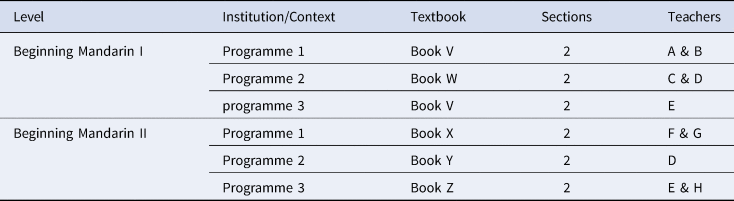
Table 1 outlines an example of a larger study design – similar (though not identical) to research into second language (L2) Spanish materials-in-use funded by the Spencer Foundation (2019–2021) (Guerrettaz et al., Reference Guerrettaz, Marcos Miguel and Bell2018b). Such a configuration of materials, students, and teachers allows for interaction-focused research into different teachers using the same materials (teachers A/B, C/D, F/G, E/H). Additionally, this (Table 1) involves the same teacher and textbook with different students (teacher E with book V; teacher D with book Y). Also, smaller programme sites could provide an opportunity to investigate the same students with different teachers, as a class moves together from one level (e.g., Beginning Mandarin I) to the next (e.g., Beginning Mandarin II) in a course sequence using different units of the same textbook, for example. Preliminary studies of this size have recorded 9–12 classroom hours per course section (e.g., Guerrettaz et al., Reference Guerrettaz, Marcos Miguel and Bell2018b; Guerrettaz, Reference Guerrettaz2021).
Large example study of materials-in-interaction

Note: Table adapted from Guerrettaz et al. (Reference Guerrettaz, Marcos Miguel and Bell2018b, p. 11).
This design (Table 1) would generate vast amounts of data, requiring a team of co-investigators or an expert researcher with ample time. For either the smaller (i.e., 2–3 teachers) or larger (Table 1) study, analytic field notes and memos would allow researchers to highlight salient interactions during data collection, facilitating more efficient analysis long-term.
Various frameworks of multimodal analysis have the potential to provide insights into classroom interaction involving materials. For further discussion, Norris (Reference Norris and Chapelle2020) describes multimodal analysis in depth, and O'Halloran (Reference O'Halloran, Hyland and Paltridge2011) surveys multiple approaches from which researchers might select appropriate frameworks. More specifically, the few existing interaction-focused articles on materials use have employed multimodal interaction analysis (Mathieu, Reference Mathieuin press), multimodal conversation analysis (e.g., Jakonen & Jauni, Reference Jakonen and Jauniin press; Matsumoto, Reference Matsumoto2021; Sert & Amri, Reference Sert and Amri2021), ethnomethodological conversation analysis (Thorne, Hellermann, & Jakonen, Reference Thorne, Hellermann and Jakonen2021), and polysemiotic action analysis (Guerrettaz, Reference Guerrettaz2021).
Findings from research task 4 could be most practically useful to teachers if researchers identify both more and less ‘successful’ examples of materials use vis-à-vis classroom interaction, concerning particular learning goals. Ultimately, findings are expected to provide insights into how particular materials and uses thereof foster meaning-focused interaction patterns and thus opportunities for language learning. Thus, the potential practical implications of this research are noteworthy.
Research task 5
Focusing on student language use, examine expected and unexpected outcomes of materials by recording classroom interaction in small-group activities (e.g., dyads, triads, etc.). Conduct multimodal interaction analysis of these as well as pre- and post-observation interviews.
A central quandary in materials use research (and language teaching practice more broadly) is that learners’ responses to and engagements with materials are often unpredictable. Thus, a main goal of this research task is to explore expected and unexpected impacts of materials on classroom interaction. Research task 5 examines the materials-interaction interface by centring on learners’ actions, language, and experiences when using various types of materials. An underlying premise of this task is that meaning-focused student language use is desirable for fostering L2 development. In particular, small-group interaction – in contrast to teacher-fronted interaction – is an ideal context for research task 5, for several reasons.
For one, how small-group interactions occur has potential implications for language learning (McDonough, Reference McDonough2004; Hasegawa, Reference Hasegawa2021). For example, L2 students who interact in collaborative rather than in competitive ways may better retain knowledge from the group activity for future use (Storch, Reference Storch2002). Moreover, language teachers and learners alike tend to value and expect small-group activities to afford students with opportunities to use the target language, although in reality these often do not (Cao & Philp, Reference Cao and Philp2006; Ewald, Reference Ewald2008). Such unexpected outcomes of small-group activities have been attributed to: individual student traits (e.g., shyness, insecurity), group dynamics (e.g., size, members’ mutual familiarity, degree of partner participation), and the cultural context (Cao & Philp, Reference Cao and Philp2006, Ewald, Reference Ewald2008). Also, inquiry into task-based learning has shown that learner talk during small-group activities often involves unpredictable patterns of language use. For instance, in Murphy (Reference Murphy2003) one learner used group work time to create and memorise a script, rather than do the more spontaneous communicative task prescribed by the teacher. As another example, learners of L2 Thai engaged in jigsaw and information gap tasks where they were expected to: (1) negotiate meaning, (2) produce recasts, and (3) ask questions, all while producing the Thai grammatical structure of classifiers. While students did the first two (i.e., engaged in negotiation of meaning and produced recasts), the small group task did not promote the third, student production of questions as the teacher had expected (McDonough & Mackey, Reference McDonough and Mackey2000).
A final motivation for this research task is that classroom teachers in their daily practice often cannot closely observe small-group interactions in full. Multiple group interactions typically occur simultaneously, hence more privately than all-class interactions. Thus, findings from this research task can elucidate phenomena that teachers may not otherwise be able to readily analyse or evaluate in-depth. As such, this research has useful implications for language pedagogy.
Simply put, small-group interaction is central to many L2 classrooms (e.g., Dörnyei, Reference Dörnyei1997; Sato & Ballinger, Reference Sato and Ballinger2016); however, research has overlooked the roles and impacts of materials therein (e.g., McDonough & Mackey, Reference McDonough and Mackey2000). The one exception to this is Hasegawa's (Reference Hasegawa2021) study of L2 Japanese learners in the US, which revealed two discursive ‘layers’ of small group work involving materials: (1) the ‘pedagogical task layer’ in which students produce controlled dialogue turns and language prescribed by the materials, and (2) the ‘normative interaction layer’ in which students orient to one another much like one would in non-scripted day-to-day conversation (e.g., with humour, by helping one another, by building interpersonal rapport). However, additional research beyond this one case study is needed on different types of materials, diverse interactional phenomena, and other pedagogical contexts. Moreover, Hasegawa's (Reference Hasegawa2021) focus differs considerably from research task 5 (i.e., on the unexpected and expected outcomes of materials).
Overwhelmingly, studies of small group work in language education have typically focused on spoken classroom discourse with little concern for print texts, images, signs, and other types of materials. Meaning, a great deal of nonverbal, gestural, and visual meaning-making ostensibly occurs in small-group activities that have yet to be adequately documented or understood. For instance, a small body of previous research suggests that learners in small groups do the following: collaborate physically by sharing notes (Jakonen, Reference Jakonen2015), rely heavily on varied texts or images for jigsaw tasks (Guerrettaz, Reference Guerrettaz2021), and consult textbooks and mobile devices in their individual line of vision as part of interaction (Ehret & Hollett, Reference Ehret and Hollett2013; Mathieu, Reference Mathieuin press). The multimodal interactional possibilities are vast.
By focusing on student engagements with small-group materials, this research task has the potential to make another valuable type of contribution to language education more broadly. Namely, the field does not have a good understanding of students’ use of materials (Guerrettaz et al., Reference Guerrettaz, Engman and Matsumoto2021) relative especially to the expansive literature on teachers’ perspectives, particularly in the realm of materials development and evaluation (e.g., Tomlinson & Masuhara, Reference Tomlinson and Masuhara2018). Research task 5 squarely addresses this gap by centring on student-to-student interactions involving materials.
We have found that student-material interactions during small-group activities are particularly difficult to record without specialised methods. As a solution, for research task 5 each student participant can wear a small point-of-view, head-mounted camera (e.g., Thorne & Hellermann, Reference Thorne, Hellermann, Colpaert, Aerts, Kern and Kaiser2017; Malinowski, Reference Malinowski, Phakiti, De Costa, Plonsky and Starfield2018); this captures the interactions surrounding small-group materials. Ethically, Wiles et al. (Reference Wiles, Prosser, Bagnoli, Clark, Davies, Holland and Renold2008: ‘Consent Issues’) point to the importance of strong trust between researchers and participants to ensure that the head-mounted cameras are not disruptive. Interestingly, Engman and Hermes (Reference Engman and Hermes2020) similarly used head-mounted cameras, noting that youth welcomed the opportunity to deploy this technology. Supplementary use of traditional video (e.g., two camcorders on tripods) can provide the fuller context of key classroom happenings.
Previous audio-only studies on small-group interaction (e.g., Storch, Reference Storch2002; McDonough, Reference McDonough2004) have each examined a single course that the researcher knew would typically involve many small-group activities. Focusing on one course allows understanding of the broader class and comparison of particular students and groups interacting around the same or different small-group materials. A study of a smaller class (16 students) that met a few hours weekly lasted 16 weeks (McDonough, Reference McDonough2004) while another study – into a larger class (33 students) with more weekly class times – finished sooner (8 weeks) (Storch, Reference Storch2002). Balancing such considerations (e.g., class size, study duration) can yield a manageable data set. These previous audio-only studies diverge from research task 5 since polysemiotic analyses like multimodal transcription are often more time consuming. Thus, a single researcher with sufficient time or a small team might invite one entire class to participate. Alternatively, if more feasible, just a portion of the class could be studied.
Additionally, pre-observation interviews with teachers would query their expected outcomes for student language use vis-à-vis the materials. Then, post-observation recall interviews with teachers would involve questions about expected and unexpected aspects of the interaction. Additionally, post-observation interviews with students would probe their emic experiences of the interactions. Recall interviews with language learners and teachers would use clips of salient classroom interaction as well as physical and digital copies of relevant materials (also see Borg, Reference Borg2003). The modalities and formats of these copies of materials should be identical to the original, to accurately represent the datum's materiality for participants (e.g., use colour copies of in-colour materials, paper copies of loose paper materials, audio-video recordings of music video materials). Additionally, even when these recall interviews have been filmed, during subsequent analysis the material under discussion at a given moment in the interview recording can be difficult for researchers to identify. To avoid such confusion, during naturally unfolding interview interaction with the participant, the interviewer can say a descriptor (i.e., the label) for each material in question.
Analyses will unpack teacher expectations for student language use (e.g., daily survival requests, advanced debates, language functions like greetings) in each small-group activity. Findings can examine if, how, and why teachers attribute or align particular design features of materials (e.g., linguistic qualities, specific content, text-types) with these expectations of student language use. Teacher expectations and materials can be studied in relation to actual patterns of student language use or disuse. Of particular interest are materials that consistently succeed or fail at fostering student language use. Teachers who enact communication-oriented, content-based, and task-based language teaching approaches would likely be good participant candidates for documenting materials use patterns that succeed at fostering student language use.
To conclude this overarching section, research into interaction is foundational to understanding the classroom in general and materials use in particular. Moreover, research tasks 4 and 5 have great potential to further recent advances in the field related, for example, to the multimodality of language teaching and learning. Interaction is a critical social dimension of language pedagogy. In the next thematic area of this research agenda, we consider other key social dimensions of language education: namely, the sociolinguistic, political, and cultural dynamics of materials-in-use.
5. Language diversity, culture, and power in materials use
Materials are not merely technical tools for language teaching but are also rooted in particular worldviews – beliefs about what should be taught, how, to whom, and for what end. As a type of discourse, materials often serve to maintain or sometimes contest existing relations of power (Street, Reference Street1984; Gee, Reference Gee1990). They involve ideologies as to what language varieties are considered legitimate or worth teaching, whose culture is represented, and what (or whose) ways of learning are encouraged, all of which serve to promote the interests of particular groups of people. When materials are used in the classroom, students and teachers interpret and respond to them with their own understandings of language, culture, and self.
As mentioned previously, the socio-political and cultural dimensions of materials represent the most theoretically advanced area of language teaching/learning materials research broadly conceived. However, that body of materials research overwhelmingly consists of analyses of discourses and ideologies within textbooks, in relative isolation from teachers, students, and classrooms (e.g., Azimova & Johnston, Reference Azimova and Johnston2012; Curdt-Christiansen & Weninger, Reference Curdt-Christiansen and Weninger2015; Canale, Reference Canale2016). As a critical next step, it is imperative to understand how students and teachers respond to, interact, and engage with these, and how these practices relate to learners and teachers as social, cultural, and political beings. Materials use research on language diversity, culture, and power is essential for promoting more learner-centred pedagogies.
Among various directions such research can take – drawing on scholarship from educational linguistics, literacy, and language policy and planning – in this section, we present two research tasks. One focuses on issues of language variation and culture that shape students’ and teachers’ use of materials in classroom interactions. Language variation and culture are foundational concepts in the field of language education, and hence high priority foci for this research agenda. Finally, research task 7 turns to another prominent yet different area of socio-political research in language education which has grown and changed significantly over the past one to two decades: language policy and planning (lpp).
Regarding the methodology for research tasks 6 and 7, a foremost scholar of language education, Diane Larsen-Freeman (Reference Larsen-Freeman2014), has called for ethnographic inquiry into materials-in-use. Ethnography can afford understanding of complex systems of materials use in context and how materials use phenomena occur and possibly even change over time within schools. Indeed, although ethnographic research is a strong tradition in the field of language education, the focus has mostly been on the sociocultural and linguistic practices of students or teachers, while the roles of materials therein have for the most part only been implicitly acknowledged or simply overlooked.
Research task 6
Conduct ethnographic research to explore how students and teachers accept, resist, or otherwise respond to language varieties and cultures in materials used in class.
Languages and cultures represented in materials often index particular social groups – including specific ways of speaking, behaving, and thinking. As students and teachers interact with the languages and cultures embodied in materials, their own self-conceptualisations may be affected. Only a few studies of such identity-related engagements have been conducted (e.g., Canagarajah, Reference Canagarajah1993). In a two-year critical ethnography, Helmer (Reference Helmer2014, p. 194) observed that materials in a Spanish heritage language (SHL) class in the United States triggered students’ ‘strike-like behaviour’; they mocked a Spanish-learning telenovela (soap opera) shown in class by mimicking its characters with exaggerated facial expressions and slow speech. If representations in materials do not align with the students’ views of themselves, they may engage in oppositional learning strategies (Ogbu, Reference Ogbu2003) to maintain the integrities of their identities.
Future research can reveal how language variation and culture shape materials use by identifying patterns of student behaviour in relation to these. Ethnography can also uncover the following: deeper social meanings and local knowledge (Geertz, Reference Geertz1983) behind such linguistic and cultural practices; how such meanings and knowledge shape interaction; and the consequences such behaviours and interactions have on teaching, learning, student identity, and more (see Spindler & Spindler, Reference Spindler, Spindler, Millroy and Preissle1992).
In particular, ethnographic studies of materials use in heritage language or Indigenous language learning are needed since these contexts have been explored less than those of societally dominant languages. As an example, in heritage language learning, European Spanish is promoted in many US classrooms, which SHL students often see as incongruent with their own Spanish language communities (i.e., Latin American and Chicano varieties) and linguistic practices (e.g., Spanish-English translanguaging). Thus, this Eurocentric practice often discourages SHL students (Potowski, Reference Potowski2002; Leeman, Reference Leeman2005). Such symbolic violence further subjugates these learners to the loss of social and cultural capital resulting in poor school performance (see Bourdieu, Reference Bourdieu1991). Research on materials use for these and other heritage languages would make a valuable contribution to this emerging area of inquiry and the broader field of language education. As for Indigenous language learners, many cases of revitalisation efforts demonstrate that success often depends on whose perspectives are incorporated into the curriculum – those of community members or outside researchers, or the collaboration of both (see the 1995 special issue of Bilingual Research Journal). More studies with a particular focus on materials use in such classrooms are needed. (Also see Norton & De Costa, Reference Norton and De Costa2018, pp. 98–99 on Indigenous identity).
Furthermore, materials use research in other contexts – where socially or linguistically marginalised students study a society's dominant language – is still another promising direction. Adopting Anderson's (Reference Anderson1991) notion of imagined communities, Norton (Reference Norton and Breen2001) attributed ESL immigrant learners’ withdrawal from learning to a discrepancy between the students’ imagined communities and the teachers’ positioning of them. Imagined communities can refer to representations of identities, cultures, and language groups in materials (e.g., Canagarajah, Reference Canagarajah1993; Azimova & Johnston, Reference Azimova and Johnston2012). Ethnographic studies can examine how the teacher's choice and interpretation of materials affect students’ goals, experiences, behaviours, and responses to particular representations of identity, culture, and language varieties in the materials.
Research task 7
Conduct an ethnographic study of materials use in a language planning endeavour.
Traditionally, language planning has been understood as a top-down endeavour of governmental institutions or other authorities (cf. Haugen, Reference Haugen1959). However, the field of language policy and planning (LPP) has in recent decades shifted to also encompass bottom-up, local efforts that initiate such sociolinguistic change. This has engendered ethnographic studies of LPP on-the-ground (e.g., classroom-based language learning/teaching practices). Criticising ‘top-down versus bottom-up’ planning binaries, many contemporary researchers conceptualise LPP as scalar activities, arguing that agency and power are distributed across these (Johnson & Johnson, Reference Johnson and Johnson2015). In such studies, while the agency of human actors (e.g., teachers, students, and individual policymakers) has been foregrounded (e.g., Valdiviezo, Reference Valdiviezo2009; Jaspers, Reference Jaspers2015), the role of language teaching/learning materials has only been tangentially acknowledged.
Nonetheless, materials have an important presence and impact across interrelated language planning activities; for example, in curriculum development, teacher training, educators’ lesson planning, and classroom instruction. Moreover, creating various types of pedagogical materials for a minoritised language is often a core goal of LPP; meaning, materials occupy a privileged – if not often contentious – role in this arena. For instance, some LPP efforts centre on developing materials for Indigenous languages that have traditionally not been taught in schools. This is due to some such languages having historically been used orally but not in writing, and/or in many cases because they had previously been barred from formal education (e.g., Reyhner & Lockard, Reference Reyhner and Lockard2009, pp. 141–210; Meek, Reference Meek2010, pp. 108–135). Thus, LPP at times involves creating the first set of widely available textbooks in a particular Indigenous language. Moreover, materials involved in LPP are often entangled with common sociolinguistic and political debates; for example, about the place of standard written language in Indigenous language revitalisation and education (Sallabank, Reference Sallabank2010). Such concerns are not nearly as ubiquitous when developing or selecting materials for dominant international languages. This research task seeks to study materials creation/selection in tandem with materials use in LPP in part because such processes interrelate in uniquely important and complex ways for minoritised languages.
Ethnographic LPP research on materials use would include classroom observation and recording as well as policy documents pertaining to local practices (see Hornberger, Tapia, Hanks, Dueñas, & Lee, Reference Hornberger, Tapia, Hanks, Dueñas and Lee2018 on LPP ethnographies). Fieldwork may examine ways that actors, such as students, teachers, parents, and school administrators, talk about and perceive particular materials and related language policies, and how they actually use the materials. An example for conceptual analysis might be how the agency of local actors is negotiated through the constraints and affordances of national, local, and/or institutional language policies, in terms of their use of materials.
A scaled-up version of this research task might involve multi-sited ethnography, which allows understandings that a single-site study cannot. This can be conducted either by an individual researcher or a team of researchers to explore interrelated LPP contexts in and beyond the classroom, where materials are developed or selected, and used. ‘[M]ulti-sited research … follow[s] people, connections, associations, and relationships across space’ in order to understand substantively ‘continuous’ issues that are ‘spatially non-contiguous’ (Falzon, Reference Falzon2016, p. 1). For instance, while not focused squarely on materials use in LPP, ethnographic studies have similarly documented the progress of the African Storybook initiative (https://www.africanstorybook.org). This project promotes multilingual literacy for African children through open-access, picture storybooks in more than 200 African languages. Research sites include Ugandan primary schools and libraries, and a South African teacher education programme, which inform the ongoing development and use of digital storybooks across the continent (Reed, Reference Reed and Carmo2016; Tembe & Reed, Reference Tembe and Reed2016; Stranger-Johannessen & Norton, Reference Stranger-Johannessen and Norton2017).
As a possible focus, a multi-sited ethnography on materials use in LPP can be conducted in different schools using the same mass-produced materials. Such research could have far-reaching educational implications in a nation, province, or state with widespread government-mandated textbooks; or, in contexts where a few private publishers dominate the L2 textbook market (following Tomlinson, personal communication, June 16 2019). Such studies can explain how the same materials are interpreted, appropriated, and/or transformed depending on the local situation (i.e., culture, educational policies, teacher background, learner identity). Also, such a multi-sited ethnography can trace the policy chain by which textbooks are developed, selected, and used, in order to understand how agency is distributed across time and space. This may include examination of: the processes through which government institutions mandate a new school curriculum and guidelines for language textbooks (e.g., Kang, Reference Kang2011; Lee, Reference Lee2019); how individual publishers develop textbooks following the mandated school curriculum; and/or, how teachers, students, and communities in local school settings use, appropriate, reject, or otherwise respond to such materials.
6. Conclusion
The Douglas Fir Group (2016) has called for new and transdisciplinary directions into language teaching and learning research, and we believe that materials use inquiry represents this type of innovative path. In this article, we have proposed a three-pronged agenda for researching materials use in language education contexts, highlighting various perspectives on language teaching/learning materials and materials use that have recently emerged in the field. We propose future research on (A) materials use and language pedagogy, (B) the ways materials mediate classroom interaction, and (C) the sociolinguistic, cultural, and political dynamics of materials use. The seven research tasks outlined in this article are by no means exhaustive of the possibilities for materials use research in language education (see Tarone, Reference Tarone2014 for other research questions). However, they outline what we see as important next steps for advancing materials use research as a robust and theoretically grounded area of applied linguistics inquiry.
For all of the research tasks described in the previous sections, particular ethical concerns arise. Materials use inquiry can be considered ‘visual research’ (following Wiles et al., Reference Wiles, Prosser, Bagnoli, Clark, Davies, Holland and Renold2008) because it employs images as data. These classroom images often include participants’ faces and are typically collected through more obtrusive methods than traditional classroom-based research. The presence of a camcorder on a tripod, for example, is usually more intrusive than smaller and more discreet audio recorders. As with all classroom-based research, efforts must be made to minimise this intrusiveness and foster trust between researchers and participants. Wiles et al. (Reference Wiles, Prosser, Bagnoli, Clark, Davies, Holland and Renold2008: ‘Consent Issues’) suggest that identifiable images of participants should not be published or presented unless, for example, facial expressions are central to the analysis in question. Researchers may consult Wiles et al. (Reference Wiles, Prosser, Bagnoli, Clark, Davies, Holland and Renold2008) for their in-depth discussion of ethical concerns inherent to visual research (e.g., materials use inquiry).
We conclude with a final reiteration of the importance of materials use research to understanding language teaching and learning in classroom settings. While much remains to be understood, prior research has consistently demonstrated that materials play powerful roles in the classroom, roles that are sometimes unseen or unanticipated by the language teacher (e.g., Canagarajah, Reference Canagarajah1993; Leeman, Reference Leeman2005; Guerrettaz & Johnston, Reference Guerrettaz and Johnston2013; Mathieu, Reference Mathieu2017). As such, the study of materials use has great potential to shine new light on previously held beliefs about what occurs in language classrooms and how language teaching can be improved. We hope this research agenda will inspire others to embark on projects that propel this exciting new field forward, particularly since materials use inquiry has noteworthy implications for both language education practice and theory.
Anne Marie Guerrettaz (Ph.D.) is an associate professor of language education at Washington State University. Dr. Guerrettaz's two primary areas of research are: materials use in language teaching and learning, and Indigenous language revitalisation.
Corinne S. Mathieu (Ph.D) is an assistant professor of education at University of Wisconsin - Green Bay. Her research explores the potential of pedagogical materials for supporting content and language integration in dual language, immersion, and bilingual classrooms.
Siwon Lee (Ph.D.) is a lecturer in the Department of East Asian Languages and Civilizations at the University of Pennsylvania. Drawing on language policy and sociolinguistics, she researches translanguaging practices and ideologies among multilingual youth in community-based heritage language programmes.
Adon Berwick is currently an independent scholar. His doctoral research investigates the sociological conditions that regulate the design and use of listening materials for university classrooms in EFL contexts.
The article authors are members of MUSE International, a research group that seeks to understand how materials affect language classrooms. (https://museinternational.wordpress.com/)