1. Introduction
Ever since the basic assumption endorsed in the seminal work of Hatch in the late 1970s that learners learn the structure of a language through interaction rather than learning grammar in order to interact (Hatch Reference Hatch and Hatch1978), the relationship between interaction and acquisition has been one of the core issues in second language acquisition (SLA) research. A central claim resulting from this research is that, though interaction may not be strictly necessary, it nevertheless constitutes the primary means by which language learners obtain data for language learning, not only because interaction is how most learners receive input, but also because the input obtained through interaction is more conducive to acquisition than input received in other ways. Within SLA research, input obtained via interaction has been conceptualized and researched in terms of ‘comprehensible input’ (Krashen Reference Krashen1981), ‘negotiation of meaning’ (Long Reference Long1983), and ‘comprehensible output’ (Swain Reference Swain, Gass and Madden1985, Reference Swain, Cook and Seidlhofer1995, Reference Swain and Hinkel2005). The interrelatedness of these three notions is concisely articulated in Long's revised version of the Interaction Hypothesis:
I would like to suggest that negotiation for meaning, and especially negotiation work that triggers interactional adjustments by the NS or more competent interlocutor, facilitates acquisition because it connects input, internal learner capacities, particularly selective attention, and output in productive ways. (Long Reference Long, Ritchie and Bhatia1996: 451–452)
Given the assumed acquisitional potential of negotiated interaction, the question arises as to how to best create a learning environment in which negotiation of meaning and interactional adjustments can occur. From the middle of the 1980s onwards, a large number of studies have been conducted which observe language learners working on specially designed tasks. These ‘referential communication tasks’, as they have been called (see Yule Reference Yule1997 and Pica, Kang & Sauro Reference Pica, Kang and Sauro2006 for an overview of their use in L2 research), have been classified along several task variables (see Pica, Kanagy & Falodun Reference Pica, Kanagy, Falodun, Crookes and Gass1993) such as information distribution (information shared among vs. split between interactants) and information flow between interactants (one-way vs. two-way). Typically, then, such tasks have been investigated as to how they induced L2 production, the negotiation of meaning, and/or the modification of output (see Pica Reference Pica1994; Gass Reference Gass1997; Gass & Mackey Reference Gass and Mackey2006, Reference Gass, Mackey, VanPatten and Williams2007; Mackey Reference Mackey and DeKeyser2007 for research overviews).
Although this strand of research is primarily concerned with the cognitive and interactive conditions of language acquisition, such studies on negotiated interaction also claim to be directly or indirectly relevant to SLA and L2 pedagogy. Tasks, although they were developed for research, are claimed to be of immediate applicability as a teaching tool in the L2 classroom (e.g. Long & Porter Reference Long and Porter1985; Long & Crookes Reference Long, Crookes and Das1987; Pica et al. Reference Pica, Lincoln-Porter, Paninios and Linnell1996; Pica Reference Pica2005; Eckerth Reference Eckerth2006). However, these studies have typically not been conducted in classrooms:
The bulk of task-based research in SLA has taken place under laboratory conditions rather than in actual classrooms. A question of some interest to SLA researchers interested in the pedagogical application of their research is whether the results they have obtained can be replicated under normal classroom conditions. Task evaluations conducted by teachers, then, can serve as a way of testing the transferability of research findings. (Ellis Reference Ellis1997: 230)
What Ellis stated over ten years ago still reflects the current tendency (see Gass, Mackey & Ross-Feldman Reference Gass, Mackey and Ross-Feldman2005). Given the immense productivity of task-based research − see the research overviews in book length (Ellis Reference Ellis2003; Long forthcoming) as well as several edited volumes (Bygate, Skehan & Swain Reference Bygate, Skehan and Swain2001; Leaver & Willis Reference Leaver and Willis2004; Müller-Hartmann & Schocker-von Ditfurth Reference Müller-Hartmann and Schocker-von Ditfurth2004; Edwards & Willis Reference Edwards and Willis2005; Ellis Reference Ellis2005; van den Branden Reference Van den Branden2006; García Mayo Reference García Mayo2007; van den Branden, van Gorp & Verhelst Reference Van Den Branden, van Gorp and Verhelst2007; Eckerth & Siekmann Reference Eckerth and Siekmann2008; Samuda & Bygate Reference Samuda and Bygate2008), and the ever-growing popularity of task-based language pedagogy (see Lee Reference Lee2000; Nunan Reference Nunan2004; Swan Reference Swan2005), the question of the transferability of research results to the language classroom is a pressing one. The issue at hand is not the external validity or even the legitimacy of experimental and laboratory L2 research per se (see Hulstijn Reference Hulstijn1997 for the possibilities and limitations of experimental SLA research). Rather, the critical question is whether an approach to L2 pedagogy which claims to be firmly founded in and closely related to research findings is not at risk of losing some of its credibility, if this research does not attempt to demonstrate its validity in laboratory and in classroom settings. One way to do this is to attempt to reproduce the results of a laboratory study in the L2 classroom, an approach chosen by Foster (Reference Foster1998). Another approach is to use the same tasks in both settings and in one and the same investigation, as recently exemplified by Gass et al. (Reference Gass, Mackey and Ross-Feldman2005). As the Gass et al. (Reference Gass, Mackey and Ross-Feldman2005) study was in part a reaction to Foster (Reference Foster1998), in the following I shall discuss the latter before focusing in the main part of the paper on the former.
Gass et al. (Reference Gass, Mackey and Ross-Feldman2005) conducted a comparative same-methodology/different-settings investigation of learners' task-based interaction. Three different tasks were administered in the two settings. The subjects were 74 native speakers of English who were enrolled in third-semester university-level Spanish courses. In one of the three dyadic tasks, information exchange was optional – on the basis of shared information about several universities, pairs of students had to decide which university they would recommend a friend to choose. In the other two tasks, information exchange was obligatory – the tasks involved spotting differences in two similar pictures, one of which was held by each student, and drawing a driving route on a shared map on the basis of different pieces of information held by each of the students in the pair. Intact classes were randomly assigned to either classroom or laboratory settings. Whereas 44 students completed all three tasks during their regular class time with their regular instructor, 30 students from the other two classes accomplished the tasks in a laboratory setting with a research assistant. Learners' interactions in both settings were audio-taped and coded for negotiation of meaning, language-related episodes, and recasts. The two guiding research questions were: (i) In what way does task-based interaction in the classroom compare to task-based interaction in a laboratory setting? and (ii) How do different tasks influence learners' interactions in both settings? In order to answer these questions, two-factorial repeated-measures analyses of variance (ANOVAs) with the factors ‘task’ and ‘setting’ and the dependent variable ‘learners' interactions’ were conducted. Overall results showed no significant interaction between the setting and task factors, and no significant differences between the two settings. Significant differences, however, were reported between the different tasks in terms of all three measurements, i.e. amount of meaning negotiation, language-related episodes, and recasts. Thus, the authors conclude, although the setting had no influence on the frequency of the three interactional patterns under investigation, the type of task did (Gass et al. Reference Gass, Mackey and Ross-Feldman2005: 596–597).
The Gass et al. study was partly motivated by Foster's (Reference Foster1998) claim that her own results ‘call into question the typicality of previous research into the incidence of negotiation of meaning and the justification therefore for constructing an SLA theory upon it’ (Foster Reference Foster1998: 19 as cited in Gass et al. Reference Gass, Mackey and Ross-Feldman2005: 578). The indirect reference here is to Pica et al. (Reference Pica, Holliday, Lewis and Morgenthaler1989). Foster argues explicitly against the use of inferential statistical analyses of the quantitative results employed in the Pica et al. (Reference Pica, Holliday, Lewis and Morgenthaler1989) study; first because ‘complex statistical computations obscure what is happening at an individual level’ (Foster Reference Foster1998: 8), and second because the purpose of her own investigation ‘was not to test a hypothesis but to observe individual students' classroom performance’ (ibid.). Whereas Pica et al. inferred from their results gained in a laboratory setting that negotiation of meaning and output modification were ‘alive and well’ (Pica et al. Reference Pica, Holliday, Lewis and Morgenthaler1989: 83), Foster concludes from her own study ‘that uncoached negotiation for meaning is not “alive and well” in the classroom, and, given the minute number of syntactically modified utterances, is much too fragile to bear the weight of the SLA theory that researchers like Pica have built upon it’ (Foster Reference Foster1998: 19).
Given the inconsistent empirical results achieved by Gass et al. (Reference Gass, Mackey and Ross-Feldman2005) and Foster (Reference Foster1998), the author of the present paper decided to conduct a replication of Foster's (Reference Foster1998) original study. This decision was motivated inter alia by the huge impact of Foster's study in the field. Not only does Foster's Reference Foster1998 paper rank among the 50 most frequently read articles that have been published in the refereed journal in question since its first issue in 1980 (see www.applij.oxfordjournals.org), but it has also been frequently cited and discussed in major books (e.g. Skehan Reference Skehan1998; Ellis Reference Ellis2003) and papers (e.g. Gass et al. Reference Gass, Mackey and Ross-Feldman2005; Seedhouse Reference Seedhouse2005; Swan Reference Swan2005).
The goal of the present replication study was twofold. First, it was set up to confirm or otherwise the results of Foster's (Reference Foster1998) study. Second, it attempted to shed more light on the validity of Foster's interpretation of these results. In particular, the replication sought to address the question whether it is warranted to consider Foster's results as a function of the classroom setting in which the data was collected. It furthermore attempted to explore whether, in so far as Foster's findings diverge from results achieved in the laboratory, Foster's results evidence a lack of transferability of experimental research findings. The distinction between the results and the conclusions derived from those results was informed by the findings of previous and current research into task-based interaction.
With respect to results, a great number of studies investigating students' interactions when working on information-gap tasks in a controlled environment have reported high frequencies of meaning negotiation. Among them have been studies that included monitored sessions outside the classroom (Long Reference Long, Gass and Madden1985; Pica & Doughty Reference Pica and Doughty1987; Pica et al. Reference Pica, Holliday, Lewis and Morgenthaler1989, Reference Pica, Holliday, Lewis, Berducci and Newman1991, Reference Pica, Lincoln-Porter, Paninios and Linnell1996), special researcher visits to actual classrooms (Pica Reference Pica1991), and breaks during regular class meetings (Doughty & Pica Reference Doughty and Pica1986). All these studies used different kinds of information-gap tasks and were conducted at different places with differing participants by different researchers. Thus, it is noteworthy that all of these studies report similar overall frequencies of meaning negotiation. These results, then, can be taken to show the robustness of meaning negotiation based on information-gap tasks across participants, target languages, and level of L2 proficiency. Given such a robustness of the interactional pattern across experimental settings, it appears to be highly appropriate to investigate task-based meaning negotiation under non-experimental classroom conditions.
With regard to the interpretation of these results, at least three issues have to be considered, the first referring to research settings, and the other two related to research methodology. First, as has been pointed out by Gass et al. (Reference Gass, Mackey and Ross-Feldman2005: 579), ‘claims about research in classroom contexts require us to decide what is meant by a classroom’. Obviously, types of classrooms − status and function of the L2, intensity, characteristics, goals, purposes of instruction, etc. − can differ to a large degree, as can different laboratory settings and the perception of these settings by different learners. In other words, if the participants believe that a certain research is simply part of their teaching program, then it is a classroom happening in the relevant sense. Rather than assuming characteristics of a certain setting, such an assumption should be verified against learners' perceptions of the setting. Second, there is growing empirical evidence that learners' task-based interactional behavior cannot be explained exclusively by the variable ‘task type’. Using transcript-based and individualized post-hoc tests, some studies (Swain & Lapkin Reference Swain and Lapkin1995, Reference Swain and Lapkin1998, Reference Swain, Lapkin and Bygate2001; Williams Reference Williams2001; Loewen Reference Loewen2002, Reference Loewen2005; Eckerth Reference Eckerth2008a) have shown how learners exploit learning opportunities beyond the pedagogic focus of the task, thus adapting the task to their individual learning needs and goals. In the same vein, several studies have shown how different learning activities can result from the same task when completed by different learners (Coughlan & Duff Reference Coughlan, Duff, Lantolf and Appel1994; Gourlay Reference Gourlay2005) and how these learning activities might be contingent on learners' perceptions of the task (Slimani-Rolls Reference Slimani-Rolls2005). In light of these findings, task-based research is slowly shifting from the conceptualization of the L2 learner as a mere ‘task executioner’ to a ‘task interpreter’ (Breen Reference Breen, Candlin and Murphy1987; Ellis Reference Ellis2003; Mondada & Pekarek Doehler Reference Mondada and Pekarek Doehler2004; Lantolf & Thorne Reference Lantolf and Thorne2006; Eckerth Reference Eckerth, Eckerth and Siekmann2008b). Third, there is a growing awareness in the field that a straightforward identification of classes of interactional moves on the part of the researcher may or may not conform with the communicative intentions of the interactants. Thus, whereas a speaker's repetition of an interlocutor's previous utterance with rising intonation has typically been labeled ‘clarification request’ (e.g. Long & Porter Reference Long and Porter1985; Pica et al. Reference Pica, Holliday, Lewis and Morgenthaler1989; Pica Reference Pica1994; Gass Reference Gass1997; Gass et al. Reference Gass, Mackey and Ross-Feldman2005), it is not always clear whether the speaker's intention actually had been to clarify a lack of understanding (see Firth & Wagner Reference Firth and Wagner1997; Hauser Reference Hauser2005).
For these reasons, and in terms of data collection, a stimulated recall methodology was added to the present replication study. On the one hand, it was assumed that this procedure would not interfere with the main data collection instrument, i.e. the administration and observation of different tasks in the classroom (see below). On the other hand, it was expected that the triangulation of interactional data with the interactants' accounts of their own performance could help to better understand and interpret the results of Foster's original study. It was hypothesized, for instance, that it was not the difference in setting per se which caused the incongruent results in the studies of Foster (Reference Foster1998) and Gass et al. (Reference Gass, Mackey and Ross-Feldman2005), but rather the learners' perception of these settings (issue 1 above) as well as differences in research methodology (issues 2 and 3 above). Investigating students' perceptions of their task work was judged as a suitable means to bridge both interpretative issues, the research setting issue and the research methodology issue. With respect to the latter, it was expected that students' accounts of their task performance would provide a check of the researcher's interpretative accuracy. For instance, Foster suggests that students may perceive the laboratory as a more formal setting, where the emphasis is rather on accuracy, and thus may apply a ‘check and clarify’ strategy (Foster Reference Foster1998: 19). Accordingly, the replication study attempts to explore whether students may perceive the classroom as a more relaxed setting, thus focusing rather on fluency and applying a ‘let it pass’ strategy (Firth Reference Firth1996: 243). Consequently, empirical evidence supporting such an assumption of differing student perceptions could explain some of the frequency differences in input negotiation and output modification between the two studies. Therefore, the approximate replication reported in the remainder of this paper closely duplicates the methods of data collection and data analysis of Foster's original study, while altering the target language (L2 German).
2. The original research study
Foster's original study was set up to see ‘“what the student in the classroom does” with the negotiation of meaning’ (Foster Reference Foster1998: 5). For this purpose, lower intermediate ESL learners in an actual classroom were observed while they were working in small groups and in pairs on different language learning tasks. The study sought to investigate to what extent the learners would produce a) talk in general, b) comprehensible input, and c) modified output, and whether the variables ‘task type’ (optional vs. required information exchange) and ‘participant structure’ (group vs. pair work) would affect a), b), and c).
3. The replication study
The replication study closely followed the research procedures adopted in the original study. As will be specified in the following sections, the relevant parameters such as participants (3.1), setting (3.2), tasks (3.3), data collection procedures (3.4) and data coding (3.5) were identical or closely comparable to those in the original research, whereas the stimulated recall methodology (3.6) has been added to the research design.
3.1 The participants
While the original study was conducted with ESL learners at a municipal college in Great Britain, participants in the replication study were students in an L2 German university course. The class met four times a week for approximately three hours a day as compared to three times a week for two hours a day in Foster's study. With the exception of some L1 speakers of various Slavic languages, the students came from similar L1 backgrounds as in the original study (Arabic, French, Korean, Spanish) and from a similar range of ages (20–42 years compared to 17–41 years) with an average age of 23 years (as compared to 21). As in Foster's study, they were of lower intermediate L2 proficiency and had been assigned to the class based on a written test and an interview. While the ESL learners consisted of typical ‘part-time learners in colleges throughout Britain’ (Foster Reference Foster1998: 5), the L2 German learners can be characterized as typical college and university applicants in Germany. As in the original study, the class had been running for eight weeks at the time of data collection. Due to erratic attendance, 12 out of the 16 students in the class were observed in this study, most of them female, as was the case in the original study.
3.2 The setting
In line with the original study, the setting of the classroom was preserved as far as possible. Therefore, all recordings were made during three scheduled lessons. In the case of the replication study, these recordings were part of a more extended sequence of data collection for the purpose of a larger research project (see Eckerth Reference Eckerth, Eckerth and Siekmann2008c). At the time of the recordings the students had become fairly accustomed to the presence of the researcher and the recording devices. The researcher had been introduced and occasionally acted as a co-teacher, unlike in Foster's study, where researcher and teacher were identical. As in the original study, on each of the data collection occasions the students were asked to do one task which was presented as part of the normal class routine. They all did the task at the same time and in the same room, as is normal classroom practice.
3.3 The tasks
In Foster's study, the two variables ‘task type’ (optional vs. required information exchange) and ‘participant structure’ (small group vs. pair work) were systematically combined, exemplified by four tasks with varying ‘task foci’ (three linguistically unfocused tasks, one linguistically focused consciousness-raising task). The replication study did not vary the participation pattern, but rather had all tasks completed in pairs of learners. Such a departure from the original study has been motivated by two factors. First, research on the effect of participant structure on task-based interactional behavior is fairly consistent in showing a more balanced distribution of turns and negotiation moves when compared to small groups (e.g. Pica Reference Pica1987, Reference Pica1994; Gass Reference Gass1997). Second, a particular interest of the replication study was to investigate Foster's claim that her results were due to the nature of the classroom as opposed to a laboratory setting (Foster 1989: 19). Thus, the replication study had to be relatable to relevant research that addressed the transferability issue either directly (Gass et al. Reference Gass, Mackey and Ross-Feldman2005) or indirectly (Slimani-Rolls Reference Slimani-Rolls2005). As both of these studies exclusively employed dyadic tasks, the use of dyadic tasks was felt to enhance the potential of relating the results of the replication study to the current discussion. However, the replica maintained the variation and comparison of ‘task type’ and ‘task focus’ of the original study.
Three tasks were chosen for the replication study, two linguistically unfocused referential tasks and one linguistically focused consciousness-raising task. In contrast to Foster's study, the tasks were not taken from actual textbooks, but had been developed by the researcher. In the case of the grammar-based task, for instance, this decision was guided by the interest of shifting the focus of the task more towards meaning and meaning negotiation, as opposed to a rather mechanical manipulation of L2 forms which is typical of Foster's (Reference Foster1998: 6) grammar-based task. With respect to the two referential communication tasks, one was identical in structure to Foster's ‘consensus task’ and the other was a variation of her ‘picture difference’ task (Foster Reference Foster1998: 6). As picture difference tasks had been frequently used in the classroom under investigation, such a variation has been introduced in order to keep students motivated and interested. Thus, as the tasks developed for the purpose of the replication study closely corresponded to Foster's tasks as well as to typical textbook tasks of the respective type, such a procedure was not expected to affect the comparability of the two studies. In order to ensure their authenticity and their face value as judged by the students, the tasks were didactically embedded in the curriculum through extensive discussion with the teacher cooperating in the investigation. Both the researcher and the teacher had the impression that the tasks were perceived by the learners as part of the regular language study program. The tasks recorded for the replica (see Appendices A–C in the electronic supplement) were as follows:
1. Consciousness-raising task ‘text repair’
Students were required to work on a written L2 text (e.g. a farewell letter) with missing grammatical information. Completing a text repair task involved inserting items such as articles, reflexive pronouns, or verbal complements, and inflecting pronouns and verbs appropriately. Students working on this text in pairs had to produce a written version of the text that is grammatically correct, semantically coherent, and pragmatically appropriate. Though this task focuses on specific L2 features (reflexive prepositional verbs), it does not confront learners with isolated, decontextualized linguistic forms, thus allowing them to make use of their own language resources. However, as there is no obligation to exchange information, this task is, like the ‘grammar-based task’ in Foster's (Reference Foster1998: 6) original study, classified as optional information exchange.
2. Assembly task ‘women’
Students held sets of numbered pictures showing different women. Through the detailed description of a particular woman by one learner, the interlocutor had to identify this woman on his/her own worksheet. When in doubt about the woman's identity, the interlocutor was supposed to inquire about specific features of the person in question. This could only be done by students sharing individually-held information and is classified – like the ‘picture difference’ task in Foster's (Reference Foster1998: 6) original study – as required information exchange task.
3. Decision-making task ‘desert’
Students were provided with one worksheet showing a list of 16 equipment items available for a planned desert trip. They were required to argue for and to agree on a selection of the most useful eight items to be taken on the trip. Once they had reached a consensus on which items to select, they received a further piece of information which set them a new problem to solve. They again had to reach a consensus, which entailed further problems and choices until the task ended. As all the information was available to both students, this task is, as the ‘consensus’ task in Foster's (Reference Foster1998: 6) original study, classified as optional information exchange task.
3.4 Data collection
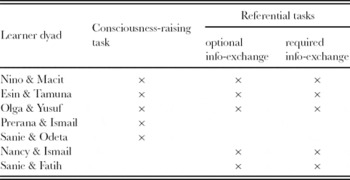
As in the original study, recordings were made at weekly intervals during scheduled classes. The tasks were all part of the normal lesson plan and were not presented as being in any way ‘special’. In contrast to the original study, an external microphone was connected to the tape recorder, ensuring high sound quality. No tapes had to be discarded from the data analysis due to unintelligible speech, as reported by Foster (Reference Foster1998: 7). This resulted in five recorded dyads per task, in contrast to the three dyads and groups per task in Foster's study. Foster transcribed the first five minutes of three tasks and the first ten minutes of the remaining task, halving the scores from the ten-minute recording to enable comparison. In the replication study, the first ten minutes of each interaction were transcribed and coded for data analysis. Thus, while replicating the original data collection procedure, the amount of data transcribed and coded was larger both in terms of number of interacting dyads and amount of interactional time. The decision to quantitatively alter the original study's data collection procedure was taken in the interest of assembling a larger, that is, more representative corpus (2175 vs. 918 c-units in the original study; see below) as well as reducing potential biases from the recording of untypical ‘warming-up’ sequences (Aston Reference Aston1986: 132 as cited in Gass et al. Reference Gass, Mackey and Ross-Feldman2005: 580). As in Foster's study, some learners were observed for all three tasks, but, because of erratic attendance, some were not. Table 1 shows the composition of learner dyads and their distribution across tasks.
Recorded learner dyads across tasks.

3.5 Transcription and coding
Identical with the original study (Foster Reference Foster1998: 7), the ‘c-unit’ was used to measure students' speech production. Foster, Tonkyn & Wigglesworth (Reference Foster, Tonkyn and Wigglesworth2000) have suggested the ‘A-unit’ as better suited for the measurement of spoken language and have, rather atypically, attempted to operationalize the unit in a detailed way. However, in order to ensure comparability, the replication study used the same coding procedures as the original investigation. Thus, all data was counted for c-units, defined as ‘utterances, for example, words, phrases, and sentences, grammatical and ungrammatical, which provide referential or pragmatic meaning to NS–NNS interaction’ (Foster Reference Foster1998: 8, referring to Pica et al. Reference Pica, Holliday, Lewis and Morgenthaler1989 and Brock Reference Brock1986). Thus, whereas false starts would be excluded from analysis, elliptical constructions, which abound in oral language and are meaningful and pragmatically sufficient, would be counted. Along with the original study, negotiated interaction was coded for clarification requests (a request for further information from an interlocutor about a previous utterance), comprehension checks (the speaker's query of the interlocutor(s) as to whether or not they have understood the previous speaker utterance(s), and confirmation check (the speaker's query as to whether or not the speaker's (expressed) understanding of the interlocutor's meaning is correct) (Foster Reference Foster1998: 8, referring to definitions from Chaudron Reference Chaudron1988: 45). Also in accordance with the original study and in order to measure modified output, the transcripts were coded using the definitions from Pica et al. (Reference Pica, Holliday, Lewis and Morgenthaler1989: 88) for semantic modification (through synonym, paraphrase, or example), morphological modification (through addition, substitution, or deletion of inflectional morphemes and/or functors), phonological modification, and syntactic modification (through embedding and elaboration in clauses).
3.6 Stimulated recall
For reasons stated earlier in this paper, a stimulated recall methodology was included in the design of the replication study. Data was collected in the form of interviews with pairs of learners who had jointly worked on a task the day before. After class, students were accompanied to the researcher's office, where the purpose of the interview was explained to them. They were assured that the interview would have no effect on their course grades and that all information would be held confidential (see section 3.6 of the e-supplement for more details).
4. Results
As the purpose of the investigation was to observe task-based language learner performance in an actual L2 classroom rather than to test pre-specified hypotheses, both the original and the replication study left the coded data in the form of simple totals and percentages. However, although Foster (Reference Foster1998: 8) explicitly states her intention to ‘observe individual students' classroom performance’, no effort has been made to keep the composition of the groups and dyads constant. As Foster (Reference Foster1998: 8) claims, this was not possible ‘without compromising the naturalistic setting of the study’. In the present study, however, it was generally the same students working together on the different tasks. This procedure was not a condition of the research project imposed onto the classroom, but rather accorded with the established and common classroom practice of working with one's neighbor. It allowed for a performance comparison across learners as well as across tasks for that subset of students who completed all three tasks.
In line with the structure of Foster's paper, the data will be presented according to the research questions posed earlier: language production (Tables 2 and 3 in the e-supplement, section 4.1), comprehensible input (Tables 4 and 5 in the e-supplement, section 4.2) and modified output (Tables 6 and 7 in the e-supplement, section 4.3). Within each of these three categories, the first table specifies the performance of the dyads, and the second table breaks these figures down as to individual learner performance. Assigning negotiation moves to individual students was not based on the assumption that the initiators of an input-negotiation move or an output-modification move would benefit more (or less) from this move than their interlocutors. Rather than the assumption of unequal benefits in terms of language acquisition, the guiding interest was to see in what way certain tasks varied in stimulating a more or less equal distribution of speech production, negotiation and modification within dyads.
4.1 Language production
Language production was analyzed as a function of task type and individual student. First, c-units were calculated to measure the amount of language produced by each dyad (Table 2 in the e-supplement). A cross-task comparison reveals clearly less speech production for the referential task with required information exchange as compared to the referential task with optional information exchange. As can be seen in Table 2 in the e-supplement, this does not only hold true in terms of the total of c-units produced by all dyads, but mostly also in terms of individual dyads. Such a result is in conflict with Foster's scores, which show the same ratio for the groups, but the reverse for the dyads. Furthermore, compared across dyads and consistent with Foster's study (Reference Foster1998: 9), the overall amount of language production varies widely. For example, in the consciousness-raising task, the c-units produced by different dyads vary between 171 and 89, and in the referential task with required information exchange, between 171 and 96. A closer look at the performance of different dyads also reveals that in both types of referential tasks it is always the same dyad who talks most (Esin–Tamuna) or least (Nancy–Ismail). Also instructive in this regard is Table 3 in the e-supplement, which reports the individual variation of speech production within the dyads.
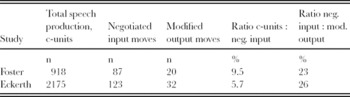
Absolute and relative overall frequency of negotiated input and modified output.

In contrast to a small-group constellation, a dyad makes it hard to completely drop out of the verbal interaction. Accordingly, there are no instances when a learner does not produce any or hardly any language, as reported by Foster (Reference Foster1998: 10). However, the individual students in a dyad contribute varying proportions of the amount of language produced by the dyad as a whole. In contrast to the student Yusuf, who produces less than half the amount of language his interlocutor does (49%; Olga & Yusuf, Table 3 in the e-supplement), the distribution of c-units between Nino and Macit or Nancy and Ismail is rather balanced (92% for both dyads; Table 3 in the e-supplement). Again, a comparison across learners is informing. Looking at the dyads which have carried out two or three different tasks clearly shows that if one learner verbally dominates his partner, this learner dominates not only in one, but in all tasks.Footnote 1 The final section will consider in what way these results reflect the relationship between particular task features and individual task performers.
4.2 Comprehensible input
Negotiation of meaning was measured by calculating the number of negotiation moves (confirmation checks, clarification requests, comprehension checks; examples are provided in the e-supplement, section 4.2, Transcripts 1–3) across tasks and dyads. Table 4 in the e-supplement shows both the total number of negotiation moves and their percentages when compared to the number of c-units produced by a dyad. As a whole, the corpus includes 123 negotiation moves with all the students producing at least a few negotiation moves. Foster's study shows a lot of students not negotiating at all, particularly when working in a group rather than a dyad (Foster Reference Foster1998: 13). Thus, the factor of participation pattern seems to have an impact not only on the amount of language production but also on the amount of meaning negotiation. When it comes to the impact of task type, in line with Foster's results, negotiation was relatively more frequent in the two referential tasks. Negotiation was also the most frequent in the task that required information exchange. This applies both to the average percentages of all dyads as it does for the single dyads. This picture changes somewhat when looking at the relative distribution of negotiation moves within the dyads (Table 5 in the e-supplement).
Although one might assume that the split distribution of information among both learners would result in a mutual responsibility for information exchange and therefore in a balanced share of meaning negotiation, this is not the case. When comparing the ratio of negotiation moves produced by the two learners of a dyad, the two tasks with shared information distribution and optional information exchange produce higher average percentages (44% and 28%, Table 5 in the e-supplement). However, a comparison across learners reveals that if learners dominate their interlocutors in terms of negotiation moves, they do this not only in one task, but in all tasks. This finding is consistent with the pattern of verbal dominance with regard to the distribution of language production within dyads (Table 3 in the e-supplement).
4.3 Modified output
Modified output, that is, utterances which were semantically, morphologically, syntactically, or phonologically altered in response to a negotiation move, were calculated across tasks and dyads (see the e-supplement, section 4.3, Transcripts 4–7). Table 6 in the e-supplement shows both the absolute and relative number of negotiation moves produced by a dyad.
In relation to the overall amount of language production, the extent of output modification is rather limited, as it is also in Foster's data. A total of 123 negotiation moves (Table 4 in the e-supplement) is followed by an output modification in 32 cases. As Foster discovered (Foster Reference Foster1998: 15), no consistent pattern can be found when comparing tasks with optional as opposed to tasks with required information exchange. More revealing is the comparison across learners. Almost half of all output modifications are produced by one dyad, Esin & Tamuna. Furthermore, relating output modification to input negotiation, the students in this dyad are also found to be the most active input negotiators (Table 4 in the e-supplement). As with language production and input negotiation, modified output has also been measured with respect to the relative distribution of output modifications within the dyads (see Table 7 in the e-supplement)
The dyad-internal distribution of modified output (Table 7 in the e-supplement) is consistent with the distribution of negotiation moves (Table 5 in the e-supplement) in two ways. First, a comparison across tasks shows again the two tasks with optional information exchange to produce a more balanced distribution of output modification. Second, a comparison across learners reveals that if learners dominate their interlocutors in terms of output modification, they do this not only in one task, but in all tasks. Again, this is consistent with the distributional pattern of language production (Table 3 in the e-supplement) and input negotiation (Table 5 in the e-supplement) within dyads. Table 2 summarizes the overall frequency of meaning negotiation and output modification in Foster's (Reference Foster1998) original and in the replication study.
5. Discussion
As the main purpose of a replication study is to better understand the results, outcomes, and implications of the replicated study, it will be helpful to summarize Foster's (Reference Foster1998: 17ff.) findings briefly. First, based on the total scores for groups and dyads in relation to task type, Foster states (i) no recognizable pattern relating task type to language production, (ii) the most consistent occurrence of meaning negotiation during pair-work on tasks with required information exchange, and (iii) the most frequent occurrence of output modification when working in a dyad setting independent of task type. Second, based on the individual scores, Foster reports that (i) the amount of meaning negotiation and output modification per student was rather low, and (ii) the range of scores between individual students was extremely wide. Third, she explains these results with reference to (i) the potentially painstaking, frustrating, and face-threatening nature of extensive negotiation and modification, resulting in a ‘pretend and hope’ rather than in a ‘check and clarify’ strategy, (ii) the classroom environment as opposed to a laboratory setting with its tightly designed information-gap tasks, and (iii) she calls for tasks which do allow and encourage the reflection and negotiation of form, rather than absorbing learners' cognitive resources by the need to exchange information most efficiently.
The present study did not compare group and dyad settings. However, in comparison to Foster's study, it found a more consistent distribution of language production (Foster: Table 2 and 3, pages 9–10; present paper: Table 2 and 3 in the e-supplement) and a more consistent occurrence of meaning negotiation (Foster: Table 4, page 12, and Tables 5 and 6, page 13; present paper: Tables 4 and 5 in the e-supplement). This outcome indirectly supports the assumption that a dyadic setting is both more conducive to a balanced distribution of speech and negotiation. In a pair, as opposed to a small group, it is much harder for a single student to retreat or to drop out of the communication.
Neither the original nor the replication study could confirm the overriding effect of task type (required vs. optional information exchange) on the amount of language production and meaning negotiation established by former studies (e.g. Pica & Doughty Reference Pica and Doughty1985; Doughty & Pica Reference Doughty and Pica1986). Foster explains her results as a consequence of the learners' adaptation of the tasks, resulting in a strategy that ‘could reduce some information exchange tasks to a format whereby the side holding the information need only answer yes or no to the informed guesses of the other side’ (Foster Reference Foster1998: 11). With regard to dyadic task completion, such task adaptation strategies are unequivocally confirmed by the findings of the replication study (see Transcript 11 in the e-supplement).
The evidence of task adaptation points to the necessity of investigating individual learners' actual task-based interactions more closely. ‘Across the data as a whole’, Foster (Reference Foster1998: 18) summarizes her results, ‘the range in individual scores is so wide, and the lack of participation by so many students is so striking as to make any statistics based on group totals very misleading’. With respect to the dyadic tasks, this outcome is consistent with the results of the present replication study. It was consistently the same dyad (Esin & Tamuna) who talked most (Table 2 in the e-supplement), negotiated most (Table 4 in the e-supplement), and modified most (Table 6 in the e-supplement), rather independently of task-type. Furthermore, the replication study allowed not only for the comparison of dyads, but also for the comparison of individual students across tasks. The present study shows that if one learner dominated one dyadic exchange with respect to one of the three investigated parameters − language production, negotiation of input, modification of output − s/he would dominate all exchanges with respect to this very parameter (Tables 3, 5 and 7 in the e-supplement). Moreover, there is a strong tendency for the learner who verbally dominates with respect to one parameter, to dominate with respect to all three parameters (Tables 3, 5 and 7 in the e-supplement).
Variation of meaning-negotiation across dyads and individual learners is also reported by Slimani-Rolls (Reference Slimani-Rolls2005). While 60% of the negotiation sequences in her study come from only 25% of the learners, another 25% of the learners do not contribute at all (ibid.: 202). Gass et al. (Reference Gass, Mackey and Ross-Feldman2005), however, do not show asymmetrical distributional patterns of meaning negotiation across dyads (ibid.: 598).Footnote 2 Neither variation of meaning negotiation between single learners and dyads nor variation between settings is confirmed by the results reported by Gass et al. (Reference Gass, Mackey and Ross-Feldman2005). The question of individual variance and the related question of transferability of experimental research findings to classroom settings deserve therefore more extended discussion. It may well be the case that the consistency of Gass et al.'s results across individuals, across dyads, and across settings is a function of the characteristics of the settings investigated, and the research methodology, i.e. the instruments of measurement used.
As has been mentioned earlier, Foster (Reference Foster1998) accounts for her main results − comparatively low frequency of interactional adjustments combined with marked variation across subjects − by referring to the very nature of task-based learner–learner interaction in the classroom, as opposed to task-work in the laboratory. She considers that task-based learner–learner interaction in a classroom might be seen by the students as a rather informal activity taking place in the sheltered intimacy of a pair or a group, and with the focus on practicing the language and maintaining the smooth flow of conversation rather than on accuracy, self-monitoring, and learning. Thus, if students regard pair work as a ‘light-hearted and informal part of class, rather than a pedagogical activity specifically designed to promote SLA’, Foster (Reference Foster1998: 19) claims, ‘we cannot be surprised if they are relaxed enough about communication problems to let them pass, thereby missing opportunities to gain comprehensible input and to create modified output’. However, Foster (Reference Foster1998) provides no specific evidence to support her claim that it was the classroom environment which stimulated the learners in her study ‘to let them [communication problems] pass’. In the present study, combined and related evidence from task completion and stimulated recall data (see e-supplement, Transcripts 12–15) exemplifies how students may deal with communication problems during task-work in the L2 classroom. Task-based learner–learner interaction appears not just as the verbal equivalent of a cognitive language learning activity; it is at the same time a communicative event and a social process that is mediated by socio-affective variables. At times, learners might even decide to ‘react to social motives at the expense of their own pedagogical advancement, to preserve their social relationships’ (Slimani-Rolls Reference Slimani-Rolls2005: 208). As research has shown, comprehension can take place without much input processing (Ellis Reference Ellis and Ellis1994: 92). Top–down processing of existing linguistic knowledge (Faerch & Kasper Reference Faerch and Kasper1986; Ellis Reference Ellis and Ellis1994), guessing from the linguistic context (Frantzen Reference Frantzen2003), guessing based on knowledge of social appropriateness (Hymes Reference Hymes, Gumperz and Hymes1972), pretending comprehension and hoping for more clues from the ongoing conversation (Hawkins Reference Hawkins, Gass and Madden1985; Firth Reference Firth1996) are all strategies that contribute to the understanding of one's interlocutors' utterances. Rather than following a ‘the more the merrier’ principle (Aston Reference Aston1986; Allwright & Bailey Reference Allwright and Bailey1991: 145), students' moderate use of requests for clarification and confirmation or checks of one's interlocutor's comprehension appear to reflect the social nature of the ‘interactional architecture’ (Seedhouse Reference Seedhouse2004) of the L2 classroom.
In what way, then, do the results from this replication and other work on meaning negotiation in the L2 classroom (Foster Reference Foster1998; Slimani-Rolls Reference Slimani-Rolls2005) relate to the findings of Gass et al.'s (Reference Gass, Mackey and Ross-Feldman2005) carefully designed comparative study? As mentioned earlier in this paper, results of the ANOVAs showed no significant differences between the two settings. However, significant differences were reported between the different tasks in terms of all three measurements, that is, amount of meaning negotiation, language-related episodes, and recasts. Thus, the authors conclude that whereas the setting did not have any influence on the frequency of the three interactional patterns under investigation, the type of task had (Gass et al. Reference Gass, Mackey and Ross-Feldman2005: 596–597).
As Gass et al. (Reference Gass, Mackey and Ross-Feldman2005) used different measures (absolute frequency counts rather than relative to the amount of speech production), it is hard to directly compare their quantitative results with the outcomes of Foster's original study and the present replication study. However, this is hardly a satisfying answer. After all, if, as Gass et al. (Reference Gass, Mackey and Ross-Feldman2005) convincingly demonstrate, participants do the same thing whether working in the classroom or in the laboratory, then why care about the students' perceptions, interpretations, and motivations? One possible answer could be that we indeed do not have to care if we could know for sure that they were doing the same thing. In other words, what may be coded and counted as the same interactional pattern on a discourse level might turn out to reflect quite different cognitive operations and discourse functions.
Since the comparison of task-based interaction in an actual classroom versus a laboratory setting is at the very center of the Gass et al. (Reference Gass, Mackey and Ross-Feldman2005) study, the authors take great care to describe the conditions under which the data has been collected (ibid.: 583–584). However, while the reported data collection procedures clearly contribute to the internal validity of the study, they might at the same time threaten its external, or, more precisely, ecological validity.Footnote 3 ‘Ecological validity’, as Bronfenbrenner (Reference Bronfenbrenner1979: 29) defines the term, ‘refers to the extent to which the environment experienced by the subjects in a scientific investigation has the properties it is supposed or assumed to have by the investigator’. To what degree this has been the case in the Gass et al. (Reference Gass, Mackey and Ross-Feldman2005) study, however, is hard to assess. For one thing, it is rather surprising that all three tasks, which were different in detail but similar in design, were administered in uninterrupted succession and without any variation of the social pattern in class, that is, dyadic learner–learner interaction. For another, the reader is further surprised to learn that these three-task sessions hardly varied in length, both in the classroom and the laboratory setting, with all of them lasting between 50 and 55 minutes. Based on the study reported in this paper, and on abundant episodic evidence from language teachers, it is hard to imagine that all learners accomplished all three tasks in nearly the same time. One wonders, then, how exactly the teacher in the classroom setting was ‘keeping the students on task where necessary’ (Gass et al. Reference Gass, Mackey and Ross-Feldman2005: 584), and how much interference was required to do so. Therefore, while the classroom may have looked like a classroom, it may not have been perceived as such by the students. As the present study shows that students' task perceptions can influence their task performance, such an account of learners' interpretations of their own task work and interactional behavior could have helped with the appraisal of the investigation's ecological validity.Footnote 4
6. Conclusion
Growing empirical evidence demonstrates that tasks of the kind commonly used in SLA research ‘are not just performed but rather are interpreted, resulting in activity that is ‘constructed’ by the participants in accordance with their particular motives and goals’ (Ellis Reference Ellis2003: 187). Using transcript-based and individualized post-hoc tests, some studies show in what ways learners exploit tasks beyond the pedagogical focus of the task, thus adapting the task to their individual learning needs and goals (see Swain & Lapkin Reference Swain and Lapkin1995, Reference Swain and Lapkin1998, Reference Swain, Lapkin and Bygate2001; Williams Reference Williams2001; Nabei & Swain Reference Nabei and Swain2002; Loewen Reference Loewen2002, Reference Loewen2005; Adams Reference Adams and Mackey2007; Eckerth Reference Eckerth2008a). Moreover, studies such as Kumaravadivelu (Reference Kumaravadivelu1991), Coughlan & Duff (Reference Coughlan, Duff, Lantolf and Appel1994), Gourlay (Reference Gourlay2005) and Harris (Reference Harris2005) have revealed different activities emerging from the same task when completed by different learners. Thus, what has been called the ‘permeability of tasks’ (Mondada & Pekarek Doehler Reference Mondada and Pekarek Doehler2004: 512) or their ‘interactional reconfiguration’ (ibid.: 510) points to two major challenges in task-based research.
First, there seem to be good reasons for bringing together qualitative analyses of contextualized task-based interactions with quantifications of isolated linguistic units. Rather than perpetuating unproductive ‘paradigm wars’ (Edge & Richards Reference Edge and Richards1998: 335), such a multi-methodological perspective seeks to connect different approaches in order ‘to link, but not reduce, one perspective to another’ (Wertsch Reference Wertsch1998 as cited in Ellis & Larsen-Freeman Reference Ellis and Larsen-Freeman2006: 578). Such an integrated approach might be one way to inform us about potential gaps between ‘intended’ and ‘actual’ pedagogy (Seedhouse Reference Seedhouse2005) and to improve the content validity of our research constructs. If supported by further research, evidence of learners' task adaptation, I suggest, does not question the validity of interactional adjustments and its significance for second language acquisition (see Gass Reference Gass, Doughty and Long2003; Doughty Reference Doughty, VanPatten, Williams, Rott and Overstreet2004; Pica et al. Reference Pica, Kang and Sauro2006; Gass & Mackey Reference Gass and Mackey2006, Reference Gass, Mackey, VanPatten and Williams2007; Mackey Reference Mackey and DeKeyser2007). It also does ‘not prevent tasks and their range of influence from being researchable at the level of probable outcomes’, as Skehan & Foster suggest (Skehan & Foster Reference Skehan and Foster1999: 117; my emphasis). However, they conclude, this does not imply that ‘task characteristics might have a deterministic impact on performance’ (ibid.; my emphasis).
Second, studies on task adaptation sketch a picture of the language learner as an intentional and reflective practitioner as well as a social agent, rather than a data processor with purely cognitively defined ‘data needs’ (Pica Reference Pica and Regan1998: 11). Unfortunately, there are still rather few accounts of how learners perceive tasks and how they position themselves within a task. Apart from the work that has been done within a sociocultural approach to language learning (Roebuck Reference Roebuck and Lantolf2000; Lantolf & Thorne Reference Lantolf and Thorne2006), an integration of the learners' perceptions and perspectives has been attempted (e.g. Nakahama, Tyler & van Lier. Reference Nakahama, Tyler and van Lier2001; Mackey Reference Mackey2002, Reference Mackey2006; Nabei & Swain Reference Nabei and Swain2002; Swain & Lapkin Reference Swain and Lapkin2002; Lindgren Reference Lindgren2002; Adams Reference Adams2003; Egi Reference Egi2004; Ewald Reference Ewald2004; Carpenter et al. Reference Carpenter, Jeon, MacGregor and Mackey2006; Polio, Gass & Chapin Reference Polio, Gass and Chapin2006; Roehr Reference Roehr2006; Watanabe & Swain Reference Watanabe and Swain2007, Tavakoli forthcoming) and should be pursued in psycholinguistically oriented SLA.
Combining a stimulated recall methodology with an analysis of task performance, the present study tried to show in what way learners' task perceptions can influence their task-based interactions. This study also attempted to contribute to our understanding of task-based L2 classroom learning as being perceived by the learners as a cognitive activity, a communicative event, and a social process. However, as the empirical base of these and related findings is still limited, all conclusions have to be provisional in nature. Finally, they call for more classroom-based interventionist studies (Brumfit & Mitchell Reference Brumfit, Mitchell, Brumfit and Mitchell1990: 12). Such investigations require not only a sound understanding of research methods but also a thorough knowledge of the learning–teaching environment in which any interventions and research instruments are introduced. Only then will we arrive at research designs which do not result in ‘disrupting the class or compromising the data’ (Foster Reference Foster1998: 21).
Note
This paper is accompanied by supplementary material on the Journal's website, journals.cambridge.org/LTA.
Acknowledgements
I would like to thank Willis Edmondson and Tucker Childs as well as the anonymous reviewers for their insightful suggestions and feedback on an earlier version of this paper. Needless to say that all remaining shortcomings are my own responsibility. Finally, I would like to thank the editorial board of Language Teaching, above all Graeme Porte, for suggesting an e-supplement to the printed paper. I believe that providing additional space for the publication of relevant data can significantly increase the transparency and thus the credibility of qualitative, transcript-based L2 research.
Johannes Eckerth is Senior Lecturer at King's College London. Prior to this position, he has taught and conducted research on L2 German and L2 English at Applied Linguistics departments in The Netherlands, Germany, Turkey and the USA. His research interests focus on interfaces between SLA research and L2 pedagogy. He has widely published on SLA and L2 classroom interaction and has recently co-edited (with Sabine Siekmann) a volume entitled Task-based language learning and teaching: Theoretical, methodological, and pedagogical perspectives (Peter Lang, 2008).
Comment from the author of the original study
I often thought that I would replicate my 1998 study, having been told on so many occasions that my results were the random outcome of poor data-gathering. It was my first foray into classroom research and I was dealing with recording in a very noisy place with equipment that appears ante-diluvian now. I was not surprised that the pervasive background noise (a normal feature of communicative classrooms) made some of my recordings unusable, but I was never convinced that somewhere in all that untranscribable chatter were the missing negotiations of meaning. If, ten years later, I were doing that replication, the recording equipment would be completely different, but the authentic classroom setting I was so keen to preserve would be the same. A learner in a classroom is aware that a task with a partner is as much a social interaction as a pedagogic exercise and crystalline clarity is neither a necessary nor desirable goal.
As in my study, the participants in this replication are in their scheduled class, and they are doing nothing other than normal class work. Apart from using only dyads (which makes sense given the way groups allow participants to remain silent), the procedures and analyses are all very similar. And gratifyingly, as summarised in Table 2 here, the numbers come out rather similar also. More importantly, the author has improved on my study. He has been able to get considerably more data than I did, and this strengthens his conclusions. He has also added a stimulated recall procedure which demonstrates what I was only guessing at, that learners will put up with partial understanding in order to keep the task interaction moving forward. This paper lays out together the transcript evidence and the recall evidence in a neat demonstration of how learners will smooth over the bumps rather than make explicit their lack of complete understanding.
In seeking an explanation for the results in Gass et al. (Reference Gass, Mackey and Ross-Feldman2005), which show no difference in the incidence of negotiation of meaning in classroom or laboratory settings, the author very plausibly suggests that their classroom setting might not have appeared much like a classroom to the participants, who had to do three tasks in seamless progression. But the way to test properly the effect of setting on L2 performances is to use a within-participants design comparing task interaction in an environment that very clearly is a classroom and one that very clearly is not, and this has not been done. For me, though, it is not so much whether negotiations of meaning happen in one setting or another, or in one task type or another; rather it is whether their overwhelmingly lexical nature makes them as valuable as is claimed.
Dr. Pauline Foster
Reader in Applied Linguistics, St. Mary's University College