1. The publish-or-perish system in academia
In academia, contract renewal, tenure and promotion all hinge on the ability of academics to publish. The publish-or-perish mantra has, in recent years, pervaded academia and increasingly taken its toll on academics. Apart from long working hours, strained eyes and back pain caused by a sedentary lifestyle dominated by reading and computer work, more and more academics are suffering from risks of demotion, termination of contracts, and inability to obtain tenure after long service. Such effects of ‘publish or perish’ are felt more strongly in some places than others, where universities are putting more and more stringent requirements on academic output (e.g. in my work context – Hong Kong), ranking publications in terms of not only quantity but also the venues of publications, with an increasing emphasis on whether the work, as far as our field is concerned, is listed on the Social Science Citation Index (SSCI)Footnote 1.
From the vantage point of universities, it is perhaps not difficult to understand why ‘publish or perish’ should have become the rule of the game. In many parts of the world, universities are scrambling for higher international rankings, and in order to prosper they need to boost their research profiles, which in turn depend on the research output of their academics. Unsatisfactory research performance of faculty members not only reflects badly on universities but also leads to a reduction in research funding.
The publish-or-perish sentiment has bred cynicism about the purposes of academia and is increasingly criticised because it shifts emphasis away from teaching (Brandon Reference Brandon1996). As a result, there have been discussions about the real purposes of academia, the place of teaching and research in universities, and how scholarship in academia should be defined. Though crucial, these issues are beyond the scope of this paper. Instead of arguing for or against ‘publish or perish’, or the place of research as opposed to teaching, in this talk I focus on academic publishing itself, examine the problems associated with publishing in the publish-or-perish system, revisit what it means to publish in the system, and propose some coping strategies to survive ‘publish or perish’. I should add, to begin with, that what I include in this plenary talk emanates from my own experience as an academic in Hong Kong, as well as my understanding of the experience of academics in some East Asian countries (such as Taiwan, mainland China and Singapore), based on my email interviews with twelve of them. While my examples and perspective may have resonance for academics in other parts of the world, it is not my intention to generalise my discussion and argument to all other contexts.
2. Problematising ‘publish or perish’: What academics need to publish in order not to perish
The notion ‘publish or perish’ is more intricate and problematic than it suggests, because even though academics do publish, they may still perish in the system if their publications do not meet the requirements laid down by their universities. So what do we need to publish and not perish? To answer this question, we need to ask further questions such as what criteria universities use to determine the worth of publications, whose views they seek, and what yardstick is used to evaluate academic output.
These questions are not easy to answer, and may vary from institution to institution, but let me highlight a few problems using my own experience. In a previous Research Assessment Exercise (RAE) conducted in Hong Kong (first started in 1994 and conducted every six years across the board in all Hong Kong universities), the university in which I was working carried out a mock RAE. I submitted five articles for internal review. In my university, journals were listed as ‘A’, ‘B’ or ‘C’ (in the actual RAE, articles submitted were rated as ‘A’, ‘B’ or ‘C’ but the results were not disclosed to faculty members). Eager to show that my best articles would be listed as ‘A’, at least internally in the mock RAE, I searched various indexes in the hope that I could find evidence to indicate that my work was published in ‘A’ journals. I then emailed the editor of one of the journals and asked. He replied:
The journal is considered an ‘A’ journal within the field. However, there's nothing I can do to stop people from thinking that it's a ‘B’ journal!
I then turned to another journal in which one of my best five articles was published. Although it was a leading journal in the field, in all the indexes I looked up it was listed as a ‘B’ journal. I became rather frustrated and began to wonder what really counted as a ‘good’ or ‘top’ journal publication. Did the university administrators really know, and did they care? What they wanted was probably concrete evidence that it was an ‘A’ journal according to a prestigious index. So in the entire publish-or-perish system, what does it mean to publish ‘good’ work? Whose views are we seeking – our personal view, the view of our department, faculty or university, the research granting body, or journal editors? What yardstick should we use to gauge the quality of publications, and if indexes are used, which indexes are the most reliable indicators of the quality of publications?
Then, in another internal research assessment exercise, I submitted four representative articles in my dossier, and with good intentions, my Department Chair suggested I include papers listed as ‘A’ in some indexes. For one particular journal publication, I failed to find an index that listed the journal as ‘A’. So I emailed the editor of the journal (who was based in North America) and asked. The editor's reply took me by surprise:
We don't pay any real attention at all to this kind of stuff here (SSCI and ‘A’ versus ‘B’ journals) but I know they do in Europe. I never even heard of this stuff until lately, believe it or not; it's just a non-issue in universities here.
In my personal communication with another scholar working in North America, I learnt that it was probably universities in Hong Kong (and perhaps some others in the region) that were creating such hurdles (e.g. ‘A’, ‘B’ or ‘C’ categories of journals and preference for the SSCI) for academics:
We don't have assessments beyond the university. We have annual reviews by the department and promotion/tenure reviews by the department, college and university committees (as well as the president and the board of trustees). The research output affects the university ranking, which may affect funding indirectly, but not necessarily. The crucial criteria are the prestige of the journal, the acceptance rate, and whether the publication is refereed or not. The impact factor does not play such a huge role, though things may be changing at some universities.
My experiences show that, within the publish-or-perish system, publishing ‘good’ work largely depends on the criteria universities use to gauge publications, but do we know what ‘good’ publications really mean? Do ‘good’ publications refer to those published in ‘A’ journals? But what indexes should we use? Are ‘good’ publications those published in ‘international’ journals? But what counts as ‘international’? Are locally published journals with an international editorial board considered ‘international’? In Hong Kong, apparently not! If ‘good’ publications are decided on the basis of whether journals are refereed, then I wonder why refereed conference proceedings tend to be considered less prestigious than refereed journal articles. If it is the reputation of journals that determines the merit of our publications, I am not sure why reputable journals that publish practically-oriented articles tend to be considered less ‘strong’ than those that publish research papers. And if it is the reputation of the publishers that helps us decide whether publications are ‘good’, I doubt whether and why publishers alone can guarantee quality publications. So what and where should we publish in order not to perish?
3. Important questions to ask about publishing: What it means to publish in the publish-or-perish system
In my quest for a better understanding of what it means to publish in the publish-or-perish system, I conducted an email interview with twelve Asia-based scholars, inviting them to share with me their perspectives on academic publishing under the publish-or-perish system. I did not ask them whether they agreed with the publish-or-perish mentality. Instead I posed some general questions about academic publishing (using the wh-questions as guidance, including why we publish, for whom we publish, what counts as a ‘scholarly’ publication, and where we should publish), hoping to find out the values they bring to academic publishing and to gain insights into how we should approach publishing in the publish-or-perish system.
My twelve informants are from Hong Kong (4), China (2), Taiwan (2), Singapore (2) and Japan (2). All of them are active members in academia. Two of them are full professors, five of them are associate professors, and five assistant professors. Nine of them are tenured while three are hired on contract terms. Below I present the findings in relation to the wh-questions of publishing.
3.1. Why publish?
My twelve informants publish for reasons that fall into three major categories:
• Related to the academic/research community (9/75%), for example:
• Share research results/maintain meaningful academic communication with other researchers
• Gain membership of the academic community/to be part of the research community
• For the benefit of the language education enterprise
• Job related (7/58%)
• Job security
• As a duty (part of the job)
• Peer pressure
• Career advancement
• Accumulating capital for research funding
• Personal satisfaction (6/50%)
• Gain satisfaction/self-actualisation/love writing papers/writing helps develop ideas/gain satisfaction from doing difficult and challenging tasks/intrinsic motivation
• Best reward for one's hard work/see your own name
• Personal drive for academic excellence
The results show that within the publish-or-perish system, the informants engage in publishing not only to keep their job but also for more intrinsically motivated reasons, such as self-actualisation and personal enrichment.
3.2. For whom?
Who do my twelve informants publish for? The findings show that they are thinking mainly of the academic/research community when they publish, but they also have in mind students and interested readers:
• Fellow researchers/teachers (9/75%)
• Graduate students and students in general (4/33%)
• Interested readers (3/25%)
None of them are thinking of the university administrators when they publish.
3.3. What counts as ‘scholarly’ publications?
How do my informants’ views of publications compare with those held by universities (as expressed by, for example, the ‘A’, ‘B’ and ‘C’ categories)? The findings show that publications are ‘scholarly’ if they have the following characteristics:
• Sound research design (4/33%)
• Theoretically and methodologically sound – e.g. based on solid research and structured investigation
• Contribution to knowledge (4/33%)
• Significant/ground-breaking; original contribution in theory and practice; shed new light on practical/theoretical issues
• Articles that describe the fruits of their research
• Good quality of writing (4/33%)
• Well written
• Precise use of technical terms
• Published by reputable journals/publishers (3/25%)
• Published by internationally recognized scholarly publishers/university presses
• Available in prominent international publication portals
• Relevant and beneficial to academic/research community (3/25%)
• Widely-cited (3/25%)
• Containing citations (2/17%)
• Not only peer-reviewed journal articles but also conference proceedings, book chapters and book reviews (1/8%)
The above findings suggest that the ‘scholarliness’ of publications is assessed primarily by a subjective qualitative evaluation, with reference to criteria such as sound research design, contribution to knowledge and quality of writing.
3.4. Where to publish?
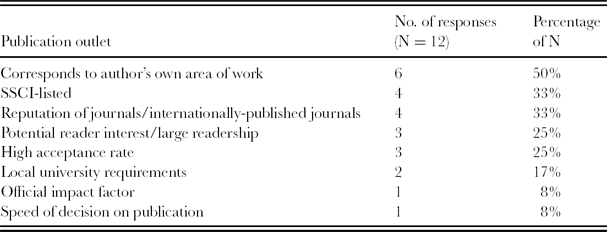
How do my informants choose the venues for their publications? Table 1 summarises the results, showing that the three most important criteria are the fit between their work and the scope of the journal, whether the journals are listed on the SSCI, and the reputation of the journals (e.g. whether they are internationally published journals).
Criteria for choice of publication outlet

While publications attain their ‘scholarliness’ through their intrinsic value, as revealed in the previous sub-section, 33% of my informants would like to have their work published in SSCI-listed journals, and 8% referred to the impact factor (as calculated by the SSCI) as an important criterion in their journal choice. As more and more universities require or encourage academics to publish in SSCI-listed journals, especially those with high impact factors, I also asked my informants about their views about this policy.
3.5. The SSCI and its impact factor
While most academics may agree that ‘publication in recognized scholarly outlets is the prime indicator of academic worth’ (Sullivan Reference Sullivan1996: 40), probably fewer hold the belief that ‘scholarly outlets’ should be confined to certain publication outlets. In recent years, however, more and more academics in our field (like those in Hong Kong and Taiwan) have been under pressure to publish in SSCI-listed journals (Deem, Mok & Lucas Reference Deem, Mok and Lucas2008; Min Reference Min2011). These days, publication metrics are increasingly used as a measure for research assessment (Togia & Tsigilis Reference Togia and Tsigilis2006), and are generally being considered an objective criterion to gauge academic output. In some universities, rate of publication in SSCI-listed journal publications is directly linked to contract renewal, tenure, promotion, salary increment and/or performance bonus (Kwan Reference Kwan2010). Of my twelve informants, four (three already tenured) mentioned the importance of getting published in SSCI-listed journals in order to ‘keep the job’ (as it was an explicit requirement stipulated by the university), to get a favourable appraisal (which affected annual salary increment and performance bonus), or to satisfy the university's reward policy (i.e. to get promoted). One of the youngest informants referred to publishing in SSCI-listed journals as a ‘bonus’. The publish-or-perish idea is, inevitably, complicated by the perception that the more SSCI-listed journal articles we can publish, the more capable and competent we are, and thus the more valuable we are perceived to be as continuing faculty members.
To make things worse, some universities impose a further requirement, assessing academic output in terms of the ‘journal impact factor’. This notion was first introduced in the 1960s by Eugene Garfield, founder and chairman of ISI, as a measure for evaluating scientific journals. Its original purpose was to select journals for inclusion in the Science Citation Index. Since 1975, journal impact factors have been published in Journal Citation Reports (also published by Thomson Reuters), containing the Science edition and Social Sciences edition. In its original application, impact factors were used for information retrieval, for librarians as an aid in decision making in relation to journal selection and cancellation, and for publishers as an information source for marketing decisions. In recent years, however, journal impact factors have increasingly been used by universities for evaluating academics’ performance (Leydesdorff Reference Leydesdorff2008). Institutional perceptions are that the more citations and the higher the impact factor, the stronger the research.
Academic success, therefore, hinges not only on getting published in ‘good’ journals but also on getting cited (Klein & Chiang Reference Klein and Chiang2004). Hobbs suggests, indeed, that ‘the average academic article was read by seven people and that included the author's mother’ (Hobbs Reference Hobbs2001: 217). This may be a reason why universities are so keen to prove that academics’ works are cited, as it is generally felt that citations can provide evidence that published articles are read (Varian Reference Varian1997). However, there are problems associated with citations (and hence the impact factor): first, citations can include self-citations (and hence are subject to manipulation), which can also boost the citation rate. Second, some articles are cited without being read – these are the so-called secondary citations. Third, articles may be cited because of weakness rather than merit, but this factor is not accounted for in the impact factor. Finally, journals that are available on the Internet tend to attract more readers and citations than those that are not (Togia & Tsigilis Reference Togia and Tsigilis2006). Together, these problems show that impact factors can be manipulated, so qualitative (instead of quantitative) evaluation of academic output is much needed (Bence & Oppenheim Reference Bence and Oppenheim2005).
With the increasing premium placed on SSCI-listed journals and their impact factors, universities are taking the position that such publications, especially those appearing in high impact factor journals, are more scholarly than non-SSCI-listed publications or those appearing in lower impact factor journals. With the publish-or-perish system thus complicated by the SSCI preference or requirement and the high impact factor expectation, academics toil under enormous pressure. As one of my informants (tenured professor) remarked:
I don't completely agree with this requirement because there aren't as many SSCI-indexed journals in our field as there are in the hard sciences, and some of them don't accept local research on Taiwanese contexts. There should be other options like publishing in locally accredited journals and books.
An assistant professor hired on contract terms rightly pointed out the limitation of the ‘SSCI policy’ (i.e. the university's requirement for publications in the SSCI):
I think the policy actually limits the many channels where we can publish our work. It's difficult to say whether SSCI is the best yardstick to appraise one's scholarship. Some journals listed on SSCI are not particularly highly rated by people in our field while some non-listed journals actually publish good work.
Ranking academic output according to impact factors makes academic publishing an even more suffocating activity. The same informant continued:
In our department, we even grade SSCI journals into different tiers according to their impact factors. That even makes it worse. In our field, certain journals are considered to be prestigious but have smaller circulations because of their specialisms and the smaller research communities that they can reach out to. But it doesn't mean that the impacts that the journals make are not significant.
Are academics pleased with the ‘SSCI policy’? Even those who are striving to publish in SSCI-listed journals show their disapproval. For example, one of my informants said that she found herself overly preoccupied with getting her work published in the SSCI:
As a matter of fact, I was not very happy with it given that I am obsessed about getting published in an SSCI-listed journal.
In fact, the publish-or-perish principle may not be too daunting if we accept the fact that as academics we are expected to publish and disseminate knowledge (McGrail, Rickard & Jones Reference McGrail, Rickard and Jones2006). What bothers academics most, apart from some universities’ lack of transparency in evaluating academic output (e.g. how journals are categorised as ‘A’, ‘B’ or ‘C’), is probably the supposedly objective measure used to evaluate publications, based on whether they appear in SSCI-listed journals (the impact of which is increasingly felt in some countries in East Asia), and whether the journals have high impact factors. Although many SSCI-listed journals have prestige in our field and do play an important role in creating knowledge, if academics are required to publish mainly or only in SSCI-listed journals, they will have little choice other than to limit their publications to these journals. Our discipline will be impoverished as we will sustain fewer journals and have much less diversity.
What does it mean to publish, and what makes scholarly publishing worth pursuing? My informants’ interview data, presented above, show that scholarly publishing per se has nothing to do with indexes (and specifically not with the SSCI), impact factors, salary increments or performance bonuses, but that it is ‘the process of contributing to specific bodies of knowledge’ (Sweeney Reference Sweeney2001: 26) that makes publishing ‘scholarly’. Given this, publications should be evaluated qualitatively for their own sake rather than judged against quantitative measures such as impact factors. It is important to remember that there are a great many non-SSCI-listed journals that publish quality work, and that low impact factors do not necessarily mean that the journals are of a lower quality. If ‘scholarly’ publications should be more broadly defined than those found in SSCI-listed journals, and if the venue of publications is not the sole or primary indicator of international excellence, what academics should do is publish to challenge the ‘SSCI requirement’ held by some universities as well as the assumption that works published in SSCI-listed journals are more worthwhile than those published elsewhere.
4. Navigating the challenges of publishing in ‘publish or perish’
While we continue to make our voices heard about the problematic assumptions of the system (like the need to publish in high-impact SSCI-listed journals), with ‘publish or perish’ being a game-like system (in the sense of being arbitrary and with rules that we have to abide by), and given our lack of complete knowledge of our ‘opponents’, if we stay in the field we need strategies to help us win the publishing game.
4.1. Publishing as a game
In a game, our goal is to win. In the publishing game, our goal is to get published, regardless of the rules imposed by different institutions. However, in a game we do not always win, and we have to accept this as a fact of life. Having said this, the more we play the publishing game, the more we are likely to win. Practice makes perfect. Since the course of the game is never the same, we may win this time but when we try to publish again, even in the same journal, we may lose. In a game, luck is sometimes involved, so if we lose we should not think that this is the end of the world. In playing the publishing game, even though we may be a single author, we should know that there is more than one person playing with us: other key players include journal editors and reviewers. Most important of all, the game's judges (reviewers, in the case of academic publishing) may disagree. When this happens and a final ruling has to be made, the outcome may not be what we expect. Whatever it is, the result of the game is beyond our control. When the judges say ‘no’, it means ‘game over’, and there is nothing we can do to reverse the result of the game. However, when the judges say we have a chance to play the game again by revising our work, we have the right to decide whether to continue or stop. We may revise and resubmit our work to the same journal, or we may decide to resubmit elsewhere.
4.2. My losing and winning experience
Let me illustrate the game metaphor with my own publishing experience. Losing in the publishing game is definitely not a good experience, but I have been through this many times, ranging from downright rejection the first time round or rejection after one or two rounds of revision. Once I got this rejection email from the editor of a journal:
Without setting a context for our international readership, our readers cannot learn the lessons you hope to present. Our reading raised concerns significant enough that we decided not to consider your manuscript for publication.
In this case, I lost the game because I did not observe the rules by thinking carefully about the readership before I submitted. In fact, I hardly knew the target audience and did not write with one in mind. I probably failed because it was not the right journal for my work. However, I did not jump to the conclusion that my work was not publishable. Taking into consideration the reviewers’ comments, I revised my manuscript, resubmitted it to another journal, and was accepted. My experience shows that we have to know the audience, make full use of the reviewers’ comments to improve our writing, and find a suitable home for our work.
Winning the publishing game is a thrilling experience, though we usually have to wait for a long time before we finally learn of our success, which often involves at least one round of revision. This is another rule of the game. On one occasion, however, within a very short time after my manuscript was acknowledged by the editor, I received an email telling me that my paper had been accepted for publication, with no revision required (though later, during the editing stage, some queries were raised by the editor and minor revisions were made). I could not believe it. The journal is international, peer reviewed, and the publisher is reputable. Its peer review statement says that all articles published in the journal have undergone rigorous peer review by at least two reviewers. The journal is also abstracted in a few reputable indexes. Although I was very pleased with the outcome, my experience reinforced my belief that academic publishing is indeed a game-like activity, in which, however much we as the players care about the review process and what we can learn from it, in the end, people simply look at the product. When my work is published, the readers do not know whether a review was rigorously carried out, or how it was done. What matters most is whether the work is published, and more importantly, whether it is published in an international, peer-reviewed journal with a good reputation.
In a game, there are times when we are confused, especially when the judges disagree. On another occasion, after waiting for six months, I received comments from three reviewers. The editor told me very frankly that the reviewers’ evaluations differed quite significantly and that it would not be easy to make revisions according to the comments, though the overall recommendation was ‘revise and resubmit’. But the time given for me to revise the manuscript was only one month – not an easy game to play! After reading the reviewers’ comments, I was totally confused and decided not to participate. While the first and second reviewers found my manuscript ‘generally well-written’, with ‘relevant theory’ and a ‘sophisticated’ theoretical framework, the third reviewer pointed out lack of ‘unity’ and ‘poor presentation’ of theoretical background as major weaknesses. I was at a loss as to the ‘best’ action to take. In fact, one of the reviewers, as well as the editor, suggested I consider submitting my manuscript to another journal that suited my research topic better. Weighing up the chance of success in the game, I decided that I would be better off revising the manuscript and resubmitting elsewhere.
4.3. How to play the publishing game
Over the 17 years of my publishing career, I have come to realise that in academic publishing, however hard I try, there are many things beyond my control. I have to admit that I am still nervous when I read reviewers’ reports, and still feel disappointed when the response is a ‘no’ from the editor, but one of the best things I have learnt is to adopt a relaxed (though serious) attitude and approach academic publishing from a balanced perspective, telling myself, for example, that if I lose the game it may not be due to my incompetence, and if I lose in one game (being rejected by one journal) I may still win in another. And if I lose, I shouldn't be too surprised, especially when the average rate of acceptance for most international journals is a mere 20%.
To be a smart player of the publishing game, we need to understand its rules. It is crucial that we read articles published in the target journal to identify the current ‘hot’ topics, to see if we are likely to make a publishable contribution. While recognising the requirements of our institution regarding publication, it is important that we aim at quality in our writing, as our primary purpose is to advance knowledge in the field. To survive the publish-or-perish system, we should not let the system manipulate and defeat us but instead try to take control. We should be strategic in planning for our academic output and talk to experienced researchers in the field to get tips about academic publishing. We can have mentors and critical friends, and whatever our university's requirements, we must cling to the belief that our scholarship is not defined by specific journals or indexes; it can be defined by other endeavours rather than ‘research’ in a narrow sense. For instance, apart from research articles, we can publish papers that describe innovation in the classroom, and those that contribute to classroom practice or deal with innovative materials design. We should challenge the status quo, problematise the institutional requirement to publish in SSCI-listed journals, especially those with a high impact factor, and create knowledge to redefine scholarship. This is not easy, but it depends on the concerted efforts of academics. In Taiwan, 1400 scholars working in the fields of arts and humanities signed a petition in late 2010 to protest against the requirement of SSCI-listed journal publications imposed by their universities (Min Reference Min2011). Although the outcome of the petition is not yet known, the Taiwanese scholars’ experience shows that we need to work together to make our voices heard. Whatever we do, it is important to be reminded of the fact that, in the end, we survive the publish-or-perish system because of our passion and enthusiasm and our wish to make a difference in the work that we do.
5. Re-visiting publish-or-perish
Although academia is dominated by the publish-or-perish sentiment, and in spite of universities’ requirements about publishing, my own experience and my informants’ views strengthen my belief that we don't just publish to keep our jobs, but to become contributing members of the academic/research community, to advance knowledge in the field, to gain personal satisfaction, and to make a difference. We don't publish just for university administrators but for the benefit of the research academic/educational community. While we may be obliged to publish in certain journals, we should be aware of the need to view scholarship broadly and cherish the possibility of publishing work of different types, such as full-length research articles, practically-oriented papers, research in progress, book reviews, issues in forum/responses to previously published articles, book chapters and conference proceedings. We should also believe that quality work can appear in all kinds of journals (SSCI-listed and otherwise), and the most important thing about publishing is that our work can open up new frontiers and bring improvement to teaching and learning.
One of the roles of universities is to generate new knowledge ‘at a higher level for the overall benefit of the society’ (Braimoh & Alade Reference Braimoh and Alade2005: 6). Nevertheless, universities need to conduct periodic national research assessments and hold their academic staff accountable for the research they undertake. We therefore need to continue publishing. But in our field, ‘publish or perish’ is complicated by the stringent requirements universities then put on academics, such as using the SSCI and/or impact factors to gauge the merits of scholarship, placing an increasing emphasis on quantitative evaluation. Although it is understandable that universities need an objective measure to evaluate academic output, a parochial outlook that relies solely on the SSCI and impact factors is problematic. Perhaps one solution would be to balance quantitative evaluation with qualitative evaluation, and use multiple indexes rather than rely on a single index, whether it be the SSCI, or others. What academics care about most, after all, is the quality of our work and contribution to knowledge. Instead of ‘publish or perish’, we academics should persist and publish, and publish to accomplish – to create knowledge, or to challenge taken-for-granted assumptions. If ‘publish or perish’ could be replaced with a more positive mantra like ‘publish to accomplish’, and if publishing could be rewarded for its own sake and publications evaluated for their own worth, academic publishing would become a much more rewarding, fulfilling and productive experience for all concerned.
Icy Lee is an associate professor in the Department of Curriculum and Instruction at the Faculty of Education of The Chinese University of Hong Kong. Her research interests include second language writing and second language teacher education. She was President of the Hong Kong Association for Applied Linguistics and is currently Chair of the NNEST (Nonnative English Speakers in TESOL) Interest Section of TESOL. Her articles regularly appear in Journal of Second Language Writing, ELT Journal and The Canadian Modern Language Review.