When we talk about accents, we're talking about different ways of producing speech. Of course, everyone has an accent, and no accent, native or non-native, is inherently better than any other. Because our research involves immigrant L2 speakers in western Canada, when we use the word accent here, we refer to the ways in which their speech differs from that local variety of English and the impact of that difference on speakers and listeners. These learners share many characteristics with learners in other contexts, but each context entails its own idiosyncrasies. As a result, some, but not all, of our research findings are generalizable to other contexts.
Accent has been blamed for all sorts of things. It has been seen as the cause of miscommunication, and it has been used as a cover-up for racism and other kinds of discrimination. It has even been viewed as a kind of disorder that requires remediation. We would like to sort through some of the misconceptions about accent and put it in its place. We'll do this by examining the growing body of research evidence that considers accent from its many different facets.
First we'll talk about some dimensions of accent, particularly salience, intelligibility, and comprehensibility. Then we discuss the teaching and learning of pronunciation and how research can inform pedagogy. We will also address social aspects of accent, especially identity. Finally we'll suggest future directions for pronunciation research and teaching.
1. Dimensions of accent: salience, intelligibility, and comprehensibility
1.1 Listener sensitivity
Listeners generally think they're very good at identifying characteristics of speakers based on speech alone. Sometimes they are extremely accurate and other times they are not. For example, listeners tend to be accurate at judging a speaker's sex. They're also fairly good at distinguishing older from younger adult speakers, but not so good at determining sexual orientation. On body characteristics, the results are mixed. Collins (Reference Collins2000) asked women to judge whether men had hairy chests, muscular bodies and wide shoulders, based on voices alone. The women agreed with one another on who had the hairiest chests and most muscular bodies, but their guesses bore no relationship to the actual body characteristics of the speakers.
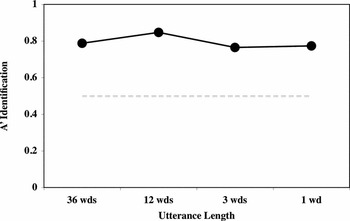
One dimension that listeners are amazingly sensitive to is the presence or absence of a foreign accent. Numerous studies have documented people's ability to detect when a speaker comes from a different L1 background. For example, Flege (Reference Flege1984) played increasingly shorter speech samples to phonetically untrained listeners and found that they could reliably distinguish native English from French-accented speakers on the basis of only 30 ms of speech. If that weren't astounding enough, we have conducted studies of the identification of native versus non-native accents in backwards speech. You can see in Figure 1 that people performed well above chance. This was true whether they heard passages of 36 words or even a single word played backwards. We have done backwards speech identification experiments using different accents, different sample lengths and neutralized rate differences. Yet, listeners’ performance is always above chance, despite these manipulations. What are they reacting to? Clearly, no segmental, lexical or grammatical information is available, and even suprasegmental factors cannot fully explain the results. One aspect of speech that does remain available in backwards speech is voice quality. As Esling & Wong (Reference Esling and Wong1983) have pointed out, long-term configurations of the vocal tract differ from language to language. Transferring these configurations from an L1 into an L2 may be an important source of accentedness. This aspect of L2 speech has not received much attention and deserves more focus in future research.
Foreign accent detection in backwards speech (Munro, Derwing & Burgess Reference Munro2003).

Another amazing fact about listeners’ sensitivity to accent is Major's (Reference Major2007) finding that people can distinguish foreign-accented speech samples from native-produced samples in languages they don't speak. As Scovel (Reference Scovel1988) has pointed out, accent features are exceptionally salient, and as a result we're very good at detecting perceived outsiders on the basis of their speech patterns. However, the fact that accents are easily detectible doesn't necessarily mean that they cause communication problems. Having an accent is not a sign of overall low proficiency. People who are indistinguishable in other ways from native speakers (e.g. grammar, vocabulary, and idiom) can still have accented speech. Having an accent doesn't necessarily impinge on communication – but sometimes it does.
1.2 Perceptual dimensions for L2 speech evaluation
Martha Pennington noted that it's virtually impossible to come up with a good definition of accent (Pennington Reference Pennington1996). We don't have a better definition than anyone else, but like many researchers, we have operationalized the construct in terms of listeners’ perceptions of speech. We understand accentedness as how different a pattern of speech sounds compared to the local variety. And, like other researchers, we assess it by having listeners rate speech on a Likert scale. We define comprehensibility as the listener's perception of how easy or difficult it is to understand a given speech sample. This dimension is a judgment of difficulty and not a measure of how much actually gets understood. Our research shows that comprehensibility ratings correspond to the amount of time, or the effort it takes to process utterances, even if they are perfectly understood in the end. Again, we measure this through listeners’ judgments on a Likert scale.
In our research, listeners usually agree with each other quite strongly on who has a heavy accent and who doesn't, and who is easy to understand and who isn't. This is true whether they are native or non-native listeners. Reliability is almost always high, with intraclass correlations of above 0.9. From our perspective, listeners’ judgments are the only meaningful window into accentedness and comprehensibility. For this reason, judgment data are the gold standard; what listeners perceive is ultimately what matters most. In the numerous studies we have done involving judgments of this sort, over a wide range of speech sample types, L1s, and listeners, we obtain the same findings. This is a very reliable approach to assessing accentedness and comprehensibility.
We'd like to make it clear that intelligibility, our third construct, is distinct from the other two. We define intelligibility broadly as the degree of a listener's actual comprehension of an utterance. Intelligibility is extremely important but somewhat difficult to assess. How do you measure how much someone has understood? While there are many ways of assessing intelligibility, no one way is fully adequate. We have given listeners dictations and counted the percentage of words they transcribed correctly; we've asked them to indicate whether sentences are true or false; we have had listeners answer comprehension questions and write summaries to determine how well they actually understood what was said, regardless of how easy or difficult it was to understand and regardless of how accented they thought the speech samples were. None of these methods tells the whole story, but they all show that intelligibility differs from accentedness and comprehensibility.
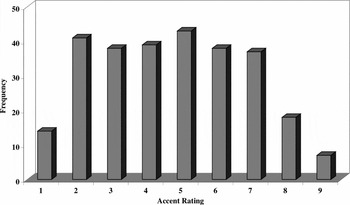
Figure 2 shows accentedness ratings of L2 utterances that listeners transcribed perfectly, and are thus by definition 100% intelligible. The accentedness ratings for these utterances fell across the range, so that even perfectly intelligible utterances were judged to be heavily accented, obtaining ratings of 7, 8 or 9 on the scale. This is one of the most robust findings that has emerged from every study we have done on intelligibility: intelligibility and accentedness are partially independent. In other words, it is possible to be completely intelligible and yet be perceived as having a heavy accent. The reverse doesn't happen. That is, speakers who are unintelligible will always be rated as having a heavy accent.
Accentedness ratings of utterances that were 100% intelligible (1 = no accent, 9 = extremely strong accent).

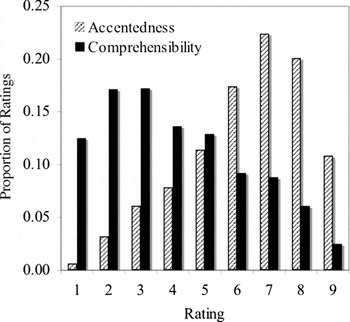
Now, let's go back to comprehensibility. In general, comprehensibility ratings are more closely related to intelligibility than accentedness ratings. As one would expect, then, comprehensibility and accentedness are also quite distinct. Figure 3 shows distributional patterns for accentedness and comprehensibility ratings from Derwing & Munro (Reference Derwing and Munro1997). The accentedness ratings tend to be harsher and clustered around the heavily accented end of the scale, while the comprehensibility ratings tend to be clustered at the low, easy-to-understand end. Clearly these are distinct constructs. In addition, these dimensions are not static properties; they can change over time, on their own, and as a result of instruction. To sum up, we want to emphasize again that accent is about difference, comprehensibility is about the listener's effort, and intelligibility is the end result: how much the listener actually understands (Munro & Derwing Reference Munro and Derwing1995; Munro Reference Munro2008).
Accentedness and comprehensibility ratings of 48 ESL speakers (based on Derwing & Munro Reference Derwing and Munro1997).

1.3 Changes in adult L2 speakers' pronunciation in the absence of focused instruction
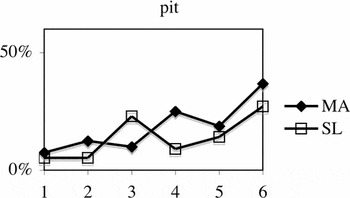
It is widely accepted that adult L2 speakers, with very few exceptions, have a foreign accent. However, pronunciation is learnable. With exposure to L2 over time, some changes in the direction of the target language will occur, as several studies have shown (Flege Reference Flege and Winitz1988; Riney & Flege Reference Riney and Flege1998; Flege & Liu Reference Flege and Liu2001; Trofimovich & Baker Reference Trofimovich and Baker2006). Figure 4 shows longitudinal data on vowel acquisition by speakers of Mandarin (MA) and Slavic languages (SL) (Munro & Derwing Reference Munro and Derwing2008). These were low oral proficiency learners enrolled in general ESL classes. Even in the absence of specific pronunciation training over one year, both groups made significant improvement in their production of the vowel in pit. The Mandarin speakers went from 8% intelligibility to 37%, and the Slavic language speakers went from 5% to 27%. Although both groups improved, neither was near 100% at the end of the year. Other vowels also improved, but there seems to be a limit on the degree of development without any focused learning.
Intelligibility of the vowel in pit over time for Mandarin (MA) and Slavic language (SL) ESL speakers.

2. Pedagogy
2.1 Changing views
Even quite recently, common views on pronunciation teaching have been pessimistic. As Pica (Reference Pica1994) noted, the generally-accepted goal of pronunciation teaching was native-like speech, but that goal was clearly unrealistic. Few studies showed that pronunciation instruction could improve intelligibility, because that was not the goal. Also, communicative language teaching de-emphasized pronunciation; it was assumed that sufficient input would help learners improve oral production. However, a serious misinterpretation of this situation was the notion that pronunciation teaching is ineffective.
That is not to say that no one was working in the area of pronunciation in the 1980s and 1990s. A relatively small cadre of researcher/practitioners, such as Gilbert (Reference Gilbert1984), Brown (Reference Brown and Brown1991), Morley (Reference Morley1987), and Celce-Murcia, Brinton & Goodwin (Reference Celce-Murcia, Brinton and Goodwin1996) were strong advocates of the benefits of pronunciation instruction. Nonetheless, as Brown (Reference Brown and Brown1991) noted, very little research on issues of L2 pronunciation was carried out in this period. Even that venerable source of misinformation, the Wikipedia, had an entry as late as 2007 claiming that pronunciation does not show any significant response to explicit teaching.
2.2 Where should the focus be?
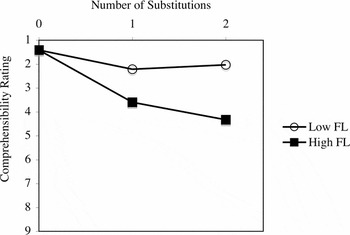
More recent studies have illustrated a direct and positive effect of pronunciation instruction on intelligibility and comprehensibility (Derwing, Munro & Wiebe Reference Derwing, Munro and Wiebe1997, Reference Derwing, Munro and Wiebe1998). In other studies (Couper Reference Couper2003, Reference Couper2006; Derwing & Rossiter Reference Derwing and Rossiter2003), improvement has been shown for individual elements of learner production, but no measures were made of intelligibility or comprehensibility. Though these findings are important, merely knowing that pronunciation training can be effective is insufficient. We have to know where to put the focus. If not, there is a risk of teaching things that are salient, but which will not result in actual improvement in communication for the speaker. In other words, we might modify accent without improving intelligibility or comprehensibility. Here we have to look to research to explore the contributions of specific aspects of prosody and segmentals. For example, Hahn's (Reference Hahn2004) study showed that sentence stress errors have a negative impact on intelligibility. Recent work by Zielinski (Reference Zielinski2008) demonstrates the relevance of syllable stress and segments in strong syllables. Another proposal for investigation is functional load. Catford (Reference Catford1987) and Brown (Reference Brown and Brown1991) independently predicted that certain segmental contrasts are more important to intelligibility than others. For instance, substituting /s/ for /∫/ – for example, saying so for show – should cause more problems than substituting /d/ for /ð/ – for example, saying day for they – because of the higher functional load of the first contrast. We tested the role of functional load in comprehensibility judgments and found what we see in Figure 5. Indeed, high functional load (FL) errors caused a greater reduction in comprehensibility ratings than did low functional load errors. This is preliminary work; we need much more research on what matters most to intelligibility and comprehensibility.
Comprehensibility ratings of utterances with zero, one or two errors (from Munro & Derwing Reference Munro and Derwing2006).

Another study (Derwing, Munro & Wiebe Reference Derwing and Munro1998) indicates why we need more research on the focus of pronunciation instruction. In some of our work on classroom teaching, one group of ESL learners had general global/prosodic instruction while a second focused on individual consonants and vowels. Both groups learned what they were taught, but the global group received better comprehensibility ratings on extemporaneous speech at the end of the study. However, the segmental group's comprehensibility ratings did not change. Any instructor can devote only limited time to pronunciation in a general L2 class. If time is spent on something that doesn't affect intelligibility or comprehensibility (such as the infamous interdental fricatives in English), something that really does matter will be neglected. Evidence is accumulating that what's important are the macroscopic things, including general speaking habits, volume, stress, rhythm, syllable structure and segmentals with a high functional load (Derwing & Munro Reference Derwing and Munro2005).
2.3 Who should teach pronunciation?
How we view pronunciation determines how we approach it and how we decide who is qualified to teach it. We've observed three principal perspectives on pronunciation: a medical view, a business view, and a pedagogical view. If we take the medical view that an accent is a disorder or abnormality, then it falls under the purview of medical professionals. Unfortunately some people think this way: ‘[t]he goal of instruction in pronunciation is that the student . . . should learn to speak the language as naturally as possible, free of any indication that the speaker is not a clinically normal native’ (Griffen Reference Griffen1980: 182).
The medical view overlaps somewhat with the business view. One speech pathologist from an accent and stuttering improvement institute has urged others to reinvent themselves by looking for new market niches, particularly accent reduction. Incorporating this niche into existing businesses leads to some very peculiar combinations of services. For example, one company is a cancer rehabilitation centre, where patients can get their tumours sized. They can also get support for feeding and swallowing difficulties and they can get accent modification. Some of the programs in the accent reduction industry show all the hallmarks of charlatanism and quackery. Fear-mongering is common, and we frequently see exaggerated or false claims. For instance, some businesses produce books and web courses claiming to eliminate a foreign accent within specific periods of time; 28 days is a popular number. There is no empirical evidence that this ever actually happens. Often these companies use pseudo-medical jargon and mysterious techniques with no known empirical basis. For instance, in one accent reduction program, students are told that they will improve their pronunciation of the phoneme /p/ if they recite the Peter Piper tongue twister with a big marshmallow between their lips. Every introductory linguistics student knows that one can't make a good /p/ if one can't achieve stop closure. This sort of program isn't cheap: we have found two-day courses that cost nearly $1000.00. Preposterous advice is also dispensed on the Internet. One website – and there are scores of these – makes some ludicrous suggestions, such as avoiding nasal sounds, speaking slowly, and speaking all the letters in a word. This advice is not helpful. In the first place, it's pretty hard to avoid nasal sounds in English! Secondly, some of our research (Munro & Derwing Reference Munro and Derwing1998, Reference Munro and Derwing2001) has shown that speaking slowly can sometimes make comprehensibility worse for the listener. As for the last point, it is certainly true that speaking all the letters in a word will make a big difference – especially for words like through, phlegm, knee, debris and aligned.
Clearly, we do not favour the medical or business views (see Derwing Reference Derwing, Munro and Thomson2008). Many learners don't require any pronunciation instruction because they are already easy to understand. Others, who struggle with intelligibility, need nothing more than basic pronunciation instruction that could be incorporated into a general L2 curriculum. There is nothing special, mysterious, or medical about their pronunciation needs. Unfortunately, many L2 teachers are afraid to teach pronunciation, in part because they have had no training in the area. Surveys of teachers in Australia (MacDonald Reference MacDonald2002), Britain (Burgess & Spencer Reference Burgess and Spencer2000) and Canada (Breitkreutz, Derwing & Rossiter Reference Breitkreutz, Derwing and Rossiter2002) have highlighted this problem. Murphy's (Reference Murphy1997) study indicated that nearly half of MATESOL programs listed in the TESOL directory did not offer a course specifically on phonology.
3. Social aspects of accent: benefits and costs of speaking with an accent
The social ramifications of accent constitute a huge area of study, and we will only touch on some of the important sub-areas.
Several researchers have noted that having an accent can be beneficial to L2 speakers. First, it can signal to language learners’ interlocutors that they may need modified input or, as it used to be called, foreigner talk. Second, some accents, particularly European accents, are associated with sophistication, to such an extent that some individuals have intentionally adopted foreign speech patterns. A good example of this is Leopold Stokowski, the famous conductor. He was born and raised in London, England, and spent his whole life between the UK and the US, yet in radio interviews he often spoke with what people described as a vaguely Eastern European accent. Maurice Chevalier was allegedly required to exaggerate his French accent as part of his contractual agreements with his movie studio, because people found his accent ‘charming.’
Despite these benefits, accents can also entail social costs. Loss of intelligibility is the most obvious of these. Not being understood, despite good control over the grammar and vocabulary of an L2, can be frustrating or embarrassing for both the speaker and the speaker's interlocutors. Take, for example, the case of another famous conductor. Gianandrea Noseda, in an address to an audience before a concert, produced (with emphasis) a problematic vowel in the word fact, such that the word rhymed with ducked. The vowel error was extremely salient, and the audience could be heard tittering in the background. This is an example of a vowel substitution error that has a particularly negative consequence and is a good candidate for pronunciation instruction.
3.1 Accent and identity
Given the importance of intelligibility to successful communication, we find it disconcerting to see some people actually claiming that intelligibility is not important. There appears to be a perception of a trade-off between changing the L2 speaker's pronunciation and preserving identity. Golombek & Rehn Jordan (Reference Golombek and Rehn Jordan2005), for instance, have argued that ‘a decentering of the primacy of intelligibility as a skill is necessary if preservice teachers are to make informed decisions about how best to establish their credibility as speakers and teachers of English’ (p. 529). An example of an especially extreme statement coming from the identity perspective is found in Porter & Garvin (Reference Porter and Garvin1989: 8): ‘[t]o seek to change someone's pronunciation – whether of the L1 or of an L2 – is to tamper with their self-image and is thus unethical – morally wrong.’ If that's the case, then put us on the side of the devil. Would it really be morally wrong to help Noseda change his pronunciation of the word fact? Or if we drew that error to his attention, would he be appreciative or would he be morally offended?
Now we'll describe some utterances taken from interviews with L2 engineers in the workplace in Canada. We found these utterances quite difficult to understand the first time we listened to them. In the sentences in question, one speaker produced a segmental error. Another made a stress error, and the third speaker was monotone and lacked vocal projection. These are all pretty straightforward problems – there is nothing mysterious about how to help them, and there are no medical issues here. These engineers have found that some aspects of their pronunciation are a liability, and they have expressly asked for help. We therefore don't think it is immoral or threatening to their identities to assist them to become more intelligible. We have no expectation that pronunciation students will fully adopt Canadian English patterns – there is no need to erase their accents. We simply want them to achieve successful communication both at work and in their everyday lives – exactly what they want and why they have sought help.
The Golombek & Rehn Jordan (Reference Golombek and Rehn Jordan2005) study of two EFL speakers that we mentioned above stands in sharp contrast to the findings in other work. Several studies actually contradict the view that identity preservation and pronunciation learning are incompatible. For instance, in a large study of 400 EFL students, Timmis (Reference Timmis2002) found that 67% aspired to native-like pronunciation. In a Canadian study of 100 adult ESL learners (Derwing Reference Derwing2003), 97% strongly agreed that it is important to pronounce English well, and 95% said that they wanted to sound like a native speaker. In these days of learner-centred curricula, it seems ironic that some authorities advocate the opposite of what the students want. If someone wishes to retain his or her identity through accent, that is a personal choice. But denying students help with intelligibility on the basis of protecting their identity seems not only misguided but paternalistic. Identity and intelligibility are both obviously important, but when it comes to sacrificing intelligibility for identity, there is no reason to believe that many learners will make that choice. Surely, if one is intelligible and comprehensible, one's expression of identity will come through more clearly. When the 100 ESL learners in Canada were asked if they felt their identity would be threatened if they were able to speak English with a native-like accent, their response was overwhelmingly negative – because they had full use of their own L1. They saw their L1 as the clearest expression of their identity. Their preference was to be fully competent speakers of both their own language and English.
In our view, the discussion of identity in some of the pronunciation literature is over-simplistic. First, it ignores learners’ responses to questions like these. Second, it doesn't recognize the differing effects of context on people's understanding of the role of pronunciation in identity. Third, it ignores the possibility that people can have multiple identities. Fourth, it does not acknowledge that there are both volitional and non-volitional aspects of accent (we'll come back to this point shortly). There is good work on identity issues outside the field of pronunciation, and we'd like to see a more careful consideration of the subtle problems of understanding identity. In our view some of the best work on identity and pronunciation has been done by our colleagues Gatbonton, Trofimovich & Magid (Reference Gatbonton, Trofimovich and Magid2005), who examined perceptions of ethnic loyalty, and by Piller (Reference Piller2002). In an investigation of high proficiency L2 speakers she found many who professed to pass as native speakers in brief encounters. This led her to argue that native speaker ‘is no longer an identity category, and rather than being something that someone is, it becomes something that someone does’ (p. 201).
The extent to which a speaker can use accent to express identity is constrained by the degree to which accent features are volitional. Some aspects of accent are simply outside the speaker's control. This depends on many factors: age of learning, how close the L1's phonological inventory is to that of the L2, the availability of suitable models and sufficient input, and probably a number of other variables, including aptitude. More than any other aspect of language, there is a motor component to pronunciation, which limits the ability to change one's speech patterns. It is wrong to interpret accent as an intentional expression of identity if the speaker has no control over these non-volitional features. Of course, there are volitional features of accent that any speaker can choose to modify – or not. If we enhance intelligibility and comprehensibility by working with volitional aspects, we increase rather than reduce the L2 speaker's choices for self-expression.
3.2 Discrimination
We do not want to minimize another important aspect of accent – the fact that many L2 speakers experience discrimination in reaction to their accented speech. Lippi-Green (Reference Lippi-Green1997) pointed out the strong association of accent with race. She also suggested that the media perpetuate stereotypes through accent. Munro (Reference Munro, Derwing, Burgess, Solé, Recasens and Romero2003) documented three types of accent discrimination. First there is stereotyping, often through shibboleths. Someone who is biased against Iraqis, for instance, may recognize a Middle Eastern accent on the phone and deny the speaker a service or employment, solely on the basis of an assumption that the individual is from Iraq. The second type is harassment – for example, a coworker may mock an L2 accent. The third type of discrimination occurs when a prospective employee is told that his or her accent is unacceptable for a particular job, even when the speaker is fully intelligible or the job does not require language skills. We stress that accents do not cause discrimination – the fault is with intolerant, often monolingual interlocutors. Some listeners will fail to understand even the clearest L2 speaker, simply because they have made up their minds that they can't understand accented speech.
3.3 Listener responsibility
The responsibility for successful communication should be shared across interlocutors. Although we advocate pronunciation training for intelligibility, we don't mean to suggest that the L2 speaker is at fault every time there is a communication breakdown. Empirical evidence indicates that familiarity with L2 speech improves comprehension (Gas & Varonis Reference Gass and Varonis1984). Moreover, listeners’ attitudes also have a role to play. Rubin's (Reference Rubin1992) study showed that if listeners merely thought that a person might be from a different language background, they understood less of what was said. Although sometimes prejudice based on race or ethnicity may be involved, it is not fair to assume that everyone who is apprehensive about interacting with people from other language backgrounds is discriminatory. In fact, some people, because of their limited experience interacting with L2 speakers, lack confidence in their own abilities to communicate, and therefore avoid situations where they need to talk with L2 speakers. These individuals can be helped with familiarity instruction. We attempted to address this issue in a training study in which social work students were exposed to Vietnamese-accented speech along with phonological explanations for Vietnamese accent (Derwing, Rossiter & Munro Reference Derwing, Rossiter and Munro2002). The participants were more confident at the end of the study and much more willing to interact with L2 speakers. Several cited real-life examples of positive experiences they'd had following the training.
We are now starting to see more interest in listener responsibilities in the workplace. Improving interactions is important in parts of the private sector where immigrant employees work in teams with native speakers of English. Many employers seek to implement training programs for their staff that emphasize enhancing communication for everyone in the company. In parts of Canada, we are currently experiencing severe labour shortages, which are a boon for immigrant professionals in that they are getting jobs in their original occupations. However, when immigrants are hired into engineering companies, for example, there is often a need for instruction in the areas of cross-cultural awareness and pragmatics for both Canadian-born and L2 newcomers.
4. Future directions
We will conclude with some suggestions for future directions in the areas of L2 speech research, L2 pedagogy and L2 social aspects of accent. We see many possibilities for research on accent issues to support L2 learners. First, we need more investigations of L2 phonological development, both naturalistic and instructed, across multiple languages. This will necessitate longitudinal studies that trace development over time (e.g. Derwing, Munro & Thomson Reference Derwing2008). Some aspects of L2 phonology may not need to be taught if they tend to develop naturally, whereas others may require intervention. More classroom studies are also needed. The reason there are so few of them is that they are so hard to carry out, but closer collaboration among teachers and researchers would help to bring this about. We also need more studies investigating the relative importance of various accent features to intelligibility, some along the lines of Hahn's (Reference Hahn2004) study showing the effect of sentence stress, and more studies of functional load. We also need far more work in languages other than English.
As for pedagogy, preliminary studies of pronunciation teaching have given us a starting point, but there is room for more research to identify effective teaching approaches. Technology offers a great deal of promise, provided that technological applications are guided by pedagogical specialists who understand appropriate goals and priorities in teaching pronunciation. There certainly is a place for more teacher training. In our own country, Canada, very few programs offer courses in how to teach pronunciation, but without preparation, many language instructors will neglect this aspect of language learning.
In the area of social aspects of accent, we need more careful investigations of the relationship between identity and accent, rejecting the idea that pronunciation instruction and identity preservation are mutually exclusive. We also need far more research from the perspective of listeners, both native and L2 users. This is emerging as an important workplace issue in an increasingly diverse world. In this talk we have focused on ESL settings, but there is a growing body of work in English as an international language (EIL) settings as well. Many social issues such as the costs and benefits of an accent, discrimination and listener responsibility need to be examined across a variety of language learning contexts. A growing area of concern is the practice of assessing asylum seekers’ country of origin on the basis of accent by self-professed experts who have no linguistics background. This serious problem has been highlighted by Eades et al. (Reference Eades, Fraser, Siegel, McNamara and Baker2003) in Australia. In some cases, accent is used to make crucial decisions, for example, deciding whether or not to send people back to their countries of origin to face certain death. Increasingly, accent is at issue in other legal and forensic applications as well. Finally, we see a real need to evaluate the interaction of pragmatic factors and accent. It is very clear that accent is sometimes a scapegoat that masks a negative reaction towards unfamiliar pragmatic behaviour, or discrimination.
So, let's conclude by going back to our title – putting accent in its place. On the one hand, accent is important in that people use it to make social evaluations, and these evaluations clearly affect both listeners and speakers. Furthermore, in those instances where accent really does reduce intelligibility, it is worth addressing. On the other hand, we know that accent, comprehensibility, and intelligibility are partially independent constructs, and that simply altering accent will not necessarily affect the other two. In fact, communication obstacles are often based on things other than accent, but because of its extreme salience, accent is given more weight than it deserves. Recognizing both sides of this very complex phenomenon is essential to improving the lot of everyone who lives and interacts in linguistically diverse contexts.
Acknowledgements
We would like to acknowledge two people who have made huge contributions to our field, and who have inspired and encouraged us personally: Jim Flege and Tom Scovel. We also thank these people and organizations, all of whom have contributed importantly to our ideas and research: Alan Borden, Bruce Derwing, Marian Rossiter, Ron Thomson, Susan Morton, Jean Wang, Cliff Burgess, Herman Li, Jacqui Dumas, Jen Foote, Talia Isaacs, Lori Diepenbroek, Kama Jamieson, Natasha Penner, John Levis, Leila Ranta, Dean Mellow, Nina Spada, staff and students at NorQuest College and Metro College, Social Sciences and Humanities Research Council of Canada, University of Alberta, and Simon Fraser University.
Tracey Derwing is a professor of TESL and a Co-Director of the Prairie Metropolis Centre: A Centre for Research on Immigration, Integration and Diversity. She has conducted extensive research on second language learners’ pronunciation and oral fluency. She has also examined the negative effects of modifications native speakers make when addressing low proficiency L2 learners. Tracey has conducted large studies on the settlement experiences of refugees and the attraction and retention of immigrants. She has served as a co-editor of the Canadian Modern Language Review and the TESL Canada Journal. She has received lifetime achievement awards from her province's organization, ATESL, and from TESL Canada.
Murray Munro is a Professor of Linguistics and Director of TESL at Simon Fraser University, and a former co-editor of the TESL Canada Journal. He began his career as an instructor of adult ESL before completing graduate studies in speech production and perception and working as a SSHRC Postdoctoral Fellow. He is interested in all aspects of L2 speech, especially age and accent, the role of accents in communication, and the social evaluation of L2 speakers. He recently published the co-edited volume Language experience in second language speech learning. Murray has received extensive research funding from SSHRCC.