1. Introduction
Teacher education for CALL has become an increasingly important subset of research in TESOL, as evidenced by two book-length publications in this area: Hubbard & Levy (Reference Hubbard and Levy2006) and Peters et al. (Reference Peters, Murphy-Judy, Lavine and Kassen2007); state-of-the-art articles as chapters in important collections (Motteram et al. forthcoming); the establishment of special interest groups in teacher organisations such as CALICO and EuroCALL and three journal special issues: Language Learning and Technology, 2002, Innovation in Language Learning and Teaching, 2009 and ReCALL, 2011. It seems timely, then, to consider the research traditions that we use to explore teacher practices and teacher education for CALL and build on what Hubbard & Levy (Reference Hubbard and Levy2006: 3) describe as a tradition that has been bottom up and ad hoc into a perspective on this field that is more systematic and in tune with developments within the TESOL teacher education field as well as teacher education in general.
While the field of teacher education and TESOL, which has a much longer tradition, has been debating the issues of theory in teacher education for some time (e.g. Johnson Reference Johnson1996) and has increasingly looked to more mainstream theory for ways of understanding practice (Wright Reference Wright2010), there is less evidence of an engagement with theoretical frameworks in some of the papers being published about teacher education for CALL; many are still simply descriptive reports. While this is an effective starting point, if we are going to build a broader understanding of the field of teacher education for CALL and its relationship to the wider teacher education literature, we must offer ways of comparing and analysing the work. The use of a consistent theory set adds explanatory power and connects this growing field to research traditions recognised by a broader community, thus increasing the legitimacy and standing of the work in which the members of the teacher education for CALL community engage.
This lack of an accepted theory set is even more surprising when we find that at least some of these published reports form the basis of Ph.D.s or funded research projects where one would expect more engagement with theory used in general teacher education. One explanation may be that many of the writers of these articles come from backgrounds in applied linguistics and are, as a result, less aware of the development of ideas in the field of teacher education. This is to some extent speculation, but it is surprising how many times SLA theory is invoked in articles on teacher education for CALL.
The range of methodologies that are used is also surprisingly limited, and we find that we are yet again shown a ‘scientific’ view of the world with pre- and post-test paradigms often in evidence. This is again rather surprising, considering the breadth of methodology that can be found in much of the teacher education world.
2. The value of theory in teacher education research
It is important to show that the argument being presented here is not peculiar to TESOL, as we should be centrally involved in the on-going debates in the teacher education field in general. Views from Wilson (Reference Wilson1978) help us to understand where theory fits in and how it helps to support and explain the research we do in teacher education:
Theory provides a means of integrating and interpreting available information and influences the search for new knowledge. . . [in] short, the appeal is either to an organised conceptual framework or a melange of personal preference, intuition and subjective judgement. (1978: 218)
The ‘organised conceptual framework’ that this paper is arguing for will help us bring some explanatory power to the ‘melange of personal preference’ that we still find so often in the published literature.
Having reviewed and listened to the papers at a recent specialist conference on teacher education and CALL, where this paper was originally given as an invited talk, I find a range of theories offered. These papers were more along the lines of what I am arguing for here and the discussion they presented can be argued to have fallen within the ‘sociocultural family of learning theories’ (Roth & Lee Reference Roth and Lee2007), such as situated practice, situated teacher cognition, Communities of Practice and Activity Theory.
Johnson (Reference Johnson2009), in making the case for sociocultural theory in the realm of general teacher education and TESOL, suggests that:
At the core. . .the epistemological stance of a sociocultural perspective defines human learning as a dynamic social activity that is situated in physical and social contexts and is distributed across persons, tools and activities. (2009: 1)
TESOL teachers with an interest in CALL use a wide range of tools and engage in many different activities in an increasing number of spaces: conventional classrooms, blended classrooms and fully online. Such activities also happen in many different social contexts, TESOL teachers being found in all parts of the world, as we will see in the examples below.
It has been at more recent conferences, and particularly within the realm of a Special Interest Group on teacher education for CALL, that we find the more concentrated use of a particular theory set. However, the most influential book to be published in this field so far, Hubbard & Levy (Reference Hubbard and Levy2006), contains an interesting collection of articles, some of which do engage with sociocultural theory, though others are mainly reports of practice. My own article with Diane Slaouti (Reference Slaouti, Motteram, Hubbard and Levy2006) engages with the theory of situated practice, as does that of Egbert (Reference Egbert, Hubbard and Levy2006) in her exploration of how to engage teachers in the realities of classroom teaching whilst on a course. Other writers support their discussion with Papert's Constructionism (Debski Reference Debski, Hubbard and Levy2006). Debski is exploring project-oriented learning on an M.A. programme at the University of Melbourne; Chin-chi Chao (Reference Chao, Hubbard and Levy2006) uses the cognitive apprenticeship model of Collins, Brown and Newman (Reference Collins, Brown, Newman and Resnick1989) and both Meskill et al. (Reference Meskill, Anthony, Hilliker-VanStander, Tseng, You, Hubbard and Levy2006) and Hanson-Smith (Reference Hanson-Smith, Hubbard and Levy2006) make reference to Communities of Practice.
I am not suggesting that a sociocultural perspective is the only way forward for research into teacher education and CALL; alternatives exist, for example in a number of other papers in Hubbard & Levy (Reference Hubbard and Levy2006), which explore practice in terms of research in teacher autonomy. However, it does seem that as many of the leading writers are beginning to take a sociocultural stance, it may be a useful starting point for future research, even if it needs modifying to fit with our understanding of the practice that emerges.
Having proposed a useful theory set, I now turn to a way of selecting methodologies to help in the collection of data and their analysis.
3. Fashioning an instrument
Each research project has its own dynamic and therefore requires a specific methodology as well as particular research questions and methods. One approach that can be found in the research methods literature is that of ‘[f]ashioning an instrument’ (Czarniawska Reference Czarniawska1998), which has a resonance with a phrase from sociocultural research, ‘creating a lens’ (Barab, Evans & Baek Reference Barab, Evans, Baek and Jonassen2004), or the idea of the ‘bricoleur’ (Levi-Strauss Reference Lévi-Strauss1962: 19). Crotty (Reference Crotty1998) describes the bricoleur as:
. . .someone able to perform a whole range of specialist functions or even to employ unconventional methods. It is the notion of a person who makes something new out of a range of materials that had previously made up something different. The bricoleur is a makeshift artisan, armed with a collection of bits and pieces that were once standard parts of a certain whole but which the bricoleur, as bricoleur, now reconceives as part of a new whole. (Crotty Reference Crotty1998: 50)
All of these ideas have at their core the notion that there is no fixed process; it is because of the messiness (Robson Reference Robson2002) of the work in which we are engaged that we need to create a new research framework each time we enter the field. One danger of this is that we might end up having no system in our work, which is where theory helps to give us some overarching organisational structure that we can refer to; it provides us with a map against which we can plot what we do. However, the ‘bricoleur’ is skilled in bringing together ideas and materials in a way that best suits the conditions of, in this case, the particular research study. As researchers develop their skill, they become increasingly proficient in creating suitable frameworks for research.
In these circumstances it seems to me very difficult to perform the kind of experimental research that still appears quite common in the CALL profession, where if we try to control variables, we end up in a situation where potentially rich data are lost to us. We do see changes in the way that research is reported in typical journals like Language Learning and Technology, ReCALL and Computer Assisted Language Learning, but if less experienced researchers turn to these publications for guidance, they will still find quite a lot of reporting that relies only on statistical analysis.
In an earlier paper (Motteram Reference Motteram, Debski and Levy1999), I argued for a general move to qualitative research in CALL itself and traced the broad domain that this kind of research covers, illustrating this with a study I had undertaken in a school. It is interesting to see that in the field of CALL itself, many articles are still presented in the experimental tradition and a good many articles in the field of teacher education for CALL adopt a survey approach. At this stage in the development of the field of teacher education for CALL exploratory surveys may be necessary, but as we acquire a more mature professional identity, we should offer deeper studies with a broader and more insightful data set.
Vygotsky (Reference Vygotsky1978, Reference Vygotsky1986), one of the originators of sociocultural theory in the modern age, demonstrated how this theory could be used at various stages in the research process. He talked of particular events, such as the engagement in a particular classroom at a particular moment in time. These he termed microgenetic events. He talked also of ontogenetic events, series of events over time related to individual development, as well as phylogenetic events, which have transformational power for humankind.
In most cases in our current research work as practising teachers we are operating at the level of the microgenetic event where the study we are engaged in is concerned with our own classroom, or a particular event in the classroom. However, we may become involved in larger studies taking place over a longer time period, such as the one I have undertaken with colleagues for Cambridge University Press. In this study we were concerned with a series of events over time; our final report was based on 17 case studies from which we were able to draw out some overarching factors that might be termed ‘generalisations’. The current phylogenetic event is the digital turn that is affecting all of society. This event is having a very major impact on the way we live our lives and on education, and the work that is discussed in this article is making a small contribution to this.
I will now go on to look at three research studies of teacher education and CALL which illustrate the different processes that we can engage in and the role that methodology and theory can play. This will show the practice of the bricoleur and the way that different methodologies can be effectively applied to suit the needs of the research study as well as the development of the profession.
4. Three recent studies
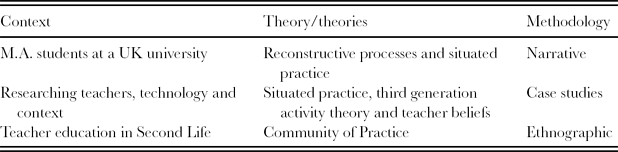
Table 1 summarises the three studies featured in this section, picked to show how the linked group of theories and different methodologies are used to support effective studies. They cover different aspects of teacher education and insights into the practice of language teachers which is used to inform the teacher education process.
Outline of studies discussed in section 4

4.1 Example 1: M.A. students at a UK university
This example looks at a study of reconstructive processes in teacher education on our own M.A. programme. This study was undertaken collaboratively with Diane Slaouti, a colleague at Manchester. It is reported in Hubbard & Levy (Reference Hubbard and Levy2006) so I will not consider it in detail here. It involved 20 students: ten studying on site and ten on our distance course. We used written narratives prompted by a series of questions to explore whether these teachers believed that the course had an impact on them, whether it had enabled them to reconstruct their practice, that is, whether they did things differently because of their engagement with the course. The concept of reconstruction as we used it in this research has roots in the work of Dewey. He was a constructivist and viewed the development of knowledge as an engagement with information that we learn and puzzles that we solve as an on-going process. People develop over time and their perspective changes as they think their way through the problems that are set. Dewey argued that ‘education is a constant reorganizing or reconstructing of experience’ (Reference Dewey1916: 89); in our study we collected data to discover whether the course participants believed that they had changed during their course with us and whether they had taken ideas back to their home contexts and employed them in their teaching. Teachers who do the course by distance learning can find this process easier because they are still engaged in teaching while they study.
We used a narrative technique here because we wanted the teachers to relate to us their stories of development. Did the M.A. process make a difference for them? Did it alter what they did in their teaching? We wanted them to relate what they were doing/had done on the course to the teaching that had occurred as a part of the course. We chose to use written narratives for pragmatic reasons. We had students with us at the University and students studying at a distance. Many had already completed the course so were using the narratives to enable them to think back through the course and relate it to what they were doing in their own teaching.
We felt that such linking of a philosophy of situated learning with the narrative technique was effective and supportive. The narratives helped the course participants to reflect on what they had done on the course and how they might have applied this in their teaching.
4.2 Example 2: Researching teachers, technology and context
The second study continues with the concept of situated practice, but also calls on a broader landscape of sociocultural theory and a case study methodology. The case studies that were used here were a part of a commissioned project funded by Cambridge University Press. I and two other colleagues, Diane Slaouti and Zeynep Onat-Stelma, spent two years exploring technology use around the world by teachers of adults. This project started with a survey of 370 teachers in 54 countries, as well as a survey of 178 learners. The learner survey was conducted by the teachers themselves and was not a core part of the project. We were interested in using the survey to find out about a number of issues:
• Technology access and locations of use;
• Teacher perceptions of the roles that technology plays;
• Teacher perceptions of digital resources (bespoke and teacher-created);
• Teacher perceptions of EFL materials (digital and non-digital), the role of content providers and aspirations for the future.
Following on from the survey, we then spent a year conducting 17 case studies with teachers in Asia, Europe, the Middle East, North Africa and South America. We collected data from online interviews, weekly reports of technology use from each teacher, and detailed reports of technology use in two chosen lessons. We also collected various support documents including photographs, teaching materials and links to online resources.
The two sets of data were processed separately and each year a report was produced for Cambridge University Press. The survey was used to explore the general trends in the use of technologies in adult language education and was expected to give some guidelines to the publishers about how teachers use technology and what they do, in order to inform publishing policy for the future. The case studies were more significant in that they give a detailed insight into the practice of teachers in the modern world.
Considered together, the survey and the case studies provide us with a comprehensive cultural history and an ontogenetic overview; the case studies themselves provide us with 17 microgenetic analyses of particular situations occurring at a time of significant change in the world of knowledge creation and maintenance with the move into a digital world, arguably a phylogenetic event. These case studies provide us with a cultural historical snapshot, but one which can be significant in our understanding of what is happening in the world.
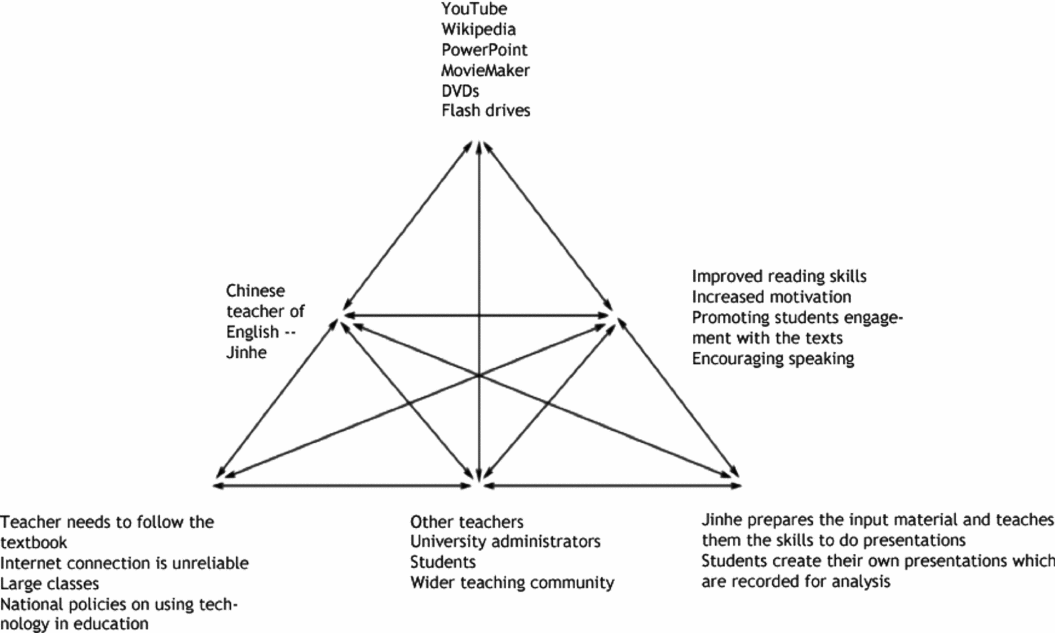
Using the typical triangular heuristic that we commonly find in studies involving activity theory (Mwanza Reference Mwanza2001; Roth & Lee Reference Roth and Lee2007), we can represent a case study as in Figure 1.
An activity heuristic of Jinhe's case study
Activity theory is one of the ‘sociocultural family of learning theories’ (Roth & Lee Reference Roth and Lee2007: 189) and proposes that we examine events that occur in the world taking into account a range of factors. The nodes on the triangle used to represent the theory correspond to these factors. This heuristic shows a Chinese teacher, Jinhe – her real name, which she has agreed can be used – (the subject of the activity) working on a number of elements in her reading class in a university in northeast China (the object of the activity). When you consider this case study and look at how she tries to reach the learning outcomes, she has a number of factors which need to be taken into account. For her class she needs to follow a particular textbook; the Internet is not reliable in her university, so she brings most of her materials on a pen drive (in the theory these are termed ‘rules’: these might be interpreted as the constraints or barriers to success that the teacher needs to consider). Jinhe belongs to a community that will support or hinder her in what she does. She needs to keep her students happy as well as other professionals in her context (community). Different people in the classroom do different things (division of labour), so while Jinhe prepares input materials based on the different tools (sometimes referred to as ‘means’ or ‘artefacts’) she wants to use (YouTube, Wikipedia, etc.), she also wants this to act as an illustration for her learners, who will go on to do their own presentations.
Normally, these classes would take place in a conventional classroom, but Jinhe chooses to use a computer room or a classroom with projection facilities, so that she can make use of material that she has created at home. She uses her home connection to create materials, doing her research using Wikipedia, for example. She uses PowerPoint to organise the material and downloads all of it on to a pen drive. She also downloads clips from YouTube that are relevant to the material that she is working with. For example, one of the writers in the textbook she uses is C. S. Lewis, so she uses Wikipedia and other sources for background information on him and pictures that she can use to create her presentation. She may then download a clip from YouTube showing some of the trailers from The Lion, The Witch and The Wardrobe, or she may use a DVD to show an extract from the film. Having modelled a presentation in class, Jinhe will later get her students to do similar presentations, collecting information themselves and creating their own PowerPoints about other writers. When the students give these presentations, Jinhe records them so that she can focus later on the language that they use. Students are increasingly expected to make presentations either at university or in their future work, and this is a useful skill for them to practise. The recorded videos mean that Jinhe can give the students more targeted feedback on their language.
Here are two comments that Jinhe made on the student presentations that support the claims made above:
Comment 1
Students’ presentation material is wonderful; for example, this group imitated some of the movie scenes, and prompted their fellow students to think about love. They made their costumes and used a digital camera to record the scene. They also edited the video clip by adding music and voice.
Comment 2
I am often surprised at the material done by students. They demonstrated shrewd understanding. There are also shocking grammatical mistakes in their materials, which catch my attention. If they simply deliver the information verbally, I am not sure whether I have the chance to correct them in a timely way.
Comment 1 shows the level of student engagement with the activity and shows that it has achieved Jinhe's objectives. Students appear both motivated and engaged in what they are doing. Comment 2 picks up on the issue of the additional information that Jinhe can gather from these recordings, showing their value for language learning and development. Jinhe can then make use of these videos to provide feedback to her learners, or use the insights as the basis for further lessons focussing on the language that they are having difficulties with.
In this study we interviewed the teachers at least twice to gain an understanding of how they create lessons, how they make decisions about the teaching process, about what their beliefs are when it comes to choosing to teach with a particular technology, and why they do what they do. In terms of our analysis we can place the teacher's beliefs at the rules node (Figure 1, bottom left), as they affect teachers' decision-making when they start using technology to support their teaching. Jinhe believes that her learners will benefit because of the tools that she has decided to employ and that practising making presentations is valuable for their future careers. If she were not convinced that the technology had value in this way, she would not be persuaded to use it; it governs her activity and can be seen as a rule.
These 17 case studies have enabled us to reveal these insights along with a good understanding of the overall sociocultural environment in which the case study is played out. We have brought together two research strands to give a stronger and more in-depth understanding of practice. Activity theory acts as a ‘lens’ (Barab, Evans & Baek Reference Barab, Evans, Baek and Jonassen2004) for a complex situation like the one described here. We can see why Jinhe acts as she does and the constraints and affordances that make a difference in the particular context.
4.3 Example 3: Teacher education in Second Life: The AVALON Project
The final example uses a different sociocultural lens, Communities of Practice, to explore the teacher education process in a European project. AVALON (Access to Virtual and Action Learning Live Online) was a two-year project (2009–2010) funded by the European Commission as a part of the Education and Culture DG Lifelong Learning ProgrammeFootnote 1. The project has a number of elements and more detail can be found on its website, www.avalonlearning.eu. I will focus here on the teacher education component, which I led.
While the project included the creation of an actual introductory training course which was piloted as a part of the project, what also developed over the two years was a community of teachers engaging with what was happening on a day-to-day basis, which has continued after the funded period of the project. While I entered the project thinking I might explore the teacher training course from an activity theory perspective, as this was where my ideas were focussed, as the project developed I began to realise that this was not going to be the most appropriate theory set and to consider whether Communities of Practice (CoP) might be the right alternative.
Writers most closely associated with this theory are Lave & Wenger (Reference Lave and Wenger1991), although I am going to focus here on the formulation presented by Wenger (Reference Wenger1998, Reference Wenger2006). On his website, Wenger (Reference Wenger2006) talks about the domain, the community and the practice. The domain is the area of interest that people have in common. ‘Interest’ here means much more than a general liking for a topic; it is a significant part of their lives, and understanding should develop over a period of time. We are not talking here about a group of friends with an interest in film who go to the cinema together. The people in the community share a level of skill in the topic, which develops over time. The community may consist of people with different levels of knowledge, experience and interest, but over time the people who remain committed engage in a variety of activities and discussions. It is a social network and people get to know each other and learn together. The practice implies that the community engages in activities that build a shared set of resources that may include practices, tools and histories. The building of a community takes time and may last for a long period.
The data in this study consist of email exchanges, recordings and minutes of meetings, sessions that were run as a part of the project, pictures taken at various meetings both on and off line, the material that was gathered from the two principle digital tools used in the project: a Ning (a social networking site) and a wiki that became the repository of documents for the project. This is an on-going research project and not all of the data set has been finalised. What is presented here is an initial set of ideas gathered from a small subset of the data that is being coded on the basis of theoretical concepts derived from the literature.
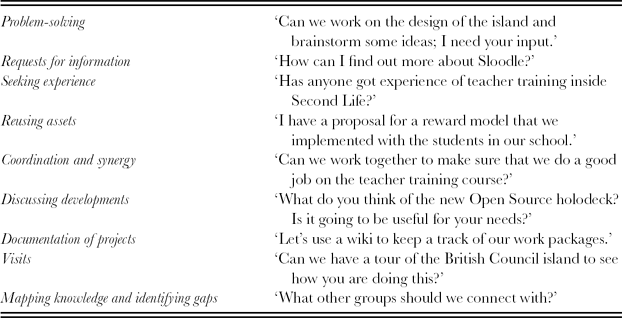
A CoP consists of a number of elements. In the left column of Table 2, we find the elements suggested by Wenger (Reference Wenger2006), and in the right column, data from the AVALON project.
Elements of a Community of Practice
The project uses the virtual world Second Life as its online space. Second Life consists of a series of 3D islands set in a virtual sea, and the island owners have rights to landscape their island and build structures. Landscaping and building uses resources, which are limited, so you need to be careful in this process that there is enough space left for the avatars to move around and engage with each other. The project team rented an island from Linden Lab and in the early stages needed to make decisions about what the island would look like. This is the discussion that is represented in Table 2.
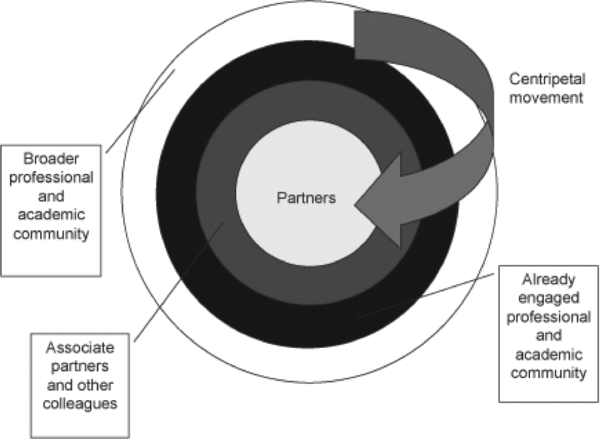
All the data come from the on-going conversations or exchanges that we had as a team during the early stages of the project and represent the coming together of the initial community. In Figure 2, we can see how the ten project partners formed the central core of the community as they began to work together on the project. The partners recognised that they were not the only people engaged in such practices, but first they needed to find their own way into the project before they started broadening it out to include others. If we take the first row in Table 2, problem-solving, we find a colleague who was managing the technical set up of the island requesting help in deciding on the design. The set up of the island needed to be a group decision so that everyone in the project would feel part of the developing community. It was agreed that the name of the project AVALON would not be allowed to completely dominate the island design. We did not want a medieval island that was inhabited by dragons and knights, but we did want it to have some of the characteristics of the countryside around the modern town of Glastonbury in the UK where the Arthurian legends were set, so there would be an English-looking village with a pub, corner shop and bookshop. There was also a modern performance area reflecting the modern Glastonbury rock festival. There were a number of other technical problems that needed to be solved at the same time. Islands in Second Life where the virtual space (island) was to be established have certain limitations in terms of the resources that are available for building, and using too many of these resources would make working with learners and other teachers on the island difficult.
The development of a Community of Practice
In row 2 of Table 2 we can see an example request for information. The ten partners had a variety of skills and understandings of virtual worlds and the way that they interact with other elements on the Internet. Sloodle is a technical solution for linking Second Life to Moodle, the open source VLE, which we were planning to use as a non-3D space for managing courses. This again was an early stage in the project and there were a lot of information requests at this time as the team built up its expertise.
All the elements of the community activity involved a range of voices in the community (Wenger Reference Wenger2000; Forman & Ansell Reference Forman and Ansell2001). There was the management voice, academic, pedagogic, technical, learner and the virtual learning community, amongst others. Each voice had a role in the setting up and development of different aspects of the community.
The partners in the community engaged in activity to encourage others to join, and a large number became members of our social networking Ning site (http://avalon-project.ning.com/) without being directly invited. There is often an increase in membership following presentations about the project at conferences. Events are publicised and people can both offer to put on an activity and ask others to do so. As can be seen in Figure 2, the centripetal movement (Lave & Wenger Reference Lave and Wenger1991: 122) within the community, illustrated by the arrow, shows people becoming core members of the community. As Lave & Wenger argue (Reference Lave and Wenger1991: 36), we should not take this notion of movement from the outside to the inside too literally. It is connected to the term ‘legitimate peripheral participation’, where people who start off by showing interest in a community become more engaged and committed to its activities. The outer rings in the diagram in Figure 2 show the broad categories of people who began to engage in the early stages of the project and who are now central to the community of activists and remain interested in the project. There are currently approximately 600 people registered on the Ning site with five active sub-groups and regular meetings of teachers in Second Life. The teachers meet to discuss and demonstrate what they do in Second Life as well as working together to organise a yearly conference to showcase their practice.
5. Towards a theoretical framework for teacher education and CALL
These three studies have been presented to illustrate how the researcher as ‘bricoleur’ ‘fashions an instrument’, making use of different tools to suit the needs of the particular study. This fashioning is conducted within a sociocultural framework, as this allows us to see the connections between these studies and others that are being reported elsewhere in the broader field of teacher education. Researchers who write about teacher education and CALL are perhaps still being unduly swayed by research that is reported in the CALL literature, rather than making use of the more obvious resource of teacher education.
This paper has tried to show that the move towards a more consistent approach to theory in conjunction with a broader methodological set will enable researchers interested in the field of teacher education for CALL to make a more consistent and effective contribution to that field. It will also help to align our practice as teacher educators more closely with the broader world of teacher education. I have attempted to show that while there are some moves in this direction, some papers published in this field look back towards CALL's links with SLA. It can be argued that this is valid for some aspects of CALL research; however, it is not in tune with recent developments in teacher education and the practice of teachers in general.
Acknowledgments
I would like to thank Julian Edge for his careful reading and detailed comments on an earlier version of this text, and the EUROCALL SIG: Teacher Education for CALL for inviting me to give this talk in the first place. I would also like to thank Graeme Porte for his suggestion I submit this paper and his detailed editing. Both colleagues have added to the quality of the final paper.
Gary Motteram is a Senior Lecturer in Education at the University of Manchester. He set up and still runs an M.A. in Educational Technology and TESOL, which is taught both on-site in Manchester and by e-learning. He has presented at conferences and publishes regularly in the fields of technology in language learning and technology-supported distance education. He has recently managed a number of international projects for the University of Manchester including eChinaUK (www.echinauk.org) and AVALON (www.avalonlearning.eu) and was principal investigator on a two-year research project for Cambridge University Press exploring what teachers do with technology.