1. Introduction and background
Investment in the provision of technology in schools and universities has increased significantly in recent years (Macaro, Handley & Walter Reference Macaro, Handley and Walter2012). At the same time, the use of technology in language learning is now stipulated in a number of language standards (Macaro et al. Reference Macaro, Handley and Walter2012). In order to enable developers to make decisions about the design of future CALL software and activities as well as enable practitioners to make informed decisions about CALL adoption, the construction of a valid and reliable evidence-base with explanatory power is increasingly important. As discussed elsewhere, there are a number of different dimensions to the validity and reliability of an evidence-base (Cohen et al. Reference Cohen, Manion, Morrison and Bell2011). One dimension which merits further consideration in the context of CALL research is external validity or generalizability. Generalizability in the context of CALL refers to not only the potential for the findings of research to translate to different educational contexts with different learners, but also the potential for findings to apply to CALL software and activities beyond those specifically investigated in an individual study (Stockwell Reference Stockwell and Stockwell2012). Explanatory power refers to the extent to which studies are able to provide reasons for any observed impact of the attributes and affordances of technology on language learning (Pederson Reference Pederson and Smith1987). Knowledge construction refers to the potential to integrate and synthesise the findings of different individual studies into a coherent evidence-base (Handley Reference Handley2014).
This paper, however, argues that, in addition to lack of evidence of validity and reliability also observed in the wider field of SLA due to the lack of replication (Porte Reference Porte2013), the current CALL evidence-base also lacks generalizability (to other CALL software) and explanatory power, and there is an absence of knowledge construction. It is argued that generalizability to other CALL software might be achieved by focusing in on attributes and affordances which transcend multiple technologies (Pederson Reference Pederson and Smith1987; Stockwell Reference Stockwell and Stockwell2012), where attributes refer to ‘features of the computer which have the potential to support and develop cognitive processing, such as symbol systems, multimedia and random access’, and affordances refer to ‘features of the computer which enable learners to engage in processes that support language learning’ (Handley Reference Handley2014: 49). Broad CALL versus non-CALL comparisons, however, dominate the literature (Felix Reference Felix2008; Macaro et al. Reference Macaro, Handley and Walter2012), and consequently there are currently few insights into the impact of attributes and affordances which transcend multiple technologies. Explanatory power, it is argued, is best achieved when links are drawn with SLA theory and research, which might explain how different attributes and affordances of technology might either provide conditions or enable learners to engage in processes which are known to support language learning (Pederson Reference Pederson and Smith1987). Such links between SLA theory and research and the attributes and affordances of technology are, however, rarely made in the CALL literature and there is a lack of instrumental replication (Macaro et al. Reference Macaro, Handley and Walter2012), that is re-use of measures commonly used in SLA research. Knowledge construction, it is argued, is achieved by conducting more narrowly focused studies investigating the impact of one or more specific attributes or affordances of technology and engaging in instrumental replication, where instrumental replication refers to the re-use of measures employed in previous research. The former ensures the longevity of research and better enables researchers to build on one another's findings (Pederson Reference Pederson and Smith1987). The latter permits the integration of findings with those of other studies in CALL and the broader field of SLA. Further, with respect to the validity and reliability of the CALL evidence-base, and as has been observed in relation to SLA research more broadly (Porte Reference Porte2013), there is a lack of replication in the field of CALL (Chun Reference Chun2012).
In the remainder of this paper, these issues are discussed in more detail and exemplified through the critical examination of two key studies which make an important contribution to our understanding of the potential benefits of CALL. Both studies were selected on the basis of the ‘weight of evidence’ they had been attributed in Macaro et al.’s (Reference Macaro, Handley and Walter2012) systematic review of research on the use of CALL in primary and secondary EFL teaching. In that study, weight of evidence was determined by the relevance of the study to the review, the appropriateness of its design, its trustworthiness or credibility, and its overall contribution to the review. Further factors which contributed to the selection of these studies were the significance of the research questions addressed by the studies and their findings as discussed below. The first study focuses on the use of Automatic Speech Recognition (ASR) to support the development of pronunciation skills (Neri et al. Reference Neri, Mich, Gerosa and Giuliani2008b), where ASR refers to software that ‘listens’ (Wachowicz & Scott Reference Wachowicz and Scott1999). Specifically, the study compares the effectiveness of ASR-based pronunciation training with standard non-CALL provision in an intervention involving young Italian learners of English. The second study focuses the use of synchronous computer mediated communication (CMC), i.e. chat, to support the development of speaking skills and reduce anxiety (Satar & Ӧzdener Reference Satar and Ӧzdener2008). It compares the impact of text chat on the speaking proficiency and anxiety levels of Turkish learners of English with the impact of audio chat on their speaking proficiency and anxiety levels.
Neri et al.’s (Reference Neri, Mich, Gerosa and Giuliani2008b) study merits consideration for two reasons. First, it is one of very few (classroom) evaluations of the impact of ASR on the quality of learners’ pronunciation – a notable exception being Neri, Cucchiarini & Strik's (Reference Neri, Cucchiarini and Strik2008a) own evaluation of similar software with adult learners of Dutch. Classroom (or field) evaluations of the impact of ASR-based CALL software on language acquisition are important because ASR is based on probabilistic algorithms and the feedback provided is not entirely reliable. Whichever ASR system you employ, there is always the possibility of false positives, i.e. ‘the system . . . determine[s] that the user pronounced a correct sound or word when in reality the sound was incorrect’ (Eskenazi Reference Eskenazi2009: 834), and false negatives, i.e. ‘the system . . . determine[s] that the user pronounced an incorrect sound or word when in reality it was correct’ (Eskenazi Reference Eskenazi2009: 834). Second, Neri et al.’s (Reference Neri, Mich, Gerosa and Giuliani2008b) approach to assessing the quality of learners’ pronunciations at pre- and post-test is rigorous in comparison with other studies in the field of CALL (see Macaro et al. Reference Macaro, Handley and Walter2012). Neri et al. (Reference Neri, Mich, Gerosa and Giuliani2008b) asked three native speakers of English to rate each learner production and to rate a small sub-sample a second time on a later occasion in order to assess the level of inter- and intra-rater reliability. Further, examples of both native speaker productions and ‘very poor’ learner productions were played to the native speakers at the start of each rating session to help them anchor their ratings.
Satar & Ӧzdener's (Reference Satar and Ӧzdener2008) study is significant for three reasons. First, it focuses on a learner variable which has been found to be negatively associated with oral test performance, namely foreign language learning anxiety (Phillips Reference Phillips1992; Hewitt & Stephenson Reference Hewitt and Stephenson2012). Second, it identifies a possible solution which may help break the ‘vicious circle’ of speaking anxiety and low speaking proficiency (Compton Reference Compton2002: 25, cited in Satar & Ӧzdener Reference Satar and Ӧzdener2008). At post-test, Satar & Ӧzdener (Reference Satar and Ӧzdener2008) found that learners who had completed tasks through the medium of text chat during their intervention had lower levels of anxiety than learners completing tasks through the medium of audio chat. They therefore suggest that text chat tasks might be used to reduce learners’ anxiety before progressing to audio chat and face-to-face tasks. Third, it is one of only a few field evaluations of task-based language teaching (TBLT) – notable exceptions being Philp, Oliver & Mackey's (Reference Philp, Oliver and Mackey2006) investigation of the impact of planning time on task-based interactions and Li, Ellis & Zhu's (2016) comparison of task-based and task-supported language learning. To date, previous research on TBLT has predominantly focused on investigating the impact of different task designs and conditions on the types of interaction that learners engage in during speaking tasks (e.g. Slimani-Rolls Reference Slimani-Rolls2005; Fujii & Mackey Reference Fujii and Mackey2009; Park Reference Park2010) and the quality of output produced and the inter-relationship between complexity, accuracy and fluency (e.g. Ellis Reference Ellis2009; Ahmadian, Tavakoli & Dastjerdi Reference Ahmadian, Tavakoli and Dastjerdi2012; Foster & Skehan Reference Foster and Skehan2013) in controlled laboratory studies, teacher and learner attitudes towards TBLT (e.g. Carless Reference Carless2007; McDonough & Chaikit-Mongkol Reference McDonough and Chaikit-Mongkol2007), and teachers’ understanding (Zheng & Borg Reference Zheng and Borg2014) and adoption of TBLT (e.g. Andon & Eckerth Reference Andon and Eckerth2009; van den Branden Reference van den Branden2009). Field or classroom evaluations of computer-mediated TBLT are important because the findings of tightly controlled laboratory studies tend not to generalize to classroom studies; effect sizes for laboratory studies tend to be larger than those for classroom studies (Ziegler Reference Ziegler2015). One reason for this might be that TBLT generally requires teachers to adopt a learner- rather than teacher-centred approach, which is a significant change in practice for teachers in many educational contexts.
In the following sections, the original studies mentioned above will be described in detail. An approach to replication will then be offered following a discussion of the original studies.
2. The original studies and suggested approach to replication
2.1 Neri et al. (Reference Neri, Mich, Gerosa and Giuliani2008b)
This study, published in Computer-Assisted Language Learning, is an evaluation of the ASR-based pronunciation training system PARLING (PARLa INGlese; Speak English). Designed for young Italian learners or English, each module focuses on a simplified version of a well-known story. When a module is loaded, PARLING displays the story on screen and plays a recording of a native speaker reading the story. Some of the words have hyperlinks which allow learners to access their meaning and a model pronunciation recorded by a native speaker. Learners can also record themselves pronouncing the words. PARLING provides the learner feedback on their pronunciation of the correct/incorrect type through the use of ASR, and asks learners to repeat any words it judges them to have pronounced incorrectly. When the learners have finished reading the story, the system presents them an adaptive ASR-based word game.
The study compared the use of the software with current classroom-based pronunciation teaching in a quasi-experiment with two intact classes of young (ten-year-old) Italian learners of English. The experiment had a between subjects design with a pre-test post-test format. During the pre-test learners were asked to read a list of 28 words selected from the training materials and designed to cover the most frequent phonemes of British English. During the intervention, the experimental group (N = 13) received four 30-minute sessions of training with PARLING, and the control group (N = 15) received four 60-minute sessions of training with the classroom teacher – sessions with the Computer-Assisted Pronunciation Training system were shorter because of the limited numbers of computers available to the class. The control group received similar training to the experimental group but delivered by their class teacher in a whole group setting. Specifically, the learners in the control group were given a printed copy of the story and the teacher read it aloud to them. The teacher also explained the meaning of some of the words in the story and provided learners with a pronunciation model which they were encouraged to imitate as a group. Having read the story, the learners completed a printed word game. During the post-test, learners were asked to read the list of 28 words again.
The pronunciation quality of each of the learners’ productions was rated on a ten-point scale by three native speakers of British English, and a satisfactory level of inter-rater reliability as well as a high level of intra-rater reliability was achieved. Further, differences between the groups at pre-test were not statistically significant (t = .32, p = .75, r = .06).Footnote 1 Statistically significant improvements in pronunciation quality were observed for both groups from pre-test to post-test (F(1.26) = 78.818, p < .05, r = .87), but no effect of training group was observed (F(1.26) = .610, p = .44, r = .15), and there was no interaction between time and training group (F(1.26) = .548, p = .45, r = .14). The researchers argue that this finding suggests that the two forms of training are comparable, and highlight that this is a significant finding given that the learners in the experimental group received half as much training as those in the control group.
2.1.1 Approach to replication
One cannot deny the importance of conducting field evaluations of CALL software such as this. CALL versus non-CALL studies without doubt play a significant role in the CALL development life-cycle. Importantly, having optimized the design of a piece of CALL software or a CALL activity, they allow researchers to compare its effectiveness with current (non-CALL) provision (Grgurovic, Chapelle & Shelley Reference Grgurovic, Chapelle and Shelley2013). As such, Neri et al.’s (Reference Neri, Mich, Gerosa and Giuliani2008b) study has high ecological validity.
However, if we put the authors’ own research aims to one side, and consider the potential for the study to contribute to the construction of a valid and reliable CALL evidence-base, a number of replications of this study merit consideration.
First, in order to permit the generalization of findings to different CALL software a series of more narrowly focused conceptual replications in which key features of the design of ASR-based CALL software are isolated and manipulated is recommended (see Pederson Reference Pederson and Smith1987). The current study is an example of a broad comparison of CALL and current (non-CALL) provision. As has long been acknowledged in the field of CALL, the results of such broad comparisons are constrained to the specific software investigated (Pederson Reference Pederson and Smith1987; Garrett Reference Garrett1991; Handley Reference Handley2014). This is because the CALL condition often differs in multiple ways from the non-CALL condition (Handley Reference Handley2014). For example, in this study, in addition to whether or not ASR-based feedback on pronunciation quality is provided, the CALL condition differs from the non-CALL condition with respect to the voice in which the pronunciation models are presented, a variable which other research suggests has an impact on the effectiveness of pronunciation training (Probst, Ke & Eskenazi Reference Probst, Ke and Eskénazi2002). Further differences include amount of training (duration of the training and number of repetitions), nature of the training (individual vs group), and the nature of the word game (adaptive vs paper-based). In other words, there are a number of threats to the internal validity of this study, and it is not possible to definitively attribute the findings to the provision of ASR-based feedback. In particular, a narrowly focused conceptual replication similar to Neri et al. 2008 is recommended. In this study, two versions of the CALL software were compared, one with ASR-based feedback and one without in which learners were required to judge for themselves whether their productions matched the models provided.Footnote 2
Second, given the extent of individual variation in success among language learners (Dörnyei Reference Dörnyei2005) and the impact of different educational settings on the effectiveness of language learning interventions (Chapelle & Jamieson Reference Chapelle, Jamieson and Dunkel1990), demonstrating the generalizability of the findings of CALL research through replications with other populations in other educational settings is also important (Polio & Gass Reference Polio and Gass1997; Mackey Reference Mackey and Porte2012; Plonsky Reference Plonsky and Porte2012; Polio Reference Polio and Porte2012). This will become more important in the context of speech-enabled CALL as first language-independent (L1) approaches to automatic pronunciation scoring emerge (see for example Cincarek et al. Reference Cincarek, Gruhn, Hacker, Nöth and Satoshi2009), and it is possible that the same software might be used with learners from a range of L1 backgrounds.
Replications with other populations are also important when working with intact classes as in Neri et al.’s (Reference Neri, Mich, Gerosa and Giuliani2008b) study. When one intact class is allocated to each experimental condition, the differences observed between the experimental groups may reflect a cluster or class effect, that is, differences between the classes in terms of pronunciation quality at pre-test and language learning experiences (Torgerson & Torgerson Reference Torgerson and Torgerson2003) rather than the impact of ASR-based feedback on the quality of learners’ pronunciation. Where the curriculum, timetabling and other constraints of the participating schools permit, in any future replications rather than allocating intact classes to conditions, a split class design in which an equal proportion of each intact class is assigned to each condition through random allocation is therefore recommended (Marsden Reference Marsden2007).
2.2 Satar & Ӧzdener (Reference Satar and Ӧzdener2008)
This study, published in The Modern Language Journal, compared the impact of text and voice chat on learners’ speaking proficiency and anxiety levels. The participants were ninety 16–17-year-old Turkish learners of English studying at a vocational high school. The experiment had a between-subjects design with a pre-test post-test format. At pre-test, learners were asked to complete a speaking test and a questionnaire focusing on foreign language learning anxiety. The speaking test consisted of five parts. In the first part of the test, the learners were asked to talk about themselves; in the second, they were asked to describe what the people in a series of pictures were doing; in the third, they were asked to discuss the similarities and differences between two pictures; in the fourth, they were asked to tell a story about something they had witnessed; and, in the fifth, they were asked to perform a role-play with a partner. The Turkish version (Aydin Reference Aydin2001) of Horwitz, Horwitz & Cope's (Reference Horwitz, Horwitz, Cope, Horwitz and Young1991) questionnaire was used to measure foreign language learning anxiety. The learners were then allocated to the two experimental conditions according to their scores on the initial speaking test in order to ensure that they were matched. All learners received the same in-class instruction delivered by their class teacher, who was also one of the authors of the study. In addition to classroom instruction, the learners in the two experimental groups participated in one 40–45-minute out-of-class chat discussion per week for a period of four weeks. In both experimental groups, the chat discussions focused on a number tasks. Each session, the learners completed two tasks with a partner. The first two tasks were information gap tasks; the second two were problem-solving tasks; the next two were jigsaw tasks; and, the final two were decision-making tasks. The only difference between the two experimental groups was the mode of discussion: the first experimental group (N = 30) participated in text chat, while the second participated in voice chat (N = 30). The control group was not assigned any out-of-class activities, i.e. there was no provision for the control group. At post-test the speaking tests and the foreign language learning anxiety questionnaire were administered again.
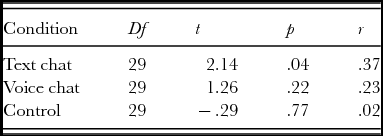
Two language teachers, one of which was one of the researchers, rated the learners’ productions using Hughes's (Reference Hughes2003) general speaking proficiency scale and a language development scale created for the specific purposes of this study. Hughes's (Reference Hughes2003) speaking proficiency scale comprises five sub-scales focusing on pronunciation, vocabulary, grammar, fluency, and understanding respectively. The language development scale comprised two sub-scales focusing on vocabulary and grammar development respectively. High levels of both inter-rater reliability and test-retest reliability were achieved for the speaking tasks, and the experimental and control conditions did not differ significantly in speaking proficiency at pre-test (F(2,87) = 1.85, p = .16, w = .25). At post-test, significant differences were observed across the experimental and control conditions (F(2,87) = 23.76, p < .01, w = .33),Footnote 3 with learners in both the text chat and voice chat conditions scoring significantly higher on the speaking test than learners in the control condition and no significant differences between learners in the voice chat and text chat conditions. The anxiety questionnaire was also found to have a high level of internal consistency. Learners’ anxiety levels were found to decrease from pre-test to post-test in both experimental conditions, but this decrease in anxiety levels was only statistically significant for learners in the text chat condition (see Table 1).
Results of pre-test post-test comparisons of learners’ anxiety levels in Satar & Ӧzdener (Reference Satar and Ӧzdener2008)

On the basis of these results, the researchers concluded that text chat is as effective as voice chat in terms of impact on speaking proficiency, that transfer is possible from written to oral communication, and that engaging in text chat activities may help learners gain confidence in their language skills. Satar & Ӧzdener (Reference Satar and Ӧzdener2008), however, note that it should be taken into consideration that the learners in the text chat group had higher levels of anxiety than those in the voice chat group at pre-test. They also speculate that voice chat may have had a differential impact on the anxiety levels of more and less proficient learners, decreasing anxiety levels for more proficient learners and increasing them for less proficient ones.
2.1.1 Approach to replication
Again, the significance of this piece of research cannot be denied. As indicated above, it is one of few field evaluations of TBLT. Further, the results of the study suggest that text chat might help learners overcome the common problem of reluctance to speak in the target language.
However, if we put aside the authors’ own specific aims in conducting this study, and focus on the aim of constructing an evidence-base which can inform the design of future CALL software and activities as well as decisions about their adoption, a number of replications of this study merit consideration.
First, a replication with a face-to-face control condition is recommended (see also Ziegler Reference Ziegler2015).Footnote 4 As the authors argue, it is acknowledged that without CMC, learners have limited opportunities to engage in speaking practice outside the classroom. Therefore a no provision control condition is appropriate. However, if, as this study suggests, engaging in text chat mediated tasks does indeed reduce learners’ levels of anxiety for speaking, and engaging in text chat mediated tasks has a comparable impact on speaking proficiency to engaging in voice chat mediated tasks, engaging learners in text chat-mediated tasks in the classroom may be beneficial and a comparison with standard (non-CALL) provision merits consideration. A replication in which text chat is compared with standard provision, i.e. face-to-face tasks, is also important to permit knowledge construction in the field. The inclusion of a face-to-face control condition would permit comparisons with the large body of TBLT research outside CALL (Ziegler Reference Ziegler2015; and see Robinson Reference Robinson2011 for a review of TBLT research) and the integration of findings from this strand of research into meta-analyses of related research in that area (Mackey Reference Mackey and Porte2012).
Second, in order to validate the findings of this study, it is recommended that a replication is conducted in which learners’ levels of anxiety are controlled for at pre-test. This might be achieved by matching learners on anxiety levels at pre-test or randomly allocating learners to conditions and including a measure of pre-test anxiety levels as a covariate in statistical analyses. Further, replications with more and less anxious learners are also recommended. As already stated, the finding that learners are less anxious is an important one and merits further investigation because it suggests that text chat might break the ‘vicious circle’ of speaking anxiety and low speaking proficiency (Compton Reference Compton2002: 25). While a likely explanation for the finding is that text chat places less time pressure on learners than voice chat, as the authors themselves suggest, there are a number of other possible explanations for the findings. These include differences in the anxiety levels of the learners in the study at pre-test and consequently the potential for their anxiety levels to decrease, as well as the possibility that text and voice chat have a differential impact on learners with different initial levels of anxiety:
the pre-test anxiety level of the text chat group was higher than that of the voice chat group. This might have resulted in a larger drop in the anxiety levels of the text chat participants . . . than the voice chat participants . . . [A]nother possible reason for the smaller decrease in the anxiety levels of the voice chat participants could be that the voice chat affected learners with different proficiency levels differently: higher proficiency learners might have become more confident, but those with lower levels might have lost their confidence as they struggled to put their thoughts into words in the synchronous environment (Satar & Ӧzdener Reference Satar and Ӧzdener2008: 607).
The collection of observational or ‘process’ data, as suggested by Satar & Ozdner (Reference Satar and Ӧzdener2008) themselves, ought also to be considered in any replication of this study. The purpose of the collection of such data would be to permit the exploration of possible explanations for the differences observed at post-test (Marsden Reference Marsden2007; Révész Reference Révész2014). Satar & Ӧzdener (Reference Satar and Ӧzdener2008) speculate that a potential reason for learners’ reduced anxiety in the text chat condition might be the reduced time pressure that learners experience. While it is acknowledged that there may be some interview evidence from learners in other studies (Beauvois Reference Beauvois, Bush and Terry1997, cited in Satar & Ӧzdener Reference Satar and Ӧzdener2008) which supports the claim that there is less time pressure in text chat because there is greater tolerance of ‘silence’, a replication in which time pressure is quantified and associated with anxiety levels would strengthen these claims. This might be achieved by recording and transcribing voice chat conversations and comparing them with text chat logs obtained through the chat software or through screen-capture technology such as Camtasia.
Replications in which outcome measures typically used in TBLT studies are employed should also be considered to permit comparisons of results with the significant body of research on the impact of TBLT on the quality of the speech produced by language learners (see Robinson Reference Robinson2011 for a review of TBLT research) and the integration of CALL studies into meta-analyses focusing on TBLT (Mackey Reference Mackey and Porte2012). That is not to say that studies employing native speaker ratings, as in the original study, are not important. Indeed, such studies have an important place in the research cycle. Given their alignment with the way in which oral proficiency is assessed in high-stakes assessments, they play an important role in linking more theoretically oriented research with practice. Measures frequently used in TBLT, however, merit consideration to permit the comparison of results with this large body of research (Robinson Reference Robinson2011). These measures of proficiency typically include measures of complexity – ‘the capacity to use more advanced language’, accuracy – ‘the ability to avoid error in performance’, and fluency – ‘the capacity to use language in real time’ (Skehan & Foster Reference Skehan and Foster1999: 96). Further, each construct is considered to be multi-dimensional and has been operationalized in a number of different ways (Ellis Reference Ellis2009). The use of such measures, therefore, has the potential to provide more in-depth insights into the impact of different forms of chat on oral language proficiency than ratings. It is acknowledged, however, that such instrumental replication may be difficult because the tasks used to obtain outcome measures are often not provided in journal articles (Marsden & Mackey Reference Marsden and Mackey2014) and information on coding procedures is often not sufficient to permit closer replication (Polio & Gass Reference Polio and Gass1997). Notable exceptions include Foster, Tonkyn & Wigglesworth's (Reference Foster, Tonkyn and Wigglesworth2000) article on coding for complexity using the AS-Unit, and Foster & Wigglesworth's (Reference Foster and Wigglesworth2016) article on coding for accuracy. In order to permit more of this form of replication, which is essential for knowledge construction in the field, editors of journals in applied linguistics might be advised to encourage the inclusion of instruments in appendixes, or their submission to the Instruments for Research Into Second languages (IRIS) database (https://www.iris-database.org; Marsden & Mackey Reference Marsden and Mackey2014), and the submission of methodological articles reporting and discussing data collection procedures, instrument design, coding and data analysis in depth.
Finally, like any study in CALL and SLA more broadly, replications with different populations in different settings ought to be considered in order to demonstrate the generalizability of findings, along with replications in which task variables and conditions that have been observed to impact on learning outcome in computer-mediated TBLT are manipulated. Examples of such variables include the focus target form and the type of interlocutor, native or non-native speaker (Ziegler Reference Ziegler2015).
3. Conclusion
In conclusion, as the original studies reviewed here demonstrate, CALL has the potential to add significant value to language learning. Replication is, however, necessary to validate important findings in the field and demonstrate their reliability, including not only generalizability to different populations and educational settings but also generalizability to different CALL systems. A summary of recommended replications is as follows:
Neri et al. (Reference Neri, Mich, Gerosa and Giuliani2008b)
− Focused on the specific affordances of the medium to increase internal validity and explanatory power as well as permit knowledge construction
− With a split class design to increase internal validity
− With other populations in other educational settings to test external validity
Satar & Ӧzdener (Reference Satar and Ӧzdener2008)
− With a face-to-face control condition to permit knowledge construction
− Using instruments and measures commonly used in related research in applied linguistics to permit knowledge construction
− With process data to increase explanatory power
− With other populations in other educational settings to test external validity
− With other task variables and task conditions to test external validity
Further, any future replications should be designed to contribute to the construction of an evidence-base upon which decisions about the design of future CALL software and activities can be made as well as decisions about investment in and use of CALL. That is, when planning replications, in fact any study, researchers need to carefully consider the potential for their study to build on existing knowledge in the field of CALL and applied linguistics more broadly, and for others to subsequently use and build on their findings.
Acknowledgements
The author is grateful to Dr Emma Marsden and Professor Leah Roberts for comments on earlier versions of this paper. She is also grateful to the authors of the studies recommended for replication in this article who kindly clarified the design of their studies and provided insightful comments on the proposed replications, as well as to the two anonymous reviewers who provided further constructive feedback on the paper.
Zöe Handley is a lecturer in the Department of Education at the University of York and a member of the Centre for Research in Language Learning and Use. Her main research interests are in CALL and second language speech learning, including pronunciation training, fluency development and TBLT. She has published a systematic review on the use of technology in primary and secondary EFL classrooms and a number of articles on the use of text-to-speech synthesis in language learning.