1. Introduction
The ‘Thinking Allowed’ strand of Language Teaching offers me the chance to give a more personal appraisal of discourse studies – a vast, multidisciplinary, and rapidly expanding area of research, which I believe has strong relevance to foreign language teaching materials design and classroom practice.Footnote 1 The broad approach to discourse studies advocated here mirrors the kind of collaborative processes, and attempts to reach beyond disciplinary boundaries, occurring in many fields of contemporary academia, where ‘there is a tension between disciplinary specialization and the need to acknowledge the complex reality of the 21st century.’ (Austin, Park & Goble Reference Austin, Park and Goble2008: 557). It is also an approach that suits the needs of foreign language teachers who, denied the comfort of limiting themselves to a narrow field of enquiry, are required to combine eclectically insights from multiple sources, in an attempt to enhance the language learning process.
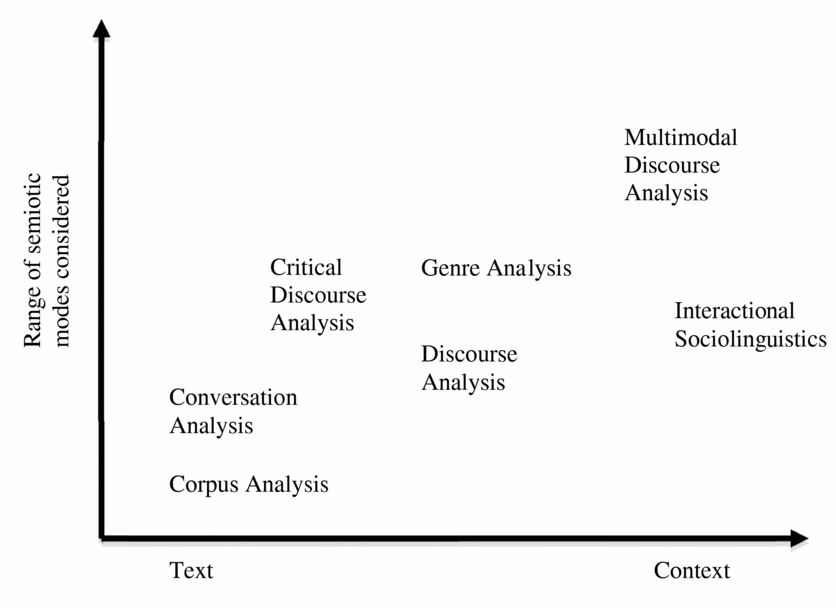
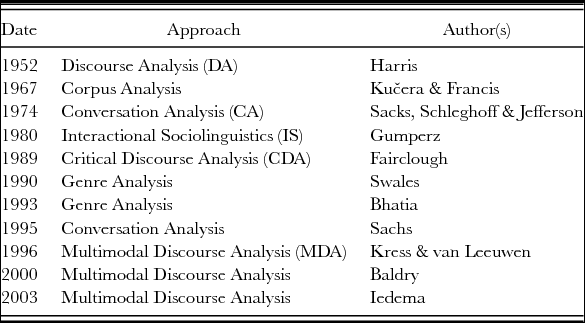
Definitions of discourse are varied and rather ambiguous, but tend to be framed either in linguistic terms, as ‘language above the level of the sentence or clause’ and ‘language in use’ (Cameron Reference Cameron2001: 13) on the one hand, or in non-linguistic terms, as ‘all forms of meaningful semiotic human activity seen in connection with social, cultural, and historical patterns and developments of use’ (Blommaert Reference Blommaert2005: 2,3) on the other. Within this definitional framework, different approaches to the study of discourse can all be roughly situated two dimensionally, depending on the extent that they consider text, social context, or a range of semiotic modes in their descriptions (Bhatia, Flowerdew & Jones Reference Bhatia, Flowerdew and Jones2008) (see Figure 1).Footnote 2 These varied approaches to the study of discourse have all appeared on the scene at different stages over the last 50 years or so. Tracing the exact timing of their emergence, or the key influences involved in their conception, is not always easy, but Table 1 attempts to position them historically through important landmarks in the research literature:
Unfortunately, space limitations prohibit a comprehensive discussion of all of these approaches, and I will limit my focus here to the four areas that (currently) have the closest associations with the English Language Teaching (ELT) profession: corpus analysis, conversation analysis, discourse analysis and genre analysis.
How seven approaches to DA vary in their focus on text, context or semiotic modes

The emergence of different approaches to the study of discourse
1.1 Corpus analysis
Corpus analysis is essentially a ‘bottom-up’, text-based approach to the study of discourse, with the majority of data coming from the written, rather than the spoken, mode because of the difficulties and expense associated with recording, transcribing and compiling corpora of naturally occurring speech (Römer Reference Römer2006; McCarthy Reference McCarthy2008). Corpus linguists typically deal with quantitative data such as frequency lists (of individual words or ‘clusters’), dispersion measures, keywords, type token ratios and collocation/colligation patterns, but then use this information to guide more qualitative inspections of concordance lines or short stretches of the source texts. Consideration of the context of target language often stops at this stage though and, despite the obvious links between the two disciplines of corpus analysis and discourse analysis, surprisingly little corpus-based discourse analysis (CBDA) has been carried out to date (Baker Reference Baker2006; Lee Reference Lee, Bhatia, Flowerdew and Jones2008). This could be due to a number of factors, such as the relative scarcity of spoken corpora (the focus of interest for many discourse researchers), or a lack of familiarity with corpus techniques amongst discourse analysts (Lee Reference Lee, Bhatia, Flowerdew and Jones2008). A further obstacle is the absence of adequate details on the context of production of texts in many large corpora, although the trend towards smaller, specialized corpora ‘where the compiler-cum-analyst has access to valuable background information for interpretation of the data’ (Flowerdew Reference Flowerdew, Bhatia, Flowerdew and Jones2008: 115) is likely to encourage a greater discourse focus (Connor & Upton Reference Connor and Upton2004). In the future, multimodal corpora, which move beyond tagged, text-only files and allow researchers to inspect context in finer detail for both written texts (layout, font size or style, visuals) and spoken texts (posture, gaze, gestures, prosody) (Carter & Adolphs Reference Carter and Adolphs2013) are also likely to facilitate a CBDA approach.
1.2 Conversation analysis
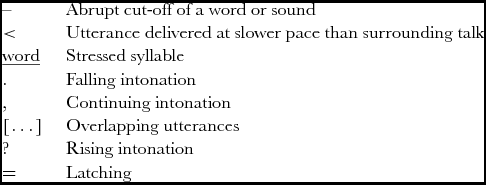
‘Conversation analysis’ (CA) is another markedly text-centred form of investigation, which gives primacy to naturally occurring spoken interaction as the ‘primordial site of sociality’ (Schegloff Reference Schegloff1986: 112). Instead of looking to the context or participants themselves to explain their data, conversation analysts rely on close transcription of talk to explore the ways speakers orientate to each other in the unfolding sequences of interaction, asking of each utterance, ‘Why that now?’ (Schegloff & Sacks Reference Schegloff and Sacks1973). Unlike corpus studies, CA therefore tends to be interested in single instances as opposed to aggregates, and suspicious of attempts to quantify, arguing, for example, that a measure like ‘laughter per minute’ has no explanatory power (Schegloff Reference Schegloff1993). The precision and depth of the transcription process in CA (see Schegloff Reference Schegloff2007, appendix 1, for a useful summary of transcription conventions), capturing phenomena such as openings and closings, turn-taking, interruptions, pauses, topic shift, laughter and prosodic features, ‘defamiliarizes what we normally take for granted and reveals the unsuspected complexity of our everyday verbal behaviour’ (Cameron Reference Cameron2001: 89).
A good example of the kinds of insights CA can afford comes from work on pre-sequences and the important ‘face-saving’ role they play in framing invitations, offers and requests and avoiding dispreferred responses (in this case, rejection) (Schegloff Reference Schegloff1988; Bernsten Reference Bernsten2002; Bowles Reference Bowles2006; Curl & Drew Reference Curl and Drew2008). In the following extract from Schegloff (Reference Schegloff2007: 31),Footnote 3 John uses the pre-invitation ‘say what’r you doing’ in line 2 to gauge the likelihood of a favourable response to a projected invitation. Judy can reply with a go-ahead, blocking, or hedging response; in this case she uses a blocking response, ‘Well, we’re going out’ in line 3 which, by itself, is likely to discourage John from continuing to the invitation adjacency pair. However, she extends her turn with a hedging response, ‘Why’, which indicates that she may be willing to consider the projected invitation. This prompts John to produce an indirect rather than a direct invitation, using the past continuous tense and just as softeners, ‘Oh, I was just gonna say come out’, in line 4 and to add, ‘but if you’re going out you can't very well do that’ in order to give Judy the possibility of refusing the invitation without a loss of face for either interlocutor.
Speakers’ strong orientations to face issues, highlighted in CA transcripts such as this through the delicate interactional negotiation that occurs around face-threatening acts (FTAs), is something largely ignored in English as a foreign language (EFL) textbooks and provokes questions as to the extent to which language learners are being effectively prepared for the social world we all inhabit (Wajnryb Reference Wajnryb1996).
1.3 Discourse analysis
‘Discourse analysis’ (DA) is commonly used as an umbrella term for all of the approaches considered in this paper, leading to a certain amount of definitional ambiguity. For this reason, I have followed van Dijk (Reference van Dijk and van Dijk2007, Reference van Dijk2011) in referring to the broader cross-discipline as ‘discourse studies’, limiting ‘DA’ to a more restricted sense, which has its roots in the field of linguistics. Although the term ‘discourse analysis’ first appeared in the literature over 60 years ago (Harris Reference Harris1952), it really only began to emerge as a subject in its own right in the 1970s, through the work of British linguists such as Halliday, Sinclair, Brazil and Coulthard, who moved attention away from structural regularities at the sentence level (in the Chomskian tradition), to wider considerations of ‘texts’ (both spoken and written), and meaning-making in response to the contextual variables of field (the content or topic), tenor (the nature of relationships) and mode (the medium or channel of communication) (e.g. Sinclair & Coulthard Reference Sinclair and Coulthard1975; Halliday Reference Halliday1978; Brazil, Coulthard & Johns Reference Brazil, Coulthard and Johns1980). DA has also been heavily influenced by speech act theory from linguistic philosophy (e.g. Austin Reference Austin1962; Searle Reference Searle1969; Grice Reference Grice, Cole and Morgan1975), pragmatics (e.g. Leech Reference Leech1983; Levinson Reference Levinson1983), and text linguistics (e.g. Halliday & Hasan Reference Halliday and Hasan1976; De Beaugrande Reference De Beaugrande1980), as well as conversation analysis and interactional sociolinguistics from the USA. DA, in the form it has emerged from in linguistics, can therefore be seen as embracing a wide scope, with varying levels of attention to text, context and semiotic mode.
1.4 Genre analysis
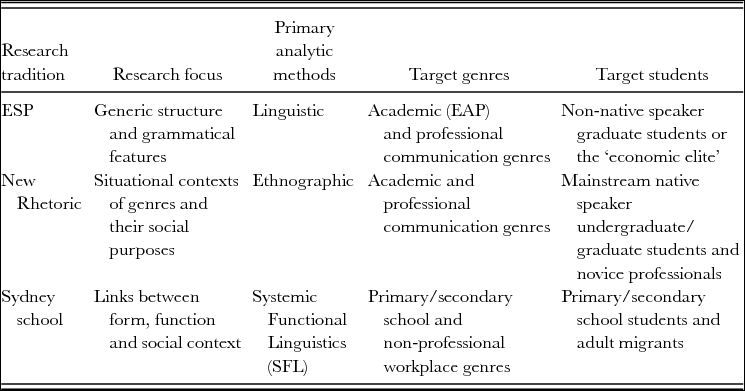
Genre analysis is the study of discourse conventions, ‘which arise from preferred ways of creating and communicating knowledge within particular communities’ (Swales Reference Swales1990: 4) (see Table 2). It has been shaped by three key research traditions – English for Specific Purposes (ESP), New Rhetoric Studies, and Systemic Functional Linguistics (the Sydney school) – each with its own particular concerns and perspectives. Traditionally, genre analysis has tended to focus on structural or textual regularities in writing, particularly across academic and professional contexts, but more recent insights from studies of spoken discourse have highlighted the important role that generic forms, such as narratives, gossip and joke-telling, also play in casual conversation (Eggins & Slade Reference Eggins and Slade1997). Characteristic patterns of language use and behaviour emerge naturally in society to allow interlocutors to effectively manage the complexity of communicative events and ‘get things done’ in recurring types of rhetorical situation, from a visit to the doctor to a research report in an academic journal (McCarthy & Carter Reference McCarthy and Carter1994; Hyland Reference Hyland2002). Discourse patterns tend to evolve differently from one culture to the next and characteristic cultural preferences can be identified in both spoken and written genres (Connor Reference Connor1996). Providing learners with access to the privileged genres of a target discourse community is obviously an important goal in language education, and an area where the interests of genre analysis, CDA, IS, and pedagogy overlap (e.g. Swales Reference Swales1990; Hyland Reference Hyland2003; Martin & Rose Reference Martin and Rose2003). However, as Bhatia (Reference Bhatia2004) points out, pedagogic goals in language/professional communication classes tend to encourage the presentation of simplified or idealized genres that are viewed as static or fixed entities. In reality, genres constantly evolve and change in response to environmental and rhetorical pressures (e.g. Bazerman Reference Bazerman1988), and expert writers mix, embed and bend generic forms to suit their own particular rhetorical needs.
Different approaches to genre analysis (see Hyon Reference Hyon1996)
1.5 Discourse studies and interdisciplinarity
A number of observations can be made from this brief overview of some of the different approaches to discourse studies in existence today. Firstly, while each brings its own unique perspective to the field, there is also a high degree of interconnectivity and overlap amongst the various sub-disciplines. Rather than limiting ourselves to one particular approach, it would seem to me much more useful to see them all as complementary tools in our ‘discourse toolbox’: a selection of lenses that can be combined eclectically to reveal different layers of meaning in our data (see Young Reference Young2002 and Stubbe et al. Reference Stubbe, Lane, Hilder, Vine, Vine, Marra, Holmes and Weatherall2003 for examples of this). Collaborative work of this type brings with it significant challenges – relinquishing ‘ownership’ of knowledge, substantial time commitments, obstructive institutional structures, trust and process issues amongst participants, the negotiation of a common interdisciplinary language, and uncertain outcomes (Austin et al. Reference Austin, Park and Goble2008) – but, as Blommaert (Reference Blommaert2005: 237) says, this is ‘a richer and more interesting field to dwell in than rigidly defined habitual orthodoxies of scientific exploration’. Secondly, although discourse studies started out as being predominantly about text linguistics, there has been a noticeable shift in focus away from texts towards the context of production, as well as increased interest in non-textual forms of social semiotics (Bhatia et al. Reference Bhatia, Flowerdew and Jones2008). This trend in itself is encouraging more interdisciplinary dialogue, as researchers begin to better appreciate the fact that the complexity of social interaction, as it is played out in the real world, requires a multi-level analytical approach in order to be truly descriptive.
In the following two sections of this paper, I will try to assess the extent to which the four perspectives on discourse mentioned above have found their way into language learning materials, and will offer up some suggestions on how discourse studies may influence ELT classrooms of the future.
2. Research findings that are getting through
2.1 Corpus analysis
The ‘corpus revolution’ (Rundell & Stock Reference Rundell and Stock1992) has had a major and lasting impact on language learning materials in some respects. The first corpus-based learner dictionary, the Collins Cobuild English language dictionary, appeared on the market in 1987 as a result of the pioneering work of John Sinclair at the University of Birmingham. At the time it was considered by many to be over-elaborate and expensive and was only a modest commercial success (D. Willis, personal communication), but has since been widely imitated by all the major publishers, such as Oxford, Cambridge and Macmillan. Reference grammars, such as Collins Cobuild English grammar and Cambridge grammar of English, are also now corpus-informed and provide more accurate descriptions of everyday usage, as well as clarifying distinctions between spoken and written modes.Footnote 4 The fact that these kinds of resources are designed around word frequency lists or collocation data from mega corpora, and provide authentic samples of the language, ensures a higher level of reliability and validity absent from traditional publications, which depended more on lexicographers’ or grammarians’ intuitions and the accumulated descriptions from earlier works.
The Cobuild corpus also inspired innovative approaches to textbook design with the Collins Cobuild English course (Willis & Willis Reference Willis and Willis1988), a task-based lexical syllabus built around the most frequent 2,500 words from the corpus, which constitute 80% of all spoken and written English. Its design, unfortunately, proved to be too radical for the English language teaching community and it was not a commercial success, although it did influence later publications such as Cutting edge (Cunningham & Moor Reference Cunningham and Moor1998) and Inside out (Kay, Jones & Hird Reference Kay, Jones and Hird2001) (D. Willis, personal communication). The potential benefits of corpora on materials design can be seen very clearly in the business English textbook, Business advantage (Upper-intermediate) (Handford et al. Reference Handford, Lisboa, Koester and Pitt2011), which uses data from the Cambridge Business Corpus and the Cambridge and Nottingham Business English Corpus to both identify key discourse features of the genre and to provide semi-authentic models of spoken interaction from business contexts. For example, the listening exercise 2.14 in unit 10 is adapted from an authentic internal meeting within a luxury hotel chain, taken from CANBEC (see Handford Reference Handford2010: 44,45 for the original transcript). More than 40 minor changes were made to the original transcript in the editing process,Footnote 5 illustrating some of the difficulties involved in tailoring real interaction to the classroom, but the final product does, at least, recognize the value of authentic discourse for language learners. The material allows the authors to highlight persuasion strategies employed by the manager (contrast structures and their prosodic features, management speak and the use of if to direct staff) – features that are only possible to identify as significant with the help of a corpus. The textbook also claims to incorporate insights from the Cambridge Learner Corpus in order to identify and clarify typical learner errors and to avoid teaching structures that are unproblematic for students – another example of the way that corpus data is now commonly informing language teaching.
Specialized corpora are increasingly being exploited to describe and teach academic or professional discourse, as they are better able to address the language needs of specific groups (e.g. Flowerdew Reference Flowerdew, Connor and Upton2004; Hyland Reference Hyland2008; Feak & Swales Reference Feak, Swales and Harwood2010). This trend towards smaller, specialized corpora, developed locally to meet local needs, is likely to continue, given the wide availability of electronic text, increasingly powerful computers and improved corpus software (Rundell Reference Rundell1996).
2.2 Discourse analysis
Discourse analysis (in its applied linguistics sense) has always had close ties with foreign language pedagogy, and a wide range of books exist that explore the links between theory and practice (e.g. Cook Reference Cook1989; McCarthy Reference McCarthy1991; Hatch Reference Hatch1992; McCarthy & Carter Reference McCarthy and Carter1994; Thornbury & Slade Reference Thornbury and Slade2006; Jones Reference Jones2012; Flowerdew Reference Flowerdew2013). These cover important themes (such as language variation, transactional/interactional distinctions, implicature and the cooperative principle, speech acts, text cohesion/coherence, discourse intonation and discourse structure), which can heighten language teachers’ overall discourse awareness and have positive knock-on effects in the classroom. The impact of these insights on globally marketed textbooks has been relatively modest to date, although an increasing emphasis on authentic language models (e.g. Gilmore Reference Gilmore2007a) means that relevant features are more likely to crop up in texts and can be highlighted by teachers, even if they are not the focus of attention in the original materials. Some textbooks have been more successful than others in adopting a ‘language as discourse perspective’. The Touchstone series (McCarthy, McCarten & Sandiford Reference McCarthy, McCarten and Sandiford2004, Reference McCarthy, McCarten and Sandiford2005, Reference McCarthy, McCarten and Sandiford2006) and the Natural English series (Gairns & Redman Reference Gairns and Redman2006, Reference Gairns and Redman2010), for example, cover topics such as opening, extending and closing conversation, vague language, discourse markers, listener responses, oral narratives and discourse intonation. Other books worthy of mention because of their more explicit discourse focus are Exploring spoken English (Carter & McCarthy Reference Carter and McCarthy1997), Discourse analysis in the language classroom (Riggenbach Reference Riggenbach1999), and Intonation in context (Bradford Reference Bradford1988). Exploring spoken English contains recorded samples of authentic conversational data from eight common speech genres, accompanied by detailed line-by-line commentaries which identify pervasive lexicogrammatical features often ignored in language textbooks (e.g. back-channels, deixis, ellipsis, heads and tails, vague language). Although originally intended for use, either in the classroom or for self-study, by teachers, teacher-trainers, materials developers, students of applied linguistics or advanced learners of English, it is probably most valuable as a resource to be consulted selectively by language experts, to illustrate the kinds of discourse features occurring in natural speech, and indeed there have been innumerable requests to the authors from around the world to print single chapters in teaching materials to this end (Carter, personal communication).
Discourse analysis in the language classroom describes a series of sample activities, encouraging learners to take on the role of the discourse analyst through a six-step process, which involves collecting, transcribing and analysing their own data. The teacher's role is therefore more of a facilitator, creating the conditions for learners to discover systematic features of the target language for themselves, and to ‘notice the gap’ between their own second language (L2) performance and that of more proficient speakers, in the hope that it will enhance the acquisition process (e.g. Schmidt & Frota Reference Schmidt, Frota and Day1986; Basturkmen Reference Basturkmen2001). This kind of open-ended, inductive approach, with its unpredictable conclusions, may be uncomfortable for teachers more familiar with working from a fixed syllabus, and is certainly very time-consuming (Riggenbach estimates one to five hours in class, per activity, plus a considerable amount of out-of-class work gathering and analysing data). However, the active role it gives learners in their own learning is likely to prove motivating and has been shown by some researchers to be both practical and effective (e.g. Crandall & Basturkmen Reference Crandall and Basturkmen2004). Teachers can maintain greater control over the process by providing students with materials rich in target discourse features, rather than asking them to go out and find their own, and film scenes can be a useful source of data in this kind of approach (Gilmore Reference Gilmore, Rilling and Dantas-Whitney2009a, Reference Gilmore, Mishan and Chambers2010).
Intonation in context is one of the few attempts (but see also Brazil Reference Brazil1994a and, more recently, Hewings Reference Hewings2007 or Cauldwell Reference Cauldwell2013) to translate David Brazil's systematic description of discourse intonation (e.g. Brazil Reference Brazil1985a, Reference Brazil and van Dijkb; Brazil et al. Reference Brazil, Coulthard and Johns1980) into practical pedagogic materials. Rather than associating intonation with either grammatical forms or attitude, as is commonly the case in language textbooks, it emphasizes ‘the importance of speaker choice and adjustment to the constantly changing state of play between participants in the talk’ (McCarthy Reference McCarthy1991: 114). Speakers select from options within the three sub-systems of prominence, tone and key in response to the unfolding interaction: ‘prominence’ relates to the use of vowel lengthening, increased volume or pitch variation to highlight salient words in the conversation; ‘tone’ refers to pitch changes on the tonic syllable of a tone unit which have either a ‘proclaiming’ or ‘referring’ function, depending on whether information is viewed as new or shared; and ‘key’ describes pitch jumps (between low, middle and high options) to reiterate or contrast information, or to signal topic initiation and termination in talk. This all serves to illustrate that, despite a reputation ‘for difficulty and for slipperiness’ (Brazil Reference Brazil1994b: 2), intonation can be made accessible to students in a way that can benefit both their listening and speaking proficiency, although it is rarely given the space it deserves in textbooks.
2.3 Genre analysis
Genre analysis and rhetorical consciousness-raising has had a significant impact on language learning materials. General English textbooks regularly include pre-reading/listening activities, designed to activate learners’ content or formal schemata and facilitate top-down processing and text comprehension (e.g. Carrell Reference Carrell1985, Reference Carrell1987; Richards Reference Richards1990), as well as writing exercises highlighting the structural characteristics of some of the more predictable genres, such as application letters or expository essays. Genre-based approaches have been particularly influential in English for academic purposes (EAP)/ESP contexts (e.g. Henry & Roseberry Reference Henry and Roseberry1998; Hyland Reference Hyland2002; Belcher Reference Belcher2004), where students are initiated into the rhetorical practices of their target discourse communities. Study skills books (e.g. Wallace Reference Wallace2004) attempt to develop efficient reading strategies by illustrating the systematic organization of academic textbooks or journal articles, and helping learners identify where key information can be found. Common ‘frames’ for writing assignments, such as cause/effect, problem/solution and compare/contrast, are also regularly taught to help students conform to rhetorical norms that can differ considerably from those in their first language (L1). Swales’s (Reference Swales1990) work on the structure of research articles (RAs) has been influential, and many academic writing courses cover topics such as the IMRD (introduction, method, results and discussion) model and rhetorical moves in article introductions (e.g. Swales & Feak Reference Swales and Feak1994; Hamp-Lyons & Heasley Reference Hamp-Lyons and Heasley2006). As Hyland (Reference Hyland2009: 18) points out, academic publications now play a crucial role in the careers of many researchers, so a focus on this key genre would seem justified in EAP courses:
Participation in the global exchange of information is now a prerequisite for promotion and job security for a growing number of academics around the world, and this increasingly has to be done in English. Visibility is all important and statistics show that academics all over the world are ever less likely to publish in their own languages and to find their English language publications cited more often.
‘Occluded genres’, which operate behind the scenes in academic communication (such as request/reminder letters to peers/supervisors or submission/review letters), have also been found to cause considerable difficulties to non-native speaker (NNS) graduate students (Swales Reference Swales1990: 77), and are beginning to receive more attention in instructional materials (e.g. Swales & Feak Reference Swales and Feak2000). Similarly, the problems posed by spoken academic genres (such as lectures, seminars, conference presentations, supervision meetings and dissertation defences) are attracting more interest from both researchers (e.g. Flowerdew Reference Flowerdew1994; Hyland Reference Hyland2009) and materials writers (e.g. Anderson, Maclean & Lynch Reference Anderson, Maclean and Lynch2004; Lynch Reference Lynch2004), as universities seek to internationalize and switch to English as their medium of instruction (Lillis & Curry Reference Lillis and Curry2010). However, Young's (Reference Young and Flowerdew1994) phasal analysis of the macro-structure of university lectures suggests that the generic descriptions (of the beginning-middle-end variety) currently provided in study skills books are over-simplistic, and there is clearly more work to be done in describing these genres and translating the findings into useful pedagogic materials.
3. Research findings that are not getting through
3.1 An overview
Appendix 1 (See ‘supplementary materials, to be found at http://journals.cambridge.org/action/displayJournal?jid=lta) summarizes the findings from 44 different sources in the research literature, which explicitly address the issue of mismatches between the language models provided in textbooks and ‘authentic’ discourse found outside the classroom.Footnote 6 This list is, no doubt, far from comprehensive and may be biased towards my own particular research interests, but it does allow us to make some tentative observations:
1. For a wide range of discourse features (including lexicogrammatical items, speech acts, generic structure, and interactional features of contingent talk), ELT textbooks often provide learners with distorted or partial representations of the target language to work from, and these are likely to impact negatively on students’ developing communicative competence.
2. The work spans a time period of over three decades (1981–2012), mirroring the growing interest in discourse studies within the research community from the early 1980s onwards, and is predominantly informed by insights from DA, CA and corpus analysis. This is, perhaps, unsurprising, given that these sub-disciplines tend to focus more on the textual features of discourse and are therefore more closely aligned to the lexicogrammatical concerns of traditional language courses.
3. The majority of criticisms made in the literature relate to inaccuracies in spoken, rather than written, models in ELT textbooks, and this probably reflects the difficulties materials designers have in, firstly, accessing and recording authentic speech, and then identifying pedagogically useful samples which still remain comprehensible and interesting for learners once decontextualised in the classroom (see Brown & Yule Reference Brown and Yule1983: 82; Carter & McCarthy Reference Carter and McCarthy1997: 7). Scripted dialogues, tailored to the specific goals of the materials writer and then recorded by professional actors in a studio, are an understandable choice in this situation, but native speaker intuitions about language and speech behaviour are notoriously unreliable (e.g. Slade Reference Slade1986; Wolfson Reference Wolfson1986; Burns Reference Burns1998) and, as the appendix demonstrates, the danger is that students are then presented with distorted models of the target language to learn from and mimic. A good compromise (as seen in Handford et al. Reference Handford, Lisboa, Koester and Pitt2011) is to base textbook models on authentic interactions, modifying as necessary to meet pedagogic aims, while preserving as many of the original discourse features as possible.
4. The information detailed in these studies, whilst interesting, fails to provide us with any kind of systematic evaluation of the accuracy of textbook models. The CA-focused work tends to deal mainly with opening and closing sequences in conversation, while the DA- and corpus-based research covers a random selection of lexicogrammatical features; even for those target forms focused on in the research literature, there is little evidence of any subsequent impact on the design of language-learning materials. Undoubtedly, many gaps still remain in our knowledge, and it is also unclear which discourse features are more likely to impact on learners’ overall communicative competence and should therefore be prioritized in a language syllabus. Systemic functional linguistics (SFL) probably offers a better foundation for syllabus design from a discourse perspective because, rather than organizing itself around functional categories or grammatical structures, it begins by considering the typical communicative contexts and language choices available to speakers of a target group across the register variables of field, tenor and mode. Commonly occurring genres which learners are likely to encounter in their future (imagined) contexts of use can be used to structure the syllabus – any discourse features regularly cropping up in these generic samples will then have guaranteed pedagogic relevance. This is the kind of approach taken by Burns, Joyce & Gollin (Reference Burns, Joyce and Gollin1996), who use Eggins’ (Reference Eggins1990) ‘typology of spoken interactions’ to teach spoken English in the classroom. Genres illustrating differences across the tenor dimensions of (a) social distance, (b) attitude/emotion towards addressee, and (c) authority/power are presented to students and provide an effective way of systematically modelling language variation in the target discourse community (Burns Reference Burns1998).
5. Given the time span covered in the survey, there is a possibility that some of the criticisms levelled at language textbooks in Appendix 1 may no longer be justified, as materials writers react to debates in the literature. Gilmore (Reference Gilmore2004), for example, identifies some improvements in the representation of spoken discourse features such as latching, hesitation devices and back-channelling in course books published between 1981 and 2001, and this might be indicative of a research-driven trend towards greater authenticity. ELT publishers are, however, notoriously conservative and slow to respond to calls for change from the applied linguistics community (Littlejohn Reference Littlejohn1992; Tomlinson Reference Tomlinson2011; Burton Reference Burton2012), and findings from research often ‘linger in the journals’ (Bouton Reference Bouton and Bouton1996) in a way that indicates a significant disconnect between the experienced realities of the two groups. As Littlejohn (Reference Littlejohn1992: 276, 277) rather cynically points out, ‘The publishers’ premises for publication [. . .] emphasise financial goals and they thus appear to have few vested interests in the precise nature of the materials (apart from cultivating continued purchasing of teaching materials)’.
6. Most of the research summarized in Appendix 1 focuses on English, although there is some evidence that models for other languages exhibit similar distortions. This is unsurprising given that the method of production, using contrived language models, is likely to be the same for all foreign language textbooks.
3.2 Corpus analysis
As we saw in section 2, corpus analysis has had a significant impact on some aspects of foreign language learning, but there are at least two areas where the take-up has been less enthusiastic. Firstly, the evidence suggests that textbook authors are not yet habitually checking their materials against relevant corpus data to ensure that the language models they provide are as naturalistic and pedagogically useful as possible. As Rundell noted in 1996 (para. 28) about the ELT profession:
has been rather slow to incorporate corpus methods into its working practices. It is still the case that the majority of ELT materials-writers rely on a combination of their own intuitions and teaching experience, and a well-established canon of apparently self-evident ‘facts’ about the language which have, more or less, the status of tradition.
Very little seems to have changed in the intervening years. Burton (Reference Burton2012) asked 13 professional textbook authors about their writing practices and found that only eight of them had made any use of corpus data in the production of their materials (unfortunately, the extent of their use is not reported). The decision to refer to corpora tended to come from the authors themselves, rather than their publishers, suggesting that many publishing companies are still not actively encouraging the development of corpus-informed materials. Those participants in the survey who had never referred to corpora cited a lack of expertise, access or time as their major reasons, all of which seem rather weak from an applied linguist's perspective: the rudimentary principles of word/cluster frequency, collocation or key words are easy to grasp, a wide range of corpora are freely accessible online (see O’Keeffe & Farr Reference O’Keeffe and Farr2003: 417, 418 for an extensive list), and publishers should surely be making time to get their materials right. Overall, the picture at present is of an industry with little commitment to empirically grounded language learning materials, and it will probably require intense lobbying from teachers and learners to bring about any real change in the status quo (McCarthy Reference McCarthy2008).
A second area of limited penetration relates to the direct use of corpora by language teachers and learners themselves, and a number of researchers have commented on the widening gap between corpus-linguistics research and classroom teaching (Mukherjee & Rohrbach Reference Mukherjee, Rohrbach, Ketteman and Marko2006; Römer Reference Römer2006; McCarthy Reference McCarthy2008; Zhang Reference Zhang2008; Aijmer Reference Aijmer2009). Of course, researchers are often quick to claim practical relevance for their work and, historically, this has sometimes resulted in the over-exuberant application of (now discredited) methods such as audiolingualism in the classroom (Howatt Reference Howatt1984; Richards Reference Richards2006). However, the potential benefits for classroom-based corpus analysis, or ‘data-driven learning’ (DDL) (e.g. Johns Reference Johns, Johns and King1991), are well known: (1) DDL encourages students to discover language patterns for themselves, inductively, which is thought to lead to greater cognitive processing and deeper learning (e.g. Gollin Reference Gollin1998); (2) it is more learner-centred, allowing students to test their own hypotheses and discover rules in ways that best suit their own particular stage of interlanguage development (Rundell Reference Rundell1996); and (3) it allows students to notice patterns which have been omitted from text/reference books, either because they are too complicated or have been overlooked (Johns Reference Johns, Johns and King1991).
A number of possible causes for the disappointing levels of corpus take-up in the classroom have been put forward:
1. Groom (Reference Groom2009) and Boulton (Reference Boulton, Boulton, Carter-Thomas and Rowley-Jolivet2012) suggest that it may be because of a lack of technical resources or availability of free, stable corpus analysis tools. Schools and universities are often unable to provide ready access to online corpora, or the means to display search results to the whole class, and hands-on practice by students is normally only possible in computer rooms or at home, none of which encourages spontaneous querying of corpus data. These limitations can be overcome to some extent by providing worksheet activities and printed sample concordance lines for students to analyse, which has the added advantage of removing unnecessary ‘noise’ from data (concordance lines that are difficult to re-contextualize, culturally opaque, or illustrate a different use of the target word/phrase). This is the kind of approach offered in Exploring academic English: Workbook for student essay writing (Thurston & Candlin Reference Thurston and Candlin1997), which investigates key language around important rhetorical functions in academic writing, such as referring to the literature or hedging claims.
2. Another potential discourager is the time-consuming nature of inductive learning; teachers may find it impossible to make the necessary space in an already crowded syllabus and students may see corpus tasks as ‘tiresome and time-wasting activities to be endured until the teacher finally weighs in with the correct answer’ (Groom Reference Groom2009: 27). Concordance lines can be difficult to interpret at first, as the natural tendency is to read from left to right along the sentence, rather than looking for collocational patterns either side of the node (O’Keeffe & Farr Reference O’Keeffe and Farr2003). They can be particularly overwhelming for lower proficiency students, who might choose to ignore them altogether as a coping strategy (Gilmore Reference Gilmore2009b; Parise Reference Parise2009).
3. On a related theme, Römer (Reference Römer2006: 128) points out that students might be reluctant to engage with corpus data because it ‘destroys their orderly world of clear-cut grammatical rules and clear right-or-wrong decisions’ – a response which is likely to be closely associated with L2 proficiency level, with more advanced learners showing increasing interest in, and willingness to engage with, the finer nuances of language variation and usage. This is in line with the concepts of scaffolding and ‘working within the Zone of Proximal Development’ (ZPD) from social constructivism, which suggest that learners need to be constantly challenged by tasks and knowledge just beyond their current level of development in order to maximize learning processes (e.g. Williams & Burden Reference Williams and Burden1997). Students are well aware of their own stage of language development and have an intuitive sense of what materials or tasks are most suitable at any particular point in time – by observing closely as learners engage in corpus-based tasks, teachers should be able to judge for themselves whether corpus tools are effectively mediating learning or not and respond appropriately.
4. Technical challenges, including the mastery of unfamiliar terminology (parsing, tagging, type-token ratios, etc.) or corpus software, might also act as a deterrent (Zhang Reference Zhang2008). However, many of the online platforms available today, such as the BYU site (http://corpus.byu.edu/corpora.asp), MICASE (http://micase.elicorpora.info/) Compleat Lexical Tutor (http://www.lextutor.ca/), or the Sketch Engine (http://www.sketchengine.co.uk/), are all fairly user-friendly and well supported with online help pages or video tutorials.
5. A final reason seldom mentioned in the literature is the unpredictability that a DDL approach often engenders in the classroom. Since neither the language selected by students for corpus investigation nor the resulting random sample of concordance lines pulled up to test their hypotheses can be specified in detail beforehand, teachers are forced to think on their feet, and, deprived of the sense of security which comes with having an answer key to hand, might be concerned about losing face in front of their students. The solution to this could be, quite simply, to encourage teachers and learners to see the learning process as a voyage of discovery they embark on together, on an equal footing – to accept that language descriptions presented to them in textbooks or reference books are only ever partial, that both native and non-native speaker intuitions about language can often prove to be flawed when checked against empirical data, and that the exploration of corpora can provide a more nuanced and complete picture of language patterns and meanings (Recski Reference Recski2006).
3.3 Conversation analysis
The application of insights from CA to language learning is still very much in its infancy, with interest only noticeable in the last 15 years or so (Seedhouse Reference Seedhouse2005; Barraja-Rohan Reference Barraja-Rohan2011). Although traces of it can be seen in many internationally marketed textbooks, the association is not usually explicitly acknowledged and any metalanguage from the discipline is generally avoided. Common themes cropping up include the matching of first and second pair-parts in adjacency pairs such as greetings and return-greetings (e.g. Hutchby & Wooffitt Reference Hutchby and Wooffitt2008), the use of Reactive Tokens (Clancy et al. Reference Clancy, Thompson, Suzuki and Tao1996) to show interest in listenership roles during conversation, conversation openings or closings and topic expansion to develop turns.Footnote 7 The only truly CA-based textbook produced to date, to my knowledge, is Beyond talk (Barraja-Rohan & Pritchard Reference Barraja-Rohan and Pritchard1997), which explores key mechanisms of spoken interaction through filmed extracts of unscripted native speaker role-plays or authentic conversation, supported by a comprehensive teacher's book and detailed transcriptions showing relevant prosodic and paralinguistic features. There were very positive reactions from students, teachers and CA researchers associated with the project (Barraja-Rohan personal communication), and although now out of print, Beyond talk is still available online (http://eslandcateaching.wordpress.com/beyond-talk/).
A number of teacher resource books are also CA-informed to some extent: Conversation (Nolasco & Arthur Reference Nolasco and Arthur1987) and Conversation and dialogues in action (Dörnyei & Thurrell Reference Dörnyei and Thurrell1992), unfortunately both out of print now, include awareness-raising activities on features such as back-channelling, projecting completion of turn-constructional units (TCUs), conversational repair and preferred/dispreferred responses to various speech acts. Also regrettable is the fact that no authentic interactions or detailed transcripts are provided in these resource books, so teachers have to generate their own materials to supplement the activities, something requiring considerable time and know-how.
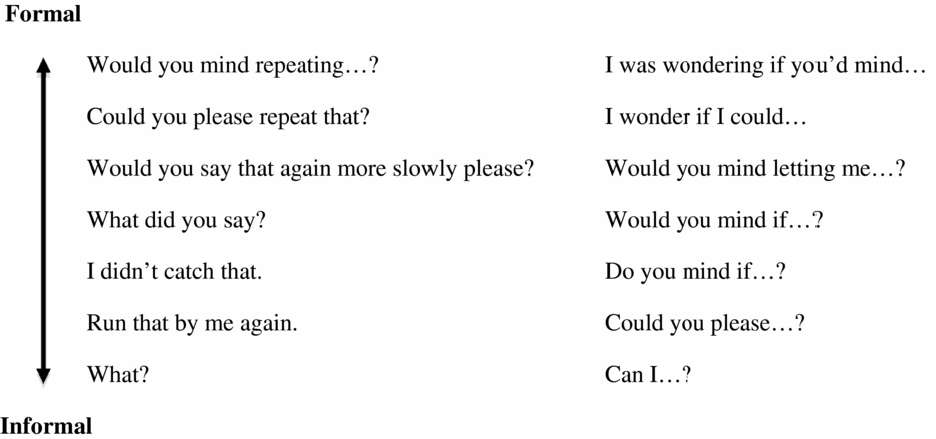
Emanuel Schegloff, one of the founders of CA, has pointed out that conversation analysts are not usually overtly concerned with identifying instructable aspects of their work, and that there is ‘open terrain for enquiry [. . .] for those who will undertake to bring together the necessary training in CA with engagement with the issues which applied linguistics brings to the fore’ (Schegloff et al. Reference Schegloff, Koshik, Jacoby and Olsher2002: 18). The most recent attempt to bridge this gap between research and practice is Conversation analysis and second language pedagogy (Wong & Waring Reference Wong and Waring2010), which provides a systematic account of turn-taking and topic management in talk, sequencing practices in common speech acts (such as inviting, complementing or complaining) or oral narratives, conversation opening/closing strategies and conversational repair practices. An interesting insight to emerge from the discussion is the tendency of many EFL/English as a second language (ESL) textbooks to oversimplify language decisions in terms of register choices on formality scales, such as those shown at Figure 2, illustrating other-initiated repairs and request forms.
CA prefers to see repair mechanisms in terms of ‘their power to shine the spotlight on the trouble source’ (Wong & Waring Reference Wong and Waring2010: 229), with, for example, ‘What?’ providing a weak focus whereas an utterance such as ‘You mean + understanding check’ would give a strong focus. The authors suggest that learners should use the strongest repair mechanism possible, to clarify the source of the misunderstanding and better manage negotiation of meaning in conversation. Request speech acts, on the other hand, are viewed in terms of ‘the contingencies surrounding the granting of a request as well as their [the speaker’s] entitlement to make the request’ (Curl & Drew Reference Curl and Drew2008: 147). While modal forms, such as can or could, treat requests as non-contingent and unproblematic (with the conditions necessary for the granting of the request as already fulfilled), I wonder-prefaced forms view requests as contingent (dependent on factors that the speaker may be unsure about or which are unknown). Although the book is successful in identifying conversational features with potential pedagogic applications, the suggested classroom activities are less convincing as they tend to rely on fragments of decontextualized talk, represented with inconsistent and often unnecessarily detailed transcriptions, extracted from the research literature. No global comprehension of the texts, or the contexts which shaped them, is required before learners are asked to analyse target features, and this is something that would, in any case, be difficult to establish from such brief samples of conversation.
Representations of other-initiated repairs and request forms respectively
The language teaching community has often reacted diffidently to ideas from CA. The reasons for this can only be speculated at, but probably stem from a general lack of awareness of the value of CA insights for developing interactional competence, a greater emphasis on written, rather than spoken, modes of communication in many parts of the world (Carter & McCarthy Reference Carter and McCarthy2006: 9), and perhaps lingering views of conversation as being unsystematic and therefore unteachable (Eggins & Slade Reference Eggins and Slade1997; Riggenbach Reference Riggenbach1999). There is still much debate as to whether direct or indirect methods of teaching conversation are more effective, particularly for ‘higher order conversational skills implicated in the global management of talk’ (Thornbury & Slade Reference Thornbury and Slade2006: 276). It seems to me, however, unlikely that the benefits of ‘noticing’ on acquisition (Schmidt Reference Schmidt1990, Reference Schmidt and Robinson2001) are limited purely to lexicogrammatical features of the language, and a number of recent studies provide support for a CA pedagogical approach in this regard (Huth & Taleghani-Nikazm Reference Huth and Taleghani-Nikazm2006; Barraja-Rohan Reference Barraja-Rohan2011; Gilmore Reference Gilmore2011).
4. Conclusion
This has been something of a whistle-stop tour through the challenges and possibilities associated with the application of insights from discourse studies to language learning. I have tried to show how adopting a more interdisciplinary approach to the field has the potential to significantly benefit the materials design process by, firstly, improving the naturalness of the language models students are exposed to in the classroom, and, secondly, helping in the selection and prioritization of content and the design of tasks appropriate to learners’ needs. Interdisciplinarity involves building bridges not just between the increasingly specialized and divergent sub-disciplines of discourse studies, but also with other stakeholders in the language learning process, notably students, teachers, materials designers, and publishers. To date, remarkably little effort has been made to improve cross-disciplinary communication amongst the various interested parties: applied linguistics researchers often energetically pursue their own narrow fields of interest with minimal concern for the accessibility or intelligibility of their work to other stakeholders, or its pedagogic implications (Tomlinson Reference Tomlinson2012); language teachers are rarely encouraged (or able) to keep up to date with theoretical advances and, as Crookes (Reference Crookes1997: 75) says, ‘Much teaching remains at the level of coping; most schools are hard pressed to adapt, swiftly or at all, to new demands’; materials writers seem to rely more on replication of previous successful models, tried-and-tested activity types and their own creative muses than theory-driven, principled design criteria (Sheldon Reference Sheldon1987; Hidalgo, Hall & Jacobs Reference Hidalgo, Hall and Jacobs1995; Prowse Reference Prowse and Tomlinson2011; Tomlinson Reference Tomlinson2012), and publishers appear to show more concern for their bottom dollar than the provision of innovative textbooks, in tune with contemporary theory (Littlejohn Reference Littlejohn1992).
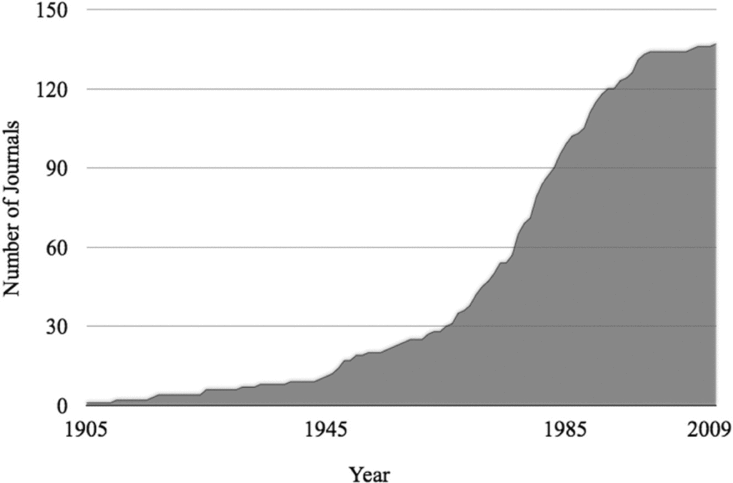
There are often very good reasons for things being the way they are, of course. The explosive growth in research activity in applied linguistics since The Modern Language Review was first published in 1905 (see Figure 3) has led to ‘staggering’ quantities of data ‘pouring off the presses’ (Perry Reference Perry2005: 3), and it is little wonder that the resulting information overload is affecting our ability to make rational decisions on exactly what to include in our language courses (e.g. Toffler Reference Toffler1970).
The growth in applied linguistic journals, 1905–2009Footnote 8 (author's data)
Even when novel materials or approaches are proposed in the research literature, establishing whether they have any ecological validity in authentic classroom settings is never straightforward. Classrooms are complex places with multiple variables at play (e.g. Gilmore Reference Gilmore2007b, ch. 3) so identifying exactly how learners’ interlanguage or motivation has changed as a result of any particular set of materials or activities is extremely difficult. Classroom-based research using mixed methods can provide some answers but, as Green (Reference Green and Bouton1995) points out, this requires a considerable investment of time and resources – something that few are willing or able to make. Nunan (Reference Nunan1991), surveying the methods used in 50 classroom-oriented studies, found that only 30% were carried out in genuine classrooms, while Allwright & Bailey (Reference Allwright and Bailey1991) point out that classroom research tends to be biased towards visible aspects, which are easier to measure. Ultimately, language teachers themselves, experimenting with novel materials or methods through ‘action research projects’ (e.g. Ur Reference Ur1991; Burns Reference Burns2010) or similar initiatives, are probably best placed to judge the value of new ideas in their own teaching contexts. It is therefore important to see insights from discourse studies making it through to initial or in-service teacher training programmes in forms that are both accessible to ordinary language instructors and adapted for pedagogic purposes.
Richards (Reference Richards2006: 20,23) contends that little of the research from DA and CA has any relevance to materials design in EFL contexts and that ‘the success of materials is not dependent on the extent to which they are informed by research’.Footnote 9 While I strongly disagree with this position (see also Nguyen & Ishitobi Reference Nguyen and Ishitobi2012), it does illustrate some of the challenges we face in implementing research-informed changes in the classroom. Change is often a painful process and there are many forces at work that serve to maintain the status quo. But the question I try to ask myself is this: to what extent do current language syllabuses fairly represent what we now know about discourse, and how do decisions on course content or task design affect students’ developing communicative competence? As McCarthy & Carter (Reference McCarthy and Carter1994: 201) pointed out almost two decades ago:
Syllabuses tend to reflect our view of language at any point in history; the language-as-discourse view has yet to make itself fully felt, but description now offers us the opportunity to take a closer look at how we organize language for teaching purposes.
As we have seen in this paper, insights from discourse studies have already had an impact on foreign language learning, and I hope their influence will increase in the future as useful findings from the research community trickle down to language professionals with the skills to transform them into pedagogically effective materials.
Acknowledgements
The author would like to thank the six anonymous reviewers, Ronald Carter, Dave Willis, Anne-Marie Barraja-Rohan and Suzanne Bernsten for their invaluable help with this paper.
Appendix 1
To view supplementary material for this article, please visit http://journals.cambridge.org/action/displayJournal?jid=lta.
Alex Gilmore is Associate Professor (English for Academic Purposes) in the Department of Civil Engineering at the University of Tokyo, Japan. He has worked as a language teacher, teacher trainer, and applied linguistics researcher in Spain, Mexico, Saudi Arabia, England and Japan. His research interests include discourse studies, materials design and language pedagogy.