Introduction
More than six decades ago Gougenheim, Michéa, Rivenc, and Sauvageot (Reference Gougenheim, Miche´a, Rivenc and Sauvageot1964) set out to select the most important words for the L’élaboration du Français Fondamental (1964) taking into account the new findings of Michéa and the new term ‘mot disponible’ which he had coined in 1953. These researchers (Gougenheim et al., Reference Gougenheim, Miche´a, Rivenc and Sauvageot1964) showed that very common and habitually used words had a low frequency rate and hence were excluded from the elementary list. Frequency was not enough as a research criterion. A mot disponible was described as onef with a very concrete meaning (dents, métro, roi, etc.), which, ‘without being necessarily frequent, is always ready to be used and comes immediately and naturally to our minds when it is needed’ (Michéa Reference Michéa1953, p. 339).
With regard to the L2 languages that represented the object of study of lexical availability research, while there is a well-established body of research literature in Spanish as a foreign language (e.g. Carcedo González, Reference Carcedo González1998, Reference Carcedo González2000; Samper Hernández, Reference Samper Hernández2002; Hernández-Muñoz, Cristina, & Andrew, Reference Hernández-Muñoz, Cristina and Andrew2006), English as a foreign language (EFL) has received relatively scant attention in spite of its growing importance worldwide. However, much of the current research work has studied multiple and complex aspects of lexical availability, such as the difference between basic and advanced semantic categories in both English first language (L1) and L2 speakers (Ferreira & Echeverría, Reference Ferreira Campos, Echeverría and Jiménez Catalán2014), semantic networks of words in English L1 and EFL (Ferreira & Echeverría, Reference Ferreira Campos and Echeverría2010), the effect of age on EFL learners’ lexical availability (Jiménez Catalán, Llach, Fernández-Fontecha, & Alonso, Reference Jiménez Catalán, Llach, Fernández-Fontecha, Alonso and Jiménez Catalán2014) or gender and lexical variation (Agustín Llach & Almudena, Reference Agustín Llach, Almudena and Jiménez Catalán2014), among others.
The research project reported on hereFootnote 1 aims to explore the lexical availability of a group of 79 English-major students in the second year of the degree in modern languages at the University of Las Palmas de Gran Canaria within the framework of Dörnyei's L2 Motivational Self System (Reference Dörnyei2005). Cue words ‘body parts’, ‘food and drinks’, ‘health and medicine’ and ‘social issues’ have been analysed as well as the three constituents of the L2 Motivational Self System and their correlation with lexical availability and overseas experience. Consequently, we hope to shed some ‘more light on the multifaceted nature of motivation’ (Al-Hoorie, Reference Al-Hoorie2018, p. 734) by using not only ‘intended effort’ as the primary criterion variable, but also the behavioural measure of lexical availability.
The three components of the L2 Motivational Self System (Dörnyei, Reference Dörnyei2005) are:
(1) Ideal L2 self, which enables learners to imagine themselves as successful English speakers and which drives them to reduce the discrepancy between their actual self and their desired future self-image;
(2) Ought-to L2 self, which refers to the expectations learners believe they ought to meet in order to avoid negative outcomes;
(3) L2 learning experience, that is, the impact of the teacher, methodology and content chosen, classmates or the experience of success or failure on the learner.
Apart from these three components, we have also explored: (1) the learner's intended Learning effort, which is our criterion variable, together with the behavioural measure of Lexical availability; (2) Family influence; (3) Instrumentality (prevention), which refers to our fear of not being successful (e.g. ‘I have to learn English because I don't want to fail the English course’); (4) Instrumentality (promotion), which refers to our drive to do something because we want to obtain positive outcomes (e.g. ‘Studying English is important to me because I am planning to study abroad’); and (5) Cultural interest and integrativeness.
Method
In order for us to measure our participants’ motivation, we used a questionnaire designed by You, Zoltán, and Kata (Reference You, Zoltán and Kata2016), which contained a first part with 73 six-point Likert scale items and a second which consisted of questions about the students’ backgrounds.
The paper-based Lexical availability test contained 15 lexical domains, and for each of them students were allowed two minutes to write down as many words as came to mind when thinking of each topic. Due to the exploratory nature of the current research, we will focus on four of them, namely ‘body parts’, ‘food and drinks’, ‘health and medicine’ and ‘social issues’.
Results and discussion
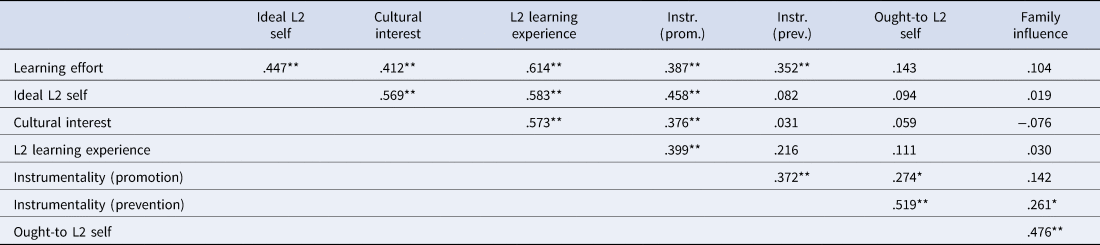
Table 1 shows the lack of correlation between our university students’ Ought-to L2 self and the effort they expend in learning English L2 as Language effort does not correlate with this variable. Csizér and Kormos (Reference Csizér, Kormos, Dörnyei and Ushioda2009) also found that this variable plays ‘a limited role in predicting the effort Hungarian students invest in language learning as in the university student sample its relation to motivated behaviour is very weak’ (p. 105).
Correlations between motivational factors

** Correlation is statistically significant at the 0.01 level (2-tailed).
* Correlation is statistically significant at the 0.05 level (2-tailed).
L2 learning experience, Cultural interest, Ideal L2 self and Learning effort show very high intercorrelations. L2 learning experience is the factor that has the highest impact on our university students’ efforts in learning English as a foreign language.
The L2 Motivational Self System and Lexical availability
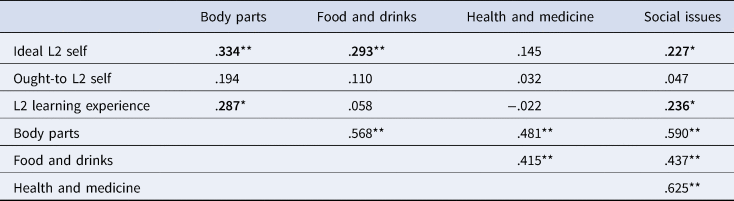
By focusing on the correlation between the three constituents of the L2 Motivational Self System and Lexical availability (see Table 2), we observe that the Ideal L2 self correlates with three of the four semantic categories we are analysing in this study – body parts, food and drinks, and social issues, while L2 learning experience correlates with body parts and social issues. The second constituent of this theory, the Ought-to L2 self, shows no correlation with any of the four cue words, which is strongly consistent with the previous conclusion, i.e. that this factor does not affect students’ effort in language learning.
Correlations between the three constituents of the L2 Motivational Self System and Lexical availability

** Correlation is statistically significant at the 0.01 level (2-tailed).
* Correlation is statistically significant at the 0.05 level (2-tailed).
Ideal L2 self and ‘having visited an English-speaking country’
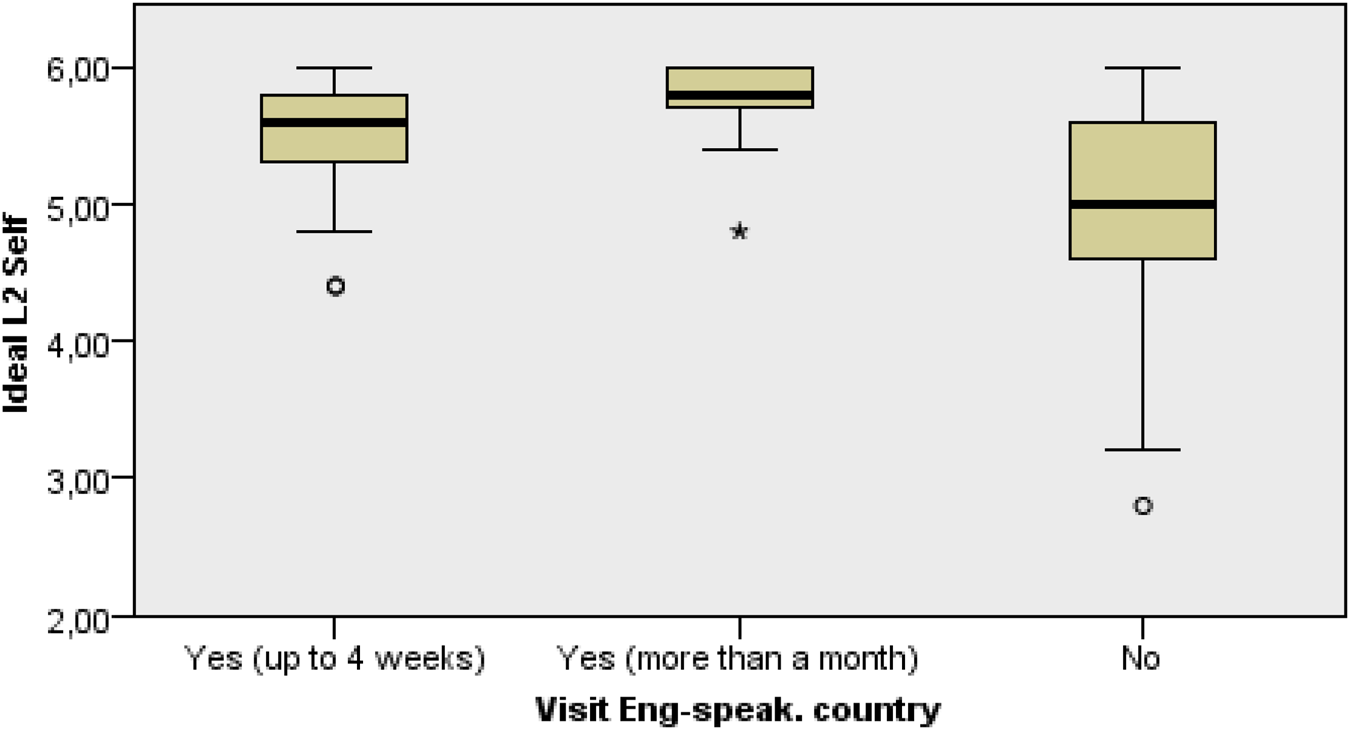
Figure 1 shows that most students, regardless of their overseas experience, have a strong Ideal L2 self. Having said that, a large number of learners who have this kind of experience firmly agree with statements related to this variable and the rest only agree. Furthermore, none of the students who have overseas experience go below the agreeing line, that is, they all agree to a different degree.
Kruskal-Wallis test: Ideal L2 self and ‘having visited an English-speaking country’.

Conclusions
Our participants’ Ideal L2 self is the strongest motivational variable analysed; a very high percentage of our students agree or strongly agree with its statements; despite the homogeneity which characterizes our sample, this variable does have an impact on lexical availability in three cue words.
The analysis of the Ought-to L2 self shows the marginal relevance this factor bears concerning the effort our students devote to learning English. Its strong correlation (0.519**) with Instrumentality (prevention) and the statistically significant correlation of Instrumentality (prevention) with Learning effort might mean that in our case a better factor to take into account when studying this motivational theory might be Instrumentality (prevention) rather than the Ought-to L2 self.
L2 learning experience shows a correlation of 0.583** with the Ideal L2 self and of 0.614** with Learning effort which, according to Dörnyei, means they measure more or less the same thing.
Our students’ overseas experience in an English-speaking country reflects their interest in the culture of people who speak L1 English and this has a positive effect on their Ideal L2 self. Our findings show a statistically significant relation between the Ideal L2 self and the variable ‘having visited an English-speaking country’.
Supplementary material
The supplementary material for this article can be found at https://doi.org/10.1017/S0261444820000154
Bianca Manuela Sandu is an assistant lecturer of English at the Faculty of Philology in Las Palmas de Gran Canaria (ULPGC), where she has been teaching in the modern languages department for two years. She has been carrying out research in lexical availability in Spanish and EFL for more than ten years and now researches and writes about the L2 Motivational Self System and its impact on lexical availability.
Gina Oxbrow currently works at the Faculty of Philology at the University of Las Palmas de Gran Canaria, where she is both an associate lecturer in modern languages and Vice Dean of Mobility. Her research interests include the implementation and design of content and language integrated learning (CLIL) methodology training programmes, integrated training in language learning strategies, the role of metacognition in second language acquisition, motivational and affective issues in language learning contexts, and lexical approaches in language teaching.