1. Introduction
This paper presents an argument for replication of two key studies on the topic of written corrective feedback (CF), or written error correction, in the field of second language (L2) writing studies. The two studies (Connors & Lunsford Reference Connors and Lunsford1988;Footnote 1 Lalande Reference Lalande1982), both completed in the 1980s, were published in major journals (College Composition and Communication and The Modern Language Journal) and have been frequently cited and are quite influential in their respective fields of composition studies and applied linguistics. They represent two different research paradigms—descriptive text analysis and quasi-experimental classroom research—and reported findings that have been useful in subsequent research and in the design of teaching materials. They have thus been important and are worthy of replication. In both cases, the research methods were clearly described, and there are ways in which the designs could be modified and improved upon for approximate and/or conceptual replications (Porte Reference Porte and Porte2012).
This paper begins with a brief overview of the history of research on the topic of written CF as a means to situate these two landmark studies in the literature. It explains further why these studies were chosen. The body of the paper then focuses on a description of each study followed by specific suggestions for replication.
2. Background
The study and practice of written CF has been a controversial topic in both composition and L2 studies. Some scholars have argued that providing feedback on errors to student writers is futile at best and harmful at worst (Williams Reference Williams1981; Truscott Reference Truscott1996). Others have countered that L2 writers need (and want) feedback and instruction on their language miscues in order to remediate persistent error patterns, improve the accuracy of their texts, and communicate most effectively with their readers (e.g., Shaughnessy Reference Shaughnessy1977; Eskey Reference Eskey1983; Leki Reference Leki1991). Pedagogical approaches to error correction in L2 writing have ranged from intensive correction of all errors, to marking errors very little, if at all, to targeted CF that focuses on a few patterns of error at a time and provides metalinguistic explanation along with the corrections so that learners can better understand the rules involved.
Because there have been widely disparate philosophical stances and approaches to the related questions of if and how to correct language errors in L2 writing, researchers in both composition studies and L2 studies (including foreign language contexts) have investigated the phenomenon of written CF in various ways. Some of these studies date back nearly a century (see Santa Reference Santa2006, for a detailed overview). Before suggesting targets for replication, it is useful to understand the different approaches researchers have taken toward studying CF in order to assess their impact on our knowledge about this topic.
2.1 Text analytic description of student error patterns
In composition studies, the most common research design related to CF has been to gather a large corpus of student writing and to examine, categorize, and quantify the patterns of written error found in those texts. This type of study dates back to the early 20th century, and by 1930, one scholar presented a synthesis of 33 previous studies of this type (Harap Reference Harap1930). The study by Connors & Lunsford (Reference Connors and Lunsford1988; also Lunsford & Lunsford Reference Lunsford and Lunsford2008) to be discussed later in this paper follows this tradition but with the added element of analyzing not only the student errors but also the teachers’ error markings. Generally speaking, these researchers have reported that, contrary to popular belief, students’ error frequencies have not increased over time, but the types of errors they make have changed.
2.2 Longitudinal classroom studies of the effects of error correction
In this second group of studies, researchers have examined teachers’ CF approaches and their effects on student writers/texts over time (a term or a school year). Some of these efforts have taken the form of qualitative case studies (e.g., Cohen & Robbins Reference Cohen and Robbins1976; Hyland Reference Hyland2003; Ferris et al. Reference Ferris, Liu, Sinha and Senna2013; Storch & Wigglesworth Reference Storch and Wigglesworth2010) in which students commented in think-alouds and/or retrospective interviews about the CF they had received and what they had learned from it. In other classroom studies, one or several intact classes were studied to see whether the accuracy of their writing improved over time (e.g., Haswell Reference Haswell1983; Semke Reference Semke1984; Robb, Ross & Shortreed Reference Robb, Ross and Shortreed1986; Kepner Reference Kepner1991; Ashwell Reference Ashwell2000; Chandler Reference Chandler2003; Ferris Reference Ferris, Hyland and Hyland2006) and to evaluate whether particular approaches to CF seemed to facilitate those outcomes. The second study to be proposed for replication, Lalande (Reference Lalande1982), falls into this group.
2.3 Controlled experimental studies of specific CF techniques and/or error types
This final group of studies represents the dominant paradigm for written CF research over the past 15–20 years. Conducted by applied linguistics researchers, these studies have included pretest—posttest—delayed posttest designs and have always included a control group that received no CF at all (e.g., Sheen Reference Sheen2007; Ellis et al. Reference Ellis, Sheen, Murakami and Takashima2008; Bitchener & Knoch Reference Bitchener and Knoch2010a, Reference Bitchener and Knoch2010b; van Beuningen, de Jong & Kuiken Reference van Beuningen, de Jong and Kuiken2012). Most (not all) of these studies have focused on only a few target features at a time (most typically definite and indefinite articles). This recent body of work has yielded important findings with applications for instruction and directions for future research. This article does not make a specific replication proposal for a study from this third group. Because there has been so much activity of this type, it has already become a self-replicating line of research—either researchers are doing approximate replications of their own previous work or other researchers are taking up similar projects (e.g., Ellis et al. Reference Ellis, Sheen, Murakami and Takashima2008; Bitchener & Knoch Reference Bitchener and Knoch2010a, Reference Bitchener and Knoch2010b).
In contrast, studies from the first two groups have tended to be scattered, one-off attempts, yet with questions and variables that could profit from further, focused investigation. Taken together, the three groups of studies have provided a comprehensive picture of the types of errors students may make, instructors’ various approaches to CF and their effects, individual and contextual variables that may influence the success or failure of CF, and the types of language errors that may be the most responsive to CF. Although we have learned a great deal from this research base about this ubiquitous pedagogical practice, many more questions remain. Rather than simply designing completely new research, replication of earlier studies from two of the three dominant research paradigms will allow scholars to continue exploring key questions.
The following section describes two landmark studies on written error and CF and suggests profitable avenues for replication efforts. The studies were chosen for several reasons: (1) They were published in major composition or applied linguistics journals; (2) They reported upon the research design in terms descriptive enough to allow replication; (3) They have been influential and frequently cited in subsequent research and pedagogical literature; and (4) Their contributions to the discussion of written CF are immediately apparent, but it is also easy to see how replications would improve upon and extend their designs and findings in useful and productive ways.
3. The original studies and suggested approaches to replication
3.1 Connors & Lunsford (Reference Connors and Lunsford1988); also Lunsford & Lunsford (Reference Lunsford and Lunsford2008)
Connors & Lunsford situated their study against the historical backdrop of the many descriptive quantitative studies of students’ written errors conducted in the early 20th century and comprehensively summarized in Harap (Reference Harap1930). As the article's title suggests, they were interested in ‘the frequency of formal errors in current college writing’ (p. 395).They described the purpose of the research on page 396:
We became interested in error-frequency research as a result of our historical studies, when we realized that no major nationwide analysis of actual college essays had been conducted, to our knowledge, since the late 1930s. . .we determined to collect a large number of college student essays from the 1980s, analyze them, and determine what the major patterns of formal and mechanical error in current student writing might be.
In short, as the authors also explained, they wanted a data-driven understanding of the types of errors college student writers currently made (in the U.S. in the 1980s) rather than simply relying on their own intuitions or assuming that the frequency and nature of student errors had not changed over time.
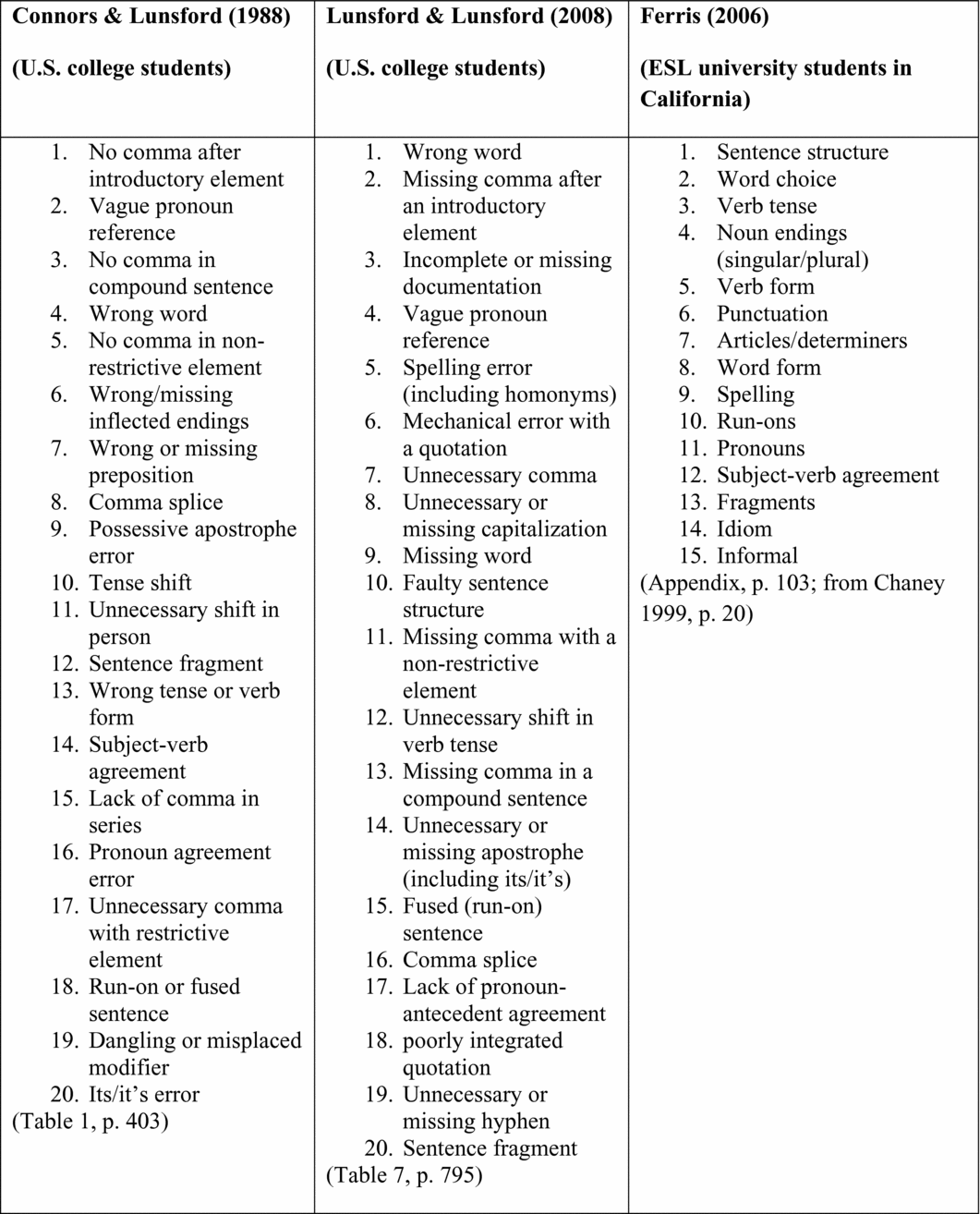
To address their goal, Connors & Lunsford solicited contributions of student papers from college writing instructors across the U.S. They contacted 1,500 teachers by mail to request their help and received more than 21,500 papers from 300 instructors. From this large corpus, they created a stratified random sample of 3,000 student papers, already marked for errors by the teachers, to use for error analysis. Rather than relying on error lists from earlier studies or from handbooks, Connors & Lunsford developed their own ‘taxonomy’ of the most frequent errors in their sample (see Figure 1). To do so, they randomly selected 300 papers from their large sample and ‘set out inductively to note every formal error pattern we could discover in the two piles of papers. . .we tried to ignore any elements of paper content or organization except as they were necessary to identify errors’ (p. 399). The resulting taxonomy has become known as the ‘top-20’ error list.
Student error types in L1 & L2 composition studies (listed in order of frequency) Note: This figure has been taken from Bitchener & Ferris Reference Bitchener and Ferris2012, p. 97.

Having gathered and prepared their sample and created their analysis scheme, Connors & Lunsford then gathered a group of 50 raters (faculty and graduate students from a large U.S. university) to participate in a two-day training and reading session. They explained their error categories, and the raters practiced and discussed the classification procedures with sample papers. Then the raters read, marked, and classified errors in the 20 categories for the 3,000 papers. No inter-rater reliability calculations were performed, for reasons the authors explained on p. 401.
In their analysis of their findings, Connors & Lunsford looked not only at the frequencies and percentages of the errors found by the raters but also compared those independent findings to the actual errors marked by the teachers who had contributed their students’ papers. Their analysis yielded the desired quantitative description of the most common errors made by U.S. college writers at the time (Figure 1, first column), and the authors further offered some generalizations about the teachers’ marking habits (see discussion, pp. 402‒444):
• Teachers’ decisions about what errors to mark were highly variable, even idiosyncratic.
• Teachers did not choose to mark all of the errors present in student papers. On average, about 43% of the errors in the top 20 categories found by the independent raters were marked by the classroom teachers.
• Teachers seemed to have two distinct (and sometimes even contradictory) criteria for which errors to mark: (1) errors that seemed especially serious within the context of the paper; or (2) errors that seemed quicker or easier to explain and/or to mark.
Beyond the teachers’ approaches to marking, Connors & Lunsford further observed (pp. 405‒406) that student error patterns in their sample were different from those noted in the early 20th-century studies that had inspired their own research. In particular, college writers in the 1980s tended to make more errors in spelling, particularly with homonyms such as its/it's or two/to/too. They speculated that late 20th-century students read less than did students decades earlier, and that less exposure to ‘the visible aspects of written forms’ (p. 406) may lead to the increased incidences of such errors. However, they were also careful to note (pp. 406‒407) that even though students made different types of errors than they had in the past, the overall error frequencies had not risen—in other words, current student writers were not making more written errors or ‘getting worse.’
The second author of the study, Andrea Lunsford, together with Karen Lunsford, published a replication of the Connors & Lunsford study 20 years later (Reference Lunsford and Lunsford2008). The purpose of the replication, again, was largely historical—the authors wanted to document whether both student error patterns and teachers’ marking strategies had changed in the years since the original study. The second study's procedures were virtually identical to those of the original, but they worked with a much smaller sample (877 student papers rather than 3,000). Lunsford & Lunsford took some care in their article to explain why the sample was smaller: Between 1988 and Reference Lunsford and Lunsford2008, colleges and universities had begun enforcing much more stringent rules for institutional research, and it was difficult and cumbersome to obtain the necessary permissions to collect student papers from a range of different institutions.
Rather than using the same ‘top 20’ list from 1988, Lunsford & Lunsford again went through the step of analyzing a subsample of their student paper corpus to identify the 20 most frequent error types. They did find differences from their original list (as to both types and relative frequency); these can also been seen in the middle column of Figure 1. The authors speculated that some of the differences could be explained by tasks and assignment genres in their recent sample that were distinct from the papers in the 1988 sample. For instance, many more papers were source- or research-based in 2008 than in 1988, leading to the inclusion of ‘incomplete or missing documentation’ as the third most frequent error on the new top-20 list. The authors were somewhat disappointed to discover that teachers’ marking strategies had not changed much in 20 years. Between 1988 and 2008, teacher preparation, especially principles for responding to student writing, had evolved, but the authors did not find evidence of this progress in the teacher feedback in their sample.
3.1.1 Approach to replication
Connors & Lunsford were ahead of their time, especially in composition studies, in pursuing quantitative descriptions of students’ written errors. When their study was first published in 1988, the affordances of modern corpus linguistics and computational linguistics were barely known, let alone readily available to the average researcher. Nonetheless, their desire to provide a large-scale description of both student error and of teachers’ marking practices is a worthy one, as is their interest in updating the findings at regular intervals, given changes in student populations and in pedagogical practices. There have been relatively few attempts in either first language (L1) composition or L2 writing studies to provide data-based quantitative descriptions of student errors or teachers’ CF. Such findings are important for teacher preparation, for materials development, and for feedback to the student writers themselves because they help teacher educators, textbook authors, and classroom instructors target structures on which to focus.
Thus, replication studies should, generally speaking, follow the procedures used by Connors & Lunsford (Reference Connors and Lunsford1988) and later by Lunsford & Lunsford (Reference Lunsford and Lunsford2008): A sizable corpus should be gathered, a taxonomy of common errors should be generated from a subsample of texts taken from the corpus, and trained raters should find and classify the errors in the texts. However, to make such studies even more useful, several modifications should be considered for approximate replications.
First, the taxonomy of errors to be included in a top-20 list should also include consideration of common errors made by L2 writers. One recent study (Ferris Reference Ferris, Hyland and Hyland2006) of L2 writers at one university in the U.S. yielded a similar ranked list, but as can be seen in the final column of Figure 1, this list is quite different from those generated in the two studies already discussed. In 1988 there were fewer L2 writers in U.S. colleges and universities than there are now, so it is perhaps not surprising that the sample obtained by Connors & Lunsford did not present typical ‘English as a second language’ (‘ESL’) errors such as problems with verb tense, omitted articles before nouns, and so forth. However, the U.S. college/university population was certainly much more diverse by 2008, when Lunsford and Lunsford published their replication.
The lack of representation of errors more unique to L2 writers on the 1988 and 2008 top-20 lists may be traceable to the ways in which the sample papers were gathered and how the taxonomy was created and the raters were subsequently trained. The sampling limitation could be addressed by actively soliciting student samples from college writing instructors who work with large L2 populations (or teach composition courses specifically designated for L2). The rating issues could be resolved by having someone trained and experienced with reading and responding to L2 writing participate in the process of creating the analysis taxonomy and training and norming the raters.
Second, background information about the student writers should be obtained along with the sample of student papers. Teachers could be asked to complete a summary sheet describing their students—class status, age ranges, L2 backgrounds, gender, and so forth. It is difficult to assess whether a large sample of student writing is ‘typical’ of U.S. college students (or students elsewhere) if nothing is known about the student populations that the sample has been gathered from.
Third, data collection should be triangulated by asking the teachers to fill out questionnaires or surveys about their written CF philosophies or practices. On these surveys, teachers could be invited to volunteer to telephone, email, or Skype interviews to investigate their responses in more depth. A set of interviews with focal teachers, along with the survey responses from a larger sample of instructors, would reduce the speculative nature of the discussion of how/why teachers marked errors as they did (or did not). In other words, rather than inferring teachers’ motives and strategies from marks on student papers, researchers should actually ask at least some of the teachers what they were thinking. (See also Reid Reference Reid1994 and Goldstein Reference Goldstein, Silva and Matsuda2001 for thoughtful discussions of the limitations of text analysis alone as a vehicle for studying teacher strategies in responding to student writing.)
Finally, inter-rater reliabilities need to be calculated and reported for large-scale text analysis. The explanation offered by Connors & Lunsford for why they did not do so, while thoughtful, is not ultimately convincing. If numerous raters are employed to make judgments and classifications, and conclusions and recommendations based upon those judgments are offered, it is important that readers be confident that the raters were relatively consistent and that the quantitative findings reported are robust and reliable. It is instructive to note that the ‘top-20’ findings from the two studies were (and still are) used in a best-selling series of writing handbooks authored by Andrea Lunsford. In other words, those findings have had a practical impact on teacher training and especially on materials used with students. Thus, it is important for such descriptions to be trustworthy—and inter-rater reliability scores are one recognizable way of approaching this issue.
3.2 Lalande (Reference Lalande1982)
As discussed in section 2 of this paper, written CF studies situated in classroom settings represent only one of the three major approaches to research on this topic. Large-scale quantitative text analysis (as in the Connors & Lunsford study) yields descriptive information about the features/errors seen in student writing, sometimes with the added goal of examining teacher markings on those errors. However, such studies, in order to be useful, must also be large, meaning that an emphasis on what happens in individual classroom settings is not practical. The third group of studies discussed above was controlled experimental studies, and in such designs, researchers design writing tasks and provide carefully focused feedback to examine students’ acquisition/control of a handful of carefully selected linguistic features. Neither the writing tasks nor the feedback are provided by the classroom instructors; thus, researchers can maintain maximum control over the procedures and ensure reliability of the findings.
Both descriptive text analyses and controlled experiments provide information that is useful for researchers and for classroom teachers. However, while removing student writing and feedback from the classroom setting may enhance reliability, it also threatens validity: How do we know that the carefully controlled writing and feedback processes used in the experiments will transfer in any meaningful way to real classrooms and actual student writing? This is an important question, and thus classroom studies, especially longitudinal ones, are a critical piece of the research base on written CF.
Like Connors & Lunsford's large-scale text analysis, Lalande's (Reference Lalande1982) classroom study, published in the The Modern Language Journal, was ahead of its time. The concepts and techniques used in his study have influenced later discussions, research, and pedagogical suggestions regarding written CF, and his early work is frequently cited. In his introduction, Lalande explained that his study built upon several key principles/theories regarding L2 writing:
1. To make progress in written accuracy, learners need correction or feedback.
2. For such feedback to be useful, teachers’ corrections must be systematic and not haphazard or idiosyncratic.
3. Students should be asked to engage in a process of ‘guided learning and problem-solving’ (p. 140) in which they are asked to analyze and correct errors that have been called to their attention. Making students aware, in an ongoing manner, of the written errors they make also facilitates this guided learning process.
Lalande's study focused on intermediate learners of German enrolled in four sections of the same course at a large U.S. university. There were 15 students in each section, for a total of 60 subjects, and each section was taught by a different instructor. Lalande took great care to ensure and to explain that the students in the four sections were at equal levels of proficiency in German (including writing) and that the four teachers were equally capable of identifying and systematically marking student errors in their compositions.
Two of the sections were designated as control groups, and they received ‘traditional’ written CF: the teachers provided corrections for all of the errors and then students were required to rewrite their texts to incorporate the corrections. In the two experimental sections, students received corrections that followed a specific Error Correction Code that included 12 grammatical and orthographic error categories. Each error was marked and coded with the exception of lexical errors, which were directly corrected by the teacher. The student, at the next class session, was asked to interpret the codes and correct the errors. To help solve problems, students were allowed to consult their textbooks, their peers, or their instructors. Finally, students in the experimental sections were able to monitor the frequency of their errors by referring to an ongoing Error Awareness Sheet, a chart that tallied the errors in the various categories across all writing assignments. These charts were also maintained by the researcher for the control group students, but they were not shown to those students as the experiment progressed.
In the course of a semester, students wrote five in-class essays. The first and fifth were retained by the researcher as a pretest and posttest. The second, third, and fourth essays followed the correction and revision procedures just described. Lalande used the pretest and posttest texts to measure student progress in reducing errors in the categories that had been marked. He also obtained end-of-term questionnaire data from the students to assess their reactions to the error correction procedures they had experienced.
Lalande found strong evidence that the CF procedures used with the experimental group were more helpful than the traditional correction style employed for the control group. Differences between the two groups in reducing errors were statistically significant in 11 of the 12 targeted error categories. Notably, this improvement held as the term progressed, even though the students attempted more complex structures (which might have led to more writing errors) as their knowledge of German improved. Further, while students in both groups felt that their German writing had improved and that receiving corrections had helped them, only the experimental group saw value in the rewriting activities, and they found the information in the Error Awareness Sheet to be useful to them.
Despite Lalande's use of terms like ‘control’ and ‘experimental’ groups, this was a situated, longitudinal classroom study. The essays were written as part of the normal curriculum and were based upon German literature that had been read and discussed in class. The teachers provided feedback to their own students, and the rewriting activities were completed during class, with students able to ask questions if they needed to. In contrast, in the third group of controlled studies described above, students typically produce contrived texts based upon pictures, researchers rather than teachers give the CF, and rewrites are not part of the design. In Lalande's study, both instructors and students perceived the data collection activities as a regular part of their classes; indeed, the students were never told that they were part of an experiment.
This study is extremely valuable because it highlights several aspects of CF that were later discussed and researched extensively. First, Lalande was one of the first researchers to investigate systematic, focused feedback on targeted error categories rather than unfocused corrections of anything that catches a teacher's eye. Interestingly, Lalande reported success using a large number (12) of error categories; later researchers have posited that students can only cope with a few at a time. Perhaps because Lalande's procedures were repeated several times over a semester and were accompanied by guided rewriting activities and error awareness charts, the students were able, due to the added practice and information, to cope with the additional information.
Second, Lalande's study compared the effects of direct and indirect feedback, though he did not use those terms himself (see Hendrickson Reference Hendrickson1980; Ferris Reference Ferris2011; Bitchener & Ferris Reference Bitchener and Ferris2012; Ferris et al. Reference Ferris, Liu, Sinha and Senna2013). The control group in this study received direct feedback, meaning that the teachers provided the correct forms and students simply transcribed them during the rewriting activity. The experimental group received indirect feedback, which provides information about errors but asks students to figure out the corrections for themselves. In subsequent studies of reactions to CF, students have expressed a preference for indirect feedback, perhaps sensing that even though direct feedback requires less effort from them, they will learn more by engaging in the problem-solving process (Leki Reference Leki1991; Ferris & Roberts Reference Ferris and Roberts2001; Ferris Reference Ferris, Hyland and Hyland2006; Ferris et al. Reference Ferris, Liu, Sinha and Senna2013)
Third, Lalande's design required students to rewrite their texts after corrections, rather than simply noting them for future reference. Later researchers have argued that revision after feedback is an important step to ensuring both immediate uptake and long-term retention of CF (see Ferris Reference Ferris2004, Reference Ferris2010). Finally, Lalande's inclusion of the error awareness chart to give students further information about their progress laid the groundwork for future studies of the effects of error logs on students’ writing development (Roberts Reference Roberts1999; Ferris Reference Ferris, Hyland and Hyland2006).
Unfortunately, these important aspects of the written CF process have not been adequately researched in the 30 years following the publication of Lalande's study. There have been several controlled studies of focused versus unfocused feedback (e.g., Sheen Reference Sheen2007; Ellis et al. Reference Ellis, Sheen, Murakami and Takashima2008) and a few attempts to contrast direct and indirect feedback, but nearly all of these have been in controlled experimental settings rather than natural classroom contexts. Further, there has been little research on the effects of revision following CF (an exception is Chandler Reference Chandler2003; see also the discussion in Ferris Reference Ferris2010) or of using error awareness charts to raise students’ consciousness about their recurring error patterns (one recent exception is Ferris et al. Reference Ferris, Liu, Sinha and Senna2013). In short, while the innovations and techniques recommended and tested in Lalande's study seem useful, they should be further operationalized and tested with other groups of learners.
3.2.1 Approach to replication
Lalande did many things well in designing this study. He included pretest and posttest measures, he ensured that the student groups and the instructors were equivalent in their abilities, and he triangulated the statistical measures by adding the student questionnaire element. Replications of this study in other contexts (e.g., in secondary classrooms, in ESL or composition settings, with other L2s besides German, looking at different target structures for correction) would be valuable to assess whether Lalande's highly structured approach to error correction, revision, and error awareness works well outside of U.S. university foreign language classrooms. Further, replications of this study could benefit from a couple of adjustments to the design.
First, it would be useful to isolate the different elements of the design for further comparison. Specifically, there were four contrasts between Lalande's control and experimental groups:
• The control group received comprehensive corrections while the experimental group received focused corrections on targeted error categories;
• The control group received direct correction, but the experimental group received indirect correction with error codes attached;
• While both groups were required to rewrite their essays after receiving CF, the control group students merely were asked to transcribe their teachers’ corrections, and the experimental group students had to engage in problem-solving;
• The experimental group students were given information about their error patterns and progress via the Error Awareness Sheet, but the control group students were not.
While it is clear that the experimental group benefited more from the ‘enlightened’ methods used with them than did the control group students from the ‘traditional’ methods, it is hard to tell which of the four elements of the contrasting treatments were the most beneficial or necessary for the reported positive outcomes.
A replication (or a series of replications) might target the above contrasts more precisely. For example, one group could receive focused, indirect CF but with no required rewriting, while another group could receive the same CF but be required to rewrite. Or a group could receive focused, indirect CF with revision and be given an error awareness chart, while another would have feedback and revision held constant but not see the chart. Lalande's design contrasts one overall approach with several elements with a more traditional approach. Replications that isolate the specific elements, alone or in combination, would help us to understand better which aspects of the CF process are more important—focused CF? Indirect CF? Rewriting? Error charts? All of these elements in combination? A replication which looks at the same elements of the error treatment approach that Lalande did but divides the treatment groups differently would help us to better interpret his findings and speculate as to their reliability and generalizability to other contexts.
The second general replication suggestion is related to the first. If the purpose of the research is to investigate the effects of the techniques discussed above, it becomes less necessary to contrast an ‘enlightened’ approach with a ‘traditional’ one. In other words, the ‘controls’ used in Lalande's study would be irrelevant and would be replaced by the presence or absence of a particular technique (+/− revision, or +/− charts, for instance). What is most interesting about Lalande's design and findings is not that an ‘old-school’ approach to error correction did not work as well as a modern one. Rather, the individual pieces of the modern approach have potential benefits and are worth more careful study. However, since few instructors these days would argue for the traditional approach implemented for the controls in Lalande's research, it does not seem beneficial to continue to use such an approach as a straw man to prove that the newer methods in combination are superior. Further, as already noted, the correction/revision/awareness variables operationalized by Lalande have not been adequately investigated in subsequent written CF research.
4. Conclusion
Some readers might believe that, given the proliferation of studies on written CF in recent years, the last thing the field needs is more of them in the form of the replications I have proposed. I would argue that, on the contrary, the quantity of research already completed makes it easier to see where there are gaps and where continued, carefully targeted investigations would be useful. The Connors & Lunsford (1998; Lunsford & Lunsford Reference Lunsford and Lunsford2008) study should be replicated regularly for the same reasons they did the study in the first place: students and their writing change over time, and we cannot assume that conclusions drawn about student errors in the past will hold true in the present and future. The Lalande (Reference Lalande1982) study should be pursued further for an entirely different reason. He did a nice job of designing a compelling classroom study that highlighted a number of issues that could profitably be investigated further in a range of contexts but to date have been rather neglected by subsequent researchers. Longitudinal classroom studies are more difficult to design and complete than are text analyses or short-term controlled experiments, but they are critically important if classroom instructors are to take researchers’ findings seriously. In sum, both types of research are necessary and valuable to make our knowledge current and applicable to real-world contexts.
Dana Ferris is Professor and Associate Director for Second Language Writing in the University Writing Program at the University of California, Davis, USA. In her research projects, she has extensively investigated teacher response to student writing, including (but not limited to) the specialized topic of written CF. Her books include Written corrective feedback in second language acquisition and writing (with John Bitchener, Routledge, 2012), Treatment of error in second language student writing (Michigan, 2011), Response to student writing (Erlbaum, 2003), and Teaching L2 composition: Purpose, process, and practice (with John Hedgcock, Routledge, 2014). Her work has appeared in journals such as TESOL Quarterly, Journal of Second Language Writing, Language Teaching, Studies in Second Language Acquisition, and Research in the Teaching of English.