A basic sociolinguistic problem concerns the possible causal relationship between social factors, and language variation and change. Classical sociolinguistic studies (e.g., Labov, Reference Labov1966; Milroy, Reference Milroy1980; Trudgill, Reference Trudgill1974) analyze language variation as reflecting differences in social structure: for instance, speakers of low social status show different linguistic behaviors from speakers of high social status. Such studies have been criticized for an unsophisticated and atheoretical view of social structures (Williams, Reference Williams1992). Recently, sociolinguistics has indeed undertaken theoretical discussions of the issue (for instance, Coupland, Sarangi, & Candlin, Reference Coupland, Sarangi and Candlin2001; see also Hudson, Reference Hudson1996). Rampton (Reference Rampton2001) describe classical sociolinguistic perspectives on the relationship between social structures and language variation as either a “difference” view or a “dominance” view, both of which think of language variation as a reflection of social variation. An alternative perspective is the “discourse” view, which, to a greater extent, sees language variation as the speakers' means of negotiating identities and social relations. In other words, the discourse view also includes the view that social differences can be reflections of language variation.
Furthermore, language variation is closely related to language change, and the question of cause and effect is largely the same. Language change involves two aspects, one of which is the emergence of new features in language, for example the back-tongue r sound in Europe in the late 1600s. The other aspect is the spread of new features once they have emerged in a speech community, such as the ongoing spread of back-tongue r sounds throughout Europe, currently continuing in, for instance, Norwegian (Torp, Reference Torp2007). It has been suggested that the emergence of new features must relate to a range of different factors, including inner-linguistic structures, the physiology of the human speech organs, and social phenomena (e.g., Aitchison, Reference Aitchison2001). Similarly, it has been suggested that the spread of new features is related to different factors, some of them the same as the factors related to the emergence of new features. Both the emergence and the spread of new features raise two (types of) questions.
MODELS OF LANGUAGE CHANGE
First, there is the “how” question. The spread of sound changes, as well as other linguistic and cultural phenomena, at least in modern and late modern societies, has regularly been found to follow s-curves (Bailey, Reference Bailey1973; Jørgensen & Kristensen, Reference Jørgensen and Kristensen1995). The s-curve is an integrated part of our understanding of how patterns of linguistic change spread (Aitchison, Reference Aitchison2001:91ff; Hock & Joseph, Reference Hock and Joseph1996:150). The s-curve, however, describes only how a change spreads; that is, it illustrates the process through mechanically quantifiable registrations of a new feature being used by an increasing number of (different types of) speakers. Discussion of the second question, namely, why new features become increasingly used in a given speech community, possibly even spreading into other communities, is a different matter. We see at least two types of explanations: one formulated in the difference perspective, and one formulated in the discourse perspective.
An example of the first type is the so-called Napoleon Principle (Brink & Lund, Reference Brink and Lund1979:202), which describes the process involved in the spread of linguistic change as a “simple contagion,” by which speakers gradually increase their use of the features that are most frequently used around them. In a typical area of contact between varieties, the users of one variety will be more numerous than all other groups in the area one by one, without actually being an overall majority. The features used by this group will prevail because they are the most frequently used features in the actual contact situations, that is, in the prototypical interaction between speakers in the area.
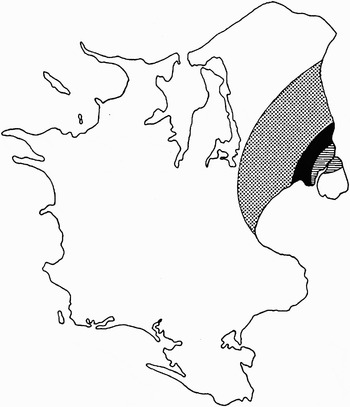
This is the Napoleon Principle: Always be sure to engage the opposition in a place and at a time when you are in the majority, even when your enemies combined outnumber you. Brink & Lund (Reference Brink and Lund1974:70) illustrate this principle with the map shown in Figure 1, which depicts an urban center and its surroundings. This model is an example of the difference view. Different populations speak as they do because they belong to different groups (in casu geographically determined). In surrounding areas, different varieties (dialects) may be spoken by language users who, when combined, are more numerous than speakers of the variety in the urban center. However, in the area of contact, speakers of the urban variety will almost always be in the majority, and therefore their urban features will spread to speakers in the rest of the area “by simple contagion.” According to this model, language change is an effect of social structuring. In other words, it is a difference perspective model.
The Napoleon principle (after Brink & Lund, Reference Brink and Lund1974:70).

An example of the second type of explanation is presented by Kristiansen & Jørgensen (Reference Kristiansen, Jørgensen, Auer, Hinskens and Kerswill2005), who suggest a model with a different explanation of the spread of linguistic features. According to this model, the background of language change is social-psychological. As members of a social species, human beings seek group membership, and there is a constant social-psychological tendency to evaluate “own-groups” positively in comparison with other groups. This is related to a desire to stand out as a group, that is, to mark the own-group as different from other groups. Speakers are aware of the values ascribed to specific features, and regularly pay attention to them. Differences in feature use are signals of attitudes and desired social membership(s). Speakers will tend to use features that signal membership in groups that they value positively. According to this model, changes are caused by the accumulation of such subjective choices. These choices are thus motivated by social-psychological factors such as attitudes. Features that signal membership in a high-prestige group will be chosen by an increasing number of speakers, as long as the features are taken to be characteristic of this group. Different groups may be associated with different kinds of prestige among speakers. Therefore, the development of any one feature need not be unidirectional, but may lead to different outcomes among different groups of speakers.
Kristiansen & Jørgensen (Reference Kristiansen, Jørgensen, Auer, Hinskens and Kerswill2005) suggest that subjective factors are the sine qua non of language change, both with respect to the emergence and spread of new features. Societal factors, language-structural factors, and such, “are necessary factors in language variation and change, in the sense that they are always involved. But it is our contention that only the sociopsychological, subjective factors can constitute the driving force behind such processes” (p. 287). Kristiansen & Jørgensen operationalize the subjective factors through attitudes, insofar as they can be deduced from guise tests. This is, of course, not the only relevant subjective factor that one can study.
Another factor is studied by Ferrer & Sankoff (Reference Ferrer and Sankoff2003). They suggest that the high status of a group of speakers, with whom a specific way of speaking is associated, is not the primary cause of a language change that leads to other speakers converging to the high-status group. Instead, they suggest that the speakers' feeling of identity, their sense of being members of the group to which a particular way of speaking is thought to belong, determines the way they choose to speak. Ferrer & Sankoff found, using a semimatched guise technique, that identity in this sense is a more important factor behind language choice than the prestige of the varieties. Both Kristiansen & Jørgensen (Reference Kristiansen, Jørgensen, Auer, Hinskens and Kerswill2005) and Ferrer & Sankoff (Reference Ferrer and Sankoff2003) see language behavior as a means to negotiate social relations. In their views, language change is a social phenomenon.
Brink & Lund (Reference Brink and Lund1979) disagree. They discuss the emergence of new linguistic features (in casu new phonetic features) and suggest that they emerge as a result of children acquiring their mother tongue slightly different from the way it is spoken by the older generation. The spread of new features in a speech community is explained by the Napoleon Principle, and Brink & Lund conclude precisely that “we must not forget that sound change is essentially a non-social phenomenon” (1979:203).
These two stands can be considered the end points of a scale that also includes such classical sociolinguistic studies as Labov's (Reference Labov1972) explanation of sound change (or perhaps more precisely, reversed sound change) on Martha's Vineyard, and Eckert's (Reference Eckert2000:219f) description of the sound changes represented among students at Belten High, both of which are closer to the discourse-perspective end of this scale. Other explanations of language change also belong here, such as an explanation of Danish weakening of Scandinavian postvocalic stops during the Middle Ages as a result of “the suppressed and downtrodden conditions of the people, particularly the peasantry” (Petersen, Reference Petersen1829: our translation), or Jespersen's (Reference Jespersen1897–1899:423) explanation of the occurrence of back-tongue r as caused by Europeans living increasingly more indoor lives.
PREDICTING LANGUAGE CHANGE
A consequence of the model proposed by Kristiansen & Jørgensen (Reference Kristiansen, Jørgensen, Auer, Hinskens and Kerswill2005) is that predictions can be made regarding the spread of known features with known value ascriptions. The claim is that subjective factors, for instance attitudes that can be measured as evaluations of speakers with specific pronunciations, cause speakers to choose their own pronunciations in accordance with their evaluations. Speakers choose among the variants at their disposal with an eye on the prestige (or other positive values) associated with the variants. In this view, language change will result from changing evaluations.
In other words, if we have insight into the existing variation among a given group of speakers, and we know the attitudes toward the variants represented among the speakers, we may determine whether there is a basis for change. This is the case if the attitudes of the studied group do not match the behaviors observed. In this case, we can predict a change, and we can predict the direction of change. There is no way of predicting what new features (beside borrowings) may arise in the speech of the group, but once new features are there, they are subjected to evaluations, and consequently we can make predictions about increases or decreases in the use of them. If we know the current attitudes among (groups of) speakers, we may, according to this view, predict the spread of changes among these speakers.
In the case of the variation in Danish as spoken in Næstved, we do have access to attitudes as well as language use among the younger generation in the mid-1980s. Jørgensen & Kristensen (Reference Jørgensen and Kristensen1994) is a study of linguistic variation among young speakers. There are two dimensions of variation. One is between local speech and national standard speech, the other one between conservative and modern national standard speech. Jørgensen & Kristensen found no significant difference between male and female speakers with respect to the variation between local and national forms, only with respect to variation between the conservative and modern standards. Female speakers of the young generation at that time used fewer modern standard variants and more conservative standard variants than male speakers did. At the same time, differences in attitudes among young speakers in the same locality were measured in guise tests by Kristiansen (Reference Kristiansen1991). The female speakers were found to have attitudes that are more positive toward young standard national speech than those of male speakers. In other words, the differences in attitudes did not match the differences in practice.
Based on this, the Kristiansen & Jørgensen (Reference Kristiansen, Jørgensen, Auer, Hinskens and Kerswill2005) model predicts that young female speakers will gradually become less conservative speakers, and that the group may eventually develop a variation practice that is the opposite of the one reported in the 1980s, namely that female speakers will use more modern variants than male speakers will.
In the present study, the speakers who provided the spoken data for the Jørgensen & Kristensen (Reference Jørgensen and Kristensen1994) study were recorded once more in similar types of situations, but now they are some 20 years older. This study is part of a general project at the Center for Language Change in Real Time (Lanchart) to collect data from the speakers who participated in sociolinguistic studies all over Denmark in the 1970s and 1980s (i.e., the very same individuals, see Gregersen, Reference Gregersen2009b). This enables us to study the behaviors of the same individuals with a 20-year interval. Traditionally, language change is assumed to take place between generations. A famous Bloomfield (Reference Bloomfield1933:347) quote states, “The process of linguistic change has never been observed; we shall see that such observation, with our present facilities, is inconceivable.” Citing this, Peng (Reference Peng1976, Reference Peng1979) emphatically claims that language change is not only possible, but also likely in individual speakers, at least until they are 35 years old, and therefore observable. He suggests such changes can be traced “with the investigations of fairly large samples in the same areas with the same method at an interval of hopefully 20 years” (Peng, 1979:236).
Against this background, we compare the attitudes expressed among young Næstved speakers of Danish in the 1980s with the observed changes in language use among a group of Næstved speakers between the mid-1980s and the mid-2000s. The attitude study was carried out in the same community, though among a different group of individuals than the language use studies, which included the same individuals recorded in the 1980s as well as in the 2000s. In this connection, we address two problems. First, we ask: Do individual speakers change their pronunciation between teenage and adulthood? The second question regards the motivation of change: Do speakers' relatively positive attitudes toward one of several available varieties lead to a change in their own linguistic behaviors in the direction of the characteristics of the variety in question? In other words, can we support or reject the Kristiansen & Jørgensen model?
DATA
The data forming the basis of the study we report on here include audio-recorded conversations involving 24 informants from the Næstved area in Denmark. The informants all participated in relatively formal individual interviews, as well as informal group conversations. They were born 1969–1970, and in the mid-1980s, they attended one of three different schools in Næstved. One was the Næstved high school, a second was the Næstved technical school, and the third was the Herlufsholm (boarding) high school. Stereotypically, high schools carry more socioeconomic and intellectual clout and prestige than technical schools; in particular, the Herlufsholm school, which is a more than 800-year-old institution, is stereotypically associated with high status and prestige. The informants consisted of 11 female and 13 male speakers. The first rounds of data were collected 1986–1989, and in the following, we refer to these as the old recordings. Each informant participated in both an interview and a group conversation in each of the years 1986, 1987, and 1989, when the informants were in the first, second, and third years of their educations.
During the interviews, informants were asked formal questions about their name, address, class, parents' education, and so on. Following this phase, the conversation was freer. At the end of the interviews, the informants were asked to read aloud a written text. During the group conversations, the informants wore buttonhole microphones while they played a board game (i.e., occasionally the participants would read aloud from the game rules or from the board, so that the group conversations also yielded reading forms). These group conversations were set up to allow for maximally informal speech.
In 2007–2008, the 24 informants were audio-recorded again, both in an interview and in a group conversation. We refer to this round of data as the new recordings. The interviews were conducted in the same way as in the 1980s. In the group conversation, the informants did not play board games, but talked about the old days, so that the speech could be just as informal.
In the following section, we analyze the variation in the informants' use of the Danish aj-diphthong with a particular emphasis on changes in the variation patterns that we can observe among the speakers between the mid-1980s and the mid-2000s.
Aj IN DANISH
The aj-diphthong in Danish appears in many words spelled with -eg, -ej, -aj, and pronouns with -ig (examples are steg ‘steak’; vej ‘way’; svaj ‘sway’; mig ‘me’). The first part is an open, more or less low, front-tongue vowel, and the second part is a high, front-tongue semivowel. The crucial variation lies in the vowel, which varies in height between an [ ] and an [
 ]. The vowel quality has varied considerably in standard or near-standard spoken Danish over the past 150 years.
Brink & Lund (Reference Brink and Lund1975:97) is a historical study of the development of the national Copenhagen-based standard from 1840 to 1955 (year of birth); it traces the development of the aj-diphthong from 1816 onward. The Brink & Lund study uses written sources to show that at the earliest point, the first element of the aj-diphthong was an [ ] that was gradually raised and fronted among middle-class speakers born later, so that [æ] was the only variant among middle-class people born in the years up to 1920. From 1920, this development has been gradually reversed, and most middle-class speakers born in the second half of the 1900s use a variant between [] and []. Throughout the period, speakers belonging to the lower socioeconomic range have had only []. Variation involving the aj-diphthong has also been studied by Holmberg (Reference Holmberg, Gregersen and Pedersen1991), Jørgensen (Reference Jørgensen1980), and Jørgensen & Kristensen (Reference Jørgensen and Kristensen1994). In general, the picture given by Brink & Lund (Reference Brink and Lund1975) was confirmed by Jørgensen (Reference Jørgensen1980). Holmberg (Reference Holmberg, Gregersen and Pedersen1991) found very few significant differences; however, this may have been an artifact of the study. The Jørgensen & Kristensen study compared pronunciation across gender, school type (high school and technical school), place (countryside vs. town), and social class (three socioeconomic status groups). They found a significant difference between the genders: female speakers had more [æ] pronunciations than the male speakers did. There were no other significant differences between the groups.
It is difficult to get a comprehensive view of aj-variation, in part, because different studies have applied different criteria in their analyses. First, the number of possible aj-pronunciations varies between two and five. Unless the different categorizations share at least one carefully defined border between forms, this will inevitably lead to different analyses of the same reality. If, for instance, study X distinguishes among three as (aX1, aX2, and aX3), and study Y distinguishes among four as (aY1, aY2, aY3, and aY4), the studies can only be compared in detail if one border is exactly the same in the two studies (such as the border between aX2 and aX3 being the same as the border between aY3 and aY4). This seems precisely not to be the case, particularly in studies of Copenhagen pronunciation (Gregersen, Reference Gregersen, Farø, Holsting, Larsen, Mogensen and Vinther2009a:23), and is likely to lie behind some of the discrepancies between studies, as we have observed.
Nevertheless, some observations are generally shared. The [] pronunciation is more frequent overall, at least through the 1900s. Furthermore, the phonetically higher variant [æ] is more frequent among high-socioeconomic-status speakers than among low-socioeconomic-status speakers. The phonetically higher variant is also more characteristic of female speech than of male speech. The phonetically lower variants are the only ones observed in low-socioeconomic-status speech in the Brink & Lund (Reference Brink and Lund1975) material. This leads to the conclusion that the development from the phonetically lower variants toward the phonetically higher variants, and back again, is an affair among relatively higher-socioeconomic-status speakers. Holmberg's results contradict this—however, he stands alone by finding more phonetically low variants among middle-class speakers than among working-class speakers. The other studies agree that lower-social-class speakers use more phonetically low aj-diphthongs than others do. Jørgensen's results indicate that the phonetically high variant may not be on its way out as suggested by Brink & Lund, at least not among H-speakers, but neither Holmberg (Reference Holmberg, Gregersen and Pedersen1991) nor Jørgensen & Kristensen (Reference Jørgensen and Kristensen1994) have anything to say about this point. Against this background, it is not very surprising that the phonetically low variant is evaluated negatively by middle-class speakers, even as an indication of disease (for example, Phister-Andersen, Reference von Phister-Andersen, Hansen, von Phister-Andersen, Troelsen, Malberg and Møller1977:85f), whereas the phonetically high variant is considered “correct” and “nice.” The phonetically low variant is stereotypically associated with working-class identity and values, and the phonetically high variant with middle- (or upper-) class identity and values.
ANALYSIS
We have analyzed our recordings, the 1986–1989 data, as well as the 2007–2008 data, and we have included at least 10 tokens of the aj-diphthong in each recording. We have categorized these tokens in four degrees of raising of the first element, as a1, a2, a3, and a4. The a1 is the highest and most fronted variant; a2 can be described as [æ] and a3 as []; and a4 is the lowest and most retracted variant. While listening to the recordings, we registered when the occurrence happened during reading. About one-third of the data have been analyzed by all three of the authors, the rest by at least two of us, and in case of initial disagreement between these two, also by the third of us. As it happened, we found no occurrence of a1, so in the following we discuss only the variants a2, a3, and a4.
We have cross-tabulated the results with background information about the speakers' gender, social class when young (i.e., parents' social class), social class as adults, residence when young (countryside or town), residence as adults (local or away from Næstved), and school type. In this section, we present the more general and the statistically significant results of our project. First, we look at general use of the aj-variable in the old (1980s) and new (2000s) recordings. Following this, we take a closer look at the gender-related differences to get a more detailed picture of the real-time changes in our material, and we also study the school-type–related differences as well as differences related to social class. Finally, we study individual differences between the two sets of recordings. We use the Pearson chi-square test when testing for statistical significance. Differences are marked with * when p < .01. Differences marked with ** are significant with p < .001, and differences marked with *** are significant with p < .0001.
CHANGE IN REAL TIME
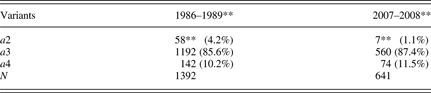
In Table 1, we give the total distribution of the a2, a3, and a4 variants in our old and new data. In the old data, there are about twice as many occurrences of the aj-variable as in the new data. This is because our old data include three times as many interviews and group conversations as the new data. Data from the three rounds of old recordings in the 1980s have been combined. In Table 1, we see a large number of a3 occurrences and smaller numbers of the a2 and a4 variants. In addition to the cross-tabulation in Table 1, we have studied the change in representation of each of the variants. This shows that the change between the old recordings and the new recordings are mainly due to a significant decrease in the use of a2 (p < .0001), whereas the change in representation of the other a-variants was not significant.
Distribution of aj-variants in the old and new recordings
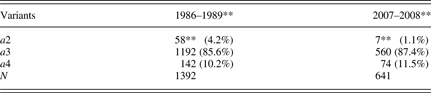
Note: ** p < .001, horizontally.
In the old data, we find, not surprisingly, that the a3 variant is the most frequent. This applies for both male and female informants. The second-most frequent variant is a4. We find a similar distribution of the variants in the new data. The informants generally have more a2 pronunciations in the old recordings than in the new ones. A drop in the a2 rate from 4.2% to 1.1% is the only significant difference in Table 1. With the a3 and a4 variants, we only find nonsignificant changes.
Table 1 can answer our first question, namely whether individuals can change their pronunciation over time. The overall answer to this question is that some changes do happen, although not wholesale substitutions of one variant with another. The most essential change is the decrease in the use of the a2 variant. To get a better understanding of this change, we look at gender-related differences. Later, we look into change among the female informants in our data.
GENDER DIFFERENCES
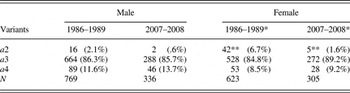
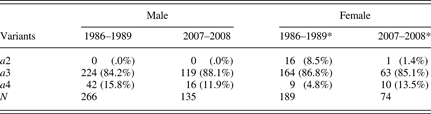
Table 2 displays the use of a2, a3, and a4 variants among male and female informants in the old and new recordings. We can see from the table that men generally have more a4 pronunciations than women do, whereas women have more a2 pronunciations than men do. However, the change between the old recordings and the new ones is due to the women decreasing their use of a2 significantly. Comparison of a3 and a4 use between the old and the new recordings shows no significant changes. Furthermore, the a3 variant is the most frequently used across genders. This is the case in the old as well as the new recordings. The female informants have a more even and relatively high use of both the a2 and the a4 variants in the old recordings, whereas the men have a more uneven distribution, with a low use of a2 and a more frequent use of a4. This is not the case in the new recordings, where the women have a distribution of the three variants just as uneven as that of the men. We now look further into this development.
The use of aj-variants among male and female informants in the old and new recordings

Note: * p < .01; ** p < .001, horizontally.
Only the female informants as a group change their behavior significantly. There are no statistically significant differences in the data regarding the men as a whole. One observation, based on the data presented in Table 2, is that there is a significant difference between male and female speakers' aj-distribution in the old recordings (p < .0001), but no significant difference in the new recordings. This indicates that our male informants as a group have not developed in any one direction concerning usage of the aj-variable. As we can see in Table 2, there is a drop of 5.1 percentage points in women's use of the a2 variant between the old and the new recordings. Our female informants have almost stopped using the a2 variant. This means that they have almost the same distribution of a2 and a4 as the men, which is interesting in relation to Kristiansen's hypothesis because our data shows that the women today talk like the men they rated highest 20 years ago. This contributes to our answer to the second problem we raised, regarding the motivation for change. Because of this significant decrease in the use of a2 among the women, we can conclude that they are the ones behind the general decrease of a2 we observed in Table 1.
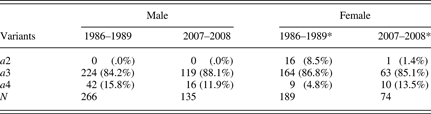
With the a2 variant almost nonexistent among female informants in the new data, a4 is the second-most frequent variant (next to the a3) used among women in the new recordings. Where does this development come from? We can throw some light on this matter by looking into where the female informants went to school. Table 3 shows the use of the three variants among male and female informants at the Næstved high school.
The use of aj-variants among male and female informants at the Næstved high school in the old and new recordings
Note: * p < .01, horizontally.
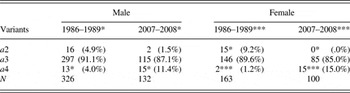
The female informants follow almost the same pattern as we saw in Table 2—a decrease in the use of the a2 variant and an increase in the use of a4. However, in this case, we see a much greater increase in the use of a4 than displayed in Table 2. Among the men, we see no statistically significant changes between the old and new recordings—a similar picture as we saw in Table 2. Looking at change among female informants at the Herlufsholm high school, displayed in Table 4, we see almost the same pattern as we saw among women at the Næstved high school. In this case, however, some of our observations are statistically significant.
The use of aj-variants among male and female informants at the Herlufsholm high school in the old and new recordings

Note: * p < .01; *** p < .000, horizontally.
In the group of Herlufsholm female speakers, we find an even larger decrease in the use of the a2, as the variant actually disappears between the old and the new recordings. In addition, we find a greater increase in the use of a4, which is an even greater increase than among the male informants. By replacing one variant (a2) with another (a4) within a time span of 20 years, the female informants at Herlufsholm are the ones behind the most dramatic real-time change in our material. A quick look at the men tells us that they have the same development as the women, although to a lesser degree. This was not what we found in Table 2, where the men, in general, did not change their pronunciation at all. The difference may be related to the fact that the male informants at Herlufsholm did not have the same frequent use of a4 in the old recordings as the men at the Næstved high school and technical school and, therefore, have become more like other men in the meantime, just as much as they have become like the women.
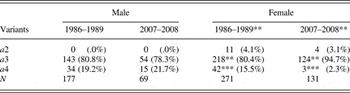
A group of women at the Næstved technical school, displayed in Table 5, is particularly interesting because the change in that group is the opposite of what we have seen among the female informants so far.
The use of aj-variants among male and female informants at the Næstved technical school in the old and new recordings

Note: ** p < .001; *** p < .0001, horizontally.
In the group of female speakers from the Næstved technical school, we observe a significant decrease in the use of the a4 variant. This development is the opposite of what we have seen earlier among the women. The women at the Næstved technical school shift from being the ones who use the most a4 pronunciations in the old recordings compared with the other women with respect to a2. Here we only find a slight decrease in the use of the a2 variant. This should be seen in relation to the fact that they, as opposed the other women, did not use the a2 variant as frequently in the old recordings.
To sum up, we can see that the general development among our female informants in real time, as displayed in Table 2, originates from women at the Næstved and Herlufsholm high schools, whereas female informants at the Næstved technical school follow an opposite pattern.
SUMMING UP
Summing up the distribution of the three variants, we see that the most frequently used variant in our material is a3, followed by a4, and the least used variant among our informants is a2. In broad terms, our male informants generally use more a4 than the female informants do, and female informants generally use more a2 than male informants do. This is the general picture in the old as well as the new recordings.
We find one significant change between the old and new recordings in the pronunciation of the aj-variable among our informants. This is the decrease in use of the a2 variant. This change, as we saw in Table 1, is primarily because the women in our material, as displayed in Table 2, nearly stop using this variant in the new recordings. Furthermore, this development can be traced back to women at the Herlufsholm and Næstved high schools. Apart from women at the Næstved technical school, the a4 variant is the second-most frequently used variant among the women. The same pattern is found among the men. Thus, all indications are that the a4 variant may be on its way toward becoming a middle-class variant, while a2 is retreating.
That this could be the case can be further substantiated by the way the a4 variant is used by informants of different social classes. Jørgensen & Kristensen (Reference Jørgensen and Kristensen1994) divided the informants into three categories according to the occupation and education of their parents: low (L), middle (M), and high (H) socioeconomic status. They used the following criteria:
H: People with an academic education and a matching occupation, and individuals in charge of many employees.
M: People with a middle-range education and a matching occupation, and skilled workers.
L: Unskilled workers, people who spend their time at home, and pensioners.
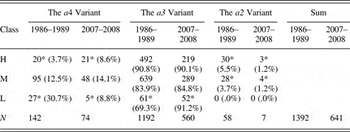
(Jørgensen & Kristensen, Reference Jørgensen and Kristensen1994: 31; our translation)Information was collected in interviews, and the parent with the highest education and occupation determined the categorization. In the new study, we have used the same criteria and categories to classify informants, only this time the categorization is based on our informants' own education and occupation. In Table 6, we see the distribution of the a2, a3, and a4 variants among our higher-, middle-, and lower-class informants.
The use of the a4, a3, and a2 variant among high-, middle-, and low-status speakers; percentages of all aj-diphthongs pronounced by the groups

Note: * p < .01, horizontally. H: high, M: middle, L: lower.
The real-time change present in the use of the a4 variant among our L- and H-speakers is particularly interesting in this context. With the H-speakers, we see a statistically significant increase in the use of the a4 variant. In the old data, this variant was not as commonly used among H-speakers compared with M- and L-speakers. The increase, therefore, indicates that this variant has become more acceptable to this group of speakers over the years. Another indication that the a4 variant may have become a more accepted middle-class variant is that our L-speakers have adjusted their use of this variant to a level that is not far from our M-speakers. The overall picture is that both our lower- and higher-class informants have adjusted their use of the a4 variant to a level not far from our middle-class speakers. In addition, the H-speakers have decreased their use of the a2 variant. The combined results further contribute to our conclusion that the a4 variant, traditionally known as a lower-class variant, now may be on its way to becoming an accepted middle-class variant.
So far, we have only looked at our informants by groups with respect to school, gender, and social class. In the following, we look at our informants on an individual level and thereby shed light on the individuals' distributions of the a2, a3, and a4 variants in real time.
Individual changes
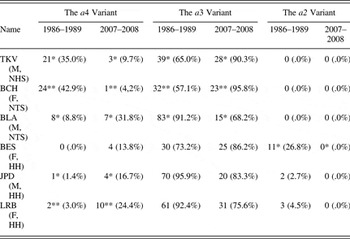
In our data, 6 (3 male and 3 female informants) of our 24 informants show significant individual variation between the old and new recordings. Table 7 shows this variation.
Selected individual speakers' use of a4, a3, and a2 from the three schools in the old and new recordings

Note: * p < .01, horizontally; ** p < .001; *** p < .0001, horizontally. F: female, M: male; NHS: The Næstved high school, NTS: The Næstved technical school, HH: The Herlufsholm high school.
TKV is the only representative from the Næstved high school group. Differently from Table 3, where we saw no significant change between the old and the new recordings, TKV here shows significant change in his use of the a4 variant. His use of this variant drops from 35.0% to 9.2%. His decrease in the use of a4 is matched by an increase of 25.3 percentage points in his use of a3. He is the only one from the Næstved high school group who changes significantly during the period from 1986–1989 to 2007–2008. His change is not enough to have an impact on the results in Table 3; therefore, we do not see any significant change among the males in the Næstved high school group.
In contrast to the Næstved high school students, the group of female students from the Næstved technical school show significant changes in their use of a3 and a4 (see Table 5) between 1986–1989 and 2007–2008: the use of a3 increases and the use of a4 decreases. BCH follows this tendency as her use of the a4 variant dramatically decreases from 42.9% in the old recordings to 4.2% in the new ones. This change is matched by an increase in the use of a3. Therefore, she can be seen as representative of the linguistic development among the female informants from the Næstved technical school. BLA is the only male representative from the Næstved technical school who shows any significant change. Contrary to BCH, he has an increase in his use of the a4 variant and a decrease in his use of the a3 variant from the old to the new recordings. As with TKV, this development is not enough to affect the level of significance in Table 5. Common to TKV, BCH, and BLA is that they do not use the a2 variant at all in the old recordings, nor in the new recordings.
This is not the case for BES, JPD, and LRB who are all from the Herlufsholm high school. BES is the only one from this group who shows a significant change regarding the a2 variant as she completely stops using it in the 2007–2008 recordings. This is representative of the linguistic development among the female students from the Herlufsholm high school (see Table 4). The development in her use of the a4 variant shows the same pattern as the rest of the group, but her change is not significant. In the case of LRB, however, the use of the a4 variant between the old and new recordings shows a dramatic significant increase from 3.0% to 24.4%. Given this, LRB is representative of the development within the use of this variant among the female Herlufsholm students despite her more frequent use of the a4 variant in the new recordings as compared to the group average use. JPD is the only male representative from the Herlufsholm high school group who shows a significant change in his use, an increase in his use of the a4 variant. On the basis of the changes among the male and female informants from Herlufsholm high school, we can conclude that all of them show an increase in the use of the a4 variant, which is paralleled by the loss of the a2 variant. Thereby, they all function as representatives of the linguistic development within this group.
The significant individual changes among our informants show that language change is possible, and even likely in individual speakers. It is further evident that such developments can be observed by quite simple methods. We also witness that the changes we have documented indeed can be traced within an interval of 20 years as suggested by Peng (Reference Peng1976, 1979).
CONCLUSIONS
In this paper, we have studied pronunciation of the aj-diphthong among 24 informants from the Næstved high school, the Næstved technical school, and the Herlufsholm high school. All of the informants participated in recordings from the years 1986–1989 and 2007–2008. We have analyzed more than 2000 pronunciations of the aj-diphthong. The purpose of this study was to try to answer two questions. The first question was whether individual speakers change their pronunciation between teenage and adulthood. The answer is that some speakers indeed do change their pronunciation, but not all. Women change more than men do, and apparently middle-class speakers change less than other groups do. This leads to the second question: Do speakers' relatively positive attitudes toward one of several available varieties lead to a change in their own linguistic behavior, in the direction of the variety in question's characteristics? In other words, we wanted to find out if the Kristiansen & Jørgensen model could be supported or rejected. According to this model, changes are caused by the accumulations of subjective choices. These choices are motivated by social-psychological factors such as attitudes, which can be deduced from guise tests. One way to support or reject this model involved the guise test by Kristiansen (Reference Kristiansen1991). A hypothesis we could base on the Jørgensen & Kristensen (Reference Jørgensen and Kristensen1994) findings, as well as the Kristiansen (Reference Kristiansen1991) findings, is that girls who had more conservative forms than boys in 1986–1989 would use more nonconservative forms by 2007–2008 because they had a more positive attitude toward modern variants by the mid-1980s. The girls do indeed use fewer conservative variants more frequently in their pronunciation in 2007–2008 than in 1986–1989, so the hypothesis is thereby supported.
Overall, this study shows that the most obvious change through the period was in the use of the variant a2. In the old recordings, we found significantly more instances of a2 than in the new recordings. With the variant a4 it was the opposite, but not with the same degree of significance. We conclude that the more conservative variant a2 may be on its way out of Danish standard pronunciation, and the variant a4 seems to be on its way into the (Copenhagen) standard. The most common variant is a3 in all our results, so the change and development have been clearest in changes in the use of two extreme variants.
Furthermore, this study has showed that women from the Næstved and Herlufsholm high schools in the old recordings in general have more conservative forms in their pronunciation of the aj-diphthong than the men do, but this difference is almost evened out in the new recordings. For some reason, female informants at the Næstved technical school follow the opposite pattern. This could have something to do with social class, if we suppose that social identity is reflected in language, and our results regarding social class show that the H-speakers more often pronounce aj-diphthongs with the variant a2 than the L-speakers do. Within all of the social classes, though, the direction is toward fewer instances of the variant a2 and more incidents of a4. It also seems that the differences in pronunciation dependent on social class are almost evened out over time. In this material, we find a smaller difference in pronunciation between informants from different social classes in 2007–2008 than in 1986–1989; additionally it seems that the variant a4 is on its way toward becoming an accepted middle-class variant, as partly predicted by Kristiansen's (1991) guise test. There is a certain basis for concluding that these changes could be motivated by social-psychological factors such as attitudes, as the Kristiansen & Jørgensen (Reference Kristiansen, Jørgensen, Auer, Hinskens and Kerswill2005) model suggests.