

It has been said that unexpressed subjects in English are “restricted to certain types of discourse and/or register” (Roberts & Holmberg, Reference Roberts, Holmberg, Biberauer, Holmberg, Roberts and Sheehan2010:5), and that the constraints on subject expression in registers that do allow it in English (e.g., “diary drop”) differ from those in canonical “null subject languages” (e.g., Haegeman, Reference Haegeman2013:93–94). As yet, however, there has been no quantitative evidence adduced in support of these claims. Here we address this, through a comparison of the factors conditioning the variation in pronominal and unexpressed third-person singular (3sg) human specific subjects in two spoken registers of English: interactional conversation and monologic narratives.
Overall, the two registers studied present vastly different rates of expression: roughly 4% (153 of approx. 3500) of the 3sg human specific subjects are unexpressed in the conversational registers, compared with 22% (165 of 748) in the narrative data. The very low rate of nonexpression in conversation is of little surprise for a language typically classified as having obligatory subject expression (e.g., Dryer, Reference Dryer, Dryer and Haspelmath2011; Roberts & Holmberg, Reference Roberts, Holmberg, Biberauer, Holmberg, Roberts and Sheehan2010:4). The rate of nearly one quarter unexpressed subjects in the narratives is, however, remarkably high for such a characterization. If we were to categorize language types on the basis of rates alone, these figures might suggest that English narrative is a kind of “null subject” register, while conversation is not. They may also lead some to wonder whether these two registers are operating under different grammars, or as Weir (Reference Weir2012:116) put it, there is a “reranking” of constraints across the registers (cf. Walkden, Reference Walkden2013:174). Such an understanding would be in accordance with Biber and Conrad's (Reference Biber, Conrad, Schiffrin, Tannen and Hamilton2001:176) proposal that there exist “systematic and important linguistic differences across registers.” However, a difference in rates of use alone cannot be taken as evidence of differences in grammar, as rates are affected by extralinguistic factors, including, crucially for our purposes, register (e.g., Silva-Corvalán, Reference Silva-Corvalán2001:163; Travis, Reference Travis2007). Hypothesized register differences can instead be ascertained through comparisons of factors conditioning the variability (see Szmrecsanyi & Hinrichs, Reference Szmrecsanyi, Hinrichs, Nevalainen, Taavitsainen, Pahta and Korhonen2008, for an illustration).
Thus, here we look beyond rates to compare the conditioning of subject expression in the two registers. We consider first the contexts where unexpressed 3sg human specific subjects do not occur (that is, categorical constraints), and then examine the linguistic conditioning of expression in the remaining contexts where unexpressed and pronominal subjects exist in variation (probabilistic constraints). The results demonstrate that the two registers are subject to identical constraints, including those that are categorical and those that are probabilistic, thus supporting Guy's (Reference Guy2005:562) claim that “the grammar is unchanged in stylistic variation.”
Furthermore, we compare these constraints with those that have been identified in so-called null subject languages, to examine whether unexpressed subjects in English have “special properties which distinguish them from the canonical null subjects” (Roberts & Holmberg, Reference Roberts, Holmberg, Biberauer, Holmberg, Roberts and Sheehan2010:5). We find that subject expression in English has a narrower envelope of variation than null subject languages, with unexpressed subjects occurring only in coreferential clauses conjoined with a coordinating conjunction, and outside of that, in prosodic initial position in main clause declaratives. However, within the envelope of variation, English is not “special” at all, and the constraints in operation (accessibility, priming, temporal sequentiality, and coordination) are parallel to those widely described for null subject languages, suggesting a need for further exploration into the widely accepted distinction between “null” and “non-null” subject languages.
UNEXPRESSED SUBJECTS IN CONVERSATION AND NARRATIVE
The data for this study come from two spoken corpora representing distinct registers, interactional conversation from the Santa Barbara Corpus of Spoken American English (SBCSAE, Du Bois, Chafe, Myer, Thompson, Englebretson & Martey, Reference Du Bois, Chafe, Myer, Thompson, Englebretson and Martey2000–2005), and monologic narratives from the transcriptions of the Pear Stories in English (Chafe, Reference Chafe1980).
The SBCSAE is a publically available corpus of transcriptions of 60 recordings, made between 1988 and 1996. The recordings consist of spontaneous spoken interaction between people of different sociodemographic backgrounds from across the USA. Most of the transcriptions that make up the corpus involve face-to-face interaction among groups of two to four friends, family members, and acquaintances. The corpus consists of a total of 249,000 words; in this study, we make use of the 34 transcripts that comprise interactional discourse and have tokens of unexpressed 3sg human specific subjects. This subcorpus totals 162,000 words, with individual transcripts ranging from approximately 3000 to 8000 words.Footnote 1
The Pear Story corpus consists of transcriptions from recordings made in 1975 of 20 participants (US undergraduate native speakers of English) recounting a 6-min silent film that they were shown and asked to describe. Participants narrate the story to an interviewer, who claims not to have seen the film. The corpus totals 16,000 words, with the individual narratives ranging from approximately 300 to 1750 words. All transcripts present tokens of unexpressed 3sg human specific subjects, and thus all were included in this study.
Both of these corpora have been transcribed following the principles of the method outlined in Du Bois, Schuetze-Coburn, Cumming, and Paolino (Reference Du Bois, Schuetze-Coburn, Cumming, Paolino, Edwards and Lampert1993). Central to this method is the Intonation Unit (IU), characterized as “a stretch of speech uttered under a single, coherent intonation contour” (Du Bois et al., Reference Du Bois, Schuetze-Coburn, Cumming, Paolino, Edwards and Lampert1993:47). Each IU is presented on a single line in the transcription, with punctuation used to mark the prosodic contour (or transitional continuity) at the end of the unit (see the appendix for the transcription conventions for each dataset). The IU corresponds largely to the Intonational Phrase (Pierrehumbert & Hirschberg, Reference Pierrehumbert, Hirschberg, Cohen, Morgan and Pollack1990) or the tone group (Halliday, Reference Halliday1967), though it is defined on the basis of the boundaries of the unit rather than its internal structure (cf. Chafe, Reference Chafe1994:58–59). It has been argued to be a basic unit of spoken discourse, where the validity of the “sentence” has been questioned (cf. Croft, Reference Croft1995:875; Izre'el, Reference Izre'el, Auran, Bertrand, Chanet, Colas, Di Cristo, Portes, Reynier and Vion2005). The IU is particularly important to the variable under study here, as an “IU-initial constraint” (Torres Cacoullos & Travis, Reference Torres Cacoullos and Travis2014:28–29) has been put forward as an alternative account of the restriction of unexpressed subjects to “sentence-/clause-initial” position (reported in Harvie [Reference Harvie1998:21]; Leroux & Jarmasz [Reference Leroux and Jarmasz2005:4]; Roberts & Holmberg [Reference Roberts, Holmberg, Biberauer, Holmberg, Roberts and Sheehan2010:90]; though see Napoli [Reference Napoli1982] and Weir [Reference Weir2012] on a proposed “initial material” or “left-edge deletion” constraint).
The conversational data included here are characterized by a large amount of interaction (turn-taking, question-and-answer sequences, overlaps), as seen in (1). The narrative data, on the other hand, are entirely monologic, as participants recount the series of events that occurred in the film (with occasional metalinguistic commentary on the film), as seen in (2). All 3sg subjects have been marked in bold, and tokens of unexpressed subjects are indicated with Ø.
(1)
1. Jeff: (H) ~Ro=b (H) … decided that he just needed a vacation or something?
2. Jill: Unhunh.
3. Jeff: So=%,
4. … (TSK) (H) he= .. took off for .. Big Bear.
5. Jill: … You're kidding.
6. Jeff: Ø Had no idea where he was going,
7. [he just took] --
8. Jill: [All by] himself?
9. Jeff: All by himself,
10. a=nd,
11. (H) he found a cabin,
12. he called me?
(SBCSAE 28:628–639)Footnote 2
(2)
1. [6.35[1.1] U--m [.7] then [.4] u--h [2.1]] a .. girl on a bicycle,
2. [1.15] comes riding towards him,
3. .. in the opposite direction.
4. [.9] And as they pass,
5. [.45] he sort of turns,
6. and Ø looks at her,
7. [.6] and his hat flies off,
8. [2.1[.2] a--nd [1.2]] his [.3] bicycle hits a rock.
9. .. Because he's looking at the girl.
10. [.75] Ø Falls over,
11. 1.5[1.35] uh] there's no conversation in this movie.
(Pear 6:10.1–13.2)
Third-person singular human specific subjects, the focus of study here, represent the bulk of the subjects in the Pear narratives, and the bulk of the third-person unexpressed subjects in both datasets. While some studies have considered the third person alongside other persons (for English, see Cote, Reference Cote1996; Harvie, Reference Harvie1998; Leroux & Jarmasz, Reference Leroux and Jarmasz2005; Shin & Montes-Alcalá, Reference Shin and Montes-Alcalá2014), focusing on just one person may permit a fuller understanding of the conditioning, as it is yet to be established whether all subject personal pronouns are affected by the same constraints. For example, issues related to accessibility are likely to apply differently to the third person as compared with discourse participants (first and second person) (cf. Chafe, Reference Chafe1994:79), and this may manifest itself in subject expression. In Finnish, for instance, first and second person, but not third person, are reported to be generally left unexpressed (Helasuvo, Reference Helasuvo2014:454). Third person itself has a wide range, including animate and inanimate, human and nonhuman, as well as specific and nonspecific referents, such that Scheibman (Reference Scheibman, Bybee and Hopper2001:163) suggested that “third person singular subject is not a coherent category in English conversation.” Hence, we restrict the analysis to what can be assumed to be a coherent category: human specific subjects.
We extracted all instances of finite verbs with an unexpressed 3sg human specific subject in both datasets. We do not count as unexpressed tokens that occurred in the context of repair (3), where there is a potential subject in a preceding IU (4), nor in cases of what could be considered “subject-aux deletion” (cf. Harvie, Reference Harvie1998:19) (for example, for ask in he'll turn around and ask). We do consider to be unexpressed, but exclude from the study, a small number of tokens where the transcript is unclear, or it is not possible to conclusively determine whether the unexpressed subject has a 3sg human specific referent.
(3) potential unexpressed subject in the context of repair:
And u--m[1.35]] this man came by,
[.3] walked by,
(Pear 14:17.1–17.2)
(4) potential subject produced earlier in the discourse:
Miles: Well !Sue !Swing,
I mean when she was teaching was definitely more sedate,
(SBCSAE 2:1079–1080)
Following these guidelines, unexpressed 3sg human specific subjects were exhaustively extracted from the two datasets, for a total of 153 in the conversational data (produced by 52 speakers) and 165 in the Pear Story narratives (by 20 speakers).
We can estimate an initial overall rate of expression by comparing this with the number of tokens of he and she in the data, assuming that the vast majority of these will be subject pronouns representing specific human referents (as the use of he and she for inanimate and generic uses would be rare). Based on counts in each corpus using the concordance program Monoconc (Barlow, Reference Barlow2004), the overall rate of nonexpression is 22% (165 of 748) in the Pear Stories, compared with just 4% (153 of approx. 3500) in SBCSAE (significantly lower, p < .0001).Footnote 3 Note that the rate for the conversational data is comparable to that observed for first-person singular (1sg) in this same corpus by Torres Cacoullos and Travis (Reference Torres Cacoullos and Travis2014:22) and is slightly lower than the rate for all persons reported by Shin and Montés Alcalá in data from the talk show Larry King Live (Reference Shin and Montes-Alcalá2014:88).
The difference in rates across the two registers is also to some degree comparable to other languages. For example, in Spanish Pear Stories produced by Peninsular Spanish speakers, Comajoan (Reference Comajoan, Clements and Yoon2006:60) found a rate of unexpressed (vs. pronominal) 3sg specific subjects of 97% (275 of 285); in sociolinguistic interviews, a lower rate has been reported, ranging from 92% unexpressed in Madrid (n = 286, Cameron, Reference Cameron1992:233) to 60% in Barranquilla, Colombia (n = 758, Orozco, Reference Orozco, Carvalho, Orozco and Shin2015:21); and in conversational Colombian Spanish, 68% (n = 1413, Torres Cacoullos & Travis, Reference Torres Cacoullos and Travis2015b). Despite these very different rates of expression, however, the constraints identified across different varieties of Spanish correspond, and thus, as Torres Cacoullos and Travis (Reference Torres Cacoullos, Travis, Carvalho, Orozco and Shin2015a:82) put it for 1sg, “the grammar is the same across Spanish varieties.”
THE VARIABLE CONTEXT FOR ENGLISH SUBJECT EXPRESSION
We focus the analysis here on the variability that exists between unexpressed and (personal) pronominal subjects, assuming these forms to be essentially equivalent ways of referring to given information, unlike full noun phrases (NPs), which are also used to introduce new information (in accordance with Givón's [Reference Givón and Givón1983:17] accessibility hierarchy; cf. also Chafe [Reference Chafe1994:75–76]).
In order to identify the conditioning of this variation, we first need to determine in what contexts pronominal and unexpressed subjects exist as competing variants in English.
It has been widely recognized in English grammars that unexpressed subjects occur relatively freely in coordinated contexts (e.g., Biber, Johansson, Leech, Finegan & Conrad, Reference Biber, Johansson, Leech, Finegan and Conrad1999:156; Dixon, Reference Dixon2005:22; Quirk, Greenbaum, Leech & Svartvik, Reference Quirk, Greenbaum, Leech and Svartvik1985:910). This has been referred to as “VP coordination” (or predicate—vs. clausal—conjunction), in which the second conjunct is not clausal, and thus does not have an unexpressed subject (e.g., Haspelmath, Reference Haspelmath2004:31; Huddleston & Pullum, Reference Huddleston and Pullum2002:238). VP coordination has not, however, been explicitly defined. It is generally applied to explain the occurrence of unexpressed subjects in the context of coreferential clauses (Quirk et al., Reference Quirk, Greenbaum, Leech and Svartvik1985:948), usually conjoined with a coordinating conjunction such as and, but, or or (Quirk et al. Reference Quirk, Greenbaum, Leech and Svartvik1985:910), though coordination without a conjunction (“asyndetic” coordination) has also been described (Biber et al., Reference Biber, Johansson, Leech, Finegan and Conrad1999:156; Haspelmath, Reference Haspelmath2004:4). Some scholars have also noted a role for prosody, specifically occurrence of the two conjuncts in a single prosodic unit (e.g., Mithun, Reference Mithun, Haiman and Thompson1988:333; Quirk et al., Reference Quirk, Greenbaum, Leech and Svartvik1985:948). Line 3 in example (5), which exhibits all these characteristics, would seem to be a canonical case of VP coordination.
However, VP coordination does not explain the occurrence of unexpressed subjects in English, because, on the one hand, pronominal subjects also occur in canonical VP coordination contexts, seen in (6), and, on the other, unexpressed subjects also occur in noncoordinated contexts (in the narrative data, 45% of the time, a rate similar to that of the coordinated tokens, see Table 2). One example can be seen in (7), where there is no coordinating conjunction and one clause intervening between the target clause in line 5 and the previous clause with a coreferential subject in line 2. Thus, the variability in English subject expression that exists in both coordinated and noncoordinated contexts must be accounted for in order to obtain a full understanding of this phenomenon.
(5)
and he goes and Ø takes the hat to the kid,
(Pear 10: 48.5)
(6)
1. Rebecca: [(H)] So this man walked up to him and he said,
2. <Q I'm standing close to you,
3. I'm looking at you,
4. does that make me a pervert Q>?
(SBCSAE 8:1224–1227)
(7)
1. Miles: then she went out there,
2. Ø got on her knee = s.
3. … in front of him.
4. … in this skirt that's this short,
5. … (H) Ø takes her hands,
6. .. and Ø goes along his toes,
(SBCSAE 2:1169–1174)
The envelope of variation in the coordinated and noncoordinated contexts is somewhat distinct, as was identified by Torres Cacoullos and Travis (Reference Torres Cacoullos and Travis2014:22–23) for 1sg subjects in the SBCSAE. In the context of coreferential-subject verbs which are syntactically conjoined with a coordinating conjunction (and, but, or, and/but + ADV), unexpressed subjects occur relatively freely. Outside of this context, they are restricted to prosodic-initial position, occurring only in main clause declaratives in absolute IU-initial position and therefore not in subordinate clauses nor interrogatives (cf. Haegeman, Reference Haegeman2013:93–94; Harvie, Reference Harvie1998:21; Leroux & Jarmasz, Reference Leroux and Jarmasz2005:4; Roberts & Holmberg, Reference Roberts, Holmberg, Biberauer, Holmberg, Roberts and Sheehan2010:90; Weir, Reference Weir2012). Unexpressed subjects with quotative verbs occur only in coordinated contexts, and there are no instances of unexpressed subjects with contracted auxiliaries.
With this now established, we can proceed with the extraction of pronominal subjects that fall within this envelope of variation.
Extraction of Pronominal Subjects
In order to obtain a comparable corpus of pronominal subjects, we utilized an artificial sampling method that has been applied to the study of subject expression in English, extracting the closest pronominal subjects preceding and following each unexpressed token (cf. Harvie, Reference Harvie1998:18; Leroux & Jarmasz, Reference Leroux and Jarmasz2005:3; Torres Cacoullos & Travis, Reference Torres Cacoullos and Travis2014:23). We extracted preceding and following tokens produced by the same speaker and aligning with the envelope of variation as described, that is, noncontracted forms occurring either in coreferential clauses with a coordinating conjunction, or in declarative, main clauses.Footnote 4 Thus, in (1) and (2), the pronouns in line 1 in (1) and in line 9 in (2) fall outside the variable context because they occur in non-IU-initial position (in subordinate clauses); the pronoun in line 9 in (2) is also contracted.
In the SBCSAE, this gave an initial total of 306 pronominal subjects (2 for each of the 153 unexpressed). This included non-IU-initial pronouns, which were subsequently excluded in all noncoordinated contexts (n = 42), leaving a total of 264 pronouns for inclusion in the analysis, and therefore an artificial rate of nonexpression of 37% (153 of 417). In the Pear Stories, this same method resulted in the extraction of all available pronominal tokens (n = 307), slightly short of the goal of two pronouns for each of the 165 unexpressed subjects. Of these, 54 pronouns occurring in non-IU-initial position were excluded, leaving 253 for analysis, and thus a rate of nonexpression of 39% (165 of 418).
Summary
To summarize this discussion of the variable context, we make three points. The first is that the nonvariable contexts identified here represent a sizable proportion of the pronominal data: in the Pear Stories, where all 3sg human specific pronouns were extracted, pronouns falling within the envelope of variation account for well under one half (253 of 583) of all pronouns in the data, a proportion similar to that which Torres Cacoullos and Travis (Reference Torres Cacoullos and Travis2014:22, 28) reported for 1sg pronouns. This means that the real rate of nonexpression in the Pear Stories is closer to 40% (165 of 418) (as opposed to 22%). Following these same calculations, we can estimate that the real rate of nonexpression in the SBCSAE data would be at around 10% (153 of 1515) (as opposed to 4%). Were the variable context to be overlooked, we would end up with a substantially different set of data for the analysis, leading possibly to quite distinct results.
Second, the envelope of variation in the two registers is identical, and thus here at least, we see no evidence for any difference in the grammars.
And third, these constraints are reported to not pertain in null subject languages (Haegeman, Reference Haegeman2013:93–94). In Spanish, for example, unexpressed subjects occur in IU-medial position (cf. Torres Cacoullos & Travis, Reference Torres Cacoullos, Travis, Carvalho, Orozco and Shin2015a:93), and in interrogatives and subordinate clauses. Thus, in this sense, English would indeed appear to differ from the so-called canonical null subject languages.
Remaining to be answered, however, is whether, in the contexts where variability does exist, the two registers behave in the same way or not, and how this compares with patterns observed in languages with more widespread variability. It is to this that we now turn.
ENGLISH SUBJECT EXPRESSION IN THE VARIABLE CONTEXT
The wide body of literature on subject expression in null subject languages has identified a range of constraints that condition this variability, and the constraints we test for here are drawn from this literature.
Accessibility
Cross-linguistically, probably the most widely discussed constraint on subject expression relates to what has been termed “accessibility” (Ariel, Reference Ariel1994:2630; Givón, Reference Givón and Givón1983:17), “activation” (Chafe, Reference Chafe1994:75), or “recoverability” (e.g., Haegeman, Reference Haegeman2013:89; Weir, Reference Weir2012:116), such that the greater the accessibility, activation, or recoverability of the subject referent, the greater the likelihood that the subject will be unexpressed. Quantitative studies have shown this to be one of the most robust constraints conditioning variable subject expression across a range of languages, including Arabic (Owens, Dodsworth, & Kohn, Reference Owens, Dodsworth and Kohn2013:263), Australian Sign Language (McKee, Schembri, McKee & Johnston, Reference McKee, Schembri, McKee and Johnston2011:388), Bislama (a Vanuatan creole) and Tamambo (an indigenous language of Vanuatu) (Meyerhoff, Reference Meyerhoff2009:308), and Spanish (e.g., Silva-Corvalán, Reference Silva-Corvalán, Amastae and Elías Olivares1982:104).
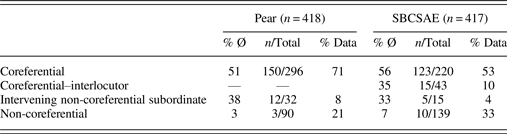
While there are different paths of accessibility—previous mention in the discourse, situational presence, shared knowledge (cf. Chafe, Reference Chafe1994: chap. 6; Prince, Reference Prince1978)—previous mention in the discourse is that which is most readily operationalized. Here, we focus on previous mention as subject, as this appears to have a greater effect than a nonsubject mention: in both datasets, subjects are unexpressed approximately one half of the time when coreferential with the subject of the immediately preceding clause (150 of 296 in Pear and 123 of 220 in SBCSAE), but only 10% of the time when coreferential with a nonsubject mention in the immediately preceding clause (4 of 40 in Pear and 4 of 34 in SBCSAE). Also note that coreferential subject mentions in the immediately preceding clause are some seven times more frequent than nonsubject mentions in the immediately preceding clause (296 vs. 40 in Pear, and 220 vs. 34 in SBCSAE).
Table 1 presents the rate of unexpressed subjects in relation to the previous mention of that same referent as subject. “Coreferential” refers to contexts where the immediately preceding clause is produced by the same speaker and shares the same subject referent, as in lines 2 and 6 in (7). “Coreferential–interlocutor” (only relevant to the conversational data) refers to contexts where the immediately preceding clause is coreferential but was produced by the interlocutor, as illustrated in line 4 in (8). “Intervening non-coreferential subordinate” refers to contexts where the preceding main clause shares the same subject referent, but intervening between it and the target clause is a subordinate clause, or clauses, with a distinct subject referent as in line 5 in (7). And “non-coreferential” is where the immediately preceding main clause has a distinct subject referent, as lines 9 and 12 in (9), where the unexpressed mentions refer to discourse participants (Jenn and Lisbeth, respectively), as the speakers report to Bill on an incident that happened at the supermarket.
Rate of unexpressed 3sg human specific subjects according to previous coreferential subject mention

(8)
1. Jo: I don't think ~Kathy ever buys him socks.
2. Cam: … Oh.
3. Jo: … [You know],
4. Wess: [Ø Buys e]verything else,
5. but not socks.
(SBCSAE 59:206–210)
(9)
1. Lisbeth: And she specifically said,
2. .. not to put [2everything2] on the [3counter3].
3. Laura: [2Okay2].
4. [3Well then3],
5. I didn't,
6. [I didn't know that].
7. Bill: [Yeah=,
8. and so what] happened.
9. Lisbeth: .. (SNIFF) .. Ø Starts putting everything on the cou[2nter2].
10. Jenn: [2No=2],
11. … I w- --
12. … Ø Acts like I'm a child,
13. like I'm just throwing things on.
(SBCSAE 33:660–672)
Note that in both registers, accessibility functions as predicted: the highest rate of nonexpression is in coreferential contexts (51% in the Pear Stories and 56% in the SBCSAE), and the lowest in non-coreferential contexts (3% and 7%, respectively).Footnote 5 Intermediate rates of nonexpression are found in contexts where the preceding coreferential token was produced by an interlocutor (35% unexpressed), or where there is an intervening subordinate clause(s) (38% and 33%; cf. Labov and Waletzky (Reference Labov and Waletzky1997[1967]:14) who point out that subordinate clauses are irrelevant in narrative sequences).
Though the effect is parallel, there is a difference in the two registers in terms of the distribution of the data (indicated in the third column, labeled “% data”): while over two thirds (71%) of the narrative data occur in coreferential contexts, just over one half (53%) of the conversational data do, and similarly, under one quarter (21%) of the narrative tokens occur in non-coreferential contexts while a third (33%) of the conversational data do. This is an artifact of greater subject continuity in the monologic narrative data, where the speaker is recounting an event, uninterrupted, while the interactional nature of the conversational data disrupts the subject continuity. Thus, here we see a clear register effect that can partially account for the higher rate of nonexpression in the narrative dataset. That effect is not, however, one of different grammars, but rather of contextual distribution (mirroring what Travis [Reference Travis2007:130] found for subject continuity in a comparison of 1sg subject expression in Spanish conversation and narratives).
Given the strength of the accessibility effect in both of these datasets, we exclude from the subsequent analyses those tokens occurring in non-coreferential contexts, focusing on the categories in the top three rows in Table 1, that is, when the target clause has the same subject referent of the immediately preceding clause, be that produced by the interlocutor or the speaker, and when the non-coreferential intervening material consists solely of a subordinate clause (or clauses).
Variable subject expression: Beyond accessibility
Beyond accessibility, there is a wide range of factors that have been found to apply in null subject languages. Here, we consider the form of the previous coreferential subject, to test for a widely observed coreferential subject priming effect (e.g., Cameron & Flores-Ferrán, Reference Cameron and Flores-Ferrán2003; McKee et al., Reference McKee, Schembri, McKee and Johnston2011:389; Torres Cacoullos & Travis, Reference Torres Cacoullos and Travis2014:29–30; Reference Torres Cacoullos and Travis2016; Travis, Reference Travis2007:120–122; Travis & Torres Cacoullos, Reference Travis and Torres Cacoullos2014:376–378); tense, which has been found to play a role in Spanish subject expression (e.g., Otheguy & Zentella, Reference Otheguy and Zentella2012:186; Shin, Reference Shin2014:311; Silva-Corvalán, Reference Silva-Corvalán2001:160–163; Travis & Torres Cacoullos, Reference Travis and Torres Cacoullos2012:733–734); temporal relationship between clauses, which would appear to play a role in Spanish (Cameron, Reference Cameron1992:207), Brazilian Portuguese (Paredes Silva, Reference Paredes Silva1993:43–45), and has also been suggested for English conversation (Oh, Reference Oh2006:832); and coordination, which has been reported for English (as discussed in relation to the variable context) and Spanish (e.g., Otheguy & Zentella, Reference Otheguy and Zentella2012:190; Shin, Reference Shin2014:311).
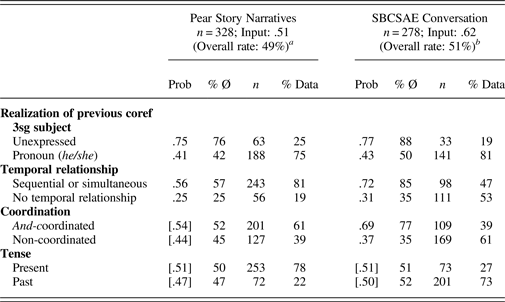
In order to identify the role these factors jointly play in conditioning the variation, we conduct logistic regression analyses (Sankoff, Reference Sankoff, Ammon, Dittmar and Mattheier1988), using Goldvarb LION (Sankoff, Tagliamonte, & Smith, Reference Sankoff, Tagliamonte and Smith2012). Following the variationist comparative method (cf. Poplack & Tagliamonte, Reference Poplack and Tagliamonte2001), we conduct independent, but identical analyses, in each dataset. The results of these two analyses are presented in Table 2, with the Pear Story narratives on the left, and the SBCSAE conversation on the right.Footnote 6 The factor groups (independent or predictor variables) appear in the left-hand column. The first column of numbers depicts the Probability (or factor weight) with which the 3sg subject is unexpressed in the corresponding context. A value closer to 1 indicates a favoring of nonexpression, and closer to 0, a favoring of the pronoun. The second column indicates the percentage of unexpressed instances in that subcontext. The hierarchy of constraints that is captured in these relative weightings is considered to be representative of “the grammar underlying the variability” (Poplack & Levey, Reference Poplack, Levey, Auer and Schmidt2010:400). The third and fourth columns provide the distribution of the data across the subcontexts (the contextual distribution): the number of tokens (n) and the proportion (% data) that each factor accounts for.
Two independent Variable-rule analyses of the contribution of factors selected as significant to the choice of unexpressed 3sg human specific subjects, in Pear Story narrative and SBCSAE conversational data
Note: aAll eligible tokens. bSample of expressed subjects. Factor weights of nonsignificant groups, given in square brackets, are drawn from the first stepping down run, in which all factor groups are included.
These results show very similar effects in the narrative and conversational data. In both datasets, Previous Realization and Temporal Relationship (marked in bold) have a significant effect on the variation: unexpressed subjects are favored when the previous subject was also unexpressed and are disfavored when there is no temporal relationship between the target and the preceding coreferential subject. In neither dataset does Tense have a significant effect. The one apparent difference concerns Coordination: while in both datasets, and-coordinated contexts exhibit a higher rate of nonexpression than noncoordinated contexts do, it is only in the SBCSAE that this achieves significance, with a rate of nonexpression over twice as high in contexts of and-coordination (77% vs. 35%) compared with the very slight difference of 52% vs. 45% in the Pear narratives. We will now review these results in detail.Footnote 7
Coreferential subject priming
Realization of the previous coreferential 3sg subject allows us to test for priming, whereby the same syntactic structure is repeated across clauses (cf. Bock & Griffin, Reference Bock and Griffin2000:177). Structural priming has been reported in experimental studies (cf. Pickering & Ferreira, Reference Pickering and Ferreira2008), as well as in corpus-based studies (e.g., Gries, Reference Gries2005). In variationist work, priming has been found in virtually every study that has tested for it, including for the agentless passive in English (Weiner & Labov, Reference Weiner and Labov1983); variable plural (s) expression in both Spanish (Poplack, Reference Poplack and Labov1980) and Brazilian Portuguese (Scherre, Reference Scherre2001); and variable subject/verb and subject/predicate adjective agreement in Brazilian Portuguese (Scherre & Naro, Reference Scherre and Naro1991, Reference Scherre and Naro1992). Crucially, it has also been reported for subject expression in several languages, including Australian Sign Language (McKee et al., Reference McKee, Schembri, McKee and Johnston2011:388), Bislama and Tamambo (Meyerhoff, Reference Meyerhoff2009:308), and Spanish (cf. Cameron & Flores-Ferrán, Reference Cameron and Flores-Ferrán2003; Torres Cacoullos & Travis, Reference Torres Cacoullos and Travis2016; Travis, Reference Travis2007:120–122; Travis & Torres Cacoullos, Reference Travis and Torres Cacoullos2012:730). For English 1sg subject realization, priming has been reported both for expression (Torres Cacoullos & Travis, Reference Torres Cacoullos and Travis2014:29–30) and stress on the pronoun I (Travis & Torres Cacoullos, Reference Travis and Torres Cacoullos2014:376–377).
In order to test for a priming effect, we coded for the form of the previous coreferential subject (be that the immediately preceding clause, or of the previous main clause, skipping over an intervening non-coreferential subordinate clause or clauses). We excluded tokens where the previous coreferential subject was produced by the interlocutor, as cross-speaker priming may not function identically to same-speaker priming (see Travis, Torres Cacoullos, and Kidd [Reference Travis, Torres Cacoullos, Kidd, Kootstra and Muysken2015:Section 5] for discussion). We also excluded tokens for which the previous coreferential subject was realized as a full NP or as an indefinite pronoun, as in line 2 in (10), where the unexpressed subject is preceded by the full NP, Ron (the rate of unexpressed subjects is close to the average in this context, 46% [32 of 70] in Pear and 50% [25 of 50] in SBCSAE).
As seen in Table 2, unexpressed subjects are favored when the preceding subject was also unexpressed, with rates of 76% in the Pear data (probability .75) and 88% in the SBCSAE data (probability .77). The following examples (in which the targets are bolded and the primes underlined) illustrate this phenomenon, with strings of unexpressed subjects.
(10)
1. Lajuan: .. ~Ron f=lew to Dallas,
2. .. And Ø went to my brother's house,
3. and Ø banged on the door,
4. and Ø said I want to see him,
5. we need to talk,
(SBCSAE 44:867–871)
(11)
1. [.3] = and /you see he notices that the bushel's missing,
2. and Ø counts them,
3. [.3] Ø can't figure out what's happening,
(Pear 8:6.9–6.11)
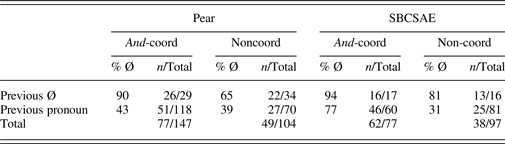
The priming effect holds in both and-coordinated (lines 3 and 4 in (10)) and noncoordinated contexts (line 3 in (11); see the section on and-coordination for the operational definition applied here). This is depicted in Table 3, which shows that in both contexts, the rate of unexpressed subjects is higher when the previous coreferential subject was also unexpressed (in the first row) than when it was pronominal (second row). In Pear, this difference is significant in both and-coordinated (p < .0001) and noncoordinated contexts (p = .0067), and in SBCSAE is significant for the noncoordinated tokens (p = .0004), but not for the and-coordinated tokens (p = .1677). This corresponds with the weaker priming effect in and-coordinated contexts for English 1sg subjects reported in Torres Cacoullos and Travis (Reference Torres Cacoullos and Travis2014:30). We attribute this to the fact that the rate of unexpressed subjects in coordinated contexts in the conversational data is so high even following a pronoun that it simply cannot be affected as much by a previous unexpressed subject. In noncoordinated contexts, however, unexpressed subjects are sufficiently rare following a previous pronoun (with rates of 31% and 39%) that they rise substantially following an unexpressed subject, doing so by between 1.5 (from 39% to 65%) and 2.5 times as much (from 31% to 81%).
Rate of unexpressed 3sg human specific subjects according to priming and and-coordination
As we saw to be the case for Accessibility, here also we see largely parallel effects for priming across both datasets, but distinct contextual distributions. Looking overall (Table 2), the difference is marginal: in the Pear Story narratives, 25% (63 of 251) of the tokens occur in the context of a previous unexpressed subject, while in the SBCSAE conversational data, 19% (33 of 174) do (p = .1961). Recall that we have excluded tokens where the previous realization was a full NP or an indefinite pronoun and where it was produced by the interlocutor; if we consider all tokens, the difference in the distribution is significant: 19% (63 of 328) in the Pear narratives and 12% (33 of 278) in the SBCSAE conversation occur with a previous unexpressed subject (p = .0199). Thus, once again, a higher proportion of the narrative data occurs in a context favorable to an unexpressed subject, namely following another unexpressed subject.
Comparing now across the coordinated and noncoordinated tokens (Table 3), we again see a significant difference in the contextual distribution: while the proportion of the data represented by a previous unexpressed subject is similar in coordinated instances, at around one fifth (29 of 147 in Pear, and 17 of 77 in SBCSAE), in noncoordinated contexts, a preceding unexpressed subject accounts for 33% (34 of 104) of the Pear data, but only 16% (16 of 97) of the SBCSAE data (p = .0091). That is, in the Pear data, there are more opportunities for unexpressed-to-unexpressed priming among the noncoordinated than the coordinated tokens (33% vs. 20%), which serves to raise the rate of nonexpression in noncoordinated contexts and lessen the difference with the and-coordinated contexts.
Temporal relationship
In her qualitative study of unexpressed subjects in English conversation, Oh (Reference Oh2006:832) proposed an association between temporality and unexpressed subjects. Such an association for Spanish was quantitatively verified by Cameron (Reference Cameron1992:207) in his study of subject expression in San Juan, Puerto Rico, and Madrid, Spain, where he found a higher rate of unexpressed subjects in clauses that “stand in a temporal relationship to each other.” It would seem that such an effect is relevant across coreferential mentions only, in accordance with Paredes Silva's (Reference Paredes Silva1993:43) finding for written Brazilian Portuguese of a favoring of unexpressed subjects in “discourse connected” clauses expressing a “sequence of events centered on the same referent” (that is, with the same subject and the same tense). This is supported by Shin (Reference Shin2014:321), who reported no effect for temporal sequencing in switch reference contexts in narratives occurring as part of sociolinguistic interviews by Spanish speakers newly arrived in New York.
To test for such an effect in the data under study here, we coded all clauses for the absence versus presence of a temporal relationship. Two types of temporal relationship were identified. The first is temporally sequential events, where the event referred to in one clause follows temporally from that of the previous clause, as in lines 3 and 4 in (12) and in (10)) presented previously. The second is temporally simultaneous events, illustrated in (13) and in lines 2 and 3 in (12) (where, as the boy is putting the pears away, he picks up a pear—note the use of the progressive here indicating that an event [picking up a specific pear] overlaps with a situation [putting away the pears] [cf. Hopper, Reference Hopper and Givón1979:216]). We collapse these two temporal relationships in Table 2, because the effect for sequentiality and simultaneity is similar—in the SBCSAE data, the rates are identical at 85% (60 of 71 in sequential contexts and 23 of 27 in simultaneous contexts), in the Pear Stories, they are nearly so, 58% (117 of 202) for sequential and 54% (22 of 41) for simultaneous contexts. Note also that the temporally sequential clauses represent the majority of the temporally related data (approximately three quarters in both datasets).
(12)
1. and he comes back down,
2. [1.1[.7] a--nd] he's putting the rest of the pears away,
3. and he picks this pear up,
4. and Ø polishes it up,
5. and everything else.
(Pear 10:13.7–13.11)
(13) Beth: for one thing it bothered me,
because Anna takes ahold of something like that and Ø doesn't let go.
(SBCSAE 31:1447–1448)
The absence of a temporal relationship applies where one of the verbs occurs with habitual aspect or is a stative predicate (e.g., with modal can in can't figure out in (11)), or where the second clause is some kind of repetition, (14) or elaboration of a prior comment, (15) (where the progressive he was walking provides background information on stops).
(14) Mitchell: and- he % totally evaded me,
.. he has to this day evaded me,
(SBCSAE 53:677–678)
(15) and .. the boy on the bicycle s [.45] stops,
[2.15[.75] u--m [.8] tsk..]] he was walking it at that time,..
(Pear 13:20.2–20.3)
Excluded from coding were instances where the temporal relationship between clauses was not relevant, including where the previous coreferential subject was produced by the interlocutor (n = 43), where it occurred in quoted speech (n = 7), and where it occurred in a subordinate clause, as in (16) (in the temporal “before she left”; n = 48, consisting of 28 from Pear and 20 from SBCSAE). This is because, as noted by Labov and Waletzky (Reference Labov and Waletzky1997[1967]:14), “only independent clauses are relevant to temporal sequence.”Footnote 8
(16) Alice: .. One that she bought just before she left.
(H) .. She couldn't get it open.
(SBCSAE 43:44–45)
As we saw in Table 2, the presence of a temporal relationship has a significant effect in both registers. In the Pear Stories, there is a strong disfavoring of unexpressed subjects in nontemporal clauses (with a weight of .25), and in SBCSAE, we observe a similar disfavoring (.31), but also a favoring in temporal clauses (.72).
Once again, while the effect is similar, the distribution across the two datasets is distinct, with 81% of the narrative data occurring in temporally related contexts compared with less than half of the conversational data (seen in column 4 in Table 2). Remembering that the majority of the temporally related clauses are sequential, this result is not surprising. The Pear Story corpus consists of narratives that recount a series of events that the speaker had just seen, in temporal sequence, on a video. The nature of the task thus ensures frequent occurrence of temporally sequential clauses. The conversational data is less event focused, evidenced in a higher proportion of stative verbs than in the narrative data (25% of all verbs in SBCSAE vs. 11% in Pear). As stative verbs tend to occur in nontemporal contexts, this raises the proportion of the nontemporal data. Furthermore, the interactional nature of the conversational data results in a higher number of (nontemporal) repetitions and elaborations than in the monologic narratives of the Pear data.
The patterning for temporal relationship holds across and-coordinated and noncoordinated contexts: in both datasets, the rate of nonexpression is higher when there is a temporal relationship between clauses than when there is no such relationship. However, once again the distribution of the temporally and nontemporally related tokens according to coordination is somewhat different, as illustrated in Figure 1. In the Pear data, there is a higher proportion of temporally related clauses in both and-coordinated and noncoordinated contexts (considering just that portion of the data to which it is possible to apply the notion of a temporal relationship, 84% [157 of 186] of the and-coordinated tokens are temporal and 76% [86 of 113] of the noncoordinated tokens are). In the SBCSAE, in and-coordinated contexts, temporally related clauses remain in the majority (accounting for two thirds of the data [69 of 103]), but in noncoordinated contexts, temporally related clauses account for just one quarter of the data (29 of 106). Thus, in the conversational data, the noncoordinated tokens occur primarily in an environment that disfavors unexpressed subjects, while in the narrative data, the noncoordinated tokens (like the coordinated tokens) occur primarily in a context that favors unexpressed subjects. This distribution, then, lowers the rate of nonexpression in noncoordinated contexts in the SBCSAE data (heightening the difference between and-coordinated and noncoordinated) and raises it in the Pear data (lessening the difference).
Distribution of Temporal and Non-Temporal clauses according to and- Coordination in Pear and SBCSAE (n of tokens in temporal/nontemporal contexts).
It is worth briefly noting here that Tense is not entirely independent from Temporal relationship. While we would expect the Past tense to be more associated with temporal sequentiality than the Present tense (cf. Hopper Reference Hopper and Givón1979:216), this is not the case in the Pear Story narratives, where both Past and Present tense tokens occur in temporally related contexts approximately 80% of the time. This is because, given the nature of this dataset, all Present tense tokens are in fact the Historical Present (illustrated in the Pear examples given thus far). In the conversational data, Historical Present tokens account for over one third (28 of 73) of the Present tense tokens (examples can be seen in (7) and (9)), and while over one half (57%, 16 of 28) of the Historical Present occur in temporally sequential contexts, just over one tenth (5 of 45) of the remaining Present tense tokens do. Correspondingly, we find a higher rate of unexpressed subjects with the Historical Present (64%) than the other Present tense tokens (42%). Thus, while we do not see an effect for Tense itself, we do see an effect for discourse function, such that those tenses with a higher occurrence in temporally related contexts may have a higher rate of unexpressed subjects (similar to what Silva-Corvalán [Reference Silva-Corvalán2001:160–163] proposed for Spanish).
And-coordination
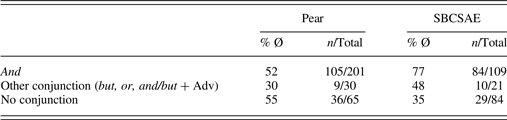
And-coordination is used here to refer to strictly coreferential clauses (produced by the same speaker, with no intervening subordinate clauses) conjoined by and; all other clauses are considered noncoordinated. We limit the definition of coordination to strictly coreferential clauses because, as was seen in Table 1, these have the highest rate of nonexpression. Table 4 gives the breakdown of the tokens in strictly coreferential contexts according to presence and type of conjunction: conjoined with the preceding clause by and; with another conjunction (but, or, and/but + adv [e.g., and just, and apparently]); or without a conjunction. As can be seen, and is overwhelmingly the most frequent conjunction in both datasets, occurring over five times as often as the other coordinating conjunctions combined. And also occurs with a significantly higher rate of unexpressed subjects than other coordinating conjunctions: 52% vs. 30% in the Pear narratives (p = 0.0305), and 77% vs. 48% in SBCSAE (p = 0.0142)). With no conjunction, we find a still lower rate of expression in SBCSAE, of less than half that of clauses conjoined with and (35%). In the Pear data, however, the rate of nonexpression without a conjunction is similar to that with and at 55%.
Rate of unexpressed 3sg human specific subjects in strictly coreferential contexts according to presence and type of conjunction
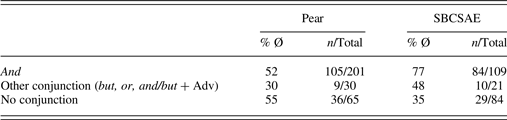
While some might interpret this as evidence of asyndetic coordination in the narrative, but not the conversational, data, it can instead be accounted for by the contextual distribution in each register according to temporality. In the narratives, we find a high proportion of temporally related tokens both with and and without—78% (157 of 201) of the tokens conjoined with and, and 60% (39 of 65) of the tokens with no conjunction, are temporally related. This results in a high rate of nonexpression in both environments in the Pear Stories data. In the conversational data, however, while 63% (69 of 109) of the tokens conjoined with and are temporally related, just 18% (15 of 84) of those with no conjunction are, thus lowering the rate of unexpressed subjects in contexts where there is no conjunction. The higher rate of temporal sequentiality both with and without a conjunction in the Pear Story data is a reflection of the very high proportion of the data overall that occurs in temporally related contexts (81%, as we saw in Table 2). In order to disentangle coordination from temporal sequentiality, then, we restrict coordination to the presence of and.
As seen in Table 2, in the conversational data, unexpressed subjects occur over twice as often in and-coordinated contexts than in noncoordinated contexts (77% vs. 35%), while in the narrative data, there is only a marginal, and nonsignificant, difference between the two, of 52% versus 45%.
In order to test whether this might be evidence of a real grammatical difference between the two registers, we conducted separate analyses of tokens in and-coordinated and noncoordinated contexts in each of the two datasets utilizing the same factor groups as those included in the analyses reported in Table 2, and one further factor group only applicable to the and-coordinated tokens, namely, the occurrence of the two conjuncts in the same IU. The same constraints emerged in all analyses: in both datasets and in both registers, unexpressed subjects are favored when the preceding subject is unexpressed, disfavored when there is no temporal relationship, and unaffected by tense. The priming effect does not reach significance for the coordinated tokens in the SBCSAE, which is consistent with the weaker effect for priming in coordinated contexts in this dataset seen in Table 3. And in all analyses, unexpressed subjects are favored when the two conjuncts occur in the same IU, as in (17) and (18), more than when they occur across IUs, seen in (19) (as Torres Cacoullos and Travis [Reference Torres Cacoullos and Travis2014:27–28] found for 1sg subjects).
(17) Tom 2: (H) we got a new guy k-,
named Mason called up and Ø said,
hey,
would you join,
(SBCSAE 32:963–966)
(18) [.5] And the kid turns around,
and he goes and Ø takes the hat to the kid,
[2.2[.85] a--nd um [.65]] the kid gives him three pears.
(Pear 10:48.4–48.6)
(19) Marie: (TSK) this man went to Wal-Mart.
And Ø just shot.
(SBCSAE 36:906-907)
While these same-IU occurrences have been interpreted as cases of so-called VP coordination, pronominal subjects also occur in such contexts, as noted previously (and illustrated in example (6)). Torres Cacoullos and Travis (Reference Torres Cacoullos, Travis, Carvalho, Orozco and Shin2015a:93–95) argued that VP coordination does not exist as a discrete category, but rather as a continuum from conjuncts that are more to less tightly linked, with linking being based on occurrence in the same IU, the same tense and constituting a single event (cf. Barth-Weingarten & Couper Kuhlen, Reference Barth-Weingarten, Couper Kuhlen, Auer and Pfänder2011:280; Croft, Reference Croft1995:846; Mithun, Reference Mithun, Haiman and Thompson1988:335). Tightly linked conjuncts tend to favor unexpressed subjects more than less tightly linked conjuncts do.
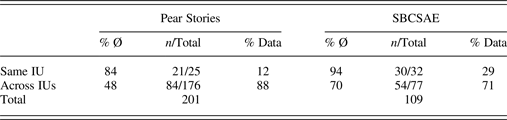
This is supported by the data examined here. Table 5 shows the rate of unexpressed subjects in and-coordinated contexts, according to occurrence in the same IU versus across IUs. In both datasets, the subject of the second conjunct is unexpressed more often when the two conjuncts occur in the same IU than when they occur across IUs (with rates of 84% vs. 48% in the Pear Story data, and 94% vs. 70% in the SBCSAE data).
Rate of unexpressed 3sg human specific subjects in and-coordinated contexts according to occurrence in the same IU vs. across IUs
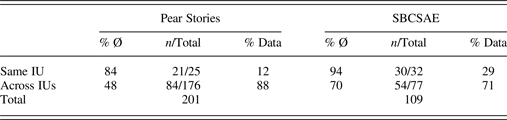
However, there is once again a difference in terms of the contextual distribution. In the Pear Story data, just 12% (25 of 201) of the coordinated tokens occur in the same IU, while in the SBCSAE conversational data, close to one third (32 of 109) do (p = .0004). This, then, raises the rate of nonexpression in and-coordinated contexts in the conversational data and heightens the difference in rates of nonexpression between the and-coordinated and noncoordinated tokens.
Among these single-IU occurrences, for 1sg, Torres Cacoullos and Travis (Reference Torres Cacoullos and Travis2014:31) identified two set constructions, both of which occur in the 3sg data studied here, namely with a motion verb as the first conjunct ([Motion Verbiand Ø Verbi]) (cf., Brinton, Reference Brinton and Fisiak1990:124–125; Hopper, Reference Hopper, Bybee and Noonan2002:152; Quirk et al., Reference Quirk, Greenbaum, Leech and Svartvik1985:978), and with a verb of speech as the second conjunct [Verbiand Ø Verb-of-speechi]. These constructions together account for close to two thirds of the same-IU coordinated tokens in the SBCSAE (including 11 tokens of the motion verb construction, illustrated in (5), 8 with the speech verb construction, as in (17), and two where the two occur together, as in (6)). In the Pear data, the single-IU speech verb construction does not occur (not surprisingly, as this is a silent film), and the motion verb construction (seen in (18)) accounts for just 40% of the same-IU tokens. Thus, we find not only a higher proportion of single-IU and-coordinated tokens in the conversation than in the narrative data, but within those single-IU and-coordinated tokens, we find a higher proportion of set constructions in the conversational data than in the narrative data (66% vs. 40%, nearly significant, p = .0658).
The lack of a significant effect for and-coordination in the narrative data, in contrast to the conversational data, is therefore not reflective of differing constraints in the two registers. Rather, it is attributable to the higher proportion of the narrative noncoordinated tokens occurring in contexts favorable to unexpressed subjects (following a preceding unexpressed subject and in temporally sequential clauses) and a higher proportion of the conversational and-coordinated tokens occurring in contexts favorable to unexpressed subjects (in temporally related contexts and in single-IU coordinated constructions, in particular with certain set constructions).
CONCLUSIONS
Here, we have provided the first empirical test of the hypothesis that different English registers have distinct grammars for subject expression, through examination of the variability between pronominal and unexpressed 3sg human specific subjects in monologic narrative and interactional conversation. One very notable difference is in the proportion of unexpressed subjects in each dataset: just 4% in conversation, but close to one quarter (22%) in the narratives (or, taking into account the variable context, 10% in conversation and 40% in the narratives), strikingly high for a so-called non-null subject language. Despite this stark disparity in rates, examination of the factors conditioning this variation across the two registers provides no evidence for grammatical differences between them, but demonstrates that, instead, the disparity is attributable to diverging contextual distribution of the tokens in each dataset.
The envelope of variation in both registers is identical: unexpressed subjects exist in variation with pronominal subjects only in coreferential clauses conjoined with a coordinating conjunction, or outside of that, in noncontracted declarative main clauses in IU-initial position. Such constraints have not been reported for canonical null subject languages, and thus English would appear to differ from such languages in this restricted set of variable contexts.
The probabilistic constraints in operation within the variable context are also identical in both registers: 3sg human specific subject expression in English narratives and conversation is sensitive to accessibility (unexpressed subjects are favored in coreferential contexts), priming (favored when the preceding coreferential subject was also unexpressed), and temporal relationship (disfavored when there is no temporal relationship with the preceding clause). These probabilistic constraints parallel those reported for null subject languages. That is, the variable grammar of subject expression in English corresponds to that of other languages, suggesting that the proposed typology of languages according to rates of subject expression deserves further exploration, in particular in terms of potentially shared constraints on speaker choice of expression versus nonexpression.
The explanation for the difference in overall rates of expression is found in the contextual distribution, which is itself attributable to the nature of the registers studied. In the narrative data, a higher proportion of the tokens occur in environments that favor nonexpression, namely coreferential contexts (Table 1), following a previous unexpressed subject (Table 2) and in temporally related clauses (Figure 1). This is to be expected, given that the Pear Story data comprise monologic narratives that recount a series of events centered around a small number of participants. In the conversational data, there is a higher rate of switching of subjects (non-coreferentiality) and of clauses expressing a nontemporal relationship, consistent with the interactional nature of this data.
The effect of coordination is the one apparent difference across the two registers. Though in both registers unexpressed subjects occur proportionally more in and-coordinated than noncoordinated contexts, this effect only reaches significance in the conversational data. Here again the explanation can be found in the contextual distribution. In the narrative data, a higher proportion of the noncoordinated tokens occur in environments that favor nonexpression (following a preceding unexpressed subject [Table 3] and in temporally related clauses [Figure 1]), whereas in the conversational data, it is the and-coordinated tokens that tend to occur most in environments favorable to unexpressed subjects (in temporally related clauses [Figure 1], and in same-IU contexts [Table 5], in particular with motion and speech verb constructions.
We conclude that, while observing overall rates and drawing hypotheses about differences in function are important foundations for the study of grammatical patterning, grammatical similarities and differences can best be elucidated through comparisons of the probabilistic constraints operating in variable contexts. Such comparisons should be conducted in full cognizance of possible effects of the contextual distribution of the data, as differing relative proportions of occurrences in favoring and disfavoring contexts can mask shared patterns and create the illusion of different grammars.
APPENDIX: TRANSCRIPTION CONVENTIONS
SBCSAE (DU BOIS ET AL., 1993)
- Carriage return
IU break
- .
final intonation contour
- ,
continuing intonation contour
- ?
appeal intonation contour
- …
medium pause (> .7 sec)
- ..
short pause (about .5 sec)
- --
truncated intonation contour
- -
truncated word
- =
lengthening
- [ ]
speech overlap
- [N N]
used to distinguish adjacent overlaps
- (H)
in-breath
- (TSK)
click
- %
glottal stop
- !
booster: emphatic speech
- <Q Q>
quoted speech, produced with marked voice quality
- ~
name is a pseudonym
PEAR STORIES (CHAFE, 1980)
Note that the conventions are slightly different for the Pear Stories and SBCSAE, because the method had not been fully developed at the time the former were transcribed, and the sound files are not available to us to standardize the transcriptions.
- .
sentence-final falling intonation
- ?
sentence-final level or rising intonation
- ,
clause-final but not sentence-final intonation
- /?/
portion unintelligible
- --
lengthened segment
- •
break in timing too short to be measured as pause
- [X]
pause lasting x seconds
- [X[Y]a--nd u--m [Z]]
a sequence lasting a total of x seconds, consisting of a pause of y seconds, “a--nd u--m,” and a pause of z seconds