In earlier English there was a long period of competition as
“periphrastic” (or “supportive”) DO replaced the
finite verb in questions and in negative declaratives. Before the 14th
century only the older form with a simple finite verb was available; this
type is shown in (1). After the 19th century, these clause types have
their modern form with finite DO, as in (2). In the intervening period,
and particularly from 1400 to 1800, both are available, as they were in
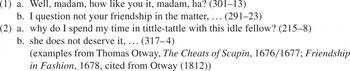
the 1670s to Thomas Otway, the source of my
Early Modern English examples here and below. In negative declaratives
like (1b) and (2b) this development shows an abrupt reversal in the late
16th century, when the incidence of DO dropped sharply. Hence the title of
this article, which is focused on the interpretation of this sudden drop
in incidence.
The origin and rise of DO has been much studied. See Rissanen (1999a) and Denison (1993)
for recent general accounts of its history, and for bibliography. One of
the most important studies is that of Ellegård (1953), both because of its care and sophistication,
and because it is based on a large and systematic collection of data. This
database is of great value, because it provides us with material for
reaching a better understanding of the variation between DO and the finite
verb across three centuries of change. In particular, it enabled Kroch
(1989) to make his major claim about the
Constant Rate Effect, when he demonstrated that the increase in DO up
until 1575 showed an unexpected similarity between different surface
syntactic contexts, in that the s-curves of change for each context were
parallel. Subsequently, Ellegård's database shows different
types of questions parting company from each other, and from
“negative declaratives,” that is, clauses in which sentential
negation is expressed by NOT. It also shows the beginning of a decline in
the use of unstressed affirmative DO, a type illustrated in (3), which had
shown a steady increase up until the middle of the century. Thus in the
second half of the 16th century there was a “point of inflection in
the curves of change,” and Kroch's reasonable hypothesis was
“that this point of inflection … corresponds to a major
reanalysis of the English auxiliary system” (1989:223–224).
The development of negative declaratives in Ellegård's
database is rather striking. This clause type shows a dramatic collapse in
the level of DO in the last quarter of the 16th century (the period of
Kroch's “major reanalysis”), and an uneven recovery in
the 17th century. So the relative levels of DO in negative declaratives
and affirmative yes–no and adverbial questions differ sharply at
different periods. Before 1575 negative declaratives were 25 years behind
such affirmative questions in their adoption of DO. After 1600 they lag by
over a century. The transition involves a very rapid decline in the
proportion of DO in negative declaratives from 38% in 1550–1575 to
24% in 1575–1600 (Ellegård, 1953:161ff.). A similar decline in negative
declaratives is attested in The Corpus of Early English Correspondence
(Nurmi, 1999), and negative questions also show
a decline in Ellegård's database, from 85% DO in
1550–1575 to 65% DO in 1575–1600.
A rather natural approach to this rapid decline of DO in negative
declaratives and questions would be to seek to interpret it as a
consequence of the more general change, which underlies Kroch's
“point of inflection.” If successful this would give a single
account for multiple phenomena, in line with general scientific practice
and the methodology advocated in Lightfoot (1979). Indeed, in his 1989
article Kroch proposed an explanation of just this type. But there is also
a further possibility that remains to be investigated: Could the decline
be a consequence of sociolinguistic factors? In this article I will use
Ellegård's database to investigate this possibility. The method
will have to be somewhat indirect, because Ellegård did not pay
attention to sociolinguistic categories when he collected his data, and it
is therefore not possible to use such categories as gender or class. But
the date of birth of many of Ellegård's authors is known, so
that the age profiling of DO is open to investigation. The internal
stylistic properties of texts can also be established, and the possibility
of register variation examined. Between them, these properties of
Ellegård's texts are sufficient to show that a dramatic
sociolinguistic change took place between the mid-16th century and the
17th century. I will show that both the drop in DO in negative
declaratives and its subsequent continuing low level can be explained in
large part not as a grammatical phenomenon but as a sociolinguistic one.
My data are a reconstitution of Ellegård's database of English
plays and prose from 1500 to 1710, which I owe to Tony Kroch (see initial
acknowledgments). My conclusions here leave intact the position that there
was a grammatical change in the English auxiliary system in the latter
half of the 16th century, though they remove one of the pieces of evidence
from which one might have wanted to argue that position.
First, then, I will set up a stylistic ranking of
Ellegård's texts and will examine the distribution of DO in
negative declaratives from this perspective, showing that the data argue
for the conclusion given in the preceding paragraph. Second, I will argue
that the distribution of DO in relation to the age of each text's
author points strongly in the same direction. Then I will lay out the data
for negative questions, and show that these data suggest that the
concurrent cliticization of NOT to auxiliaries may be implicated in this
sociolinguistic change. Finally, I have some reflections on the
consequences of my arguments for interpretations of the syntactic history
of DO.
INTERNAL STYLISTIC DIFFERENCES BETWEEN
TEXTS
A scale of lexical complexity
Ellegård's database was not selected with social
structuring in mind. He did not pay attention to class or gender in
compiling it. His informants are virtually all men who have sufficient
education to be literate. It is not therefore possible to treat social
variables directly, as has been done in work on the Corpus of Early
English Correspondence. But it is possible to look at the internal
properties of texts. There has been a range of approaches to the
characterization of stylistic variation, and work on style has examined a
variety of properties of texts (for some recent discussion see Eckert & Rickford, 2001). An important approach is
found in the work of Biber and his associates, which depends on an
assessment of cooccurring linguistic properties. Two factors that seem
likely to be illuminating, given that Ellegård's texts include
a range of types of published literature, are the type–token ratio
and the average word length of each of his texts. Investigation shows that
each of these properties separately correlates with the incidence of DO in
negative declaratives, and that they correlate well with each other. They
also form a component of Biber's most important dimension of textual
variation, indicating the extent to which each text shows “high
informational density and exact informational content” (1988:108), to borrow part of his characterization of
this dimension. Together they should provide a robust measure of the
lexical complexity of texts. So scales for each of these properties were
established,1
Figures for each text were
based on a 600 word sample drawn from the database. DO and NOT were
excluded (because Ellegård's sample was chosen to contain these
items), and variation in spelling was eliminated to give a reliable
measure of word length.
then normalized and summed, following
Biber's procedure, to give a single scale of lexical complexity. The
issue of constructing an appropriate measure of style will be returned to
later after some results have been presented.
DO and lexical complexity in the period
1600–1710
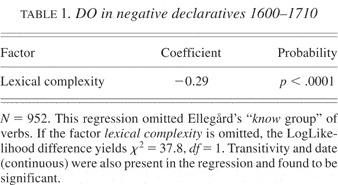
When tokens are coded for two properties of texts, lexical complexity
and date, both treated as continuous variables, then, in a logistic
regression for the period 1600–1710, lexical complexity is very
highly significant, see Table 1.2
The program DataDesk (Velleman, 1995) has been used, because it allows for
continuous variables. Tables and Figures in this article present results
drawn from Ellegård's database unless the title explicitly says
otherwise.
The dependent variable here is the choice between DO
and a finite nonauxiliary verb, as in (1) and (2).
3 Other auxiliaries are omitted, as are verbs belonging to
Ellegård's “know group,” DO as a main
verb, and some minor items consistently omitted by Ellegård. These
all have a very low level of DO. Thus percentages, like those given
earlier, are (frequency of DO)/(frequency of DO + frequency of simple
finite nonauxiliary verb) with the further omissions just noted. These
omissions hold throughout the discussion of negative declaratives. Figures
for negative questions include members of Ellegård's
“know group,” but share the other omissions. I have
also omitted data from the Plumpton letters (taking them to be northern),
and instances where NOT precedes the finite verb. Thus my figures are
somewhat lower than Ellegård's.
The coefficient is
negative, which means that DO in negative declaratives is more frequent in
lexically less complex texts, and less frequent in lexically more complex
texts. Thus there is less DO in “higher” registers. For
example, Congreve's play of 1693
The Old Batchelor has 89%
DO in negative declaratives, but his novel
Incognita (published
the preceding year) has 77% DO. Some twenty years earlier, Otway's
plays have 66% DO, Bunyan's novel,
Pilgrim's Progress
has 36% DO, and Dyden's late essays have 26% DO. These were all
written within a few years of one another.
DO in negative declaratives 1600–1710
It is also important to look systematically at the individual texts.
Here, it is helpful to set date aside as a variable impacting on the
analysis. This can neatly be done by using the rate of change for the
period 1600–1710 to estimate what the proportion of DO in negative
declaratives for each text would have been in some base year.4
The appropriate equation for 1655
is:
This calculation has the effect of moving the text
along the s-curve of change to the selected year. So, Beaumont and
Fletcher's play
The Knight of the Burning Pestle has 64.7%
DO in negative declaratives. It was first performed in 1607, and it is
possible to work out that the corresponding percentage for 1655 is 81.0%.
Essentially this says that if the text had been written under the same
conditions at the later date, it would have had 81.0% DO. Similarly,
Congreve's play
The Old Bachelor has 89% DO in 1693; it is
on a distinct but very close s-curve, with a corresponding figure for 1655
of 80.4%. When corresponding figures are calculated for all the texts in
the period, we can compare the results with respect to stylistic
differentiation without interference from date.
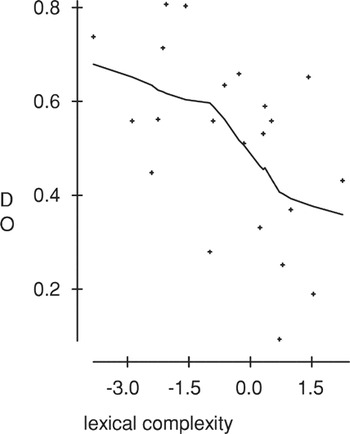
Figure 1 is a scatterplot for the 22 texts
occurring in the period 1600–1710, with proportions of DO estimated
for the year 1655.5
This number is larger
than Ellegård's number of texts, because some have been split
(e.g., Congreve (one novel, one play); Dryden (early versus late)). In
Figure 3 and scatterplots for negative questions, the number is lower
because some smaller texts have been amalgamated to give more robust
figures.
The line is a running average to help you see the
trend.
6 This running average is a
“lowess.” It takes a proportion of the data as a window (here
35%) and produces an average by weighting values more highly as they are
closer to the point being established. The running averages given in later
figures in this article are all lowesses set at 30% or 35%. See Velleman
(1995:33/11–12, 33/16–18)
and Cleveland (1979).
You can see that
the trend is sharply down from left to right. Three other points are
relevant here. First, the linear regression of DO against the scale of
lexical complexity is significant (
p < .01). Second, if we
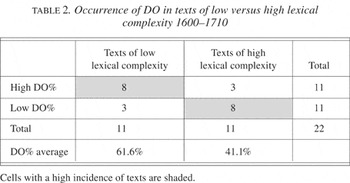
present the figures underlying the scatterplot of
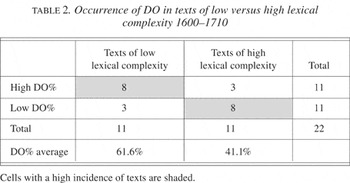
Figure 1 in four quadrants, dividing at the mid point,
the median, of DO% (56%) and of the scale of lexical complexity
(−0.2), we find that most of the texts occur in two quadrants: low
complexity and high DO; high complexity and low DO; see
Table 2. Third, we can look at the averages for texts
of low and high lexical complexity to get some real idea of the scale of
this difference. The average proportion of DO in the 11 lexically less
complex texts is 62%, whereas in the 11 lexically more complex texts it is
41%. The contrast is striking. Overall, the lexically less complex texts
show 50% more DO than the lexically more complex texts. These three sets
of figures for individual texts strikingly confirm the results of the
overall logistic regression given in
Table 1,
and show that the proportion of DO is higher in lexically less complex
texts in Ellegård's database for the period
1600–1710.
Proportion of DO for 1655 versus lexical complexity,
1600–1710.
Occurrence of DO in texts of low versus high lexical complexity
1600–1710
DO and lexical complexity in the period
1500–1575
The situation is, however, interestingly different in the period
1500–1575. Here the results for lexical complexity in a logistic
regression, including date and transitivity, show that this factor is very
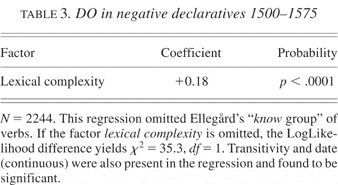
highly significant (p < .0001) (see Table
3). But now the coefficient is positive, that is, in negative
declaratives, there is more DO in texts of higher lexical complexity, and
less DO in texts of lower lexical complexity. So we have a striking
difference between the periods 1500–1575 and 1600–1710. The
later period apparently reverses the earlier situation, that is, complex
lexis is associated with higher levels of DO in the earlier period and
with lower levels of DO in the later period.
DO in negative declaratives 1500–1575
Figures for individuals also support this conclusion. The same method
as outlined earlier was used to set aside the impact of date, but this
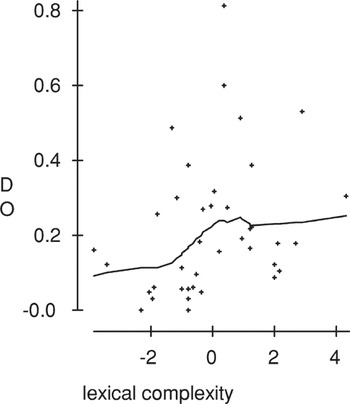
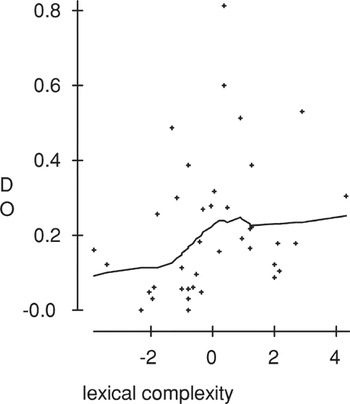
time 1535 was the base year. Figure 2 is a
scatterplot giving estimates of proportions of DO in negative declaratives
for that year, plotted against lexical complexity. There is a clear upward
trend from left to right, shown in the running average. Three points to
parallel those made previously can also be made here. First, the linear
regression is significant.7
Actually, the
appropriate significant regression in this case is between the square root
of DO% and lexical complexity, because this has an approximately normal
distribution, as DO% itself does not; here p = .027. But I give
the graph for the untransformed variable.
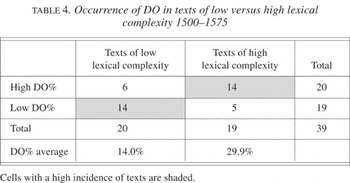
Second, if we present
the figures in four quadrants, dividing at the mid point, or median, of
each scale, as before, we find that most of the data occur in two
quadrants: low complexity and low DO%; high complexity and high DO%; see
Table 4. Third, comparing the averages is again
interesting. The average percentage of DO for the lexically less complex
texts is 14%, whereas for the lexically more complex texts it is 30%.
There is twice as much DO in lexically more complex texts. So there is
also a considerable difference here. As before, we have mutually
supportive results from both the logistic regression on individual tokens,
and from the figures for individual texts, showing that the incidence of
DO in Ellegård's database is higher in texts of higher lexical
complexity at this earlier period.
Proportion of DO for 1535 versus lexical complexity,
1500–1575.
Occurrence of DO in texts of low versus high lexical complexity
1500–1575
DO and lexical complexity in negative declaratives in
the period 1500–1710
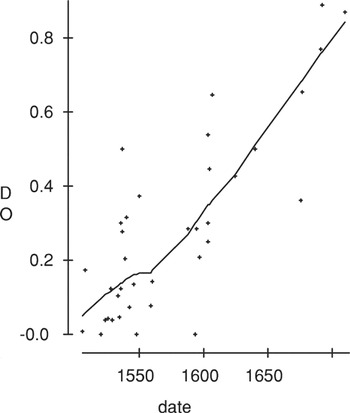
We can put this together by looking at graphs of change for the whole
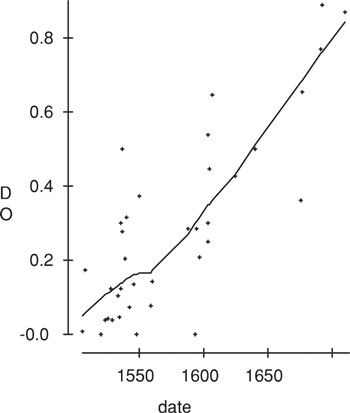
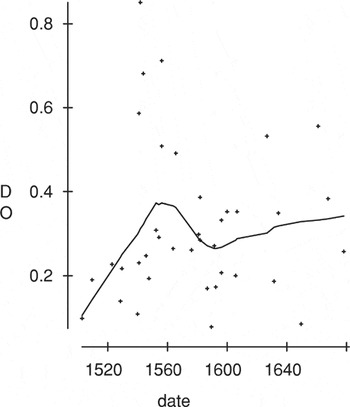
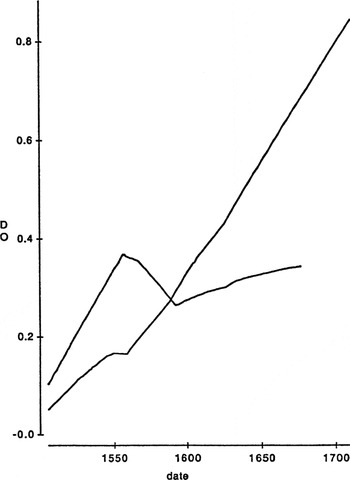
period 1500–1710, presented in Figures 3
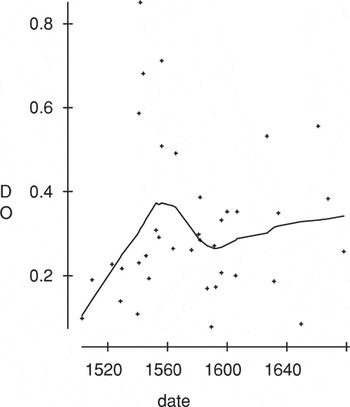
and 4. Here texts have been divided into two
groups of equal size by cutting the scale of lexical complexity at the
median. In one group there are 39 texts of high lexical complexity; in the
other, 38 texts of low lexical complexity. In each case, the value of DO
for the text is the proportion of DO in negative declarative sentences,
and (as before) a running average has been added to help you discriminate
the major trends.
DO versus date in texts of lower lexical complexity.
DO versus date in texts of higher lexical complexity.
The difference between these graphs is striking. In texts of low
lexical complexity there is no sign of the late 16th century collapse seen
in Ellegård's overall figures, though there is a gap in the
data from 1565–1585, and an earlier blip. Nor can you see the later
irregular and rather flat development his figures reveal until the second
half of the 17th century. But in texts of high lexical complexity the
downward movement is dramatic, and a lower level of DO is maintained
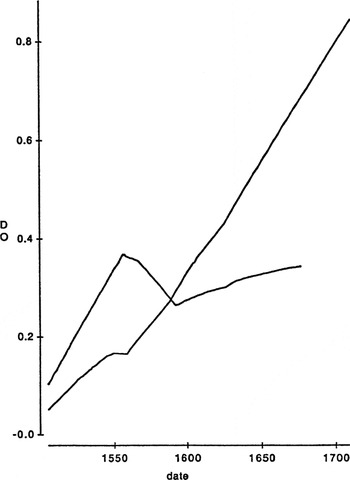
across the following century. The next graph, given in Figure 5, simply imposes the two running averages on
each other. It shows that there is a difference in the 16th century, and
that the situation alters radically as we approach the 17th century, and
remains different.
Superimposed running averages from Figures 3
and 4.
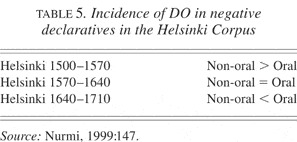
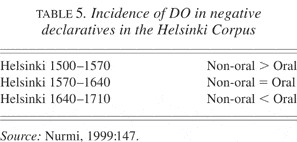
This analysis is supported in general terms by what Nurmi found in the
Helsinki Corpus, see Table 5. This shows a
similar stylistic switch in the use of DO NOT between the period
1500–1570 and the second half of the 17th century.8
My interpretation in the table is based on Nurmi's
figures, which imply that the two categories are very close in
1570–1640. She kindly informs me that the percentage given for
non-oral texts in this period is in error.
The categories used
here (oral versus non-oral) differ, being based on a classification by
types of genres. But the situation is clearly shown to be parallel, and it
is not clear that there is any difference in timing. There is, however, a
difficulty when we consider the evidence of The Corpus of Early English
Correspondence. This parallels Ellegård's data in showing an
overall decline in the use of DO NOT after a period of increase. But it
differs in that the decline is shown in the early decades of the 17th
century rather than towards the end of the 16th. I will return later to
consideration of this difficulty.
Incidence of DO in negative declaratives in the Helsinki
Corpus
It is clear, then, that in Ellegård's database:
- A higher rate of DO with NOT is found in texts of high lexical
complexity in the period 1500–1575.
- There is a sharp reversal of this association in the 17th century.
In this period a lower rate of DO with NOT is associated with texts of
high lexical complexity.
- The sharp drop in the late 16th century in Ellegård's
overall figures may simply reflect this switchover, which essentially
depends on the lexically more complex registers.
In texts of lower lexical complexity there seems to be a pretty steady
increase across the whole period. This implies that there is likely to
have been a relatively steady underlying development of DO NOT in the
vernacular, given the reasonable assumption that we can extrapolate
meaningfully from the lexically less complex texts in
Ellegård's database. The further drop in 1625–1650, which
can be seen in Ellegård's figures, does not appear in either
graph: It is a result of sampling differences (as Ellegård himself
suggested, 1953:163), because
Ellegård's period 1625–1650 has a much higher proportion
of lexically more complex texts than the preceding and following
periods.
The switchover shown in the graph points to a change in the basis for
stylistic (or register) variation of DO with NOT compared to the simple
finite with NOT at the end of the 16th century. Whatever were the reasons
underpinning the greater proportion of DO NOT in texts of higher lexical
complexity in 1500–1575, it is clear that there is a new situation
in the 17th century.
The relevance of lexical complexity
Why choose lexical complexity as the measure of style here? I earlier
referred to the work of Biber and his associates. Biber set up
“dimensions” of variation where he found major groupings of
cooccurring linguistic properties. The most important of his dimensions is
what he calls Factor 1. He calls it “a very important, fundamental
dimension of linguistic variation among texts” (1988:108), and says that it marks the contrast between
“high informational density and exact informational content”
on the one hand, and “affective, interactional and generalized
content”on the other (1988:107). I have
defended my measure of style as part of that dimension. Why not then
include other properties which might relate directly to the degree of
interaction represented in a text, or to the extent to which it reflects
oral uses, by looking at the distribution of such characteristics as the
use of first and second person pronouns and of questions? I started indeed
by doing exactly this, establishing the incidence of such features in
samples from Ellegård's texts, and setting up a scale for each
feature. Now, since the dimensions established by Biber reflect the fact
that a series of features essentially rank texts in the same way as each
other, one should be able to see how well this dimension applies to data
from earlier English by asking to what extent these features march in step
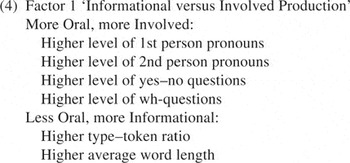
with each other, and rank texts in broadly the same way. For the period
1600–1710, scales for the six features I isolated, which are listed
in (4), correlated very well with one another: All 15 pairwise
correlations were significant at the p < .05 level.
This strongly implies that an interpretation in terms of Biber's
more general Factor 1 is appropriate, and that this gives us apparent
evidence of an oral–literate scale. As before, scales for individual
features were normalized and summed, to establish this more broadly based
scale. It turned out to be directly relevant to the distribution of DO in
the period 1600–1710, where results show a higher incidence of DO in
more oral texts. The logistic regression across tokens is highly
significant (p < .0001), and a series of results for
individual texts parallels those given earlier. So there is a very clear
correspondence between the frequency of DO in negative declaratives in a
particular text, and that text's position in the oral–literate
scale, as defined by the features in (4).
In the period 1500–1575, however, the situation was very
different. The six features of (4) correlated very poorly with one
another. Only two of the 15 pairs drawn from these six had a significant
correlation (type–token ratio with average word length; and
yes–no questions with wh-questions), and most had very low
correlation coefficients. So the evidence that these features can be seen
to define an oral–literate scale, or to correspond to Biber's
Factor 1 in Ellegård's data for this period, is absent. It
seems likely that the reason for this is the restricted nature of the 16th
century texts; most crucially, plays are virtually absent before 1575,
whereas they are predominant among the oral texts in the later period, and
it seems likely that the more oral end of Biber's dimension is
inadequately represented in the data. Plainly, then, I cannot set about
using the full set of criteria to locate and compare the incidence of DO
with any confidence, because the interpretation of the scale for the
earlier period is unclear. But it is possible to back off and rely on the
two of the features that did correlate well with each other, that yielded
a series of differentiated values across the range of texts (unlike
questions), and whose conjunction is readily interpretable. Hence, my use
of these two characteristics to define a scale of lexical complexity,
which has a clear relationship to a wider oral–literate
dimension.
AGE-GRADING
Some further evidence that seems supportive of the suggestion that
there is a change in the basis for register variation by the beginning of
the seventeenth century can be found in age-grading. This also gives us a
strong clue as to the nature of the change. Before 1575, the relationship
between a writer's age and the incidence of DO in negative
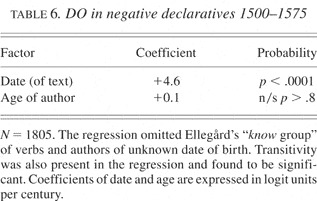
declaratives is straightforward. When tokens are coded for the date of
texts and the age of the author, and these factors are included in a
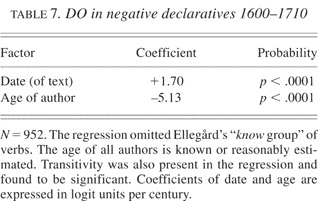
logistic regression, age is completely nonsignificant. See Table 6, where the coefficient of age is minimal. This
looks just like a “communal” change in Labov's (1994) sense, whereby individuals change their usage as
they grow older, without giving rise to a distinction of apparent time.
The older you are, the more you use DO, in line with the changing
community norm.
DO in negative declaratives 1500–1575
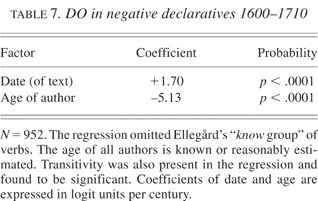
In the period 1600–1710, however, things are different. Age is a
highly significant factor, and its coefficient is negative (see Table 7): The older you are, the less you use DO,
although its overall incidence in the sample of users is continuing to
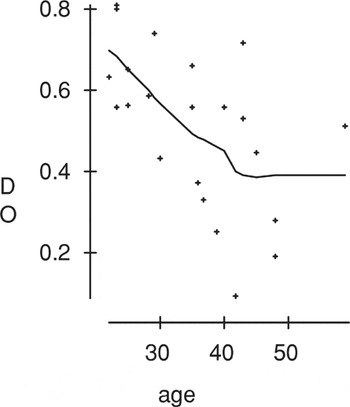
increase. This too can usefully be examined by looking at the levels of DO
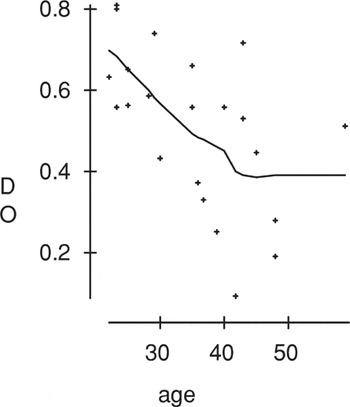
for individuals estimated for 1655 in Figure 6.
The scatterplot shows a declining trend, clear from the running average.
The levelling out depends on one text with a substantially older author
(Breton, publishing in 1604 at age 59, who perhaps has not adopted new
norms,9
Breton was born 1545. See Nurmi
(1999:173–174) for figures and graphs
which imply that the group of individuals born 1520–1539 differ from
those born 1540–1559 and later, in that they did not show a drop in
usage in the early 17th century, unlike those born later. Given that the
boundaries here are arbitrary, Breton might, in effect, have belonged to
the earlier group.
or who perhaps shows a reversion to the less
carefully monitored behavior patterns of his youth). The linear regression
of age against date is significant (
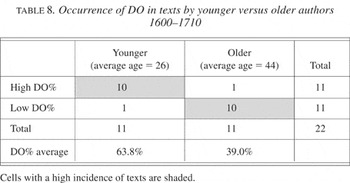
p = .0076). If the data is
split at the medians for age (35.5), and for incidence of DO (56%), the
quadrants are as given in
Table 8, with a clear
contrast, and the average incidence of DO also shows a clear distinction,
as you can see in the table.
DO in negative declaratives 1600–1710
DO for 1655 versus age of author. 1600–1710.
Occurrence of DO in texts by younger versus older authors
1600–1710
As Labov (1994:73, 83–84) points out,
the distribution across age levels found in age-grading may resemble that
resulting from “generational” change, in which individuals do
not alter their usage as they age, so that linguistic change results in a
distribution in apparent time, showing different levels of the incoming
phenomenon across ages at any chosen point in time. Is what is going on
here reasonably interpreted as generational change in this sense? There
are two reasons for rejecting such an interpretation. The first is that
the estimated rate of decline within the individual for each year of his
age is well in excess of the rate of increase within the community for
each calendar year. Individuals are not stable, as in generational change,
but are losing DO much faster than the general increase. You can see this
from the fact that the running average of Figure
6 (where the overall increase has been eliminated from the figures)
is not level, but shows a steep decline. You can also see it from the
figures in Table 7. Pure generational change
should give us coefficients for age and date which sum to zero, so that
here the coefficient for age should be −1.7, whereas it is
−5.13. So an account involving generational change by itself would
be insufficient, and there is no need to suppose that there is a
generational element in a more complex situation. Instead, we seem to have
age-grading in the sense of a pattern that repeats stably across
generations, combined with change, as, for example, in the case of
lenition of (ch) in Panama City (Labov, 1994:94–97).
A second reason for rejecting an interpretation involving an apparent
time distribution reflecting stability within the individual is that the
development of DO in negative declaratives before 1575 seems to be an
instance of communal change, since here age is not a significant factor.
Moreover, the same is true of questions, both before 1575 and in the
period 1575–1710 (Warner, 2004:238ff.). It
would seem very strange if the development of DO was a communal change in
these categories, but a generational change in 17th century negative
declaratives. Such an analysis would demand an account of the nature of
this shift in behavior, and its restriction to one subcategory of DO.
Given, then, that the decline with age found in the period
1600–1710 is indeed an age-grading pattern that repeats across
generations, the situation is fully consistent with the development of an
evaluative set up that differentiates DO NOT from the use of the simple
finite with NOT. In the 17th century we have a dramatic reversal of the
scales for register variation, coupled, importantly, with the introduction
of age-grading. As Labov noted, “distributions across age levels
might not represent change in the community at all, but instead might
represent a characteristic pattern of ‘age-grading’ that is
repeated in every generation … Many well-established
sociolinguistic variables exhibit such age-grading, where adolescents and
young adults use stigmatized variants more freely than middle-aged
speakers, especially when they are being observed.” (1994:73). Given this, the facts about
Ellegård's data (i.e., the 17th century situation itself and
the contrast with the preceding period) are consistent with, and indeed
strongly imply a differential evaluation which takes effect from the late
16th century, whether this is a stipulative, hostile evaluation of DO NOT
or a positive evaluation of the simple finite with NOT. But either way, it
is the onset of this that we see in the sharp drop of DO NOT in
Ellegård's database.
The demonstration that the decline in the use of DO NOT shown in
Ellegård's database is a consequence of the introduction of a
new evaluation of DO versus lexical verb in combination with NOT can shed
light on the difference found between the evidence of
Ellegård's database and that of the Corpus of Early English
Correspondence. This parallels Ellegård's data in showing a
decline in the use of DO NOT, after a period of increase. But it differs
in that the decline is shown later, in the first four decades of the 17th
century (as reported by Nurmi, 1999:148–149, 165ff.). We might, however,
reasonably suppose that a new evaluation, being a social psychological
fact, will take time to diffuse across social groups and situation types
(and may remain variable). The databases being compared here are
differently composed. The letter corpus contains personal (including
private) letters; as Nurmi noted, “In the Correspondence Corpus the
letters are personal, but not necessarily private, business letters and
other less private types being included” (1999:61). It also includes writing by women.
Ellegård's data after 1600, by contrast, is the language of
men, much of it written for publication. It must seem possible that a
corpus of writing, like Ellegård's, which is more public, would
be the first to show the impact of a new stylistic evaluation and would
show it more sharply, and that a different mix of individuals and of ages
in the databases might also underlie the timing difference. Further
investigation will shed more light on this, and on possible relationships
between stylistic evaluation and the age and gender differences noted by
Nurmi (which also seem to undergo change in the early 17th century).
DO NOT IN NEGATIVE QUESTIONS AND
IMPERATIVES
So far, this article has been concerned entirely with negative
declaratives. But the development of periphrastic DO in negative contexts
included questions and imperatives, where there was also variation between
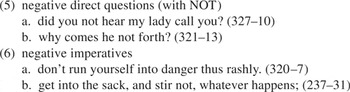
constructions with DO and a finite lexical verb, as illustrated next.
In negative questions Ellegård's figures show a major
collapse in the last quarter of the 16th century, which seems to parallel
that in negative declaratives. But despite this collapse, compelling
evidence for a contrast between texts of higher and lower lexical
complexity in negative questions after 1600 is weak. The graphs for
negative questions, which parallel Figures 3 and
4, do indeed show a similar configuration: There
is a monotonic increase in the running average for texts of lower lexical
complexity, whereas texts of higher lexical complexity show a sharp
decline in the last quarter of the 16th century, to a lower (but
increasing) level in the 17th century. The combined graphs are thus
broadly similar to that of Figure 5, though the
17th century differences are less pronounced. But the differences between
the incidence of DO in distinct text types are not significant for the
period 1600–1710.
A possible reason for the lack of significant contrast is that
negative questions occur most commonly in plays and other texts which are
clearly “oral” in their general properties, and these are
predominantly texts of lower lexical complexity. Texts of higher lexical
complexity, which are typically literary prose, may contain few or no
negative questions in Ellegård's sample. So, although token
numbers in texts of higher lexical complexity are not especially low, they
are drawn from a small number of texts. Thus, the contrast is at the mercy
of the properties of a few individual texts representing one end of the
continuum, which are arguably not typical of the wider distribution
outside the sample.10
In texts of higher
lexical complexity from 1600–1710, 60/76 (79%) of question
tokens are from two authors (Jonson and Hawkins).
At best then,
it is possible to suggest that negative questions are consistent with the
analysis of this article so far, and may well have partaken of the
contrast that we can see in negative declaratives, although
straightforward evidence for this is weak.
In negative imperatives there are very few instances of DO until the
end of the 16th century, when the incidence of DO rises to meet that of
negative declaratives. So there is no parallel to the late 16th century
collapse in negative declaratives shown in Ellegård's graph.
The possibility of a distinction between texts of lower and higher lexical
complexity in the 17th century is hard to evaluate, because the
distribution of tokens across texts of higher lexical complexity is even
more restricted than with negative questions.
In the case of negative questions, however, there is a further
striking distributional fact, which potentially gives us a major clue
about the nature of the stylistic contrast or evaluation involved here.
This depends on the fact that in questions with personal pronoun subjects
there is variation in the position of NOT with DO. Taking examples, as
before, from Otway, we find the contrast between (7a), with the order DO +
pronoun subject + NOT, and (7b) or (7c), where (7b) has the order DO + NOT
+ pronoun subject, and (7c) shows the further development to
don't, which appears as a written form in the 17th
century.
Historically, NOT in questions is increasingly found between the
finite verbal form and its subject, instead of after the subject. This
development takes place much earlier with full nominal subjects, and with
them it occurs with both full verbs and auxiliaries. It seems to be
effectively complete by the 16th century, though both variants remain
grammatical today (Huddleston & Pullum, 2002:chap. 9, sect. 2.1). There are no instances in
questions of the sequence Finite + NP subject + NOT in
Ellegård's database after 1501 or in the first Early Modern
English period of the Helsinki Corpus (1500–1570) (Rissanen, 1994:340). With personal pronoun subjects,
the earliest examples of Finite + NOT + pronoun subject in the Helsinki
Corpus are found in the Late Middle English period, the order develops
strongly with auxiliaries in the 16th and 17th centuries, and, on the
assumption that contracted forms such as don't,
mayn't, can't, should be treated as a further
development, today the change is close to completion with auxiliaries. In
corpora drawn from the 1960s, the London–Lund Corpus of spoken
English, and the Lancaster–Oslo/Bergen Corpus of written
English, rates are 94% and 84%, respectively (figures from Rissanen, 1999b:198). So there was a rapid increase in
incidence with considerable variation in the 16th and 17th centuries. The
extent of increase and variation in Early Modern English in which the
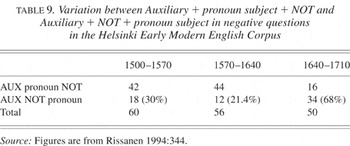
finite verb was an auxiliary can be seen from Table
9, which gives figures from Rissanen's (1994; 1999b) investigation
of the Helsinki Corpus.
Variation between Auxiliary + pronoun subject + NOT and Auxiliary +
NOT + pronoun subject in negative questions in the Helsinki Early Modern
English Corpus
It is interesting to see that in Ellegård's database this
variation patterned differently before and after 1600 in texts of higher
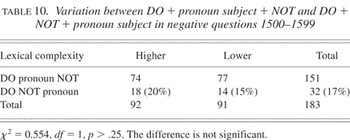
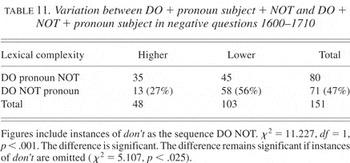
and lower lexical complexity. Tables 10 and
11 give figures for negative questions formed
with DO, omitting questions with inverted finite lexical verb. They make
three things clear: Comparing the “total” column in each table
shows that the overall proportion of DO + NOT + pronoun subject increases
across time, from 17% in the 16th century to 47% in the period
1600–1710; Table 11 shows that after 1600
there is a clear stylistic element in the variation between DO + pronoun
subject + NOT and DO + NOT + pronoun subject; and Table
10 shows that there is no apparent effect of stylistic level on
this variation before 1600. This holds also for subperiods before 1600,
most importantly, the effect cannot be seen in 1575–1600 or
1585–1600. It seems reasonable to associate this development with
the evaluation of negative forms proposed earlier for negative
declaratives. Then, if we make the natural assumption that evaluation will
have had a weaker effect in the texts of lower lexical complexity, and a
stronger effect in the texts of higher lexical complexity, it is clear
that when texts of higher lexical complexity use DO they are preferring
the older variant DO + pronoun subject + NOT, and dispreferring the
incoming variant DO + NOT + pronoun subject. So it seems likely that there
is a more complex stylistic effect here. Instead of (or, in addition to)
the opposition V versus DO found in negative declaratives, in questions
with pronoun subjects, we have DO + pronoun subject + NOT versus DO + NOT
+ pronoun subject. The overall situation is consistent with an evaluation
dependent on established literary models, in which the incoming variants
are disfavored, and the older established variant is favored.
Variation between DO + pronoun subject + NOT and DO + NOT + pronoun
subject in negative questions 1500–1599
Variation between DO + pronoun subject + NOT and DO + NOT + pronoun
subject in negative questions 1600–1710
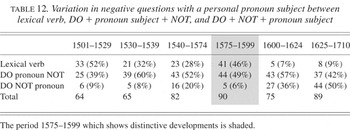
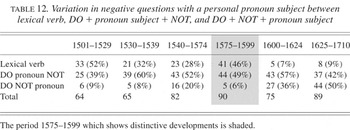
If this is the case, then arguably, we should expect the drop in
Ellegård's data to impact more strongly on DO + NOT + pronoun
subject than on DO + pronoun subject + NOT. And this is indeed the case,
as can be seen from Table 12. Although the
stylistic contrast is not clear until after 1600, Ellegård's
drop in 1575–1599 clearly involves a dramatic reduction in DO + NOT
+ pronoun subject, alongside an essentially stable situation in DO +
pronoun subject + NOT. Overall, Table 12 shows a
steady decrease across time in the incidence of inverted lexical verbs,
and a steady increase in the incidence of DO + NOT + pronoun subject. But
both developments are sharply interrupted at 1575–1599. In contrast,
the incidence of DO + pronoun subject + NOT is much more stable, and does
not show a distinctive shift at 1575–1599. Ellegård comments
that the figures for negative questions are small and perhaps therefore
somewhat erratic, so perhaps too much should not be made of this, but the
difference here is certainly suggestive.11
An alternative grammatical mechanism for part of this
development is conceivable. Let us accept the position of Han (2001) and Han and Kroch (2000) that there are two positions for NegP, one
between TenseP and MoodP, the other between AspP and VP, where MoodP
dominates AspP. For them, the rise of periphrastic DO is a consequence of
the loss of V-movement from Mood to Tense in the 15th and 16th centuries,
but a consequence of the loss of V-movement from V to Asp from the end of
the 16th century. Then suppose further that (1) the higher NegP
increasingly has NOT in the head position, so that DO incorporates with
it, and a possible question order is DO + NOT + pronoun subject, alongside
the DO + pronoun subject + NOT, which results when NOT is in SpecNeg and
there is no incorporation; and (2) the lower position has proportionately
much less head NOT, and much more SpecNeg NOT. This would be expected if
modals are typically generated above this position. Then as the loss of
V-movement from V to Asp begins, it will result in the replacement of a
proportion of examples with finite lexical verb in negative questions by
examples of DO + pronoun + NOT, giving of a higher overall proportion of
the category DO + pronoun + NOT. This might be responsible for the
changing proportions of DO + pronoun subject + NOT versus DO + NOT +
pronoun subject discussed in this section and shown in Table 12, though we
apparently need to assume some independent reason for the more general
decline of DO in negatives, and for the stylistic difference shown in
Table 11.
We might also expect that there would be a drop with
nominal subjects. Here the situation is less clear, because with
transitive verbs, DO has essentially gone to completion by 1575. But
although the numbers are small, intransitives show the expected drop in
the sequence DO NOT preceding a nominal subject.
Variation in negative questions with a personal pronoun subject
between lexical verb, DO + pronoun subject + NOT, and DO + NOT + pronoun
subject
A POSSIBLE RATIONALE FOR EVALUATION
Why should there be such an evaluation in negative questions and in
negative declaratives? And why should it occur when it does? Maybe we
should just accept as a fact that when DO NOT in declaratives reaches a
certain level (here 38%) evaluation of the opposition between incoming and
established forms becomes possible, and in lexically more complex
registers it is reasonable to assume that the forms typical of established
literary norms would be preferred. This would imply a preference for a
finite lexical verb in negative declaratives, and for the finite lexical
verb or for the sequence DO + pronoun subject + NOT in inverted questions.
But the further development of contracted forms is evidenced in spelling
not long after this period, and it is worth considering whether this
change might be involved in some way.
Jespersen suggested a date of 1600 for the development of contracted
forms of NOT (1909–1949:part V 23.15),
although spellings that reflect such contractions directly do not appear
until later in the 17th century. Subsequently, Brainerd (1989) has cited earlier forms than previously known,
giving examples of can't, don't,
han't (= haven't), shan't,
won't from the 1630s along with a few instances from the
1620s. Brainerd also noted the earlier existence of spellings that show
auxiliary and NOT as one word, including, for example, the combinations
didnot, shallnot, wilnot in the
Respublica (1553), suggesting that these point to
“portmanteau” disyllabic forms. Rissanen (1994; 1999b) has paid
attention to the early stages of the development of contracted forms, and
argued very convincingly that the reduction of NOT is comfortably under
way in the first half of the 16th century (1994:345; 1999b:197). He
suggested that in this century, when NOT occurred immediately after an
auxiliary, it could be pronounced with low stress and a centralized vowel.
Rissanen referred to the portmanteau spellings of the type cited, but his
main evidence was the changing order of pronominal subject and NOT with
auxiliaries. Rissanen pointed further to the fact that in questions when
the subject is a personal pronoun, NOT occurs directly after DO (and other
auxiliaries) much more frequently than it does directly after a full verb.
This distribution is seen in the Helsinki corpus for 1500–1570, and
it is confirmed by figures from the much larger Oxford Shakespeare Corpus
(1999b:197). He went on to say that
“enclitic forms are typical of auxiliaries – the weakened
forms of not were probably never appended to full verbs”
(1994:345).
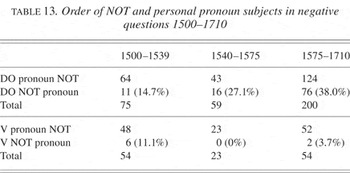
Ellegård's data showed a similar disproportion, though it
is a less dramatic one: For 1500–1575 NOT + pronoun subject order
occurs in 20.1% of instances of DO, and in 7.8% of instances of the finite
lexical verb. But there is also an interesting diachronic difference,
because it is clear that the placement of NOT is already developing
differently in the two categories from the middle of the 16th century. The
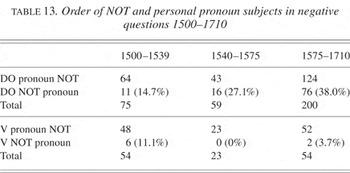
figures of Table 13 clearly show this
divergence, which continues to widen. With DO, the development is making
rapid progress; for verbs it is at best stable, more probably declining.
This is further evidence for the status of a reduced form and its
association with auxiliary DO. It strongly implies that Rissanen was right
and that the development was a real fact about the language by the middle
of the 16th century. The distribution of figures in Table 13 also supports his further suggestion that the
reduced form did not occur with nonauxiliary verbs.
Order of NOT and personal pronoun subjects in negative questions
1500–1710
This opens the interesting possibility that evaluation of the contrast
between interrogative inversions with DO and with lexical verb was
triggered by the development of reduced forms of NOT alongside more fully
stressed forms. These variants would have been differentiated not only by
stress, by also by syntactic distribution (with the reduced forms being
restricted to the position immediately following an auxiliary) and
presumably by style, with more fully stressed variants proportionately
more common in careful styles. If evaluation, whether covert or overt,
followed the establishment of this difference, it is straightforward to
see which way around it would go; the more fully stressed variants would
have been interpreted as appropriate for more careful styles, and the
reduced variants as less appropriate for such styles. This could have led
to the contrast in negative declaratives and the more complex patterning
found in negative questions. The suggestion is necessarily speculative,
but it seems not implausible.12
This might
imply that a similar development could be traced with modals. I do not
know whether this is the case.
We are, of course, familiar with
later evaluations that stigmatize the occurrence of clitic forms such as
He'll or
shan't in formal speech or in
writing.
CONCLUSIONS AND IMPLICATIONS
There is a clear reversal of direction of register variation in
negative declaratives with NOT between the periods 1500–1575 and
1600–1710 in Ellegård's database. In the earlier period,
DO is more common in texts of higher lexical complexity than in texts of
lower lexical complexity. In the later period, the relationship is
reversed. The later period also shows strong age-grading of a type
compatible with an evaluation of the opposition between DO and lexical
verb, which is disregarded among younger writers, but is more observed
with increasing age. It seems reasonable to conclude that a new evaluative
principle for register variation is introduced in the late 16th century,
and that its effects are seen in texts of higher lexical complexity. The
effects could be held to account for the major drop in overall incidence
in the use of DO NOT in negative declaratives in Ellegard's data in
the period 1575–1600, and there is no apparent need to appeal to
further (specifically, grammatical) mechanisms to account for this fall.
In contrast, texts of lower lexical complexity seem to show a steady
development, which may reflect the underlying, more vernacular trend in
the development of DO NOT. Negative questions show some of the same
effects, and the incidence of DO + NOT + pronoun versus DO + pronoun + NOT
may imply that evaluation focused on the sequence DO + NOT, or even that
the cliticization of NOT is implicated in the evaluation.
It is clear for independent reasons that there was a reanalysis of DO
in the second half of the 16th century. But the substantial overall dip in
negative declaratives in Ellegård's data as we cross 1575 does
not supply any further support for such a reanalysis, granted that it is a
fundamentally stylistic phenomenon. Similarly, if 1600–1710 is a
period in which evaluation prefers the simple finite over DO NOT, then the
fact that the development of DO NOT seems to diverge from that of
questions is not good direct evidence for a grammatical divergence. This
line of argument was advanced by Kroch (1989:234) who claimed that DO underwent three
independently evolving processes after 1575, in affirmative declaratives,
in negative declaratives, and in question contexts, on the ground that
each context shows a distinct rate of change. His general conclusion is
absolutely correct; and this form of argument was accepted earlier, when
it was agreed that the distinct behavior of affirmative declaratives was
evidence for grammatical change. But the status of negative declaratives
is unclear, because we can now see that we need to take account of the
contribution of register variation in estimating the apparent rate of
change of DO. In a similar vein, we need to reexamine the evidence for
Roberts' account (1993:303–306). He
suggested that NOT occurs in SpecNeg until 1600, so that when obligatory
DO support entered the language in the late 16th century, the incidence of
DO with NOT represented the older optional DO, and declined in tandem with
affirmative DO. Subsequently, NOT was reanalyzed as Neg0, with
which DO support is obligatory, and the incidence of DO recovered. But,
again, if the decline of DO NOT in the last part of the 16th century is a
stylistic matter, then it no longer counts as rather compelling evidence
for a particular interpretation for the interface of two grammatical
developments (obligatory DO support, and the reanalysis of NOT as
Neg0). Slade (2003) also took the
decline of DO NOT to be a grammatical fact, and predicted it to be a
consequence of the addition of a particular constraint ranking at the end
of the 16th century, within an Optimality Theoretic model. This too needs
reexamination, given the interpretation argued for in this article