




No CrossRef data available.
Article contents
The Meaning of που in Homer
Published online by Cambridge University Press: 22 April 2026
Abstract
[The etymological meaning ‘somewhere’ of this particle seems obsolete in the Homeric poems, in which it designates an emotional coloring that may be described as confident belief in something that cannot be demonstrated. Nowhere is it the expression of a doubt.]
Information
- Type
- Research Article
- Information
- Copyright
- Copyright © 1929 Linguistic Society of America
References
1 Might also be put under (3) and compared with ν 418.
2 Including those in past or imagined situations.
3 Including φημί of subvocal speech. Examples in past tenses E 473, ii 830, X 331, could also be placed under (2).
3a Might also be put under (1) and compared with ζ 173.
4 ‘A Set of Postulates for the Science of Language’, Language 2.154 (1926).
5 Disregarding occasional examples in which the effect aimed at seems rather ‘react to me as to one having the pou-feeling’, cf. II 514, λ 139.
6 Consequently no other alternative can be added, and ō 113 is to be recognized as an interpolation. There was previously reason to believe this, cf. my External Evidence for Interpolation in Homer 216 (Oxford: 1925). The line has recently been omitted by Bérard.
7 Formally speech, but practically narrative.
8 Two passages are noteworthy because of repetitions of the particle.
In K 206-7 (cf. Leaf's note for punctuation) Nestor after asking whether no one will have the courage to go among the Trojans, says:

The first που is in the ascription of an obvious motive, ‘in the hope, of course, of killing a foeman’; the second introduces an alternative that cannot be gainsaid, ‘or surely he may hope to learn some  among the Trojans’.
In λ 457-61 Agamemnon says to Odysseus:
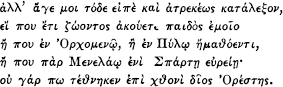
The first που (cf. ρ 510) indicates that the question might be foreseen. The second, if we trust text and language, means that Agamemnon had made such arrangements for his absence that Orestes must be in one or the other of these two cities. The third introduces a happy afterthought: by this time Menelaos is home and caring for his nephew. Our ignorance of the underlying legends stops further discussion. There is nothing in this to justify the attack upon line 461 made in the scholia. Aristarchus there read οὐγάρ που, which would be perfectly normal. Our tradition, which runs back to an ambiguous IIO, decides nothing for us.
9 Homer 2.13 (Leipzig: 1922).
10 Bursian's Jahresbericht 207.41 (1926). How much less bad his ‘wohl gar schon’ may be, is best left to native speakers of German. Wilamowitz, Die Heimkehr des Odysseus 102, paraphrases in substantial agreement with Bethe: ‘und der Seher weiss auch, dass Odysseus irgendwo in der Naehe ist, und auf Rache sinnt’. This seems to me (cf. above) to miss the emotional coloring given by the particle.