

Published online by Cambridge University Press: 22 April 2026
I wish to express gratitude to Professor Bernard Bloch for suggesting the topic of this dissertation and for guiding my analysis; I am further indebted to him for much of my understanding of linguistic theory. I am grateful also for the kind encouragement and guidance throughout my graduate work of other faculty members at the University of California 1947-9, the Linguistic Institute at the University of Michigan 1948, and Yale University 1949-50: Professors Peter A. Boodberg, Denzel Carr, Y. R. Chao, .J.M. Cowan, Franklin Edgerton, Murray B. Emeneau, Mary R. Haas, Harry Hoijer, and Ralph L. Ward. I have profited from discussions with Professors Isidore Dyen, Elizabeth F. Gardner, Johannes Rahder, and Rulon S. Wells of Yale University. Other influences will be found in the Bibliography. To Dr. Eleanor Harz Jorden I am grateful for permission to use part of her data on numeral-counter compounds; to Dr. Masako Yokoyama of the University of Hawaii, and to Mrs. Miyo Okada, Mr. Toshio Kono, and Mr. Senzo Usui of Yale University, I express my thanks for their kindness in checking certain facts. The Graduate School of Yale University made the completion of this dissertation possible through the grant of a Junior Sterling Fellowship. Part of the dissertation was presented before the Linguistic Institute at Ann Arbor in 1950, which I attended on a Postdoctoral Fellowship from the American Council of Learned Societies, and the present version benefits from suggestions received at that time.
page 9 note 1 Certain typographical conventions are observed. Words are usually separated by space; the morphs within a word are separated by a dot. Infixed morphs are enclosed between dots and parentheses: (.x.). The hyphen is used in various ways, usually to indicate some part of a word, often to show the immediate constituency. Specifically phonemic transcriptions are enclosed by slant bars, specifically morphophonemic transcriptions by double slants; but no slants are used where the type of transcription is unambiguous. Square brackets enclose allophonic transcription.
A single colon is used between forms to indicate alternation; thus, x : y ‘x alternates with y’, usually implying morphemic identification. A double colon is used to deny morphemic identification; thus, a : : b ‘a is not in the same morpheme with b’ or ‘a contrasts with b’. Single quotes enclose glosses (translational equivalents). Chinese graphs are referred to by the traditional K'ang-Hsi radical number, followed after a dot by the residual-stroke count. The symbol q represents an automatic alternation of the phonemes p (before p), t (before t, c, or č), k (before k), s (before s), š (before š). The symbol -V represents a repetition of the preceding vowel. The use of the acute and grave accent marks to indicate basic pitch patterns is described in §3.4.
page 10 note 2 Cf. Ootuki 3.544.
page 14 note 3 Cf. Hockett, Lg. 26.74–7 (1950).
page 17 note 4 Eleanor Harz Jorden, The syntax of modern colloquial Japanese (MS); Yale dissertation, 1949.
page 19 note 5 Cf. Zin̄bo Kaku and Tunemi Sen̄ri, Kokugo hatuon̄ akusen̄to ziten̄ 44–9.
page 21 note 6 It is of passing interest to note that a morphophoneme—a synchronic class of one or more phonemes in alternation with each other or with zero—may have more than one historical source. Diachronically, the morphophoneme //w// can be traced to *k (in the honorific-infinitive suffix) and *p (elsewhere). This development is apparently a result of dialect mixture at an earlier period.
page 22 note 7 Although not an original part of the syllabary, the line is now often included in what is still called a ‘50-sound syllabary’ despite the fact the number of syllables exceeds fifty.
page 32 note 8 For accent data, in addition to my own observations, I have freely used material in the following items from my bibliography: Bloch, Studies in colloquial Japanese I: Inflection; Bloch and Jorden, Spoken Japanese; Heibon̄sya, Daiziten̄; Kin̄daiti, Meikai kokugo ziten̄; Terakawa and Kusaka, Hyoozyun̄ nihon̄go hatuon̄ daiziten̄; Yosizawa and Miyake, Akusen̄to hyoosi sin̄zikai; Zin̄bo, Kokugo on̄seigaku; Zin̄bo and Tunemi, Kokugo hatuon̄ akusen̄to ziten̄. See now also Nippon hoosoo kyookai [Japan Broadcasting Companyl, Nihon̄go akusen̄to ziten̄ [Dictionary of Japanese accent]; Tokyo, 1951.
page 32 note 9 The topic particle wa is untranslated. Throughout the other parts of this work a written final accent is understood as occurring (phonemically) only when followed by another word.
page 33 note 10 Also pronounced kayú.i.
page 34 note 11 Also pronounced kuyú.ru.
page 34 note 12 But also pronounced óo.i.
page 40 note 13 This follows Zin̄bo and my own data. According to Akiyama Yukio of the Japan Broadcasting Company, current usage favors tonic -náŋara with atonic verb infinitives as well: ik.i-náŋara ‘while going’.
page 41 note 13a The regular infinitive of an adjective can be made honorific by prefixing o- (ohayaku 'being early'). The form here called the 'honorific infinitive' occurs only preceding the verb gozáru or as a sentence by itself.
page 42 note 14 Studies in colloquial Japanese I: Inflection 109. The categories have been rearranged here to display certain features of the accent more clearly.
page 43 note 15 A similar condition may hold true for the induced-accent form of the atonic infinitive: the Japan Broadcasting Company's dictionary gives akáku wa ‘as for being red’ where my notes show akakú wa.
page 43 note 16 In the speech of the older generation, the imperfect presumptive of atonic verbs acquires a final accent -(y)óo before the particle to + omóu ‘thinks’ or suru ‘does, attempts’: ikóo to omóu ‘I think I'll go’, ikóo to shita ‘I started to (tried to) go’. But in the speech of the younger generation, the forms are usually atonic in all environments.
page 43 note 17 After a base homonymous with the base of a verb. This morph group is actually a portmanteau, belonging both to the negative morpheme (na-) and the presumptive category morpheme.
page 43 note 17a After a base homonymous with the base of a verb. This morph group, too, is a portmanteau, belonging at the same time to the negative morpheme (na-) and the infinitive category morpheme.
page 44 note 18 More recent data indicate that the accent of this word is currently dominant only after atonic words (as would be expected) and words with a final accent. Thus, kooba dókoro ka ‘far from being a factory’ (koobá), but náŋoya dokoro ka ‘far from being Nagoya’ (náŋoya).
page 45 note 18a Usually the words oozée ‘a crowd of, many’ and takusán̄ ‘a lot of, many’ are treated as if numbers: oozée no, takusán̄ no.
page 48 note 19 Change from surd to sonant in Japanese compounds.
page 48 note 20 Lyman-si no ren̄daku-ron̄.
page 58 note 21 Studies in colloquial Japanese I: Inflection.
page 58 note 22 This was suggested by Bloch.
page 58 note 23 Cf. Denzel Carr, Certain verb formations in modern Japanese.
page 59 note 24 Studies in colloquial Japanese III: Derivation of inflected words 312 fn. 16.
page 60 note 25 Studies in colloquial Japanese III: Derivation of inflected words.
page 61 note 26 Attached directly to the adjective root. This should not be confused with the independent word raší.i—based on the same morpheme—which follows an inflected word in its entirety. Cf. kitana.raší.i ‘is dirty looking’ with kitana.i raší.i ‘seems to be dirty’. Etymologically, this suffix is perhaps the Y morph ra ‘class’ + the common adjective suffix ši: ‘of the class of, like’. Descriptively, such an analysis is of dubious value.
page 63 note 27 Bracketed elements appear only after consonant verb bases; parenthesized elements only after vowel verb bases.
page 63 note 28 These are perhaps best regarded as portmanteau morphs : -mai is an allomorph of the negative, adjective, and presumptive morphemes; -[a]zu is an allomorph of the negative, adjective, and infinitive morphemes. An alternative treatment would be to assign the allomorph arbitrarily to some one morpheme and have the other morphemes represented by zero.
page 68 note 29 Perhaps to be further divided into ma, an alternant of the morpheme in mé ‘eye’ and ji, an alternant of the first morph of ši.mé.ru ‘closes’, ši.már.u ‘is closed’.
page 69 note 30 Cf. tokkúri ‘bottle’, toku.toku ‘gurgle’, an etymological case.
page 70 note 31 For a detailed discussion of this name along historical lines see Iwai Hirosato, A study of the varied names for Japan, Cultural Nippon 8:1.21–48, 8:2.113–44 (1940).
page 70 note 32 The morph ta may be the second morph of ata.ta.mé.ru ‘heats up’; cf. acú.i ‘is hot’.
page 73 note 33 The morph hu is in contrast with the morph mu. The morph bu is in complementary distribution with both; it is traditionally divided between the two graphs on the basis of Chinese meanings; in Japanese all three are simply negative prefixes. I place all occurrences of bu with hu.
page 74 note 34 The morph non̄ may perhaps be associated with the long base of the verb nom.u ‘drinks’ (cf. nón̄.be ‘drunkard‘). Descriptively, the meaning is different enough to warrant treating the non̄ of nón̄.ki as a separate morpheme.
page 75 note 35 The original common semantic element; immediate meanings seem too divergent for morphemic identification.
page 76 note 36 The morphs oo : noo may perhaps be associated with graph 96.(-1) ‘king’; koo : oo is not a unique alternation however, as shown by item 71 in §13.3.
page 76 note 37 The morph zan̄ is better associated with graph 78.8 ‘cruel’.
page 77 note 38 I think the morph te should be identified with the Y morph in the word té ‘hand’; -ko is the Y morph which functions as a diminutive suffix, etymologically related to the word for ‘child’. A lever is a kind of ‘hand-child’, i.e. ‘little hand’.
page 77 note 39 There may be two morphemes here rather than a semantic extension, but each shows both shape alternants.
page 77 note 40 The form kit.ča is rejected as a substandard variant.
page 78 note 41 The words gó.ze ‘afterlife’ and kóo.see ‘after-ages, future generations’ do not necessarily conflict, since it is possible to regard se and see as belonging to different morphemes in these words, despite the traditional association with the same graph.
page 80 note 42 In the words ku.huu ‘device’ and kóo.hu ‘repairman, section-worker’, the morphs huu and hu belong to different morphemes, though traditionally associated with the same graph.
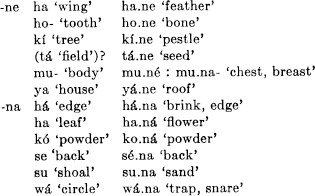
page 85 note 43 The two derivative suffixes -na and -ne seem to be in complementary distribution and therefore probably belong here. Examples are given below, with the prior morph identified where possible. The meaning of the suffix is usually specificative or diminutive. Some of the cases are on the borderline between etymology and morphemics.

For the negative reaction of a Japanese linguist to the suggestion that ha ‘leaf’ and haná ‘flower’ might be morphemically related, see Hattori Siroo, Gen̄go ken̄kyuu [Journal of the Linguistic Society of Japan] 19/20.100–1 (1951); for an expanded explanation of his position, see ibid. 6–7. Hattori had not seen the other examples listed here.
page 86 note 44 A similar case, but with alternation of the first vowel (together with sequential voicing of the initial consonant) : čikará ‘force’ alongside mí.zukara ‘by oneself, spontaneously’ and ono.zukara ‘by oneself, spontaneously’.
page 91 note 45 See now David L. Olmsted, Covert (or zero) morphemes and morphophonemic juncture, International journal of American Indian linguistics 17.163–6 (1951).
page 92 note 46 But the ultimate morphs of this example are probably ha- ‘edge’ as in há.na ‘edge, beginning’, and -ši, a common derivative suffix.
page 96 note 47 There is also the numeral óku ‘100,000,000‘; I have not heard this used in numeral-counter compounds, but it probably occurs.
page 97 note 48 A paradigm is a set of partially similar words with interdependent distributions, corresponding to a system of semantic categories. Here the paradigms are of the counters, the categories are the numerals.
page 97 note 49 The morph -hai ‘glassful’ is of pattern 2, but pattern 1 after go-.
page 103 note 50 Some idea of the difficulties in Japanese is given by the question whether ‘typhoon’ (meaning 'big wind') is one or two morphs in English—ef. tycoon 'big lord'—and, if two morphs, whether on the one hand the morph ty- belongs to the same morpheme as 'big' (or 'large'? or 'magni-'? or 'mega-'?), and whether on the other hand the morph -phoon belongs to the same morpheme as 'wind' (or ‘vent-‘?).
page 110 note 51 There seems to be no other compound to show this morph group in basic form; there-ore, there seems to be no descriptive way to ascertain whether it is jiku or jicu. It might be described as just jik- but this would be a shape of unique range. Etymologically, the rm is jiku.