







Published online by Cambridge University Press: 22 April 2026
[It is shown that a linguistic dating system can be set up on the basis of several explicit assumptions about morpheme decay. Thirteen sets of data, presented in partial justification of these assumptions, serve as a basis for calculating a universal constant to express the average rate of retention k̄ of the basic-root-morphemes : k = 0.8048 ± 0.0176 per millennium, with a confidence limit of 90%. Finally an expression is derived for the sampling-error to be expected in the calculated time-depths of related dialects.]
1 See B. Trnka, A tentative bibliography (CIPL: Publication of the Committee on Linguistic Statistics, No. 1; 1950); H. E. Driver, Statistics in anthropology, Am. anthr. 55.4 ff. (1953), with bibliography.
2 A. L. Kroeber and C. D. Chrétien, Quantitative classification of Indo-European languages, Lg. 13.83-103 (1937) ; id., The statistical technique and Hittite, Lg. 15.69-71 (1939); C. D. Chrétien, The quantitative method for determining linguistic relationships, Univ. Cal. Pub. Ling. 1.11 ff. (1948); M. Swadesh, Salish Internal relationships, IJAL 16.157 ff. (1950); id., Lexico-statistic dating of prehistoric ethnic contacts, Proc. Am. Phil. Soc. 96.457 ff. (1952); id., Mosan I: A problem in remote common origin, IJAL 19.26 ff. (1953); D. W. Reed and J. L. Spicer. Correlation methods of comparing idiolects in a transition area, Lg. 28.348 ff. (1952) ; R. B. Lees, Relationships among the Germanic dialects by a statistical method (unpublished, 1950); id., The genetic relation in linguistics (unpublished, 1952); C. F. Hockett, Linguistic time perspective and its anthropological uses (paper read before the summer meeting of the Linguistic Society, Bloomington, 1952) ; D. Taylor, Sameness and difference in two Island Carib dialects, IJAL 18.223 ff. (1952); E. Cross, Chronometrie and telemetric determination of the relationship of Latin, Gothic, Old Church Slavic, and their present affiliates (paper read before the meeting of the Linguistic Society, Cambridge, 1952). This list is not exhaustive.
3 Probably no meaning is completely universal : it would not surprise us to find languages containing no morpheme correlated with man, head, three, or sky, or languages in which water is represented by an affix (already excluded from consideration). We hope that such cases are so rare and so randomly distributed that our sampling process will show no significant effects from the non-universality of any one meaning.
4 By cognate we mean, of course, derivable one from the other by the use of a systematic set of phoneme correspondences, furnished by the traditional comparative method as applied to the language family in question.
5 See L. Bloomfield, Language 392-495 (New York, 1933); E. H. Sturtevant, Introduction to linguistic science 123-53 (New Haven, 1947).
6 We shall even try to show later that the rate-constant may be considered the same for all languages.
7 We use In for logarithms to the base e, log for base 10. Eq. 9 is identical with Swadesh's equation
![]()
as given in IJAL 16.161 (1950).
8 Ibid. 161 (§2.2, Par. 1 and 3). The English words of Swadesh's list were originally chosen to be representative of universal semantic areas, to be relatively stable and resistant to culture changes, and to be easily found in the lexicons of many languages. Swadesh has since suggested a slightly modified word list, Proc. Am. Phil. Soc. 96.456-7 (1952).
9 To save space we will not list the 215 words used, but a copy of the work-sheet may be obtained from the author upon request. All the original data are available for inspection.
10 That is,
![]()
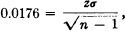
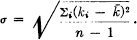
where σ is the standard-deviation of the k's by the small-sample formula
![]()
n = 13 is the number of k's averaged, and z is the unit-deviate for 12 degrees of freedom on the't'-distribution for the 90% level of confidence. We have used the 9/10-error as a measure of uncertainty throughout this study.
11 The standard-deviation is the root-mean-square deviation about the mean :
![]()
12 The author gratefully acknowledges the invaluable help that he received, in preparing this formulation, from W. Kruskal and his associates in the Department of Statistics, University of Chicago.
13 The number of independent observations used to calculate χ2, however, is only 12, because the 13 in the ‘lost’ category may be determined from N 0 and the value in the ‘retained’ category in each case, and one last value may be determined from the remaining 13 and their mean (or its equivalent, the mean k), leaving altogether only 12 degrees of freedom, not 26.
14 Members of the Assyriology staff in the Oriental Institute, University of Chicago, may be able to supply the necessary word lists.
15 One could object that part of this discrepancy may be due to failure of our first hypothesis of interlingually constant k. But if we recalculate, using the individual rateconstants for German and English instead of the mean constant k, we reduce the date by only 27 years, to 689 a.d.
16 The Azerbaijani word list was provided by F. W. Householder Jr., of Indiana University.
17 The Uzbek words, taken from the author's field notes, were supplied by Rusi Nasar of Margalan, Özbekistan.
18 Proc. Am. Phil Soc. 96.452-3 (1952). The difficulty with this example is that (1) we cannot be sure that the owners of the organic matter from which the C-14 was taken spoke Eskimo-Aleut, and (2) we do not know how long after or before the deposition of the sample the two branches of Eskaleut split apart.
19 Taylor, IJAL 18.229 ff. (1952).
20 G. L. Trager and H. L. Smith Jr., A chronology of Indo-Hittite, SIL 8.61 ff. (1950).
21 Using as informants Nataraj Vashi of Bombay and Kumar Sumer Singh of Jaipur.
22 From Eq. 9,
![]()
and expanding in a Taylor's series about the point (k 0, F 0) :
![]()
where the partial derivatives are to be evaluated at the point (k 0, F 0). Neglecting terms of higher order, multiplying out, and collecting constant terms:
![]()
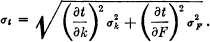
Now since var (c) = 0, var (x + y) = var (x) + var (y), and var (cx) –- c2 var (x), the variance in t is given by :
![]()
or, Snice var (x) = (σx) 2,
![]()
Substituting for the partial derivatives
![]()
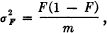
and also the expression for
![]()
we obtain :
![]()
Substituting for the values k = 0.8048 and σk = 0.00987, and converting to the 9/10-error by (9/10-error) = 1.645 σ:
![]()
where m is the number of items in the word list.