





1. Introduction
This article focuses on agreement puzzles and parametric variation in two closely related Northern Iroquoian languages: Kanien’kéha (also known as Mohawk) and Oneida. The main theoretical claim advanced here is that the complex distribution of pronominal prefixes in these languages can be captured through the proposal that inanimate nominals lack person, number, and gender (φ) features and are therefore invisible to the agreement system. This claim is of wider relevance because both of these languages have been separately argued to require major shifts in our understanding of the principles shared by human languages. Baker (Reference Baker1996) draws primarily on Kanien’kéha for his proposed ‘Polysynthesis Parameter’—a macroparameter relating to the realization of agreement morphology, which has far-reaching impacts on the syntax of polysynthetic languages. In a 2015 article in Language, Koenig and Michelson discuss two agreement puzzles in Oneida and reach a very different conclusion: that Oneida has ‘no evidence of local selection or the presence of a level of argument structure’ (Koenig & Michelson Reference Koenig and Michelson2015:41); the result, for them, is a much wider range of possible variation in how languages map from semantic representation to morphology. In this article, I examine the empirical landscape related to the realization of argument-indexing morphology with a focus on Kanien’kéha and argue for an analysis that relies on the assumption—standard across various formal frameworks—that nominal arguments are selected and hierarchically organized, together with the proposal that inanimates are featureless, without appeal to macroparameters.
What are the properties of these languages that have called for such extremities and variation in analyses? At a typological level, Northern Iroquoian languages are head-marking and polysynthetic, making frequent use of noun incorporation as well as derivational and inflectional morphology. Typical examples illustrating the complexity of verbal morphology from Kanien’kéha and Oneida are shown in 1 and 2, respectively.Footnote 1
(1)
Enionkhitsenhaién:hahse’
akwé:kon.
En-ionkhi-tsenh-a-ien-hahs-e’
akwekon
fut-3pl>1pl-fire-jr-set-ben-punc
all
‘They will kindle fire for us all.’
(Kanien’kéha; Mithun Reference Mithun, Tsunoda and Kageyama2006b:213)
(2)
Waʔ-te-khey-atat-yʌ·téle-hs-eʔ
Tá·wet
kháleʔ
Só·s.
fact-dup-1sg>3pl-refl-know-ben-punc
David
and
Susan
‘I introduced David and Susan to each other.’
(Oneida; Koenig & Michelson Reference Koenig and Michelson2015:10)
In addition to being morphologically polysynthetic, Northern Iroquoian languages share characteristics of ‘nonconfigurational’ languages (É. Kiss Reference É. Kiss1995, Hale Reference Hale1983, Payne Reference Payne1992): they have been described as having ‘free’ or discourse-governed word order and exhibit null anaphora, with free-standing pronouns being pragmatically marked (e.g. Michelson Reference Michelson2016, Mithun Reference Mithun, Aikhenvald and Dixon2017).
Baker (Reference Baker1996:3) clearly articulates the puzzle that these languages pose for our understanding of crosslinguistic variation. He notes that there are ‘two extreme positions one can take toward the superficial differences among languages’: on the one extreme, it could be that the Northern Iroquoian languages differ from English in a number of small ways, and that it is ‘the cumulative effect of all these little differences’ that results in their very different surface grammars. On the other extreme, it could be that there is one major difference between Kanien’kéha and Oneida, on the one hand, and a language like English, on the other. Though very different in their ultimate conclusions, both Baker (Reference Baker1996) and Koenig and Michelson (Reference Koenig and Michelson2015) argue for the latter path.
In this article, I focus on the two main puzzles related to the distribution and realization of pronominal prefixes raised in Koenig & Michelson Reference Koenig and Michelson2015—a prefix ‘shift’ in the stative aspect, and a restriction on the distribution of animate nominals—and propose that both can be accounted for under a proposal in which inanimate nominals lack features for person, number, and gender altogether. Inanimates are thus entirely ignored by the agreement system. Expanding on existing empirical descriptions with new language material, I show that the full range of pronominal prefix patterns in Kanien’kéha is not only compatible with a syntactic analysis relying on standard assumptions about agreement and argument structure, but indeed requires explicit reference to a hierarchical arrangement of arguments.
Finally, I turn to implications of this account. I contextualize the claim that inanimates are featureless within the larger literature on nominal typology and discuss typological precedents and implications. Lastly, I note that the proposal that inanimates bear no φ-features requires minimally a weakening of Baker’s (Reference Baker1996) Morphological Visibility Condition (MVC), the principle underlying the polysynthesis parameter that requires all arguments of a verb to be morphologically referenced. I propose that inanimates are invisible to the agreement system and are associated not with null morphemes, but rather with the absence of agreement altogether—a result that is incompatible with the MVC. I conclude—in the spirit of Haspelmath’s (Reference Haspelmath2018) review of The Oxford handbook of polysynthesis (Fortescue et al. Reference Fortescue, Mithun and Evans2017)—that ‘polysynthesis’ is likely best not treated as a technical term or single property for which a single parameter should account.
The remainder of this article is organized as follows. Section 2 introduces relevant background on the language and pronominal prefix system; Section 3 then articulates the proposal that inanimate nominals lack φ-features altogether. Here I lay out a probe-goal system of Agree that captures the basic patterns of pronominal prefixes in transitive and intransitive clauses. Sections 4 and 5 turn to the two puzzles related to the distribution of pronominal prefixes laid out in Koenig & Michelson Reference Koenig and Michelson2015. The first involves an ‘agreement shift’ in what is known as the stative aspect. I show that the stative shift pattern provides evidence that inanimate nominals cannot be analyzed as involving null agreement morphology (contra Baker Reference Baker1996), but rather must be completely ignored by the agreement system. The second puzzle involves restrictions on argument realization in benefactive constructions, which I argue provides evidence that nominal arguments must be hierarchically organized. In each of these sections, I lay out the empirical pattern and then show how the absence of φ-features on inanimates and the probe-goal system developed in Section 2, together with independently supported proposals about clause structure, can handle the facts. Section 6 concludes with a summary and discussion of wider implications for nominal feature typology and for polysynthesis.
2. Northern Iroquoian agreement
Iroquoian languages are divided into Northern and Southern branches (Lounsbury Reference Lounsbury and Trigger1978). Cherokee is the only language of the Southern branch, while the Northern branch includes languages of the Six Nations Rotinonhsión:ni (Haudenosaunee or Iroquois) Confederacy: Cayuga, Kanien’kéha, Oneida, Onondaga, Seneca, and Tuscarora, as well as Wendat (Huron)/Wyandot and a few less-documented and dormant languages (Barrie & Uchihara Reference Barrie, Uchihara, Siddiqi, Barrie, Gillon, Haugen and Mathieu2019, Michelson Reference Michelson2016, Mithun Reference Mithun, Aikhenvald and Dixon2017, Mithun & DeCaire Reference Mithun, DeCaire, Dagostino, Mithun and Rice2024). This article focuses on Kanien’kéha [ganjʌ̃ʔgéha] (ISO 639-3 moh), a language spoken in what is today called Quebec, Ontario, and New York primarily by Elders who learned it as a first language, as well as by a growing population of fluent second-language speakers and their children. DeCaire (Reference DeCaire2023) estimates a little over 600 total ‘advanced level’ speakers across all communities, as well as over 1,000 intermediate speakers, as the result of robust community-driven language revitalization efforts (Benedict Reference Benedict2026, Brant Reference Brant2016, Reference Brant2023, DeCaire Reference DeCaire2023, Green Reference Green2009, Green & Maracle Reference Green, Maracle, Hinton, Huss and Roche2018, Stacey Reference Stacey2016, Reference Stacey2024).
This article draws on the thorough description of the distribution of pronominal prefixes laid out in Koenig & Michelson Reference Koenig and Michelson2015. Although their discussion focuses on Oneida, they note that the generalizations they list hold in other Northern Iroquoian languages as well (see also Michelson Reference Michelson2016, Mithun Reference Mithun and Brown2006a, Reference Mithun, Aikhenvald and Dixon2017 on the close relation between Kanien’kéha and Oneida). Unless otherwise noted, all examples below are presented in Kanien’kéha. The language material in this article is drawn in part from published sources, cited below and rechecked, and in part from consultation work with community language experts Mary Onwá:ri Tekahawáhkwen McDonald of Ahkwesáhsne and Akwiratékha’ Martin of Kahnawà:ke, as well as additional consultation on the benefactives in Section 5 with first-language speakers Konwaronhiá:wi Helen Norton and Katerí Deer of Kahnawà:ke. Elicitation sessions were conducted in English and followed standard context-driven elicitation methodology (see Bowern Reference Bowern2008, Matthewson Reference Matthewson2004). In some cases, spelling, glosses, or gloss abbreviations have been modified from original sources for consistency, and Kanien’kéha examples from earlier works have been updated to reflect the current orthographic norms adopted by communities (Lazore Reference Lazore1993). Any remaining or introduced mistakes are my own.
2.1. Verb stems and verbal inflection
Northern Iroquoian languages are typically recognized as having at least three surface parts of speech: nouns, verbs, and particles (see discussion in Michelson Reference Michelson and van Lier2023b). Verbs are the primary focus of our discussion here, and the basic layout of the Northern Iroquoian verb stem is previewed in 3 (Lounsbury Reference Lounsbury1953, Mithun Reference Mithun, Lieber and Štekauer2009, Reference Mithun, Aikhenvald and Dixon2017).
-
(3) Northern Iroquoian verb morphology
(prepronominal prefix(es) –) pronominal prefix – [Verb stem] – aspect (– tense)
As indicated in 3, verbs include at least a verb stem bearing an aspectual suffix (except imperatives, which lack aspect) and prefixed by a pronominal prefix, discussed in detail below. Verbs may also appear with optional past marking (see Gatchalian Reference Gatchalian2025, Martin Reference Martin2023b) and with one or more of a set of what are called ‘prepronominal prefixes’, which encode a range of grammatical information including negation, modality, location, direction, iterativity, and others (Barrie & Uchihara Reference Barrie, Uchihara, Siddiqi, Barrie, Gillon, Haugen and Mathieu2019, Mithun Reference Mithun, Aikhenvald and Dixon2017). Examples of forms with simple verb stems illustrating the components in 3 are shown in 4.
(4)
a.
wa’khní:non’
wa’-k-hninon-’
fact-1sg.A-buy-punc
‘I bought it’
b.
katá:wenskwe’
k-atawen-s-kwe’
1sg.A-swim-hab-for.pst
‘I used to swim’
c.
wakatórion
wak-atori-on
1sg.P-drive-stat
‘I have driven’
(Martin Reference Martin2023b)
The forms in 4 also serve to illustrate the three core aspects relevant below: perfective (glossed here following Iroquoianist literature as ‘punctual’), imperfective (glossed ‘habitual’), and stative. The perfective aspect requires the addition of one of a set of three modal prepronominal prefixes, such as the ‘factual’ wa’- in 4a. Forms in the stative aspect, the focus of Section 4, may have either a perfect or ongoing state interpretation, depending on their lexical aspect (Cross et al. Reference Cross, Gatchalian, Morgunova, Myers and Norton2023, Gatchalian Reference Gatchalian2025, Michelson Reference Michelson1975).
The verb stem represented in square brackets in 3 may itself be internally complex, including minimally a verb root suffixed by one or more derivational suffixes, with incorporated nouns and reflexive or middle (‘semireflexives’ in Iroquoianist terminology) markers preceding the root, as schematized in 5.
-
(5) Northern Iroquoian verb stem
(semi)reflexive – noun stem – verb root – derivational suffixes
Examples of more complex verbs stems include those previewed in 1 and 2 above, as well as those in 6, where the stem components are enclosed in square brackets and the root is boldfaced. Stem-internal elements sometimes require what is called a ‘joiner’ or a ‘linker’ vowel in order to break up consonant clusters, here glossed ‘jr’; on the distribution of the joiner, see Michelson Reference Michelson1988, Reference Michelson, Gerdts and Michelson1989.
(6)
a.
aonsakonwaia’tisákha’
a-onsa-konwa-[ia’t-isak-ha]-’
opt-rep-3pl>z.sg-[body-seek-purp]-punc
‘they should go back to look for her’
(Mithun Reference Mithun, Lieber and Štekauer2009:568)
b.
iakwatenonhsatariha’tahkwha’
iakwa-[ate-nonhs-a-tarih-a-’t-a-hkw]-ha’
1pl.excl.A-[srfl-house-jr-heat-jr-caus-jr-inst]-hab
‘we heat our house with it’
(Mithun Reference Mithun2005:453)
2.2. Introducing pronominal prefixes
Central to the larger discussion here are the sets of ‘pronominal prefixes’, which expone person, number, and gender features of arguments. Chafe (Reference Chafe and Li1977:493), discussing Cayuga, Kanien’kéha, Oneida, Onondaga, and Seneca, notes that ‘each language has on the order of sixty-five or seventy such prefixes, and one of the joys of Iroquoian linguistics has been to unravel their form and function in each language’. Kanien’kéha’s pronominal prefixes, from Martin Reference Martin2023b, are shown in the Appendix.
Pronominal prefixes are divided into three sets: (i) agent prefixes (also called ‘subjective’), (ii) patient prefixes (also called ‘objective’), and (iii) transitive prefixes.Footnote 2 These prefixes distinguish person, number, and gender (Chafe Reference Chafe and Li1977, Lounsbury Reference Lounsbury1953, Martin Reference Martin2023b, Michelson Reference Michelson, Hellinger and Motschenbacher2015). Person distinctions include first, second, and third persons, as well as a clusivity distinction for first-person nonsingulars, while number includes singular, dual, and plural. An example of each type of prefix is shown in 7.
(7)
a.
iakenihiá:tons
iakeni-hiaton-s
1du.excl.A-write-hab
‘we(du.excl) write’
b.
rotí:ten
roti-iten
m.pl.P-be.poor[stat]
‘they(m.pl) are poor’
c.
takhró:ris
tak-hrori-s
2sg>1sg-tell-hab
‘you tell me’
(Martin Reference Martin2023b)
Third-person nominals can be classed into four genders based on the pronominal prefixes they trigger: masculine (‘m’), feminine/indefinite (‘f’), feminine/zoic (‘z’), and neuter (‘n’). Masculine gender is used for singular males and groups with at least one male. The feminine/indefinite gender comprises singular female humans, as well as nonspecific or generic human referents. The feminine/zoic, by contrast, includes singular, dual, and plural female humans, as well as animals and some supernatural beings. The choice of whether to use the feminine/indefinite or the feminine/zoic for singular female humans carries social implications; see discussion in Abbott Reference Abbott1984, Bonvillain Reference Bonvillain1973, Michelson Reference Michelson, Hellinger and Motschenbacher2015, and Mithun Reference Mithun and Corbett2014. Finally, nominals denoting inanimate entities are classified as neuter.
I follow Harley & Ritter Reference Harley and Ritter2002 and much subsequent work in taking features to be arranged in geometries, with more specified features entailing the presence of less specified features. Formally, I propose the featural organizations in 8 for the four genders, shown here together with their corresponding free-standing pronouns, and discussed in turn below.
(8)
φ-features for third-person nominals
person
gender
number
pronoun
masculine
[anim [hum]]
[masc]
[#]
raónha
feminine/indefinite
[anim [hum]]
—
—
akaónha
feminine/zoic
[anim]
—
[#]
aónha
neuter
—
—
—
—
With respect to person features, I propose that masculine, feminine/indefinite, and feminine/zoic all contain an animate node, [anim], which neuter nominals lack. The claim that the least specified person category can be represented by the absence of features draws on discussion in Harley & Ritter Reference Harley and Ritter2002 as well as other specific works on a range of different languages, discussed further in Section 6.1. Masculine and feminine/indefinite genders are further restricted to humans with the feature [hum]; feminine/zoic lacks this human node, consistent with its use for animals, some supernatural entities, and women in certain contexts, sometimes described as derogatory (Abbott Reference Abbott1984, Bonvillain Reference Bonvillain1973, Michelson Reference Michelson, Hellinger and Motschenbacher2015, Mithun Reference Mithun and Corbett2014). The proposal that the contrast between humans, nonhuman animates, and inanimates is in fact a distinction in person (and not gender) finds precedent in work such as Oxford Reference Oxford2019 for Algonquian, Lochbihler et al. Reference Lochbihler, Oxford and Welch2021 for Algonquian and Dene, Toosarvandani Reference Toosarvandani2023 for Zapotec, and other works cited there, discussed further in Section 6.1. First and second persons would include further specifications on the person node (Harley & Ritter Reference Harley and Ritter2002), not discussed here.
I propose that masculine nominals are the only ones formally specified for a gender feature, [masc]. Under this approach, the two ‘feminine’ genders can be understood as simply the absence of this specification. This aligns with the historical trajectory, for which it has been proposed that the masculine/feminine distinction was the last to emerge (Chafe Reference Chafe and Li1977), as well as with discussion in Boas Reference Boas, Boas, Dixon, Kroeber, Hodge and Smith1909, noted by Abbott (Reference Abbott1984), who called the feminine/indefinite and feminine/zoic the ‘nonmasculine’ genders.Footnote 3 The proposal that only masculine has a true gender feature may find support in the prefix paradigm shown in the Appendix, in which singular masculine forms typically do not participate in the same range of syncretisms as the other third persons (i.e. these forms would be specified for [masc]).
Masculine and feminine/zoic encode number distinctions. Neuter and feminine/indefinite nouns do not make number distinctions, and in the glosses I do not include number for these categories. For neuter nominals, this is compatible with the proposal that they lack φ-features altogether. I suggest that the absence of a number distinction for feminine/indefinites correlates with their ‘indefinite’ function, akin to ‘impersonal pronouns’, like German man, which have been argued to be featurally deficient (e.g. Ackema & Neeleman Reference Ackema and Neeleman2018, Fenger Reference Fenger2018; see Little Reference Little2024 for an overview). Adopting the proposal in Harley & Ritter Reference Harley and Ritter2002 that gender and number are both dependent on an individuation node (discussed further in Section 6.1), one possibility would be to represent the feminine/indefinite as bearing only the person features in 8 and lacking an individuation node altogether. The use of the feminine/indefinite with singular female humans can then be understood insofar as this form is not marked for masculine gender and not marked for number. For the purposes of this work, I remain agnostic about the featural representation of the three-way number contrast that is available for first/second persons, masculine, and feminine/zoic nouns; see Cowper Reference Cowper2005 and Harley & Ritter Reference Harley and Ritter2002.
Finally, note that forms for feminine/zoic singular are nearly always—but not entirely—syncretic with neuter forms, as can be seen in the Appendix. The syncretism is shown in 9, and a minimal pair that shows a contrast between neuter and feminine/zoic objects is shown in 10.Footnote 4
(9)
a.
kenòn:we’s
ke-nonhwe’-s
1sg.A-like-hab
‘I like it(n)’
b.
kenòn:we’s
ke-nonhwe’-s
1sg>z.sg-like-hab
‘I like it(z)’
(Martin Reference Martin2017:3)
(10)
a.
ienòn:we’s
ie-nonhwe’-s
f.A-like-hab
‘she likes it(n)’
b.
konwanòn:we’s
konwa-nonhwe’-s
f>z.sg-like-hab
‘she likes it(z)’
(Baker Reference Baker1996:20)
In addition to the contrast in 10, further evidence for a formal distinction between feminine/zoic and neuter comes from the inventory of free-standing pronouns, used in emphatic or contrastive contexts, shown in the rightmost column in 8 above. While feminine/zoic nominals can be referred to with the pronoun aónha’, no pronominal form is available for inanimates. Finally, while feminine/zoic forms include a number contrast, neuter does not (see the Appendix). As Koenig and Michelson (Reference Koenig and Michelson2015) note, even inanimates that are clearly plural appear with a neuter prefix, not with a feminine/zoic plural form.
The above discussion is intended to provide an introduction to the featural distinctions relevant in the pronominal prefix system, though details of the featural representation of animates are not crucial to the analysis below. The key claim I motivate below is that neuter nominals lack formal person, number, and gender features altogether. This is in line with work on other languages with animate/inanimate contrasts, such as languages of the Algonquian and Dene families (Lochbihler et al. Reference Lochbihler, Oxford and Welch2021, Oxford Reference Oxford2019), and in line with Michelson (Reference Michelson, Hellinger and Motschenbacher2015:278), who describes neuter as a ‘formally covert gender’ in Oneida. Michelson (Reference Michelson, Hellinger and Motschenbacher2015) similarly contends that neuter arguments are never referenced on the verb, and Koenig and Michelson (Reference Koenig and Michelson2015:9) describe inanimates as ‘invisible to morphological derivation’. An important part of the proposal below is that despite being identical on the surface, the verb in 9a involves agreement only with the first-person argument, while that in 9b involves agreement with both arguments. We return to the empirical motivation for this in Section 5.
3. Inanimates are featureless
Koenig and Michelson (Reference Koenig and Michelson2015) make four generalizations regarding the distribution of pronominal prefixes in Northern Iroquoian. Taken together, these generalizations cover the empirical patterns that any successful analysis of this system must cover, so I use them to guide the discussion here. I show that the proposal that inanimates are featureless, coupled with a theoretically grounded proposal about agreement, can derive the full set of generalizations. This section covers the first two generalizations and lays out a system of agreement to capture the distribution of pronominal prefixes; we turn to the third and fourth generalizations in the following two sections. The first generalization is shown in 11 (Koenig & Michelson Reference Koenig and Michelson2015:12).
(11) K&M’s generalization 1: ‘All verbs must have a pronominal prefix, which, by default, is a third-person [neuter] prefix.’
The forms in 12 illustrate. Verbs with no arguments, like the weather verb in 12a, as well as verbs in which the sole argument has been incorporated, as in 12b, appear with a default pronominal prefix.
(12)
a.
iokennó:re’s
io-kennor-e’s
n.P-rain-hab
‘it rains’
(Michelson et al. Reference Michelson, Michelson and Deer2024:208)
b.
takawí:ren’ne’
ta-ka-wir-en’-ne’
cis.fact-n.A-baby-fall-punc
‘the baby fell’
(Baker Reference Baker1996:317)
My choice to gloss the pronominal prefixes in these forms as ‘n.A’ (neuter agent) and ‘n.P’ (neuter patient) departs from the glosses of equivalent Oneida forms from Koenig and Michelson (Reference Koenig and Michelson2015), who label the default pronominal prefix in forms equivalent to 25 as ‘feminine/zoic’ and propose that there is no morpheme corresponding to neuter agreement. Recall that singular feminine/zoic forms are nearly—but not always—syncretic with neuter forms. In this article, I reserve the zoic gloss for verbs with true zoic arguments (see Section 2.2) and use ‘n.A’ and ‘n.P’ to represent the default forms. Ultimately, my choice of glossing aligns with the larger point in Koenig & Michelson Reference Koenig and Michelson2015: there is no such thing as true ‘neuter agreement’, and in the absence of an animate argument, the default form surfaces.
Koenig and Michelson’s (Reference Koenig and Michelson2015:13) second pronominal prefix generalization is in 13.
(13) K&M’s generalization 2: ‘All and only (distinct) animate semantic arguments are referenced by pronominal prefixes.’
This generalization is illustrated by transitive predicates in which one of the arguments is inanimate. Compare the intransitive form in 14a, which indexes its sole argument with the feminine/indefinite agent prefix ‘f.A’, with the transitive form in 14b. The transitive in 14b has an inanimate object, which is not indexed by the pronominal prefix (regardless of whether it is overt, pro-dropped, or incorporated).
(14)
a.
ieráthens
ie-rathen-s
f.A-climb.up-hab
‘she climbs up’
(Martin Reference Martin2023b)
b.
ienòn:we’s
(ne à:there’)
ie-nonhwe’-s
(ne a’there’)
f.A-like-hab
(ne basket)
‘she likes it (the basket)’
(Baker Reference Baker1996:204)
While most intransitives are like 14a in appearing with A-prefixes to index their sole arguments, some intransitives, like io’ten ‘work’ in 15a, take P-prefixes. This gives the language its characteristic Split-S alignment (Mithun Reference Mithun1991), to which we return below. Importantly here, transitive verbs with inanimate subjects appear with the same P-prefixes found on P-marked intransitives, as shown in 15.
(15)
a.
iakoió’tens
iako-io’ten-s
f.P-work-hab
‘she works’
b.
iakoia’takéhnhas
iako-ia’t-akehnha-s
f.P-body-help-hab
‘it helps her’
(Baker Reference Baker1996:204)
The patterns in 14 and 15 are systematic across the language and illustrate that—for the purposes of the verbal morphology—inanimate arguments behave as if they are not there at all.
Finally, note that the qualifier ‘distinct’ in Koenig and Michelson’s formulation in 13 covers the fact that reflexive and reciprocal forms are marked via a reflexive prefix on the verb and are morphologically intransitive in terms of their pronominal prefix selection (see 64 and discussion in Section 5.1 below). While a detailed analysis of reflexives and reciprocals is outside the scope of this paper, see Baker Reference Baker1996 for an analysis that is compatible with the probe system proposed below.
3.1. Agent and patient prefixes and their probes
In the remainder of this section, I lay out a model of agreement framed within a generative probe-goal model (see e.g. Baker Reference Baker2008, Béjar Reference Béjar2003, Deal Reference Deal2025, Preminger Reference Preminger2014). Though modeled within this specific theoretical framework, the generalizations this model seeks to capture can be summarized in theory-neutral terms as follows: (i) argument-indexing morphology is the result of a feature-sharing relationship between a head (bearing a ‘probe’) and a nominal argument (‘goal’); (ii) this relationship (‘Agree’) is subject to certain locality requirements; and (iii) probe-bearing heads can include sublexical elements, such as particular aspects or components of the verbal projection (e.g. v 0). To model the Northern Iroquoian patterns previewed above, I propose that the pronominal prefixes are formally pronominal clitics generated as the result of an Agree relation between a φ-probe bearing unvalued features, represented as [uφ], and a nominal argument (Béjar Reference Béjar2003, Preminger Reference Preminger2014). The successful Agree relationship triggers the obligatory creation of a clitic, formally a D0 head, doubling the nominal in argument position (possibly a null pro) (Anagnostopoulou Reference Anagnostopoulou2003, Preminger Reference Preminger2019).Footnote 5 This is illustrated in 16.
(16)

The analysis of the pronominal prefix morphemes as pronominal clitics—that is, D0 heads that adjoin to the verb stem—aligns with the spirit of the Iroquoian literature, which describes them as pronouns. Analyzing these morphemes as pronominal clitics is also consistent with diagnostics in Baker & Kramer Reference Baker and Kramer2018, which discusses the inability of pronominal clitics to double nominals that are quantified, anaphoric, or contain a variable bound by a quantifier; a key point in Baker Reference Baker1996 is that Kanien’kéha does not have nominals of this sort, compatible with the claim that the pronominal prefixes are in fact pronominal D0 heads. I continue to refer to the pronominal clitic doubles as ‘pronominal prefixes’ below, noting that pronominal clitics need not be phonological clitics (see discussion in Akkuş et al. Reference Akkuş, Embick and Salih2025, Bennett et al. Reference Bennett, Harizanov and Henderson2018).
I propose that A- and P-prefixes are generated by φ-probes on T0 and v 0, respectively, summarized in 17. This finds language-internal support, discussed below, and also mirrors typical locations for subject- and object-agreement-generating probes crosslinguistically; see Deal Reference Deal2025 for a recent overview.
(17)
A- and P-prefixes and probes
pronominal prefix
functional head
φ-probe(s)
agent (A)
T0
[uφ]a-probe
patient (P)
v 0
[uφ]p-probe
Recall from 3 above that the pronominal clitics attach immediately to the left edge of the verb stem, which is delineated on the right side by an aspectual suffix and optionally a tense suffix. While overt tense morphology is optional, Gatchalian (Reference Gatchalian2025) provides an in-depth analysis of the temporal semantics of Kanienk’éha and argues that the functional head T0 is present even when not morphologically realized, making T0 a suitable host for the A-prefix. I assume that the stem is composed of the heads internal to TP, in line with the Mirror Principle (Baker Reference Baker1985), and that the clitics move to adjoin to a dedicated clitic position at the left edge of this stem, shown in 18. Prepronominal prefixes, not discussed here, adjoin further to the left.Footnote 6
-
(18) $ \dots =\boxed{D^0}=\left[{}_{{\mathrm{T}}^0}{\mathrm{V}}^0-{\mathrm{V}\mathrm{oice}}^0+{v}^0-{\mathrm{Asp}}^0-{\mathrm{T}}^0\right] $


With respect to the split-S distribution of pronominal prefixes on intransitives, P-marking is often used for nonvolitional events—but there are exceptions to this, and it is generally agreed that intransitives that take P-prefixes must be understood as lexically specified (Baker Reference Baker1996, Michelson et al. Reference Michelson2016, Mithun Reference Mithun1991). Baker (Reference Baker1996:§5.4) provides evidence that the choice of agent or patient prefix does not correlate with the independently diagnosable differences between unergative and unaccusative verbs. For example, Baker (Reference Baker1996:212) shows that both verbs in 19 pattern as unergatives (e.g. disallow incorporation of their single argument), but one requires an agent prefix, while the other requires a patient prefix. Similarly, the verbs in 20 are both syntactically unaccusative—that is, their subjects are both internal subjects—but nonetheless differ in their pronominal prefix choice.
-
(19) Unergatives
-
a. wa’thahséntho’
wa’-t-ra-hsentho-’
fact-dup-m.sg.A-cry-punc
‘he cried’
-
b. wahoió’ten’
wa’-ro-io’ten-’
fact-m.sg.P-work-punc
‘he worked’
-
-
(20) Unaccusatives
-
a. wahatotáhsi’
wa’-ra-t-otahsi-’
fact-m.sg.A-srfl-appear-punc
‘he appeared (i.e. came into view)’
-
b. wahokè:tohte’
wa’-ro-ke’toht-e’
fact-m.sg.P-appear-punc
‘he appeared (i.e. showed up)’
-
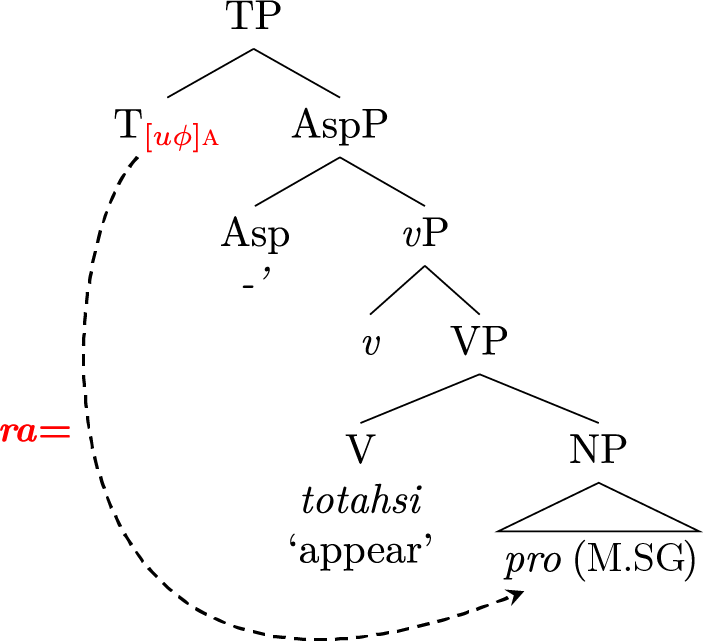
I follow Baker (Reference Baker1996) in taking P-prefixes to be the lexically specified or ‘marked’ form for intransitives, with A-prefixes occurring with intransitives otherwise. The lower placement of the P-prefix probe—that is, on a head local to the lexical root—aligns with the lexically specified nature of these forms, as well as the fact that P-prefixes index the highest φ-bearing internal argument, as we will see below.Footnote 7 The structures in 21 and 22 illustrate the proposed Agree mechanism for intransitives (here unaccusatives) with A- and P-prefixes, respectively.Footnote 8
(21)
Intransitive → A-prefix = 20a
(22)
Intransitive → P-prefix = 20b
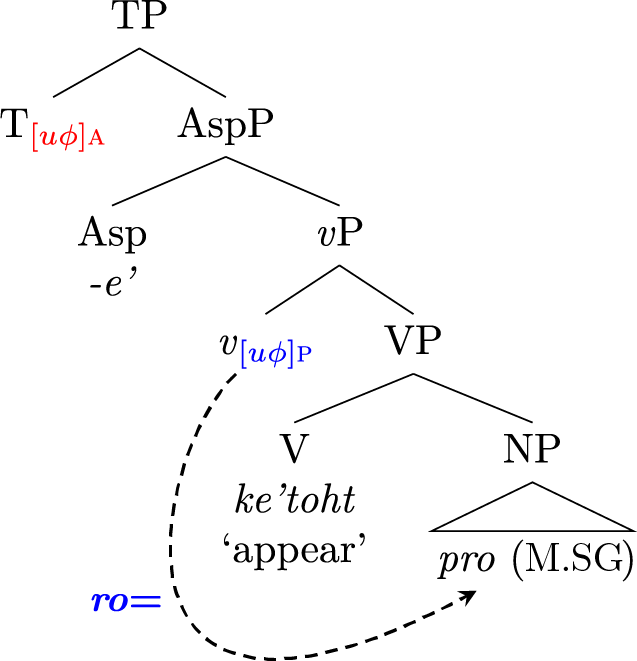
From the bottom up, the verb combines with the single internal argument; here I represent the root as V (alternately, it could be a category-neutral root verbalized by the v 0 head). Following recent work in argument structure, I assume that the v 0 head defines the type of eventuality of the predicate (e.g. eventive or stative, discussed further in Section 4; see e.g. Beavers & Koontz-Garboden Reference Beavers and Koontz-Garboden2020 and Harley Reference Harley, D’Alessandro, Franco and Gallego2017 for discussion of different approaches). The eventive vP is selected by an aspectual head Asp0, here punctual (i.e. perfective). In 21, the unvalued φ-features on T0 search the probe’s c-command domain, entering into Agree with the intransitive subject bearing φ-features and triggering movement of the pronominal prefix (i.e. clitic double) from the agent series. The clitic adjoins to the left of the stem, as in 18.
Intransitive verbs that are lexically specified to take P-prefixes feature a lower probe [uφ]p on v 0, as shown in 22. When a root is lexically specified to appear with P-prefixes, I assume it must be selected by the [uφ]p-probe-bearing v 0 (and conversely, this v 0 does not combine with roots not lexically specified for P-prefixes). I take unergative structures to be similar except that the subject is generated in the specifier of vP; a lexically specified [uφ]p-probe on unergative v 0, as in 19b, may cliticize the argument in its specifier.Footnote 9
Crucially, note that the [uφ]a-probe is still present on the T0 head in 22. In order to capture the absence of A-prefixes cooccurring with P-prefixes, I propose, following Anagnostopoulou Reference Anagnostopoulou2003, Béjar & Rezac Reference Béjar, Rezac, Pérez-Leroux and Roberge2003, Coon & Keine Reference Coon and Keine2021, and Preminger Reference Preminger2009, that a nominal that has been cliticized is no longer visible for future Agree operations. Furthermore, following Preminger Reference Preminger2014 and much subsequent work, while probes with unvalued features must initiate search operations, failure to find a goal (as for the [uφ]a-probe in 22) does not result in a derivational crash. Assuming a bottom-up model of syntactic derivation, this system correctly derives the fact that in cases where more than one probe may potentially access a single goal, the lower probe will always trigger the clitic.
In summary, locating the [uφ]p-probe on a low head, v 0, is motivated by the generalization that P-prefixes reference the highest internal argument, as well as by the need for certain verbs to lexically specify a P-prefix (which can be handled by the local selectional relationship between v 0 and the root). Locating the [uφ]a-probe on a higher functional projection, here T0, aligns with its ability to reference the highest accessible (i.e. not already-agreed-with) nominal, as well as the stative shift pattern discussed in Section 4 below. This system, together with the proposal that inanimates bear no φ-features, provides a straightforward account of the use of these prefixes in transitive verbs that have only a single animate argument, in line with generalization 2 in 13.
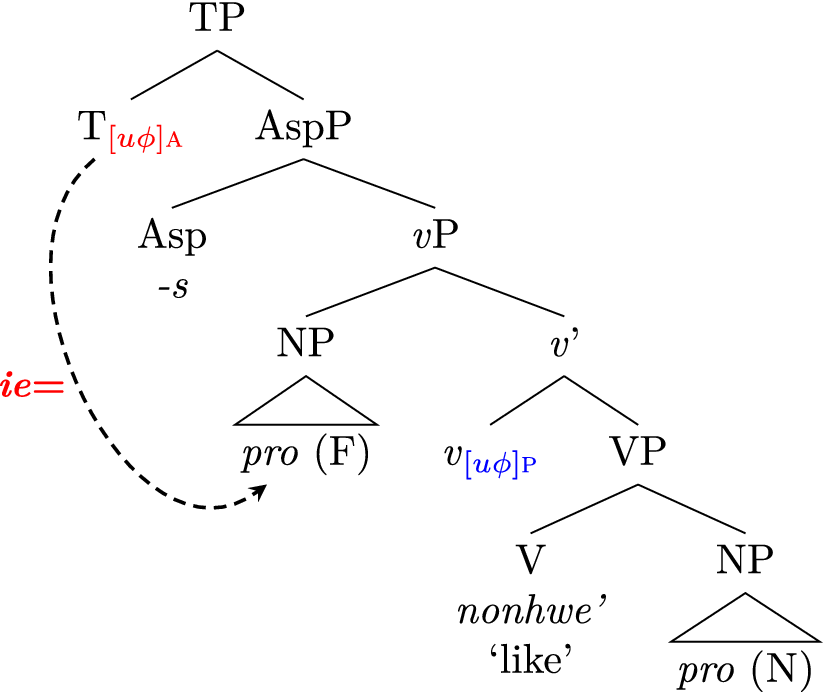
The proposed structure for a transitive verb with an animate external argument and an inanimate internal argument, like the one in 14b, is shown in 23. Here the lower [uφ]p-probe on v 0 finds no goal; the inanimate object is syntactically present and interpreted by the semantics, but due to its lack of φ-features, it is invisible to the agreement system (recall that failure to Agree does not crash the derivation). The higher [uφ]a-probe enters into Agree with the agent in Spec,vP, correctly resulting in the A-prefix. For a transitive verb with an inanimate external argument and an animate internal argument, like the one in 15b, the [uφ]p-probe enters into Agree with the internal argument, shown in 24. The featureless external argument is invisible to the higher A-probe, and only the P-prefix surfaces.Footnote 10
(23)
inan patient → A-prefix = 14b
(24)
inan agent → P-prefix = 15b

The two probes on T0 and v 0 in 17, combined with the proposal that inanimates are featureless, thus captures the patterns for verbs with only a single animate argument, whether they are transitive or not. This is in line with Koenig and Michelson’s second generalization in 13. We now turn to capturing the default pronominal prefix forms from their first generalization in 11.
3.2. Default forms
As stated in 11, all verbs in Kanienk’éha must appear with a pronominal prefix; when no arguments are accessible for agreement, this is a default prefix (Baker Reference Baker1996, Koenig & Michelson Reference Koenig and Michelson2015). We saw initial evidence for this in 12 above; an additional pair is given in 25.
(25)
a.
wa’kaién:ta’ne’
ne
atià:tawi
wa’-ka-ient-a-’n-e’
ne
atia’tawi
fact-n.A-be.on.ground-jr-inch-punc
ne
shirt
‘the shirt landed (on the ground)’
b.
ontia’tawi’tsheraién:ta’ne’
wa-w-atia’wi’-tsher-a-ient-a-’n-e’
fact-n.A-shirt-nmlz-jr-be.on.ground-jr-inch-punc
‘the shirt landed (on the ground)’
(Martin Reference Martin2023a)
At first, one could imagine that the neuter agent prefix in 25a is the result of the A-probe proposed above entering into agreement with the inanimate subject, ne atià:tawi ‘the shirt’. However, this same prefix (here a prevocalic allomorph) appears even when the subject is incorporated, as in 25b. Incorporated nominals are not viable goals for agreement in Kanien’kéha (Baker Reference Baker1988, Reference Baker1996), and we thus have another domain in which inanimate arguments are treated on par with the absence of an argument altogether.Footnote 11
I follow Baker (Reference Baker1996:§7.4.2) in analyzing the default pronominal prefix forms like the ones in 25 as expletives, on par with expletive subject clitics. While subject clitics appear to be less common than object clitics among the world’s languages, some subject-clitic languages are shown to use clitics in expletive subject environments, as in the Friulian and Spoken French examples in 26.
(26)
a.
Al=
plof.
subj.cl
rains
‘It’s raining.’
(Friulian; Poletto & Tortora Reference Poletto, Tortora, Ledgeway and Maiden2016:782)
b.
Et
là,
i=
reste
plus
qu’un
croissant.
and
there
subj.cl
remains
more
than.one
croissant
‘And there, there’s more than one croissant left.’
(Spoken French; Culbertson & Legendre Reference Culbertson and Legendre2014:88)
Of course, in split-S Kanien’kéha, expletive subject clitics come in two possible forms: agent (n.A) and patient (n.P), as shown in the forms in 12 above, repeated in 27. A successful analysis of these constructions must capture the fact that (i) verbs lexically specified for P-prefixes will show the expletive patient form, and (ii) only a single pronominal prefix is ever present on a stem (in other words, we need to rule out a scenario in which both a [uφ]p-probe and [uφ]a-probe produce default forms on a single stem).
(27)
a.
iokennó:re’s
io-kennor-e’s
n.P-rain-hab
‘it rains’
(Michelson et al. Reference Michelson, Michelson and Deer2024:208)
b.
takawí:ren’ne’
ta-ka-wir-en’-ne’
cis.fact-n.A-baby-fall-punc
‘the baby fell’
(Baker Reference Baker1996:317)
First, as already noted for P-prefix unergatives in Section 3.1, I propose that the lexically specified [uφ]p-probe proposed for intransitives like 27a differs from the [uφ]p-probe found on regular transitive verbs in always resulting in a clitic, ensuring that the neuter patient form (here io-) will always surface in the absence of an accessible animate goal (see also fn. Footnote 9). Some evidence for this comes from a relatively small set of transitive verbs discussed in Baker Reference Baker1996 that are lexically specified to index their agents with a P-prefix—but only when the patient is inanimate. In the transitive form in 28a, the masculine plural agent is indexed using the patient clitic; however, when both arguments are animate, as in 28b, the expected transitive prefix appears.Footnote 12
(28)
a.
ia’thonón:ko’
ia’-t-ron-onko-’
trans.fact-dup-m.pl.P-bump-punc
‘they bumped it’
(Baker Reference Baker1996:200)
b.
ia’tekheia’tón:ko’
ia’-te-khe-ia’t-onko-’
trans.fact-dup-1sg>f-body-bump-punc
‘I bumped her’
(Baker Reference Baker1996:217)
These forms provide independent evidence that the lexically specified [uφ]p-probe behaves differently from the [uφ]p-probe found on regular transitives. In a transitive like 14b/23 above, an inanimate internal argument results in failure of the [uφ]p-probe, and an A-prefix indexes the animate subject. The lexically specified [uφ]p-probe found on certain transitive and intransitive v 0s, however, is different: it creates a P-prefix in all constructions. In a transitive like 28a, or an unergative like 19b above, it will enter into Agree with the external argument in Spec,vP, and in the absence of any accessible goal, as in 27a, it will result in the default form.
Finally, to capture the fact that only a single pronominal prefix is ever present on a Kanien’kéha stem (i.e. the default A-prefix is inserted only in the absence of any other prefix), I propose that clitics must move to occupy a single dedicated (and obligatorily filled) position at the left edge of the stem, as schematized in 18 above, repeated in 29.Footnote 13 Recall that T0 ultimately hosts the stem created by the concatenation of heads terminating in the aspectual suffix or an optional tense suffix.
-
(29) $ \dots =\boxed{D^0}=\left[{}_{{\mathrm{T}}^0}\;{\mathrm{V}}^0-{\mathrm{V}\mathrm{oice}}^0+{v}^0-{\mathrm{Asp}}^0-{\mathrm{T}}^0\right] $

This is in line with Baker’s (Reference Baker1996:217) suggestion that the generalization that all stems have a pronominal prefix can be related to an EPP (extended projection principle) requirement. This also parallels Arregi and Nevins’s (Reference Arregi and Nevins2012) discussion of what they term a ‘T-noninitiality’ requirement in Basque, in which finite auxiliaries must be preceded by a clitic. Typically, this initial clitic position is filled by an absolutive clitic in Basque, but in the absence of an absolutive clitic, an ergative clitic or an expletive clitic may be inserted (their ‘L-support’; Arregi & Nevins Reference Arregi and Nevins2012:§5.4). In Kanien’kéha, if a patient prefix has been created by the probes internal to vP, this clitic will move to occupy the clitic position at the left edge of the stem. If the lower probe fails, the [uφ]a-probe on T0 may either find a goal and move the resulting A-prefix to the clitic position or, in the absence of any goal, will generate a default form, just as in the Romance examples in 26 above and Basque L-insertion.
3.3. Transitives with two animate arguments
Having tackled the distribution of A- and P-prefixes, we now turn to transitive prefixes. Transitive prefixes are reserved for verbs with two animate arguments, indexing the external argument or agent and the ‘primary object’ in the sense of Dryer Reference Dryer1986 (see details in Section 5). The primary object is the patient or most patient-like argument of a monotransitive, as in 30a, or the applied argument of a ditransitive, as in 30b.
(30)
a.
tahatié:na’
ta-rak-iena-’
cis.fact-m.sg>1sg-catch-punc
‘he caught me’
b.
wahá:kon’
wa’-rak-on-’
fact-m.sg>1sg-give-punc
‘he gave it to me’
(Baker Reference Baker1996:193)
While in many cases there are pieces of transitive morphemes that can be segmented into features of one argument or the other (Bonvillain Reference Bonvillain1973, Lounsbury Reference Lounsbury1953, Postal Reference Postal1962), these are often treated, at least for expository purposes, as portmanteaux. The gloss X>Y indicates a subject with X features and a primary object with Y features. Additional examples are shown in 31.
(31)
a.
wa’tkonrénhsaron’
wa’-t-kon-renhsaron-’
fact-dup-1sg>2sg-praise-punc
‘I praised you’
b.
tshisenihró:ris
tshiseni-hrori-s
2du>m.sg-tell-hab
‘you(du) tell him’
(Martin Reference Martin2023b)
Transitive prefix formation requires a mechanism with the ability to reference features of two arguments. Formally, I take the transitive prefixes to be the result of clitics generated by the φ-probe located on v 0, which enters into Agree with the highest internal argument (i.e. the primary object) and the external argument in its specifier, shown in 32. The fact that the [uφ]a-probe on T0 is not involved in the formation of the transitive prefixes is important to the analysis of statives in Section 4. In particular, I argue below that the probes responsible for the generation of transitive prefixes must be located below the head responsible for aspectual contrasts, here Asp0.
(32)
Two animate arguments → transitive prefix = 30a

A single head with the ability to access both internal and external arguments, as with transitive v 0 pictured in 32, is regularly employed in literature on agreement that seeks to derive forms which require reference to two arguments, for example, hierarchy effects and direct/inverse systems (Béjar Reference Béjar2003, Béjar & Rezac Reference Béjar and Rezac2009, Deal Reference Deal2024, Reference Deal2025). This can be modeled within a Cyclic Agree framework, in which the v 0 agrees with the internal argument and then reprojects a probe that enters into Agree with the external argument, as proposed by Béjar and Rezac (Reference Béjar and Rezac2009) specifically for Kanienk’éha.Footnote 14 Alternatively, v 0 could in fact be composed of two bundled heads, v 0 and Voice0 (Harley Reference Harley, D’Alessandro, Franco and Gallego2017); the [uφ]p-probe on v 0 would consistently agree with the primary object, and Voice0 could introduce and enter into Agree with the external argument in its specifier via an additional probe, as in analyses of ergative agreement (Coon Reference Coon2017, Wiltschko Reference Wiltschko, Johns, Massam and Ndayiragije2006). Under any implementation, it is important that the external argument is agreed with by this low probe only when Agree with the primary object is successful (i.e. the object is animate); when the primary object is inanimate, T0 agrees with the subject, resulting in an A-prefix, as in 14b/23. This could be captured either via specific conditions on Cyclic Agree and probe reprojection or, on a two-probe account, via a selectional relation between Voice0 and v 0, in line with transitivity requirements on probes in languages with external argument agreement (see Legate Reference Legate, Coon, Massam and Travis2017).
Importantly here, the two clitics generated by these Agree relations are local to one another and therefore able to undergo idiosyncratic feature impoverishment and morphological fusion processes (Embick & Noyer Reference Embick and Noyer2001, Halle & Marantz Reference Halle, Marantz, Hale and Keyser1993), resulting in the opacities and systematic syncretisms in the transitive prefix system, shown in the Appendix. The system proposed here is also consistent with the fact that—to the extent that some of the transitive prefixes are decomposable into distinct agent and patient components—the component corresponding to features of the agent typically precedes the component corresponding to features of the patient (see e.g. Bonvillain Reference Bonvillain1973:139). For the derivation in 32, the clitics corresponding to the masculine singular agent and the first-person singular patient result in the m.sg>1sg form rak- (in this particular case, decomposable into ra [masc] and k [1sg] components).Footnote 15
3.4. Interim summary
To summarize what we have seen to this point, all Kanien’kéha verbs appear with a single pronominal prefix chosen from one of three sets: agent, patient, or transitive. Importantly, though, transitive prefixes are reserved for verbs with two animate arguments; inanimates are ignored by the verbal morphology, with the result that transitive verbs that have only a single animate argument behave morphologically as intransitives. In the absence of any accessible animate nominal, a default form appears. These facts are the subject of Koenig and Michelson’s first two generalizations, repeated in 33 and 34.
-
(33) K&M’s generalization 1: ‘All verbs must have a pronominal prefix, which, by default, is a third-person [neuter] prefix.’
-
(34) K&M’s generalization 2: ‘All and only (distinct) animate semantic arguments are referenced by pronominal prefixes.’
I formalized these patterns with the proposal that inanimate arguments are present in the syntactic derivation, but lack φ-features altogether, and are therefore invisible to the pronominal clitic system driven by the φ-probes. Specifically, I proposed that the prefixes are generated by φ-probes located on the functional heads T0 ([uφ]a-probe) and v 0 ([uφ]p-probe); in a transitive construction with two animate arguments, v 0 enters into Agree with both the primary object and the external argument. Once an argument has undergone cliticization, it is no longer accessible to higher probes. This fact, together with the proposal that clitics adjoin to an obligatorily filled clitic position at the left edge of the stem delineated by T0, correctly captures the distribution of expletive forms.
An obvious question arises at this point: are these three different probe mechanisms really necessary? Given that the two probes on T0 and v 0 can access external and internal arguments, could it not be that these probes work in tandem to create transitive prefixes? Or alternatively, if a Cyclic Agree or low two-probe mechanism is needed to access both arguments to create transitive prefixes, could this same probe not also be responsible for A- and P-prefixes? I argue in the next section that neither mechanism alone suffices to capture the stative shift patterns. Instead, A-prefixes must be generated by a probe at or above the projection responsible for the aspectual contrast, while transitive prefixes must be generated below this projection. In a recent squib, Barrie (Reference Barrie2023) discusses the need for separate subject and object probes (contra Béjar & Rezac Reference Béjar and Rezac2009), but notes further that ‘there is currently no agreed upon mechanism for agreement in Northern Iroquoian. Indeed’, he adds, ‘there is currently no proposal to account for the difference between subject and object agreement and its interaction with aspect’ (Barrie Reference Barrie2023:438). We turn to this aspectual puzzle—which corresponds to Koenig and Michelson’s third generalization—next.
4. Stative shift
Pronominal prefix patterns in the stative aspect provide additional evidence for the proposal that inanimates are ignored by the verbal morphology, which I capture through the proposal that they lack φ-features. The facts seen to this point are in principle compatible with analysis like that in Baker Reference Baker1996, in which inanimate nominals undergo agreement, but this agreement happens to be indexed by phonologically null morphemes. However, as discussed in Koenig & Michelson Reference Koenig and Michelson2015 and summarized by the generalization in 35, details of the stative aspect show that this is not the case.
(35) K&M’s generalization 3: ‘Polyadic verbs with only one animate semantic argument behave like monadic or medadic predicates with respect to pronominal prefix selection.’
As Koenig and Michelson (Reference Koenig and Michelson2015) show, this generalization goes beyond the basic patterns we saw in the previous section: for eventive predicates appearing in the stative aspect, A-prefixes consistently shift to P-prefixes, regardless of whether the verb is intransitive, as in 36, or transitive, as in 37.
-
(36)
-
a. kahténtie’s
k-ahtenti-’s
1sg.A-go.away-hab
‘I go away’
-
b. wakahténtion
wak-ahtenti-on
1sg.P-go.away-stat
‘I have gone away’
-
(37)
a.
kenòn:we’s
ke-nonhwe’-s
1sg.A-like-hab
‘I like it(n)’
b.
wakenonwè:’on
wake-nonhwe’-on
1sg.P-like-stat
‘I have liked it(n)’
(Michelson et al. Reference Michelson, Michelson and Deer2024)
The fact that A-prefixes on eventive stems consistently shift to P-prefixes in the stative results in transitive forms that are possibly ambiguous, as shown in 38.
(38)
wakarahsénthon
wak-arahsentho-on
1sg.P-kick-stat
(i) ‘I have kicked it(n)’ or
(ii) ‘it(n/z) has kicked me’
(Martin Reference Martin2023a, McDonald Reference McDonald2023)
The patient pronominal prefix on the form in 38 tells us that one argument is animate (here first-person singular), but not which one. Koenig and Michelson (Reference Koenig and Michelson2015) use the stative facts described in this section as part of their argument that Northern Iroquoian languages lack a level of syntactic argument structure, concluding that ‘morphological referencing of animate semantic arguments is a purely inflectional process in Oneida, with no syntactic reflex’ (p. 42). In other words, for Koenig and Michelson, the ambiguity in 38 is related to the fact that only a single intransitive morphological prefix form is available in the stative, and it can be associated with either an agent or a patient.
I argue that the probe system proposed above, together with an independently motivated proposal about the nature of the stative aspect, is able to capture the patterns under the standard and framework-neutral assumption that arguments are selected by predicates and hierarchically organized. Crucially, however, capturing the pattern relies on the claim that inanimates do not enter into agreement.
4.1. Patient prefixes in the stative aspect
In Section 3 we observed the split-S pattern found in Kanien’kéha intransitives: some intransitive verbs are specified to take P-prefixes (see 19b, 20b), while others appear with A-prefixes (19a, 20a). Importantly, however, verbs that show aspectual alternations show a different pattern in the stative aspect. Kanien’kéha’s three-way aspectual contrast previewed in Section 2.1 is shown in 39. The intransitive verb atori ‘drive’ appears with agent prefixes in the perfective (aka ‘punctual’, shown here with a future-punctual) and imperfective (aka ‘habitual’) aspects in 39a–b. In the stative aspect form in 39c, however, a pronominal prefix from the patient set appears. This is a systematic pattern for all verbs that show aspectual alternations. As previewed in 37, the absence of A-prefixes in the stative aspect also has an effect on transitive verbs with inanimate internal arguments. Recall that transitive verbs with inanimate objects appear with A-prefixes in perfective and imperfective aspects, as in 40a–b. Just as intransitives that take A-prefixes switch to P-prefixes in the stative, so too transitive verbs with inanimate patients must take a P-prefix in the stative, shown in 40c (Deering & Harries-Delisle Reference Deering and Harries-Delisle1976, Koenig & Michelson Reference Koenig and Michelson2015, Mithun Reference Mithun1991).
(39)
a.
enkató:ri’
en-k-atori-’
fut-1sg.A-drive-punc
‘I will drive’
b.
katórie’s
k-atori-’s
1sg.A-drive-hab
‘I drive’
c.
wakatórion
wak-atori-on
1sg.P-drive-stat
‘I have driven’
(DeCaire Reference DeCaire2016)
(40)
a
enkarahséntho’
en-k-arahsentho-’
fut-1sg.A-kick-punc
‘I will kick it(n)’
b.
karahsénthos
k-arahsentho-s
1sg.A-kick-hab
‘I kick it(n)’
c.
wakarahsénthon
wak-arahsentho-on
1sg.P-kick-stat
‘I have kicked it(n)’
(McDonald Reference McDonald2023)
Verbs that take patient prefixes or transitive prefixes in the punctual and habitual aspects, by contrast, maintain these prefixes in the stative, as shown by the forms in 41 and 42.
(41)
a.
enwakió’ten’
en-wak-io’ten-’
fut-1sg.P-work-punc
‘I will work’
b.
wakió’tens
wak-io’ten-s
1sg.P-work-hab
‘I work’
c.
wakio’tèn:’en
wak-io’ten-en
1sg.P-work-stat
‘I have worked’
(DeCaire Reference DeCaire2016)
(42)
a.
enkonhró:ri
en-kon-hrori-’
fut-1sg>2sg-tell-punc
‘I will tell you’
b.
konhró:ris
kon-hrori-s
1sg>2sg-tell-hab
‘I tell you’
c.
konhró:ri
kon-hrori
1sg>2sg-tell[stat]
‘I have told you’
(Martin Reference Martin2025)
The table in 43 illustrates the distribution of transitive, agent, and patient prefixes for verbs that show aspectual alternations.
(43)
Stative aspect prefix alternations
anim>anim
anim
p
inan>anim
anim
a
anim>inan
punctual
trans
pat
pat
agt
agt
habitual
trans
pat
pat
agt
agt
stative
trans
pat
pat
pat
pat
Foreshadowing details of the analysis below, I argue that this distribution supports the claim from Section 2 that the probes necessary to create both transitive and patient prefixes are located below aspect (and are thus unaffected by aspectual alternations), while the [uφ]a-probe is located higher.
4.2. Accounting for stative shift
In order to formally account for the shift to P-prefixes, I follow the analysis proposed for Kanien’kéha by Ormston (Reference Ormston1993) and Baker and Travis (Reference Baker and Travis1998): the stative aspect is not a grammatical aspect on par with the habitual and punctual aspects—that is, it does not occupy Asp0. Rather, it is a light verbal element with stative semantics, its own argument structure, and importantly, its own φ-probe.
Evidence for the special status of the stative aspect is discussed further in Baker & Travis Reference Baker and Travis1998, Gatchalian Reference Gatchalian2025, and Ormston Reference Ormston1993; I summarize two points here. First, there is a class of property-denoting roots that combine only with the stative aspect. ‘Stative-only’ roots like rak ‘white’ and hnir ‘hard’ in 44a cannot appear in the habitual or punctual aspect without the addition of inchoative or other derivational morphology. Baker and Travis (Reference Baker and Travis1998)—elaborated further in Baker Reference Baker2003—propose that these ‘stative-only’ roots are adjectival and require the use of a light verb (i.e. the stative) in order to predicate. Second, as Baker and Travis (Reference Baker and Travis1998) note, the stative aspect may be followed by further derivational morphology, such as causative and ‘progressive’ morphemes (see examples in Baker & Travis Reference Baker and Travis1998, and see Baker & Travis Reference Baker and Travis1998 and Gatchalian Reference Gatchalian2025 on the derivational properties of the progressive); the same is not possible for habitual or punctual aspects. A form illustrating that stative-aspect forms may additionally be nominalized and incorporated is given in 44b. This form involves the nominal tsikhe’t ‘candy’ incorporated into the stative predicate hniron ‘hard.stat’; this stem is then nominalized and incorporated into the verb k ‘eat’, which is in turn inflected with the habitual aspect. While this type of recursive incorporation is considered ‘creative’, the stative aspect marker was deemed necessary in this form.
(44)
a.
iohní:ron
io-hnir-on
n.P-hard-stat
‘it is hard’
b.
ktsikhe’tahnirónhtsheraks
k-tsikhe’t-a-hnir-on-htsher-a-k-s
1sg.A-candy-jr-hard-stat-nmlz-jr-eat-hab
‘I eat hard candy.’
(McDonald Reference McDonald2025)
As Ormston (Reference Ormston1993) and Baker and Travis (Reference Baker and Travis1998) note, the proposal that the stative suffix is a verbal element provides us with a natural means to account for the stative prefix shift: like transitive v 0, stative v 0—represented here as v BE0—always bears a [uφ]p-probe and triggers P-prefixes.
For stative-only verbs, the stative v BE0 head combines directly with an adjectival root to derive a stative interpretation, as in 44a. To derive perfect interpretations found with verbs that show aspectual alternations, like 39c above, I propose that the stative head combines with what is effectively a small-clause complement, containing the argument structure up through the highest argument (here vP), but not the higher aspectual layer associated with the perfective/imperfective contrast (Asp0). This is in line with the meaning of these perfect forms: for Comrie (Reference Comrie1976:52), for example, the perfect denotes a state that ‘indicates the continuing present relevance of a past situation’ (see Bertrand et al. Reference Bertrand, Aonuki, Chen, Davis, Gambarage, Griffin, Huijsmans and Matthewson2022 for general discussion, as well as Cross et al. Reference Cross, Gatchalian, Morgunova, Myers and Norton2023, Gatchalian Reference Gatchalian2025, and Michelson Reference Michelson1975 on Kanien’kéha specifically).
The treatment of the suffix found in the derivation of perfect interpretations as a stative light verb also aligns with the discussion by Mithun (Reference Mithun, Tsunoda and Kageyama2006b:198), who notes that an imaginable motivation behind the stative shift pattern exemplified again in 45–46 is that ‘the person involved in he has escaped is not now actively instigating an action, simply experiencing the result of a previous event’. In other words, while the imperfective form in 45 denotes an event of escaping, the stative perfect form in 46 denotes a state of having escaped. This pattern then relates to more general properties of the split-S system.
-
(45) ra’niá:ken’s
ra-’niaken-’-s
m.sg.A-escape-inch-hab
‘he escapes’
(46)
ro’niakèn:’en
ro-’niaken-’-en
m.sg.P-escape-inch-stat
‘he has escaped’
(Mithun Reference Mithun, Tsunoda and Kageyama2006b:198)
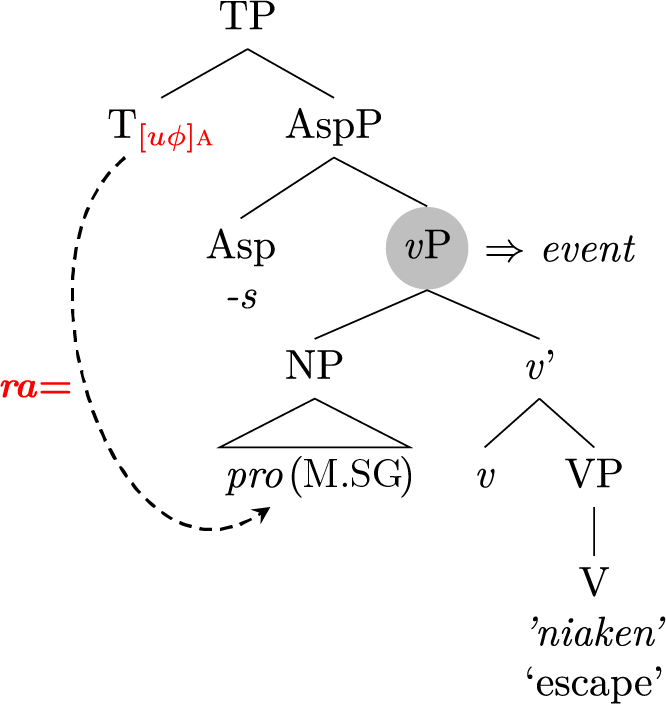
In Section 3.1 I proposed the structure in 47 for an intransitives with an A-prefix like the one in 45. The head responsible for the two-way perfective: imperfective grammatical aspect contrast, Asp0, merges with the eventive vP, followed by the T0 head, which bears a [uφ]a-probe. In the stative form in 46, by contrast, stative v
BE0 merges directly with the vP. The [uφ]p-probe on the stative head enters into Agree with the sole argument, triggering a patient prefix, illustrated in 48. Given the possibility of optional tense morphology on stative forms, there is reason to believe that a T0 head is still present in these forms—however, given that the lower arguments have already been agreed with, the [uφ]a-probe here will fail.
(47)
Imperfective intransitive → A-prefix = 45
(48)
Stative intransitive → P-prefix = 46

Note that the vP portion of these two forms (highlighted in gray) is identical—in both examples, this portion of the structure will denote an event of a masculine singular subject escaping. What differs is what merges next. In perfective and imperfective forms, like the imperfective in 45/47, the aspectual head merges and contributes the appropriate aspectual interpretation. In the stative, however, the stativizing head merges and results in a perfect interpretation: that is, a state in which an event of a masculine singular subject escaping has occurred. This aligns with approaches to the perfect in which the perfect is a stativizer and derives a result state, as in Kamp & Reyle Reference Kamp and Reyle1993 and Nishiyama & Koenig Reference Nishiyama and Koenig2010; see Gatchalian Reference Gatchalian2025 and Gatchalian et al. Reference Gatchalian, Coon and Paparounas2026 for detailed semantic derivations for the Kanien’kéha perfect.
We are now in a position to understand the ambiguous stative form from 38 above, repeated in 49. Recall that in transitive forms with only a single animate argument, the P-prefix consistently references the animate argument in the stative aspect, regardless of whether that is the agent, as in reading (i), or the patient, as in (ii).
(49)
wakarahsénthon
wak-arahsentho-on
1sg.P-kick-stat
(i) ‘I have kicked it(n)’ or
(ii) ‘it(n/z) has kicked me’
(Martin Reference Martin2023a, McDonald Reference McDonald2023)
The derivations for readings (i) and (ii) are shown in 50 and 51, respectively. In 50, the internal argument is inanimate; as in the derivation in 23 above, this means that the [uφ]p-probe on v 0 finds no goal and stops its search. Crucially, in the stative, rather than being selected by Asp0 and then the [uφ]a-probe-bearing T0, the vP is selected by stative v
BE0, which also bears a [uφ]p-probe. The [uφ]p-probe enters into Agree with the animate agent, resulting in the P-prefix shown in 50.
(50)
Stative anim
>
inan → P-prefix = 49(i)

For the second reading in 49, the internal argument is animate. Here the derivation proceeds as in 24 above: the [uφ]p-probe on transitive v 0 enters into Agree with the animate internal argument; there are no features on the inanimate external argument, so the [uφ]p-probe stops. The stative head merges, just as in 50, but finds no goal: the external argument has no φ-features, and the internal argument has already been cliticized.
(51)
Stative inan
>
anim → P-prefix = 49(ii)

The ambiguity in 49 then falls out naturally from the ingredients above. Transitives with animate patients and inanimate agents are expected to expone features of the patient using the P-prefix due to Agree with the [uφ]p-probe on v 0. However, transitive forms in the stative aspect always have two [uφ]p-probes: one on the lower transitive v 0, and one on the stative head itself. The derivation in which only the agent is animate is correctly predicted to show a patient prefix because (i) the lower argument is inanimate, meaning the [uφ]p-probe on the lower transitive v 0 fails, and (ii) the stative head bears a [uφ]p-probe that agrees with the animate argument before the higher [uφ]a-probe on T0 has a chance to probe. The result is then that the higher [uφ]p-probe generates a P-prefix based on Agree with the agent.Footnote 16
This proposal correctly derives the fact that it is only the agent prefixes that must shift in the stative aspect. This is because these are the only prefixes under this account that involve a probe on the higher T0 head, and this head is made irrelevant in the stative, since the [uφ]p-probe on the lower stative head will always be the one to agree first. Verbs with two animate arguments maintain transitive prefixes across all three aspects, as in 43 above. This fact is again predicted by the proposal here: all of the probes needed to create the transitive prefixes are within vP, and the full vP is projected in a transitive stative. The derivation thus proceeds as in 32 above up through vP. The stative head selects the vP, but its probe finds no goals since both animate arguments have already been agreed with.
That the shift to P-prefixes in the stative for transitive verbs is specific to transitives with inanimate objects can be seen by contrasting the pair in 40 above (with neuter objects, repeated in 52) with the forms in 53 (with feminine/zoic singular objects). The key fact, foreshadowed by the pair in 36–37 above, is that despite the surface identity between first-person agentive prefixes in 52a and transitive prefixes with first-person agents and feminine/zoic patients in 53 (see also 9 above), the stative shift shows us that these have different underlying representations. Forms with inanimate objects behave like intransitives in shifting to P-prefixes (52b), while forms with feminine/zoic objects behave like transitives in maintaining their form (53b); see 43 above.
-
(52)
-
a. karahsénthos
k-arahsentho-s
1sg.A-kick-hab
‘I kick it(n)’
-
b. wakarahsénthon
wak-arahsentho-on
1sg.P-kick-stat
‘I have kicked it(n)’
-
-
(53)
-
a. karahsénthos
k-arahsentho-s
1sg $ > $
z.sg-kick-hab‘I kick it(z)’
-
b. karahsénthon
k-arahsentho-on
1sg>z.sg-kick-stat
‘I have kicked it(z)’
-

This pattern is formally captured by the proposal that the φ-features of the feminine/zoic object in 53 have been registered by the [uφ]p-probe; this successful agreement in turn triggers the [uφ]p-probe (or a cyclic reprojection of it; see Section 3.3) to copy back features from the agent, as in the derivation in 32 above. These two agreement relations result in a transitive pronominal prefix—in this case, one that happens to be identical to the first-person singular A-prefix. In 52a, however, the inanimate internal argument is not registered by the agreement system at all; this form is derived as in 23 above via agreement with the agent by the [uφ]a-probe, which is rendered unavailable in the stative aspect form in 52b. Though different in terms of how it is formalized, this characterization aligns with the analysis of Koenig and Michelson (Reference Koenig and Michelson2015), who consider forms with only a single animate argument to be fundamentally intransitive. Postal (Reference Postal1962) also cites the distinction between 52b and 53b as evidence that the feminine/zoic gender must be formally distinguished from neuter, despite frequent syncretism.
Although the formal system—like the patterns themselves—is complex, note that all of the pieces needed to capture the distribution of pronominal prefix realization across the three main aspects find precedent in other work. These are summarized in 54.
-
(54) Ingredients of the stative shift analysis
-
a. Inanimate nominals lack φ-features (Lochbihler et al. Reference Lochbihler, Oxford and Welch2021, Oxford Reference Oxford2019);
-
b. Two φ-probes result in the three sets of prefixes; these can be related to crosslinguistically common probes responsible for subject agreement ([uφ]a-probe on T0) and object agreement ([uφ]p-probe on v 0); the lower probe may enter into Agree with the external argument in its specifier (Béjar & Rezac Reference Béjar and Rezac2009, Deal Reference Deal2025);
-
c. Nominals that have undergone cliticization are invisible to future Agree operations (Anagnostopoulou Reference Anagnostopoulou2003, Béjar & Rezac Reference Béjar, Rezac, Pérez-Leroux and Roberge2003);
-
d. The stative aspect does not occupy Asp0, but is a stative light verb with its own [uφ]p-probe (Baker & Travis Reference Baker and Travis1998, Ormston Reference Ormston1993).
-
The proposal for stative shift further aligns with work on other aspectually driven alignment splits in which a split in agreement marking is argued to be governed by the predicative nature of a stative or imperfective aspect marker (see e.g. Laka Reference Laka, Johns, Massam and Ndayiragije2006 on Basque and Coon Reference Coon2013 on the Mayan language Ch’ol). In line with the claims in Koenig & Michelson Reference Koenig and Michelson2015, I argue that this shift pattern provides support for the invisibility of specifically inanimate nominals to the morphology—but that this can be captured through a hierarchical organization of syntactic arguments, together with the absence of φ-features on inanimates.
5. Animacy restrictions
In this section, I turn to the second agreement puzzle that I claim motivates the absence of φ-features on inanimates. I argue that it is not only compatible with the approach to argument structure and the probe-goal system laid out above, but in fact necessitates appeal to a hierarchical organization of arguments. Specifically, this section focuses on the fourth and final of the generalizations listed in Koenig & Michelson Reference Koenig and Michelson2015:13, given in 55.
(55) K&M’s generalization 4: ‘There are no basic or derived stems with three animate semantic arguments.’
Like the stative pattern in the previous section, Koenig and Michelson (Reference Koenig and Michelson2015) propose that this pattern is morphological in nature, requiring no reference to syntactic structure. Their characterization of the restriction is as follows: Northern Iroquoian languages can index maximally two animate arguments on the verb, through the transitive series of pronominal prefixes. As we will see below, ditransitive verbs exist, but the third argument is restricted to being inanimate. They write that ‘it is as if inflectional morphology requires arguments to be marked, but is limited (only two arguments can be marked via pronominal prefixes), and, as a result, there are restrictions on the kind of stems (base or derived) that can “surface” as verb forms’ (Koenig & Michelson Reference Koenig and Michelson2015:11).Footnote 17
I begin in Section 5.1 with a look at animacy restrictions in ditransitives, which provide initial evidence that it is specifically the theme (lower object) of a benefactive that must be inanimate. We turn in Section 5.2 to benefactives of intransitives, which allow us to refine the generalization and connect it to the structural position of the arguments in question; these first two subsections draw on the empirical observations in Baker Reference Baker1996 and relate them to the proposals about pronominal prefixes in the sections above. In Section 5.3, I briefly situate the Northern Iroquoian pattern within the more general literature on person/animacy restrictions and discuss how the proposed absence of φ-features on inanimates can capture the patterns.
5.1. Ditransitives
As discussed by Woodbury (Reference Woodbury1975:26) for Onondaga, Baker (Reference Baker1996) for Kanien’kéha, and Koenig and Michelson (Reference Michelson, Hellinger and Motschenbacher2015) for Oneida, ditransitives are restricted in Northern Iroquoian languages. Koenig and Michelson (Reference Koenig and Michelson2015:9) note that this both holds of underived ditransitives such as the Oneida root u ‘give’ and also holds systematically of all derived triadic stems. They illustrate with the Oneida forms in 56–57. In both Oneida and Kanien’kéha, animate themes may not incorporate into eventive verbs (with a few apparent exceptions, discussed below). The contrast between the stems in 56 illustrates that ahseht’ ‘find’ requires incorporation of the root yaʔt ‘body’ whenever the theme is animate. In 57a, the same root appears with a benefactive applicative suffix, which introduces a beneficiary. However, this derived stem now cannot appear with an animate theme, as shown by the impossibility of 57b with incorporated yaʔt.
-
(56) Oneida transitive stems
-
a. -ahseht’-
-hide-
‘hide something’
-
b. -yaʔt-ahseht-
-body-hide-
‘hide someone’
-
-
(57) Oneida ditransitive stems
-
a. -ahseht-ʌ(ni)-
-hide-ben-
‘hide something from someone’
-
b. *-yaʔt-ahseht-ʌ(ni)-
-body-hide-ben-
intended: ‘hide someone from someone’
-
Baker (Reference Baker1996) describes a similar restriction in Kanien’kéha. In 58a, the cognate ditransitive on ‘give’ is necessarily understood as having an inanimate theme. The verb appears with a transitive pronominal prefix indexing the agent and recipient arguments. As noted by Mithun (Reference Mithun, Aikhenvald and Dixon2017) and Section 3.3 above, this makes Kanien’kéha a secundative or primary object language in the sense of Dryer Reference Dryer1986: in terms of the agreement system, the applied object of a ditransitive (here the masculine singular recipient) is treated on par with the single object of a monotransitive. In 58b, the only possible interpretation of the stem is one in which the theme is inanimate and the dog is not understood as a verbal argument.
(58)
a.
wahí:ion’
wa-rii-on-’
fact-1sg>m.sg-give-punc
‘I gave it to him’
b.
#è:rhar
enkón:nonte’
erhar
en-kon-nont-e’
dog
fut-1sg>2sg-feed-punc
intended: ‘I will feed you to the dog’
possible as: ‘dog, I will feed you something’
(Baker Reference Baker1996:193)
In addition to the verbs ‘give’ and ‘feed’ in 58, Kanien’kéha ditransitives may also be derived through the addition of a benefactive suffix (Martin Reference Martin2023b, Mithun Reference Mithun, Tsunoda and Kageyama2006b), often realized as -hs or -’s, as shown by the pair in 59. The benefactive adds a recipient, beneficiary, or maleficiary to the event (Martin Reference Martin2023b, McDonald Reference McDonald2026, Mithun Reference Mithun, Tsunoda and Kageyama2006b), which is then treated as the primary object; the transitive pronominal prefix khei- in 59b, for example, indicates a first-person agent and feminine beneficiary.
(59)
a.
Wa’katena’tarón:ten’.
wa’-k-ate-na’tar-ont-en’
fact-1sg.A-srfl-bread-bake-punc
‘I baked bread.’
b.
Wa’kheiatena’tarónthahse’
ne
Wá:ri.
wa’-khei-ate-na’tar-onth-a-hs-e’
ne
Wari
fact-1sg>f-srfl-bread-bake-jr-ben-punc
ne
Mary
‘I baked bread for Mary.’
(McDonald Reference McDonald2025)
As in Oneida, the restriction against animate themes holds of derived ditransitives in Kanien’kéha as well, discussed in detail in Baker Reference Baker1996. A minimal pair is shown in 60. Here, the monotransitive stem tshenri ‘find’ appears with the benefactive suffix -’s. As above, the pronominal prefix indexes the agent and recipient. The theme is not morphologically referenced on the verb and is restricted to being inanimate.
(60)
{Kà:sere’ /
*káhskare’}
enhitshénria’se’.
{ka’sere’ /
*kahskare’}
en-ri-tshenri-a-’s-e’
car
friend
fut-1sg>m.sg-find-jr-ben-punc
‘I will find him {a car/*a girlfriend}.’
(Baker Reference Baker1996:194)
Koenig and Michelson (Reference Koenig and Michelson2015:10) note that some apparent exceptions to the animacy restriction are found in Oneida texts, but all involve nouns that they argue have ‘low animacy’ or have a meaning suggestive of ‘depersonification of their referents’. These are nouns that pattern unlike typical animates in other ways, for example, in their ability to undergo incorporation. The Oneida equivalent of káskare’ in 60 is one such noun (depersonifiable into ‘mate’), and indeed, Kanien’kéha speakers consulted did not find the example in Baker’s original 60 outright unacceptable. However, proper names and unambiguously animate nouns were deemed ungrammatical in ditransitive theme position, as shown in 61. The presence of the incorporated ia’t ‘body’ (cognate with Oneida yaʔt above) is indicative of an animate theme.
(61)
a.
*Wá:ri
enhiia’tatshénria’se’.
Wari
en-ri-ia’t-a-tshenri-a-’s-e’
Mary
fut-1sg>m.sg-body-jr-find-jr-ben-punc
intended: ‘I will find Mary for him.’
b.
*Enkheia’tatshénria’se’
ne
raksà:’a.
en-khe-ia’t-a-tshenri-a-’s-e’
ne
raksa’a
fut-1sg>f-body-jr-find-jr-ben-punc
ne
boy
intended: ‘I will find the boy for her.’
(Martin Reference Martin2023a, McDonald Reference McDonald2023)
In a similar vein, the example in 62a shows that the verb atenhninon ‘sell’ can combine with a second-person theme.Footnote 18 In 62b we see that the benefactive applicative can be added to a stem with an inanimate theme; as expected, the transitive prefix here indexes the agent and recipient arguments. However, combining features of 62a and 62b—that is, a second-person theme with a beneficiary—is ungrammatical. The ungrammatical form in 62c shows that such a form is impossible using the pronominal prefix to index features of the agent and recipient and expressing the theme as a free-standing pronoun; other monoclausal attempts at expressing this meaning were deemed equally bad.
(62)
a.
Wa’koniatenhní:non’.
wa’-koni-atenhninon-’
fact-1sg>2sg-sell-punc
‘I sold you out.’
b.
Wa’koniatenhní:non’se’.
wa’-koni-atenhninon-’s-e’
fact-1sg>2sg-sell-ben-punc
‘I sold it to you.’
c.
*Í:se’
wahiiatenhní:non’se’.
ise’
wa-rii-atenhninon-’s-e’
pron.2sg
fact-1sg>m.sg-sell-ben-punc
intended: ‘I sold you (out) to him.’
(Martin Reference Martin2023a, McDonald Reference McDonald2023)
I propose the structure in 63 for derived ditransitives like those in 62b: the beneficiary is introduced in the specifier of an applicative head (Appl0), above the theme and below the agent; the head is realized by the benefactive suffix, and its position between the stem and the aspect suffix thus aligns with the mirror principle. In the typology of Pylkkänen (Reference Pylkkänen2002, Reference Pylkkänen2008), these are high applicatives, which relate an argument to an eventuality (here VP; see Renard Reference Renard2025). The agent and beneficiary (in shaded boxes) may be animate and are referenced by the transitive pronominal prefix created by the probe on v 0 (Section 3.3); the lower theme (in a plain box) must be inanimate.
(63)

Several pieces of evidence support the proposal that Kanien’kéha benefactives are high applicatives, relating a beneficiary to an eventuality, as opposed to low applicatives, which relate an argument to another argument (Pylkkänen Reference Pylkkänen2002, Reference Pylkkänen2008). First, the Kanien’kéha benefactive may apply to both unergative and stative verbs, as we will see in Section 5.2, in line with Pylkkänen’s (Reference Pylkkänen2008:18) diagnostics for high applicative structure. Second, no transfer-of-possession relation is required; the form in 59b, for example, is felicitous both in a context in which I baked bread to give to Mary and in a context in which Mary was supposed to bake bread for a party, but broke her arm, so I stepped in to bake it for her. This flexibility is compatible with high applicative structure, which relates the applied argument to the event, but unexpected with low applicative structure, which is argued to require a transfer-of-possession relation. Finally, Renard (Reference Renard2025) argues that Kanien’kéha does have a low phonologically null ‘source’ applicative, restricted to transfer-of-possession verbs, which contrasts with the high benefactive applicative.Footnote 19
The basic structure in 63 aligns with proposals for ditransitives crosslinguistically in which (i) the head responsible for object agreement, v 0, c-commands both the recipient (i.e. beneficiary or applied object) and the theme in a ditransitive, and (ii) that the recipient c-commands the theme (Anagnostopoulou Reference Anagnostopoulou2003, Bruening Reference Bruening2010, Harley Reference Harley2002, Pylkkänen Reference Pylkkänen2008; see discussion in Bárány Reference Bárány2024). One piece of Kanien’kéha-internal evidence for this configuration comes from the secundative nature of the prefix system: as we have already seen (e.g. the pair in 30 above), monotransitive themes are treated on par with ditransitive beneficiaries by the pronominal prefix system. This pattern receives a natural explanation in a structure in which the [uφ]p-probe is consistently present on v 0 and enters into Agree with the closest feature-bearing element it encounters: the applied beneficiary or a monotransitive theme.
Additional evidence that the beneficiary is the more structurally prominent internal argument comes from reflexives, discussed in Baker Reference Baker1996. The reflexive prefix atat- may appear with both mono- and ditransitives and establishes coreference between the external argument and the primary object, as shown by the reflexives of mono- and ditransitives in 64a and 64b, respectively (Baker Reference Baker1996, Mithun Reference Mithun, Tsunoda and Kageyama2006b). See also Michelson Reference Michelson, Janic, Puddu and Haspelmath2023a for similar facts in Oneida.
(64)
a.
katatarahsénthos
k-atat-arahsentho-s
1sg.A-refl-kick-hab
‘I kick myself.’
(Martin Reference Martin2023b)
b.
enkatatahióhare’se’
en-k-atat-ahi-ohare-’s-e’
fut-1sg.A-refl-fruit-wash-ben-punc
‘I will wash the fruit for myself.’
(Baker Reference Baker1996:202)
I do not offer an account of reflexives here (see discussion in Baker Reference Baker1996:Ch. 5), but note that the fact that reflexivization targets the beneficiary in a ditransitive aligns with the proposal that the beneficiary is more structurally prominent than the theme.
While the ditransitive examples examined so far are all in line with Koenig and Michelson’s generalization in 55 that verbs appear with a maximum of two animate arguments, as Baker (Reference Baker1996) discusses, the restriction on animate arguments is not simply about the number of animate arguments, but rather about the syntactic configuration in 63: themes cannot be animate in the presence of a recipient or applied object. If the problem were simply about the total number of arguments, we might expect ditransitives with animate themes to be possible if the recipient or agent were inanimate.
The first option is not testable, because the argument added by a benefactive must be animate, regardless of the animacy of the theme (see discussion in Baker Reference Baker1996:194). Inanimate beneficiaries were judged bad by speakers I consulted across a number of different forms and contexts. A pair is shown in 65.
(65)
a.
Wa’koniahsirahní:non’se’.
wa’-koni-ahsir-a-hninon-’s-e’
fact-1sg>2sg-blanket-jr-buy-ben-punc
‘I bought a blanket for you.’
b.
*Wa’kahsirahní:non’se’
wanitskwahráhtsheres.
wa’-k-ahsir-a-hninon-’s-e’
w-anitskwahra-htsher-es
fact-1sg.A-blanket-jr-buy-ben-punc
n.A-chair-nmlz-be.long[stat]
intended: ‘I bought a blanket for the couch.’
(Martin Reference Martin2025, McDonald Reference McDonald2025)
The second option is testable and confirms that the generalization requires reference not just to the number of animate arguments, but to their structural configuration. Specifically, inanimate subjects of ditransitives are possible, but such constructions still do not permit animate themes in benefactives, as shown in 66. In 66a, we see that an inanimate subject—in this context, a newly invented child-washing machine—is grammatical with an animate object. As expected, we find a patient prefix reflecting features of the animate object. Adding a benefactive with an animate theme, as in 66b, is ungrammatical regardless of the choice of prefix; here speakers commented that ia’tohare’se’ ‘body-wash-ben-punc’ is simply not a possible verb (in line with the discussion of the Oneida form in 57b). The form in 66c shows that there is no inherent incompatibility with a benefactive form of ohare ‘wash’, so long as the theme is inanimate.Footnote 20
(66)
a.
Masín
wa’akoia’tóhare’
kheièn:’a.
masin
wa’-ako-ia’t-ohare-’
khe-ien’a
machine
fact-f.P-body-wash-punc
1sg>f-child
‘The machine washed my daughter.’
b.
*Masín
wa’onkia’tóhare’se’
kheièn:’a.
masin
wa’-onk-ia’t-ohare-’s-e’
khe-ien’a
machine
fact-f>1sg-body-wash-ben-punc
1sg>f-child
intended: ‘The machine washed my daughter for me.’
c.
Masín
onke’serehtóhare’se’.
masin
wa’-wake-’sere-ht-ohare-’s-e’
machine
fact-1sg.P-car-nmlz-wash-ben-punc
‘The machine washed the car for me.’
(Martin Reference Martin2025, McDonald Reference McDonald2025)
Reflexives of benefactives, Baker (Reference Baker1996) argues, provide further evidence that the restriction against animate themes in ditransitives is not about the number of agreement slots, but about the syntactic configuration. Reflexives, like those in 64 above, consistently show A-prefixes reflecting the features of the external argument and the coindexed primary object. In principle, then, we might expect the freed-up agreement slot (i.e. the second set of features contributing to a transitive prefix) to be able to index features of an animate theme. As the ungrammatical example in 67 shows, this form is impossible both with an animate feminine theme and with a reflexive theme (since the reflexivization must target the primary object, as in 64).
(67)
*wa’kheiatatia’tóhare’se’
wa’-khei-atat-ia’t-ohare-’s-e’
fact-1sg>f-refl-body-wash-ben-punc
intended: ‘I washed her for myself.’
also bad as: ‘I washed myself for her.’
(Baker Reference Baker1996:202)
In this section we have seen that ditransitive themes are restricted from being animate in Kanien’kéha. I propose below that it is precisely because inanimates lack φ-features that they alone are able to appear in this position. First, we turn to differences between benefactives of intransitives. The same benefactive suffixes that appear on transitives to derive ditransitives may also appear on intransitives, where they also introduce a beneficiary argument (Martin Reference Martin2023b). Differences in behavior between two classes of intransitives will allow us to further pin the animacy restriction to the syntactic structure.
5.2. Benefactives of intransitives
Examples of benefactives of intransitives from Martin Reference Martin2023b are shown in 68. While benefactives use a consistent set of allomorphs—here the -hse form seen above, as well as an allomorph -(n)i—they can be distinguished by patterns in pronominal prefix choice.
(68)
Benefactives of intransitives from Martin Reference Martin2023b
a.
ioiánere’
‘it is good’
watianeráhse’
‘I find it good’
b.
iohní:ron
‘it is hard’
wakhniròn:se’
‘I find it hard’
c.
iókste’
‘it is heavy’
wakekstè:se’
‘I find it heavy’
d.
wáhtons
‘it disappears’
wakahtón:ni
‘it’s disappeared on me’
e.
tewátia’ks
‘it breaks’
tewakatià:ki
‘it’s broken on me’
f.
tkanónhtons
‘I’m in control’
tkonianonhtòn:se’
‘I’m controlling you’
g.
watió’tens
‘I work’
konio’ténhse’
‘I work for you’
h.
katá:tis
‘I speak’
koniatatià:se’
‘I speak for you’
i.
khtháhrha’
‘I talk’
konhthará:ni
‘I’m talking to you’
j.
kká:ratons
‘I tell a story’
konkaratón:ni
‘I tell you a story’
The first five forms (68a–e) appear with inanimate subjects in their underived forms in Martin Reference Martin2023b, and in their benefactive form, we find the first-person singular patient prefix wak(e)-, indexing the beneficiary (translated colloquially into English as ‘for me’, ‘on me’, or ‘I find it … ’). The second group of forms (68f–j), by contrast, appear in their intransitive forms with first-person singular agents; in the benefactive forms we now find the transitive prefix kon(i)-, indexing the first-person agent and an added second-person beneficiary. The choice of benefactive allomorph cross-cuts these patterns.
I propose that the difference between benefactive forms presented with P-prefixes and those with transitive prefixes in 68 is not accidental, but relates to a difference in argument structure: the forms in 68a–e are unaccusatives, while those in 68f–j are unergatives. As we will see below, we find a similar animacy restriction to that seen above for applicatives of unaccusatives, which restrict their theme arguments to being inanimate; the first set of forms are restricted to appearing with P-prefixes. No such animacy restriction is present for applicatives of unergatives, like those in the bottom half of 68, which may therefore appear with transitive prefixes. An updated generalization—which unifies the restriction on ditransitive and applicative-of-unaccusative themes—is given in 69.
(69) Revised animacy restriction: If there are two internal arguments, the lower of the two (i.e. the theme) must be inanimate.
One diagnostic that distinguishes unergatives from unaccusatives is the ability of unaccusative predicates to incorporate their subjects (Baker Reference Baker1996:§5.4). The examples in 70 show that the unaccusative predicate kste ‘be heavy’ from 68c can incorporate an inanimate subject.
(70)
a.
Iókste’
ne
o’neróhkwa’.
io-kste’
ne
o’nerohkwa’
n.P-heavy[stat]
ne
box
‘The box is heavy.’
b.
Io’nerohkwákste’.
io-’nerohkw-a-kste’
n.P-box-jr-heavy[stat]
‘The box is heavy.’
Animate themes like those in 71 may not incorporate, but here trigger the presence of the incorporated nominal ia’t ‘body’.
(71)
a.
Roia’tákste’
ne
raksà:’a.
ro-ia’t-a-kste’
ne
raksa’a
m.sg.P-body-jr-heavy[stat]
ne
boy
‘The boy is heavy.’
b.
Saia’tákste’.
sa-ia’t-a-kste’
2sg.P-body-jr-heavy[stat]
‘You are heavy.’
(Martin Reference Martin2023a, McDonald Reference McDonald2023)
The benefactive applicative suffix can be added to unaccusative stems to introduce a beneficiary. While simple unaccusatives may appear with A- or P-prefixes (Section 2.2), benefactives of unaccusatives always appear with P-prefixes (discussed in Baker Reference Baker1996:§5.3). The simple unaccusative in 72a with an incorporated theme appears with an expletive A-prefix; the same verb with a benefactive applicative appears with a P-prefix indexing the applied argument in 72b.Footnote 21
(72)
a.
Takawí:sen’ne’.
ta-ka-wis-en’-ne’
cis.fact-n.A-glass-fall-punc
‘The glass fell.’
(Baker Reference Baker1996:213)
b.
Sá:k
wahowí:sen’se’.
Sak
wa’-ro-wis-en’-s-e’
Jim
fact-m.sg.P-glass-fall-ben-punc
‘The glass fell on (i.e. to the detriment of) Jim.’; ‘Jim dropped the glass.’
(Martin Reference Martin2023a)
The inanimate theme in a benefactive-of-unaccusative can appear incorporated or not, as seen in the pair in 73a–b. The patient prefix consistently indexes the beneficiary or maleficiary.
(73)
a.
Onkékste’se’
ne
o’neróhkwa’.
wa’-wak-kste-’s-e’
ne
o’nerohkwa’
fact-1sg.P-heavy-ben-punc
ne
box
‘The box was heavy to me.’ (i.e. ‘I found the box heavy.’)
b.
Onke’nerohkwákste’se’.
wa’-wak-’nerohkw-a-kste-’s-e’
fact-1sg.P-box-jr-heavy-ben-punc
‘The box was heavy to me.’
(Martin Reference Martin2023a, McDonald Reference McDonald2023)
However, the theme of these benefactives may not be animate, as shown by the ungrammatical forms in 74. As with the ditransitives above, these forms are bad on the intended meaning regardless of the choice of pronominal prefix; the intended meaning must simply be expressed in a different way (e.g. using a biclausal construction). Comparison with the forms in 71 above shows that there is no problem with this predicate combining with an animate theme—rather, ungrammaticality arises only with an animate theme in the presence of a benefactive.
(74)
a.
*Wahakia’tákste’se’
ne
raksà:’a.
wa’-rak-ia’t-a-kste-’s-e
ne
raksa’a
fact-m.sg>1sg-body-jr-heavy-ben-punc
ne
boy
intended: ‘The boy was heavy to me.’
b.
*Wahstia’tákste’se’.
wa’-hst-ia’t-a-kste-’s-e’
fact-2sg>1sg-body-jr-heavy-ben-punc
intended: ‘You were heavy to me.’
(Martin Reference Martin2023a, McDonald Reference McDonald2023)
This pattern is consistent across a number of benefactives of unaccusatives. The form in 75a shows that ahton ‘disappear’ can be predicated of a human. A benefactive form is possible with an inanimate theme, as in 75b; as expected, a P-prefix indexes the beneficiary. The transitive prefix indexing two animate entities with the benefactive in 75c, however, is impossible (regardless of the choice of prefix).
(75)
a.
Wa’káhton’.
wa’-k-ahton-’
fact-1sg.A-disappear-punc
‘I disappeared.’
b.
Wakahtón:ni.
wak-ahton-ni
1sg.P-disappear-ben[stat]
‘It has disappeared on me.’
(Martin Reference Martin2023b)
c.
*Koniahtón:ni.
koni-ahton-ni
1sg>2sg-disappear-ben[stat]
intended: ‘You disappeared on me.’/‘I disappeared on you.’
(Martin Reference Martin2023a, McDonald Reference McDonald2023)
A similar trio with another predicate is illustrated in 76. See Baker Reference Baker1996:197 for additional examples.Footnote 22
(76)
a.
Kentó:re.
k-entore
1sg.A-difficult[stat]
‘I am difficult.’ (i.e. ‘I’m a difficult person’)
b.
Wakentorà:se’.
wak-entor-a-’s-e’
1sg.P-difficult-jr-ben[stat]
‘I find it difficult.’
(Martin Reference Martin2023b:9)
c.
*Konientorà:se’.
koni-entor-a-’se’
1sg>2sg-difficult-jr-ben[stat]
intended: ‘I find you difficult.’/‘You find me difficult.’
(Martin Reference Martin2023a, McDonald Reference McDonald2023)
I propose that benefactives of unaccusatives have a structure like the one in 77. The relative position of the arguments is identical to the ditransitive in 63 above, but without the external argument in Spec,vP. The v 0 head that merges with ApplP always bears a [uφ]p-probe (as with the v 0 in regular monotransitives), ensuring that these forms will always take a P-prefix; I take this to be a selectional fact, which one could imagine is functionally motivated by the fact that Appl0 always introduces an animate beneficiary in its specifier. The theme must be inanimate, consistent with the revised structure-based generalization in 69. We turn to an account of this restriction in the next section.
(77)

Benefactives of unergatives, in contrast, permit two animate arguments. This is shown by the forms in 68f–j, as well as the pairs in 78 and 79. The verb stems aterennot ‘sing’ and io’ten ‘work’ may not incorporate their subjects, consistent with unergative structure. When they appear with a benefactive suffix, they take a transitive prefix indexing the agent and the beneficiary.
(78)
a.
Katerennótha’.
k-aterennot-ha’
1sg.A-sing-hab
‘I sing.’
b.
Koniaterennotá:nis.
koni-aterennot-ani-s
1sg>2sg-sing-ben-hab
‘I sing to you.’
(DeCaire Reference DeCaire2023:207)
(79)
a.
Enwatió’ten’.
en-wak-io’ten-’
fut-1sg.P-work-punc
‘I will work.’
(DeCaire Reference DeCaire2016)
b.
Enhiió’tenhse’.
en-ri-io’ten-hs-e’
fut-1sg>m.sg-work-ben-punc
‘I will work for him.’
The structure here mirrors that for the ditransitive in 63, but now without the theme argument. This structure, together with the proposal about the probes generating pronominal prefixes from Section 3 above, correctly predicts that transitive prefixes will be available to index the agent and the applied object.
(80)

The revised animacy restriction in 69 above then correctly captures the full range of empirical patterns, seen in 63, 77, and 80: when two internal arguments are present, only the highest may be animate. Put differently, themes may not be animate in the presence of a higher applied object, which generalizes across the ditransitive and benefactive-of-unaccusative structures in 63 and 77, respectively.
5.3. Situating and accounting for the restriction
As already pointed out by Baker (Reference Baker1996), an account that derives the ungrammaticality of animate themes in ditransitive constructions from an insufficient number of morphological agreement ‘slots’ on the verb, without appeal to a hierarchical argument structure, fails to capture the contrast between applicatives of unaccusatives and applicatives of unergatives. The probe-goal system laid out in Section 3 provides a natural account of the facts: transitive prefixes index only the external argument and the highest internal argument; patient prefixes are consistently found with benefactives of unaccusatives, consistent with the proposal that P-prefixes are the result of a probe on v 0 (in this case, v 0 that selects ApplP).
Animacy and person restrictions like those seen in Kanien’kéha benefactives are familiar from literature on the Person Case Constraint (PCC). While ditransitives are a common domain in which PCC effects are found, a range of work on person restrictions like these has identified the environments in which these effects occur as environments in which two accessible nominals are found in the same domain as a single agreeing probe (Anagnostopoulou Reference Anagnostopoulou2003, Béjar & Rezac Reference Béjar, Rezac, Pérez-Leroux and Roberge2003, Coon & Keine Reference Coon and Keine2021, Nevins Reference Nevins2007, Oxford Reference Oxford2019, Preminger Reference Preminger2014, Reference Preminger2019, among others). This includes not only ditransitives (with a low probe on v 0), but also dative-subject configurations in Basque (Arregi & Nevins Reference Arregi and Nevins2012) and Icelandic (Sigurðsson Reference Sigurðsson1996); binomial copular clauses in German (Keine et al. Reference Keine, Wagner and Coon2019) and Hindi-Urdu (Bhatia & Bhatt Reference Bhatia and Bhatt2023); and certain transitives in Algonquian (Keine et al. Reference Keine, Oxford and Coon2022) and Zapotec (Foley & Toosarvandani Reference Foley and Toosarvandani2022), among others. This relates directly to the fact that Kanien’kéha effects are found not just in ditransitives, but also in benefactives of unaccusatives (and crucially not with benefactives of unergatives). While such restrictions often involve first- and second-person speech-act participants, restrictions related to animacy—like the one found in Kanien’kéha—are also reported for other unrelated languages. Zapotec languages, for example, exhibit complex animacy hierarchies, distinguishing animates from animals from humans (see fn. Footnote 10), and in certain configurations restrict the lower of two nominals from certain animacy specifications.Footnote 23 Situated against this backdrop, there is nothing surprising about the animacy restriction in Kanien’kéha.
Within a probe-goal model, two families of accounts have been used to capture PCC and related effects. Both, I propose, can be extended to Kanien’kéha under the proposal that inanimates lack φ-features. Under a feature-gluttony approach to PCC effects proposed in Coon & Keine Reference Coon and Keine2021 (see also Bhatia & Bhatt Reference Bhatia and Bhatt2023, Keine Reference Keine, Fischer, Georgi, Heck, Hein, Himmelreich, Murphy and Weisser2024, Keine & Mendia Reference Keine and Mendia2026, Keine et al. Reference Keine, Oxford and Coon2022), person restrictions are the result of an excess of Agree. Specifically, a probe that has entered into Agree with more than one goal is said to be ‘gluttonous’. A gluttonous probe does not in and of itself give rise to ungrammaticality, but rather can create irresolvable conflicts for the realization of agreement morphology or, in the case at hand, for the movement operation involved in cliticization. To apply this approach to Kanien’kéha, I assume that the [uφ]p-probe is a Multiple Agree probe, following Hiraiwa (Reference Hiraiwa2001, Reference Hiraiwa2005) and Keine (Reference Keine, Fischer, Georgi, Heck, Hein, Himmelreich, Murphy and Weisser2024): it must enter into Agree with every accessible (i.e. φ-feature-bearing) nominal in its search domain; Agree is an obligatory operation that must take place when the structural conditions are met (Preminger Reference Preminger2014). Following the approach laid out in more detail in Coon & Keine Reference Coon and Keine2021, I further assume that once a clitic-generating probe has entered into Agree with a nominal, this nominal must undergo cliticization. In the grammatical cases above, when a probe enters into Agree with a single argument, no problems arise. However, when there are two accessible goals in the probe’s search domain, as schematized in 81, two clitics must be created. Cliticizing only one or the other nominal would violate the cliticization requirement; cliticizing both would require simultaneous head movement of two D0 clitics to the host. As a result, a ‘gluttonous’ cliticization probe results in ungrammaticality.Footnote 24
(81)
Ungrammatical feature gluttony configuration

The only possible configurations in Kanien’kéha in which a single probe will have access to multiple accessible goals (i.e. animate goals that have not already undergone cliticization) would be those with two internal arguments. Given that the applied object is always required to be animate, this means that gluttony—and therefore ungrammaticality—will arise exactly in configurations in which the lower of two objects is also animate. Under the proposal that inanimates lack φ-features altogether, they will not create a gluttony problem for the [uφ]p-probe and are correctly expected to be the only possibility for the theme.
An alternative line of approach to PCC effects is a licensing-based approach, as in Anagnostopoulou Reference Anagnostopoulou2003, Béjar & Rezac Reference Béjar, Rezac, Pérez-Leroux and Roberge2003, Nevins Reference Nevins2007, and others. Under licensing approaches, ungrammaticality is the result not of too much agreement, but rather too little agreement: an intervening nominal blocks the required licensing relation with a lower nominal. In order to capture the Kanien’kéha pattern, one could modify the licensing condition to require that all animate (i.e. φ-bearing) nominals be licensed by Agree. Baker’s (Reference Baker1996) account of the animacy restrictions on Kanien’kéha themes is a specific version of a licensing account. Under a licensing-based approach, a question arises about why the higher [uφ]a-probe on T0 could not enter into Agree with—and thereby license—the lower theme in a structure like 77. While various stipulations could be introduced, a point in favor of the gluttony account is the fact that this issue does not arise. Gluttony will cause a problem immediately at the point the [uφ]p-probe triggers Agree; effects of higher probes will be irrelevant. Though I know of no other Kanien’kéha-internal means to distinguish between a gluttony- or licensing-based approach to the animacy restriction, see Coon & Keine Reference Coon and Keine2021 for empirical concerns with licensing approaches to hierarchy effects in other languages.Footnote 25
For our purposes here, the important takeaway message is simply that a full characterization of the animacy restriction in Sections 5.1–5.2 relies on a hierarchical representation of arguments, not simply the number of animate arguments. The restriction against φ-bearing animates appearing in the lower theme position aligns with crosslinguistic patterns and can be accounted for straightforwardly under either a feature-gluttony or nominal-licensing approach through the proposal that inanimates lack φ-features.
6. Conclusions and implications for polysynthesis
This article examined the complex system of pronominal prefixes in Kanien’kéha, drawing on the empirical generalizations laid out in Koenig & Michelson Reference Koenig and Michelson2015. In Sections 2 and 3 I introduced the basic patterns and outlined a model that relies on two clitic-generating φ-probes: (i) a [uφ]a-probe located on T0, responsible for A-prefixes, and (ii) a [uφ]p-probe located on v 0, responsible for P-prefixes and transitive prefixes. These probes, coupled with a standard hierarchical approach to argument structure and the proposal that inanimate nominals lack person, number, and gender features, captured the basic patterns.
Sections 4 and 5 examined two core agreement puzzles identified in Koenig & Michelson Reference Koenig and Michelson2015: the consistent absence of A-prefixes in the stative aspect, and the restriction against animate themes with benefactive applicatives. Both puzzles, I argued, fall out from the proposal that inanimate arguments in Kanien’kéha lack φ-features and are thus ignored by the clitic-generating probe system. I argued further that the latter facts not only are compatible with a standard approach to syntactic selection and argument structure, but also require reference to a hierarchical organization of arguments, contra conclusions in Koenig & Michelson Reference Koenig and Michelson2015. In this last section, I conclude with broader implications for nominal typology (Section 6.1) and for polysynthesis and macroparametric variation more generally (Section 6.2).
6.1. Implications for nominal typology
The proposed featural representation for Kanien’kéha’s four genders is repeated from 8 above in 82. The main claim advanced in this article is that inanimate nominals bear no φ-features at all; there is no morpheme corresponding to a ‘neuter gender’, as also proposed in Koenig & Michelson Reference Koenig and Michelson2015, and similarly no free-standing pronoun. The ‘neuter agent’ and ‘neuter patient’ pronominal prefixes seen above and in Figure A1 in the Appendix are expletive forms inserted to satisfy an EPP requirement. While Koenig and Michelson’s approach to the facts above involves radical alterations to the organization of grammar, the claim here is simply that inanimate nominals are merged in the syntax like other nominals, but are invisible to the probe system responsible for generating pronominal prefixes.
(82)
φ-features for third-person nominals
person
gender
number
pronoun
masculine
[anim [hum]]
[masc]
[#]
raónha
feminine/indefinite
[anim [hum]]
—
—
akaónha
feminine/zoic
[anim]
—
[#]
aónha
neuter
—
—
—
—
The proposal that certain categories of nominals lack certain φ-features is far from new. With respect to person features, models going back to Benveniste Reference Benveniste1966, Reference Benveniste and Meek1971 have recognized the need for a formal distinction between first- and second-person speech-act participants (SAPs), on the one hand, and third persons, on the other. Harley and Ritter (Reference Harley and Ritter2002) capture this distinction in their feature-geometric model by projecting a [participant] node (encompassing SAPs) directly from the top Referring Expression (RE) node in their geometry, a simplified version of which is shown in 83: ‘when the Participant node is absent, the underspecified Referring Expression node receives a so-called 3rd person interpretation’ (Harley & Ritter Reference Harley and Ritter2002:488) (‘so-called’ because third person is proposed to be the absence of person).
(83)
Simplified feature geometry (Harley & Ritter Reference Harley and Ritter2002)

Subsequent work has argued, however, that at least in certain languages, not all nonparticipant third persons are alike when it comes to their formal features. Alexiadou and Anagnostopoulou (Reference Alexiadou, Anagnostopoulou and Boeckx2006), Lochbihler (Reference Lochbihler2012), and others have proposed that only inanimate third persons lack person features in Algonquian; see also Adger & Harbour Reference Adger and Harbour2007, Béjar & Rezac Reference Béjar, Rezac, Pérez-Leroux and Roberge2003, Demonte et al. Reference Demonte, Fernández-Alcalde, Pérez-Jiménez and Herschensohn2011, Ormazabal & Romero Reference Ormazabal, Romero, Fernández and Garitano2001, and Toosarvandani Reference Toosarvandani2023, among others, on connections between animacy and person. Lochbihler et al. (Reference Lochbihler, Oxford and Welch2021) review evidence from Algonquian and Dene language families supporting (i) a connection between animacy and person features, and (ii) the claim that specifically inanimate nominals in these language families lack Person features. The distinction between animate and inanimate nominals is captured through the addition of an [animate] node, dominating [participant], which third-person animates bear, as in the Kanien’kéha geometry in 82; further distinctions like [human] may be added, depending on the animacy distinctions available in a language. Importantly, these geometries are constrained by entailment relations. SAPs in Kanien’kéha, for example, would be specified on the person side of the geometry as [RE[animate[human[participant]]]]; first- and second-person discourse participants are human, humans are animate, and animates are referring expressions.
Lochbihler et al. (Reference Lochbihler, Oxford and Welch2021) note that they do not claim that inanimate nominals in Algonquian and Dene—which trigger number distinctions in certain contexts—lack number features. However, other work has argued for a wholesale absence of an [individuation] node for certain categories of nominal. Harley and Ritter (Reference Harley and Ritter2002) discuss Kwakiutl (Boas Reference Boas and Boas1911), Maxakalí (Popovich Reference Popovich and Wiesemann1986), and Pirahã (Thomason & Everett Reference Thomason and Everett2002) as candidates for languages that lack [individuation]; in these languages, third-person pronouns would be represented simply as [RE] with no further featural specifications, on par with my proposal for inanimates in Kanien’kéha. Similarly, impersonal pronouns like Germanic man have been proposed to be featurally deficient, in line with my featural representation for the feminine/indefinite. As noted in Section 2.2 above, I do not make a specific proposal here about how the three-way number contrast is best represented in Kanien’kéha, but assume that both the masculine gender feature and the number contrast are reflected on an [individuation] node, which both neuter and feminine/indefinite nominals lack. As discussed in Harley & Ritter Reference Harley and Ritter2002, the interpretation of an underspecified form will depend on the other distinctions available in a particular language; for example, while the absence of person specifications (i.e. the left side of 83) could indicate a general third-person pronoun in a language with no animacy distinctions, it would index only inanimates in languages that make more fine-grained distinctions.
Note that while Kanien’kéha inanimates lack φ-features, they are nonetheless Referring Expressions—the root node on which other nominal features are dependent.Footnote 26 I assume that category-level structure (e.g. nP/DP, or at least RE in Harley and Ritter’s sense) distinguishes nominals from other categories, independent of φ-features, and that selectional relations between heads and their arguments hold at this level. Finally, I note that if it is correct that certain nominals lack φ-features altogether, this entails that φ-agreement must not be universally necessary for nominal licensing (i.e. abstract Case); see Preminger Reference Preminger, Sevdali, Mertyris and Anagnostopoulou2024 and Deal Reference Deal2025 for summaries of recent work supporting this view.
6.2. Implications for polysynthesis
This work is set within a larger context in which grammatical properties of Northern Iroquoian languages have been argued to require wide-reaching points of variation across the world’s languages: (i) an absence of a syntactic level of argument structure altogether (Koenig & Michelson Reference Koenig and Michelson2015), and (ii) a macroparameter relating to the realization of nominal arguments and agreement (Baker Reference Baker1996). I argue that appeal to these types of macroparametric variation is both unnecessary and incompatible with the full set of facts. With respect to the first claim, the account above required reference to a hierarchical organization of arguments; hierarchical structure is necessary, for example, for capturing the differences between benefactives of unergatives and benefactives of unaccusatives in Section 5.
In this last section, we turn to a brief discussion of implications for the second macroparameter, the ‘polysynthesis parameter’ proposed in Baker Reference Baker1996. The empirical generalizations laid out above, especially the stative shift pattern in Section 4, require inanimate nominals to be invisible to the agreement system responsible for generating pronominal prefixes. However, the absence of φ-features on inanimates is directly at odds with the morphological visibility condition (MVC) in 84, the formal requirement underlying Baker’s macroparameter.
(84) Morphological visibility condition (Baker Reference Baker1996:17): A phrase X is visible for θ-role assignment from a head Y only if it is coindexed with a morpheme in the word containing Y via:
-
a. an agreement relationship, or
-
b. a movement relationship.
-
According to Baker, polysynthetic languages are languages that are subject to the MVC: all arguments must either be agreed with by the verb (84a) or incorporate into the verb (84b). The agreement morphemes and incorporated nominals in the verbal head-marking system are then taken to absorb case features, and as a result, in order to avoid a Case Filter violation, all unincorporated nominals are necessarily high sentential adjuncts. As Baker notes, this claim draws on precedents such as Jelinek’s (Reference Jelinek1984) Pronominal Argument Hypothesis. For Jelinek, agreement morphemes are the arguments, forcing nominals to be adjoined (see also Bresnan & Mchombo Reference Bresnan and Mchombo1987); for Baker, agreement morphemes (i.e. the pronominal prefixes in Kanien’kéha) reference null pronouns in argument position. Under both approaches, we achieve a direct connection between core properties of polysynthetic and nonconfigurational languages: the languages are robustly head-marking (because the agreement markers either are the arguments or obligatorily reference them), and free-standing nominals are optional and flexibly ordered (because they are optional adjuncts).
The status of inanimate nominals then poses a particular problem for the MVC. The empirical patterns above motivated the proposal that inanimates lack φ-features altogether. As detailed in Section 4, it cannot be the case that inanimates simply enter into Agree but trigger null morphemes; as discussed in Koenig & Michelson Reference Koenig and Michelson2015, if this were the case, there would be no straightforward way to account for the difference in behavior between, for example, transitive verbs with feminine/zoic objects and transitive verbs with neuter objects (compare 40c and 53 in Section 4.2 above). Koenig and Michelson (Reference Koenig and Michelson2015) lay out a system in which inanimate nominals are semantic arguments, but not grammatical arguments. While I do not discuss the details of their account here, I propose that the empirical observations motivating this claim can be handled by the proposal that inanimates simply lack the φ-features present on animates, and that they do not require any special claims about argument structure. This means that inanimates cannot satisfy the MVC by agreement, as in 84a.
For inanimate internal arguments, Baker (Reference Baker1996) has an alternative to positing a null neuter agreement morpheme: he argues that the internal argument position is occupied by a neuter nominal, typically null, that incorporates into the verb, thereby satisfying the MVC via 84b. For Baker, this captures the animacy restriction on themes in 69 above: all arguments must be licensed by either agreement or incorporation. When there is an insufficient number of agreement positions available, only inanimate themes may surface, since only these arguments may be licensed by incorporation.
The possibility of incorporation does not exist, however, for inanimate arguments that are not in theme position, as in the examples in 85 (see also 15b and 66 above). Baker (Reference Baker1996) glosses the pronominal prefixes iako- and ro- as transitive prefixes referencing a neuter subject with feminine and masculine objects, respectively. Recall from Section 3.1, however, that prefixes found on transitive verbs with inanimate subjects and animate objects are identical to patient prefixes, which my glosses here reflect.
(85)
a.
Ónhka
iakoia’takéhnhas
ne
akaónha
akonónhkwa’?
onhka
iako-ia’t-akehnha-s
ne
akaonha
ako-nonhkwa’
who
f.P-body-help-hab
ne
her
f.sg.poss-medicine
‘Who does her medicine help?’
(Baker Reference Baker1996:79)
b.
Sá:k
raonekó:ta’
wa’thoia’tò:rarake’.
Sak
rao-nekota’
wa’-t-ro-ia’t-ohrarak-e’
Jim
m.sg.poss-ladder
fact-dup-m.sg.P-body-hit-punc
‘Jim’s ladder hit him.’
(Baker Reference Baker1996:111)
An important point made in Baker Reference Baker1988, Reference Baker1996 is that only internal arguments are able to incorporate. Inanimate transitive subjects like the ones in 85 thus cannot satisfy the MVC via incorporation. In order to maintain the MVC, then, neuter arguments must enter into Agree with functional heads, as in 84a—a position that is incompatible with the analysis of the complex agreement patterns argued for above.Footnote 27
A rejection of the MVC converges with other recent work that has brought more empirical evidence to bear on properties of Northern Iroquoian, for example, on the question of whether all unincorporated nominals are clausal adjuncts. DeCaire et al. (Reference DeCaire, Johns and Kučerová2017) show that incorporation of internal arguments in Kanien’kéha is not optional, as characterized in Baker Reference Baker1988, Reference Baker1996, but rather required whenever it is possible. It is impossible, they demonstrate, when the internal argument is focused. In response to the question in 86a, the object receives corrective focus and must appear unincorporated and preverbally, as in 86b. The incorporated version in 86c is infelicitous in this context.
(86)
a.
Wahahonwahní:non’
ken
ne
Shawátis?
wa’-ra-honw-a-hninon-’
ken
ne
Shawatis
fact-m.sg.A-boat-jr-buy-punc
q
ne
John
‘Did John buy a boat?’
b.
Iah.
Kà:sere
wahahní:non’.
iah
ka’sere
wa’-ra-hninon-’
no
car
fact-m.sg.A-buy-punc
‘No. He bought a car[FOC].’
c.
#Iah.
Waha’serehtahní:non’.
iah
wa’-ra-’sere-ht-a-hninon-’
no
fact-m.sg.A-car-nmlz-jr-buy-punc
‘No. He bought a car.’
(DeCaire et al. Reference DeCaire, Johns and Kučerová2017:4)
Boles (Reference Boles2024) outlines an account of noun incorporation in which incorporated nominals do not involve a dedicated movement operation (as in the MVC), but rather are bare nPs that lack higher functional projections and thus form part of the larger stem-building process; DP structure, required to host focus features, interrupts incorporation. On Boles’s account, person features involve higher functional structure, capturing the inability of animate nominals to undergo incorporation.Footnote 28 If this account is on the right track, then the wholesale absence of φ-features on inanimate nominals would have a direct relationship to the widespread use of incorporation in Northern Iroquoian. It is not the case that featureless inanimates directly cause incorporation; rather, featureless inanimates, combined with independent complex word-building processes in the language family, result in some of the famously complex properties of Northern Iroquoian verbs.
Flaim (Reference Flaim2025) further investigates information structure in Kanienéha and identifies topic and focus positions at the left edge of the clause, which she identifies with Spec,CP and Spec,TP, respectively. A context triggering both topics and foci is given in 87.
(87)
Question: What are you going to buy your son and daughter for Christmas?
a.
Riièn:’a
[TOP]
okóntshera’
[FOC]
enhihní:non’se’ …
riien’a
okontshera
en-ri-hninon-’s-e’
my.son
paint
fut-1sg>m.sg-buy-ben-punc
‘My son, I’ll buy him paint … ’
b.
kheièn:’a
[TOP]
ahthén:no
[FOC]
enkhehní:non’se’.
kheien’a
ahthenno
en-khe-hninon-’s-e’
my.daughter
ball
fut-1sg>f-buy-ben-punc
‘my daughter, I’ll buy her a ball.’
(Flaim Reference Flaim2025)
Dedicated preverbal topic and focus positions, combined with the possibility of clause-final ‘antitopics’ (see Chafe Reference Chafe and Li1976), allow for all six possible permutations of subject, verb, and object, discussed in Baker Reference Baker1996 and other works. Crucially, however, a requirement that all overt nominals be high freely ordered clausal adjuncts—as required by the MVC—does not easily capture these patterns; imposing information-structure-based ordering requirements on high adjuncts would simply replicate crosslinguistically common clausal properties in a new domain. While a full review of the impacts of the MVC in Kanien’kéha grammar is outside the scope of this work (and see Koenig & Michelson Reference Koenig and Michelson1998), it is worth noting that several correlates of polysynthesis proposed in Baker Reference Baker1996—for example, an absence of nominal anaphors and the absence of nonreferential quantified nominals—are consistent with the claim that all nominals are adjuncts, but do not necessitate this conclusion. See also Boles Reference Boles2025 for an updated look at the condition C effects discussed in Baker Reference Baker1996.
Where does all of this leave polysynthesis? I conclude that ‘polysynthesis’ should not be seen as the result of a single macroparameter; I take this to be in line with variation in what are described as characteristic properties of polysynthetic languages, as well as proposals to account for these (see Fortescue et al. Reference Fortescue, Mithun and Evans2017). Rather, the unique grammatical properties of Kanien’kéha can be viewed as the cumulative effect of smaller properties. Recent crosslinguistic work in the domain of argument structure and agreement has broadened its scope and worked to account for a typologically broader set of languages. As highlighted throughout the discussion above, all of the formal ingredients used to capture the complex Kanien’kéha patterns find precedent in the literature. A single big macroparametric difference—either via the wholesale absence of a level of syntactic argument structure, as in Koenig & Michelson Reference Koenig and Michelson2015, or via the morphological visibility condition, as in Baker Reference Baker1996—is not only unnecessary in order to capture the patterns discussed here, but also inconsistent with the full set of empirical facts.
Data availability statement
All new Kanien’kéha language material presented here has been archived with the Kanien’kehá:ka Onkwawén:na Raotitióhkwa Language and Cultural Center in Kahnawà:ke.
Acknowledgments
First and foremost, I would like to thank the Kanien’kéha language learners and speakers who are working to revitalize and promote this language. I am particularly indebted to Mary Onwá:ri Tekahawáhkwen McDonald, Akwiratékha’ Martin, Konwaronhiá:wi Helen Norton, and Katerí Deer for sharing their knowledge of the language with me (though they should not be held responsible for the details of what I say here). I am very grateful to Karin Michelson for her generosity and enthusiasm in discussing Iroquoian languages and linguistics. Thanks to the Language editorial team and three anonymous referees for extensive feedback and discussion. For helpful discussions, comments, and feedback on various aspects of this project, thanks also to Faruk Akkuş, Luis Alonso-Ovalle, Mark Baker, Arihwí:saks Benedict, Max Blackburn, Chase Boles, James Crippen, Tehokwiráthe Cross, Tsowén:te Cross, Amy Rose Deal, Terrance Gatchalian, Sophia Flaim, Heidi Harley, Robert Henderson, Matthew Hewett, Stefan Keine, JP Koenig, Simon LiVolsi, Karhó:wane McComber, Katya Morgunova, Willie Myers, Ro’nikonhkátste Norton, Will Oxford, Lefteris Paparounas, Martin Renard, and Karonhiióstha Shea Sky, as well as to audiences at UBC, Chicago, U. Arizona, U. Toronto, PLC, and the Roti’nikonhrowá:nens and McGill Syntax-Semantics groups; any mistakes or oversights are my own. [Full editorial history: Received 27 August 2023; revision invited 21 March 2024; revision received 26 March 2025; revision invited 03 October 2025; revision received 17 December 2025; accepted pending revisions 20 April 2026; revision received 01 May 2026; accepted 14 May 2026.]
Funding statement
This research was supported by a Tier II Canada Research Chair and an SSHRC Insight Development Grant (430-2023-00237).
Competing interests
None.
Ethics statement
The research meets all ethical guidelines, including adherence to the legal requirements of the study country. Specifically, research for this project was conducted under McGill University Research Ethics Board protocol #23-05-090 ‘Kanien’kéha language documentation and linguistic research’, as well as a ‘Directive for ethical and collaborative Kanien’kéha language research’ codeveloped with the Kanien’kehá:ka Onkwawén:na Raotitióhkwa Language and Cultural Center in Kahnawà:ke.
Appendix. Kanien’kéha pronominal prefixes
Figure A1 gives the full set of pronominal prefixes for Kanien’kéha for consonant-initial stems (‘C-stems’). The forms are from Martin Reference Martin2023b, where forms for other stem types can also be found. The format follows that in Lounsbury Reference Lounsbury1953, with modifications from Michelson et al. Reference Michelson2016 for Oneida. Agent and patient prefixes are shown in red and blue, respectively. As discussed above, these forms are used for verbs with only a single animate argument, regardless of whether they are intransitive (i.e. the animate argument is the only argument) or transitive (i.e. one of the two arguments is neuter). Note that they are almost—but not entirely—syncretic with feminine/zoic forms. Finally, following Michelson Reference Michelson2016, the ‘neuter’ or default prefixes are placed outside of the table, illustrating that they do not otherwise participate in the system.
Kanien’kéha C-stem pronominal prefixes from Martin Reference Martin2023b, following the format of Mithun Reference Mithun, Baerman, Corbett and Brown2010 and Michelson et al. Reference Michelson, Kennedy and Doxtator2016.

Figure A1 Long description
A complex linguistic grid with a horizontal header row labeled P with a right arrow and a vertical header column labeled A with a down arrow.
Horizontal Header (Patient categories): 1 S G, 1 D U, 1 P L, 2 S G, 2 D U, 2 P L, Agent, F Z S G, M S G, F I, F Z D U / P L, M D U / P L, N.
Vertical Header (Agent categories): 1 S G, 1 E X D U, 1 E X P L, 1 I N D U, 1 I N P L, 2 S G, 2 D U, 2 P L, Patient, F Z S G, M S G, F I, F Z D U, F Z P L, M D U, M P L, N.
Key data points by row:
- 1 S G Agent: Intersects with 2 S G at kon-, Agent at k(e)-, M S G at ri-, and F I at khe-.
- 1 E X D U Agent: Intersects with 2 S G at keni-, Agent at iakeni-, and M S G at hshakeni-.
- 1 E X P L Agent: Intersects with 2 S G at kwa-, Agent at iakwa-, M S G at hshakwa-, and F I at iakhi-.
- 1 I N D U Agent: Agent at teni- and M S G at htshiteni-.
- 1 I N P L Agent: Agent at tewa-, M S G at htshitewa-, and F I at iethi-.
- 2 S G Agent: Intersects with 1 S G at tak(e)-, Agent at hs(e)-, M S G at htsh(e)-, and F I at hshe-.
- 2 D U Agent: Intersects with 1 S G at takeni-, Agent at seni-, M S G at htshiseni-, and F I at ietshi-.
- 2 P L Agent: Intersects with 1 S G at takwa-, Agent at sewa-, and M S G at htshisewa-.
- Patient Row: 1 S G is wak(e)-, 1 D U is ionkeni-, 1 P L is ionkwa-, 2 S G is sa-, 2 D U is seni-, 2 P L is sewa-, F Z S G is io-, M S G is ro-, F I is iako-, F Z D U / P L is ioti-, M D U / P L is roti-, and N is io-.
- F Z S G Agent: Agent at ka-.
- M S G Agent: Intersects with 1 S G at rak(e)-, 1 D U / P L at hshonkeni- / hshonkwa-, 2 S G at hia-, 2 D U / P L at htshiseni- / htshisewa-, Agent at ra-, and F I at hshako-.
- F I Agent: Agent at ie-, F Z S G / M S G at konwa- / ronwa-, F I at iontat(e)-, and F Z D U / P L / M D U / P L at konwati- / ronwati-.
- F Z D U / P L Agent: Agent at keni- / konti-, F Z S G / M S G at konwa- / ronwa-, F I at iakoti-, and F Z D U / P L / M D U / P L at konwati- / iakoti- / ronwati- / iakoti-.
- M D U / P L Agent: Agent at hni- / rati-, F Z S G / M S G at konwa- / ronwa-, F I at hshakoti-, and F Z D U / P L / M D U / P L at konwati- / hshakoti- / ronwati- / hshakoti-.
- N Agent: Agent at ka-.
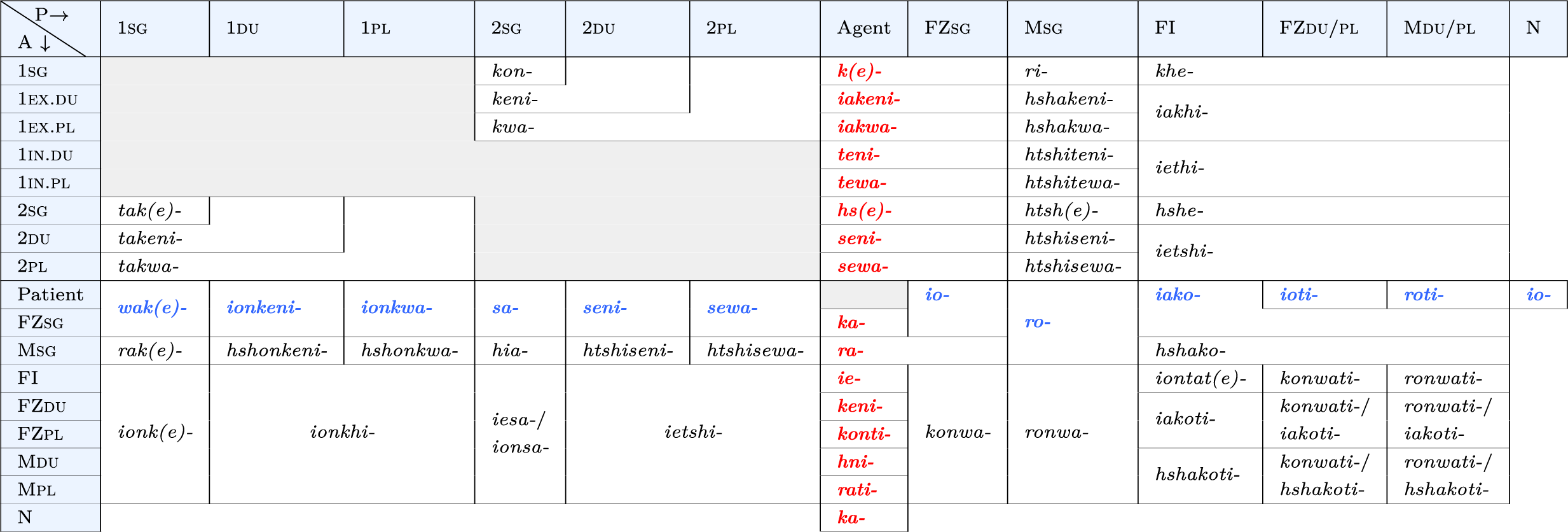

 Open access

