Published online by Cambridge University Press: 22 April 2026
Among the Anatolian proper names transmitted to us in the Old Assyrian tablets from Cappadocia, those in -uman and -l(i)ka, in
and -aššu, and finally those in -iyat/iet are particularly characteristic. Their analysis, undertaken elsewhere, has shown that they contain the following identifiable theophorous elements: Aššiyat, Ḫalki, Ilaliya, Inar(a), Išput, Perwa, Tarawa, and possibly Šiwat. The question arises whether these gods can be ascribed to a definite ethnic and linguistic layer of early Anatolia, such as is known to us from the Boğazköy texts.
1 In an article to appear later in this journal.
The following abbreviations in the present article may be unfamiliar to readers of Language :
(1) Periodicals: Bibl. Or. = Bibliotheca orientalis, JCS = Journal of cuneiform studies, JHS = Journal of Hellenic studies, JKF = Jahrbuch für kleinasiatische Forschung, OLZ = Orientalistische Literatur Zeitung, RA = Revue d'assyriologie, RHA = Revue hittite et asianique, ZA = Zeitschrift für Assyriologie, ZDMG = Zeitschrift der Deutschen Morgenländischen Gesellschaft.
(2) Publications of Boğazköy texts: ABoT = Kemal Balkan, Ankara Arkeoloji Müzesinde bulunan Bogazköy tabletleri ; HT = Hittite Texts in the Cuneiform Character from Tablets in the British Museum; IBoT = Bozkurt-Çiğ-Güterbock, Istanbul Arkeoloji Müzelerinde bulunan Boğazköy tabletleri; KBo = Keilschrifttexte aus Boghazköi; KUB = Keilschrifturkunden aus Boghazköi (usually quoted by number of volume only). Furthermore Bo (with following number) = unpublished Boğazköy tablet (quoted by museum number).
(3) Other publications of cuneiform tablets: TCL = Musée du Louvre, Textes cunéiformes.
2 E. Forrer, Die acht Sprachen der Boghazköi-Inschriften (SPAW philos.-hist. Klasse 1919.1029 ff.); F. Hrozný, Über die Völker und Sprachen des alten Chatti-Landes (Boghazköy-Studien 5, 1920).
3 Only recently the adverb kanišumnili ‘in the fashion of a man of Kaniš‘ has emerged: Otten, JKF 2.67 (1951) (Bo 6222).
4 The reasoning of H. T. Bossert, Ein Hethitisches Königssiegel 16 ff. (1944), leading to the conclusion that ‘Neshite’ is not Hittite, is invalid. Both in KBo V 11 I 3 f. and in Bo 2002—now published as IBoT I 36—III 64 the words introduced by the adverb nesili are in Hittite (ḫugaš ‘message’ and tapuša 'to the side'). Contrast with URUni-ši-li ⨿!-za!-i!· ta-pu-ša in the same text 165 nu ḫa-at-ti-i-li ta-ha-ia ⨿-za-i, and compare Goetze, Tunnawi 34. In the 'second Arzawa letter' (VBoT 2) the scribe in Egypt is asked to reply in Neshite, i.e. ‘Hittite’, since that language caused him less difficulty than Luwian and since the writer would presumably have had trouble in understanding Akkadian.
5 The names are to be understood as datives.
6 Again datives.
7 The 'singer of Kaniš' is not mentioned here, but the occurrence of the 'gods of Kaniš' and the comparison with list 1 makes the attribution certain.
8 Part of a larger system.
9 Part of a larger system; all names are in the dative.
10 This is suggested by the preceding DMAḪ.MEŠ; see A. Goetze, Tunnawi 55 ff.
11 Restoration doubtful.
12 Nisaba is not only the Sumerian goddess of grain, but also the scholar among the gods. It is therefore no surprise that she seems to substitute here for the goddess of healing Kamrušipaš.
13 In the two versions (XIX 50 IV 10 and XXVI 36 IV 5) the continuation varies. It may be quoted here since it includes—at least in the former—SAL.LUGAL.GAL. However, the epithet is here attributed to Ḫebat. With DḪé-bat SAL.LUGAL.GAL [URUU-da] and DḪé-bat DḪ[e-]b[at?] URUU-da (before URUU-da the words DIŠTAR ŠA seem erased) compare dḪé-bat [šarr]at šamẽ Tette IV 25 f. and dḪé-bat bēlet ša-me-e dḪé-bat āl⨿-pa dḪé-bat ālU-da dḪé-bat ḪKi-iz-zu-at-ni Matt. rev. 46 f.
14 Restore KUB XXVII 5 obv. 17b from the duplicate 4 obv. 15b.
15 Götze, Kleinasien 136.
16 Cf. the remarks of Laroche in Rech. 39, and also lúzi-bu-ri-aš XXX 69 1. Is it a mere accident that GAL ‘cup’ appears more fully as GAL-ri (see von Brandenstein, Bildbeschrei-bungen 28)?
17 See Laroche, RHA 7. 3 ff. (1946) ; Rech. 67 f. New examples are HUR.SAGḪllalazipa (von Brandenstein, Bildbeschreibungen 45) and DḪantašipa (see fn. 22).
18 *Išpani-šepaš; XX 24 III 2 heading a long series which ends in the ‘Körperteil-Gottheiten’ in -šaš.
19 See J. Friedrich, Hethitisches Wörterbuch 36 (1952), with older literature.
20 XVII 10 II 35; XXXIV 63 15.
21 If identical with kammara- its meaning is possibly ‘mist’.
22 II 4 III 28; Bo 84 (ZA NF 14 121) 23; Bo 1551/c etc. (ibid. 139 ff.) rev. 17; HT 26, 5; IBoT II 86 always in a Palaic milieu.
23 See below 270.
24 Bo 2416 etc.; see RA 45.185 (1951) and Bibl. Or. 8.226 (1951).
25 See below 274.
26 KUB VI 45 II 22 f.
27 JCS 1.89 (1947) against Güterbock in the preface of IBoT I. It seems that KBo II16 offers DVII.VII-ru. Cf. DŠi-bu-ru-ú X 89 II 15; DŠe-bu-ru-ú XX 19 III 5??
28 Thureau-Dangin, RA 16.144 ff. (1919); Rituels accadiens 14 ff., 24 ff. (1921); Jean, RA 21.97 ff. (1924); H. and J. Lewy, Hebrew Union College annual 17.37 ff. (1943).
29 It is difficult to decide whether the sign ‘ud’ should be read UTU ‘sun’ or UD ‘day’. Decision in favor of the latter is made here in view of UD.KAM-aš in the apparent parallel to be quoted presently.
30 Cf. ŠA DX DVII.VII-BI VII 13 25; XXVIII 4 rev. 17.
31 The equation DKAL = DInar(aš), first assumed by E. Forrer (Forschungen 1.10 fn. 1) and often contested since then, has finally prevailed. Bo 2372 (JCS 4.125) III 26 proves that, in spite of Ehelolf's remarks OLZ 1934.721 f., DKAL-aš-mi-iš (XX 24 IV 9) corresponds to DIn-na-ra-aš-mi-iš. Furthermore the sequence of gods in sacrificial texts shows that DKAL and DI-na-ar interchange (Laroche, Rec. 79 ff.; partly anticipated in F. Sommer, AU 21). The singer of Kaniš recites for DKAL also XXVIII 101 5 f. (Cf. further Otten, Bibl. Or. 8.230.)
32 KBo II 16 4. The milieu of this text is decidedly Luwian, note DTa-pár-ri-ia-aš-ši-iš (1. 5), DPí-ḫa-am-mi (1. 6) and the plural DU-ti-iu-ú-ni-en-zi (1. 8). There may also exist a Ḫurrian deity of this name (cf. von Brandenstein, Bildbeschreibungen 59 f.). Maliya is a frequent and presumably Ḫurrian name of males in the Nuzu texts (see Gelb, Purves, and MacRae, Nuzi personal names 95).
33 Otten, JCS 4.121 ff.
34 This is the nominative (correct Laroche, Rech. 60, accordingly), as it appears XX 65 3; Šuwaliyatti is dative. I do not see much reason to claim this god as Ḫurrian, as Laroche does. Before I can believe in the alleged identity of DNINURTA, I must see the unpublished text Bo 5841 from which the identification (von Brandenstein, Bildbeschreibungen 72 f.) is deduced. The data presented in the text make me rather sceptical.
35 KBo II 30 obv. 1 ff. runs parallel.
36 See below.
37 From here on also III 1 ff.
38 The insertion III 13 ff. has been disregarded here.
39 See below.
40 See below.
41 Duplicate to XXXIV 102 IV.
42 This is broken off on XXXII 84 and IBoT I 123.
43 IBoT I 23 III 17 offers DINGIR.MEŠ, which must be emended to DES, i.e. DXXX ‘Moon’. In XXXII 84 either this or the following DEA is missing.
44 Thus XXXIV 102 II 4; cf. HT 79 5.
45 See Laroche, Rec. 80.
46 The combination of Ḫašammiliš with Šuli(n)katte in XXII 27 I 9 ff. (duplicate ABoT 14 II8 ff.) seems accidental. The passage certainly must not be interpreted in the sense that the two deities are a divine couple. Instead of DUMU-RU-TI (Otten, Bibl. Or. 8.229 fn. 42) read É.MEŠ DINGIR.MEŠ-iα ku-e TUR-RU-TI (i.e. Akk. ṣeḫerūti) ŠA DŠ. U ŠA DḪ. ‘what small temples there are of Š and Ḫ.‘
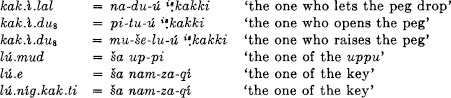
47 Sm 12 (CT XIX 23) obv. 5 ff. (names of professions) :

48 Occurrences: KBo II 30 obv. 1; KUB II 3 III 25; X 11 IV 10; XIV 8 I 35; XVI 34 I 6; XVII 1 II 13; XXIX 8 II 3 (here with determinative LÚ ‘man‘); XXX 42 I 19: XXXII 121 II 32 f.
49 A. Götze, Annalen des Muršiliš 126 f. Note the apposition ‘my lord’.
50 Otten, JCS 4.119 ff. (1950).
51 Because of Bo 2593/c rev. 11 (1.e. 124).
52 See ibid. rev. 17.
53 Or ‘fleece‘?
54 Is this a cultic vessel—analogous to the ‘Molten Sea’ of Solomon's temple—or a specific individual spring?
55 See most recently A. S. Kapelrud, Baal in the Ras Shamra texts 95 f. (1952).
56 The similarity was noticed by Sayce, JHS 45.163 (1925); see also B. Hemberg, Die Kabiren 87, 316 f. (1950).
57 Friedrich, ZA NF 3.179 ff.
58 Cf. XXX 41 II 22 DŠu-wa-li-ia-at-ti, followed in the next line by [DḪa-ša-m]i-li.
59 Quite likely DKAL is to be restored, cf. DKAL-n pí[-ra-an] XXVIII 91 I 8 following DḪal-ki p[í-ra-an] in 1. 7. Note also the sequence DUD.SIG5, DḪa-ša-am-me-li, DḪal-ki, DKAL of HT 79.
60 Perhaps KUŠkur-ši ‘to the shield’, cf. XXV 18 III (see above).
61 Perhaps [Ḫašamiliš], see Bo 2593/c (JCS 4.124).
62 Cf. KBo IV 13 VI (see presently) ; furthermore EN.ZU-an IX 38 I 5 and DXXX| IBoT I 23 III 17. Is Ši-tar-zu-na- Bo 535/c etc (JCS 4 123) also pertinent?
63 Perhaps [DGul-še-eš], see IX 28 I 8, III 3 (see below).
64 This is the clear nominative sing, of a formation in -š(š)iš which so frequently forms divine names (see Laroche, Rech. 68 ff.). Hence it seems necessary now to interpret DḪa-ri-iš-ta-ši(-in)-na in the sequence A-NA DGul-šu-uš DMAḪ.MEŠ-uš DḪ. (KBo IV 13 II 20, IV 2f., 22 f.) as an incorrect accusative in -in plus -a ‘and’ (cf. DḪa-ri-iš-ta-ši after A-NA to be restored in III 6) and not as a Ḫurrian plural in -na (Goetze, Tunnawi 55 fn. 175). The noun on which Ḫarišta-š(š)i- is based is unknown.
65 The sequel will be dealt with below.
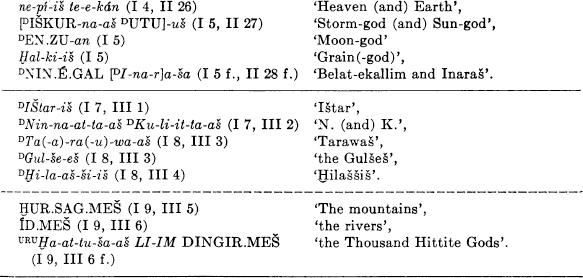
66 This deity is also included in the list of KUB IX 28 which (I 9, III 6 f.) closes with ‘the Thousand Hittite Gods’. It first enumerates some of the chief deities, namely:

and then proceeds to a special list :

The name of DTarawaš rather than that of the Ḫattic DTaru- is probably contained in the ‘Cappadocian’ and Hittite proper name Taruḫšuš (< *tarawaḫšuš).
67 See Bossert, Königssiegel 33.
68 Most members of this list are in the accusative.
69 Cf. Goetze, Tunnawi 62 f. ; Friedrich, JCS 1.280 ff. ; Laroche, Rech. 98 f. and JCS 2.125. For the reading, Palaic Gul-za-an-ni-ke-eš (Bo 1551/c etc. [ZA NF 14.139 ff.] rev. 18) is of importance. It shows that ‘gul’ is to be read thus, since complements of such length are unusual.
70 It is very unlikely that these goddesses bear the same name as DMAH = Hannahannas (Otten, OLZ 1941.18; Laroche, Rech. 101). For the reading, note DUDUTUDKAL DGull-šu-uš [Dx-š]a-ra-uš-ša VII 2 I 15 f.
71 For the sequel see below.
71a U.GUR may be of Human origin. Cf. Gelb-Purves-Macrae, Nuzi personal names 271.
72 Ḫa-pa-ta-li occurs as a proper name in the Kültepe texts: TCL I 240 1 ff.
73 The restoration is uncertain; cf. DḪu-u-ri-ia-an-zi-pa-aš V 7 obv. 17; DḪu-ri-ia-an-zi-e-pa-an XX 4 I 13; DḪu-ri-ia-an-zi-pí ibid. 16.
74 The restoration is uncertain.
75 Cf. II 8 V 29.
76 GIŠKÁ.GALDINGIR.MEŠša !-la-wa-ni-iš(plur. nom.) 118 V 24; KÁ.GAL-aš Dš|-la-u-wa-ni-iš (plur. nom., as voc.) X 89 I 15; GIŠKÁ(.GAL)-aš DING1R.MEŠša-la-wa-ni-ia-aš (plur. dat.) II 8 I 25, II 43, cf. XXV 49 III 25.
77 See above.
78 For Ḫešalla- cf. KBo IV 14 III 13 ff. '[if] something troublesome happens to the king, either that the king falls ill, or that the lands become rebellious, or that the enemy invades the land, then the blocked [ways] (KAS.ḪÁ-ta-ma Ḫi-iš-šal-al-la) let in the same way be your concern.' Restoration and interpretation are supported by XXXI 136 rev. 4 ff. : 'Should something troublesome happen to the Labarna, the k[ing, (either that) the ways of the earth are blocked to you (tu-uk Ḫé-e-ša-la??-t[i?-iš] (or) the ways of [....] are left open(?) (tar-na-ti-iš).....'
79 ABoT 3 3 = KUB IX 21 9; words preserved on ABoT 3 are between parentheses. For KUB IX 21 alone cf. Bossert, Heth. Königssiegel 43. A similar text is KUB X 50.
80 Compare 1. 9.
‘River’ in IX 21 probably means the Maraššandaš.
In a wider sense II 8 I 20 ff.85 belongs here, at least the second part of this list which centers around the River Zuliyaš. The whole list, however, may find its place here:86
A-NA DKAL URUTa-ú-ri-iš 'to Inar of Tauriš,
[A-NA AMA K]a-li-im-ma87 ‘to mother K.‘,
[DḪa-ša-me-li]88 ‘to Ḫašameliš‘,
DA-aš-ši-ia-za89 ‘Aššiyats’,
81 Probably the Maraššandaš river is meant.
82 Cf. ŠA La-ba[ -ar]-na Ḫa-an-te-ia-as-ša-aš-si-išDKAL-i KUB II 1 II 47. The formations in -šiš, structurally adjectives but syntactically equivalent to Hitt. genitives, like iš-Ḫa-šar-wa-na-aš (see KBo II38 III 9) in the preceding line, appear in this text in great numbers and qualify the often repeated dative DKAL-i; curiously enough they are never inflected themselves, and apparently remain in the nominative.
83 See also Bossert, Heth. Königssiegel 48. In IV 1 the river is mentioned by name again, but in IV 11—with the singer of Kaneš singing—he is merely referred to as ‘the River’.
84 See Goetze, JCS 1.87 f.; Laroche, JCS 2.113.
85 Easily restored from ibid. II 37 ff., V 13 ff.
86 See also Bossert, Heth. Königssiegel 33 ff.
87 Probably also XX 48 I 3 (Bossert, l.c. 45, where 1. 5 must begin with ku-it-ma-an-ma ‘as long as‘!); in 1. 7 the singer of Kaniš sings.
88 See V 20.
89 This nominative is rigidly maintained as though it were an ideogram. In II 40 one even reads A-NA DA-aš-ši-ia-za, and in V 22 DA-aš-ši-ia-za serves as an accusative. In the latter place, strangely enough, the items that follow, syntactically accusative, also appear in the nominative.
90 The festival in question takes place in the ‘Grove of Tarniš‘ (VI 4).
91 This and the three following items remain obscure, although tepu pedan, EME-aš Ḫantanza, and zipu šarrumar recur in KBo IV 13 (+ X 82) VI 36 f. and all four in X 81 6 ff. (where 1. 8 an-na-ri-iš with a preceding ‘Glossenkeil’ is noteworthy). It is of course no accident that in the long list of KAL deities of the Labarna (KUB II 1) we find:
ŠA La-ba-ar-na DKAL te-pa-u-wa-aš pé-e(-da)-aš (II 39 f.),
ŠA La-ba-ar-na ḫa-an-da-at-ta-aš DKAL-i (II 45),
ŠA La-ba-ar-na ḫa-an-te-ia-aš-ša-aš-ši-iš DKAL-i (II 47),
ŠA La-ba-ar-na tar-pa-at-ta-aš-ši-iš DKAL-i (II 48).
Cf. also ŠA La-ba-ar-na-aš [xxx -]aš tar-pa-aš DKAL (III 1 f.), which might have read [an-na-ra-]aš. For an-na-ri-in tar-pí-in, again in a god list, see also XXXII 87 rev. 14. One can hardly avoid being reminded of the DAn-na-ru-um-mi-en-zi, Luwian for DInnarawanteš of 1X 31.
92 See also Bossert, Heth. Königssiegel 45. At the beginning of col. VI there precede DḪê-bat (Human singer) and DKAL SE-RI ‘Inar of the Field’ (singer of Kaniš).
93 Uncertain, cf. ŠA DINGIR.MEḪ LU.MEŠ DMa-li-ia (dat.) KBo IV 13 I 16.
94 Also XXV 32 I 19.
95 Restored according to 1. 3.
96 See also Bossert, Heth. Königssiegel 46.
97 The singer of Kaniš sings for DKAL also XXVIII 101 5 f.
98 Cf. von Brandenstein, Bildbeschreibungen 72 f. with fn. 7. The text Bo 3533 which he quotes is still unpublished.
99 Cf. ŠA La[-b]a -a[r-]na mu-wa-ad-da-la-ḫi-da-ašDKAL-i II1 III 14 f. As for the translation of muwatalla/i = Akk. mutallu (= NIR.GÁL), because of Bossert, Heth. Königssiegel 73, the fact must be recalled that Akk. etellu, and the mutallu derived from it, have nothing to do with eṭlu ‘(sexually) mature, manly’. The singer of Kaniš sings for DX NIR.GÁL XXV 41 V 13 f.
100 In the theological sense; see also [ŠA La-ba-ar-n]a pa-ra-a ḫa-an-da-an-da-an-na-aš DKAL-i II 1 II 20 and ŠA La-ba-ar-na [DA-a-la-aš pa-r]a-a ḫa-an-ta-an-ta-an-na-aš. ibid. IV 6 f.
101 This is clearly the reading for DX RE-ṢU-TI or Á.DAH of the treaties. This whole series recalls in a striking manner the series attributed to El in the Ugaritic text, Syria 14.231 ff. = 20.129 ff. (C. H. Gordon, Ugar. handbook No. 107): b-mrḥ il, b-nit il, b-smd il, b-dṭn il, b-šrp il, b-knt il, b-ğdyn il. They have found very divergent interpretations; see E. Dhorme, Syria 14 1.e.; J. Obermann, JBL 55.21 ff.; C. H. Gordon, Ugar. literature 109; 0. Eissfeldt, El im ugar. Pantheon 60 f.
102 Otten (ZA NF 14.128 fn. 19) contended that -k(a), which occurs in the plurals Ilaliyantikeš, Gulzannikeš and Uli〈li〉yantikeš, is the plural suffix of Palaic. I think he is mistaken. The second of these plurals is certainly feminine, and the ‘Cappadocian’ names in -l(i)ka and -annika, all feminines, suggest that -ka marks the feminine gender.
103 DI-la-li-ia-an-du-uš (plur. acc.) IX 34 III 35; DI-la-li-ia-an-ta-aš (plur. gen.) II 4 V 27 (Palaie ritual!).
104 Sommer, Bogh. Stud. 7.55.
105 This article reaffirms a view which I expressed as early as 1931 and have intermittently defended ever since; see ZA NF 6.260 ff. (1931); Kleinasien 55, 68 f., 167 (1933); Haverford symposium 147 (1938); Proc. of the Amer. Philos. Soc. 97.000 (1953). Similar views are held by S. Alp, Belleten 50.269 f. (1949) = JKF 1.135 f. (1951), and by Bilgiç, AfO 15.18 f. (1951). When I received Alp's review in Ankara Universitesi Dil ve Tarih-Coğrafya Fakiiltesi Dergisi 10.249 ff. (1952), the present article had been long since completed.