


Introduction
Francisca is a middle-aged woman who provides full-time care for her mother, an older woman who was left bedridden by a stroke. Francisca suffers from major depression disorder that she attributes to the extreme burdens of her caregiving tasks. She even attempted suicide in the past. Francisca couldn’t take it anymore: “I was exhausted,” she told us. Once in the hospital after this incident, however, she begged the doctor to let her go home: “I need to go back to take care of my mother.” Despite her fatigue, depression, and financial problems, Francisca appeared confused during our interview by our insinuation that public institutions could have a duty to assist in taking care of her mother.
In this paper, we seek to understand why poor caregivers of persons in need of long-term, intensive care form and sustain conceptions of their situation that break with rights-based frames. This query emerges from a puzzle shown by sociolegal literature on caregiving that is intensely relevant in Latin America: it refers to a population in need of dramatic relief, and in a context in which the idea that caregivers and care receivers are entitled to social rights has known success. It has been articulated by the notion of derecho al cuidado (“right to care”), an ambiguous formulation referring both to the idea that care receivers are entitled to being taken care of and that caregivers are entitled to state assistance that has been championed by political elites and found institutional support (Cunil-Grau and Leyton Reference Cunil-Grau and Leyton2018; Pautassi Reference Pautassi2007, Reference Pautassi2018).
Yet, researchers have found that the most obvious targets of a rights-based approach – intensive caregivers in need of relief – tend to reject such notions, instead reproducing traditional discourses that frame family care as a moral duty (Berret and McIntosh Reference Berret and McIntosh1982; Cicirelli Reference Cicirelli1993; Dalley Reference Dalley1988; Levitsky Reference Levitsky2014: 5). In their encounters with legal and state institutions, the institutional logics associated with the family appear strongly prevalent. Whether these attitudes persist when caregivers actively receive state assistance, however, remains an open question. This paper investigates how caregivers reconcile their own understandings of care with the receipt of state aid, and how they navigate the tension between bureaucratically imposed, rights-based conceptions of identity and their own. Do caregivers integrate these institutional perspectives into their worldview, or do they instead develop alternative cultural mechanisms that allow them to sustain caregiving as a matter of purely familial responsibility?
To approach these questions, we explored how ordinary caregivers frame their role and personal experiences in relation to the right-to-care discourse. We carried out 44 in-depth interviews of caregivers, care receivers, and officials administering a centrally funded, but county-administered state assistance program named “Chile Cuida” (Chile Cares) in the Santiago metropolitan area. We leveraged the program to gain access to our target population: vulnerable, long-term, intensive caregiving providers. We theorized that because we focused on a state aid program formed under the idea of the right to care, our sampling approach would provide access to a population with a high level of exposure to institutional models of assistance and rights discourses. Thus, we would be able to witness more directly the meaning and uses that those caregivers attached to such discourses.
Even under these conditions, we found that most participants – almost exclusively women providing caregiving services to family members – framed their experiences in terms of familial duty or affection, rather than invoking caregivers’ rights discourses. As we will show, findings of this kind are not new. However, despite the absence of entitlements toward state assistance, rights-based claims did abound in our participants’ discourse, mostly serving to police and reinforce familial duties from other family members. References to state institutions appeared only in the context of assistance, as a means of redressing the state’s abandonment of poor communities.
Drawing on the rights-consciousness literature, we interpret these findings as reflecting three mechanisms that emerge from our empirical analysis of caregivers’ experiences with the law: perceptions of cultural incompatibility with social rights, familial overspilling into bureaucratic contexts, and the emergence of bridging strategies to justify entitlements to state assistance that do not defy familial dominance. Cultural incompatibility refers to caregivers’ unwillingness to frame any sense of entitlement to assistance that they perceive as contradicting familial duties. Familial overspilling, in turn, refers to the way family affection and emotional support influence the type of relationships expected by caregivers from state actors providing assistance and the role that they assign to the law in enforcing familial compliance by other members. Bridging strategies refer to the use of culturally validated sources of entitlement, mostly related to the perceptions that the state owes poor individuals assistance, used by participants to justify aid in a form that does not threaten their understanding of familial responsibility.
The paper is structured into four sections. The first section reviews the literature, examining why the enduring belief that caring for family members in need is a moral duty continues to prevail despite the recognition of care as a social and human right in Latin America. The second section presents the Chilean case, outlining the political processes through which the right to care has been advanced, and describes the methods used to address our theoretical questions. The third section reports the empirical findings. The fourth and final section discusses how familial logics have come to supersede legal and political dynamics, reinforcing the private character of the right to care – particularly among poor, long-term caregivers in Chile.
Literature review
Caregiving, the right to care, and familialism
Our study emanates from a troubling puzzle shown by the empirical literature on caregivers and most significantly studied by Sandra Levitsky (Reference Levitsky2008, Reference Levitsky2014) in the USA: a population in need of significant relief and offered politically successful discourses on having a right to assistance appears unreceptive to that right.
The first side of the puzzle concerns the population of caregivers who provide long-term, intensive care to relatives within low-income communities. Despite overwhelming evidence documenting the harms experienced by this predominantly female group – who often sacrifice personal opportunities (Brody Reference Brody2004), endure substantial physical, emotional, and economic hardship (Ogilvie et al. Reference Ogilvie, Morant and Goodwin2005; Thrush and Hyder Reference Thrush and Hyder2014), face social isolation (Hayes et al. Reference Hayes, Hawthorne, Farhall, O’Hanlon and Harvey2015), physical strain, reduced work capacity, and stigma (Ali et al. Reference Ali, Hassiotis, Strydom and King2012), as well as profound psychological distress and a sense of entrapment (Brodaty and Donkin Reference Brodaty and Donkin2009) – research consistently shows that these burdens rarely translate into a recognized right. Guided by familial logics, in the US caregivers tend to internalize responsibility for their exhaustion and lack of support; if anyone is to blame for their desperation, it is perceived to be the caregiver herself (Levitsky Reference Levitsky2008, Reference Levitsky2014).
In the Americas, the outcome is no different. Despite the obvious burdens on caregivers and the political support for a right-to-care, long-term, intensive care is still most often provided in the Americas by relatives who perceive that they are simply fulfilling their family duties and should not expect any outside help (Araujo and Hirata Reference Araujo and Hirata2020; Bazo Reference Bazo2002). Scholars have used the concept of familialism to describe this reality, widely understood as the deep-rooted belief that family care constitutes a moral obligation among relatives (Berret and McIntosh Reference Berret and McIntosh1982; Dalley Reference Dalley1988; Heller Reference Heller1970; Knight et al. Reference Knight, Silverstein, McCallum and Fox2000; Levitsky Reference Levitsky2014). This ideology is reproduced through a normative sense of family allegiance (Sabogal et al. Reference Sabogal, Marin, Otero-Sabogal, Marin and Perez-Stable1987), the principle of unconditional intergenerational solidarity (Kalmijn Reference Kalmijn2005), and the prioritization of the family over the individual member – most often to the detriment of women (Revillard Reference Revillard2006).
Although the literature shows that the structure and intensity of familialism change across cultures and countries (Leitner Reference Leitner2003; Polletta Reference Polletta2018), the cultural association of care work with familial responsibility continues to be widespread across the globe. This is also the case in Chile – our research site – where familialism is strongly entrenched (Barros et al. Reference Barros, Fernández and Herrera2014; Fernández and Herrera Reference Fernández and Herrera2022; Palacios Reference Palacios2017). Despite efforts to transition from an explicit familialism policy model to an optional familialism one (Montes et al. Reference Montes, Vera and Barra2018), caregiving is almost exclusively delivered by family members, mostly women (71.7% of caregivers are women) (Ministerio de Desarrollo Social y Familia 2022).
Familialism is certainly not per se problematic but rather builds on the experience of family life, values of love and reciprocity, and on the very fact that elderly or disabled individuals tend to prefer to be taken care of by family members at home (Woodman et al. Reference Woodman, Baillie and Sivell2016). Nevertheless, for the supporters of the right to care, familialism could symbolize failure. Its problematic traits relate to the notion that family responsibility excludes public duties to provide support for or to supplement the care work provided by (generally female) family members (Levitsky Reference Levitsky2014).
As noted, the most significant sociolegal study providing an explanation to this puzzling outcome is Levitsky (Reference Levitsky2008, Reference Levitsky2014). Levitsky draws on Felstiner and colleagues’ theory on the emergence of rights (Felstiner et al. Reference Felstiner, Abel and Sarat1980) to provide an explanation for this puzzling outcome. Under this theoretical frame, a need transforms into a right if the party comes to recognize her situation as an injury (“names it”), “blames” someone other than himself for that situation, and develops tools to mobilize (“claims it”) legal categories for the redressal of that injury.
In relation to caregiving, however, familialism would block “blaming,” impeding an outcome that Levitsky refers to as “politicization,” namely the understanding of “[..] longstanding ‘private’ needs or interest as matters of legitimate public deliberation and decision making” (p. 15). Following familialism, if anyone is to blame for feeling desperate for support in providing care, it is the caregiver herself. Furthermore, “discursive integration” – a construct associated with political imagination, positing that individuals tend to limit their welfare expectations to institutional regimes with which they are locally familiar – prevents “claiming” (Levitsky Reference Levitsky2014: 571).
Levitsky’s explanation is parsimonious and, in our opinion, generally convincing. Yet her focus on discourse exposure and integration appears narrow when applied outside of the USA and can be challenged when tested in a different political environment, such as the one that exists in Latin America around the right to care.
Contrary to Levitsky’s US case, in Latin America, there is a strong political mobilization surrounding care as a social right. The feminist discourse on significant social inequality in relationship to caregiving (Daly and Lewis Reference Daly and Lewis2000; Fraser Reference Fraser1994; Knijn and Kremer Reference Knijn and Kremer1997; Nedelsky Reference Nedelsky2011: 29; Orloff Reference Orloff1993, Reference Orloff1996), emphasizing how demographic change has dramatically intensified caregiving demands (Uhlenberg Reference Uhlenberg1992; Whitehead Reference Whitehead2008) and mostly affected women (Brody Reference Brody2004; Grigoryeva Reference Grigoryeva2017), has significantly influenced elite political discourse. Social movements and human rights networks have actively championed care as a critical human right structured around gender equality (Bango and Cossani Reference Bango and Cossani2021; Batthyány Reference Batthyány2015; Martínez et al. Reference Martínez, Henríquez and Rodríguez2024; Schil and Montenegro Reference Schil and Montenegro2018). Particularly in countries like Chile (Lamadrid and Benitt Reference Lamadrid and Benitt2019), Argentina, and Mexico (Vinokur and Giordano Reference Vinokur and Giordano2021), there has been a notable surge in recognizing and articulating the political dimensions of care.
Thus, unlike US citizens, Latin American caregivers may have more commonly been exposed to articulated notions of caregiving rights and to the construction of the politicized identity of caregiver (“cuidadora”). In Chile, they have significant experiences of direct state assistance and rights discourses, which should provide them with a frame that enables engagement in a politicized discourse about their own circumstances (Levitsky Reference Levitsky2014: 106). Therefore, an explanation based solely on a lack of exposure to the political discourse on caregiving rights is, in this context, limited.
Rights consciousness in ambiguous settings
We draw on the literature on rights consciousness to explain why intensive caregivers persist in drawing upon familial logics instead of mobilizing the Latin American politically salient and broadly institutionalized discourse of the right to care.
Rights consciousness focuses specifically on a sense of entitlement or the lack thereof. This approach, however, moves beyond lawsuits and written laws to include a general awareness of one’s rights and the willingness to act on them (Li Reference Li2010). By addressing the experience of ordinary people, the study of rights consciousness aims to explore how people’s understanding of their rights unfolds through their discourses, experiences, practices, and identity (Engel and Munger Reference Engel and Munger2003; Lovell Reference Lovell2012), even when those rights may not formally exist (Hull Reference Hull2001; Kirkland Reference Kirkland2008; Marshall and Barclay Reference Marshall and Barclay2003).
While some research has focused on how elites influence how civil and human rights travel (Heyer Reference Heyer2015; Merry et al. Reference Merry, Levitt, Şerban Rosen and Yoon2010), David Engel (Reference Engel2012) calls for a horizontal perspective, which focuses on how ordinary citizens understand and experience such rights discourses. For example, Engel shows that in the north of Thailand, local villagers did not incorporate rights languages into their narratives or dispute-resolution practices, despite the widespread dissemination of rights-based materials. Rather, Thai people relied on Buddhist teachings and karma to interpret injuries and conflicts. Just as in legal consciousness (Chua and Engel Reference Chua and Engel2019; Ewick and Silbey Reference Ewick and Silbey1998; Nielsen Reference Nielsen2000), rights consciousness shows how the development of perceptions and understandings of rights depends on the meaning associated with different cultural and institutional contexts.
As caregiving is still overwhelmingly delivered by family members, the idea of a “right to care” usually involves interactions in two types of settings: the family and the context of delivery of assistance, namely market or state assistance contexts. We contend that understanding how individuals process the ambiguity surrounding the influence of these contexts, rather than merely the exposure to the political discourse on caregiving rights, is central to understanding rights consciousness in relationship to caregiving.
In the context of family interactions or disputes, researchers have found that rights consciousness is often shaped by family expectations and emotions, which can mitigate or enhance a sense of entitlement. For instance, Morgan (Reference Morgan1999) shows that women often refrain from claiming their rights in cases of sexual harassment, prioritizing the preservation of familial relationships. Similarly, Hsiao-Tan Wang (Reference Wang2019) finds that caregiving and inheritance disputes within Taiwanese families were not resolved through formal legal norms but instead through cultural concepts that emphasize emotions and family belonging. These examples suggest that rights consciousness in family disputes is likely to adopt traits – such as emotional intensity and privacy concerns – associated with the family.
State or market assistance relationships also mediate the experiences of ordinary caregivers in need of help. Research has shown that the type of understanding prompted by assistance deliverers or mediators influences rights consciousness. For example, legal professionals have been shown to influence whether their clients understand their grievances primarily as workers or persons with disabilities (Lejeune and Ringelheim Reference Lejeune and Ringelheim2019). Similarly, Heimer and Tolman (Reference Heimer and Tolman2021) reveal that despite the political success of human rights around HIV/AIDS, rights discourses were absent among clinic staff in different countries, underscoring that “rights cannot easily be transplanted into healthcare settings where people are accustomed to thinking of care as a charitable gift or as a high-priced consumer good” (574). Furthermore, the authors use Zelizer’s (Reference Zelizer1996, Reference Zelizer1997) framework around the social meaning of money to explain the dominant norms of exchange in healthcare settings. They argue that patients and professionals conceived of services differently (as rights, gifts, or services) based on cultural meanings attached to those activities.
In our case, caregivers seeking assistance turn to welfare managers who regulate access to relief according to their interpretations of bureaucratic rules and administrative practices (Hertogh Reference Hertogh2023; Sarat Reference Sarat1990). Yet, unlike in Levitsky’s case, these bureaucracies explicitly promote a rights-based perspective grounded in the understanding that the right to care is a human right. This raises a central question: How do they navigate the bureaucrats’ politically salient, rights-based conception of identity in relation to their own? Do they integrate these perspectives into their worldview, or instead develop alternative cultural mechanisms that allow them to sustain caregiving as a matter of purely familial responsibility?
Case and methods
Our findings result from extensive, in-depth interviews with caregivers, some care receivers, and officials and assistants working in the Chile Cuida program for low-income families in a county in Santiago, Chile. We begin by providing context information on our case, specifically regarding the political success of the right to care in Chile and the creation of the Chile Cuida program. Then, we provide information on our sampling, how we approach data collection and analysis methods.
The right to care in Chile and the Chile Cuida program
Two traits significantly define our research design: the high-level political success of the right to care and the specific nature of Chile Cuida as a caregiving assistance program.
The idea that the right to care is a major social or human right has been symbolically successful in Chile and other countries of Latin America (Araujo and Hirata Reference Araujo and Hirata2020; Vinokur and Giordano Reference Vinokur and Giordano2021). It is strongly supported by different social movement constituencies, including human rights networks (CEPAL 2022; Comisión Interamericana de Mujeres 2022), feminist groups (Comunidad Mujer 2021; Torres Reference Torres2020), and groups advocating for children’s rights (UNICEF 2023). These constituencies have been successful in incorporating the right to care into the political agenda (UNICEF 2023: 3). In Chile, successive right- and left-wing administrations since 2015 have incorporated caregiving support as a central pillar of welfare policy, exemplified by the creation of the state program Chile Cuida, which provides the context for this study. Moreover, the right to care emerged as a key normative framework in the constitutional debates that took place between 2021 and 2023, underscoring its growing political and moral resonance. Furthermore, while we were conducting our study, the government launched a “caregiver credential,” which formally recognizes caregivers and facilitates their access to certain public service procedures.
Chile Cuida (technically: the Local Network of Caregiving Support Program) is a means-tested caregiving support program born out of the political agenda around caregiving. Its origin lies in the 2013–2017 administration of Michelle Bachelet. Seeking to incentivize and support female labor insertion, Chile Cuida aimed to provide vulnerable families with in-service state support and to encourage community support of caregivers. The program is funded through central government transfers to participating counties. The program’s first phase took place in 2016, reaching 6 regions and 12 counties. Since its inception, the program has expanded to all regions and other counties. When our study took place in 2022, 90 of the 346 counties in Chile participated in the program. Despite this growth, the program reached only around 4,000 families nationwide at the time of our study, yet over one million qualifying families remained without access (Ministerio de Desarrollo Social 2021). While far from establishing the infrastructure for a universal right, Chile Cuida represents a meaningful institutional and symbolic milestone: the first systematic, state-led effort to recognize caregiving as a social right deserving public support in Chile, a trajectory confirmed by the program’s expansion to 215 municipalities in 2025.
The program provides free support to low-income caregivers in their daily tasks, facilitating and promoting access to services, benefits, and social support (World Bank and Ministerio de Desarrollo Social 2017). It operates mainly through home care services, where an assistant (mainly nonprofessional women) visits the beneficiary’s home and provides aid and relief for a couple of hours. These visits take place twice a week. The program also offers personalized, specialized healthcare support to the care receiver and group support sessions.
Periodically, the Ministry in charge of the program along with the county staff organize activities where caregivers receive public recognition and share their stories (i.e., the caregivers’ day or the disability day). We participated in two of these activities, during which we encountered various participants in this study, while both government and county authorities gave speeches on the right to care, gender inequalities, and caregivers’ political and social relevance. Caregivers were also invited to go on stage to share their experiences. Thus, we directly observed both the political traction of the right to care at the level of discourse and direct exposure to it. To be sure, discursive exposure does not directly imply rights assimilation. As we will see, our findings point in the opposite direction.
At our research site in Peñalolén, the program operated within a municipality of over 100,000 low-income residents but had the capacity to serve only about 60 households. A long waitlist of potential beneficiaries reflected the high demand for assistance, and those who were admitted to the program were among the most vulnerable. All participants lived in four macrozones composed of very low-income neighborhoods, typically marked by poor infrastructure and precarious housing. During our visits to participants’ homes, we observed these conditions firsthand – most dwellings were in visibly poor repair.
Sample and methods
In our study, we draw mainly from 27 in-depth interviews with caregivers (CG) who participate in Chile Cuida in the Peñalolén county inside the Santiago metropolitan area. To supplement some findings regarding the meaning attributed to caregiving rights by assistants and officials, we also interviewed all (7) assistants (A) that supplied care services for the program and all (3) officials (O) administering it. Because of the long-term, intensive nature of the caregivers’ work, all interviews took place in their homes. In the few cases (7) in which this was possible, we also interviewed the care receivers (CR). In total, we interviewed 44 individuals.
As our research question related to meaning-making processes associated with familial and state responsibility toward caregivers and care receivers, on-site interviews appeared the most adequate research method. We sought to explore caregivers’ histories and daily experiences to understand how they perceived their rights. A more intensive ethnographic exposure to the life of a smaller sample of caregivers might have given us a deeper understanding of their daily lives and experiences, but we declined that approach as too intrusive.
We drew our sample from current participants in the Chile Cuida program in our research site, the municipality of Peñalolén. We selected Peñalolén because it combines high levels of socioeconomic vulnerability with a comparatively strong municipal capacity to provide public assistance. Indeed, Peñalolén was the site where the program was first piloted and has since developed its own complementary initiatives targeting older adults, people with disabilities, and women. The municipality thus represents a context characterized by both a high demand for public assistance and, to some extent, the institutional capacity and political will to deliver it.
Furthermore, we leveraged Chile Cuida for sampling based on two significant advantages. First, such a sampling approach provides a pragmatic solution to the problem of access to a population that, because of its very life situation, is secluded and hard to reach. Secondly, we theorized that participants in a state assistance program with a strong commitment to the right-to-care frame would have greater exposure to that idea. Of course, precisely because we only observed a population with access to state relief in a country in which this is rather rare, our sample does not aim to represent the general population of long-term, intensive caregivers.
To obtain a sample, we were provided with a deidentified database of program beneficiaries, including each participant’s socioeconomic information. The list included the age and gender of the caregiver and care receiver, the year of access to the program, the area of residence, the level of dependency of the care receiver, and the level of burden of the caregivers (measured by the Zarit scale). We aimed to interview at least a third of the beneficiaries at the time of sampling, that is, at least 28 households out of 85.
We selected our participants through a stratified random sampling approach, dividing the population by year of access to the program, neighborhood, caregiver age (divided into those older and younger than 60), and gender of the care recipient, aiming to maintain the proportion of individuals in each variable. From there, we randomly selected 49 households to contact, providing the list to the officers administering the program according to the methodology that we had agreed with them. Together with the officers, we agreed on filtering some of the selected cases based on practical grounds: in some cases, the contact information did not work, and in other cases, the participants had left the program because the care receiver had died. The officers sent invitations to the 31 households that remained in the sample, and 25 caregivers agreed to participate. To maintain consistency with our original aim of having a proportional, stratified sample, we included two additional cases. During our fieldwork, we also interviewed the care recipient in all cases where this was possible. Table 1 provides the main descriptors of our sample.
Sample descriptors

Table 1 Long description
The table compares caregiver and care receiver demographics and conditions between Chile Cuida Peñalolén and Sample groups. In Chile Cuida Peñalolén, 54% of care receivers have severe dependency, whereas in Sample, 81% of caregivers experience severe overload. Female caregivers are more prevalent in both groups, with 69 in Chile Cuida Peñalolén and 23 in Sample. Male caregivers are fewer, with 17 in Chile Cuida Peñalolén and 4 in Sample. The mean age of female caregivers is 57 in both groups, while male caregivers are older, averaging 72 in Chile Cuida Peñalolén and 74 in Sample. Care receivers in Chile Cuida Peñalolén are predominantly male, while Sample has no female care receivers. These data highlight gender disparities and varying dependency and overload levels between the groups.
The asterisk (*) indicates that data were not applicable for that group.
Interviews took place between September and December 2022. We conducted all interviews with the caregivers in their houses. Aiming to explore caregivers’ experiences and the meanings they associate with their status as caregivers, we adopted an open-ended approach characteristic of many legal-consciousness studies (Engel and Munger Reference Engel and Munger2003; Ewick and Silbey Reference Ewick and Silbey1998; Heyer Reference Heyer2015). A large part of the interviews was based on open-ended questions about their daily routines, personal stories, how they came to assume the role of caregiver for a family member, and their experiences in Chile Cuida. In short, the interviews resembled open conversations in which we encouraged participants to speak in their own words, avoiding imposing legal or rights-based language on them. As in previous research (Kozak-Isik Reference Kozak-Isik2025; Levitsky Reference Levitsky2014; Revillard Reference Revillard2019), questions regarding their perceptions of rights and their views on the state’s role in caregiving assistance were asked at the end of the interview (if these topics had not emerged spontaneously). After acknowledging their experiences in their own words, we sought to explore how they responded to rights language and how they understood it.
All interviews lasted between 40 and 90 minutes. During the interviews, we were allowed into the home and daily life of our participants, being able in most cases to observe their interactions with the care receiver. In some instances, they were visited by family members or even by Chile Cuida care assistants during our stay, thus giving us exposure to these interactions. For administrative officers and assistants, all interviews took place in private offices on the municipality’s premises.
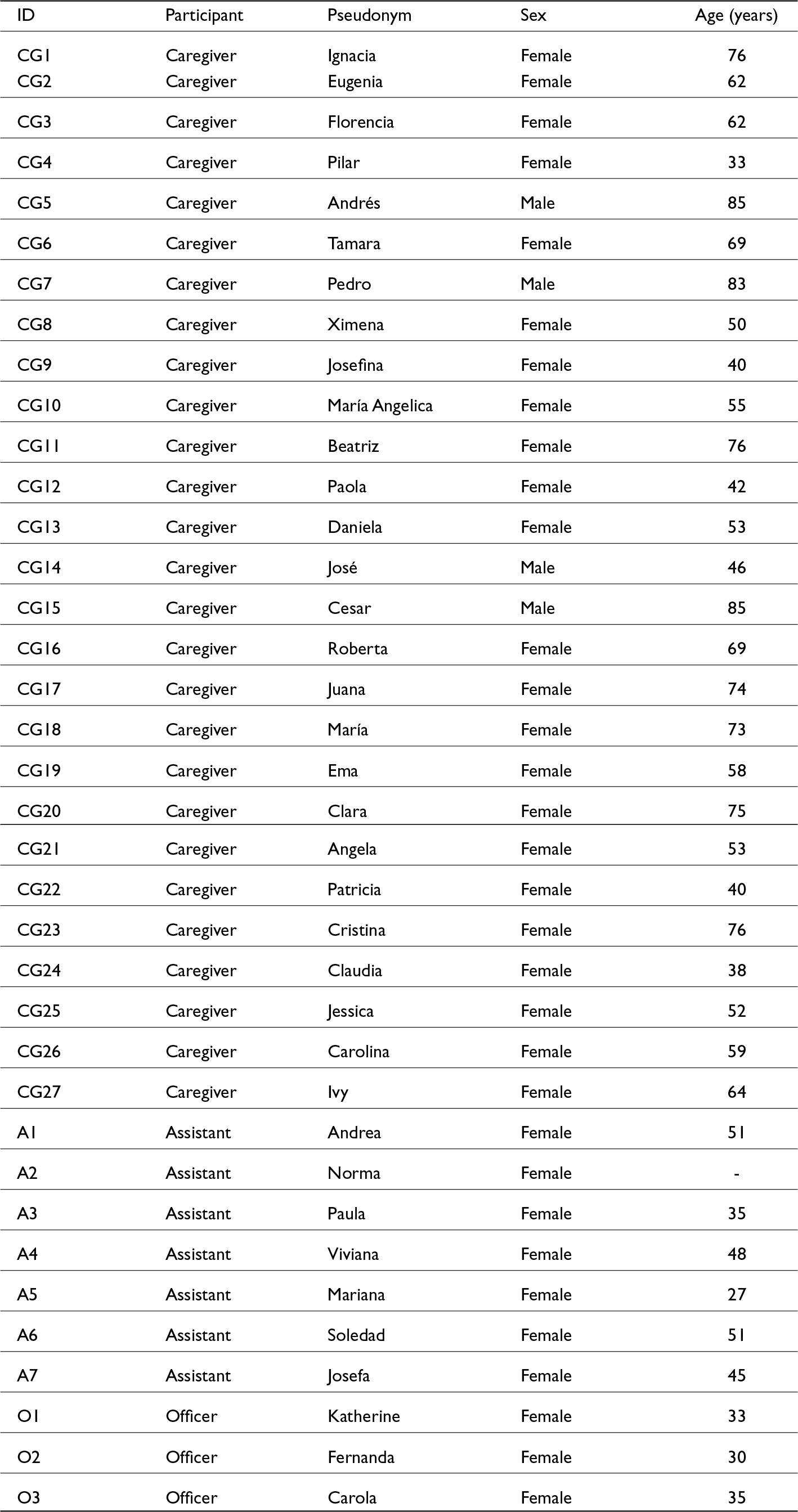
We audio-recorded all interviews and transcribed them verbatim. As we offered anonymity to all interviewees, we used pseudonyms to report their responses. All quotations are translations from Spanish to English. Ethical approval for this research was granted by the Universidad Adolfo Ibañez’s Institutional Review Board. Table A1 provides the main characteristics of our participants and their pseudonyms.
Our coding analysis strategy proceeded in two stages. We started with an open coding approach to identify the central topics in our database and generate analytical categories directly from the data. While we conducted open coding, we held weekly joint analysis sessions to discuss emerging topics and relevant categories. These included gender perceptions, responsibility for care, the decision to assume the role of caregiver, burdens and harms associated with caregiving, perceptions of state or state officers, perceptions of rights, and the activation of rights.
In the second stage, we employed a qualitative content analysis strategy, focusing on selective coding based on categories and subcategories derived from the first stage of analysis (Schreier Reference Schreier2012). We used this technique because of the heterogeneity of issues that we detected in the first stage, several of which appeared secondary to our research questions. In this second stage, we focused mainly on topics related to rights consciousness, including responsibility for care, the activation of rights, and perceptions of rights. We reorganized our data following the codes presented in Table 2.
Coding

Table 2 Long description
The table categorizes various aspects of caregiving, focusing on how caregivers perceive and act upon their rights and responsibilities. Key categories include 'Activation of rights' where caregivers may perceive issues but not seek relief, and 'Asking for help' where informal assistance is mobilized. It also covers 'Formal process' for problem-solving and 'Third-party actions' for external assistance. The table further explores perceptions of rights, life expectations, and unfairness, alongside opinions on care responsibility and gender roles. It highlights the complexity of caregiving as both a personal and social issue, with caregivers often identifying with their role and recognizing care as a social problem.
Findings
In our study, we sought to understand who those most directly affected by caregiving policies, namely vulnerable providers of intensive, long-term care, relate to the politically successful frame of the right to care. Our findings are organized to trace how caregivers make sense of their responsibilities and rights across different relational domains.
We first reconstruct how the ideology of familialism operates from within – that is, through the narratives and experiences that sustain caregiving as a moral duty within families. In the second section, we examine the kinds of rights-based discourses that, when intertwined with the emotion-laden context of family life, emerge around caregiving among relatives. Third, we explore the second relational identity to which participants often turned when reflecting on their experiences and expectations of caregiving support – that of vulnerable persons entitled to personal forms of state assistance. Finally, we analyze the relationships that caregivers establish with the assistants who support them, showing how affective and moral logics shape these interactions and reproduce, rather than transcend, familial understandings of care.
The familialism ideology: “rights in what sense?”
Almost all our interviews involved mothers, daughters, and wives caring for their own family members. Men almost exclusively provided care for their spouses. All our participants faced extreme hardship, significant health issues, and extended isolation from other social relationships. Many of them were living in impoverished homes that lacked accommodations for people with disabilities. Despite this vulnerability, claims against the state based on caregiving entitlements were largely absent. Instead, we found a prevalent familialism discourse: long-term care was seen as a moral family responsibility with traits of cultural incompatibility with notions of social rights.
References to love, care, and reciprocity provide immediate justifications for assuming the caregiving responsibility. Andrés (CG5) was 85 years old. He cared on his own for his wife who had Alzheimer’s: “Here we are both and we will continue until the end.” Ignacia’s (CG1) husband had dementia. But she confidently stated that, as his wife, she would take care of him until the end, “no matter what.” For Juana, it was about reciprocity:
Children [should take care of their parents]. This is tit-for-tat. I always said: ‘beside my mother until the end’. My daughters have always been clear about this. I think everyone should take care of their parents because they are the ones who taught them, who raised them. [..] (CG17)
Based on intergenerational solidarity (Kalmijn Reference Kalmijn2005), the logic of the family saturated questions about caregiving responsibilities and gave meaning to the caregiver’s actions. Moreover, participants’ discourses typically reflect gender roles and highlight the idea that women are better suited for caregiving. “Women have more patience,” Clara (CG20) explained. Florencia (CG3), for instance, remarked on the distribution of care work among siblings: “My mother would feel uncomfortable if my brother changed her clothes.” Similarly, Tamara (CG6) was caring for her adult daughter, explaining, “Who else was going to take care of her? Her husband has to work.”
In contrast with these rich discourses of familial responsibility, most of our interviews did not refer to caregiving in the language of law. When asked about caregiving responsibilities, our participants did not conceive of their task through the lens of social or public rights. Maria (CG18), a middle-aged woman taking care of her mother on her own, provides a fitting example of this. She was very overprotective and had a close relationship with her mother, rarely leaving her alone or with other people. When we engaged in a conversation about her rights, Maria looked at us confused. When we asked again about the rights that she thinks should benefit her as a caregiver, her response was: “You know, I don’t understand those issues, I don’t understand what you are saying.” As we tried to explain the question to Maria, it became evident that the language regarding caregiving rights was alien to her.
Q: What do you think your rights are? Because you are also a caregiver.
A: I don’t know. I haven’t thought about that because … my own rights? [ask confused]. I haven’t thought about what rights I have. At the moment, my rights are to take care of my mom wherever she needs me.
Most participants simply appeared unwilling to frame their situation in terms of rights or related to private or public institutions. Moreover, in some cases caregivers perceived rights as contrary to their role and responsibilities or even a privilege, which made it difficult for them to even imagine what such rights might look like.
Q: And what would you say are your rights? If you had to say, “my rights as a caregiver are …”
A: Honestly, I have no idea.
Q: They don’t have to be actual rights, just whatever you believe they could be.
A: That’s what I think. What rights could I possibly have? I don’t have any.… For example, if my daughter can’t … sometimes she helps me giving her father milk or food, when she comes over … when she comes, because she doesn’t come around here much either … so what rights could I have in this? Because I just can’t leave him, I think. I would have to leave him alone and say, ‘Well, today I’m going to such-and-such a place,’ but I don’t think so. It’s not right, I think, and if I have no one to help me … (CG22)
Almost none of the caregivers we interviewed invoked the language of the right to care to articulate an authoritative claim to social assistance. The few cases that explicitly challenged familialist ideology – where rights-based discourses or claims directed at the state emerged – were primarily those of adult children caring for their parents. These caregivers tended to associate caregiving with the need for economic support and framed it as a public and political issue that should be addressed by the state and its institutions.
The ideal, the best scenario, would be if you could just carry on with your life, and the State would pay for a caregiver. A comprehensive caregiver, one who does therapy with her, who keeps her company, who takes her out for walks. Just like wealthy people can pay for a nurse, that’s how I imagine it. It would be nice, and you could just live your normal life. (CG4)
Such articulated discourses were the exception and contrasted significantly with those who resisted framing family care as a public problem or as requiring public assistance. Drawing on Heimer and Tolman’s (Reference Heimer and Tolman2021) uses of Zelizer’s (Reference Zelizer1996, Reference Zelizer1997) framework, we propose the concept of cultural incompatibility to interpret these findings – a condition that arises when the meanings and practices that dominate one social domain fundamentally conflict with those governing another sphere of social life. In this case, the notion of caregiving rights and state responsibility appeared culturally incompatible with the primary institution associated with care: the family.
An example of cultural incompatibility is Roberta (CG16). She is 60 years old and cares for her husband, who has Alzheimer’s disease, and she previously cared for both her mother and father. She receives some support from her two children (ages 33 and 38). She described to us how caregiving has become increasingly challenging over the years, and that she now requires external help – typically provided by her children – to move her husband, due to arm pain. She manages the household chores, bathes her husband, attends to his medical needs, and provides constant companionship. When we asked who should be responsible for caregiving, she responded:
I would have to be unable to move an arm or a leg myself to not take care of him. My view is for the family to care for them, because this illness requires love, affection, care, keeping them clean, making sure they are well. You know that in the hospital they give them everything they need, but there are many people they have to look after; there isn’t one person dedicated just to him. So it’s a very lonely, very sad illness. So I think it’s the family. […] I’m of the idea that the family should keep them, but if the family isn’t capable, doesn’t understand, doesn’t want to, doesn’t like it… Then there’s nothing to be done. If the person doesn’t feel affection, respect, or love for the dependent person, they are not suited for this. (CG16)
Similar to other experiences of rights consciousness related to family issues (Morgan Reference Morgan1999; Wang Reference Wang2019), Roberta’s case perfectly illustrates how caregiving is connected to family expectations and emotions. Family care is understood as a moral duty that requires a particular disposition and personal dedication. This normative understanding of caregiving contrasts with her view of public and private institutions – such as hospitals and nursing homes – where, according to her, people do not receive the love and affection they need, and only family can provide them. Consequently, such spaces are rejected as they appear culturally incompatible with Roberta’s normative idea of caregiving, reinforcing familialism belief.
The law of the family: caregiving responsibilities and grievances among siblings
Familial discourses justify caregiving roles within households, assigning responsibilities to family members and excluding third parties from the duty of care. However, this produces a contradiction: when caregivers invoke the language of law, they do not assert social entitlements based on caregiving, but rather reinforce or demand compliance with familial obligations.
Ema told us how she must take care of her mother by herself: “I lived day by day with my [siblings’] indifference. They thought I was their nanny. I exhausted myself more for my brothers than for taking care of my mom and dad. They lack empathy and feeling.” On more than one occasion, she had to confront her brother for disregarding the care of their mother:
I said to him, what do you think? That I’m playing when changing our mother’s diapers? You’re not even capable of coming here. You can come next door to get high, but you can’t come to see your parents. You must put money for the diapers, I told him. Shame on you! (CG19)
The gap between the collective discourse of family obligation and the very demanding concentration of caregiving tasks on one person was perceived with sorrow, burden, and grievance by the caregivers. These types of reprimands were common among adult–child caregivers regarding their siblings. In some cases, these reprimands expressed a yearning for the distribution of the caregiving task. As explained by Ximena:
Within the family, at least with my brothers, I feel that they do not value me as a caregiver. They are not empathetic. Even though I know that my father has this disease, I also have it. Being a caregiver is a burden because no one ever taught me how to be one. No one ever told me that a year from now, my father would start refusing to walk, eat or do things that other people do and that I would have to try to handle it on my own and go to therapy. I feel like my brothers don’t value me much as a caregiver. (CG8)
Many participants connected legal or normative expectations to these family conflicts, in which the caregiver role carries strong moral significance for them. Thus, while familialism makes it culturally incompatible to conceive of care responsibilities outside the family, it simultaneously serves as a frame for claiming against relatives, mainly siblings. In this sense, familialism shapes caregivers’ rights consciousness in contrasting ways: it blocks their sense of entitlement beyond the household, while at the same time enhancing their perception of injustice within the family.
In several cases, our identity as researchers affiliated with a law faculty sparked interest among our participants, who wanted to learn from us what legal actions they could take to seek redress from other family members. Claudia, for instance, expressed a desire for assistance regarding formalizing their entitlement to receive the pension or disability funds of the care receiver, so that their siblings would not imperil her situation, and inquired about their inheritance rights.
[My brother] hasn’t seen my mom since Mother’s Day, so I want to know what I can do to take things away from him that belong to my mom. Because if he’s not interested, why should he handle the money? (CG24)
Other participants showed a surprising knowledge of legal technicalities related to their issues with family members. Some wanted to know whether we could help them prevent their unsupportive siblings from receiving their share of the inheritance (CG8 and CG17). Others sought to secure their rights to the care recipient’s home or, at least, prevent non-caretaking family members from doing so (CG3, CG4, CG8, CG12, CG16, and CG24).
In sum, law was largely absent when thinking and describing their identity as caregivers. It only arose against family members. As a tool for instrumentally redressing the failures of other family members, our interviews showed an unexpected vivacity of formal legality. Such claims and sense of entitlement are culturally compatible within the family, where relatives are expected to care for each other. “Nobody should experience this alone,” one caregiver told us during a public event, referring to the lack of support from her siblings in caring for their parents. Thus, within the family, familialism actually functions as an injustice frame (Gamson Reference Gamson, Morris and Mueller1992; Levitsky Reference Levitsky2014: 93), a schema that provides scripts for recognizing infringements on moral values and shaping caregivers’ rights consciousness.
With the state, with the law: vulnerable families as units in need of assistance, but not care
Understanding caregivers’ rights consciousness extends beyond examining beliefs and discourses; it requires analyzing the practices and experiences through which legality manifests in everyday life (Ewick and Silbey Reference Ewick and Silbey1998; Sarat and Kearns Reference Sarat and Kearns1995). Therefore, to explore caregivers’ rights consciousness, we must also examine caregivers’ experiences seeking assistance and their interactions with social services.
As mentioned earlier, our participants’ material conditions were highly precarious. Many were retired without a reasonable pension – or without any pension at all. Those in age to work were generally unable to make ends meet due to caregiving responsibilities or their own health conditions. As a result of these economic hardships and the institutional capacity of Peñalolen county, nearly all participants received some form of public assistance from the county and were accustomed to seeking help from municipal officials when in need.
In fact, most of our participants entered Chile Cuida either by seeking other forms of state help or “by accident.” For example, when we asked Ignacia (CG1) how she got into the program, she explained that it happened by accident, as was the case for many participants: “I didn’t go to the municipality with any expectation; I went just for medicines, which are cheaper,” she told us. A similar situation occurred to Patricia (CG22) as she was looking for help with her husband’s diapers:
I had no idea the ‘Chile Cuida’ program existed. I used to hear the women around here say they would go to the county to ask for help when they needed something, and my husband used to go too [before]. Later, when he couldn’t work, he went to ask for help with the garbage bill, because he couldn’t afford it. So, I went and told them, ‘Look, I’m here because of my husband; he’s bedridden.’ I came to see if you could help me with diapers’. I only went to ask for diapers, I didn’t know about anything else. So I said to them, ‘Let’s see if you can help me, because it’s very expensive.’ And then they sent me to a department, and in that department I spoke with the social worker, they registered a case number and referred me to her, and that’s how it all began. (CG22)
As Ignacia and Patricia’s cases highlight, caregivers approach and relate to the county and public assistance primarily due to their socioeconomic situation, mobilizing their identity as vulnerable persons. “I told you, the moment I have my own resources, I’m the first one to say ‘I don’t need this anymore’, because I can care for myself,” Ivy says. In this context, they are aware of the municipality as a source of solutions, and some pursue every course needed to achieve their goals, as Claudia’s (CG24) experience illustrates:
Well, now my Social Protection Registry score is going to go down. You have to understand that one has to lie. I listed my husband on my Social Registry file, and now my score is going to drop. Because like I said, I need my children to study. Because if your children don’t have an education, obviously, you remain stuck in the same vicious cycle [of vulnerability].
In this context, pleading for help was a common practice, just like Ignacia and Patricia were looking for cheaper medicines and diapers. Many caregivers described approaching the municipality or other possible providers of help and asking gently for whatever assistance was available for someone in their situation. In this case, they approached the relevant stakeholders, stressing their vulnerability both in economic and physical terms.
Instead of adopting an entitled discourse, caregivers who took this approach narrated stories in which they would stress the desperate tone of their pleas and acknowledge the goodwill of public officials and professionals for aiding them. They mobilized their situation and identity as poor and vulnerable people to justify their requests. At the same time, they sought to expand as widely as possible the sources of help. As described by one of Chile Cuida’s assistants.
I have another case too that started with a “thank you very much for your help” but then started asking and asking. When he saw that I was already telling him no, that there were no other sources of help, he went to the social services department and they called me. When I arrived, the man’s face fell because he thought he would get what I wasn’t giving him. I told him again that I was his social worker in this municipality and that he was part of our program. He said “Oh, I didn’t know” even though it had been explained to him many times. He tried to get what I wasn’t giving him. (O1)
None of the participants who recounted pleading for help strategies to obtain state support narrated stories about using the right-to-care or a caregiver identity as part of those strategies. In the abstract, that strategy might have been ineffective: the success of pleading for help was dependent on appearing vulnerable rather than entitled.
Other participants considered that a more demanding approach was needed to obtain support from local institutions. Instead of pleading for help, caregivers described different repertoires that required a strong, entitled discourse and even resorted to small scandals. They depicted the local bureaucracy or the healthcare services as unwilling to do anything unless forced by energetic demands.
For example, lately, I have been frequently going to the municipality and demanding their assistance. I told the social worker that caregivers should be paid for their services. I must take care of my daughter anyway. And yet the municipality gives us nothing, I don’t even earn any economic benefit, so there I said “I’m going to sue you for not providing assistance!” (CG12)
Participants who used these demanding strategies to obtain support often invoked legal language. As the quote shows, the initial focus on the right to care shifted quickly to a recognition of economic hardship: “I don’t even earn any economic benefit.” This economic hardship (and not caregivers’ rights) becomes the justification for legal action or a sense of entitlement for social support.
Whether they pleaded for or demanded help, what predominantly emerged from interviews was their situation of vulnerability and lack of resources. Drawing on their previous experiences with social programs and municipal services, caregivers relied on common discourses and interactions to seek assistance. In many cases, they explicitly sought help only because they were overwhelmed by caregiving responsibilities and lacked the means to provide family care on their own.
I feel vulnerable now. I feel vulnerable because I don’t have a job that generates income; I feel vulnerable because I can’t fix up this apartment that I would like to keep beautiful as my mother had it … these are my rights [to be helped] […] I can’t go and tell them ‘You know what? I need to fix my mom’s floor, fix up her house because I can’t … because if I could, I would do it and wouldn’t bother anyone. I feel vulnerable. How long it has been since I bought myself clothes? These shoes have holes in them, and I feel vulnerable because I have to say this, do you understand me? (CG21)
Poverty rather than entitlements connected to care appears as a more significant identity in demanding and obtaining assistance. Seeking external assistance and invoking social rights as a poor person becomes both permissible and culturally compatible with familial ideology. This is what we refer to as bridging strategies: the mobilization of culturally validated sources of entitlement, primarily grounded in the perception that the state owes assistance to the poor. Through these scripts, participants justified receiving aid without challenging their understanding of familial responsibility. This allows them to simultaneously uphold caregiving as a moral family duty while making legitimate claims for support from municipal and state authorities. Similarly, the vulnerable conditions of other residents in the county likely account for the program’s long waiting list.
State and program assistants: political discourses vs. family care
Unlike our participants, the officials in charge of Chile Cuida were deeply committed to notions of formal social rights around caregiving. This ideological commitment became evident through our frequent interactions with them, both during formal interviews and through direct observation of events designed to educate participants on their caregiving rights. We also observed many of our interviewees in such activities. In all such events, the officials’ commitment to highlighting the importance of distributing labor for caregiving and the dramatic realities of intense, long-term caregiving relationships in vulnerable populations was plain to see. To make their arguments, these officials constantly mobilized the institutionalized language surrounding social rights frames for caregiving.
Caregiving should be a responsibility of the state. It should not depend on what an officer thinks a person needs. Caregiving cannot rest solely on the family, or on the idea that their well-being depends exclusively on your financial means. This type of vulnerability is really violent for me. (O3)
This leads to the final piece of our puzzle: Why do caregivers continue to lean on familial discourses despite being exposed to these politicized frameworks? For the state officials overseeing Chile Cuida, the “right to care” served as a vital cultural tool. However, this language was notably absent among the program assistants – the primary actors interacting with caregivers on the ground. Consequently, while the “right to care” was championed by the officials who controlled program access and production, it failed to permeate the discourse of the program’s frontline operators.
The main challenge program assistants faced was gaining and maintaining the caregiver’s trust. The derivatives of the right to care were absent. During our visits, we commonly observed very protective attitudes from caregivers. They appeared unable to simply let the assistant take care of their loved ones, constantly giving instructions. Contrary to the program’s goal, caregivers seldom used the respite that program assistants provided. Nevertheless, over time, almost every caregiver and program assistant that we interviewed told us that they developed an intimate and trusting relationship that granted a small relief from social isolation. Only a few used that “free” time, but mostly to attend house’s chores and to run errands for the care receiver. As studies carried out in other contexts have shown, this is the most significantly valued aspect of support by caregivers (Pollock et al. Reference Pollock, Wilkinson, Perry-Young, Turner and Schneider2021).
As Rojas Lasch (Reference Rojas Lasch and Lemm2010, Reference Rojas Lasch2018) previously observed in other welfare programs in Chile, care assistants effectively mobilized sentiments and affective resources to gain caregivers’ trust. The dominating use of cultural scripts around tenderness and love displaces any reference to formal obligations or rights. Although Rojas links these traits to neoliberal policy, they may also reflect deeper structural roots present in social democratic welfare systems (Olin and Dunér Reference Olin and Dunér2019). Perhaps the most significant task of their job involved gaining this trust and familial affection, which appears to be much more useful in that interaction. They became caregivers’ emotional contention and ally:
We talked to the caregiver, because she also needs a lot. They are very grateful to us because of the bond we form … the relief they have with us is very important. (A2)
The sentiment is reciprocal in other cases, as many caregivers told us:
It also helps me because when the person comes you also talk for a while, and you can get distracted. We talk while we wash, we laugh, we play music, and we sometimes talk about the past. It is good, it is good, psychologically and as a human being, to be helped. (CG16)
As they granted the program assistants their trust, several caregivers came to consider the assistant as part of their family. “Over time you get attached to people and you become part of the family” Soledad (A6) told us. Similarly, Viviana (A4) highlights that “It’s already my family. I mean, we already have a strong and beautiful bond.”
In summary, whereas county officials administering the program explicitly embraced rights-based political discourses, the program assistants who made daily home visits operated under a different framework. Rather than advancing political values, these frontline workers viewed their role through the lens of caregiving assistance, embracing values culturally compatible with familial ideology. That is what we called familial overspilling, a cultural trait associated with family relationships that shape bureaucratic interactions.
Our participants typically valued that Chile Cuida resembles those characteristics that they connect to family care and expect particular dispositions from the program assistants:
I’m clear with them from the start. I say, ‘Look, if there’s one thing you should know, it’s that I like things done properly.’ That’s all I tell them. We won’t get along if I’m being difficult, because I’ll have to keep instructing them on how to do it, and that will get annoying. So, either they can meet my standards or they can’t. It’s that simple. (CG16)
Complaints about the program typically concerned its failure to meet these expectations. As a result, assistants face the challenges described above. Caregivers expect the program to align with familialist scripts, which in turn shape its implementation in practice. Consequently, a policy designed to promote caregivers’ rights seems to rather reinforce familialist discourses.
Discussion and conclusion
This study explores the rights consciousness of long-term, intensive, and socially vulnerable caregivers participating in a state assistance program in Chile. Despite exposure to the politically articulated “right-to-care” framework promoted by state officials, caregivers predominantly resisted this notion, framing caregiving as a familial responsibility rather than a legal entitlement. As we showed, this is not to say that caregivers reject assistance itself, but rather that they never mobilized the scripts associated with the right to care and openly rejected it when we asked.
Three main mechanisms emerge from this analysis. Firstly, cultural incompatibility designates the dominance of familial ideology when our participants perceive conflicts between the emergence of their role out of love and responsibility and public entitlements associated with this role. Participants are overwhelmingly reluctant to frame their expectations about caregiving assistance in terms of rights. Secondly, cultural norms tied to family dynamics heavily influence expectations of state assistance, spilling over to behavior expectations in this context. Caregivers often demanded institutional practices that mirrored family-like care, reinforcing familialist values even within rights-based frameworks, just as they mobilized the law mostly to reinforce family expectations. Lastly, given the need of many of our participants to obtain external assistance, they often relied in available cultural scripts that seem reconcilable with the dominating familial ideology. The entitlement to state assistance by poor communities was thus widespread as a bridging strategy to demand assistance without affecting familial dominance.
Legality certainly plays a significant role in the endurance of familial ideology. For many of our participants, the caregiving relationship defined a significant part of their identity and normative expectations. They felt entitled to gain recognition for their dedication. Family members were expected to provide similar support and assistance. Rather than serving to reinforce political expectations associated with their identity as caregivers, legality and references to rights were seen mainly as a tool to police compliance with a more egalitarian distribution of family responsibilities. Although to our knowledge none of our participants sued their relatives, a very significant number actively thought about doing so. Our identity as sociolegal researchers made sense to them mostly in connection with obtaining legal remedies to those grievances.
The continued hegemony of familialism makes right-to-care frameworks unappealing to our participants. This certainly does not imply that any social policy championed under the right-to-care frame will face resistance and ultimately fail to produce cultural changes. In our case, the operation of welfare policy in Chile and Latin America may provide for a particularly susceptible ground to family and gendered dominance. Actually, experienced assistance did not emerge out of universal programs but rather related to the sporadic, negotiated help that state institutions provide to the poor. In connection with the model of sporadic state assistance, caregivers deployed strategies based on pleading for help and adopting a demanding tone. Their demand is thus not discursively articulated as rights connected to caregiving but with other legally articulated identities (Twigg Reference Twigg1994). Poverty connects to social entitlements in our context. Caregiving does not.
Theoretically, our study resonates with Engel’s (Reference Engel2012) horizontal perspective, which examines how ordinary people relate to transnational or human rights discourses. Rights are often resisted by their intended beneficiaries when other cultural scripts are more meaningful or relevant to them. This does not imply that a single cultural system completely overrides the law. Rights are not discrete constructs; rather, rights consciousness is shaped by multiple, overlapping cultural and symbolic scripts (McCann Reference McCann2012) and how people see themselves (Heyer Reference Heyer2015; Lejeune and Ringelheim Reference Lejeune and Ringelheim2019). Generalizing: when rights-based frameworks interact with cultural systems with competing logics, discursive exposure appears largely ineffective as a tool to develop rights consciousness.
Our findings invite a theoretical conjecture that may help explain why exposure to the right-to-care discourse failed to reshape how caregivers understood their situation. The competing cultural system in this case is the family, and its logic may be especially resistant to rights-based framing for reasons that go beyond mere ideological preference. Drawing on Swidler’s (Reference Swidler1986) distinction between settled and unsettled cultural periods, we suggest that family-based caregiving operates as a settled cultural repertoire: a deeply internalized, taken-for-granted strategy of action that does not require ideological justification – it is simply how things are done.
Caregivers did not experience their role as a choice made against alternatives; they experienced it as an enactment of who they are – a daughter, a spouse, a mother – within a relational structure that predates and exceeds any political framing. Rights discourses, by contrast, belong to what Swidler would call an unsettled cultural moment: they are explicitly ideological, they require active uptake, and they ask caregivers to reconceive an intimate, affective relationship in terms of individual entitlement and state obligation. This asymmetry between cultural registers – one settled, embodied, and relational; the other unsettled, discursive, and individualist – may go a long way toward explaining a pattern that purely discursive accounts of rights consciousness cannot easily accommodate. In Latin America, where familialism has long served as a foundational organizing principle of both social life and welfare provision, this asymmetry is likely to be especially pronounced, making the family not merely a competing script but a near-inescapable one. We offer this as a conjecture warranting further theoretical development and empirical testing in future research.
From a social policy viewpoint, our research suggests that, despite the widespread support among political elites and social movements of the right to care, this right has so far failed to resonate with long-term, intensive caregivers. As a political frame meant to redress the gendered nature of caregiving, this lack of resonance is perhaps of little importance – the main issue in that regard is the uneven distribution of labor between genders. But insofar as the right-to-care frame inspires and shapes welfare policies, its poor reception could be a major burden. In a region with such strongly entrenched conceptions of family responsibility, inclusive familialist models of delivery of caregiving help are very likely to resonate more (Leitner Reference Leitner2003; Levitsky Reference Levitsky2014; Polletta Reference Polletta2018).
We end by pointing to some limitations in our study. Our study is not and does not aim to be representative of the general reality of individuals undertaking long-term, intensive caregiving functions in Chile, in Latin America, or at a wider level. Because of our sampling method, our sample is composed almost exclusively of low-income families with some access to state relief in dense urban settings. Further studies could explore rights consciousness in different settings, including dyads undergoing full isolation, families yearning to access state relief, and well-articulated families with access to market solutions or other forms of relief outside of state assistance.
Acknowledgements
This research was made possible by the generous support of the faculty at Universidad Adolfo Ibáñez and the CIDS research team. We are particularly grateful to Josefina Gambardella, Mariana Zúñiga, Andrea Sifaqui, and Valentina Canales, whose contributions at various stages of this project were essential to its completion. We also extend our sincere gratitude to the staff of the Peñalolén municipality and the Chile Cuida program, whose commitment to this research went well beyond institutional cooperation. The constructive engagement of the anonymous reviewers at Law and Society Review substantially strengthened this manuscript. Above all, we are indebted to the caregivers who opened their homes and trusted us with their experiences. We have endeavored to represent their perspectives with the care and fidelity they deserve.
Funding Statement
We acknowledge the funding and support provided by The MIGRA Millenium Nucleus, ANID – MILENIO – NCS2025_69.
Conflicts of Interest
The authors declare no potential conflicts of interests with respect to the research, authorship, and/or publication of this article.
Ethical Standards
Ethical approval for this research was granted by the Universidad Adolfo Ibañez’s Institutional Review Board.
Appendix
Descriptors of participants, pseudonyms, and abbreviations