


Introduction
On July 4, 2022, the Chilean Constitutional Convention delivered its draft to President Boric. The text stood out globally as the first to mandate gender parity and frame itself as an ecological constitution. It also included robust and justiciable socioeconomic rights, such as access to decent housing and education. Although 78% of Chileans had supported replacing the 1980 Constitution in a 2020 referendum, 62% rejected the draft in the plebiscite of September 4, 2022.
This article advances the study of legal consciousness in constitution-making contexts. It takes a ground-level approach to the Constitutional Convention, based primarily on extensive participant observation conducted over many months. There is still a lack of “thick descriptions” of the practice of “making” constitutions that explicitly address what ethnography can bring to this field (van Lier and Seidel Reference van Lier, Seidel, Foblets, Goodale, Sapignoli and Zenker2022). Scholars have examined why actors engage in constitution-making, and yet have not taken up the question as linked to legal consciousness, relying instead on incidental notions such as “rational choice” (Ginsburg Reference Ginsburg, Daniel and O´connell2010) and “constitutional faith” (Beyer Reference Beyer2015). The role of legal consciousness in constitution-making is crucial yet understudied.
This work offers a thick description of how working-class citizens experience constitution-making and how their legal consciousness changes through that experience. It not only points out how legal consciousness unfolds during constitutional moments but also places this phenomenon in dialog with participatory constitution-making scholarship. In so doing, the Chilean experience – and the cottage industry of articles that has sprung up examining what supposedly went wrong in the Constitutional Convention, such as the dominance of political independents (Landau and Dixon Reference Landau and Dixon2024; Ginsburg and Álvarez Reference Tom and Isabel2024) – will be treated here from a different angle.
It all started with protests in 2019 after a 3.75% fare hike was announced by the public transport expert’s panel. Students started the first “massive evasion,” calling on people to jump the turnstiles as a way to protest the increase. In a nutshell, stories about the micro-social experience of structural inequality were widespread throughout street demonstrations across the country, as people demanded better pensions and health care, free education, and an end to the neoliberal model embodied in the constitution inherited from Pinochet’s dictatorship. Social groups that had experienced cumulative deprivation for decades resorted to massive demonstrations, where protesters’ violence and police abuse intertwined with peaceful manifestations. As the state lost its capacity to enforce public order, this situation triggered negotiations by political parties to help control the mass demonstrations. Given that the 1980 Constitution was divisive and not universally accepted, enacting a new constitution was envisioned as building a “common home” for all.
On November 15, 2019, a multi-partisan compact was reached (hereinafter, the “Agreement”) to initiate a process aimed at replacing the 1980 Constitution. The idea was not only to advance a constitution-making process but also to set forth a law-and-order agenda to protect the economy from violence while keeping President Piñera in office. By that time, right-wing parties were expected to control at least one-third of the seats in the constitution-making body, so the norms of the new constitution and the rules to approve them would have to be adopted by a two-thirds majority. Yet if the two-thirds voting rule provided an example of an elite pact, mass demonstrations delivered simultaneous illustrations of demands for popular participation.
Music and dance were particularly active in transforming ordinary protest into something more memorable, where “many hand-made signs, as well as graffiti, contained a myriad of demands and expressions of discomfort” (Aguilera and Espinoza Reference Aguilera and Espinoza2020: 3). Negotiators felt they were becoming increasingly distanced from civil society and that unless political parties widened the margins of representation to new groups, demonstrations would continue to put the political system in check. Above all, indigenous peoples’ flags and feminist artistic performances – Las Tesis’ A Rapist in Your Path – played an important role in those bottom-up pressures. Among these microscale performances, the message on a hand-made sign was “if Pikachu got up and kept dancing, how could we not keep fighting?” In parallel, feminist organizations staged a sit-in at the negotiations in Congress and won the requirement that pushed for electoral provisions regulating different measures for the composition of the Convention. As a result, Law No. 21216, published in March 2020, modified electoral rules to ensure gender parity both in candidacies and election results, and allowed non-partisan independent candidates to create electoral pacts, along with other measures making it cheaper and easier to register independent candidacies.
These electoral reforms set the stage for the appearance of a subject rooted in a dormant but heroic memory of political struggles in Chile: women residents of the poblaciones (shantytowns), who since the 1960s have stood up to defend their rights (Hardy Reference Hardy1986). The rise of this iconic subject is embodied by Deputy Giovanna Grandón, a working-class woman who became known after falling while wearing a Pikachu costume during a protest and then standing up quickly, dancing – an image that went viral and earned her the nickname “Baila Pikachu.” Grandón was elected to the Convention as one of its top vote-getters. Her perspective provides an entry point into broader questions concerning ordinary citizens’ participation in constitution-making and epitomizes fierce debates about what went “wrong” in the Constitutional Convention.
Legal consciousness studies might be useful for illuminating the agency of working-class citizens during constitution-making exercises. We still do not know enough about the conditions under which the participation of “ordinary” citizens in constituent assemblies can be successful (Choudhry and Tushnet Reference Choudhry and Tushnet2020; Saati Reference Saati2020; van Lier and Seidel Reference van Lier, Seidel, Foblets, Goodale, Sapignoli and Zenker2022). This article thus navigates a twofold gap: first, concerning how legal consciousness rises and fades during constitutional moments; and second, concerning the qualitative assessment of participatory constitution-making. This empirical gap may have serious consequences for how public participation should be designed. Regarding the relevance of this study beyond Chile, the argument thus generalizes to settings under similar conditions of social upheaval followed by an inclusive constitution-making process. Further, the institutional arrangements of constitution-making bodies travel. Other countries might look at Chilean institutional design – which is part of a wider regional repertoire rather than a Chile-only idiosyncrasy – when setting up their constitution-making bodies.
The article unfolds in four main sections. It begins by situating the conceptual framework between constitutional theory and legal consciousness studies, arguing that the latter has much to offer the former, as it asks not only about constitutional subjectivity (Rosenfeld Reference Rosenfeld1995) but also about the processes through which constitutional beliefs become socially embedded (Taylor Reference Taylor2023). The first section aims primarily to provide a framework for interpreting how ordinary people engage in constitution-making. The second section outlines the methods and criteria for engaging with participants during ethnographic fieldwork within the Constitutional Convention. The third section presents detailed ethnographic data, zooming in on small scenes that characterize ordinary citizens’ direct involvement in constitution-making. The fourth section focuses on the development of legal consciousness among working-class deputies within the constitution-making body, tracing how this context is reconfigured by their presence. The last section examines how the normative horizons opened in the early phases of the process contract in the twilight of the constitutional moment, thereby reifying structural asymmetries.
A shift from the constitutional subject to constituent subjectivity
As an ethnographic object, constituent power – that which lawyers believe emerged from “revolutionary practice” (Atria Reference Atria2013: 16) – does not amount to a “naked fact.” Instead, it plays more of the role of a myth. To paraphrase Lévi-Strauss (Reference Lévi-Strauss2021: 290), “for contemporary man to be able to play the role of an agent of history fully, he must believe in that myth.” Situated at the core of the utopian source of constituent imagination, the scene in which “the people” themselves are presented as the constitutional subject has commonly been imagined as the act whereby “author” and “authority” are woven together, and a multitude agrees to “authorize” its representation by an “actor,” that is, the artificial person of the Sovereign (see Hobbes Reference Hobbes1996: 107; Latour Reference Latour1993: 19).
Otto von Gierke (Reference Gierke1977), an important legal theorist, argued that the sovereign is the organ of the people convened to express its legal consciousness. Owing to this, for half a century, constitutionalism has never set itself apart from some scheme of the conquest of power by a constitutional subject, often imagined as “the people” (Schmitt Reference Schmitt2004: 49). Numerous writings have used the expression as a shorthand for what in European social theory has been labeled “the subject of history” (Touraine Reference Touraine1997: 78). The most effective way to depict the emergence of that subject would be through “public acclamation” within a widespread insurrection outside established channels of political change (Schmitt Reference Schmitt2008: 131). In this way, “there is a legal breach… [but] it can be repaired and can subsequently receive a legal justification through some sort of legal procedure that will satisfy the legal consciousness of the people” (Schmitt Reference Schmitt2004: 24).
To date, there are more refined ways of conceiving constitution-making. We should replace this paradigm of “the still influential Schmittian subject of constituent power” with a pluralistic liberal as well as democratic pouvoir constituant (Arato Reference Arato2017: 418). Then, an increasingly influential literature holds that constitutionalism should govern not only the content of constitutions but also the processes by which they are drafted, thereby developing legal standards for determining when the constituent power can be legitimately exercised (Colón-Ríos Reference Colón-Ríos2020: 244; Dixon and Landau Reference Dixon and Landau2021; Klug Reference Klug2000: 49). Despite their contribution, such accounts are also problematic because they treat constituent power as something within rather than as the foundation of the legal order (Tushnet Reference Tushnet2021: 62), and often rely on a largely deterministic understanding, given that “invoking ‘the people’ – its will, constituent power, and sovereignty – may in certain contexts have salutary political effects” (Oklopcic Reference Oklopcic2014: 212). Moreover, such a view seems to live in the elites-only world of cosmopolitan scholars, given its strong embeddedness in international academic networks, whereas it has little purchase among domestic audiences, above all, in the rural areas or the poor urban neighborhoods where those images of “the people” might still provide emotive fuel in struggles for social emancipation (Tushnet Reference Tushnet2021: 65).
Either way, legal textbooks tend to refer to historical scenes, dramatized as constitution-making “anecdotes” – founding myths – such as the storming of the Bastille, as if these were evidence of peoplehood’s triumph (Oklopcic Reference Oklopcic2018: 30). More recently, trying to move beyond politico-theological connotations, advocates of progressive constitutional shifts sought to conceptualize signs of that collective agent with other figurative receptacles of constituent power, replacing “the people” with a differently conjured constitutional subject (Oklopcic Reference Oklopcic2014: 204) – such as a “de-territorialized multitude” (Negri Reference Negri1999), a “transnational demos” (Kalyvas Reference Kalyvas2005), the masses guided by a charismatic leader (Ackerman Reference Ackerman2019), a “demos in the square” (Douzinas Reference Douzinas2013: 156), or even “toilers with Twitter” (Tushnet Reference Tushnet2015). Be that as it may, in practically no case do “the people” dictate their own constitution (Oklopcic Reference Oklopcic2018: 13, 43).
Approached in a different light, Michel Rosenfeld (Reference Rosenfeld2010: 26) sheds light on the matter of the constitutional subject as an empty signifier. Rosenfeld’s (Reference Rosenfeld2012: 25) core argument is that the regimes of normative justification of a constitution can be managed only through the dialectical production of narratives that reconcile history and reason. My argument that follows accords in part with Rosenfeld’s critique. I, too, want to suggest that the constituent subject is immersed in complex relations with other relevant identities that lead to conflicts inserted into an ongoing dialectical process. Also, I believe that, to create a constitution, one needs to unsettle the existing constitutional narrative and replace it with another narrative that is compelling to those who would be governed by this new founding law (Scheppele Reference Scheppele2023: 435).
My approach to this puzzle differs from Rosenfeld’s, though. Rather than treating it as a historiographical problem (Rosenfeld Reference Rosenfeld2012, Reference Rosenfeld2005; see Schweber Reference Schweber2022: 236), my effort involves ethnographic observation of an ongoing process, in which privileged attention is given to how working-class citizens experience constitution-making and how their normative horizons are reshaped through that experience. To grasp this issue, it seems crucial to complement Rosenfeld’s valuable insights with the presumption that the constitutional subject cannot speak, at least in no way other than through the delegates of an institution. This involves taking Boltanski’s (Reference Boltanski2011: 84) suggestive aporia of the institution as “a bodiless being” seriously. This allows us to take the constitutional subject “down to earth,”Footnote 1 introducing the flesh-and-blood being of the actors who speak in its name into our characterizations. In the same way, that by not having a body, the being of the institution cannot speak (ibid.: 74), the constitutional subject should not be conflated with one of these collective beings that scholars often invoke to deal with what is usually called “society.”Footnote 2 It seems that the real-world factor confronting the pouvoir constituant involves its embodiment in situated spokespersons, with their own positionality. Rather than treating the “people” as a true constitutional subject, we shall then assess how constitutional subjectivity appears in real-world scenes, in which the figure of a sovereign people continues to be reproduced visually (Oklopcic Reference Oklopcic2018: 13). The first theoretical move for an ethnographic study of constitution-making, thus, is a shift from the constitutional subject to constituent subjectivity.
Constituent subjectivity as a form of legal consciousness
This work draws on legal consciousness research, examining how ordinary citizens experience constitution-making (see, e.g., Merry Reference Merry1985; Silbey Reference Silbey2005). In examining the legal consciousness of working-class groups in Chile, Feddersen et al. (Reference Feddersen, Wilenmann, Cavieres and Gambardella2024: 89) point to “ambivalent stances” that underscore how legal consciousness can embody both faith in law’s normative power and frustration regarding unfulfilled expectations. When making sense of the current state of affairs in Chile, the literature brings out, on the one hand, a strong attachment to legality and the rule of law, and on the other hand a deep-seated skepticism toward institutions and the law as contradictory impulses that coexist with an authoritarian legal culture (Araujo Reference Araujo2016: 196).
In a nutshell, “the legal consciousness of a society is the way in which that society integrates understanding of legal order with other ideas which give meaning to its social world” (Trubek Reference Trubek1984: 592). According to Chua and Engel (Reference Chua and Engel2019), scholarship on legal consciousness can be organized into three key orientations: the hegemony school, which examines law as a tool of hegemonic state control over individual behavior; the identity school, which focuses on how identities are constructed through legality; and the mobilization school, which explores how law can serve as a vehicle for social emancipation. As we shall see, these perspectives overlap.
In turn, Ewick and Silbey (Reference Ewick and Silbey1998: 22) focused on a deeper understanding of how “lay” people define, think about, and use law, coming up with a classification in three types of legal consciousness, namely “before the law,” “with the law,” and “against the law.” Recent works have further explored the role of objects in the making of legalities, to the extent that they mediate everyday life in ways that discourses about the law never fully capture, suggesting that legal consciousness scholarship fails to look beyond human actors (Cloatre et al. Reference Cloatre, Cowan, Hammerslev and Piilgaard Porner Nielsen2024; Riquelme Espinosa and Urrutia Steinert Reference Riquelme Espinosa and Urrutia Steinert2025: 3).
This study is the first to examine legal consciousness in the context of constitution-making. In so doing, it expands legal consciousness studies to a field previously understudied through this paradigm. In this way, it injects new insights into the way legal consciousness becomes infused with a “practice of hope” (Beyer Reference Beyer2015; Hernández Reference Hernández2010: 112). As a starting point, it seems that, when addressing constitution-making, we should instead speak of a “proto-legal consciousness,” that is, “a stream of consciousness that has to be placed into a legal context” that precedes the law’s appearance (Gierke Reference Gierke1977: 10). In this way, legal consciousness refers to “that aspect of the consciousness of any society which explains and helps justify its legal institutions” (Trubek Reference Trubek1984: 592). Rivera-Lugo (Reference Rivera-Lugo2017: Reference Rivera-Lugo, Benente and Alvear2019) introduces the concept of constituent power as the transformation of social bonds, opening the possibility of political experiences of emancipation.Footnote 3 Legal consciousness studies have sought to understand the factors that shape such experiences in the imbrication between subjects and institutions (Hilbink and Ramos Reference Hilbink and Ramos2024). In this regard, legal consciousness should be understood, as Silbey (Reference Silbey2005: 359) asserts, “in relation to the material inequality of our social life and the cultural terms of our understanding.”
Building on these insights, my take on “constituent subjectivity” reveals that it can be understood as a subset of legal consciousness, emerging through a specific process of “constitutional embedding” (Taylor Reference Taylor2023). Yet constituent subjectivity departs from constitutional embedding in crucial ways. While this concept concerns how new constitutions become meaningful in everyday life, constituent subjectivity can be understood as informing constitutional imagination (Loughlin Reference Loughlin2015). While constitutional embedding takes place in the context of a new constitution (Taylor Reference Taylor2023), constituent subjectivity arises amid a constitutional breakdown. In such cases, contradictions are uncovered, and people frame their grievances in the vocabulary of peoplehood, linking their demands to a larger utopian project, so that its reference point is not the constitution itself but the imagining of new forms of social relations (Trubek Reference Trubek1984: 610). For what makes imagination “constituent,” as Oklopcic (Reference Oklopcic2018: 13) asserts, “is its … capacity to affect, together with other imaginations, the social imaginary of popular sovereignty.”
While ordinary legal consciousness orients actors toward existing social structures, constituent subjectivity drives them beyond these, mobilizing legal beliefs to imagine radically different constitutional futures. Further, constituent subjectivity is not produced through a positive orientation toward the law, but through the “infrastructural penetration” of a constitutional moment into the most intimate aspects of daily life, “rendering personal life projects … a direct and abiding function of the larger sociopolitical project” (Holbraad Reference Holbraad2018: 491). Hence, constituent subjectivity is not merely a side effect of “a widely accepted rule of the game” (Taylor Reference Taylor2023: 3) but the very medium through which consciousness becomes a tool for questioning hegemony (Chua and Engel Reference Chua and Engel2019). Constituent subjectivity can be understood, therefore, as a specific form of legal consciousness that relies on a sort of emancipatory pulse, in a way that it “affects those who live in it, and legal consciousness becomes vulnerable to attack and reconstruction” (Trubek Reference Trubek1984: 610).
Utopian legalities in the making
On the other hand, the possibility of imagining new forms of social relations and of deriving a utopian vision of society from our legal consciousness should be understood as enacted within interrelated and complex cultural codes (see Trubek Reference Trubek1984: 610; Marshall and Barclay Reference Marshall and Barclay2003; Oklopcic Reference Oklopcic2018: 238). In her seminal work, Silbey (Reference Silbey2005: 360) suggested that one place we might advance the field “is the cultural industries where legal consciousness is most explicitly constructed.” More precisely, “consciousness, culture, and social organization are mutually interrelated and reinforcing systems of ideas about man and society.… Law on this level is one of several important interrelated systems of belief or complex cultural codes” (Trubek Reference Trubek1984: 604).
In Chile, Suárez Delucchi (Reference Suárez Delucchi2024) asserts that the Constitutional Convention was a space where utopia and ideology met, serving as a “world-making exercise” that instilled a political imaginary rooted in intersectional alliances across movements spread throughout the country. Although rejected, the 2022 constitutional draft was, in her view, an example for other countries to follow. But this assertion is only partially accurate, as it conveys an exaggerated sense in which the process was driven by politically engaged actors. Indeed, the process instilled utopian imaginaries from below, but it also revealed the widespread disillusionment felt by growing segments of the population who see themselves as part of the middle class, experience the ineffectiveness of the model, and hold negative predispositions toward all political parties (Meléndez and Rovira Reference Meléndez and Rovira2019).
In turn, Landau and Dixon (Reference Landau and Dixon2024: 231) portray the process as a failure, characterizing its output as utopian in a way that could “result in increasing disenchantment with democratic constitutionalism as a vehicle for expressing the popular will.” In this perspective, “some of the utopianism in the 2022 draft was surely a product of the peculiar electoral context in which the Constitutional Convention acted” (ibid.: 229). “The elements of utopianism in the draft,” according to Landau and Dixon (Reference Landau and Dixon2024: 232), “were largely a product of a Constitutional Convention that was too dominated by political independents.” Utopia is thus taken as the way through which those lacking partisan ties looked upon the draft as a panacea capable of resolving all their problems, downplaying the importance of institutional design in achieving rights-based goals.
With this in mind, while Landau and Dixon’s critique connects to the broader problem of constitutional promises that remain on paper, I attempted to portray how, in everyday life, like the most eminent scholars, ordinary people never stop suspecting, wondering, and submitting the morality of law to tests, beyond claims that they are technically inaccurate (Trubek Reference Trubek1984: 592; Boltanski and Thévenot Reference Boltanski and Thévenot2006: 37). I did so, particularly, by trying to avoid, as Latour (Reference Latour2010: 265) famously showed, the notion of context as “an undefined pool of explanatory forces.” Whenever experts give the impression that there is a single “situation-machine” path-determining everything or denounce the presence of “context” behind the law, it is context itself that should be explained (Tamanaha Reference Tamanaha2004: 245; Silbey Reference Silbey2005: 326). The category of “context” thus requires further development, considering overly simplistic formulations of it (Mertz and Goodale Reference Mertz, Goodale and Clark2012: 90).
On the cultural level, utopia resembles a dangerous force unbound by rational legal forms. As Graeber (Reference Graeber2015) puts it, the villains from comic plots – such as Bane in Batman: The Dark Knight Rises – are perhaps those who best represent constituent power in Western political imaginaries. Bane resembles Robespierre as “a charismatic revolutionary, who … frees the denizens of Gotham’s prisons, and releases its … populace to sack and burn the mansions of the 1 percent, and to drag their denizens before revolutionary tribunals” (Graeber Reference Graeber2015: 224). On the flip side of the plot, the billionaire superhero embodies the feeling that a given political order, however faulty it might be, must be defended because any alternative is likely to be much worse (Graeber Reference Graeber2015: 218). In turn, De Girolamo (Reference De Girolamo2021: 6) explores legal consciousness in dramaturgic performances, analyzing the messages expressed therein as “powerful tools in shaping the legal consciousness of their audience.” For his part, Deleuze (Reference Deleuze1989: 216) emphasizes the role of Third World cinema in broadcasting “the missing people.” The filmmaker’s role is not to portray a “true subject” as the “masses” of the old central committee. Instead, she collaborates with real people – not fictional characters – allowing them to shape their own stories. The result is a form of storytelling that bridges personal experiences and collective struggles (Deleuze Reference Deleuze1989: 222). With this in mind, we must focus on the lived experiences of concrete actors who are put on the stage of constitution-making rather than on a “historical character,” within a broader picture of the scenic environment.
As we shall see, disenchantment with democratic constitutionalism stems not from the utopian nature of constituent imagination but from its entrapment within bureaucratic rules that, in their actual mode of operation, have almost nothing to do with the ordinary life of any “advanced” democracy (Graeber Reference Graeber2015: 48). Likewise, sociolegal scholarship has long devoted considerable attention to investigating this gap between the reality of a constitution and the written laws, finding that its consequences on the ground differ significantly from stated goals (Abel Reference Abel1973; Voigt Reference Voigt2021). In this light, we must understand that constitutions lose their capacity to express the popular will when reduced to a by-product of elite negotiations (Arato Reference Arato2017: 252) rather than to vibrant expressions of collective creativity, utopianism, imagination, and experimentation. Claims, such as that constitution-making has gone wrong in Chile due to the “sentiment of the moment” (Tom and Isabel Reference Tom and Isabel2024: 186), mistake the consequence for the cause. For, as Loughlin (Reference Loughlin2015: 13) summarizes, “utopia is to constitution what invention is to science.”
The meaning of “empiricism” or how to specify subjectivities
To turn constitution-making into an ethnographic subject, it seems necessary to reach something empirical, “observable,” which, paradoxically, is contained within subjectivity. Hence, we should clarify the sense in which sociolegal scholars use the term “empirical” when carrying out critical scholarship, “by stressing the role of consciousness in action and that of belief in consciousness” (Trubek Reference Trubek1984: 603). The effort to characterize critical studies as “empirical research” may sound strange to those for whom that term derives from a bright line between the normative and descriptive realms (Ibid.: 580). According to Tushnet (Reference Tushnet2021), such approaches have had little purchase in the past generation’s work in comparative constitutional scholarship, as the field is imbued with a strong “selection effect” that makes them less plausible.
Although the field has more recently undergone methodological diversification, ethnographic studies of phenomena associated with constitution-making remain relatively scarce, including case studies of Bolivia (Schavelzon Reference Schavelzon2012), South Sudan (Seidel Reference Seidel, Berger and Esguerra2018, Reference Seidel2021), Kyrgyzstan (Beyer Reference Beyer2015), Mexico (Yankelevich Winocur Reference Yankelevich Winocur2018), Myanmar (Crouch Reference Crouch2020), and Libya (van Lier Reference van Lier2020). Others have examined legislative or bureaucratic dynamics analogous to those involved in constitutional change, including the Hungarian Constitutional Court (Scheppele Reference Scheppele2004), the Conseil d’État (Latour Reference Latour2010), and the Indian Supreme Court (Das Acevedo Reference Das Acevedo2013). Ethnographic approaches to constitutionalism include the legal regulation of religion in Sri Lanka (Schonthal Reference Schonthal2016), while other trends deal with the role that social movements play in constitution-building (Bailey and Mattei Reference Bailey and Mattei2013). These were efforts to pluralize research perspectives for producing in-depth, contextually detailed studies of constitutional phenomena. Despite their significance, the field continues to be strongly shaped by the prevalence of armchair research (Hirschl Reference Hirschl2014: 5). Many who think of themselves as practitioners of “empirical legal studies” are thus “standing at the door, eagerly awaiting a positivist, objective, value-neutral, yet normatively-inclined field of study that will never appear because … it does not exist” (Das Acevedo Reference Das Acevedo2022: 723).
In recent years, we have witnessed an explosion of quantitative studies in the field, which are wedded to mainstream social science methodologies and employed large-n samples. Scholars who do such research acknowledge some of the shortcomings of the knowledge it yields in identifying causality (Chilton and Versteeg Reference Chilton and Versteeg2021; Elkins and Ginsburg Reference Elkins and Ginsburg2021). Still, the uncritical acceptance of quantitative models in constitutional studies, especially those that are close to worthless in their ability to establish causality, risks misleading the audience, as many of these studies suffer from significant flaws and inspire only limited confidence in their results (Petersen and Chatziathanasiou Reference Petersen and Chatziathanasiou2021,). Most self-described “empirical legal scholars” study constitution-making to question assumptions that are taken for granted in the field. For instance, although direct citizen involvement in constitution-drafting may be desirable on normative grounds, Negretto (Reference Negretto2020: 213) suggests that ordinary citizens lack well-defined preferences about what content constitutions should have. And, even if they had such preferences, reaching a general agreement would depend on successful negotiation among leaders (ibid.: 214). This claim is empirical, not normative. But a typical critical theorist would argue that work of this type is too “deterministic” (Trubek Reference Trubek1984: 616) and suggest that it merely confirms the assumption that legal systems mirror the interests of the most powerful, thus leading to a “wrapping for power relations” (Bourdieu Reference Bourdieu1987: 225). A critical scholar might add that this view implicitly idealizes the purpose of constitutions a priori, in terms of the role constitutions are deemed to serve in the context of a regime where rules are key to limiting the power of popular majorities (Unger Reference Unger1996: 74).
Among critical voices questioning the value of quantitative studies, Kim Scheppele (Reference Scheppele2004: 399) warned that “models that see relations among variables may discover ‘laws’ that may not be true in any single actually existing case.” In the end, “all knowledge, including the sort of knowledge that is expressed through numbers … reflects personal commitments … that determine what analysis will find” (Das Acevedo Reference Das Acevedo2022: 723). Yet constitutional ethnography is not intrinsically anti-positivist. As Wedeen (Reference Wedeen2010) observes, although much ethnographic work tends to be interpretive, ethnography has also been deployed in positivist forms. Scheppele (Reference Scheppele2004: 390) coined “constitutional ethnography” as a perspective that captures how constitutions embrace “complex interrelationships among political, legal, historical, social, economic, and cultural elements.” What distinguishes constitutional ethnography is how fieldwork is theoretically connected to broader constitutional questions. Indeed, “self-consciously choosing a site for constitutional ethnography is a theoretical activity that itself allows a more general understanding of the particular sites one seeks to illuminate” (ibid.: 394). Put differently, the point is to take fieldwork as a non-normative testing ground for constitutional theory (Tamanaha Reference Tamanaha2004: 246). That said, I do not wish to suggest that ethnography implies rejecting positivism for interpretivism. Though I remain skeptical about the possibility of “objectivity” when it comes to constitution-making, ethnography can be deployed in the service of objectivist aims (Wedeen Reference Wedeen2010: 259). At the same time, the aim is not to oppose ethnography to positivist social science, but to use ethnographic observation to capture the lived details of constitution-making that remind us that the constituent realm is made up of more objects than quantitative approaches can recognize.
Methods
This article draws on ethnographic fieldwork conducted at the Chilean Constitutional Convention in its various working groups, rallies, and plenary sessions, which lasted from February to June 2022. Before beginning fieldwork, I spent significant periods of time in conversations with key actors who worked behind the scenes to draft the rules that shaped the assembly, observing the events occurring around me in different parts of Chile since 2019, alongside daily contact with the Chilean press. All in all, this extends the fieldwork to more than three uninterrupted years.
The task at hand was to perform the classical ethnographic operation, whose mission is to account for what Malinowski originally called “the natives’ point of view,” but here applied to the forms of legal knowledge of those who are not considered viable lawmakers (Geertz Reference Geertz, Rabinow and Sullivan1979). The fieldwork draws mainly on a larger biographical account of a specific subject, namely Giovanna Grandón, who links together the events under analysis in “having lived through” them, in a way that her life story opens up the possibility for a deep structural analysis (Fischer-Rosenthal Reference Fischer-Rosenthal1989). It is worth noting that life story research is often associated with an orientation toward subjectivity. This approach was complemented by document review, including newspaper articles, public archives, audiovisual recordings, and social media. The triangulation of these data included information from 49 in-depth interviews conducted with members of the Constitutional Convention, ranging from an auto mechanic, a rural teacher, and a librarian to a fisherman. Sampling combined snowball recruitment with fieldwork encounters. In short, its limitations lie in the role of “Missy Pikachu” as my main interlocutor, who not only connected me with other interviewees but also often precluded me from connecting with others. As a result, these interviewees were primarily part of her social network, and the insights they provided are not necessarily representative of the constitution-making body as a whole, nor are they treated as survey evidence. Instead, they are used to triangulate her perspectivity. The interviews do not aim to be “representative of the population” involved in the Convention. But they provide crucial insight into how the shifts in legal consciousness of working-class citizens manifest in understandings that circulate within the constitution-making body. With this in mind, decisions regarding sampling and data analysis were deliberately made to ensure that our empirical gaze presents a set of illustrative interviewees that captures the ways in which working-class deputies enact utopian constituent imaginaries.
The interviews were conducted as biographical, reflexive conversations about how collaborators felt the first time they crossed the gates of the Convention to replace Pinochet’s constitution, and not to check the quality of their knowledge according to some professional judgment. Rather than thinking about subjects within specialized vocabularies, which are already ready for use, I aimed to think about their thinking (Viveiros de Castro Reference Viveiros de Castro2015: 13). Typically, these interviews took place inside the building where the Convention was convened. Although most are not discussed in the following pages as they fall beyond the scope of this study, I transcribed, coded, and analyzed all interviews following the method of “controlling equivocation” (Viveiros de Castro Reference Viveiros de Castro2004: 11). Needless to say, given that ethnographic material is often the outcome of unfounded criticism, everything asserted here may be relativized and regarded merely as “unavowed confessions” (Lévi-Strauss Reference Lévi-Strauss2021: 284). That being said, this research is grounded in an interpretive approach, which is particularly well suited to investigating phenomena that cannot be reduced to numbers (Rabinow and Sullivan Reference Rabinow and Sullivan1979; Yanow and Schwartz-Shea Reference Yanow and Schwartz-Shea2006). The aim was not to achieve statistical representativeness but to generate analytical depth. In ethnographic fashion, “validation” refers to standards consistent with the principle of “cultivating attentiveness” (Das Acevedo Reference Das Acevedo2022: 730). To put it another way, when dealing with otherness, we should not attribute to this reality features that belong to the process rather than to the object (Lévi-Strauss Reference Lévi-Strauss2021: 285). An ethnographic approach to constitution-making, then, might capture both a hegemonic legal consciousness and openings for change that demand controlling equivocation.Footnote 4
Rapport and positionality
Vice President Jaime Bassa was the one who first opened the doors of the Constitutional Convention for me. For a few days, I entered with the daily passes he generously provided. Once the couple of daily passes he provided had expired, in order to keep entering those doors, I tried to offer my services to a few political advisers. I ended up working for one convencional, drafting comparative law reports, but whenever it came to getting me an official credential, her chief of staff was always too busy. In the end, I managed to secure a credential through the Directive Board, which gave me the green light to carry out fieldwork for the period that the plenary was in session.Footnote 5
We must begin here with critical insights into some methodological challenges faced when doing fieldwork within a sensitive political context. In dealing with the challenge of conducting fieldwork in sites involving powerful elites, the chief obstacle I faced was that some research subjects would equate doing ethnography with a particular ideological point of view. This became evident when I sought to engage with members of the right-wing coalition (Chile Vamos) on an equal footing with victims of police abuses, feminists, and social activists, and by doing so in accordance with an ethics of research based on an empathetic relationship. When there is no ethical identification with the subjects, who can turn to their social capital to discredit external observation, “collaboration” can only be a hollow hope (Abélès and Badaró Reference Abélès and Badaró2015: 112).
Following a tactic familiar to journalists, for whom I had often been mistaken at the Convention, I used my accumulated knowledge to gain access to further instances thereof by making personal friendships with young activists whom I met at the “advisors’ tent” – a space resembling a student assembly of individuals adorned with piercings, tattoos, and indigenous jewelry, weaving together pop culture visuals with spiritual accouterments. In hindsight, I found myself in the midst of several disputes over who was truer, better informed, and more legitimate to be enlisted as the spokesperson for the union, the indigenous, and so on. Becoming close to some people often precluded getting close to others (Duneier Reference Duneier2011), as those who, for instance, spread rumors that I was a CIA-infiltrated agent. Everyone had an opinion that purported to be smarter than that of the others. In developing my networks of informants, it seemed impossible to approach these interpretations without being swallowed up by them.
I first became aware of this dilemma through my relationship with Giovanna Grandón, who has been, since March 2022, one of my closest and most important interlocutors. Our encounter was only one in a series of meetings I conducted with members of the Lista del Pueblo (LdP) – an entity that arose out of the October 2019 protests, which composed a social network advocating for the “Approval” option in the 2020 constituent referendum, thus evolving into an electoral platform that won 27 seats in the Convention after the elections held in May 2021. Deputy Grandón is a self-made bus operator who was struck by witnessing police repression against underprivileged high-schoolers protesting in Santiago’s outskirts, which provoked powerful feelings of indignation and motivated her to seek to contribute to struggles for social change. At this point, we discussed the hardships surrounding her población that, over the years, has become a space of political resistance against state authority (Feddersen et al. Reference Feddersen, Wilenmann, Cavieres and Gambardella2024: 76). It became immediately apparent that our views on “constitutional matters” overlapped substantially. She and I had a very similar “anti-formalistic” understanding of what ideas such as “equal-rights” were intended to mean. So, in a certain way, we shared a common ideological intent.
As I developed rapport with the subjects, I engaged in questions of their interest. A recurring theme throughout my engagement was that there were other forms of constitutionalism, different from liberal constitutionalism. I was interested in increasing the role of disadvantaged groups in constitution-making because doing so would enhance legitimacy. I also assumed that making that argument would help the pro-approval side in debates within the Convention. Yet the legitimizing effect of my scholarly engagement was quite small. Indeed, my standpoint was situated in both conceptual and political terms. It was political, in the sense that if I had different substantive views – in particular, if I thought that strong versions of liberal constitutionalism were far more normatively desirable than others, I probably would not have engaged with Grandón in the first place. Moreover, my standpoint was conceptually biased in the sense that the purpose driving the analysis was to expose how the critical analysis of legal consciousness might contribute to social change by showing its critique (Unger Reference Unger1996). Such engagement entailed amplifying the voices of those who fall into a “blind spot” that not only prevents them from being heard but also makes their examination methodologically irrelevant to liberal constitutional theory (Colón-Ríos Reference Colón-Ríos2022).
Results
While a strong wave of destruction of businesses was unleashed all across the city, and many of Santiago’s subway stations were turned to ashes, by November 2019, I spent a lot of time in the University of Chile Law School Library talking with those who kept on frequenting the building, which was at the demonstration’s epicenter. One afternoon, I asked the cleaning worker if she agreed with the protests. She stressed that these were legitimate and that the constitution should be replaced because, weeks ago, after cumbersome procedures, she had received a denial of her mortgage application from the bank. Her frustration settled on the forms she had to fill out and some men sitting at fancy desks, whose job seemed to be to give her explanations, provided by attorneys, about why she did not have the right to housing. The argument underlying the situation was that the bank manager was operating as a “rational actor.” The efficiency of these “middle managers” (Graeber Reference Graeber2015: 15) would produce rewards for all Chileans. Though in reality, everyone knew that the magic circle of prosperity would include only some social groupings.
In the fieldwork, I have found many connections between personal grievances and claims for systemic change. Subjects often claimed that their interests are seldom represented and that they rarely participate in decision-making on issues that affect them. They also argued that there ought to be laws enabling their participation in public affairs. Yet their concerns about the inability of law to effect social change overwhelm this normative belief. Accordingly, subjects invoke rights to frame their claims and disidentify themselves from the role of “sub-citizens,” but at the same time, reveal a sense of disappointment as rights-bearing actors when they have to translate their grievances into a language admissible to the law. Several working-class deputies ultimately linked this disappointment to their lack of academic training and endorsed credentials. As we shall see, certificates and diplomas function as de facto permission to speak and are “seen as a kind of material fetish – magical objects conveying power in their own right” (Graeber Reference Graeber2015: 22), thereby silencing voices that are less likely to be heard in democratic decision-making.
Adriana Cancino, an elderly woman, a former domestic servant, who worked as a schoolteacher and was elected through a disability quota, has cautioned that learning to participate in a bigger, institutional context was a frightening task for many independent deputies who felt they needed to learn the skills to take a public role (personal communication, March, 2022). Her reservations about the promises of popular participation were based on her opinion that people like her would be unable to perform rights talk. Participatory procedures can be pernicious as they may reify rather than redress preexisting power disparity. Before the social upheaval, many of the independent deputies I interviewed – who were voted in through the LdP electoral pact – were not politically engaged. The Convention was an environment distinguished by the assemblage of newcomers, who lacked a history of militancy, as well as groups locked out of the public sphere, who had no clear ideology, lacked political party affiliations, and still shunned politics. They asserted that their actions were not political, since “doing politics” would equate to betraying “the people.” Indeed, ordinary citizens showed too little political savoir-faire in the face of experienced politicians whose objective was “fighting the cultural battle from the inside out,” as an anonymous informant who took on a leadership role in Chile Vamos summed up (personal communication, March 2022). The following results allow us to delve into how ordinary citizens experience participatory constitution-making in their interactions with political elites.
Pikachu takes the bus to constitutional province
The image of an anime character emerged spontaneously during the 2019 upheaval, as a symbol of grassroots enthusiasm. In contrast to most comic-book superheroes, whose ultimate message is a suspicion against any form of utopian legality (Graeber Reference Graeber2015), the hero in question is an endearing, cute little animal who confronts the injustices caused by an organization whose creed is that Pokémon should be exploited for corporate profit. Thus, it embodies outrage against their owners who cruelly mistreat these creatures worldwide. Faced with this situation, Pikachu awakens its wild side, with lightning bolts tossed upon the earth that change the course of the plot.
On October 25, 2019, Pikachu showed up for the first time during the historic march where one million people turned out to protest. The inflatable costume suddenly tripped over and fell to the ground. Helped by other protesters, the yellow Pokémon got up and continued dancing. Everything was recorded on a cell phone. The image went viral within seconds. “Baila Pikachu!” became one of the protesters’ chants. The way the Pikachu costume hit the ground and then stood up dancing turned the character into a metaphor for the desire to challenge the status quo. In the following days, a group of students marched with scarves stamped with the Nintendo character, while in demonstrations, people searched for the inflatable costume responsible for turning their outrage into smiles. After millions of views on YouTube, the sympathetic chant “Baila Pikachu!” became a symbol of hope, in a sense that can be associated with “enthusiasm” (Badiou Reference Badiou2012: 90). The popularity of Pikachu brought about a need to know who the person inside the costume was. What histories lie behind the inflatable costume that has become a rallying symbol of a much-expected constitution-making process, and since then, part of the country’s political folklore?
Giovanna Grandón has lived her entire life in Lo Hermida, a población in Peñalolén – a district on the outskirts of Santiago, formed through land occupations by low-income families in the 1970s. Since then, Peñalolén has absorbed many families relocated from informal settlements in other districts, as a result of a large-scale policy of eradication implemented during the military dictatorship, which relied on forced evictions and the relocation of low-income populations to peripheral areas (Hardy Reference Hardy1986: 56) – also turning housing into a commodity rather than a social right: “If you can’t qualify for a mortgage, you are left with no choice, and that’s why there are so many land occupations. … The bedroom we slept in was made up of upright pieces of wood with a few planks and a dirt floor,” Grandón explained (personal communication, 2022).
We spent an afternoon discussing whether she felt it was harmful to be called “Tía” (it can evoke both “auntie” and “missy”). “All my life, I have been a tía. I started at the age of 20 in a kindergarten; I was the cleaning lady [tía del aseo]. Then, I was hired to be a kindergarten aide [tía de jardin]; later, I was the school bus driver [tía de la van]; now, with the social upheaval, they called me Missy Pikachu [Tía Pikachu]” (personal communication, March 30, 2022). The costume came into her life accidentally. Her son took her husband’s phone and secretly bought several items through Ali Express. Feeling struck by the wave of police repression against high-schoolers, she decided to march. “My intention with the costume was to grapple with the sorrows of everything that was going on. Deaths, repression, arrests. I was another Chilean who was sinking into depression” (Debowicz Reference Debowicz2019). Illustrators across the country captured scenes from the protests, featuring Missy Pikachu as the emblem of the constitution-making process.
The first time Grandón got through the gates of this “Palace,” as she refers to the building where the Convention is convened, she hoped to bring pensions, education, and housing rights into public discussion. She always seemed to be in a rush, looking at her cell phone. Grandón often divided her routine between periods of time at the Convention and driving the school bus. One morning, in the corridors, she remarked, “There were days I couldn’t take the kids to school.” The constitutional subject is a school bus driver who sometimes has to replace tires.
These daily actions reflect an attitude of constant availability for job opportunities. As pointed out by analysts of how individuals conceive their identity in low-income urban sectors in contemporary Chile, this attitude constitutes a “philosophy of life” (Araujo and Martuccelli Reference Araujo and Martuccelli2015: 96). Giovanna followed her normal routine before going to the Convention. She woke up at 6:00 in the morning to take charge of the school run, and so she struggled to “spend more time with the family” (personal communication, March 30, 2022). The deputy’s salary was substantial, but she could not give up her job: “At the Convention, I’ll work until July 5 and then be unemployed. So, if I didn’t take the school transport at the beginning of the year, then there was no job.” Still, she was able to gather votes when consensus seemed impossible among independent delegates, allowing the collective to hold up. This happened at least with the constitutional proposals providing “just compensation” for takings (art. 78), the right to “decent housing” (art. 51), and the right to education (art. 35), all of which were sponsored by her. Missy Pikachu changed roles, exchanging votes like who replaces tires.
The car mechanic in the constitutional engine room
Pikachu was at the center of a huge web that linked seemingly separate phenomena. Her presence constituted an objective legitimizing gain for the process, connecting events that do not bear self-evident linkages: an economic model that reinforces structural asymmetries, leading to social upheaval and then a constitution-making process, which fails. Through her costume, the whole country was enrolled in a network in which associations were made.
In addition to composing the imagery of the Primera Línea Footnote 6 (First Line), Grandón possesses an easy-going personality of the soul of the party, which makes her capable of embodying the ideal type of the “funny aunt” as valuable charisma. In an interview with a local newspaper, she stated that “young folks see Pikachu as a friend. […] Dancing is also a way to fight” (Velásquez Reference Velásquez2019). In her eyes, the enjoyment of life, far from relaxation, consists of a political act.
In one of the many informal chats we have had, Ms. Grandón stated that before the 2019 protests, she felt bemused, like “a zombie,” but afterward she experienced an “awakening.” The 2019 social upheaval, amid a lot of anguish, unleashed its own consciousness – one committed to an inherent “human dignity.” A significant number of the interviewees described this process of awakening as an experience of collective revelation that actors describe with metaphors typical of a religious conversion: “we took off the blindfold,” “we opened our eyes,” “Chile woke up!”
In sum, Grandón’s attitude inspired other demonstrators who protested in inflatable costumes throughout Chile. This was the case with Cristóbal Andrade, also known as “Dino Azulado” (Blue Dinosaur). Before being elected through the LdP, he worked as a car mechanic in Valparaíso. According to Giovanna, Deputy Andrade had “the same vibe” as hers because both liked to make noise (“meter bulla”). Their activism developed together, while their political views grew in class orientation as time went on. Faced with a Convention where, in his words, “political parties continue with their elitism,” Andrade expressed his outrage against “political parties [who] listen more to lobbyists than to the citizens” (personal communication, 2022).
Andrade often had a more insidious view of government, believing that “the system” itself was corrupt and would therefore not work to effect social change. Whereas progressive representatives were interested, for instance, in advancing reproductive rights, he seemed more devoted to “classic” themes such as systemic corruption. Even if the draft could be passed, he was skeptical about implementation. Like many other least well-off individuals, he associated “systemic corruption” with the perception that the rich always “come out ahead.”
This is the point at which legal consciousness can be articulated through objects that may initially appear anecdotal but that problematize fundamental aspects of how constitutional moments aim not merely to reform the world as it is. First, the imagery of resistance at hand features Pikachu (Fig. 1) fighting the law to protect individuals from the abuses of economic power, portraying the state as an instrument for exerting power over the people. In sum, Pikachu catalyzes a rebellion that challenges the status quo through an imaginary counterpower, rescuing the country from the grips of evil, privatizing transnationals.
Grandón’s official campaign leaflet.

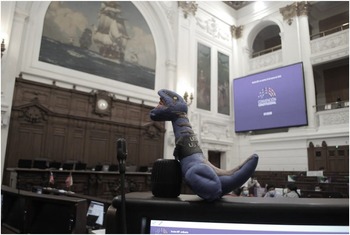
Secondly, the presence of a Tyrannosaurus in the Hemicycle (Fig. 2) represents a desire for an existential restart, a creatio ex nihilo, where actors imagine themselves to be building another world. This picturesque, even bizarre, figure allows us to shed light on the power of the “burlesque” within popular constitutional imagination. This “anti-bureaucratic” set of character types populates utopian constituent imaginaries, as they seek to bring about a new world (Graeber Reference Graeber2015: 183). In this light, as a device through which a new world is built upon “a blank slate,” we might think of constitutional transformations as processes of “political cosmogony” (Holbraad Reference Holbraad2017: 18).
The dinosaur under the Hemicycle.

By comparing the trajectories of subjects from similar socioeconomic backgrounds, this section reaches conclusions similar to those obtained by Feddersen et al. (Reference Feddersen, Wilenmann, Cavieres and Gambardella2024: 87), “indicating that class plays a more pronounced role in shaping frames related to institutional dissatisfaction and legal consciousness in Chile.” The analysis further reveals similarities across subjects, suggesting that legal consciousness is “a fully collaborative phenomenon” (Chua and Engel Reference Chua and Engel2019).
By highlighting the specific experience of subjects who started participating in protests and were thereby empowered, fueling a collective belief that another world was possible, this section documented not only the relationship between individual and collective legal consciousness but also how participation in protests can instantiate a counterpower rooted in imagination (Graeber Reference Graeber2004: 35–7). Acknowledging this dynamic reinforces the findings of Hilbink and Ramos (Reference Hilbink and Ramos2024), which suggest that participation in the massive protests of Chile’s social uprising may have had an empowerment effect on those who took part, opening new spaces for individuals to reimagine their relationship with the state and to demand that institutions address injustice and inequality.
“I’m honored that i don’t have a college degree”
In the meetings I had with Grandón, the quest for decent treatment and resistance to abuse summed up her normative expectations. The fundamental law’s duty was to promote dignity. In her view, what the new constitution meant to express were the sentiments of many whose utopia rested on “equal treatment,” that the rules are the same for everyone, that “it shouldn’t matter who your parents are,” that everyone must be treated equally by the “system.” Her normative claims reflected the perception of an unequal distribution of opportunities and rewards, in phenomena such as pituto (“nepotism”), reminding us that liberal constitutionalism is unthinkable without equality (Rosenfeld Reference Rosenfeld1995). The pobladora demanded recognition as a full citizen based on the ideals of equality and participation. Constitutional government, she believed, sought to protect the individual from the abuses of economic power. In her opening speech in October 2021, she stressed
I want a Chile where the great inequalities disappear.… We don’t want anything for free, because, for the working class, nothing has ever been free. But what we do want is a fair country, where, regardless of your place of birth, your surname, or your networks, there are the same opportunities to emerge, to have a decent life, and be happy.
Grandón is the pobladora who took to the streets to demand “more dignity and opportunities to live” (personal communication, April 2022). The struggles in the name of “dignity” underscore that the condition of being a political subject is not assured (Taylor Reference Taylor2023: 14). In Latin, as Cicero asserted, “dignitas” resonates with “authoritas” (Safatle Reference Safatle and Bottinelli2024). Similar to Feddersen et al. (Reference Feddersen, Wilenmann, Cavieres and Gambardella2024: 90), we found that, like other Lo Hermida inhabitants who share an identity tied to resistance during the dictatorship, Grandón rejects state authority and adopts an anti-hegemonic legal consciousness. In her eyes, this also translates into a grammar that takes the form of an irreverent, even festive, attitude toward power as an individual resource, based on poking fun at formal institutions.
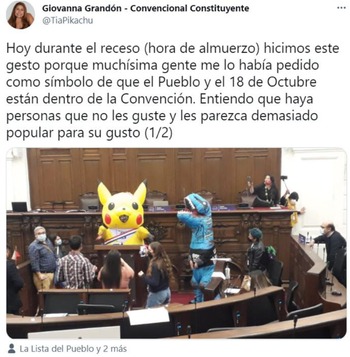
On her Twitter account on July 29, 2021, Grandón referred to the moment when she and Deputy Andrade entered the plenary dressed in their outfits as “a symbol that the People are in the Convention” (Fig. 3). The scene was weaponized by right-wing deputies who implied that independent candidates did not have the skills necessary to participate in a democratic decision-making setting. In another small scene that occurred weeks later, we witnessed a clash between the pobladora and a lawyer concerning the value of her presence in the constitution-making body.
Montealegre: Regarding Giovanna Grandón, who, as she states, intervenes quite a little, I’d appreciate it if, when she intervened, she did so based on legal grounds and not slogans for the gallery. That perhaps gave her a lot of credit while she was Tía Pikachu, in street demonstrations, but here you are already a constitution-maker, and you are being paid to do a serious job. So, I’m asking you to raise the debate a bit about that.
Grandón: I’m honored that I don’t have a college degree. I’m honored to represent the great majority of the people. And there’s a reason I’m here. To bring the desires and the experience of those of us who are the commons, who have always been exploited by this system that she defends. So, I don’t care, let her talk, … if I must come wearing the costume, that is how the people got to know me. I went out to protest, peacefully, and thanks to that, all of us are here …
Grandón’s Twitter account.

By asking Grandón to “raise the debate a bit,” so that she sized up to her level, Ms Montealegre bases her argument on the position she occupies in a hierarchical chain of subordination in which the central subject is the legal attorney. Thus, she tries to fix the scope of “legitimate speech” in professional gobbledygook, asking Grandón to express greater “linguistic competence” in her interventions. In the background of the Zoom meeting session, from Montealegre’s office, the scene offers a clue about the material object that defines the required competence: the lawyer’s bookshelves displaying a collection of legal doctrine textbooks.
In turn, from within the Hemicycle, Grandón invokes a “civic worth” (Boltanski and Thévenot Reference Boltanski and Thévenot2006: 107) to strengthen herself against criticism, legitimizing herself for having been elected by popular vote. Her worth does not depend on any sort of credentials or opinions. By invoking the collective interests of the “commons” who protest, she promotes the extraordinary, spontaneous force of “the people.” By this token, she could not be forced into silence.
Currently, Grandón is studying social services. At the time I met her, she regretted that the language used in constitution-writing was inaccessible to women who lacked higher education. In contrast, the collection of legal textbooks above Montealegre’s head serves as evidence of her authoritative position in this field. In the legal field, as Latour (Reference Latour2010: 236) asserts, people are objective in a subjective sense – that is, their objectivity draws on “a particular form of subjectivity.” For one cannot embody the law without adopting a certain form of enunciation – “objectivity,” as Latour summarizes, “is sustained entirely by the production of … a bodily hexis” (ibid.). The “micro-procedures” that produce this subjective-objectivity include a mood of distance and indifference, a quality of deportment, adjusting a tie, and posing in front of bookshelves.
But Grandón differs. She is not shielded from bias because she is subjectively objective. Rather, she must postulate her grammar as “a foreign language in a dominant language” (Deleuze 1989: 221). So, by questioning her capacity for exercising “legal language,” Montealegre casts doubt on Grandón’s ability to participate in democratic decision-making. The situation unveils a clash between two different forms of utopianism – one that, in its emphasis on creative synthesis and improvisation, sees freedom basically in terms of play, and another that sees freedom ultimately as the ability to reduce all forms of power to a set of clear rules (Graeber Reference Graeber2015: 204).
The critique that Grandón was “being paid to do a serious job” was anchored in a veiled classist discourse that upholds a merit-based social order. Having asked her about this offensive speech, I was able to explore how Grandón connected this experience with the sort of harassment she was used to while working as a domestic servant. Elected through a gender quota, Montealegre in turn demonstrates that such electoral mechanisms do not necessarily represent gains for women of all social classes and may instead reinforce power differences among women themselves. The situation is governed by a logic of “distinction” (Bourdieu Reference Bourdieu1984), sustained by the hierarchical position of the attorney in the social domain. Certain individuals, in order to argue their causes in public, must justify their own ability to justify themselves (Boltanski and Thévenot Reference Boltanski and Thévenot2006: 38). And so, “being a subject” is not a taken-for-granted worth in this domain. On the contrary, it is an element in dispute, which demands an epistemological and moral work of personal qualification from actors who are still “sub-citizens” (see Ruiz-Tagle Reference Ruiz-Tagle2021: 4).
Discussion
Many of the scholars working on the Chilean Constitutional Convention have produced sophisticated accounts that raise concerns about the interplay between party politics and the participation of independents (Tom and Isabel Reference Tom and Isabel2024: 187), weak party leadership (Larraín et al. Reference Larraín, Negretto and Voigt2023), and a lack of “ideological balance” (Issacharoff and Verdugo Reference Issacharoff and Verdugo2023). Experts often remark that independent deputies were ill-equipped to participate in constitution-making, pointing to the existence of “pernicious procedures” that maximized fragmentation, contending that it had been disruptive to building “inter-elite agreements” (Larraín et al. Reference Larraín, Negretto and Voigt2023; Tom and Isabel Reference Tom and Isabel2024). Indeed, current constitutional scholarship on Chile has focused mostly on procedural rules, emphasizing how the presence of ordinary citizens, as members of “ephemeral” civil society groups (Landau and Dixon Reference Landau and Dixon2024), contributed to the process’s failure. While this body of work has critically examined the flaws behind the failure of Chile’s constitution-making process, the present work yields different results by employing ethnographic methods. This is not to deny the validity of such scholarship, but to open up possibilities for new scholarly directions in understanding whether ordinary citizens’ involvement in constitution-making is desirable.
To begin with, ethnographic observation reveals that constitution-making is not merely a technical exercise in drafting legal documents, “in the service of a social engineering that one needs to consider as coldly as a butcher’s knife” (Latour Reference Latour2010: 272), but also a deeply imaginative process that changes how ordinary citizens talk about everyday grievances that which translate into rights talk (Taylor Reference Taylor2023: 9–12). Second, the ethnographic insights highlight how marginalized actors, often dismissed as politically immature, engage in constitution-making productively, as they bring valuable experiences to the table that are often overlooked by proceduralist approaches.
While I do not deny the possibility that ordinary citizens would benefit from political training, I do want to suggest that liberal constitutional scholars’ insistence that independent deputies, before becoming legislators, need to be taught how to function under democratic procedures may be somewhat misguided. As the participants in the process became more aware and active users of legal ideas, as ethnographers have noted in other contexts, they also became increasingly aware of the social and institutional constraints on their efforts (Silbey Reference Silbey2005: 356). This pattern is consistent with other findings, whether in public spaces, workplaces, or courthouses. The formal apparatus promises to dismantle ascriptive social hierarchy but instead delivers its reinscription (Berrey et al. Reference Berrey, Nielsen and Nelson2017). Even democratic procedures can be pernicious due to power disparity, given that the absence of certain socioeconomic prerequisites undermines the very possibility of argumentative engagement, as “excessive inequality roots a kind of power hierarchy and self-subordination that cannot be dissolved by deliberation” (Mendes Reference Mendes2014: 37).
This insight aligns with other studies that view external hierarchies and unequal power relationships as significant influences on individual legal consciousness (Nielsen Reference Nielsen2000; Chua and Engel Reference Chua and Engel2019: 346). In a study of unsuccessful housing applicants in the UK, Cowan (Reference Cowan2004: 942) looked into how, on the one hand, many applicants wanted above all “to be treated with dignity,” while, on the other hand, many found that they were “further marginalized by the process.” Our findings align with Cowan’s (Reference Cowan2004: 943) observation that “the inability to participate in a meaningful way in the process was also sometimes suggested by the interviewees to be because of the construction of themselves as unable to participate.”
In Chile, as Richards (Reference Richards2004: 122) described, “the reasons for pobladoras’ lack of a broader public voice are linked in part to the fact that they were not considered viable participants in setting priorities under democracy.” The portrayal of Ms Grandón as a radical leftist, with the characterization of the electoral pact through which she was elected as an eccentric platform (Fábrega Reference Fábrega2022; Issacharoff and Verdugo Reference Issacharoff and Verdugo2023: 51), contributes to the discursive construction of pobladoras as invalid participants in determining the substance of the constitution. By suggesting that actors like her did not have the skills to participate in constitution-making, this diagnosis puts the responsibility for the process’s failure on the shoulders of popular actors and constructs them as invalid participants in constitution-writing. In effect, these groups are intellectually humiliated, creating the subjective conditions for the rejection of constitutional utopia and the acceptance of legal hegemony (Mattei and Nader Reference Mattei and Nader2008).
As the analysis suggests, working-class citizens were aware of their interests and often had a skeptical view of the constitution, believing that even if the draft passed, its implementation would suffer sabotage. They were also aware that ordinary people’s participation in constitution-making depended on a context of interpersonal respect, in collaboration with specialists, to be fruitful. But their experience showed otherwise. Participatory constitution-making was designed to help people like Giovanna Grandón, but when it took place, the results were criticized. Experts then assumed the guise of comic-book superheroes – in a symbolic rivalry with Pikachu – presenting their views as unquestionably authoritative.Footnote 7 Thus, the interpretive hypothesis for the current diagnosis of constitutional failure in Chile is that it is simply a reaction to how ordinary citizens did not listen to comparative constitutional law scholars.Footnote 8 This tension between legal professionals and working-class constitutional drafters points to broader questions about the interplay between the “integrative function of ideology and the subversive function of utopia” (Loughlin Reference Loughlin2015: 14).
The diagnosis that ordinary people lack clear preferences, or even civic virtue, is not just unfounded. More than that, it takes people who are already bearing the costs of institutional failure and inequality and tells them that those failures are their fault. The remedies that follow from that diagnosis reveal its absurdity: the supposed absence of “clear preferences” is taken to justify less participation, paving the way for a second constitution-making body that swung too dramatically to the right, ultimately locking up the transformative process in Chile.
At the end of the day, the tension that, during the democratic transition period, had been prevented from breaking into open political expression came, during the constitution-making process, not just to expression but to sharpen in a dramatic, even bizarre, way. Rather than a grand coming together in the name of a “house of all,” there was, in its name, a grand falling out, in the form of a reinvigoration of neoliberal subjectivity. Participatory constitution-making thus risks exacerbating political tension rather than encouraging actors to recast “constitutional enterprises beyond the horizons of capitalism and liberalism” (Oklopcic Reference Oklopcic2018: 276).
In this light, the discussion of our findings illustrates the reification of structural asymmetry through participatory constitution-making. In this way, even inclusive procedures might give voice to actors generally not associated with rights talk, but in a way that may reify rather than redress preexisting disadvantage. In response to the rejection of the draft that contained rights particularly benefiting women like her, Grandón revived the pobladoras tradition of community solutions, such as “survival groups” (Hardy Reference Hardy1986: 202). By the time this study was conducted, she had organized the Union of Independent Women Workers from the Metropolitan Region, pursuing objectives such as offering personal development workshops and preparing women for job opportunities. In Chile, due to the dictatorship’s broader cultural objective, many impoverished women are reluctant to identify themselves as pobladoras (Richards Reference Richards2004: 109). Their activism has declined since the democratic transition period because the organizations that struggled against Pinochet and linked their activism to socioeconomic rights have largely dissolved.
Nevertheless, as Pikachu engaged more deeply with middle-class feminists, their discourses of rights provided her with tools not only to reconsider her place in the world but also to connect her concerns – such as rental prices and household necessities – with class struggle discourses. While I witnessed this association, I observed the transformation of her legal consciousness both before and after the constitution-making process. On the other hand, in a certain way, Grandón’s discourse still does not follow class struggle lines. The subject she embodies is not “the conscious vanguard” of the partisan intellectual, nor is it the archetypal rational actor of political science. That is, Grandón’s political identity does not appear to be attuned either to theories of class conflict or to the pursuit of material interests – generating the feeling that “the Convention was far from representative of Chile’s ideological spectrum” (Issacharoff and Verdugo Reference Issacharoff and Verdugo2023: 53).
With this in mind, we can assimilate Grandón’s legal consciousness hybridity to the hybridity of the outcome that the process brought about. While deploying critical judgments toward social inequality, her conception of justice also incorporates the acknowledgment of merit: “Because, with a lot of effort, I got ahead (‘salí adelante’)” (personal communication, March 2022). The notion of getting ahead by one’s own efforts summarizes a form of “entrepreneurial uprising,” which mirrors a feeling of being abandoned and an absence of institutional support. Being “self-made” represents a critical gesture demanding the cultivation of individual competences grounded in diverse skills (Araujo and Martuccelli Reference Araujo and Martuccelli2015). Pikachu then expresses a “deep ambivalence” (Holbraad Reference Holbraad2018: 478), identifying herself with an entire project of reinventing democracy, encouraging rather than inhibiting participation and experimentalism, while simultaneously presenting a psychological orientation toward a “bourgeois legal consciousness.”
Final remarks
The findings call for further exploration of how constitution-making not only expands what citizens think about the law but also unfolds within preexisting institutional and social arrangements that decisively determine whether those expanded normative horizons endure within participatory procedures. In so doing, the article advances the field both theoretically, by tying debates on how legal consciousness can reshape ordinary citizens’ understanding of what they can achieve through constitutional law, and methodologically, by adopting an ethnographic approach to this issue.
The 2019 uprising did not simply provide the context in which a new (imagined) constitution became intelligible – it temporarily transformed the normative horizons through which ordinary citizens interpreted their grievances as related to the law. In this way, experiences of political lockout, structural inequality, and institutional abandonment became connected to a vocabulary of rights, dignity, and constituent power. We can thus associate the transformation of legal consciousness with “a general subjective intensification” (Badiou Reference Badiou2012: 90) that influences which issues people see as deserving inclusion in the fundamental law. In this light, the emergence of constituent subjectivity depends on the types of affects that circulate within social ties. Constituent subjectivity can thus be taken ethnographically not as a “brute fact” but as an “affective resonance” (Abélès and Badaró Reference Abélès and Badaró2015) – not as a “thing” in the world, but as a mode of being affected, particularly through strange mixtures of anguish and popular joy, through which law forms consciousness and influences the durability of utopian normative horizons. As the Convention became connected to the experiences of ordinary citizens, affects such as anger, solidarity, and enthusiasm circulated through social ties, giving constituent subjectivity different meanings. At the same time, the institutional experience of constitution-making confronted these concerns with technical gobbledygook and socioeconomic hierarchies. The constitutional moment therefore changes not necessarily the law itself, but the boundaries of what people imagine law can accomplish. Yet the conditions that determine how long these expanded horizons endure – and how they subsequently contract as legal consciousness rises and fades – require further analysis. Even so, the emergence of constituent subjectivity can highlight both the role of utopia in constitution-building and the limits and possibilities of imaginative counterpower to foster new forms of collective agency (Graeber Reference Graeber2015).
As we have seen, Missy Pikachu’s presence within the Constitutional Convention not only works symbolically to convey that the social upheaval has entered the constitutional engine room but also instantiates an impulse toward the mutation of affects. When she entered the constitution-making body, her concerns about housing and inequality, through her encounter with feminist movements and other participants, met new vocabularies. From this perspective, Pikachu belongs to a broader symbolic repertoire in which an apparently innocuous image can become a catalyst, from the streets of Turkey to the transnational networks associated with the Milk Tea Alliance. In Chile, Pikachu did not merely symbolize resistance, converting a familiar pop icon into a vehicle for confronting authoritarianism, but also helped translate the social upheaval into a constituent imaginary, connecting ordinary experiences of inequality to the possibility that social relations could be remade through the law. Figure 4 thus illuminates how symbols can catalyze the shift of legal consciousness during constitution-making moments by making new political futures imaginable – and, in this case, compounds the mythology of constituent power.
Awakening constituent subjectivity.

Finally, though one can see utopian legalities throughout the constitution-making process, they can lead to a sterile, purely imaginative perspective, “out of touch with the reality below” (Tamanaha Reference Tamanaha2004: 253). This failure rests on overlooking the internal relation between thinking about ideals and thinking about institutions (Unger Reference Unger1996: 139). Put differently, people talk of dignity and rights: sure, but how can they be put into action here and now? There is a moment when constituent subjectivity must take a step toward institutional experimentalism. At such moments, the question of power, of what form it will take, is inevitably posed. And one cannot pose this question with ideals derived only from “imaginative counterpower.” One must derive it from a link between the realities of power and conscious aspirations, to provide the detailed institutional arrangements for the realization of those utopian imaginaries.
Acknowledgements
I am grateful to David Landau, Karime Parodi, Elisabeth Perham and David Cowan for their generous and insightful comments on earlier versions of this manuscript. I also thank the participants in the Law and Society Association Early Career Workshop and those in the ICON-S Constitution-Making Interest Group, for their thoughtful feedback.
Financial Support
This research was supported by the Global Challenges to Democracy (GCD) Research Grant and the Internationalization for Doctoral Students Project UCH-1866 at the University of Chile.
Conflicts of Interest
The author declares that there are no conflicts of interest associated with this research.