





Introduction
On March 16, 2020, South Korea revised its age of sexual consent from 13 to 16 for the first time since 1953, following public outrage over a massive digital sexual exploitation case. Yet, this landmark reform belied deep divisions within legal mobilization. While some feminist organizations welcomed it as essential protection for vulnerable youth, others opposed it as substituting for, rather than advancing, a more transformative shift toward consent-based rape law. This divergence contrasted sharply with coalitional unity in years of collaborative litigation over sex crimes, where feminist organizations maintained a unified front despite different constituencies and competing understandings of sexual violence law. How did the same movement transition from unity to fragmentation?
This puzzle reveals a broader theoretical question that legal mobilization scholarship has not fully addressed: Why do social movement organizations united around shared goals diverge when legal institutions shift? Scholars have examined how legal mobilization unifies movements by creating common objectives and collective identities (Arrington Reference Arrington2019; Chua Reference Chua2012; McCann Reference McCann1994; Polletta Reference Polletta2000; Scheingold Reference Scheingold1974), and how it divides movements through intra-movement conflict and selective incorporation of demands (Adam Reference Adam2017; Albiston Reference Albiston2011; Cummings Reference Cummings2018; Leachman Reference Leachman2014; NeJaime Reference NeJaime2011; Rubenstein Reference Rubenstein1996; Vanhala Reference Vanhala2011). Yet, while scholars have recognized the importance of different legal institutions and their dynamics beyond courts (Boutcher and Chua Reference Boutcher and Chua2018), most studies have centered on litigation. How shifting institutional contexts, such as between litigation and legislation, reshape coalition dynamics remains undertheorized.
This paper argues that the mode of legal mobilization shapes whether organizational identity produces unity or fragmentation: litigation enables organizations with different identities to bracket the tensions arising from distinct ideological orientations and constituency commitments, while legislation forces these differences into explicit conflict. Social movements actively engage both litigation and legislation, strategically weighing the benefits and costs of each. Litigation can sometimes yield visible wins, but legislative victories tend to offer greater durability and institutionalization (McCann Reference McCann1994). The two fields also differ in their internal logics. While litigation involves framing grievances centered on particular issues (McCammon and Beeson-Lynch Reference McCammon and Beeson-Lynch2021; Ziegler Reference Ziegler2010), legislation demands a broader rationale to be applied across cases and electoral bases (Wilson and Gianella-Malca Reference Wilson and Gianella-Malca2019; see Chua (Reference Chua2017) for collective litigation yet divergent constitutional challenges). The opportunity structures shaping each field diverge as well. Social movement in litigation is constrained by legal opportunity structures (LOSs), such as available law, funding, and judicial receptivity (Andersen Reference Andersen2005; Hilson Reference Hilson2002; Vanhala Reference Vanhala2012), whereas social movement in legislation is more responsive to political opportunities such as partisanship, institutional gatekeeping, and public opinion (Burstein and Linton Reference Burstein and Linton2002; Soule and Olzak Reference Soule and Olzak2004).
The South Korean statutory rape case in the 2010s offers a compelling case for understanding legal mobilization dynamics beyond this specific context. First, as a statute-based legal system in Asia where legislation rather than judicial precedent represents the primary site for durable legal change (Arrington and Goedde Reference Arrington and Goedde2021), South Korea illuminates dynamics particularly salient in contexts where movements cannot rely on case law to fill statutory gaps. Second, statutory rape law reform represents a critical case for examining protection-versus-autonomy tensions that have long divided feminist movements globally, from 1980s “sex wars” over pornography regulation (Abrams Reference Abrams1995) to contemporary debates over sex work and sexual violence (Halley et al. Reference Halley, Kotiswaran, Shamir and Thomas2006). At the heart of these tensions lies a recurring question: whether legal protection should rest on categorical status, such as age, or on the possibility of genuine consent within a given relationship or context (MacKinnon Reference MacKinnon, Conboy, Medina and Stanbury1997; Munro Reference Munro2017). Because statutory rape law resolves this question categorically, reforming it inevitably reopens the more foundational question of what counts as valid sexual consent, and for whom.
This paper examines how South Korean feminist organizations mobilized competing legal reform strategies around statutory rape legislation, despite their shared commitment to multiple litigation cases. First, I develop a framework linking organizational identity, political opportunities, and institutional dynamics across litigation and legislative fields. Second, I examine the contested terrain of statutory rape law reform, situating South Korean debates within broader feminist tensions over protection and autonomy. Third, I trace how feminist organizations maintained coalitional unity through collaborative litigation in two cases while carrying latent disagreements. Fourth, I analyze how political opportunities, particularly partisan ideology and institutional gatekeeping, shaped the legislative field and how a triggering event opened a legislative window. Fifth, I demonstrate how the same organizations diverged in the shifting legislative landscape, interpreting age-raising reform as either complementing or displacing a more transformative, consent-based reform. The conclusion discusses implications for understanding how institutional context shapes movement coalition dynamics across legal systems.
Legal mobilization and movement factions
Organizational identity and perceived political opportunity
Scholars have examined how legal mobilization unites or divides social movements. Legal mobilization fosters unity by framing judicial failures and specific injustices as a common enemy, promoting early-stage cohesion (McCann Reference McCann1994; Scheingold Reference Scheingold1974). Litigation’s concrete goals provide short-term objectives that enable diverse or isolated organizations to collaborate and build collective identities (Arrington Reference Arrington2019; Chua Reference Chua2012; Polletta Reference Polletta2000).Footnote 1 Yet, legal mobilization can also divide movements. While existing research has shown that both internal identity and external opportunities matter for legal mobilization, their interaction in shaping strategic divergence within movements remains underdeveloped. This paper illuminates this mechanism, explaining how constituency-based organizational identities lead to divergent interpretations of political opportunities, resulting in strategic fragmentation in legal mobilization. I define coalitional unity as organizations’ convergence on shared legal demands and advocacy strategies, rather than full ideological consensus or formal organizational integration.
Scholars have examined how social movements adapt their frames and tactics based on organizational identities and political opportunities. On the one hand, organizational identities are shaped by ideological orientations and constituency relationships. McCammon (Reference McCammon2012: 48) defines organizational identity processes as the ways in which groups’ core political values and ideological orientations shape their framing choices, such as their agendas, tactics, and public messaging (see also Haines Reference Haines2006). Constituency relationships also shape organizational identities, as members’ shared interests and experiences often provide the foundation for collective identity formation (Taylor and Whittier Reference Taylor, Whittier, Morris and Mueller1992). Crucially, these two dimensions interact: constituency ties may reinforce or reshape organizations’ ideological commitments, while ideological orientations influence which constituencies organizations prioritize and engage (Hines Reference Hines2020; Pearce et al. Reference Pearce, Erikainen and Vincent2020). For example, organizations serving the same population, such as women or teenagers, may construct different understandings of their constituency’s needs. These intertwined sources of organizational identity lead groups to develop distinct frames regarding the same legal reform.
On the other hand, political opportunity theory has been central to understanding when and how social movements mobilize for legal change (McAdam et al. Reference McAdam, McCarthy and Zald1996). Political openings can enable cooperative legal and policy advocacy, while political closures can facilitate extra-institutional actions and transnational networks (Moghadam and Gheytanchi Reference Moghadam and Gheytanchi2010). However, political opportunity does not operate as objective external conditions that movements simply respond to (Goodwin and Jasper Reference Goodwin and Jasper1999). Rather, social movement organizations and activists mediate how political opportunities translate into specific litigation and advocacy choices (Lemaitre and Sandvik Reference Lemaitre and Sandvik2015; McCammon and Beeson-Lynch Reference McCammon and Beeson-Lynch2021; Pedriana Reference Pedriana2006; Vilaça Reference Vilaça2024). Political opportunities can be interpreted differently across organizations within the same movement, with what appears as an opening to some actors representing a closure to others (Meyer and Minkoff Reference Meyer and Minkoff2004). Suh (Reference Suh2011) documents how, amid democratizing political structures, Korean women’s organizations adopted a division of labor between contentious and institutional tactics (see also Lee (Reference Lee2022) for activists turned politicians and national solidarity infrastructure in post-authoritarian Korea). The 1987 dissolution of the Korean Women’s Association for Equality (Pyong-Woo-Heo) similarly reflected competing assessments of how to engage a seemingly favorable shift in political opportunity, dividing activists who prioritized extra-institutional democratization struggles from those advocating for an independent, legally recognized women’s organization (Chung Reference Chung1997). This perspective requires examining how organizations assess their legal and political landscape, evaluate alternative activities, and mobilize resources (Vanhala Reference Vanhala2012).
The dynamics between movement factions, shaped by organizational identity and political opportunity, play a critical role in legal mobilization, producing both radical flank effects and associated costs. The radical flank effect, where the presence of radical organizations makes moderate demands appear more reasonable, has been documented across movements (McCammon et al. Reference McCammon, Bergner and Arch2015). However, scholarship has also examined how legal mobilization can generate intra-movement dissent and marginalization of radical factions (Albiston Reference Albiston2011; Cummings Reference Cummings2018; Rubenstein Reference Rubenstein1996). Legal victories may channel movement resources toward more conservative goals, potentially undermining broader transformative agendas (Adam Reference Adam2017; Leachman Reference Leachman2014). Litigation success may also fracture unified coalitions by binding dissenters or sparking debates over strategic costs (NeJaime Reference NeJaime2011; Vanhala Reference Vanhala2011). Furthermore, the expected radical flank effects within movement factions depend on specific political opportunities. When state actors selectively incorporate movement demands, they may adopt only moderate claims while marginalizing radical organizations and their transformative agendas (Barone and Rosenkranz Reference Barone and Rosenkranz2025).
Legal mobilization in litigation and legislation
Legal mobilization scholarship has concentrated heavily on litigation strategies and court access (Burstein Reference Burstein1991; McCann Reference McCann1994; NeJaime Reference NeJaime2011; Scheingold Reference Scheingold1974; Vanhala Reference Vanhala2012). Yet, the impact of litigation is amplified in combination with protest and legislation (Cichowski Reference Cichowski2007; Edelman et al. Reference Edelman, Leachman and McAdam2010; Hilbink Reference Hilbink2004; McCann Reference McCann1994). Social movements deploy both strategies as complementary tactics, frequently alternating between them based on their respective costs and benefits. For example, the U.S. LGBT movement lawyers developed a legislative strategy to aid future litigation and litigated to advance and protect legislative gains (Cummings and NeJaime Reference Cummings and NeJaime2009). While litigation offers agenda-setting and public salience, legislation provides durable policy change and institutionalized norms (Barnes and Burke Reference Barnes and Burke2020; Sala Reference Sala2026). More recently, scholars have examined legal mobilization beyond courts, including relationships between courts and legislatures, executives, and other professional fields (Barnes and Burke Reference Barnes and Burke2020; Boutcher and Chua Reference Boutcher and Chua2018; Lehoucq and Taylor Reference Lehoucq and Taylor2020; Vanhala Reference Vanhala2018a). This broader institutional lens invites further investigation into how movements engage differently in litigation versus legislation, and why these institutional contexts might produce divergent coalition dynamics.
To clarify what legislative mobilization entails, this paper defines it as the process of advocating for new laws or legal reforms through legal norms, narratives, and rights discourses, following Lemaitre and Sandvik (Reference Lemaitre and Sandvik2015) and Adam and Cooper (Reference Adam and Cooper2017). Legislative mobilization might appear synonymous with conventional lobbying, already well-studied in political interest group research. However, legal mobilization scholarship offers distinct analytical leverage for studying legislative advocacy. Unlike conventional lobbying, which focuses primarily on interest aggregation and instrumental rights claims, legal mobilization involves contesting legal meaning, categories, norms, and symbols (Lemaitre and Sandvik Reference Lemaitre and Sandvik2015; McCann Reference McCann1994; Pedriana Reference Pedriana2006; Taylor Reference Taylor2018; Vanhala Reference Vanhala2012). This conceptual distinction matters: regardless of immediate legal outcomes, legal mobilization may serve as a tool for movements to expose systemic shortcomings and expand the space for future advocacy (Vanhala Reference Vanhala2012). Moreover, legislative mobilization focuses on the explicit invocation of formal legal institutions and discourse, maintaining conceptual boundaries with diffuse legal consciousness or framings (Lehoucq and Taylor Reference Lehoucq and Taylor2020).
The institutional characteristics of litigation and legislation shape the conditions under which social movements engage with law and pursue legal change. Compared to expert judgment and bureaucratic legalism, both are more accessible and participatory modes of policymaking (Kagan Reference Kagan2001), making them viable fields for social movement engagement. Between the two, litigation is the more formally structured: decisions are bounded by procedural rules and constraints, whereas legislation is negotiated and mediated. This formal structure gives litigation a distinctive advantage at early stages of the policy cycle, when problem definition, agenda-setting, and mobilization are crucial, particularly when other branches of government fail to act (Hilson Reference Hilson2002; Jeb and Burke Reference Jeb and Burke2015; Vanhala Reference Vanhala2018a). Over time, however, litigation may produce outcomes that are uneven and inconsistent across cases, and structurally favorable to repeat players with greater legal resources (Barnes and Burke Reference Barnes and Burke2020; McCann Reference McCann1994). This structural unevenness is further compounded by institutional context: in the United States, where court dominance over other branches constrained the returns of legislative pressure, labor movements had more limited influence compared to their British counterparts, who could exert pressure through a Parliament-centered policy process (Cichowski Reference Cichowski2007).
Litigation and legislative mobilization also differ in their dependence on political opportunities. Litigation mobilization operates within relatively independent LOSs, where access to laws on standing, state legal funding,Footnote 2 and judicial receptivity create pathways for change (Andersen Reference Andersen2005; Hilson Reference Hilson2002; Vanhala Reference Vanhala2012). As Chua (Reference Chua2017: 436) notes, “LOS conditions are specific to litigation,” distinguishing it from other forms of political mobilization. This perception of litigation as a distinct mode of action further stems from liberal legalism, the notion that lawsuits operate outside the realm of political contestation (Levitsky et al. Reference Levitsky, Yeh and Armstrong2024; Silbey Reference Silbey2005). As such, litigation can bracket organizational differences within a movement by concentrating mobilization around the specific demands of a case. Legislative mobilization, in contrast, depends heavily on political opportunities, such as partisan control, institutional gatekeeping, public opinion, and triggering events (Burstein and Linton Reference Burstein and Linton2002; Soule and Olzak Reference Soule and Olzak2004). Because it is more exposed to competing political demands and policy priorities, legislative mobilization surfaces latent divisions among movement factions over representation, definitional stakes, and strategic priorities that litigation had kept beneath the surface. As Arrington and Moon (Reference Arrington and Moon2020) demonstrate in the Korean disability rights movement, coalitional unity in legislative mobilization must be actively brokered rather than assumed, requiring sustained intervention to contain factional conflict.
The interplay between litigation and legislation further shapes coalition dynamics. Litigation can generate legislative momentum through judicially articulated norms integrated into reform (Sala Reference Sala2026), or through NGOs using favorable rulings to reshape legislative opportunity structures (Cichowski Reference Cichowski2007; Vanhala Reference Vanhala2018b). Courts may also expand the legal landscape more broadly, binding and clarifying existing law (Cichowski Reference Cichowski2007), and litigation victories can consolidate support for legislative reform by demonstrating the viability of a legal claim (Jeb and Burke Reference Jeb and Burke2015). Yet the transition from legal victory to legislative consolidation may be the moment at which coalition fragmentation tends to intensify. Broad consensus that sustains a movement through litigation may give way to splintering once legislation forces negotiation over specific regulatory terms. In the U.S. LGBT rights movement, after Obergefell v. Hodges, the movement faced new challenges over anti-discrimination legislation including religious exemptions (Ball Reference Ball2019; Levit Reference Levit2016). Similarly, the reproductive rights movement maintained broad consensus in defending Roe v. Wade against judicial erosion, yet fragmented when addressing specific legislative regulations (Kretschmer Reference Kretschmer2014; Rebouché and Ziegler Reference Rebouché and Ziegler2023). These cases suggest that divergent coalition dynamics across litigation and legislation are not incidental but structurally produced by the different institutional characteristics and their relationships to political opportunity.
Furthermore, the interplay between litigation and legislative mobilization deserves more attention given the dynamics of different legal systems, responding to the call for “a comparative analysis of the effects of legalization” (Barnes and Burke Reference Barnes and Burke2020: 483). Legislative mobilization assumes even greater importance in statute-based systems than in case-law systems, where litigation generates precedents that fill statutory gaps (Vanhala Reference Vanhala2018b). Legislation represents the primary avenue for legal reform, particularly in parliamentary systems, statute-based countries, or where courts are weak or conservative. Movements in statute-based systems cannot rely on court rulings to create durable legal change. Instead, they must prioritize statutory reform to embed new rights into codified law rather than through judicial interpretation. For example, in Korea, legal mobilization in the aftermath of authoritarian regimes has been pursued through both legislative petitioning by social movement organizations and public interest litigation (Goedde Reference Goedde and Yang2013). Over time, however, public interest litigation has declined in both frequency and significance, reflecting social movement groups’ limited organizational and mobilizing capacities, the rise of counter-movement litigation by conservative groups, and a strategic shift toward legislative petitioning as the primary avenue for reform (Hong Reference Hong2008).Footnote 3
Vulnerability, autonomy, and statutory rape in South Korea
Statutory rape law, situated at the intersection of age, gender, sexuality, and state power, offers an analytically rich site for examining both the vulnerability–autonomy divide within feminism and, more broadly, the dynamics of movement unity and fragmentation. South Korean Criminal Code Article 305(2) set the age of consent at 13 from its implementation in 1953 until 2020, when it was raised to 16.Footnote 4 The revision itself took place within a context of longstanding disagreement about the appropriate framework for understanding adolescent sexuality. From the protectionist perspective, minors are distinctively vulnerable, prone to attachment to perpetrators, disproportionately harmed by sexual violence, and at heightened risk of exploitation through commercial sex. Conversely, advocates of sexual autonomy argue that as the age of political participation declines, paternalistic intervention by the state and parents has become increasingly difficult to justify (Kim Reference Kim2019; Lee Reference Lee2025).
Similar fault lines have structured debates over statutory rape in other national contexts. Since the 19th century, the regulation of adolescent sexuality has been institutionalized through shifting logics, such as protecting patriarchal property interests, preventing HIV transmission, and constructing childhood as a sphere of innocence and immaturity (Egan and Gail Reference Egan and Gail2008; Pitre and Lingam Reference Pitre and Lingam2022). These debates reflect particular social anxieties rather than a stable framework of adolescent consent. Olsen (2018 [Reference Olsen1984]: 388) argues that sexuality debates encompass both “moralistic controls” and “violence and sexual aggression.” Critically, as Tambe (Reference Tambe2011: 121) observes, age of consent laws define “the age at which a society deems sexual relations acceptable” rather than adolescents’ sexual freedom. Moreover, some feminists argue that by delimiting sexual violation strictly in terms of age, statutory rape laws may obscure other forms of coercive sexuality involving power imbalances beyond the age criterion (MacKinnon Reference MacKinnon1989).
These legal disagreements are mirrored in a broader, enduring tension between protection and autonomy that has structured feminist legal advocacy internationally. The U.S. “sex wars” of the 1980s crystallized fundamental disagreements about pornography regulation, with radical feminists advocating for legal restrictions to protect women from exploitation while sex-positive feminists resisted state intervention on sexual freedom (Abrams Reference Abrams1995). Contemporary debates over feminist advocacy on sexual violence and prostitution/sex work reveal similar fault lines, with oppression and empowerment paradigms reflecting competing frameworks of protection versus agency (Halley et al. Reference Halley, Kotiswaran, Shamir and Thomas2006; Munro Reference Munro2017).
These debates over protection and autonomy are further linked to broader questions about how feminist movements define their constituency and establish political priorities (Hines Reference Hines2020; Pearce et al. Reference Pearce, Erikainen and Vincent2020). For example, recent tensions between women’s movements and LGBTQ+ activism reveal fundamental disagreement between social constructionist and essentialist approaches to gender, particularly regarding whether feminist politics should center on binary sex/gender distinctions and embodied experiences specific to biological females (Jacobsson et al. Reference Jacobsson, Karlberg, Korolczuk and Meeuwisse2024). These theoretical divisions manifest in activist discourse and policy debates: the contested terminology of “violence against women” or “gender-based violence” (Krook Reference Krook2020) reflects broader conflicts between gender-critical and intersectional feminist frameworks, as evidenced in controversies surrounding the UK Gender Recognition Act and transgender access to sex-segregated spaces (Hines Reference Hines2020; Jones and Slater Reference Jones and Slater2020).
The Korean statutory rape case echoes, yet also departs from, feminist conflicts elsewhere, particularly through its deployment of the concept of “sexual self-determination” (seongjeok jagi-gyeoljeongkwon) in institutional and social movement spheres. The concept condenses the theoretical problem: does sexual self-determination protect the adolescent’s right to sexual autonomy, or does adolescent vulnerability justify restricting it? The 2024 Constitutional Court ruling exemplifies the debates. The Daegu District Court, which initiated the constitutional review, argued that adolescents aged 13–16 possess sufficient maturity to exercise sexual self-determination under certain conditions. Some women’s advocacy organizations countered by reframing the same concept as adolescents’ right to develop sexual identity without external coercion (Chang Reference Chang2024). On June 27, 2024, the Constitutional Court unanimously upheld the revised Article 305(2) as constitutional.Footnote 5 The ruling prioritized the public interest in shielding adolescents from exploitation and framed sexual self-determination primarily as the adult’s restricted right to choose a sexual partner.
The statutory rape debate cannot be understood apart from the structural features of Korean feminist politics that have shaped how vulnerability and autonomy are institutionally legible as competing claims. Sexual violence in colonial and postcolonial Korean law was constructed primarily through the loss or damage of chastity (Hong Reference Hong2019; Park Reference Park2012), establishing an institutional and discursive foundation in which vulnerability of both adult and child victims became the organizing principle of victimhood. In discussions of adolescent sexuality, Korea has largely treated young people primarily as objects of control rather than as sexual subjects (Oh-Kim Reference Kim2017). In the 1980s, women’s organizations joined conservative religious groups and parents’ associations in opposing what they framed as adolescents’ distorted sexual desire. The 1990s saw debates over freedom of expression and youth protection, yet without a parallel engagement with adolescent female sexuality. By the 2000s, extensive media coverage of child sex crimes recast children and adolescents as a vulnerable population requiring protection from predatory male offenders (Oh-Kim Reference Kim2017).
As the women’s movement grew and increasingly engaged with issues of sexuality, this vulnerability–autonomy divide and the underlying question of the possibility of consent moved to the center of contestation. In the aftermath of the Special Law on Prostitution (2004), the feminist movement divided over whether prostitution constituted compulsory violence or voluntary labor (Oh-Kim Reference Kim2017). In the legislation process of the child protection law (2009), the central debate focuses on reclassifying minors involved in prostitution from “target” youth to “victim” youth (Park Reference Park2017). The sexuality and agency of teenage girls engaging in conditional datingFootnote 6 to navigate their financial circumstances and sexuality against moral stigma has also been examined (Kim-Goh Reference Kim-Goh2006). By the 2010s, a broader feminist campaign had emerged to transform Korean rape law itself from a coercion-based to a consent-based standard (Lee Reference Lee2019), forming an essential backdrop to the statutory rape debates examined later in this paper. Legal scholars debated whether Korea’s coercion-based definition, which requires proof of physical force or threat (Criminal Act Article 297Footnote 7), should give way to a consent-based standard. Opponents warned against both the overprotection of women presumed too vulnerable to refuse and the overcriminalization risked by an expanding judicial definition of coercion, while proponents argued the coercion requirement left many victims of nonconsensual but non-violent assault without recourse (Park Reference Park2024).
The feminist reboot of the mid-2010s intensified rather than resolved these divisions on vulnerability and autonomy. The tensions ran between an essentialist politics grounded in biological sex and an intersectional politics open to broader solidarities, as seen in the divergence of anti-sexual violence movements (Jang Reference Jang2023). With rising emphasis on security and safety, a certain strand of new feminism centers vulnerable victimhood as a foundational category of feminist politics (Choo and Lee Reference Choo and Lee2021). At the same time, Korean feminist movements have faced a fierce anti-feminist backlash, particularly from young men’s movements that frame gender equality policies as reverse discrimination. This polarized landscape has made feminist demands for stronger punishment of sexual violence politically contested in ways that complicate reform debates (Jung Reference Jung2024).
Although these internal differences were often kept beneath the surface, out of concern that making them visible would invite patriarchal backlash or fracture the movement, feminist scholars have assessed this diversity not as a liability but as a basis for richer and more substantive debate on the nature of women’s oppression and its solutions (Oh-Chang Reference Oh-Chang2004: 177). Indeed, the divisions documented across legislative battles, organizational splits, and movement strategies do not reflect random disagreement, but rather deep-rooted divergence shaped by distinct ideological orientations and constituency commitments that have solidified over decades of organizing within the Korean feminist movement.
Data and methods
This paper draws on participant observation, interview data, and archival analysis to examine divergent feminist legal mobilization strategies around statutory rape law reform in South Korea. The multi-method approach enables analysis of both internal movement debates and their interaction with litigation and legislative processes.
Participant observation and interviews
Between 2020 and 2021, I conducted 2 years of fieldwork at the Korea Sexual Violence Relief Center (KSVRC), which served as secretariat for the joint action committees responding to both the CEO case and Telegram case examined in this paper. KSVRC is one of the main anti-sexual violence organizations in South Korea that serves as a counseling center for victims and campaigns on issues ranging from legal mobilization to policy evaluation to educational programs. Two years of fieldwork at KSVRC provided access to secretariat operations, internal strategy meetings, and internal-organizational coalition deliberations. Within the scope of this paper, I participated in two key settings where internal debates surfaced: (1) a legislative task force meeting of the Telegram case joint action committee and (2) a workshop on statutory rape law reform, both held in 2020.
I conducted interviews with 30 activists and workers from 10 victim support organizations representing different constituencies and positions on raising the age of consent (Table A1). Organizations in Table A1 are classified as “for” or “against” raising the age of consent based on the views expressed by their interviewed staff, rather than on any formal institutional statement. Only one organization, Women with Disabilities Empathy, had published an official statement opposing the age increase.Footnote 8 Within each organization, all interviewees expressed views consistent with one another, and no interviewee’s individual views diverged from the position identified for their organization in Table A1. When I requested an interview with Women with Disabilities Empathy, the organization asked that its published statement stand in place of an interview, and this statement is accordingly included in the analysis section.
Among those who opposed or questioned age-raising, I interviewed 15 KSVRC activists. The concentration of KSVRC interviews (15 of 30) reflects KSVRC’s unique structural position as the main secretariat organization for both joint action committees examined in this paper. This organizational focus is balanced by breadth through interviews with activists from nine other organizations representing diverse constituencies, supplemented by extensive archival data capturing perspectives from other organizations. Also, I interviewed activists from Wetee, Aha, the Women’s Human Rights Institute, and the Korea Cyber Sexual Violence Relief Center. Wetee is a teen feminist network that emerged from the #schoolMetee movement in 2019, organizing programs for teen sexual rights and feminist educators. As a youth-led organization, Wetee centers the voices and experiences of teenagers themselves in debates over sexual rights policy. Aha, a center for youth sexuality culture at the Seoul YMCA, similarly prioritizes comprehensive sexuality education and youth agency. The Women’s Human Rights Institute of Korea, a government institute under the Ministry of Gender Equality and Family, supports victims of gender-based violence. The Korea Cyber Sexual Violence Response Center addresses digital sex crimes through platform monitoring and legal advocacy, bringing expertise in emerging forms of technology-facilitated exploitation.
Among those who supported the age-raising reform, I interviewed activists from Tacteen, E-loom, Sunflower Center, Korea Feminist Counseling Center, and Womenlink. Tacteen focuses on teen sex education and counseling, working closely with adolescents facing exploitation. E-loom provides counseling and investigations to women in prostitution, engaging directly with commercially sexually exploited women and youth. Sunflower Center operates 39 centers nationwide, serving over 27,000 sexual violence victims annually, offering medical and legal support in the immediate aftermath of assault. Korea Feminist Counseling Center emphasizes feminist counseling services to sexual and domestic violence victims, while Womenlink provides counseling and programs on health, labor, welfare, and anti-sexual violence issues.
All interviewees were women ranging in age from teens to their 50s, with work experience spanning 1–30 years in feminist activism and victim support. Interviews explored three main areas: (1) perspectives on statutory rape and raising the consent age, particularly regarding the 2020 legal revision from 13 to 16; (2) interactions with victims and understandings of vulnerability based on their organizational work; and (3) broader goals in feminist activism. This interview enabled examination of how organizational positioning and constituency experiences shaped legislative preferences. All interview transcripts were translated and analyzed in full by the author.
Archival data
First, I analyzed 14 bill proposals concerning Criminal Code Article 305 submitted between 2010 and 2020 (likms.assembly.go.kr/bill). For each proposal, I coded the sponsoring legislator’s party affiliation, legislative outcome, main provisions, and relevant events (Table A2). Bill proposals were identified through keyword searches for “statutory rape,” “13-year-old,” and “rape,” with the final dataset limited to proposals addressing Article 305’s age of consent provision.
Second, I examined 48 National Assembly committee meetings and hearing minutes that directly addressed the age of consent between 1996 and 2024 (dataset.nanet.go.kr/). Once a bill is proposed, a National Assembly standing committee examines its appropriateness before advancing it to a final vote in the plenary session. Minutes were coded by speaker position on the revision and specific arguments deployed. Figure 1 shows the distribution of relevant minutes by year, revealing concentrated attention in the 2010s and 2020s. Figure 2 displays minutes by committee type, with the Legislation and Judiciary Committee and Gender Equality and Family Committee accounting for the majority of discussions.
Number of assembly meeting minutes including discussion of sexual consent age by year.

Percentages of assembly meeting minutes by types of committees.

Lastly, this paper analyzed official statements and workshop materials from feminist organizations addressing statutory rape in the 2010s. Key materials included the 2016 Korea Association of Sexual Violence Relief Centers workshop proceedings, which centered on raising the consent age, and the 2020 KSVRC workshop materials examining consent frameworks. These internal documents revealed debates that remained largely invisible in public discourse.
Coding of interviews and archival materials identified recurring themes including adolescent vulnerability, enforcement challenges, concerns about criminalization of youth sexuality, and tensions between protection-oriented and autonomy-oriented frameworks. Analysis focused on how these themes mapped onto organizational constituencies and how internal movement debates related to political opportunities for legislative reform.
Latent tensions in collaborative litigation
Constituency-based perceptions of vulnerability and autonomy
The distinct constituencies that organizations served shaped their organizational identities, or their views on victims’ vulnerability and autonomy. Workers at a teen sex education center and a child sexual violence center emphasized children’s distinctive vulnerabilities in sexual violence. Minor victims may develop attachments to perpetrators, particularly when the perpetrator is a guardian or authority figure. A pediatric psychiatrist at the Sunflower Center explained that child sexual violence operates through mechanisms similar to other forms of child abuse, characterized by children’s “trusting attitude toward adults” and complicated by the potential loss of a guardian upon prosecution.
Others focused on distinctive sexual harms inflicted on minor victims. A director at a counseling center emphasized that harm from childhood sexual violence is “much more severe and long-lasting” than adult victimization. An activist at a teen sex education center shared her experiences supporting teenage victims in ongoing abusive relationships, expressing frustration with cases where victims were “unable to reject perpetrators’ requests or to end the abusive relationship in which they became indulged.” She explained that adolescents’ still-developing brains make them particularly vulnerable to such manipulation and that adult sexual involvement fundamentally disrupts healthy development:
There may be sexual curiosity or an equal sexual relationship between children of similar ages. They may make mistakes and grow together through disappointing sex experiences. Adults who engage sexually with children, however, involve them in relationships, such as sado-masochistic dynamics, that are fundamentally distorted. Through such exploitative relationships, children miss the opportunity to explore their natural sexual curiosity during critical developmental stages.
This developmental harm compounds with social stigmatization. The pediatric psychiatrist at the Sunflower Center noted how victims experience isolation as “most people find these behavior patterns strange and incomprehensible.” Early sexual exposure is often perceived as “sexual promiscuity” and “the disruption of heterosexual futures” (Small Reference Small2019: 567), deepening victims’ shame and alienation.
Furthermore, activists emphasized victim vulnerability, expressing concern that child sexual violence cases can be easily reframed as commercial sex transactions. For example, in 2016, a mother accused six adults of sexually assaulting her 13-year-old daughter with a borderline intellectual disability.Footnote 9 The case was reclassified as commercial sex because the men had paid for accommodation. An activist from E-loom, an organization supporting women in prostitution, explained how this pattern operates systematically:
Even when a woman calls reporting sexual violence, if the location is a prostitution venue, a victim support center connects her to us. Through various referral pathways, we end up handling the case, or sexual violence counseling centers often tell us the case has been reclassified as prostitution. They refer it to us saying they can no longer support it. (…) In cases where there was no assault or coercion and no resistance, making consent appear obvious, (…) I think most of these cases end up being prostitution cases.
Cases involving minors in commercial sex contexts are often reclassified as prostitution when visible force is absent, leaving victims without support from sexual violence centers. The activist’s understanding of this reclassification pattern illustrates how constituency-based experiences shape perceptions of vulnerability and sexual violence.
However, activists serving the same teenage constituency constructed vulnerability differently based on their ideological orientations. A teen sexuality activist at Wetee argued that framing adolescents as inherently vulnerable denies their agency and sexual subjectivity. She connected public outrage over cases like #SchoolMeToo to widespread beliefs that adolescents lack decision-making capacity and exist as fundamentally non-sexual beings (Egan and Gail Reference Egan and Gail2008). Yet, the activist illustrated their view on teen sexuality by organizing a condom exhibition for teens, challenging South Korea’s de facto ban on adolescent condom purchases and the prohibition of certain types deemed to elicit sexual pleasure.
Activists at KSVRC, grounded in their organizational experience supporting victims with varying levels of agency, similarly challenged protectionist assumptions. Having organized survivor speak-outs since 2003, KSVRC witnessed how survivors navigated constrained circumstances with varying degrees of agency rather than as inherently vulnerable and suffering victims. A KSVRC activist described survivors becoming movement leaders and standing in solidarity with others in similar situations. Another KSVRC activist further challenged fixed categorical thinking by demonstrating how victims’ responses vary depending on the nature of the relationship, the level of exploitation, and the duration of exposure to violence.
Even if they are minors, (…) they can use a variety of systems to overcome their economic and emotional barriers beyond their abusive family or school by turning to other resources, even if they are in exploitative relationships. In this sense, it may be a little exploitative, but there are people who use a certain sexual relationship as one of the exits.
These observations led activists to locate the problem not in adolescent incapacity but in structural conditions. A teen sexuality activist at Wetee emphasized the economic precarity shaping adolescent experiences:
[Sexual violence against adolescent highlighted by media] reveals not the immaturity of the adolescents, but the reality of our society, where there was only an anonymous space for adolescents to talk about sex and where they only encountered sex through “conditional dating” to earn money from illegal economic activities. Consideration should be given to factors such as how poor their socioeconomic rights are, relying, if possible, on labor at the bottom.
From this structural perspective, addressing adolescent sexual vulnerability required expanding rather than restricting agency: “What is needed is to teach them how to agree and express their full consent, or to create a more social environment that enables consent,” a KSVRC activist echoed the Wetee activist’s statement.
These divergent understandings of vulnerability and autonomy reveal deeper fault lines within South Korean feminist movements regarding how to address sexual violence and organize political constituencies. Some activists noted experiencing significant political and strategic differences with other feminists, describing these as “impassable rivers” regarding perspectives on vulnerability and women’s positionality in society. These tensions reflected competing visions within the Korean feminist movement over its advocacy and whom it should prioritize.
Collaborative litigation
Despite different understandings of vulnerability and autonomy stemming from their different constituencies, feminist organizations actively collaborated in litigation against sexual violence. South Korean feminist legal mobilization around sex crimes against minors centered on responses to two high-profile sex crimes in the 2010s: an entertainment CEO’s assault of a girl in 2014 and the Telegram digital sexual exploitation ring in 2019. Both cases catalyzed victim support groups to form joint action committees that advocated for criminal accountability, despite latent tensions within the feminist movement.
The CEO case (2014–2017) In 2014, an entertainment agency CEO was convicted of sexually assaulting and impregnating a 15-year-old girl he had approached with debut promises. Despite receiving sentences of 12 and 9 years in lower courts, the 2014 Supreme Court overturned his convictions and remanded the case with an acquittal directive. The case concluded with a full acquittal in 2017.Footnote 10
The legal mobilization against the 2014 Supreme Court decision exemplified cross-sectoral feminist coalition-building, uniting grassroots NGOs, legal professionals, and academic institutions. Immediately following the Court’s acquittal directive, frontline service providers – the national association of sexual violence relief centers, national association of shelters for sexual violence victims, and association of youth sexuality culture centers – published a joint condemnation.Footnote 11 This initial collaboration expanded into a joint action committee of 204 organizations in 2015 (124 sexual violence counseling centers, 27 shelters, 53 youth centers), growing to 340 by 2017 as support centers for women in prostitution, women’s hotline centers, women with disabilities support centers, and other feminist groups joined (Korea Association of Sexual Violence Relief Centers 2016).
With the KSVRC serving as secretariat, the coalition deployed multiple litigation strategies. Feminist NGOs organized 7,884 citizen petitions and press conferences, cause lawyers submitted 57 legal opinions, and the Ewha Gender Law Research Institute co-hosted a mock trial that reconstructed the remand proceedings and delivered a guilty verdict. The coalition presented a unified public front, unanimously demanding harsh punishment and condemning the judiciary’s failures.
The Nth room case (2019–2021) In 2019, media exposure of a massive digital sexual exploitation ring including minor victims shocked the nation. The crime operated through Telegram group chats, the largest known as the “Nth room” with an estimated 260,000 users, and became known as the Nth room case.
Victim Support centers that had monitored the case and supported victims since 2018, before media reports emerged, quickly organized a joint action committee in response. Operating under the slogan “our solidarity defeats your complicity,” the committee comprised a main office of 10 organizations and 80 member organizations. They assembled a collective legal team to support victims throughout investigation and trial, held press conferences before and after court proceedings, and organized court monitoring to press for harsh sentencing of perpetrators. Once the Korean Women Lawyers Association published a call for victim support attorneys, more than 100 applicants replied within 5 hours, with a total of 111 cause lawyers providing pro bono legal counseling and participating in trial proceedings on behalf of victims.Footnote 12 The main organizers were sentenced to 47 and 34 years, respectively.
The committee’s legislative task force brought together diverse actors: policy research institutes, cause lawyer committees, support groups for women in prostitution, women’s associations, online sexual violence response centers, and women’s hotlines. The task force drafted a special integrated law addressing digital sexual violence punishment and victim support, defining key terms including digital sexual violence, victimization, grooming, image-based abuse, coercion, investigative procedures, etc. (The 7th TF meeting note, 2020). One discussion point in the draft highlighted an unresolved gap: “What should be done in cases where grooming leads to offline meetings resulting in molestation or rape? The problem lies with 16- to 19-year-olds to whom statutory rape provisions do not apply.”
Yet these internal divisions rarely surfaced in public discourse. Mainstream media coverage focused overwhelmingly on demanding harsher punishment for horrendous crimes, creating significant constraints on expressing opposition to punitive measures. This discursive landscape left little room for the nuanced positions many feminist activists held. A KSVRC activist explained: “Our center has not been able to publicly state that we oppose raising the age on statutory rape, but we rarely agree with or propose the policy first.” This strategic ambiguity enabled organizations to maintain coalitional unity during litigation.
While some emphasized minors’ distinctive vulnerability to guardian relationships, sexual harm, and commercial sex transactions, others focused on adolescent autonomy in sexuality, varying degrees of victim agency, and structural factors driving transactional sex. These divergent interpretations of sexual violence against minors remained largely implicit in the coalition’s public mobilization. Litigation’s characteristics as a mobilization strategy enabled this temporary unity. The focus on specific perpetrators and judicial failures created a clear common enemy that fostered internal cohesion in the early stages of a movement (McCann Reference McCann1994; Scheingold Reference Scheingold1974). The immediate, concrete goal of winning litigation provided short-term objectives that diverse organizations could pursue together, demanding punishment and condemning judicial failures (Chua Reference Chua2012; Polletta Reference Polletta2000) without resolving underlying disagreements about legal frameworks.
The unity in litigation mobilization was in part made possible by the tradition of public interest lawyering that developed in Korean social movements following the authoritarian regime (Arrington and Moon Reference Arrington and Moon2020). The 2000 Revision of the Lawyer Act, which mandated lawyers’ pro bono public activities, and the introduction of the law school system in 2009 institutionalized public interest lawyering and enabled organizations such as Gonggam, founded in 2004 (Chang and Choe Reference Chang and Choe2022; Hong Reference Hong2008). Litigation as a vehicle for public attention was pursued alongside a broader repertoire of social movement strategies, including media announcements, public forums, and legislative advocacy (Hong Reference Hong2008). Lawyers acted as intermediaries and norm entrepreneurs across sectors, assessing political and legal opportunities to utilize the most appropriate tactical responses accordingly (Arrington and Moon Reference Arrington and Moon2020). Yet, this unity during litigation would fracture when legislative opportunities emerged.
Changing political opportunities and the legislative opening
Legislative mobilization’s dependence on political opportunities contrasts sharply with litigation’s relative autonomy (Burstein and Linton Reference Burstein and Linton2002; Levitsky et al. Reference Levitsky, Yeh and Armstrong2024; Soule and Olzak Reference Soule and Olzak2004). While feminist organizations could initiate litigation in response to judicial failures, legislative reform required favorable political opportunities that organizations could not unilaterally create. This section traces how decades of blocked reform gave way to sudden passage when a high-profile criminal case created a rare legislative opening. It examines how political opportunities shaped the legislative field: partisan ideologies in the executive branch alternately supported or resisted age-raising, while the Legislation and Judiciary Committee’s institutional gatekeeping created structural barriers to reform. These competing political opportunities coexisted in legislative debates until a critical triggering event decisively shifted power toward age-raising reform.
For decades in South Korea, minimal legislative attention was paid to Article 305, which had set the age of sexual consent at 13 since 1953. Sustained legislative attention on raising the consent age emerged only in the 2010s, with multiple bill proposals concentrated in 2010–2012 (five proposals) and renewed in 2015–2019 (seven proposals) (see Figure 1 for assembly meeting minutes including discussions of sexual consent age and Table A2 for bill proposals).
Partisan ideology and institutional gatekeeping
First, the Ministry of Gender Equality and Family’s position shifted dramatically across administrations, revealing how partisan ideology shaped reform opportunities (Boucher Reference Boucher2021; Corrigall-Brown and Mabel Reference Corrigall-Brown and Mabel2017; Whittier Reference Whittier2016). Between 2011 and 2015, under conservative governments, the Ministry strongly advocated raising the age of consent, emphasizing adolescent vulnerability and the need for protection. The Vice Minister at the time articulated this position clearly in 2011: “We believe that raising the age to 16 is necessary to protect adolescents. We support raising the age to prevent sexual violence against students by middle school teachers, for example” (Gender Equality and Family Committee, November 16, 2011).
However, in 2019, the newly appointed Minister under democratic leadership expressed a strikingly different view: “Experts and scholars are divided on these issues [sex between adults and minors]. We are working on bringing various points of view together. If you are referring to statutory rape, the Ministry of Gender Equality and Family believes that the age of consent should be as young as possible.” When a committee member asked whether relationships between adults and minors necessarily involve “authority, deception, and grooming,” the Minister’s reluctance to affirm this view revealed a fundamental shift in governmental approach (Budget and Accounts Committee, September 5, 2019). These contrasting positions corresponded to broader differences in gender policy between conservative (2008–2013, 2013–2017) and democratic (2017–2022) administrations.
Scholars have examined how partisan ideologies shape state responses to gender-based violence through ministerial decisions and policy shifts (Boucher Reference Boucher2021; Corrigall-Brown and Mabel Reference Corrigall-Brown and Mabel2017; Whittier Reference Whittier2016). In Canada, conservative governments tended to channel more funding toward service-oriented women’s groups, while support for politically active feminist advocacy groups was stronger under Liberal governments (Corrigall-Brown and Mabel Reference Corrigall-Brown and Mabel2017). Scholars have further noted that gender-based violence policy, particularly under conservative governments, is frequently entangled with a law-and-order framework that prioritizes punitive carceral responses over victim agency (Gruber Reference Gruber2020; Whittier Reference Whittier2016). While a comprehensive analysis of how government political identity shapes gender policy in South Korea requires further research (see Jung (Reference Jung2024) for conservative populists’ mobilization of anti-feminism), the contrasting ministerial positions on statutory rape law reform align with these broader patterns.
Second, the Legislation and Judiciary Committee, a legislative gatekeeper common to many parliamentary systems, functions as an institutional political opportunity for legal mobilization. The Committee exercises authority over bill presentation, amendment, delay, or rejection through systematic review, linguistic scrutiny, and constitutionality assessment. This gatekeeping power makes it a pivotal site where social movement legal demands are either translated into legislative outcomes or blocked. Crucially, the Committee transformed the debate into technical legal questions of constitutionality and the principle against excessive prohibition. The Committee exhibited consistent reluctance toward age-raising proposals, consistently invoking concerns about systemic coherence and proportionality that created structural barriers to reform. A 2007 committee member articulated this position: “The new standard on statutory rape would significantly increase the sentence under the Child Protection Law. Thus, there is an issue of proportionality among other crime sentences within the overall criminal justice system” (Policy Committee, April 20, 2007). While courts may be receptive to rights-based arguments, legislative committees prioritize systemic rationality and inter-statute coordination, reshaping how movements must frame their demands to achieve reform.
Feminist lawyers adapted to this institutional logic by reframing age-raising in the Committee’s own terms. The cause lawyering literature identifies this move as normative reframing, through which lawyers transform individualized grievances into structural arguments legible to institutional audiences (Arrington Reference Arrington2025; González-Ocantos Reference González-Ocantos2016; Sala Reference Sala2026). The public interest lawyering literature similarly frames it as the strategic deployment of legal expertise to advance collective rights claims (Albiston et al. Reference Albiston, Cummings and Abel2021; Goedde Reference Goedde and Yang2013). One lawyer supporting the reform enacted this reframing by translating the demand for age-raising into the Committee’s own language of legal system coherence: if the law already withholds full autonomy over physical labor until age 15, it is incoherent to grant full autonomy over sexual conduct at 13, since sexual autonomy, the lawyer argued, is “a higher-order right than physical freedom.” On this reasoning, “keeping the statutory rape threshold at 13 contradicts the relative importance of the protected legal interests in the overall legal system” (Korea Association of Sexual Violence Relief Centers 2016: 58). This rhetorical alignment between movement framing and Committee concerns is notable. While both invoked systemic coherence, the Committee wielded it as a barrier to change, while advocates used it to demand reform. The cause lawyer’s retake exemplifies how lawyers have transformed normative frames (Arrington Reference Arrington2025; González-Ocantos Reference González-Ocantos2016; Sala Reference Sala2026; Sarat and Scheingold Reference Sarat and Scheingold2005). The result is what Sala (Reference Sala2026) theorizes as consensus realignment: judicially and administratively articulated norms being repositioned through sustained advocacy so that institutional actors come to see reform not as external pressure but as systemic necessity.
By 2018, a committee member complained about being accused of “blocking” legal revision for children and women due to their concern for legal integrity (Legislative and Judiciary Committee, December 26, 2018). This defensiveness revealed the Committee’s institutional position as a gatekeeper. Legislative committees may hold coherence mandates that create high thresholds for reform, privileging status quo stability over external or partisan demands for change (Martin and Vanberg Reference Martin and Vanberg2020). The competing uses of legal coherence illustrate this dynamic of utilizing institutional political opportunity: While the lawyer invoked legal coherence to support protection arguments, the Committee deployed it to advance overcriminalization concerns, demonstrating how ideological frames are mediated through institutional gatekeeping.
High-profile criminal cases as a legislative opening
While these various factors shaped political opportunities over decades in legislation, what ultimately opened a decisive window for reform was the Nth room case in early 2020. This massive online sexual exploitation network targeting minor victims shocked the nation with its scale and brutality. Following 100,000 citizen petitions demanding investigation and punishment, and the arrest of the main organizers in March 2020, the Minister of Justice promised strong punitive measures.
The response was swift and dramatic. Nine committee discussions occurred between February and May 2020, more than any previous year, culminating in rapid passage of the consent age revision. The same arguments that had failed for decades suddenly became irresistible, amplified by urgent demands for government action and the need to respond to public outrage. Within weeks, the Legislation and Judiciary Committee became the bill sponsor, consolidating proposals from multiple parties into a unified revision bill that passed the National Assembly with minimal opposition.
Activists recognized the government’s strategic calculation. An activist explained:
Everyone would probably say this, but it happened because of the Nth room. The government just wanted to show they were doing something immediately. I was really shocked. (…) For decades, it didn’t budge at all. Regardless of whether organizations agreed or disagreed about raising the consent age, the government had completely ignored us, and then suddenly – wow, such a quick turnaround. I thought, “Did the Nth room really instill such a sense of fear? Did they think people would actually rise up at no response?”
The Nth room case created a rare moment of moral shock (Jasper Reference Jasper1997) that overwhelmed longstanding institutional resistance and ideological divisions. The government seized this opportunity to pass reforms that appeared responsive while carrying minimal political cost, satisfying conservative protection impulses.
As the Nth room case created unprecedented legislative momentum in early 2020, feminist organizations that had maintained coalitional unity through years of collaborative litigation faced a different strategic challenge. The same legislative task force that had worked collaboratively on the special digital violence law confronted questions they had previously bracketed: whether grooming cases required categorical age-based protection or more nuanced consent-based frameworks. This marked the point where litigation’s case-specific logic gave way to legislation’s demand for universal principles and where organizational unity began to fracture. The following section examines how organizational identities, rooted in the constituencies they served and their ideological commitments, shaped these divergent interpretations of the same political moment and the direction in which sexual violence law should develop.
Divergence in legislation
Constituency-based perceptions of legislative opening
Even as organizations united in demanding punishment, they divided over the legislative issue of categorical age-based protections. In the CEO case, public commentary and internal discussions exposed fundamental disagreements about whether the case demonstrated the need for categorical age-based protections. The director of a sexual violence education center argued in a 2017 opinion piece that the CEO case revealed vulnerabilities requiring stronger legal protections for minors.Footnote 13 However, at a National Association meeting, positions proved more complex. At the 2016 National Association of Sexual Violence Counseling Centers workshop, the KSVRC director questioned whether “mechanically raising the age from 13 to 16 would automatically solve the problem of judging victim credibility,” expressing reservations about categorical age-based protections (Korea Association of Sexual Violence Relief Centers 2016: 31).
In the Nth room case, the tension continued. KSVRC organized a workshop, inviting five feminist organizations to discuss what consent means for those under 16. While some participants supported age-based protection against grooming and exploitative power dynamics in youth–adult relationships, others argued it would criminalize youth agency and fail to address underlying issues of consent assessment. The workshop revealed fundamental tensions between protection-oriented and autonomy-oriented frameworks.
While the Nth room case created what appeared to be a clear legislative opening, feminist organizations interpreted this moment through their distinct organizational identities. Organizational identity, rooted in constituencies served and their ideological orientations, shaped how groups interpreted the same political moment and calculated strategic responses. As an activist against age-raising noted, “a bill was very much in favor of some organizations that supported sexual violence against teenagers,” revealing awareness that opportunities resonated differently across organizational identities.
Activists’ positions on age-based protections were shaped by the populations they served and their ideological orientations. First, organizations serving teenage victims and emphasizing vulnerability and protection interpreted the legal landscape through their experiences with victims whose “consent” had been appropriated by perpetrators. These activists saw the previous law as enabling exploitation rather than respecting autonomy. “So-called liberal men who don’t care about female rights ask ‘Don’t teens have a right to sex?’ as a means of having sex with them,” one activist noted with outrage, against the backdrop of South Korea’s anti-feminist landscape. Another activist at a teen sex education center warned that consent mechanisms like contracts “can be abused when it becomes evidence of consent” with children. From this perspective, age-based protection appeared necessary precisely because consent could be manipulated.
Furthermore, organizations centering women’s biological sex as the primary category for feminist organizing strongly supported raising the age of sexual consent. Women’s Rights Plus of Korea, which advocates for framing violence in terms of women rather than gender, addressed concerns about potentially restricting adolescent autonomy by emphasizing that such laws “punish adults, not adolescents’ sexual lives.” The organization argued the reform was essential to address failures in existing legal frameworks: “In reality, words like love, choice, and voluntary are used as excuses by perpetrators, and courts and police demand that young children prove they are true victims.”Footnote 14
Also, activists supporting women in prostitution backed age-raising, viewing it as protection against the legal slippage between child sexual violence and transactional sex. The National Solidarity Against Sexual Exploitation of Women, a network working on prostitution issues, mobilized for age-based reforms in 2019. In particular, the E-loom activist contrasted her constituency with teenage activists from Wetee, a youth-led organization addressing adolescent sexuality issues. Her daily interactions with commercially exploited youth informed her assessment that age-based protections were necessary:
The situations of the children and youth I meet and those that Wetee activists meet are so different. (…) Thinking about the children and adolescents I encounter, I wonder if the law is more likely to work in interfering with their romantic relationships or sexual practice, or in punishing the offender who exploits children in a vulnerable position or sex market. I keep comparing the two possibilities, and since I belong here, I am more inclined to test the tool.
Her engagement with teenagers in commercial sex contexts facing exploitation led her to view age-based protection as a necessary tool despite awareness of autonomy concerns. This was not merely tactical disagreement about how to achieve a shared goal of punishing sex offenders. Rather, it revealed divergent interpretations of sexuality and vulnerability, and different understandings of what legal intervention could accomplish.
On the other hand, activists and workers who were opposed to, or at least ambivalent about, raising the consent age interpreted its legal impact differently. A teen sexuality activist at Wetee, the organization whose constituency the E-loom activist had contrasted with her own, drew on their work with teenagers navigating sexual development. The Wetee activists assessed the same legal revision through concerns about adolescent voice and agency. The revision could strengthen parental control mechanisms that already prevent youth from accessing support and reporting abuse. One activist explained how parental consent requirements create barriers to help-seeking: “Even in the Nth Room case, it was difficult for adolescents to report because they had to be accompanied by a guardian to file a report.” Beyond formal reporting barriers, activists worried about the law’s normative effects in strengthening parental surveillance over adolescent relationships. One noted: “In principle, when parents discover their adolescent is dating a non-adolescent, they could use this to enable punishment.” The law would make it harder for youth in such relationships to “talk about their dating experiences,” reinforcing rather than challenging the existing “pathologization” of adolescent sexuality.
Another critique of age-based protection came from KSVRC activists, informed by their organizational experience leading victim–survivor activities across age groups. A KSVRC activist argued that the rationale for raising the consent age “distinguishes between the victims of sexual violence who are truly needed and those who are not.” This critique revealed concerns that age-based categorization would create hierarchies among victims, with some deemed more deserving of protection than others.
A disability support organization published a public statement opposing raising the consent age, having witnessed how capacity-based protections can backfire in practice. Women with Disabilities Empathy articulated concerns about “protectionism and punitivism” rooted in their experience with disability-specific sexual violence provisions. The organization recalled experiencing “a sense of déjà vu” regarding the aftermath of a 2011 case in which staff at a disability facility perpetrated long-standing sexual violence against residents.Footnote 15 While sentences for sex crimes against people with disabilities increased significantly thereafter, “people with disabilities must prove their own powerlessness as they try to prove their victimhood.”Footnote 16 Such shifts would similarly essentialize minors as categorically incapable while doing little to address the power dynamics and exploitation that constitute sexual violence. Particularly, the position of women with disabilities shows that a seemingly vulnerable constituency does not necessarily lead to protectionism. Rather, their ideological orientations influence organizational identity (Hines Reference Hines2020; Pearce et al. Reference Pearce, Erikainen and Vincent2020) with a distinct frame emphasizing autonomy.
These divergent responses reveal how organizational identity shapes the perception of political opportunities. Organizations did not respond to an objective opportunity created by the Nth room case. Rather, their experiences serving distinct constituencies generated fundamentally different understandings of what the legislative opening represented. For organizations serving commercially exploited youth or those who experienced grooming, the moment validated longstanding concerns about consent manipulation and offered a chance to secure categorical protections. Conversely, for organizations centering adolescent autonomy, survivor agency, or disability rights, the same moment raised concerns about protectionist legislation that could marginalize their constituencies (Bernstein Reference Bernstein2015).
Additional consideration of other Korean legislative cases helps clarify this mechanism. Arrington and Moon (Reference Arrington and Moon2020) offer a valuable account of how Korean lawyers brokered a united front among organizationally divided disability groups to enact the 2007 Disability Discrimination Prohibition Act. The coalitional unity observed in the legislation committee (beopjejeong wiwonheo) of the Disability Discrimination Act Solidarity of Korea since 2002 (Arrington Reference Arrington2025: 145) may appear to challenge my argument about legislative divergence. However, broadening the lens to comprehensive antidiscrimination legislation reveals a more fractured picture. Successive antidiscrimination bills that included sexual orientation protections have been repeatedly stalled or stripped of those provisions, as was the case during the 2007 campaign itself. This underscores the persistent difficulty of sustaining coalitional unity across a wider range of movements and legislative demands. As in the consent age case, organizations united around a narrower legislative goal precisely because the broader coalition’s divergent constituencies and ideological commitments made consensus on more contested provisions difficult to sustain.
Competing visions of broader legal reform
The statutory rape debate emerged within a broader feminist mobilization to reform South Korea’s rape laws around consent rather than coercion. South Korean criminal law follows a coercion-based model, defining rape as sexual assault committed through physical force or threat (Criminal Act Article 297). Critics of this framework argue that it fails to capture the reality of sexual violence: a 2019 survey of cases handled by 66 nationwide sexual violence counseling centers found that 71.4% (735 out of 1,030 cases) involved no force or threat at all (Lee Reference Lee2019). South Korean feminist movements have actively pushed the National Assembly and the court to adopt a consent-based model of rape for a more accurate representation of sexual violence and self-determination arguments (see Park (Reference Park2024) for a fuller discussion of the coercion- versus consent-based rape model debate in South Korea). This broader legal mobilization context expanded activists’ perceptions of political opportunities and legislative openings.
Supporters of age-raising legislation viewed categorical age protections and consent-based reforms as complementary rather than competing. The director at a teen sex education center wrote:
South Korea’s statutory rape threshold is extremely low, and the requirement of assault or threats to establish sexual violence is problematic. Preventing cases like the entertainment CEO acquittal requires raising the age threshold and reforming the law to recognize sexual violence when consent is absent or invalid, examining factors like power equality and coercion rather than requiring proof of physical force.Footnote 17
From this perspective, raising the age to 16 would protect the most vulnerable minors through categorical age thresholds while consent-based reforms would provide more contextual analysis. Organizations supporting this integrative approach saw the Nth room case as creating political space for both reforms simultaneously.
Yet, some opponents of age-raising legislation viewed the reform as undermining rather than complementing consent-based legal mobilization. An activist drew a parallel between the coercion-based legal model and age-raising reform. While consent-based law would ask “whether the consent was obtained in a situation in which you could truly agree, and whether you could withdraw the consent (…) even if you say yes,” age-raising operates through opposite logic: “It simply becomes a matter of whether the age criterion is met [like checking physical force in the coercion-based model]. If checked, it’s rape.” From this view, age-based protection foreclosed transformative legal mobilization for a consent-based model for adolescents.
Furthermore, age-based frameworks could actually displace rather than complement consent-based approaches. A KSVRC activist was concerned that the revised bill would only ask perpetrators whether they knew the victim was a teenager, “not whether or not they obtained consent.” By centering perpetrator knowledge of victim age rather than perpetrator violation of consent, the law risked sending the message that consent mattered less than biological age.
Rather, an alternative strategic vision emerged among some activists. They prioritized consent-based reform as the necessary foundation, from which age-based protections would organically follow. A KSVRC activist explained:
I was not enthusiastic about raising the statutory rape age. It’s not that we shouldn’t raise the age. The first step, however, is to transform the coercion-based law into a consent-based one. We don’t need a debate about whether or not a specific age group or identity group can consent, but rather about what consent is. Then, I believe that children and adolescents, whom the new agenda sought to protect, will naturally fall into one of the categories interpreted as lacking consent.
This position reveals how organizational identity shaped not merely policy preferences but fundamental visions of legal reform sequencing and strategy. Organizations supporting age-raising saw the Nth room opportunity as enabling dual reforms simultaneously; those prioritizing consent-based frameworks saw the same moment as a costly detour that consumed political opportunities and delayed more transformative change.
Opponents of the revision expressed frustration not simply with the age raise, but with its strategic consequences. They saw it as misdirection that would undermine more transformative legal reform, illustrating the costs of factional dynamics. When political opportunities favor selective incorporation, moderate reforms can marginalize radical agendas (Barone and Rosenkranz Reference Barone and Rosenkranz2025; Bernstein Reference Bernstein2015; McCann Reference McCann2006). One activist explained the strategic cost of prioritizing age-based reform:
The issue, however, is that the Ministry of Justice, the Ministry of Legislation, and those who deal with this law make their own decisions. Organizations propose various weapons, and this and that, but they pick and choose what they can tolerate, so it is uncertain when the consent-based law will be passed.
From this perspective, the rapid passage of age-based protections represented not just a policy change but a government strategy of selective incorporation. The government accepted punitive measures that aligned with conservative protection impulses while delaying structural reforms that would challenge broader power dynamics. The presence of protection-focused organizations provided political cover for the government to claim responsiveness to the movement while avoiding systemic change.
These competing interpretations reveal how legislation’s institutional logics structurally produce movement fragmentation. While litigation enabled coalition-building through case-specific demands for justice, legislative reform required articulating universal principles and categorical boundaries that forced latent disagreements into the open (Bernstein Reference Bernstein2015; Hilson Reference Hilson2002; Scheingold Reference Scheingold1974). Fundamentally, legislation raised constitutive questions about whose vulnerabilities to prioritize and how to institutionalize individual litigation cases. Some viewed categorical age protections as essential recognition of structural vulnerability, while others viewed them as potentially marginalizing their constituencies. Some viewed age-based and consent-based reforms as complementary while others saw them as contradictory. Understanding legal mobilization dynamics requires examining not just political opportunities, but how organizational identity fundamentally shapes the perception and interpretation of political moments and legal tools. These dynamics are further mediated by the type of legal institution, whether litigation or legislation.
Conclusion
This paper examines how feminist organizations united in litigation yet diverged in legislative mobilization around statutory rape law reform in South Korea. It demonstrates that legal institutions mediate how organizations perceive political opportunities differently. In litigation, organizations maintained strategic ambiguity by uniting around condemning specific perpetrators without resolving deeper disagreements about legal frameworks. Litigation’s case-specific focus enabled this bracketing. When the Nth room case created a legislative opening, however, legislation required articulating universal principles, forcing competing interpretations into explicit conflict. The same organizational identities that coexisted implicitly in litigation produced fragmentation in legislation.
Specifically, this study investigates how organizational identities rooted in constituency relationships shape their perception of political opportunity and thereby legal mobilization strategies. Centers serving commercially exploited youth or minor victims advocated raising the statutory rape age, framing age-based protection as complementary to consent frameworks. In contrast, organizations serving teens and women with disabilities and centering adolescent autonomy or survivor agency remained ambivalent or opposed, viewing age-based protections as potentially undermining consent-centered legal reform. These divergent positions were rooted in organizations’ experiences serving distinct constituencies, which generated fundamentally different understandings of vulnerability, agency, and appropriate legal intervention.
Beyond its theoretical contribution, this paper also raises practical questions about judicial and social implementation. Feminist organizations’ competing visions of the revised law suggest that how the new age threshold is applied in courts, taught in schools, and understood by the public may itself become a site of ongoing contestation: whether to frame the threshold as a categorical rule that supersedes consent and serves as a proxy for victimization, or as a floor that still requires engaging adolescents in what meaningful consent entails. Whether such an understanding of consent, coercion, and power within relationships is incorporated in practice, and whether doing so narrows or reproduces the divisions observed among interviewees, is an important question for future research.
The findings open several avenues for future research. First, the paper identifies a general mechanism of how legal institutions mediate how organizational identity shapes responses to political opportunities (Bernstein Reference Bernstein2015; Lemaitre and Sandvik Reference Lemaitre and Sandvik2015; Meyer and Minkoff Reference Meyer and Minkoff2004; Pedriana Reference Pedriana2006; Vilaça Reference Vilaça2024), but the single-case focus limits generalizability. Comparative research across movements and policy domains would help establish under what conditions legal institutions produce divergent coalition dynamics. Second, this study examines how political opportunities are interpreted rather than simply perceived (Goodwin and Jasper Reference Goodwin and Jasper1999). Further research can explore how additional structural factors, such as penal system logics, interact with vulnerability-based protection frameworks. Third, the paper demonstrates that state actors’ selective incorporation of movement demands (Barone and Rosenkranz Reference Barone and Rosenkranz2025), adopting age-based protections while delaying consent-based reforms, produced divergent interpretations of whether legislative outcomes represented progress or co-optation. The relationship between organizational identity and interpretations of state co-optation deserves further theoretical development, particularly in terms of tracing the long-term consequences of movement fragmentation. Finally, the paper examines feminist legal mobilization in South Korea, where anti-feminist backlash has intensified in recent years. Future research could examine how external political threats interact with intra-movement divisions over legal strategy.
Acknowledgements
I owe my deepest thanks to the interviewees of this project. I am grateful to those who provided feedback on earlier versions of this paper at the ASA Collective Behavior & Social Movements workshop, especially Jo Reger, and at the Yonsei BK21 sociology seminar. I also thank Eunkyung Song for her insightful feedback, and the anonymous reviewers for their valuable comments.
Funding Statement
This research was supported by the Yonsei University Research Fund of 2026 (2026-22-0167).
Conflict of Interest
The author declares no conflict of interest.
Ethical Standards
The Committee for the Protection of Human Subjects has reviewed and approved this project (#00006252).
Appendix
Demographics of interviewees

Table A1 Long description
The data lists interviewee counts by demographic category, group, and number of interviewees, with a total of 30. Age groups are 10s, 1; 20s, 3; 30s, 13; 40s, 6; 50s, 4; and 60s, 3. Gender lists Woman, 30. Occupation lists Activist or victim support worker, 20; Doctor or Nurse, 3; and Counselor, 7. Affiliation is split into Against raising the age of sexual consent and For raising the age of sexual consent, with organizations and counts under each: Korea Sexual Violence Relief Center, 15; Wetee, Teen Sexuality Center, 2; AHA Center for Youth Sexuality Culture, 1; Womens Human Rights Institute of Korea, 1; Korea Cyber Sexual Violence Relief Center, 1; Women with Disabilities Empathy, official statement substituted; Korea Feminist Counseling Center, 2; Sunflower Center, 5; Tacteen, Teen Sexual Violence Center, 1; E loom, Center for Women in Prostitution, 1; and Womenlink, Womens Movement Organization, 1. Work experiences are Less than 1 year, 1; 1 to 3 years, 4; 4 to 10 years, 15; 11 to 20 years, 7; and 21 plus years, 3.
a Classified by views expressed by interviewed staff; only Women with Disabilities Empathy has an official published position.
List of bill proposals on statutory rape

Table A2 Long description
Rows list bill proposals by date, bill number, proposing party, main proposal, and any relevant events mentioned. Dates run from 2010.11.15 to 2020.4.29, with bill numbers 1809901 through 2024882 and proposing parties Conservative, Democratic, Combined, and Judicial committee. Main proposals most often specify a victim younger than 16 years old, appearing in 11 of the 14 rows. Several rows add relationship or position conditions: trust relationship appears in 2010.12.23, 2012.9.5, and 2018.7.25; exploitation of position appears in 2010.12.23, 2018.7.25, and 2019.4.15; education relationship appears in 2019.4.15 and 2019.10.29; and a specific relationship appears in 2018.12.21. Offender older than 19 years old is included in 2010.11.15, 2015.12.15, 2019.4.15, and 2020.4.29, and one row sets the victim younger than 15 years old in an education relationship on 2019.10.29. Relevant events are named in six rows: The CEO case in 2015.5.6, 2015.12.15, and 2016.7.11; A Student Teacher case in 2018.7.25 and 2019.10.29; Sexual grooming cases in 2018.12.21; and The Nth room case in 2020.4.21 and 2020.4.29.
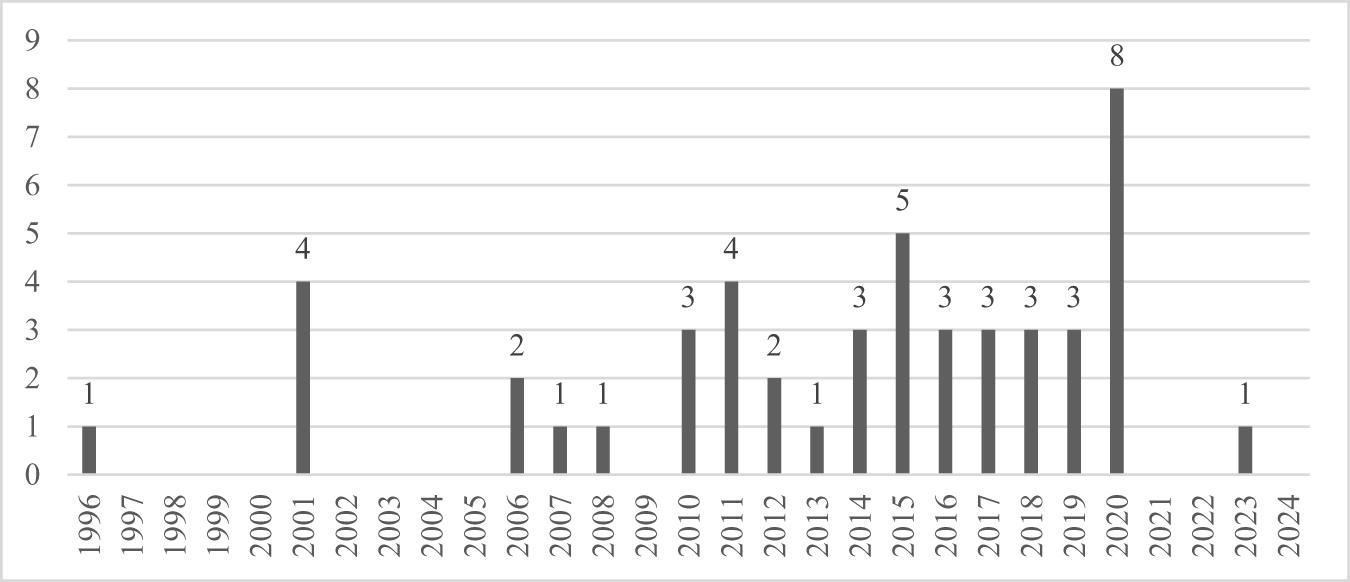
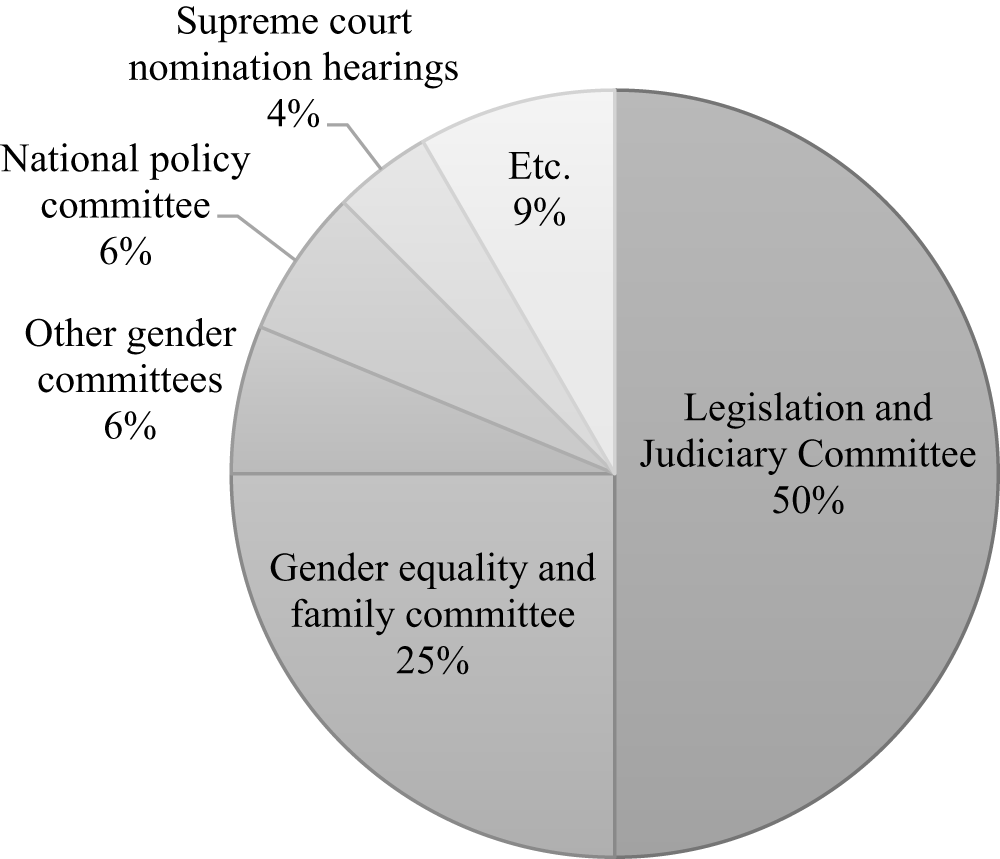
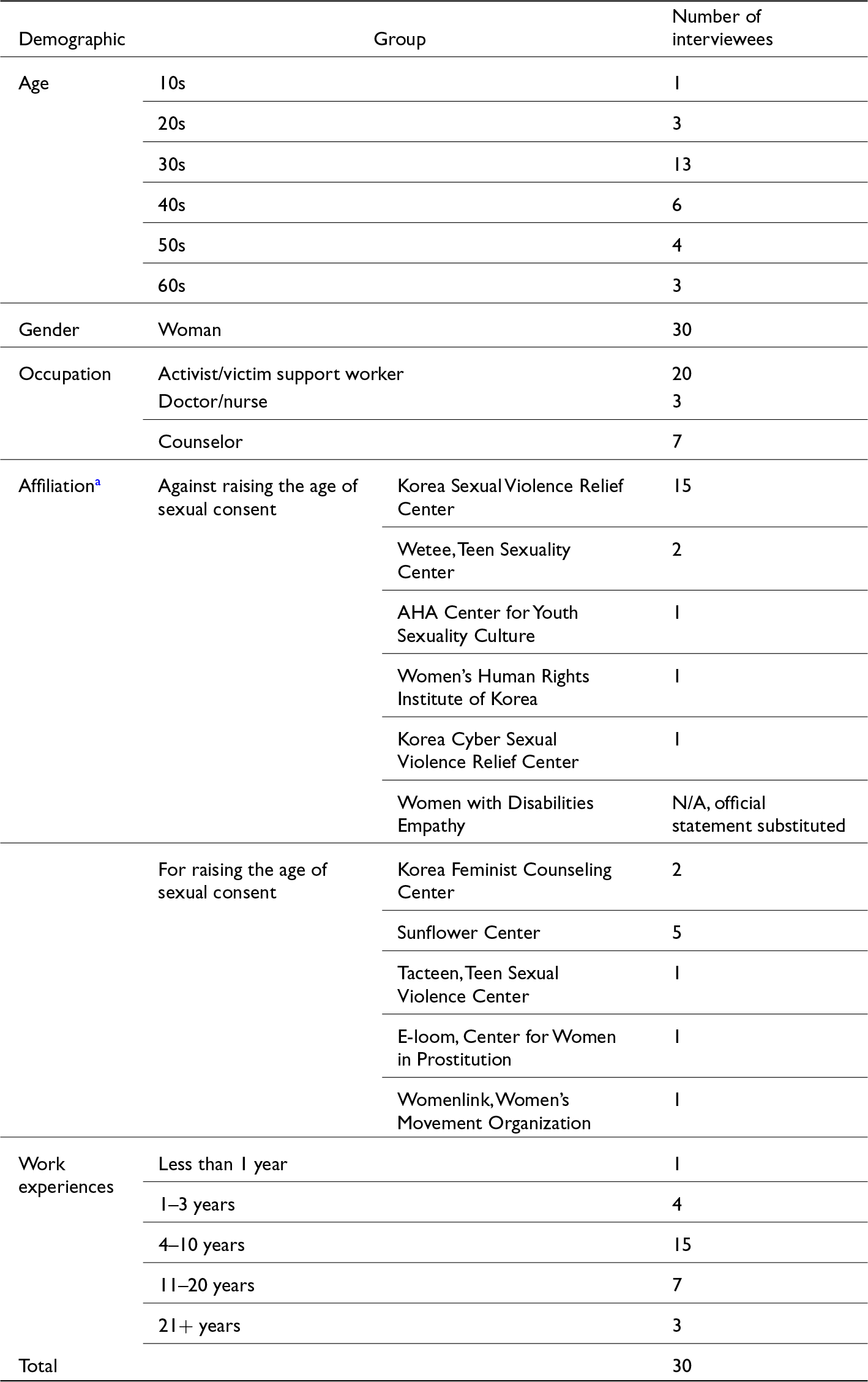
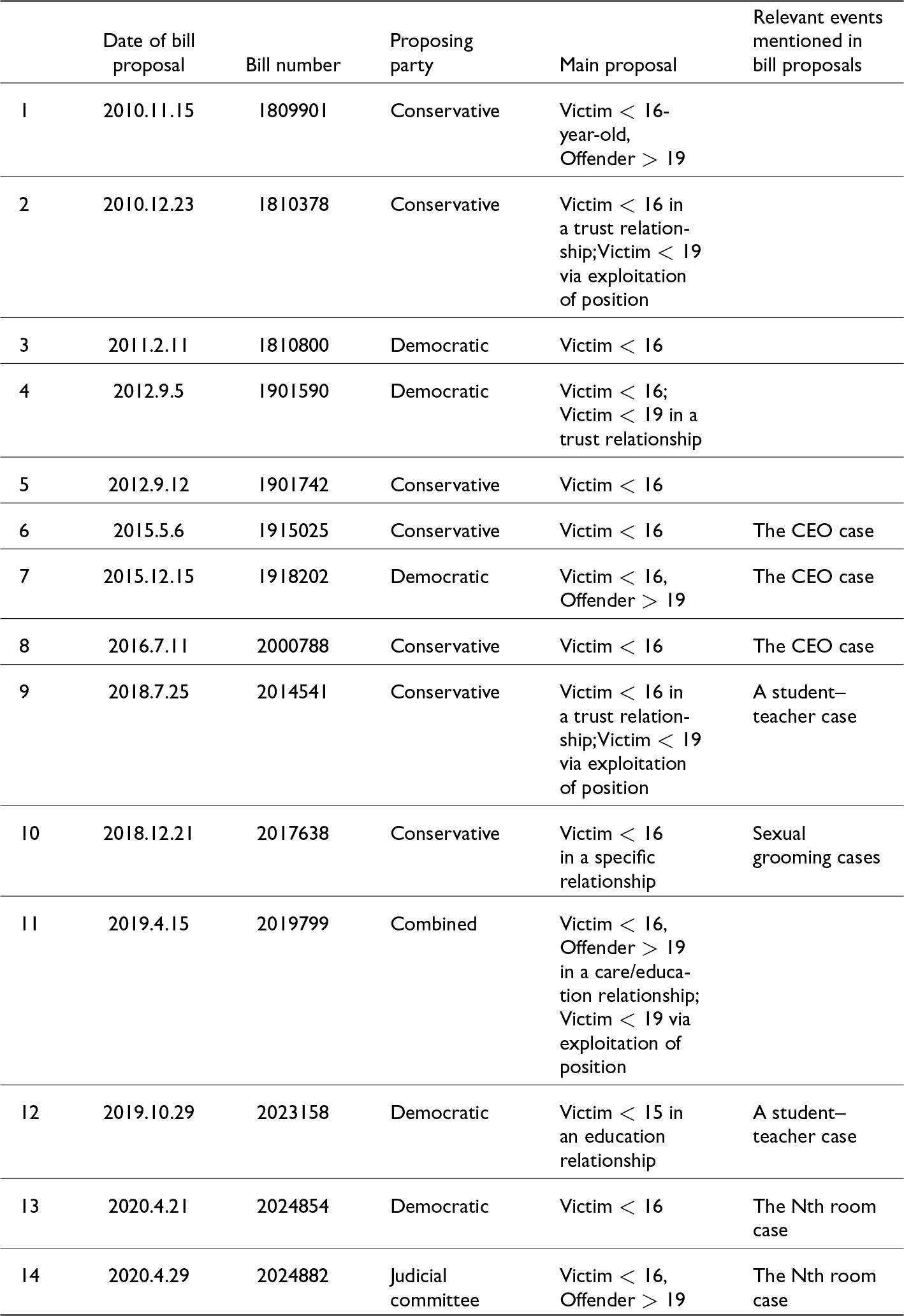

 Open access

