DESIGN THINKING CAN HELP US RE-IMAGINE KNOWLEDGE SERVICES
When I first heard about design thinking, it really hit some key notes for me. I trained about 10 years ago in PRINCE2, the project management methodology, and subsequently ran a number of knowledge projects. When I started to read about design thinking in the legal press, it was always in connection with innovation projects. I was intrigued and began to dig a little further. The more I dug, the more I liked the sound of what I was reading. It chimed with my experience of what made a project successful, particularly with its emphasis on putting people front and centre in your thinking and challenging you to empathise with your client. I also liked the sound of prototyping, with its hands-on, almost crafting approach to testing out ideas.
Although design thinking is often spoken about in relation to formal innovation projects, it became apparent to me that its application was actually much wider. It has evolved out of the field of product design and has now very much entered the realm of services, where it is often described as ‘service design’. In fact, the legal sector has claimed a version of design thinking for its own, where it is imaginatively known as ‘legal design’. Take a look at the work of Margaret Hagan, a pioneer of legal design in the US, Director of the Legal Design Lab and a lecturer at Stanford Institute of Design (known as ‘the d.school’)Footnote 1.
IT IS A WAY OF PROBLEM-SOLVING TO CREATE VALUE FOR OUR CLIENTS
Design thinking gives you tools for opening up and exploring an issue or potential opportunity, for seeing things from a different angle. It pulls on well recognised techniques and some unfamiliar ones, bringing them all together into a collection of activities that enable you to tease out value for your clients. One of the partners at IDEO, a design consultancy whose videos, newsletters and blogs I highly recommend, defines service design as follows:
‘Service design is the craft of tying together human, digital and physical interactions over time. Together they create an experience that meets the functional and emotional needs of your customers.’Footnote 2
During a conversation with a colleague about document automation, I asked whether he had encountered design thinking and, if so, what he thought about it. His response was very on point and I think gives another excellent definition of design thinking:
‘Um…well, it's common sense, isn't it? It's just about putting the client first.’
While this is true, it also presupposes that we have got our client first approach pretty much sewn up. Which is clearly not the case if we are struggling to make ourselves relevant, to make ourselves heard or to make ourselves visible. It is not the case if our resources are under-used or senior management are questioning the value we bring to an organisation. Design thinking gives us tools for making this happen. It helps us divert our focus away from our own situation and anchors us instead in the world of the clients we serve. It also gives us a shared language, to help us work better together on solutions. We become familiar with awkward words like ‘ideate’, mechanical ones like ‘prototype’ and intriguing phrases like ‘customer journey map’.
YOU CREATE VALUE BY PUTTING PEOPLE FIRST
At its core is the human-centred approach. As my colleague recognised, it puts the client at the very heart of the value you intend to create. However, it does not stop there. It also recognises the unique contribution of the people involved in or delivering that value. There is also huge emphasis on collaborative working, bringing together people of different disciplines to chew together on an issue and look at new ways of resolving it.
IT IS BETTER TO EXPERIENCE DESIGN THINKING THAN TO READ ABOUT IT
Despite its name, design thinking is a very participatory, active, hands on approach to problem solving. It does not work well lurking in the shadows of theory. To understand it, you need to get out into the light and put it into practice. In fact, this emphasis on action led to the title of an excellent tome on service design: This is Service Design Doing Footnote 3 (with thanks to Alex Smith for this recommendation).
At the 2019 BIALL Conference in Bournemouth, we did just that and got down to some doing. In the section that follows, I replicate in part the exercises that delegates participated in. While you will benefit from doing them on your own, you will find them more rewarding if you do them with colleagues, in the true spirit of design thinking.
THERE ARE VARIOUS, EXCELLENT FRAMEWORKS FOR DESIGN THINKING
Before we jump in, just a word about some different frameworks for design thinking. The Design Council describes its ‘Double Diamond’ methodology for service designFootnote 4, moving in two, separate phases of divergent and convergent thinking: initially you open up the rough sense you have of the issue or opportunity, to ‘Discover’ what it is you are looking at. You then hone down your insights until you can clearly ‘Define’ what that issue or opportunity is. Now that you have pinpointed what you want to look at, you can open up your thinking again and ‘Develop’ ideas. Finally, your ideas have taken form and you are ready to ‘Deliver’.
Another way of framing design thinking is to consider the activities grouped beneath its wing. This is suggested by the authors of This is Service Design Doing Footnote 5. The authors recommend not following a rigid process, but recognising that as you move through the development of your idea, you are likely to engage in the following four activities: research, ideating, prototyping and delivering. And this is the framework we'll follow here.
IMAGINE THIS SCENARIO AND SEE HOW DESIGN THINKING TOOLS CAN HELP YOU UNCOVER VALUE
I set out below a scenario and a series of exercises, to work through some design thinking tools. I apologise to the academic community that the scenario is set within a law firm, but I am working from experience and believe the exercises should still give you a sense of the approach. The scenario is entirely fictitious, as is the feedback set out in Exercise 1.
Scenario: You have had feedback that some of your clients are struggling to know what resources are available to them and how to access them.
What is the real problem here? How can you improve your clients' experience, using service design thinking tools?
RESEARCH: IN WHICH WE DISCOVER THE CLIENT'S JOURNEY
So here, we put aside our assumptions and start to gather information about the client experience. This is an area that knowledge professionals should feel pretty comfortable with: this is where we research! You will be aware of several research methods, like surveys, focus groups, one to one interviews and desktop research. But there are also some less familiar methods like ‘personas’, ‘customer empathy maps’ and ‘customer journey maps’. As the names suggest, these tools help us enter into the client's total experience and navigate the situation as they would.
So, in the first of our exercises let us combine one of these known methods, ‘survey research’, with one of the stranger sounding tools, ‘customer journey maps’.
EXERCISE 1:
1. Imagine that a survey has already been conducted of library users in your organisation (a law firm) and that the results are in. The results have been sifted into different constituencies and we are now looking at Associates (we also studied partners, business development and trainees at the BIALL Conference). Read through the feedback below:
Fictitious feedback from Associate fee earners
“Our PSL does most of the legal training for us, so I find out about resources we have available via her. I think she talks to the Library team quite a lot, so I'm pretty sure we have know about everything we need to. No, I didn't know there was a catalogue we could reference. Does it have everything on it? It's much easier just to ask Alice, our PSL.”
“I remember I missed the induction, because unfortunately I had to have an emergency wisdom tooth extraction that day. Not much fun! The Library team had sent me a pack of information, which I looked through. I made sure I signed up for the main legal research tools that I was familiar with. They did not have everything I expected. I'll have to work out how to ask them, once I've got a bit of time.”
“Aisha and Chris from the Library were amazing when I started a couple of years ago, making sure I knew what we had and where to find things. I always recommend my trainee make friends with them! I am not sure if it works the same way in other offices, because I sometimes hear grumblings from colleagues in other offices. I am a bit of a stickler for attending training, so whenever they organise something, I do tend to go – and encourage my team too as well. It is almost always worth investing that time. I am not sure what would happen if Aisha and Chris left. I am rather dependent on them!”
“I joined the firm 6 months ago. It was a whirl of activity and emails, so I am afraid I can't remember if I had an induction or not from the Library team. I certainly met a lot of new faces! I know I had to dig a little to find out whether we had some specific resources available that I had at my last firm. When I asked, it turned out there were various online resources that I had not even thought to ask about. Also, my colleagues told me about some magazines they received, but I wasn't sure how to get on the circulation list, so I just pinch it from my nearest colleague. I have used the enquiry desk before, asking for some press reports and I think my trainee uses them quite a lot. No, I don't know their names.”
“No, I haven't found them particularly helpful. I remember at my old firm, you could ask a question and someone would ring me up straightaway and sort it out. Now, you email them and get passed from pillar to post. Well, that was my experience the first time, so I have not bothered since then. I just get my trainee to do the research or Google it. It was bit frustrating to find out the firm was spending a huge amount of money on some of this stuff and I am really not convinced we're getting value from it.”
“I started at the firm last year. My previous firm was far more hand holdy, so it was a bit of surprise to just be left to get on with things here. I skipped the induction with the Library team as I thought it was going to be too basic for me, but in retrospect, it might have been a good idea. If I need anything, I ask my PA and he sorts it all out for me. I do not know where or how he arranges it, but I get the information I need. I think.”
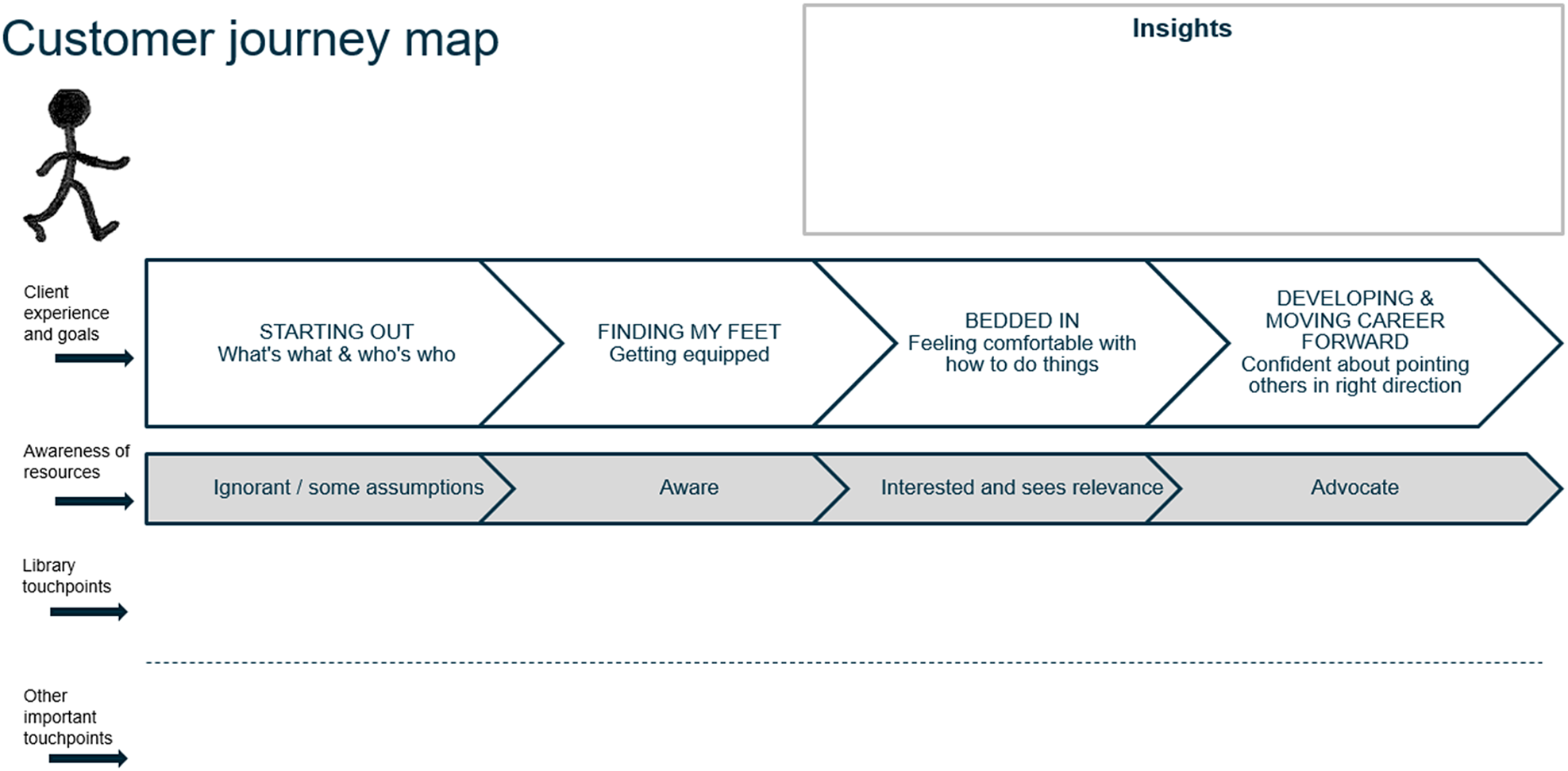
2. Now have a look at the customer journey map in Figure 1. Customer journey maps can give a high level overview of an experience or zoom right into a specific moment in time. I have sketched out a map which is fairly high level, giving a sense of the changing experience of our fictional people in our fictional law firm. Have a go at identifying the library touchpoints (i.e. the points at which these clients are coming into contact with the library team and resources) and the other important touchpoints (i.e. other people or ways that the clients are coming into contact with library resources).
3. Then decide (based on the research) how your fictional clients are feeling at each stage of their journey. Sketch the map out on a scrap piece of paper, take some post-it notes (you know it's design thinking when you pull out the post-it notes) and draw an emoji face to denote how positive or negative their experience is. Stick the post-it notes on your map. Or you could just grab a pencil and scribble on this article. Remember, the main point of this is to empathise with the client's experience.
4. If any ideas or insights have occurred to you during the process, write them in the ‘Insights’ box. This can help when you get to the ideas stage. For example, you might reflect that your critical touchpoints are very front-loaded; or that you have some unexpected allies in the PAs.
5. Looking at the map, decide which moment on the customer journey could be redesigned to have the most positive impact for the client. Ideally, you can fix everything, but in the real world, just focus on the moments that matter.
Customer journey map.

IDEATE: IN WHICH WE COME UP WITH LOTS OF NONSENSE AND A FEW SCRAPS OF GOLD
This is where we open up our imaginations to all sorts of possibilities, before then narrowing the frame down again to those ideas we think will have the most impact, whilst also being feasible.
EXERCISE 2:
1. Look at the insights you generated in the last exercise and the moment you have decided to focus on. You are about to start generating your first batch of ideas in response to what you now perceive about the client's experience. But to begin with, remember that quantity is king. You have to silence your inner critic, get silly, get playful. If you think “we could get the Queen to open our new library area!” or “let's create a library loyalty app!”, write those ideas down. You never know what other ideas that might spark for other people or where that leap of imagination might take you.
So grab the post-it notes again and write down (on your own) as many ideas as you can think of to improve your client's experience at that moment. Use one post-it note per idea and just give yourself 3 minutes.
2. If you are working with other people (after all, this is a collaborative sport), swap your ideas and see whether they prompt any new ideas for you.
3. Next, we get pickier. As a group (or on your own), agree on the top 3 ideas. Which ideas do you think would really address the client's needs in the most holistic way and how feasible are they? Remember you are going for impact. You want to elevate your client's experience at that point you identified in their journey.
PROTOTYPE: IN WHICH WE KNOCK UP ROUGH DRAFTS OF OUR IDEAS AND EXPERIMENT WITH THEM
Instead of racing ahead to implement the first idea you have, prototyping gives you the chance to test out whether there really is mileage in it. It also helps you anticipate obstacles and communicate your ideas to others in a really tangible way. It invites even more ideas to help refine the original ones. It is also lots of fun.
This is a very physical way of thinking. You are thinking by making. You are engaging your whole body in the exercise, not just drily imagining something. For example, I was thinking through lighting options for my kitchen. I loved the look of those hanging lights over the table and found some great examples online. However, I decided I would knock up a prototype first: enter half a Rice Krispies box as the light and a bit of string for the cord. I sellotaped the cord to the ceiling, so my beautiful Rice Krispies light could dangle elegantly over the table. I then immediately noticed something I had not anticipated before: that the dangling light would obscure our view of the garden. We kept our prototype light up for a couple of days and agreed that a hanging light was just going to be annoying.
EXERCISE 3:
1. Ideally, you would have several groups working on different prototypes, intermittently sharing your learnings with each other. For now, however, pick one of your top 3 ideas to prototype. If it quickly becomes tricky, you can ditch it and use another of your top ideas.
2. Choose how you will prototype your idea, how you will manifest it as visibly as possible, so you can talk about it easily with other people. You might want to think about:
• Creating a rough video on your phone
• Drawing a poster
• Sketching out a storyboard of how you see the re-imagined moment happening.
• Mocking up an app (you can use pencil and paper or an app like Marvel)
• Role playing the change
Don't sweat this. Just take 20 minutes maximum on this exercise, to get a feel for the process and see if any ideas in particular shine through. If you are doing this exercise with colleagues, spend a few minutes exploring the other groups’ prototypes.
IMPLEMENT: IN WHICH WE BUILD AND LAUNCH THE REAL DEAL
So this is where it gets real and where we send our newly shaped service out into the world. If this was a product, this is where we would ship. There are various well established methodologies to call in at this point, particularly project management. For example, PRINCE2 has given me some immensely useful tools for approaching and understanding projects. It has also given me a shared language for managing projects with colleagues. However, there is perhaps a small weakness in PRINCE, hidden in its name. PRINCE stands for ‘PRoject IN a Controlled Environment’Footnote 6. It anticipates that the environment of the project is pretty constant, that the goal posts are not constantly changing, that technology is not rapidly pulling the rugs from under our collective feet.
Far more common, therefore, particularly in software development, is the philosophy of Agile developmentFootnote 7, an approach which sees ‘implementation’ as not a one-off occurrence, but as part of a constant, iterative cycle of incremental improvement. Prototyping and implementation blur. This iterative approach is very much in alignment with design thinking and makes sense for the world we work in, where knowledge services are constantly evolving and there is no nirvana end point when we can say we have finished.
However, design thinking would also insist that even in, and especially in, the implementation phase, we keep our focus rooted in the human experience. After all it is human behaviour that is usually the hardest thing to change. At which point, we would do well to call in best practice around ‘change management’.
One of the best things I have read recently on change management is a book by Dan and Chip Heath called Switch: How to change things when change is hard Footnote 8. The brothers draw on an analogy put forward by Jonathan Haidt in ‘The Happiness Hypothesis’Footnote 9. Haidt asks that you imagine a harassed rider on top of a truculent elephant, trying to get it to move forward. The rider represents our rational mind and the elephant represents our emotional side. If the elephant does not want to move, then no-one's going anywhere.
The Heath brothers pick up the analogy and expand it, proposing a method to tackle the potential impasse if the rider and the elephant are out of synch:
(i). Direct the rider: make it crystal clear what needs to be done.
(ii). Motivate the elephant: give the big picture, allow people to see why there is change, engage them in its planning, break the change down into manageable chunks.
(iii). Shape the path: build habits, change the environment and structures to make change easier (e.g. filing prompts when sending emails), grow the social momentum (people seeing other people already involved).
NOW YOU ARE READY TO START
I hope this gives you a taste of what design thinking or service design can do for your knowledge service; that it has given you a slightly different angle from which to approach the ongoing job of ensuring relevance and connection with your client (whether they are internal or external to your organisation). And, I hope you can see that design thinking is not the exclusive domain of software developers or people with ‘innovation’ in their titles. That it means we can all be designers. That we are all innovators by nature.
At Osborne Clarke, I have discovered various teams already employing several design thinking tools. Our Projects team have considered different personas when rolling out new software and our Solutions team explicitly work in an Agile way, moving from ideating, to prototyping to delivery and back again. We are also beginning to open up this toolbox to the wider Knowledge team, to consider new ways of delivering value to our clients and approaching projects in a more collaborative, holistic way.
Finally, I give the last word to Margaret Hagan, a pioneer of this work at The Legal Design Lab, where the focus of design work is grouped around four themes: Access to Justice and Court Innovation; Better Internet for Legal Help; Smart Legal Communication; and New Models of Legal Organisations. In Hagan's open book, which is being written in stages (that is so design thinking!) she says: “we need user-centred innovation in law, and we need it now”Footnote 10.