December 2019
Training in Action conference at the British School in Rome
It was a treat to be invited to the Training in Action conference at the British School in Rome in early November. The presentations and videos illustrated that the project funded by the Cultural Protection Fund has been enormously successful. It was also marvellous to see so many Libyan friends there. Although most were from the west, including Mohammed Shakshuki, Chairman of the Department of Antiquities in Tripoli and our good friend Mustafa Turjman, Head of Research, there were representatives from the east, but sadly not Ahmed Hussein, Head of the Cyrene-based DoA, nor any of his senior personnel. There were also representatives from the Italian, French and Polish Missions working in Libya and the event gave us a rare opportunity to catch up and make plans to work ever more closely together to assist Libya in this time of crisis. On a more sombre note, conversations with Mustafa and Ziad Siala, a new appointment in the department with a portfolio to improve the lot of World Heritage Sites in Libya and a good friend, both of whom live in the suburbs of Tripoli, indicated how difficult and unreal times are. Multiple road blocks manned by both sides, regular gunfire and the occasional explosion punctuate the average day, with people shopping or travelling to and from work, trying to live a ‘normal’ life. As Ziad showed me Google Earth pictures on his mobile phone, pointing out houses near his home that have been damaged by bombing and shelling, it is perfectly clear that life is as far from normal as it can possibly be.
Tripoli
The military situation around Tripoli grows ever more worrying. Although there has been less fighting, there is a great deal of evidence to suggest that the so-called Libyan National Army (LNA) is consolidating its position to the west and south of the city. There have been reports of shipments of arms arriving from Russia to supplement those already in the hands of the LNA, including tanks and ground-to-air missiles. Russian Special Forces are also reported to be on the ground, to train and to maintain and repair Russian equipment. An Italian unmanned surveillance aircraft was downed by Haftar's forces over Tarhuna recently and US Africa Command reported the loss of a remotely piloted aircraft over Tripoli. This has led commentators to suggest that Haftar is attempting to establish an air defence system over the western region and a no-fly zone over Tripoli. Other reports indicate that alliances are being forged between Haftar's forces, Tuareg militia in the south and pro-Gaddafi supporters represented by Saif El-Islam. There are even reports of a power-sharing agreement between Haftar and Saif. In the south, recent reports suggest that the LNA controls over 90% of the area around Kufra and there is also mounting evidence to suggest that Bani Walid, Zintan and Zawiya have declared themselves loyal to Haftar. On the Government of National Accord (GNA) side there are signs of continuing division and less resistance to LNA manoeuvres, both physical and political. So difficult has the position become for the GNA that spokesmen for the LNA, echoed by pro-Gaddafi supporters, state that Haftar's victory is now not a matter of ‘if’ but ‘when’.
Outside Libya the US continues to hold an ambiguous position, with the State Department calling on the LNA to halt their offensive on Tripoli, while at the same time appreciating Haftar's role in the fight against terrorism. The stakes have been raised further this week with a meeting between the US State Department and Haftar in Washington, to discuss ways of halting hostilities and achieving a political solution to conflict in Libya. Similarly, Egyptian diplomats call on Haftar to implement an immediate and permanent ceasefire, this to appease European countries, while at the same time continuing to supply arms and logistical support to the LNA. For their part the GNA has recently met with Turkish diplomats to sign an agreement to delineate the maritime boundaries between the two countries. For Turkey, such a move will reduce Greek influence in the Mediterranean and for the GNA, it maintains Turkish arms supplies to aid their coalition.
Benghazi
The situation in Benghazi is very different. The Medina Gadima lies in ruins and nothing has been done to rebuild or relieve the forty thousand families that have been displaced. Life goes on outside the devastated centre, as if the country was not at war with itself, or rather chose not to forget what it had been through in the name of the fight against terrorism and supports the armed forces now besieging Tripoli – with potentially identical devastating consequences. Other than regular blackouts and occasional problems with the water supply, money supply and even the supply of fuel to petrol stations, life in Libya's second city is as normal-chaotic as it ever was; it is only the face on the posters that has changed. What is disturbing and totally mystifying is the support Haftar and the LNA enjoy in the east, even among those who have suffered great personal loss.
There are signs of change for the good, with positive moves towards law and order in the east, including the arrest of a particularly notorious and successful gang of car thieves and the arrest of a criminal gang specializing in cross-border migration into several cities including Benghazi, Ajdabiya, Bani Walid and Sabratha. Reports suggest that the gang is led by an Egyptian woman.
It has not been widely reported, but many Libyan state primary and secondary schools in all three provinces have been on strike over salaries since September 2019. The dispute over levels of pay and irregular payments has only been settled recently following a joint announcement from the two governments of Tripoli and the government of the east, pledging to begin procedures for adjusting teacher salaries, and an announcement from the Minister of Education in the Government and the House of Representatives to form a committee to meet with the teacher unions to reach a satisfactory solution over teacher salaries. Teachers are now back at work.
More significantly, there have been meetings of leading members of municipal governments from the three regions in Tunis, Shahat and Tripoli in both 2019 and early 2020. Each meeting, attended by well over one hundred delegates, appealed to the media – and by implication, to politicians – to be ‘left alone to try to rebuild our country’.
February 2020
Military situation
The blockade of Tripoli by Halifa Haftar and the LNA continues. Having occupied Sirte, the LNA continues its advance on Misrata. All attempts to agree an arms embargo have failed. The blockage of oil installations by Haftar's forces has reduced the national oil output by 80%. Despite desperate attempts by the National Oil Corporation (NOC) to lift the blockade, all appeals have failed. Russia and Turkey are increasingly involved with competing sides and it is just a matter of time before their ‘advisors’ are in direct conflict. The improved supply of arms including sophisticated weaponry was in evidence very recently, when GNA forces shot down a high-flying LNA drone.
Italian exhibition
An exhibition organized by various Italian Missions working in Libya, due to open in the Italian Embassy in Tripoli in December, reported by myself at our last meeting, was cancelled because of the worsening military situation.
LBBC meeting
I attended the Libyan British Business Council meeting on 30 January as a guest of Pauline Graham, to hear a presentation from the new Ambassador to Libya, Nick Hopton. The meeting chaired by Sir Vincent Fean was well attended with representatives from various British and Libyan companies. HMG priorities are:
• dealing with migrant trafficking;
• helping to stabilize the present situation;
• providing humanitarian support, including assistance for women's groups;
• helping to develop prosperity through trade and business.
A recent international meeting in Berlin organized to call for a ceasefire, talks and an embargo on arms shipments, although unsuccessful, was used by HMG to emphasize UK commitment to Libya.
I explained to the meeting that the Society with other UK organizations and academic institutions were, with financial support from the Cultural Heritage Fund, involved with training initiatives for the next generation of Libyan Cultural Resource Managers, building for a Libya after conflict and even beyond hydrocarbons. I asked for business and additional HMG support for the Society.
As a follow-up we hope to provide a presentation to LBBC, perhaps on Threats to Libyan Heritage by Armed Conflict or Archaeology Beyond Hydrocarbons, in an attempt to win their support for existing and future Society initiatives to promote local heritage within Libyan communities and to train a future generation of Libyan Cultural Resource Managers.
Hafed Walda
Hafed Walda is now recognized as the Hon. Ambassador to the permanent Libyan delegation to UNESCO. He is a major force for good and is extremely active working for Libya in Paris, Rome and London in recent weeks.
Cyrene
Oscar Mei of the University of Urbino has announced on Facebook a partnership between Italian specialists, the Department of Antiquities (of the east) and the Libyan Government (of the east) to build a covering building over the foundations of the House of Jason Magnus, which will also function as a new museum for Cyrene.
Tripoli
In March 2019 I informed Council of a scheme promoted by the French Archaeological Mission to Libya to restore the National Museum in Tripoli. An agreement was brokered between the Department of Antiquities and the French Mission, supported by the French Government in July, and in January 2020 the project has received funding from the ALIPH Foundation (International Alliance for the Protection of Heritage) based in Geneva and the French Government.
Will Wootton
Will has recently informed me that his approach to the ALIPH Foundation for funding to produce World Heritage Management Plans for the five World Heritage Sites, together with delivering training to DoA staff involved with the sites, has been successful. The first site to be worked on is Ghadames. He has recently enlisted the support of Lamees Bin Saad of the University of Tripoli, who tried unsuccessfully to get funding for restoration and training work at Ghadames from the Cultural Heritage Fund and the American Ambassador's Fund early last year. This could become a flagship project for the Society, so many congratulations to Will.
Abdulla Rhebi
I expressed my gratitude to Council for the advice we have been given by Abdulla Rhebi of the University of Benghazi and Ahmed Buzaian for the distribution of the Arabic version of Philip Kenrick's Archaeological Guide to Cyrenaica, which is being printed soon in Tunis. At the time of writing, Abdulla has very generously offered to distribute the books in eastern Libya personally.
May 2020
Military situation
Much has happened in Libya since the Berlin Summit in January 2020, none of it good. Despite world leaders coming together to agree a moratorium on the sale of arms to the competing sides, calling for peace talks and a cessation of fighting, the opposite has happened, with covert and open arms shipments arriving in Benghazi and Tripoli, together with more foreign mercenaries, greater tension and inevitably, more conflict.
The ring of steel that Haftar and the LNA dramatically established around Tripoli in April 2019 has failed to give him control of the country. It has had a reverse effect, galvanizing the militia of the west to join the GNA to oppose him. After brief periods of fighting, a stalemate ensued, enabling Haftar to try a different tack. He tightened his grip on oilfields and oil terminals, effectively holding western Libyans (and all of Libya) to ransom. At the same time, in the early part of this year Haftar's forces, with Russian, Egyptian and Emirati support, started to tighten control of the suburbs of Tripoli and most significantly, to mount an offensive against Misrata, the most obdurate and effective of the militias standing against him. With new hardware, ground-to-air missiles and the use of armed drones, he also hoped to take control of the airspace over Tripoli and gain greater control of the suburbs.
All this changed at the beginning of this year with Turkey entering the conflict in support of the beleaguered GNA. In the past few weeks GNA forces have seized control of three important coastal cities, Surman, al-Ajaylat and Sabratha, following a brief but intense period of fighting with Salafist militias allied with Haftar. From being so far on the back foot that outsiders believed that Haftar was days away from controlling the entire country, GNA supporters now believe that they can take control of the entire coast between Tripoli and the Tunisian border. Elsewhere, Berber fighters from Zuwara are moving towards the strategically important al-Watiya airbase south-west of Tripoli, a vital stronghold and supply base for Haftar. Clashes here left many fighters loyal to Haftar dead, including Sudanese and Chadian mercenaries. More recently, GNA air defences supplied by Turkey reported the destruction of two Chinese-made military aircraft and a Russian helicopter. GNA forces now claim to have wrested control of the air from the LNA, thanks to Turkish weaponry and the support of the Turkish Air Force. The Turkish military are also supplying the GNA with armed drones. In response to each defeat there are reports of the indiscriminate shelling of Tripoli airport, civilian suburbs and even the Madina Gadima itself by the LNA.
At the end of April, following calls from the international community for a ceasefire during the Holy Month of Ramadan, and no doubt because of military reverses, Haftar declared a brief cessation of hostilities. His declaration was not accepted by the GNA who say they will continue their ‘legitimate self-defence’. The push towards the Watiya airbase has continued with further losses on both sides. At the same time Haftar and UAE supporters have visited Sudan to recruit new fighters. Observers estimate that there are already 1,000 to 3,000 Sudanese mercenaries, together with an unknown number of Syrian troops fighting with Haftar. The recruitment of mercenaries on both sides is risking further destabilization of the country.
The situation remains critical with neither side backing down or likely to. It is salient to note that since Hafta's assault on Tripoli began a year ago, nearly 3,000 people have been killed and over 200,000 Libyans have been displaced.
COVID-19 in Libya
An increasing number of coronavirus cases have been reported in Tripoli and Benghazi. Although numbers are not on the great scale as the UK, the USA or Brazil at the time of writing, there is a real danger that a catastrophic epidemic could ensue in either city. On 17 March, in response to reports of new cases, the World Health Organization and the United Nations called on both sides to cease hostilities to allow health authorities on both sides to fight the coronavirus pandemic. There has been no response from either side, but a hospital in the Tripoli suburbs specializing in the treatment of victims of the virus was destroyed recently by shelling.
The economy
The present military stalemate, the shutting down of key oilfields and oil terminals and the plummeting price of oil as a consequence of the COVID-19 pandemic has hit Libya's economy exceptionally hard. Revenues in the first quarter of this year set against government expenditure imply a massive deficit of over LD 6bn, with the gap between income and expenditure growing each day the oil blockade continues. The NOC is reporting that over US$4bn of oil sales have been lost as a result of the blockade and that this is having a dramatic impact on the economy and the population, including a marked fall in the value of the Libyan Dinar and a consequential rise in the costs of imports – in Libya's case, everything.
Oberlin USA
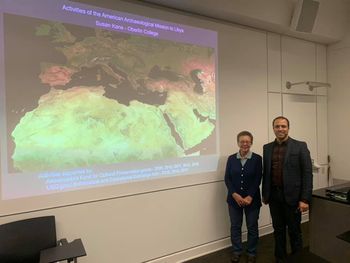
I spent a week or so of March in the USA at the invitation of Oberlin College, Ohio, to support my friend and colleague Ahmad Emrage of the University of Tocra and Benghazi during his stay at Oberlin as the Fulbright Scholar. I provided an open lecture and a seminar on Libyan heritage to Ahmad's students and colleagues, but what I was able to see while I was there was how well Ahmad and his family – wife Alya and four girls, Malak, Lubna, Hala and Nada – had adapted to living in Oberlin. The children were attending local schools and doing exceptionally well and Ahmad was providing his students with well-delivered and much-enjoyed courses to the acclaim of his fellow members of staff. I am enormously grateful to Emeritus Professor Susan Kane, Head of the American Mission to Libya and to her husband Professor Sam Carrier, both formerly of Oberlin, for all the generous help, support and the many kindnesses that they have heaped on the very deserving Emrage family. Ahmad, Alya and the girls have been wonderfully looked after by Susan's colleagues, but Ahmad has been a star Fulbright Scholar and a credit to Libya.
Haua Fteah
I was asked by a good friend Ziad Siala to help with information to support the Department of Antiquity's nomination of the Haua Fteah to be placed on the reserved list as a World Heritage Site. The information was put together by Professor Graeme Barker and sent to Ziad. Mustafa Turjman has responded on behalf of the department with his grateful thanks for the ‘wonderful information’.
Will Wootton
Despite lockdown and the difficulties in Libya, Will Wootton and his colleagues at King's College, University of London, in Egypt and in Libya are continuing to develop a project to provide World Heritage Management Plans for the five World Heritage Sites, beginning with Ghadames. The management plans, including the mapping of buffer zones, together with a large element of training for Libyan personnel who will be developing and implementing the plans, is a project that I wholeheartedly support and hope the Society can assist with.
Dr Ahmad Emrage with Professor Susan Kane at the University of Oberlin.

July 2020
Ahmad Emrage and the Archaeological Guide to Cyrenaica in Arabic
In June, I heard from Ahmed Emrage and family. Since my departure from Oberlin in March the family has been in lockdown, with Ahmed delivering seminars to his students online and the girls continuing their schooling and keeping in touch with their friends remotely. Their plans to tour other parts of the United States before they return to Benghazi had to be cancelled. There have also been many problems with the trip home, but the university and the US Embassy in Libya have been immensely helpful and generous and have organized their return via Tunis in late July.
In recent months, we have been making plans for the printing in Arabic of Philip Kenrick's Archaeological Guide to Cyrenaica. Following the production of the translation by Ahmed Buzaian and Abdullah Rhebi, we have been assisted by Medhat Singab of Papyrus Graphics with designing the volume and securing the services of a printer in Tunis. They are the same printers who produced the Arabic version of the Tripolitania Guide for us a few years ago. We hoped to print 3,000 copies of the volume in March or April, but the deteriorating security situation and fears about the spread of COVID-19 stalled the process, with the main difficulty being how we can get such a large consignment of books to Benghazi for free distribution. During Ahmad's discussions with the American Embassy in Libya about his repatriation, our problem with the books was mentioned and the Embassy has generously agreed to get the books to Benghazi for us. We are now able to instruct the printer and determine a dispatch date. We are immensely grateful to the Embassy staff for their help.
The military situation
At the time of writing this edition of ‘Notes’, the situation in Libya has changed dramatically, with the Libyan National Army in retreat and the front line now hundreds of miles from Tripoli at Sirte. The GNA forces, supported by Turkey, are now mobilizing to take Sirte. After a fourteen-month siege of Tripoli, Khalifa Haftar, supported by Russia, the United Arab Emirates and Egypt, can be seen to have failed in his attempt to take control of Libya by force.
The situation is critical. Egypt's President, Abdel-Fattah-el Sisi, is threatening to invade Libya if GNA forces, supported by Turkey, attack Sirte. In response, the GNA accuse Egypt of ‘beating the drums of war’ and of making ‘a clear declaration of war against Libya’.
Well-informed commentators believe that this development should not be taken lightly. With Turkey in the driving seat and despite internal division and an inability to manage territories recently won, the GNA still appears determined to continue the offensive. At the same time, support for General Haftar appears to have been undermined by the recent turn of events and Egypt is the glue binding sides in eastern Libya together. With east and west in the control of external allies, the need for a ceasefire and serious negotiations between competing sides has never been greater than now.