October 2014, Paul Bennett
Libya is in a state of anarchy and is now almost a failed state in the process of pulling itself apart. Cyrenaica has become fiercely tribal and is seeking federal status. Tripolitania is being fought over by militia from Zintan and Misrata (Libya Dawn), Benghazi by Operation Dignity and supposed Islamist extremists. Murders happen on a daily basis in Benghazi and air raids by unmarked aircraft are taking place in both cities. Tripoli and Benghazi airports are closed but some flights are getting into and out of Labraq near Al Bayda. Clashes are now occurring in the south between Tebu and Tuareg tribesmen near the town of Obari. There are unconfirmed reports that IS fighters from Syria have been arrested trying to cross into Libya by Tunisian security forces, whilst Algeria is discussing the building of a secure fenced and ditched boundary with Libya.
The UN Support Mission to Libya (UNSMIL) is supporting the government, which itself is still divided and based in Tobruk, whilst an opposition body, the National Salvation Government, has been established in Tripoli and is appointing new ministers and setting up new government departments.
All training of military personnel abroad has been halted if not abandoned, as there is no government-controlled standing army for trained troops to join. Those that did exist are now on indefinite leave. Following incidents involving Libyan recruits being trained by the British Army in the UK, all training has ceased. A number of Libyan recruits are in police custody awaiting trial and the remainder have been sent home. Given that I undertook two briefing sessions with army trainers, encouraging them to undertake the training, I am terribly disappointed that the initiative has failed.
All foreign workers in Libya have been advised to leave the country. For those who have to stay, travel around Tripoli is restricted with no travel at night. Benghazi is a no-go area. The Foreign and Commonwealth Office (FCO) and the US State Department recommend no travel to Libya and those nationals in the country are advised to have robust evacuation procedures in place.
As for the Society and Cambridge University, as it is not safe for us to send a team to Libya, we are organising the training of a small team of Libyans to undertake the sieving of soil samples from the Haua Fteah excavation to complete the excavation and eventually backfill the workings. Our hope is that the team will include Department of Antiquities (DoA) staff from Benghazi and Al Bayda, led by Ahmed Emrage, presently awaiting a viva for his PhD at Leicester. The team will come to the UK for training and then return to Libya to undertake the work.
I am hoping to convince the British Museum to take on two members of the Libyan DoA for the next International Study course and to encourage the Society to promote training initiatives for selected Libyan members of the Department in a range of disciplines that will help the Department to grow when all conflict is but a horrible memory.
I am also keeping in touch with Mustafa Turjman in the hope that we can publish the Arabic version of Philip Kenrick's Tripolitania guide.
For the World Bank, I am helping to set up a workshop in Tunis on the protection of Libyan built heritage in the second half of November. A manual has already been produced in Arabic and English to be launched at the workshop (yet to be printed). I am presently working with Ahmed Buzaian, Ahmed Emrage, Hafed Walda, and other UK-based Libyan friends to contact Libyans we feel should attend the workshop.
The World Bank is still keen to assist with the development of a World Heritage Management Plan for Cyrene. Although some of this work can be undertaken remotely, site visits and surveys will be required and at the present time there is insufficient security in the region. Time is running out for the project.
December 2014, Paul Bennett
The situation in Tripoli has calmed a little, following air strikes on the airport and fighting between Zintan and Misrata Brigades; Benghazi remains a severe cause for concern. A significant non-local proportion of the population are now refugees in other parts of the country (Misrata, Al Bayda, and Shahat are full of refugees) and there are a great many refugees outside the country (there are reports of tens of thousands of Libyans in Tunis; many have crossed the border into Egypt). Random shelling is still taking place in and around Benghazi and murders occur on a daily basis. Hafed Walda is in Tripoli at the moment, hoping to secure final clearance to take up his post as advisor to the Libyan Permanent Delegation to UNESCO. He reports that the city is quiet, but no one travels at night, particularly near the airport. Fighting is currently ongoing in the areas of Ubari, Sabha, and Murzuq.
Ahmed Buzaian tells me that Libyans are finding it increasingly difficult to obtain visas to visit the UK because of fears the applicants may claim asylum when they arrive here. Another friend, Ahmed Emrage, is in Tunis at the moment applying for a visa for himself and his family to return to this country to complete post-doctoral research. He fears that, while he may get a visa, his family may be refused. We hope not.
Graeme Barker and I are actively trying to bring three Libyan colleagues from the Department to the UK for training. Visas permitting, they may get here just after Christmas for three weeks. We hope that Ahmed Emrage will supervise the completion of the Haua Fteah excavation, assisted by our three friends and others in the local community. All four will be trained in Canterbury, with work in the Haua commencing in early February for approximately one month.
After many months, I am back in touch with Saleh Aghab, former Chairman of the Department of Archaeology. He is now based in Cyrene and acts as a consultant advising the Minister of Culture. The internationally recognised government of Libya is now based in Tobruk.
Despite time running out for funding, the World Bank is still prepared to publish a manual on the protection of Libyan built heritage and to organise a workshop with the help of UNESCO to launch it. We had planned for a launch in the Serai al-Hamra, but at the moment that ‘dream’ is simply not possible, so Tunis is the most likely destination, probably in late February.
February 2015, Paul Bennett
The country is subdivided into two parts: the internationally recognised government is in Cyrenaica (Tobruk) and an alternative government is now based in Tripoli, with its own ministries. The new Minister of Culture in the east (who took over from al-Habib al-Amin, now the Libyan Ambassador to Malta) has appointed a new Chairman of the DoA based in Cyrene: Ahmed Hussain (a former student of Ahmed Buzaian). In creating this appointment the Minister has effectively divided the Department into two. The Chairman of the Department in Tripoli, Abdulrahman Yaklef, has circulated a memorandum to Missions stating that he is still Chairman.
Eastern Libya has become tribal with almost self-governing communities competing with one another for recognition and resources. Tribal communities are granting permission for development without reference to the laws of the land or ancient custom. Development is happening on an alarming scale, particularly in the Green Mountain and specifically in and around the World Heritage Site of Cyrene.
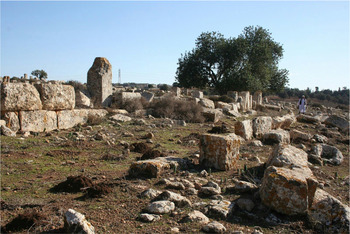
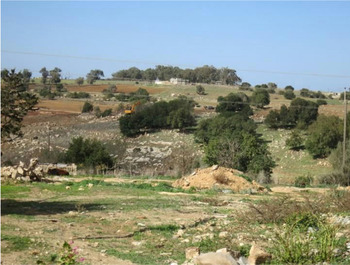
Very recently, the remains of the ancient village of Artemis at Massa have been devastated by a local developer and the valley has been cleared for a road and a new housing development. The settlement once called ‘Little Cyrene’, set in a rolling terrain with breathtaking views of the surrounding valley, is now a wasteland. I visited the site with Philip Kenrick and Ahmed Buzaian only a few years ago. Among the remains were several distinctive ‘temple’ tombs of the fifth or fourth century BC and other rock-cut tombs; also standing stones representing ancient property divisions and the foundations of numerous domestic, religious, military, and industrial buildings, including crushing stones, pressing floors, cisterns, and vats for the production of oil and wine, all dating from the sixth century BC to the seventh century AD. These buildings and the remarkable landscape in which they were set stood testament to the richness of the region and its economic importance throughout the Greek, Roman, Byzantine, and early Arab periods. Massa, that once delightful place, is now but a memory; piles of stones heaped up by the side of a modern road, reflecting negatively on the whole region (see Figures 1–9).
Massa: Plan locating Massa (Artemis).

Massa: Massive carved block from an ancient public building. Photograph: P. Kenrick.

Massa: A water cistern with intact stone roof, now destroyed. Photograph: P. Kenrick.

Massa: An example of upright stones representing an ancient property boundary (outside Cyrene). Photograph: P. Kenrick.

Massa: An ancient street in Massa, flanked by buildings, before destruction. Photograph: P. Kenrick.

Massa: The new road at Massa. Photograph: DoA Cyrene.

Massa: Bulldozed remains, mainly architectural fragments. Photograph: DoA Cyrene.

Massa: Bulldozed opus quadratum from a building or tomb. Photograph: DoA Cyrene.

A view of Massa today – a devastated landscape, cleared of historic remains. Photograph: DoA Cyrene.

In the suburbs of Cyrene, farmers and developers are taking advantage of a lack of governance and law and order to annex land once protected from development for new fields and housing. Many of the major sites around Cyrene, Al Bayda, and on the Green Mountain may be considered to be under threat, not from military activity or the insane actions of iconoclasts, but from local people bent on personal gain at the expense of the environment and heritage assets.
In Tripoli, Mustafa Turjman continues to work on behalf of Libya and many in the east do the same, but both parts of the Department are starved of resources, money, and trained staff. The reality is that Missions now have to treat with two organisations that are equally demoralised and isolated. The DoA has become a mirror image of Libyan politics.
As a direct result of development activity, there is now a great deal of clandestine excavation and a burgeoning trade in portable antiquities, particularly sculpture. Hafed Walda and I have been approached by HM Customs to assist with one case that is coming to trial soon. We are also seeking ways of preventing this illegal trade and the further destruction of archaeological sites by identifying the individuals responsible and encouraging EU countries and others to refuse travel visas and prepare a case for future prosecution. The EU has approved a system of individual sanction, built on a UN resolution. If approved by the Special Envoy, individual sanctions can be put in place with destruction of Libya's heritage resources being considered a justifiable reason.
The World Bank has agreed to fund the publication of an Arabic version of Philip Kenrick's Tripolitania guide, provided that it can be completed by the end of April. Work is now underway. A designer, Medhat Singab of Papyrus Graphics Ltd (in London), has been appointed to set the Arabic version and the book will go to Tunis to be printed. Five thousand copies will be shipped to the DoA so that they can be disseminated to their own staff, government departments, and to universities and schools as a first stage.
The World Bank has also funded a manual on Libyan built heritage protection, which sets out how any municipality in Libya can, by developing stakeholders, find a new use for heritage buildings so that they can be returned to the next generation in a better condition than they are in at the moment. An Arabic version of the manual has been translated by Fouad Awada and will be printed this year for free distribution to government departments, municipalities, agencies, and non-governmental organisations in every town and city in the country. Funding has come from the Multi-Donor Trust Fund for Cultural Heritage and Sustainable Development, with generous grants from the Italian and Indian governments, managed by the World Bank. Grant aid from this source will run out at the end of April, but it is hoped through another fund to raise further resources to organise a workshop later in the year. The workshop will be in Arabic with representatives from Libya and neighbouring Arab countries, who will give presentations on how they are approaching the conservation and protection of their heritage so that the Libyan authorities can see what is going on elsewhere.
After two months of waiting for UK visas in Tunis, four Libyan colleagues are now being trained in Canterbury to complete work on the Haua Fteah cave (see Figures 10–12).
Libyan colleagues being trained in Canterbury for work on the Haua Fteah cave: sieving samples. Photograph: CAT.

Libyan colleagues being trained in Canterbury for work on the Haua Fteah cave: sorting samples. Photograph: CAT.

Libyan colleagues being trained in Canterbury for work on the Haua Fteah cave: survey techniques. Photograph: CAT.

I recommended to the Research Grants Committee in a previous meeting that, if there were spare funding capacity, the Society should take the opportunity to arrange for identified individuals working in the DoA and other organisations (for example, Old Cities Agency) to come to the UK for training in a range of disciplines, from planning controls to archaeological excavation. I have been in touch with the Chairman of the UK government committee, who it is hoped will raise the issue of funding, training, and capacity building with the government.
May 2015, Paul Bennett
The training of Libyans at Canterbury Archaeological Trust and in Cambridge (with Lucy Farr and Professor Barker) has been successfully completed. Three members of the Department of Antiquities – Fadl Abdalaziz, Akram Masri, and Moataz Al Zwai – along with Ahmed Emrage, who has recently completed a PhD at Leicester University, have been given the skills they need to complete excavations in the Haua Fteah cave, to process soils, and eventually to backfill the workings. Work at the Haua will start on 9 May 2015 and will hopefully have been completed by the start of Ramadan, around 17 June. They will be monitored remotely from Canterbury and Cambridge. Despite the situation in Libya and the difficulties experienced in obtaining visas for Libyan trainees, given the success of the training scheme for the Haua Fteah, we hope the Society will support similar initiatives in the future.
The Arabic version of the Tripolitania guidebook has now been printed in Tunis (see Figure 13). Within days, 5,000 copies of the volume will be delivered to the Department of Antiquities in Tripoli for free distribution in Libya. One hundred copies will come to the Society for free distribution. The translation was sponsored by the World Bank through their Multi-Donor fund. I am now seeking a sponsor for the translation of the Cyrenaican guide.
Front and back cover (a and b) and inside cover map (c) opposite for the Arabic version of the Tripolitania guidebook.

The reference manual for built heritage has been produced in Arabic and English (see Figures 14 and 15 respectively). The manual, for free circulation, will go out to all municipalities, universities, and organisations dealing with heritage buildings in Libya. The document will be particularly useful in Benghazi, where recent warfare has added a significant number of damaged heritage buildings to an already long list of neglected structures.
Libyan built heritage manual in Arabic.

Libyan built heritage manual in English.

Hafed Walda and I have been assisting HM Customs as expert witnesses in Westminster Magistrates Court in an action against the illegal import of a sculpture, almost certainly from Cyrene. The case went well on the day but will not be resolved until September. After we had given evidence, a video was circulated on the Internet showing an almost identical sculpture being offered for sale, apparently in Cyrene. Both sculptures are rare and are likely to have come from the same tomb, possibly from a cemetery being illegally developed near the Sanctuary of Demeter. Both cases demonstrate an urgent need for the Society to get involved with UNESCO, the Libyan authorities, and others, to prevent this black market trade.
There will be a conference in Urbino in October 2015 in memory of the late Professor Mario Luni and another in Chieti to celebrate 50 years since the founding of the University. Members of the Society will give papers at both events. I have been asked by Mustafa Turjman (Department of Archaeology in Tripoli) to provide summary reports on the Society's activities from 2009 to 2014 for publication in Libya Antiqua. Contributions will come from Professor David Mattingly, Linda Hulin, Professor Graeme Barker, and Professor Andrew Wilson. The contributions will be collated and sent in early July.
For those of us wishing to continue fieldwork, the FCO has advised no travel in Libya unless security is in place. The situation in the west has calmed but there is still continued conflict between rival militias. The internationally recognised government remains in Tobruk and, increasingly, the east appears to be actively seeking to create a separate identity. A major operation by the Libyan Army led by General Haftar (Operation Dignity) to oust militants from Benghazi is in its final stages and the sphere of operation has shifted to the Green Mountain around Ras al Hilal and Derna, worryingly close to Cyrene and the Haua Fteah cave.
With two governments, one in Tripoli and one in Tobruk, and two Departments, one in the Red Palace in Tripoli and the other in Shahat, and two Chairmen, it is difficult to know which friends to deal with, so one deals with both equally. A Libyan colleague observed that we deal in archaeology and heritage not politics, but, sadly, it is increasingly difficult to separate the two. The team at the Haua are Libyan and local and they enjoy the support of their neighbours and the Department of Antiquities in Shahat. All is well for the time being, but it is impossible to foresee what is going to happen in the future. The EU is trying to help both sides to find common ground to create a stable government, but agreement seems to be a long way off. All we in the Society can do is try to support our Libyan colleagues as best we can, offering help and training and hope for a better future.
Business in Libya, May 2015, Pauline Graham
The current situation in Libya, from a business perspective, is not a positive one. While some international companies are still operating in the country – notably in sectors such as education, consumer goods, and, of course, security – the ongoing political and security problems on the ground mean most foreign business people (not to mention foreign government representatives) have left Libya, leaving local staff to hold the fort, and will not return until things improve. Libya currently has two governments: the internationally recognised administration in Tobruk, in the east of the country, and an Islamist coalition based in Tripoli. Neither parliament has published a budget for 2015, leaving the Libyan Central Bank in charge of the country's finances. The Bank is responsible for collecting the nation's oil revenues, which it then uses to pay salaries to government employees, as well as to militia fighters on both sides of the conflict.
The Libyan economy is based on its oil wealth. Unfortunately, more than a dozen oilfields have been shut in the past 12 months, cutting Libya's oil output to no more than 500,000 barrels a day, less than a third of its levels in 2010 before Gaddafi was ousted. As a result, oil revenues fell by 30 per cent during 2014 to 20 billion Libyan dinars (US$14.6 billion); again, less than a third of 2010 levels.
A recent report by the Libyan Audit Bureau details the effects this is having on the broader Libyan economy and warns of a rising budget deficit and inflation, and the potential devaluation of the Libyan currency. The report says Libya has become a country ‘devoid of life, work and productivity’ and adding that, ‘If the current spending policy continues, the Libyan Central Bank and the Libyan economy will collapse in less than two years’.
In terms of UK business with Libya, British companies’ exports during 2014 were significantly down on previous years to just over £165.5 million worth of goods (Source: HMRC). HMRC export figures for the first two months of 2015 are only around £15 million, indicating that the annual figures will be much reduced again this year.
There are signs that the Tobruk administration, with the support of ‘former rogue’ General Khalifa Haftar (now head of the Libyan Army), is making some progress with regards to the security (and business) environment in the country. There have been reports that the administration is planning to build two new oil refineries, which will allow the country to service its domestic oil demand; there are also reports that President al-Thinni is considering plans to establish a new central bank which will allow more oil revenues to be directed towards employees and projects which represent the Tobruk administration alone.
Additionally, the al-Thinni government has the advantage of international recognition, meaning that it can work to establish political and commercial ties with foreign partners. However, recent discussions with neighbouring MENA region countries have tended to focus on immediate concerns such as border security, IS and other terrorist activities, organised crime, drug trafficking, and illegal migration in and out of Libya – the latter dominating the international news about Libya during the past weeks.
Libyans like to know with whom they are doing business and to develop a relationship of trust before entering into a business association. These relationships can take a long time to build, but can be lost quite quickly. Unfortunately, the security and political situation in Libya is currently dictating the business environment, meaning relationships of this kind are virtually impossible to maintain and/or develop.
Hopefully, the current efforts by the UN's Special Envoy to Libya, Bernardino León, to achieve a political agreement among Libya's opposing factions will lead to a working solution which will allow business and commercial enterprises to flourish in Libya once more.