Introduction
All nitrogen (N2-) fixing bacteria, and symbiotic associations with which they might be involved, must solve the ‘oxygen problem’ (sensu Postgate Reference Postgate1982), viz. that nitrogenase, the enzyme complex responsible for N2 fixation, is irreversibly inactivated by oxygen (Gallon Reference Gallon1992). This problem is acute in cyanobacteria since they evolve oxygen during photosynthesis. Many filamentous cyanobacteria solve the oxygen problem by the spatial separation of the two processes with N2 fixation taking place in heterocytes (= heterocysts), specialized cells which lack photosystem II and thus do not assimilate carbon or evolve oxygen, while oxygenic photosynthesis takes place in neighbouring vegetative cells. This enables heterocytous cyanobacteria to assimilate N2 in the light concurrent with photosynthesis and there is a bi-lateral exchange of carbon (C) and N between heterocytes and adjacent vegetative cells (Herrero et al. Reference Herrero, Stavans and Flores2016; Nieves-Morión et al. Reference Nieves-Morión, Flores, Whitehouse, Thomen and Foster2021). Most N2-fixing lichens, and all plant symbioses involving cyanobacteria, contain heterocytous cyanobionts (Adams Reference Adams, Whitton and Potts2000). There is, however, a range of little-studied lichens, mostly in the Lichinales (Lichinomycetes (Prieto et al. Reference Prieto, Wedin and Schultz2024)), that contain unicellular cyanobacteria; these include species in the genera Anema, Lichinella, Peccania, Peltula, Pyrenopsis and Thyrea, several of which are important as members of soil crust communities in arid lands (Belnap & Lange Reference Belnap and Lange2003).
Studies on N2 fixation in free-living unicellular cyanobacteria have been confined largely to species of the terrestrial/freshwater genus Gloeothece (= Gloeocapsa) (Mareš et al. Reference Mareš, Johansen, Hauer, Zima, Ventura, Cuzman, Tiribilli and Kaštovský2019), and to species of Crocosphaera (= Cyanothece = Synechococcus) that are important components of marine nanoplankton communities (Cleveland et al. Reference Cleveland, Turk-Kubo, Zhao, Zehr and Webb2024; Masuda et al. Reference Masuda, Mareš, Shiozaki, Inomura, Fujiwara and Prášil2024). When laboratory cultures of these species are grown under light/dark cycles, nitrogenase activity occurs predominantly (but not exclusively, see Discussion) during dark periods thus providing temporal separation of N2 fixation from oxygenic photosynthesis in the light (Mullineaux et al. Reference Mullineaux, Gallon and Chaplin1981; Mitsui et al. Reference Mitsui, Kumazawa, Takahashi, Ikemoto, Cao and Arai1986; Reddy et al. Reference Reddy, Haskell, Sherman and Sherman1993; Sherman et al. Reference Sherman, Meunier and Colón-López1998; Falcón et al. Reference Falcón, Carpenter, Cipriano, Bergman and Capone2004; Mohr et al. Reference Mohr, Intermaggio and LaRoche2010; Masuda et al. Reference Masuda, Mareš, Shiozaki, Inomura, Fujiwara and Prášil2024). These laboratory observations have been substantiated by in situ measurements on natural populations of Gloeothece growing on limestone (Griffiths et al. Reference Griffiths, Gallon and Chaplin1987) and on Crocosphaera in the North Pacific Ocean (Zehr et al. Reference Zehr, Waterbury, Turner, Montoya, Omoregle, Steward, Hansen and Karl2001; Wilson et al. Reference Wilson, Aylward, Ribalet, Barone, Casey, Connell, Eppley, Ferrón, Fitzsimmons and Hayes2017), which showed that maximum nitrogenase activity and nifH transcript abundance occurred during dark periods. These temporal oscillations in nitrogenase activity appear to be orchestrated by a circadian clock since under laboratory conditions they continue when cultures are transferred to continuous light (Mitsui et al. Reference Mitsui, Kumazawa, Takahashi, Ikemoto, Cao and Arai1986; Schneegurt et al. Reference Schneegurt, Sherman, Nayar and Sherman1994; Shi et al. Reference Shi, Ilikchyan, Rabouille and Zehr2010; Cohen & Golden Reference Cohen and Golden2015; Bandyopadhyay et al. Reference Bandyopadhyay, Sengupta, Elvitigala and Pakrasi2024). Prior to and at the onset of photosynthesis, nitrogenase is progressively inactivated, and then subsequently re-synthesized and re-activated de novo leading up to and during the ensuing dark period (Gallon & Chaplin Reference Gallon, Chaplin, Rogers and Gallon1988; Gallon Reference Gallon1992; Du & Gallon Reference Du and Gallon1993; Sherman et al. Reference Sherman, Meunier and Colón-López1998; Reade et al. Reference Reade, Dougherty, Rogers and Gallon1999; Mohr et al. Reference Mohr, Intermaggio and LaRoche2010; Shi et al. Reference Shi, Ilikchyan, Rabouille and Zehr2010; Aryal et al. Reference Aryal, Stöckel, Krovvidi, Gritsenko, Monroe, Moore, Koppenaal, Smith, Pakrasi and Jacobs2011) coupled with an inactivation of PSII (Masuda et al. Reference Masuda, Bernát, Bečková, Kotabová, Lawrenz, Lukeš, Komenda and Prášil2018) consistent with a circadian periodicity. By contrast, Crittenden et al. (Reference Crittenden, Llimona and Sancho2007) reported that the lichen Thyrea girardii, containing the putative unicellular cyanobiont Chroococcidiopsis (Büdel & Henssen Reference Büdel and Henssen1983; Moreno & Egea Reference Moreno and Egea1992; Fewer et al. Reference Fewer, Friedl and Büdel2002), fixed N2 in the light at rates that were higher than in the dark.
The original aim of the present study was to better understand how concurrent N2 fixation and photosynthesis in species of Thyrea and Lichinella might be temporally and/or spatially separated in the lichen thallus. Unfortunately, this aim was frustrated by the low frequency with which nitrogenase activity was detected in the populations sampled. This problem itself then became a principal topic of this account.
Materials and Methods
The species, and their collection and pretreatment
Three lichen species in the order Lichinales with unicellular cyanobionts, Lichinella nigritella, Thyrea confusa and T. girardii, were collected from the Barcelona region (Catalonia) in Spain during three field excursions in 2017 (Table 1). These are small foliose to foliose-fruticose heteromerous lichens that form dark grey to black rosettes or cushions up to 20–25 mm in diameter, attached to the substratum by an umbilicus and with warts or globose isidia on the upper surface (Moreno & Egea Reference Moreno and Egea1992; Schultz Reference Schultz, Nash, Ryan, Gries and Bungartz2002, Reference Schultz, Nash, Gries and Bungartz2007). Specimens were collected in the air-dry state from seepage faces of limestone or basic sandstone cliffs by being cut at the umbilicus with a scalpel. They were returned to the laboratory within two days and placed in a growth room with a 15 °C/18 °C night/day cycle, a photoperiod commensurate with the Barcelona area at the time of collection and at a photosynthetic photon fluence rate (PPFR) at the thallus surface of c. 150 μmol m−2 s−1 over the waveband 400–700 nm. Most experimental work was completed within 14 days of collection as reported in Supplementary Material Table S1 (available online) which also gives data on the duration of dry periods preceding the collections.
Lichen species studied, collection sites and dates, and number of specimens in which zero, trace, low and high rates of nitrogenase activity were recorded (zero = gas chromatograph output < limit of detection; trace = gas chromatograph output > detection limit but nitrogenase activity < 5 nmol C2H4 g−1 h−1; low = nitrogenase activity > 5 and < 20 nmol C2H4 g−1 h−1; high = nitrogenase activity > 20 nmol C2H4 g−1 h−1).

Table 1. Long description
The table consists of four columns: Species, Collection sites and dates, and Number of specimens with nitrogenase activity categories zero/trace/low/high.
- Lichinella nigritella (Lettau) P. P. Moreno and Egea:
- Spain 1 and 2 (2 to 3 March 2017): 1/2/5/0
- Spain 1, 2, and 3 (28 to 29 September 2017): 4/1/1/0
- Spain 2 and 4 (27 and 28 November 2017): 4/3/2/4
- Thyrea confusa Henssen:
- Spain 2 and 4 (27 and 28 November 2017): 3/7/4/1
- T. girardii (Durieu and Mont.) Bagl. and Carestia:
- Spain 1 and 2 (2 to 3 March 2017): 8/2/1/3
- Spain 1, 2, and 3 (28 to 29 September 2017): 8/2/0/0
- Spain 2 and 4 (27 and 28 November 2017): 21/2/2/0
- Collema species s. lat.:
- Spain 2 (15 June 2021): Data not recorded (dash)
- Peltigera membranacea (Ach.) Nyl.:
- G B 5 (2 February 2017): 0/0/0/8
- Romjularia lurida (Ach.) Timdal:
- Spain 1 and 2 (27 and 28 November 2017): Data not recorded (dash)
Footnotes define nitrogenase activity in nmol C sub 2 H sub 4 g super minus 1 h super minus 1 as: zero (less than detection), trace (less than 5), low (5 to 20), and high (greater than 20).
* Collection sites
1. Limestone cliffs, Olèrdola Nature Park, near Vilafranca del Penedès (41°18′35″N, 1°39′52″E)
2. Limestone cliffs, by River Foix, near Pantà de Foix (41°14′45″N, 1°42′35″E)
3. Calcareous sandstone cliffs, near Torà (41°50′00″N, 1°27′02″E)
4. Limestone cliffs, Montserrat, by path to la Santa Cova (41°35′24″N, 1°50′21″E)
5. Moss covered limestone walls, Musden Wood, near Ilam (53°03′26″N, 1°49′30″W)
† Probably includes specimens of Enchylium polycarpon (Hoffm.) Otálora et al. (= Collema polycarpon) and Lathagrium cristatum (L.) Otálora et al. (= Collema cristatum)
Other lichen species were collected for comparative purposes: Collema spp. s. lat. and Romjularia lurida from the same cliff faces as Lichinella and Thyrea, and Peltigera membranacea from Great Britain (Table 1). Collema, Romjularia and other specimens for isotopic analysis were stored air dry at −18 °C; Peltigera, after collection, was air-dried on a laboratory bench at 18 °C and then placed in a growth room as above with a photoperiod appropriate for the collection site.
Measurement of nitrogenase activity and net CO2 exchange
Air-dry lichen thalli were rehydrated c. 14 h prior to assays by being placed on foam rafts covered with Whatman No. 1 filter paper, which dipped into deionized water, and then placed under growth room conditions. Prior to assays, all surfaces of each hydrated thallus were thoroughly but gently ‘scrubbed’ in water under a dissecting microscope using an artist’s paintbrush with the hairs cut to a length of c. 3–4 mm, aided by a water jet from a syringe fitted with a blunt needle, in an attempt to remove adhering epiphytic cyanobacteria and other contaminating debris, mostly mineral particles.
Nitrogenase activity was quantified by the acetylene reduction method (Stewart et al. Reference Stewart, Fitzgerald and Burris1967). Each thallus was placed in a 17 ml capacity glass cuvette (70 ml in the case of Peltigera) which was then sealed with a Suba-Seal septum. Acetylene was then introduced to form a 10% concentration by volume and the cuvette placed under a fluorescent light bank at temperature and PPFR values measured inside closed cuvettes of 18–22 °C and 170–200 μmol m−2 s−1, respectively. After c. 1 h the ethylene content of the headspace gas was determined by gas chromatography following Crittenden et al. (Reference Crittenden, Ellis, Smith, Wanek and Thornton2023). ‘No lichen’ and ‘no acetylene’ controls were included in each series of assays.
Note that assays used commercially available acetylene gas, the contaminant ethylene content of which was reduced following Witty (Reference Witty, Harley and Scott Russell1979). The limit of detection for ethylene, calculated after Wilson (Reference Wilson1974) as 5 × standard deviation of blank values (= at the 95% confidence level), varied between batches of purified acetylene with a mean value of 2.71 ± 0.46 pmol (± 1 SE, n = 8), roughly equivalent to 1.96 ± 0.31 nmol C2H4 g−1 h−1 for a typical thallus dry mass of 50 mg and a 1 h incubation.
Net CO2 exchange was measured following the method of Larson & Kershaw (Reference Larson and Kershaw1975; see also Busby & Whitfield (Reference Busby and Whitfield1978)). This involved incubating thalli in closed cuvettes (70 or 100 ml capacity, depending on species) under the laboratory conditions described above. Cuvettes were flushed with cylinder air and 0.5 ml subsamples of cuvette headspace gas removed at the start and end of the incubation period (typically 7–12 min). CO2 in the gas subsamples was measured by gas chromatography using a Pye Unicam 4500 GC fitted with a nickel catalyst following the method of Crittenden & Kershaw (Reference Crittenden and Kershaw1978). CO2 concentrations in cuvettes did not fall below c. 200 ppm (c. 8 nmol CO2 ml−1).
In all assays thallus wet mass was measured at both the start and end of each incubation period, and at the end of each run thallus oven dry mass was determined after 24 h at 80 °C. The mean dry mass values (± SE) of thalli used in assays were 59 ± 5 mg for L. nigritella (n = 36), 53 ± 4 mg for T. confusa (n = 15), 73 ± 4 mg for T. girardii (n = 52) and 25 ± 2 mg for P. membranacea (n = 23). At all stages of set-up and with the introduction and removal of gases, care was taken to maintain the cuvette headspace gas at atmospheric pressure.
On some occasions, sequences of net CO2 exchange and/or nitrogenase activity measurements were performed. When these sequences involved dark to light transitions, the first assays were performed in the dark, in which case the selected thalli were removed from the growth room during the late dark period with great care being taken to maintain the material in darkness until the set time to initiate illumination. In these experimental runs, thallus water content was maintained ±constant by adding water to a set target mass at the start of each assay. When both nitrogenase activity and net CO2 exchange were measured concurrently, these two assays were performed alternately on the same samples. In other sequential measurements, net CO2 exchange was monitored as thalli progressively dried.
Determination of 15N natural abundance and total N concentration
Air-dried lichen thalli were cleaned of adhering surface debris with a dry artist’s paintbrush (modified as above), oven dried at 40 °C and then reduced to powder in a ball mill. The powder was re-dried and subsamples weighed into ultra-clean tin capsules (Elemental Microanalysis Ltd). Total thallus N and its 15N:14N ratio were determined using a CN analyser coupled to an isotope ratio mass spectrometer. 15N natural abundance is expressed in δ notation (‰): δ15N = ((R sample/R standard) − 1) × 1000, where R is the 15N:14N ratio of the sample and the international standard (AIR-N2). Further details of the method are provided in Crittenden et al. (Reference Crittenden, Ellis, Smith, Wanek and Thornton2023).
Microscopic examination of thalli
When all nitrogenase and net-CO2-exchange measurements were completed, selected thalli (six from each class of nitrogenase activity) were subjected to detailed microscopic examination to determine the extent, if any, of contamination by heterocytous cyanobacteria. Hydrated thalli were dissected into separate component lobes and the surfaces of each were examined with a dissecting microscope at ≤ × 80 (Leica S8Apo). Putative cyanobacterial contamination from each lobe was then further examined under high power magnification ≤ × 603 (Leica DM2000). For each lobe within a thallus, hand-cut vertical sections were prepared from which squash preparations were made and examined under high power for the presence of heterocytous cyanobacteria; squash preparations of isidia were likewise examined.
Data analysis
Where appropriate, data were subjected to the Kruskal-Wallis one-way ANOVA followed by Dunn’s multiple comparison test, or to correlation analysis, both performed in SigmaPlot v. 11 (Systat Software Inc.), or to t-tests. Data were checked for normality and homogeneity of variances; where test assumptions were not met, data were log-transformed. Curve fitting was undertaken using HPcurves (Parsons & Hunt Reference Parsons and Hunt1981; available at https://www.roderick-hunt.co.uk/science-growth-analysis). This program fits a splined series of curves to the natural logarithms of sequential determinations of variates, 95% confidence limits being calculated for each of the resultant fitted values. In the present work, fitted values and 95% confidence limits were back-transformed from logarithms.
Results
A total of 91 specimens of Thyrea confusa, T. girardii and Lichinella nigritella combined were assayed for nitrogenase activity. Of these, 49 specimens had zero (not detectable) activity, 19 had trace, 15 low and eight high activity (Table 1). Definitions of these classes of enzyme activity are provided in Table 1. There were no obvious trends in activities among species or collection dates. Many specimens were assayed only once while others were subjected to a sequence of measurements, for example during 11–14 h dark-light-dark (night-day-night) diel transitions (Figs 1, 2A & 3A). Nitrogenase activities during these series of measurements were generally accordant (i.e. uniformly zero, trace, low or high); marked changes in activity in the same specimen were seldom observed. The consistent measurements of trace levels of activity (Figs 1B, 2A & 3A) suggest that these were not the result of measurement error. The highest nitrogenase activities recorded for Thyrea confusa, T. girardii and Lichinella nigritella were 28.7, 47.0 and 133.4 nmol C2H4 g−1 h−1, respectively; these values can be compared with a maximum of 3870 nmol C2H4 g−1 h−1 in Peltigera membranacea. Specimens found to have high activity in the first assay were cleaned by brushing for a second time in an attempt to further minimize interference from adhering epiphytic heterocytous cyanobacteria, but this did not result a decline in subsequent activity (e.g. Figs 1, 2B & 3A). Several environmental factors were varied in unsuccessful attempts to stimulate nitrogenase activity; these included thallus water content between 75–450% (see Fig. 4), the duration of hydration prior to conducting acetylene reduction assays (±added phosphate (10 μmol l−1 KH2PO4) in the bathing solution), and conducting assays during dark periods (Supplementary Material Tables S2–S4, available online).
The progress of nitrogenase activity (acetylene reduction) in individual specimens of Lichinella nigritella (A) and Thyrea confusa (B) (November collections) during dark-light-dark transitions. Data points are plotted at the times at which incubations were terminated. Thallus temperatures and water contents were in the ranges 19–20 °C and 385–569% for L. nigritella, and 19–20 °C and 369–480% for T. confusa. High activity is recorded in the three specimens of L. nigritella and trace to low activity in the five specimens of T. confusa (see Table 1). Single points on the far left are activities recorded in preliminary assays conducted on the previous day. Note that the nitrogenase activity in the T. confusa specimen with the lowest activity is greater than zero (P = < 0.001, t-test). In colour online.

Figure 1. Long description
A two-panel line graph labeled A and B. Both panels share a horizontal x-axis representing Solar time in hours from 6 to 18. Vertical dashed lines divide the time into three phases: Dark, Light, and Dark. The y-axis represents C 2 H 4 production in nmol g super minus 1 h super minus 1. A red dotted horizontal line marks the zero baseline.
Panel A (Lichinella nigritella): The y-axis ranges from 0 to 160. Three specimens are plotted. One specimen (open circles) shows high activity, starting at 100, dipping in the first dark phase, then rising to a peak of approximately 135 during the light phase before dropping sharply to 55 in the final dark phase. The other two specimens (solid circles and open squares) show lower, stable activity between 10 and 40 throughout the day.
Panel B (Thyrea confusa): The y-axis ranges from 0 to 30. Five specimens are plotted with various symbols (open triangles, solid circles, open squares, open circles, and solid squares). All specimens show significantly lower activity than panel A. The highest specimen (open triangles) shows a sharp peak of nearly 30 around 12:30 hours. The other four specimens maintain relatively flat trajectories between 1 and 11 nmol g super minus 1 h super minus 1.
In both panels, single data points are plotted at hour 6, representing preliminary assays from the previous day.
The progress of concurrent measurements of nitrogenase activity (acetylene reduction) (A) and net CO2 exchange (B) during dark-light-dark transitions in four specimens of Lichinella nigritella collected in March. Points are plotted at the times at which incubations were terminated. Thallus temperatures and water contents were in the ranges 20–24 °C and 319–531%. Nitrogenase activities ranged from zero, trace to low (see Table 1). In colour online.
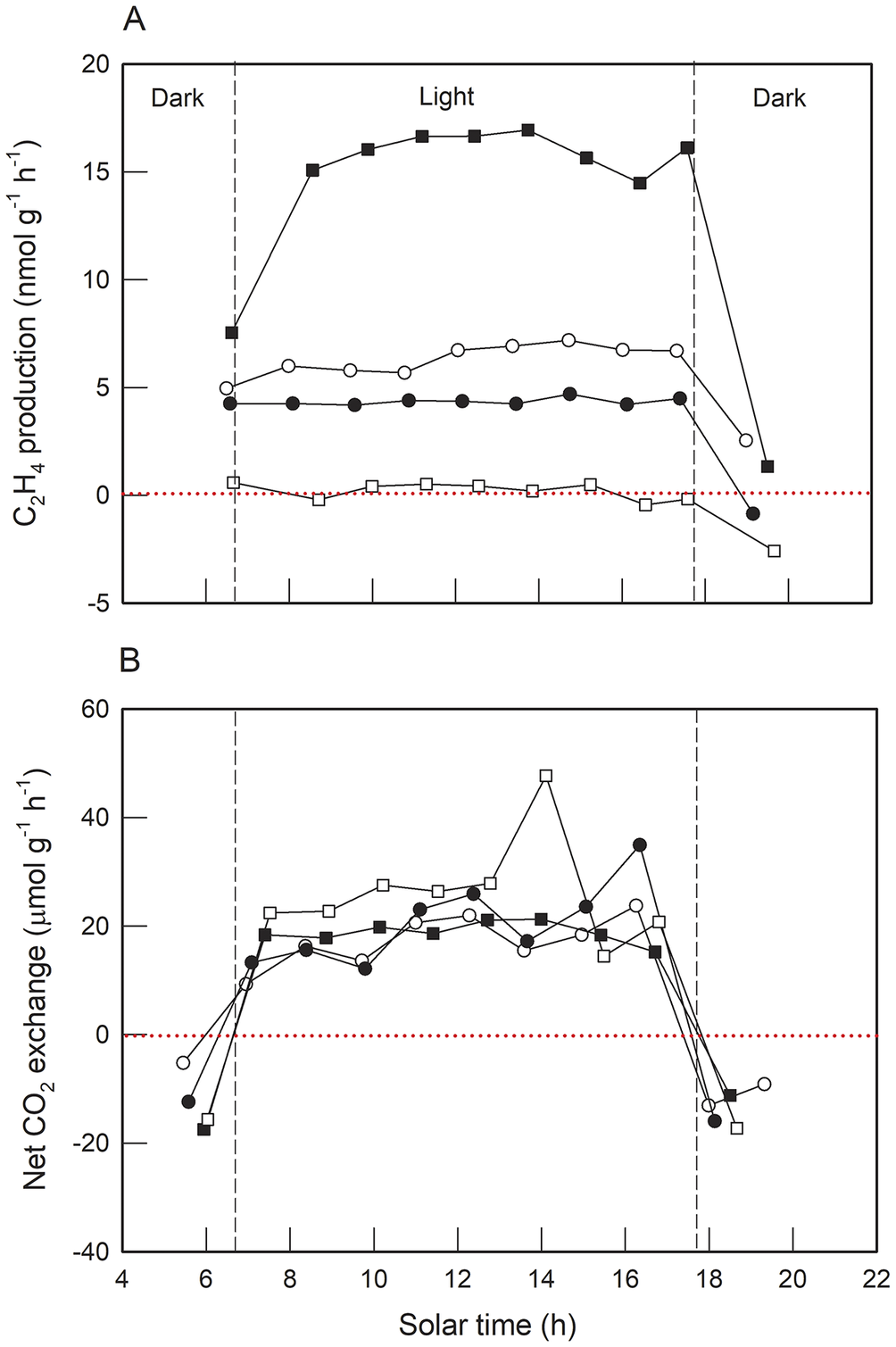
Figure 2. Long description
The figure consists of two vertically stacked line graphs, A and B, sharing a common X-axis representing Solar time in hours from 4 to 22. Vertical dashed lines divide the graphs into three temporal zones: Dark, Light (approximately 07:00 to 18:00), and Dark. A horizontal red dotted line marks the zero baseline in both panels.
Panel A: The Y-axis measures C 2 H 4 production in nmol g super minus 1 h super minus 1, ranging from minus 5 to 20. Four distinct specimens are tracked. The specimen represented by solid squares shows a sharp increase at the start of the Light period, peaking near 17 nmol, and dropping sharply at the second Dark transition. Specimens represented by open circles and solid circles maintain relatively stable, lower activities between 4 and 7 nmol during the Light period. The specimen with open squares remains near the zero baseline throughout.
Panel B: The Y-axis measures Net C O 2 exchange in micromol g super minus 1 h super minus 1, ranging from minus 40 to 60. All four specimens show negative values (respiration) during the initial Dark period. Upon entering the Light period, all specimens transition to positive values (net photosynthesis), fluctuating between 15 and 30 micromol. One specimen (open squares) shows a significant peak near 50 micromol at 14:00. At the 18:00 transition to Dark, all specimens drop sharply back into negative exchange values.
Progress of concurrent measurements of nitrogenase activity (acetylene reduction, open symbols) and net CO2 exchange (solid symbols) in Thyrea girardii (circles = material collected in March, squares = material collected in September) (A) and Peltigera membranacea (B) during dark-light-dark transitions. Mean values are plotted ± 1 SE (n = 4 for T. girardii; n = 5–8 for P. membranacea) at time points at which incubations were terminated. Thallus temperatures and water contents for T. girardii were in the ranges 21–24 °C and 221–694% for March material, and 20–21 °C and 401–574% for September samples; values for P. membranacea were 18–22 °C and 283–322%. Nitrogenase activities in T. girardii were classed as trace (September) and zero (March) (see Table 1); note that nitrogenase activity in September was significantly greater than zero (P = < 0.001, t-test). In A, the vertical short and long dashed lines indicate the times of dark-light-dark transitions for March and September collections, respectively. In colour online.
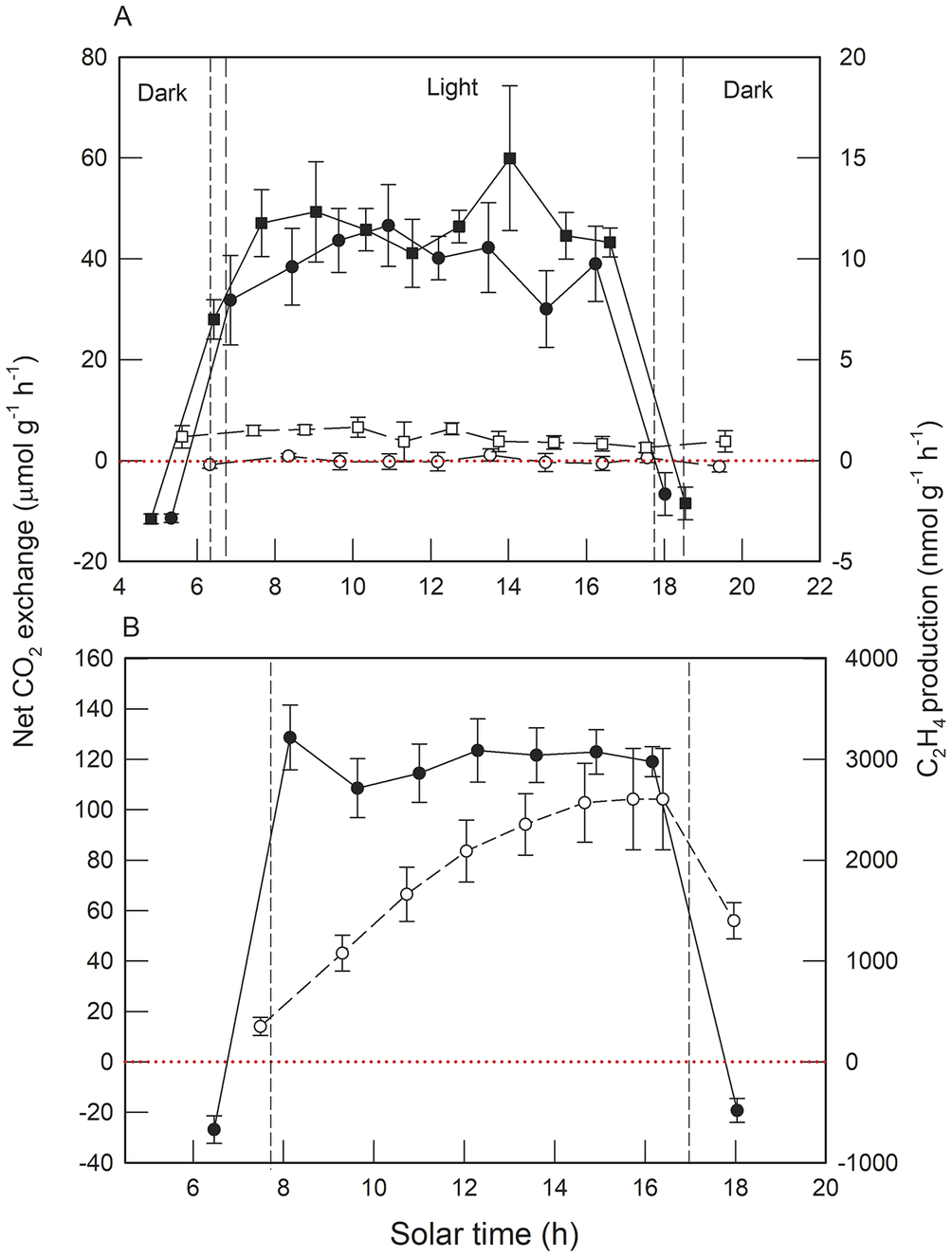
Figure 3. Long description
The image consists of two vertically stacked line graphs, A and B, sharing a common X-axis of Solar time in hours from 4 to 22. Both panels feature a primary left Y-axis for Net C O sub 2 exchange in micromoles per gram per hour and a secondary right Y-axis for C sub 2 H sub 4 production in nanomoles per gram per hour. A horizontal red dotted line marks the zero point for both axes.
Panel A (Thyrea girardii):
* The graph is divided into three sections: Dark, Light, and Dark, separated by vertical dashed lines.
* Net C O sub 2 exchange (solid symbols) shows a sharp increase from negative values (roughly minus 10) in the dark to positive values (between 30 and 60) during the light period, followed by a sharp drop back to negative values in the second dark period. Circles represent March material and squares represent September material.
* Nitrogenase activity (open symbols) remains near zero throughout the cycle for both March and September samples, with September (open squares) showing slightly higher trace activity than March (open circles).
Panel B (Peltigera membranacea):
* Net C O sub 2 exchange (solid circles) rises rapidly from minus 30 to a plateau around 120 during the light phase, then drops sharply to minus 20 in the final dark phase.
* Nitrogenase activity (open circles) shows a gradual, non-linear increase during the light phase, starting near zero and peaking at approximately 2500 nanomoles per gram per hour before declining slightly as the light phase ends.
* Error bars representing plus or minus 1 S E are present on all data points.
Relationship between thallus water content (% oven-dry mass) and net CO2 exchange in Peltigera membranacea (A), Lichinella nigritella (B) and Thyrea girardii (C), measured at PFFR values of 170–200 μmol m−2 s−1 and thallus temperatures of 18–20, 20–21 and 22–26 °C in A, B and C, respectively. Inserts show these relationships drawn to the same scale as that for P. membranacea. Smooth curves are fitted together with 95% confidence intervals for each fitted value (n = 9, 8, and 8 for A, B and C, respectively). Drying times were 3–5 h. Arrows indicate thallus water content values at which nitrogenase assays were conducted as recorded in Supplementary Material Table S4 (available online). In colour online.

Figure 4. Long description
A three-panel vertical stack of line graphs. The shared x-axis at the bottom is Thallus water content in percent dry mass, ranging from 0 to 600. The y-axis is Net C O sub 2 exchange in micromoles per gram per hour.
Panel A (Top): Peltigera membranacea. The y-axis ranges from minus 50 to 200. The data shows a rapid increase from 0 to a peak of approximately 140 at 300 percent water content, followed by a gradual decline to near 0 at 600 percent. An inset in the top right shows the curve on a standardized scale.
Panel B (Middle): Lichinella nigritella. The y-axis ranges from 0 to 80. The curve shows a slight initial dip below zero, then a steady increase to a plateau of approximately 50 between 400 and 600 percent water content. Three red arrows point to the curve at approximately 140, 250, and 400 percent water content. An inset in the bottom right shows the curve on the same scale as Panel A.
Panel C (Bottom): Thyrea girardii. The y-axis ranges from 0 to 30. The curve shows a slight initial dip, then a steady increase to a peak of approximately 22 at 450 percent water content, followed by a sharp drop. Four red arrows point to the curve at approximately 80, 130, 240, and 450 percent water content. An inset in the bottom right shows the curve on the same scale as Panel A.
All panels include vertical error bars representing 95 percent confidence intervals for each data point.
All specimens tested, including those with zero or trace nitrogenase activity, were photosynthetically competent, achieving broadly comparable rates of net CO2 exchange among replicates (Figs 2B, 3A & 4). Nonetheless, photosynthetic rates in Lichinella and Thyrea were low compared with those in Peltigera membranacea (Figs 3 & 4). There was some evidence, from an albeit limited data set, that variation in nitrogenase activity amongst these species was linked to photosynthetic capacity (Supplementary Material Fig. S1, available online).
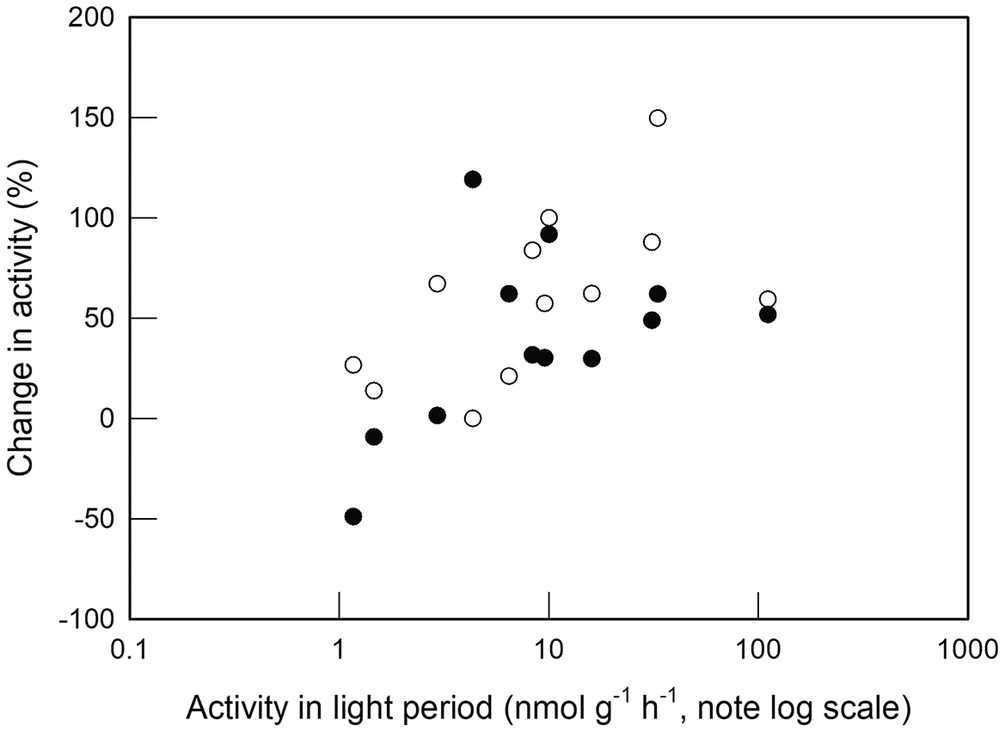
In both Lichinella and Thyrea, nitrogenase activity was greater in the light, concurrent with photosynthesis, than in the dark (Figs 1–3). Amongst the limited data available, there was no evidence that rates of photosynthesis were lower in specimens with active nitrogenase. Transitions from dark to light and light to dark resulted in abrupt increases and decreases in nitrogenase activity; these changes were proportionately greater in specimens with high rates of activity and approached zero in those with low or trace activity (Figs 1, 2A, 3A & 5).
Relationship in Lichinella nigritella, Thyrea confusa and T. girardii between mean rate of nitrogenase activity (acetylene reduction) in the light (note log scale) and the percentage increase and decrease in activity, respectively, on transfer from dark to light (open circles) and light to dark (closed circles) (r = 0.51, P = 0.0101, bivariate Pearson correlation coefficient). Plotted values are derived from data in Figs 1, 2A and 3A. The most negative value reported in Fig. 2A was considered anomalous and omitted.

Figure 5. Long description
A line graph with a logarithmic X axis and a linear Y axis. The X axis is labeled Activity in light period nmol g super -1 h super -1 and ranges from 0.1 to 1000 on a log 10 scale. The Y axis is labeled Change in activity percent and ranges from -100 to 200 in increments of 50. The data consists of two sets of points. Open circles represent the percentage increase on transfer from dark to light. Closed circles represent the percentage decrease on transfer from light to dark. The data points are clustered between 1 and 100 on the X axis and between -50 and 150 on the Y axis. There is a general upward trend from left to right, indicating that higher mean rates of nitrogenase activity in the light are associated with larger percentage changes when light conditions shift. One open circle outlier is visible at approximately 30 on the X axis and 150 on the Y axis. A closed circle outlier is located at approximately 1 on the X axis and -50 on the Y axis.
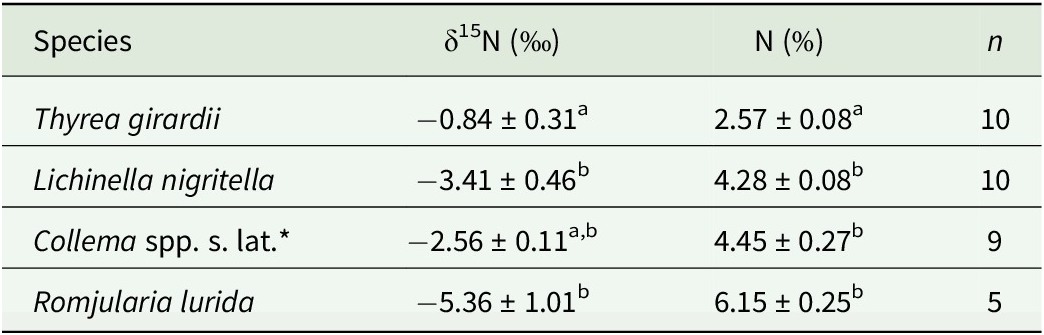
Of the four lichen species or species complexes for which 15N natural abundance was measured, the non-N2-fixing Romjularia lurida had the lowest δ15N values and the highest thallus N concentrations (Table 2). However, δ15N values in this species were markedly variable (range = −7.32 to −2.38‰) and the sample size was small. The established N2-fixer, Collema spp. s. lat. (e.g. Kershaw & MacFarlane Reference Kershaw and MacFarlane1982) had a roughly similar δ15N signature to that of the putative fixer L. nigritella, while T. girardii was the least 15N-depleted and had the lowest N concentration.
15N natural abundance (δ15N) and total thallus N concentration in four lichen species co-occurring on limestone cliffs in the study area. Values assigned the same letters are not significant at the P = 0.05 level (one-way ANOVA).
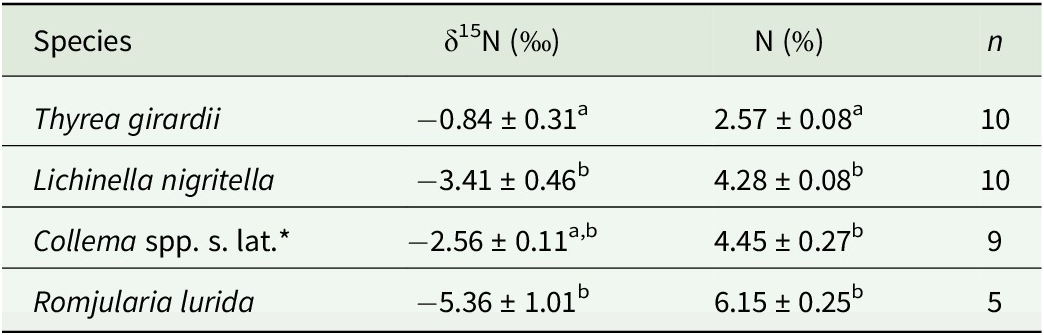
Table 2. Long description
The table consists of four columns: Species, delta 15 N per mil, N percent, and n (sample size).
* Thyrea girardii: delta 15 N is minus 0.84 plus or minus 0.31 (group a); N concentration is 2.57 plus or minus 0.08 (group a); n equals 10.
* Lichinella nigritella: delta 15 N is minus 3.41 plus or minus 0.46 (group b); N concentration is 4.28 plus or minus 0.08 (group b); n equals 10.
* Collema species s. lat.: delta 15 N is minus 2.56 plus or minus 0.11 (groups a, b); N concentration is 4.45 plus or minus 0.27 (group b); n equals 9.
* Romjularia lurida: delta 15 N is minus 5.36 plus or minus 1.01 (group b); N concentration is 6.15 plus or minus 0.25 (group b); n equals 5.
Values assigned the same superscript letters are not significant at the P equals 0.05 level based on a one-way A N O V A.
* See Table 1
Epiphytic free-living cyanobacteria occurred in varying quantities on the upper surfaces of thallus lobes of each of the three species, even after prior cleaning. The principal contaminant was referable to Scytonema (possibly S. mirabilis) while Nostoc and a unicell referable to Entophysalis were also occasionally present in trace quantities (A. Pentecost, personal communication). Of the six specimens with high nitrogenase activities that were examined in detail, three had Scytonema filaments distributed across the upper surfaces of at least some lobes, while three had negligible contamination (Supplementary Material Table S5, available online). Of the six thalli with low activity, two had well-developed Scytonema populations on at least two lobes. On all other specimens, including all with zero or trace activity, surface contamination from epiphytic cyanobacteria was either sparse or absent. No heterocytous cyanobacteria were detected within thalli.
Discussion
Overview
Perhaps the most striking finding in this investigation was the sporadic nature of nitrogenase activity in the three species of Lichinales examined. This unpredictable activity presents a considerable problem for experimental studies on N2 fixation in this lichen group with unicellular cyanobionts. These results are in stark contrast to experience with lichens containing heterocytous cyanobacteria in which nitrogenase activity is usually detectable within minutes of rehydrating freshly collected dry field material (Hitch & Stewart Reference Hitch and Stewart1973; Huss-Danell Reference Huss-Danell1977; Kershaw & Dzikowski Reference Kershaw and Dzikowski1977; Fritz-Sheridan Reference Fritz-Sheridan1988). The infrequency with which nitrogenase activity was detected in unicellular lichen cyanobionts is not without precedent. In our earlier report (Crittenden et al. Reference Crittenden, Llimona and Sancho2007), we presented data for diel variation in nitrogenase activity in Thyrea girardii. However, T. confusa was likewise assayed in that study but no nitrogenase activity was recorded and, furthermore, of 12 replicate thalli of T. girardii prepared for assay, four had no activity. Snyder & Wullstein (Reference Snyder and Wullstein1973) conducted acetylene reduction assays on Peltula cylindrica and Pyrenopsis phaecocca, species with unicellular cyanobionts, and were unable to detect activity that could be attributable to the cyanobacteria.
The identities of the cyanobacterial symbionts in the three lichen species studied here await critical assessment. Büdel & Henssen (Reference Büdel and Henssen1983) cultured photobionts from Anema, Lichinella, Peccania and Psorotichia, and considered that their developmental morphology was consistent with a Chroococcidiopsis sp. Later molecular studies have suggested that Chroococcidiopsis or other members of the Chroococcidiopsidales occur in several species of Lichinella and in Thyrea pulvinata (Jäger 2000 cited by Schultz & Büdel (Reference Schultz and Büdel2002); Fewer et al. Reference Fewer, Friedl and Büdel2002; Jung et al. Reference Jung, Brust, Schultz, Büdel, Donner and Lakatos2021). Nonetheless, the phylogeny and taxonomy of genera in Chroococcidiopsidales remain unclear (Jung et al. Reference Jung, Briegel-Williams, Büdel, Schultz, Nürnberg, Grube, D’Agostino, Kaštovský, Mareš and Lorenz2024). Studies by Jung et al. (Reference Jung, Brust, Schultz, Büdel, Donner and Lakatos2021) on the identity and phylogeny of cyanobionts from the lichen genera Gonohymenia, Lichinella, Peccania and Peltula revealed an unexpected high cyanobiont diversity, with all being described as new species: five were new unicellular species, two of which being assigned to new genera, and two (from Gonohymenia sp. and Lichinella cribellifera) were determined as new species of Komarekiella, a genus of heterocytous cyanobacteria. The authors found that none of these new species was able to grow on an N-free medium. Rippka et al. (Reference Rippka, Deruelles, Waterbury, Herdman and Stanier1979) reported that Chroococcidiopsis expresses nitrogenase activity only under anaerobic conditions, while it should be noted that cultures were maintained and assayed (see Rippka & Waterbury Reference Rippka and Waterbury1977) under continuous illumination (cf. Boison et al. Reference Boison, Mergel, Jolkver and Bothe2004). By contrast, several authors have measured aerobic nitrogenase activity in free-living endolithic Chroococcidiopsis-type unicellular cyanobacterial populations, although interference from heterocytous species could not be ruled out (Friedmann & Kibler Reference Friedmann and Kibler1980; Boison et al. Reference Boison, Mergel, Jolkver and Bothe2004; Banerjee & Verma Reference Banerjee and Verma2009). Friedmann & Kibler (Reference Friedmann and Kibler1980) also commented on the low frequency with which nitrogenase activity could be detected in endolithic samples with, for example, activity being recorded in only one of 11 rock samples from the Antarctic Dry Valleys containing endolithic cyanobacteria, purportedly unicells. This infrequency with which nitrogenase activity is detected in free-living Chroococcidiopsis-type unicells has led to uncertainty as to whether lichens with unicellular cyanobacteria are likely to be diazotrophic.
The values of δ15N measured in the four lichen species/genera growing on limestone cliffs (Table 2) are broadly in accord with published data. Crittenden et al. (Reference Crittenden, Ellis, Smith, Wanek and Thornton2023) compared δ15N values amongst eight species of lichen containing heterocytous cyanobacteria and with contrasting N2-fixing capacities; mean values varied from −4.3‰ to +2.6‰, a range that accommodates values for Lichinella and Thyrea reported here. The eight values were weakly and non-significantly positively related to maximum rates of nitrogenase activity. (Note that according to Zhang et al. (Reference Zhang, Sigman, Morel and Kraepiel2014) the theoretical δ15N value for ammonium produced by nitrogenase is c. −1.0‰ and that Dojani et al. (Reference Dojani, Lakatos, Rascher, Wanek, Lüttge and Büdel2007) reported a value of −1.9 ± 0.9‰ (n = 15) for cyanobacterial biofilms, containing both unicellular and heterocytous species, on an inselberg in French Guiana.) Chlorolichens generally have δ15N values below this range (Russow et al. Reference Russow, Veste and Böhme2005; Beck & Mayr Reference Beck and Mayr2012; Hurtado et al. Reference Hurtado, Prieto, Martínez-Vilalta, Giordani, Aragón, López-Angulo, Košuthová, Merinero, Díaz-Peña and Rosas2020; Petix et al. Reference Petix, Bell, Williams and Evans2024 (and references therein), Reference Petix, Bell and Evans2025). Nevertheless, separation between N2-fixing and non-N2-fixing lichens based on δ15N values is not complete. δ15N values for chlorolichens that fall within the range for N2-fixers have been reported for species on a rocky seashore (Riera Reference Riera2005), for Siphula ceratites on peatland (Asada et al. Reference Asada, Warner and Aravena2005) and for eutrophication tolerant species such as Parmelia saxatilis (Crittenden et al. Reference Crittenden, Ellis, Smith, Wanek and Thornton2023) and Gallowayella borealis (= Xanthomendoza borealis) (Crittenden et al. Reference Crittenden, Scrimgeour, Minnullina, Sutton, Tang and Theobald2015) amongst others. Furthermore, the above interpretations are based on a limited range of lichens for which δ15N values are currently available. Accordingly, the δ15N measurements for Lichinella and Thyrea, while being comparable with those of other N2-fixing lichens, need to be considered with caution as evidence of diazotrophy. In addition, such an interpretation would need to consider how relatively high δ15N values could be generated by only occasional episodes of nitrogenase activity.
Potential confounding factors
Two factors could conceivably present pitfalls in the interpretation of the present results. First, the Thyrea and Lichinella specimens studied were ‘contaminated’ to varying degrees with surface-bound epiphytic heterocytous cyanobacteria, principally Scytonema. Even though the quantity of this ‘extramatricullar’ material was minute compared with that of the unicellular cyanobiont, it raises the question as to whether nitrogenase activity in this heterocytous component was detectable and could have significantly contributed to nitrogenase activity in at least some specimens. Guidance on this question might be provided by the results of Fritz-Sheridan (Reference Fritz-Sheridan1987) who conducted in situ acetylene reduction assays on Scytonema mats and on adjacent stands of the N2-fixing lichen Stereocaulon virgatum in Guadeloupe. On a unit dry mass basis, nitrogenase activities in well-hydrated cyanobacterial mats and lichen thalli were remarkably similar: between 53.7 ± 18.2 and 87.2 ± 19.2 nmol C2H4 g−1 h−1 in Scytonema mats, and 52.9 ± 27.2 and 74.0 ± 21.0 nmol C2H4 g−1 h−1 in S. virgatum. It seems probable, then, that at the very least several milligrams of epiphytic Scytonema would be required per thallus in order for its nitrogenase activity to be detected, whereas the observed ‘contamination’ probably amounted to several micrograms at most. B. Büdel (personal communication) has observed Scytonema growing epiphytically quite widely among the Lichinaceae and Peltulaceae and has reached a similar conclusion regarding its potential acetylene reduction signal. Nitrogenase activity in heterocytous cyanobacteria, and lichens in which they occur, are highly responsive to dark to light and light to dark transitions, showing abrupt increases and decreases, respectively, in nitrogenase activity both under laboratory (MacFarlane et al. Reference MacFarlane, Maikawa, Kershaw and Oaks1976; Bottomley & Stewart Reference Bottomley and Stewart1977; Huss-Danell Reference Huss-Danell1979; Mullineaux et al. Reference Mullineaux, Gallon and Chaplin1981; Ernst et al. Reference Ernst, Liu, Reich and Böger1990) and field conditions (Crittenden & KershawReference Crittenden and Kershaw1979; Coxson & Kershaw Reference Coxson and Kershaw1983; Quesada et al. Reference Quesada, Nieva, Leganés, Ucha, Martín, Prosperi and Fernández-Valient1998). The responses to such transitions in Lichinella and Thyrea were positively correlated with the mean level of activity in the light (Fig. 5), with trace activity appearing unresponsive. If the source of trace activity was a small population of highly active heterocytous epiphytes, then a response to these abrupt changes in illumination would probably have been evident. The absence of such a response is more consistent with a larger population of photobiont cells with activity that is sufficiently low to be sustained by cellular reserves and/or low rates of C-transfer from the mycobiont. Taking these findings together, it seems doubtful that nitrogenase activity recorded in Lichinella and Thyrea is owing to contamination. Furthermore, the apparent link between rates of nitrogenase activity and photosynthesis amongst Lichinella, Peltigera and Thyrea (Supplementary Material Fig. S1, available online), if real, would seem unlikely to be generated by contamination.
Second, N pollution also needs to be considered as a potential source of interference. Rates of atmospheric N deposition in Catalonia are the highest in Spain (García-Gómez et al. Reference García-Gómez, Garrido, Vivanco, Lassaletta, Rábago, Àvila, Tsyro, Sánchez, González Ortiz and González-Fernández2014; Vivanco et al. Reference Vivanco, Theobald, García-Gómez, Garrido, Prank, Aas, Adani, Alyuz, Andersson and Bellasio2018). Modelled values of mean annual total inorganic N deposition among the four lichen collection sites ranged from 14–19 kg ha−1 in 2017 (downloaded from https://www.emep.int/mscw/mscw_moddata.html). Combined N is an antagonist of N2 fixation. Crittenden et al. (Reference Crittenden, Ellis, Smith, Wanek and Thornton2023) reported that in the British Isles the tripartite montane lichen Stereocaulon vesuvianum does not produce cephalodia, and does not fix N2, at mean annual N deposition rates > 10 kg ha−1, with the most significant independent variable predicting loss of cephalodia being dry deposition of reduced N (NHy). The authors speculated that the low rates of N income from N2 fixation in S. vesuvianum (acetylene reduction rate 20–70 nmol C2H4 g−1 h−1) could perhaps be readily supplanted by combined N income from elevated N deposition. Rates of nitrogenase activity in Lichinella and Thyrea (≤ c. 100 nmol C2H4 g−1 h−1) are similar to those in S. vesuvianum and a negative effect of N enrichment might also have occurred in these species. However, the oceanic climate of montane western Britain (the principal range of British populations of S. vesuvianum) contrasts strongly with the Mediterranean climate of the Barcelona region where both annual rainfall and the number of days with rain are considerably lower (by approximately an order of magnitude and a factor of 4, respectively), and the evaporating power of the atmosphere is higher (annual mean saturation deficit is greater by a factor of 3). Dry deposition of ammonia to lichens is likely to be lower in a substantially drier climate. A more detailed and quantitative discussion of this topic is presented in Supplementary Material Note S1 (available online).
On the infrequency of nitrogenase activity in Lichinella and Thyrea
The sporadic nature of nitrogenase activity in Lichinella and Thyrea might indicate that the availability of combined forms of N in their habitats is only occasionally insufficient to meet their growth-led demand. Unicellular cyanobacteria are well placed to switch from oxygenic photosynthesis to N2 fixation for short periods of time. As is the case for many species in the Lichinaceae, the habitats from which specimens were collected for the present work were relatively extreme: exposed, near-vertical cliff faces experiencing long periods of continuous desiccation, high insolation and high temperatures. Accordingly, Thyrea and Lichinella probably have low annual growth rates and moderate growth-led demand for N. The low photosynthetic rates in L. nigritella and T. girardii (Fig. 4) are in line with this suggestion, although we are mindful that the data sets for net CO2 exchange presented here are unifactorial and do not comply with the multifactorial approach advocated by Kershaw (Reference Kershaw1985). Nutrients are delivered to these lichens in dry deposits and rainfall that are intercepted directly by thalli and, in due course, in both descending surface run-off and seepage water. The presence of Rusavskia elegans (= Xanthoria elegans) in the most well-marked seepage tracks on some cliffs sampled perhaps indicates that seepage water in these locations is nutrient enriched.
Lichens that achieve high rates of N2 fixation (with rates of acetylene reduction > 1 μmol C2H4 g−1 h−1) have, with few exceptions, Nostoc as either the primary or secondary photobiont (cf. Sanders & Masumoto Reference Sanders and Masumoto2021). These include species of Collema s. lat. (Kershaw & MacFarlane Reference Kershaw and MacFarlane1982), Leptogium and Pectenia (=Degelia) (Hitch & Millbank Reference Hitch and Millbank1975), Lobaria (Alexander et al. Reference Alexander, Billington and Schell1974), Nephroma and Solorina (Kallio et al. Reference Kallio, Suhonen and Kallio1972; Granhall & Selander Reference Granhall and Selander1973), Peltigera (Hitch & Stewart Reference Hitch and Stewart1973), and Pseudocyphellaria and Sticta (Green et al. Reference Green, Horstmann, Bonnett, Wilkins and Silvester1980). Notable exceptions are Lichina (Hitch & Stewart Reference Hitch and Stewart1973), in which the principal cyanobiont is Rivularia (Ortiz-Álvarez et al. Reference Ortiz-Álvarez, de los Ríos, Fernández-Mendoza, Torralba-Burrial and Pérez-Ortega2015), and the basidiolichens Dictyonema (Fritz-Sheridan Reference Fritz-Sheridan1988) and Cora (Fritz-Sheridan & Portécop Reference Fritz-Sheridan and Portécop1987), containing the cyanobacterium Rhizonema (Lücking et al. Reference Lücking, Barrie and Genney2014). This group of lichens with high rates of activity is probably adapted to habitats in which their growth-led demands for N greatly exceed the availability of combined forms of N in, for example, atmospheric deposition and canopy throughfall. Therefore, in these circumstances, constant maintenance of N2-fixing capacity, and a metabolically costly heterocyte population, is advantageous. Lichens with lower N2-fixing capacities (e.g. with maximum rates of nitrogenase activity < 1 μmol C2H4 g−1 h−1) presumably have lower growth-led N demands yet perhaps occupy habitats where this demand is still not met by income of combined N. This would include species of Stereocaulon (Crittenden Reference Crittenden1975), Ephebe and Placynthium (Hitch & Millbank Reference Hitch and Millbank1975), and Placopsis (Crittenden Reference Crittenden1975; Raggio et al. Reference Raggio, TGA, Crittenden, Pintado, Vivas, Pérez-Ortega, De los Rios and Sancho2012), containing the cyanobionts Stigonema, Dichothrix and Tolypothrix (Sanders & Masumoto Reference Sanders and Masumoto2021). These lichens occupy open habitats where they intercept atmospheric deposition directly with minimum modification, and potential nutrient enrichment, by overlying plant canopies. It is tempting to speculate that cyanobiont species other than Nostoc may be better suited to achieving more modest rates of N2 fixation. Regrettably there is a dearth of comparative data on rates of nitrogenase activity achieved by different species and genera of cyanobacteria.
While lichens with unicellular cyanobionts can in theory readily switch between N2-fixing and non-N2-fixing states, those with heterocytous cyanobionts may be less capable of such rapid adjustment. In free-living cyanobacteria, both heterocytous and non-heterocytous species, nitrogenase activity and synthesis is inhibited by combined N (Fogg et al. Reference Fogg, Stewart, Fay and Walsby1973; Stewart Reference Stewart1973). Inhibition can occur within several hours of exposure; examples include the almost complete loss of nitrogenase activity in Anabaena sp. (Bottomley et al. Reference Bottomley, Grillo, Van Baalen and Tabita1979), Plectonema boryanum (=Leptolynbya boryana) (Rai et al. Reference Rai, Borthakur and Bergman1992), Gloeothece sp. (Cheng et al. Reference Cheng, Hipkin and Gallon1999) and Crocosphaera watsonii (Dekaezemacker & Bonnet Reference Dekaezemacker and Bonnet2011) within 2–12 h in response to NH4+ (10, 2, 2 and 0.01 mM solutions, respectively). There is also evidence that exposure to combined N inhibits nitrogenase activity in lichenized cyanobacteria (Kytöviita & Crittenden (Reference Kytöviita and Crittenden1994) and references therein). Sustained exposure of free-living cyanobacteria to combined N also inhibits heterocyte formation. For example, Willis et al. (Reference Willis, Chuang and Burford2016) report that when axenic cultures of Cylindrospermopsis raciborskii, a species with a single terminal heterocyte on each trichome, grown in N-free medium were transferred to an N-replete medium (containing 0.9 mM NO3−), heterocyte abundance declined from one per trichome to zero over a period of 20 days, some heterocytes undergoing degradation and many apparently being shed. Conversely, transferring the cyanobacterium from an N-replete to N-free medium resulted in an increase in heterocyte frequency from zero to one per trichome over a similar time period. Likewise, Chua et al. (Reference Chua, Wallace, Yardley, Duncan, Dearden and Summerfield2012) found that Nostoc isolated from Pseudocyphelaria crocata and cultured axenically in an N-replete medium (containing 2.5 mM NH4+ + 3.0 mM NO3−) produced heterocytes within 24 h on transfer to an N-free medium. It is not known at what rate and where heterocyte frequency could be adjusted within a lichen thallus if exposed to sustained N enrichment or deprivation. Heterocytes first develop in the marginal and apical growing regions of lichen thalli (Bergman & Hällbom Reference Bergman and Hällbom1982; Janson et al. Reference Janson, Rai and Bergman1993; Chua et al. Reference Chua, Wallace, Yardley, Duncan, Dearden and Summerfield2012) and hence changes in the frequency of heterocyte differentiation here will determine heterocyte abundance in new photosynthetic tissue. It is less clear how heterocytous cyanobionts in mature, fully differentiated regions of thalli would respond to changes in N supply. Heterocytes are terminally determinate structures and cannot re-differentiate back to vegetative cells (Fogg et al. Reference Fogg, Stewart, Fay and Walsby1973; Zeng & Zhang Reference Zeng and C-C2022). Therefore, a reduction in heterocyte numbers in extant photosynthetic tissue in response to N enrichment, if indeed this occurs, would likely involve heterocyte degeneration. Here also the vegetative cells of cyanobionts exist as enlarged or ‘outsized’ cells thought to be associated with cessation of cell division (Bergman & Hällbom Reference Bergman and Hällbom1982; Hill Reference Hill and Brown1984, Reference Hill1989; Honegger Reference Honegger1993; Chua et al. Reference Chua, Wallace, Yardley, Duncan, Dearden and Summerfield2012), arguably creating a quiescent cell factory with elevated photosynthetic capacity (cf. Garfias-Gallegos et al. Reference Garfias-Gallegos, Pardo-De la Hoz, Haughland, Magain, Aguero, Miadlikowska and Lutzoni2025). This leads to the thought that development of new heterocytes in response to N deprivation would probably require the recovery of cell potency. These conundrums largely relate to bipartite cyanolichens. The size and abundance of cephalodia in tripartite lichens have been shown to decline in response to N enrichment (Palmqvist et al. Reference Palmqvist, Franklin and Näsholm2017; Crittenden et al. Reference Crittenden, Ellis, Smith, Wanek and Thornton2023). Crittenden et al. (Reference Crittenden, Ellis, Smith, Wanek and Thornton2023) speculated that the development of cephalodia in N-enriched acephalodiate populations of Stereocaulon vesuvianum could take several years following reduction of N deposition rates. These arguments suggest that lichens with heterocytous cyanobionts are perhaps less suited than those with unicellular cyanobionts to environments in which N supply is only occasionally limiting.
Lichinella and Thyrea fix nitrogen in the light
Another notable finding in this study is that maximum rates of nitrogenase activity in Lichinella and Thyrea occur in the light. While this largely confirms the results of an earlier study (Crittenden et al. Reference Crittenden, Llimona and Sancho2007), here we further show that thalli with nitrogenase activity also assimilate CO2 (Figs 2 & 3A). This contrasts with natural populations of free-living unicellular cyanobacteria that fix N2 during dark periods, providing temporal separation from oxygenic photosynthesis in the light (Griffiths et al. Reference Griffiths, Gallon and Chaplin1987; Wilson et al. Reference Wilson, Aylward, Ribalet, Barone, Casey, Connell, Eppley, Ferrón, Fitzsimmons and Hayes2017). Nonetheless, laboratory cultures of the unicells Gloeothece and Crocosphaera can be induced to fix N2 in the light when grown in continuous illumination (Gallon et al. Reference Gallon, LaRue and Kurz1974; Grobbelaar et al. Reference Grobbelaar, Huang, Lin and Chow1986; Du & Gallon Reference Du and Gallon1993; Schneegurt et al. Reference Schneegurt, Sherman, Nayar and Sherman1994; Taniuchi et al. Reference Taniuchi, Yoshikawa, Maeda, Omata and Ohki2008), in well-aerated continuous cultures or under a low light/dark regime (e.g. with PPFR values of 5–10 μmol m−2 s−1) (Ortega-Calvo & Stal Reference Ortega-Calvo and Stal1991).
In free-living unicellular cyanobacteria, N2 fixation in the dark is fuelled by the utilization of carbohydrate reserves. Most frequently these are glycogen or related α-glucans, the principal C-storage products in cyanobacteria, often discernible as granules by electron microscopy (Fay Reference Fay1983). Carbon storage granules form during photosynthesis in the light and are then catabolized in support of nitrogenase activity in the dark in a diel oscillation (Mullineaux et al. Reference Mullineaux, Chaplin and Gallon1980; Livingstone et al. Reference Livingstone, Pentecost and Whitton1984; Reade et al. Reference Reade, Dougherty, Rogers and Gallon1999; Gallon Reference Gallon2001; Mohr et al. Reference Mohr, Intermaggio and LaRoche2010; Aryal et al. Reference Aryal, Stöckel, Krovvidi, Gritsenko, Monroe, Moore, Koppenaal, Smith, Pakrasi and Jacobs2011; Červený et al. Reference Červený, Sinetova, Valledor, Sherman and Nedbal2013; Welkie et al. Reference Welkie, Sherman, Chrisler, Orr and Sherman2013; Liberton et al. Reference Liberton, Bandyopadhyay and Pakrasi2019). It is perhaps noteworthy then that Paran et al. (Reference Paran, Ben-Shaul and Galun1971) did not observe glucan/glycogen granules in the unicellular cyanobiont of Lichinella sinaica (= Gonohymenia sinaica) and they speculated that this absence might result from a rapid flow of photosynthate to the mycobiont. This suggestion is in line with the possibility that in Lichinella and Thyrea respiratory substrate for nitrogenase activity is supplied by the fungus rather than reserves within the cyanobiont. Photosynthate derivatives in the mycelium of the photobiont layer are likely to be in most plentiful supply in the light before their concentration is depleted by translocation to sink regions in the thallus, such as zones of growth and surface tissues (Tapper Reference Tapper1981); accordingly, this could be a principal reason why lichenized unicellular cyanobacteria fix N2 in the light, a period when the supply of respiratory substrate from the mycobiont is maximal. While this may seem plausible, it is also possible that the specimens examined by Paran et al. had become desiccated at a point in the diel cycle before storage granules had re-formed. In free-living heterocytous cyanobacteria, C-storage granules and reserves undergo diel cycles of production and depletion as reported in unicellular species (Ernst et al. Reference Ernst, Liu, Reich and Böger1990) and they have been found frequently in heterocytous lichen cyanobionts (Boissière Reference Boissière1972, Reference Boissière1982; Rai et al. Reference Rai, Rowell and Stewart1981; Bergman & Hällbom Reference Bergman and Hällbom1982; Bergman & Huss-Danell Reference Bergman and Huss-Danell1983; Bergman & Rai Reference Bergman and Rai1989), although these observations are not without exception (Peat Reference Peat1968; Bousfield & Peat Reference Bousfield and Peat1976). Boissière (Reference Boissière1982) reported that if Peltigera canina was maintained in the dark prior to chemical fixation, the polyglucoside granules observed previously in the Nostoc photobiont then partially disappeared. Boissière (Reference Boissière1982) also noted in P. canina that granules were abundant in young Nostoc cells but generally lacking in fully developed and old cells. Additional work is required to verify the absence (or otherwise) of C-storage granules in unicellular lichen cyanobionts, a condition that would be in accord with N2 fixation being fuelled by the mycobiont.
On the location of nitrogenase activity in thalli
Where in thalli of Lichinella and Thyrea N2 fixation occurs remains to be determined. Cyanobiont cells that switch from photosynthesis to N2 fixation could be dispersed throughout the photobiont population, a suggestion that finds support from studies on free-living planktonic unicells. Crocosphaera watsonii has been found to form loose colonies or aggregations of between 3–250 cells both in natural planktonic populations (Foster et al. (Reference Foster, Sztejrenszus and Kuypers2013) and references therein) and in laboratory cultures (Masuda et al. Reference Masuda, Inomura, Takahata, Shiozaki, Sano, Deutsch, Prášil and Furuya2020). Using nanoscale secondary ion mass spectrometry (nanoSIMS), these authors demonstrated that only a subset of cells in an aggregate (34–75%) fixed N2 (cf. Mohr et al. Reference Mohr, Vagner, Kuypers, Ackermann and LaRoche2013) while assimilating little CO2, a phenomenon that had earlier been predicted to occur in Gloeothece by Stal and co-workers (Ortega-Calvo & Stal Reference Ortega-Calvo and Stal1991; Compaoré & Stal Reference Compaoré and Stal2010). Additionally, Dron et al. (Reference Dron, Rabouille, Claquin, Le Roy, Talec and Sciandra2012) estimated that 26–60% of N2 fixed by Crocosphaera might be released into the environment. Masuda et al. (Reference Masuda, Inomura, Takahata, Shiozaki, Sano, Deutsch, Prášil and Furuya2020) speculated that this released N could be available to non-diazotrophic cells and that such heterogeneity in N2-fixing capacity within an aggregate would maximize C-use efficiency. The authors constructed a simulation model to predict the effects of several factors on C costs of diazotrophy in C. watsoniia. One such factor was the efficiency with which released N could be taken up by neighbouring non-N2-fixing cells. In a lichen thallus this will approach 100% since current understanding is that fixed N is largely transferred to the mycobiont (Nash Reference Nash and Nash2008), reducing the C cost of N2 fixation. Note that the possibility of functional heterogeneity amongst photobiont cells had been raised previously by Boissière (Reference Boissière1987), whereby some vegetative cells of Nostoc in Peltigera might be partially disengaged from C transfer to the mycobiont. Gallon (Reference Gallon2001) and Ortega-Calvo & Stal (Reference Ortega-Calvo and Stal1991) proposed that N2 fixation and photosynthesis in Gloeothece could occur in the same cell if the rate of photosynthetic O2 production is sufficiently low for it to be consumed by respiratory protection, a suggestion that has subsequently found support in the results of studies on Crocosphaera (Großkopf & LaRoche Reference Großkopf and LaRoche2012; Rabouille et al. Reference Rabouille, Campbell, Masuda, Zavřel, Bernát, Polerecky, Halsey, Eichner, Kotabová and Stephan2021; Bandyopadhyay et al. Reference Bandyopadhyay, Sengupta, Elvitigala and Pakrasi2024). In addition, there might be microsites within lichen thalli where N2 fixation is favoured, such as areas of self-shading below overlapping lobes where operational PPFR values could be low enough to promote nitrogenase activity in the light (cf. Ortega-Calvo & Stal Reference Ortega-Calvo and Stal1991); hydrated single lobes of T. girardii, for example, transmit c. 5% of incident light (Supplementary Material Note S2, available online).
Finally, in free-living populations of unicellular cyanobacteria, the cyclic switching from oxygenic photosynthesis in the light to N2 fixation in the dark is coupled to, or at least parallels, the cell cycle. In Crocosphaera, in both laboratory cultures (Mitsui et al. Reference Mitsui, Kumazawa, Takahashi, Ikemoto, Cao and Arai1986; Mohr et al. Reference Mohr, Intermaggio and LaRoche2010; Shi et al. Reference Shi, Ilikchyan, Rabouille and Zehr2010; Dron et al. Reference Dron, Rabouille, Claquin, Le Roy, Talec and Sciandra2012, Reference Dron, Rabouille, Claquin, Talec, Raimbault and Sciandra2013) and in natural planktonic populations (Wilson et al. Reference Wilson, Aylward, Ribalet, Barone, Casey, Connell, Eppley, Ferrón, Fitzsimmons and Hayes2017), and also in cultures of Gloeothece (Gallon et al. Reference Gallon, LaRue and Kurz1974), photosynthesis is maximal immediately prior to cell division while nitrogenase activity develops post division. Proposing a link between nitrogenase activity and the cell cycle in lichenized unicellular cyanobacteria, in which the cell cycle has largely become arrested, could be problematic. However, we have noted that in T. girardii small photobiont cells, presumably the products of recent division, are not confined to the thallus margins but can be seen throughout the photobiont layer. Hence an ontogenetic basis for heterogeneity in N2-fixing activity within a unicellular cyanobiont population in a lichen thallus might also be at play.
Concluding comment
This report possibly raises as many, if not more, questions than it answers. However, some consolation might be taken from the large body of work pertaining to Trichodesmium, a genus of marine diazotrophic filamentous non-heterocytous cyanobacteria considered keystone species in pelagic N cycles (Zehr & Kudela Reference Zehr and Kudela2011). As is the case with Lichinella and Thyrea, Trichodesmium spp. fix N2 in the daytime concurrent with photosynthesis, yet after decades of research the mechanisms by which this is achieved, according to Zehr & Capone (Reference Zehr and Capone2024), remain elusive.
More work is needed to better understand the strategies by which N2 fixation is achieved in lichens with unicellular cyanobionts. Above all, perhaps, is how nitrogenase activity is distributed within thalli. Further research might be most effective using lichen populations that are near to research facilities, and which can be accessed and sampled frequently (e.g. on a daily basis). Such populations should preferably be in a region with low rates of N deposition (e.g. < 10 kg N ha−1 y−1, cf. Crittenden et al. (Reference Crittenden, Ellis, Smith, Wanek and Thornton2023)).
Supplementary Material
The Supplementary Material for this article can be found at https://doi.org/10.1017/S0024282926101534.
Acknowledgements
We thank Burkhard Büdel (Rhineland‑Palatinate Technical University Kaiserslautern Landau, Kaiserslautern, Germany), Jan Mareš (Czech Academy of Sciences, České Budĕjovice, Czech Republic) and Takako Masuda (Japan Fisheries Research and Education Agency, Shiogama, Japan) for useful discussions, Allan Pentecost (Freshwater Biological Association, Ambleside, UK) for identifying free-living epiphytic cyanobacteria, Antonio Gómez-Bolea (Universitat de Barcelona, Barcelona, Spain) for assistance with fieldwork and lichen identification, and Gillian Martin (James Hutton Institute, Aberdeen, UK) for assistance with isotopic analysis. Burkhard Büdel kindly read and commented on an earlier draft of this paper; it was then improved further by comments from two anonymous referees. The James Hutton Institute receives funding from the Scottish Government Rural and Environmental Science and Analytical Services (RESAS). The study was financed by an Emeritus Fellowship from the Leverhulme Trust (EM-2016-005) to PDC and this award is gratefully acknowledged. Barry Thornton sadly died before this paper was written.
Author Contribution
PDC obtained the funding, contributed to fieldwork to collect specimens, conducted all laboratory work except the measurement of N isotope ratios and thallus total N, and wrote the paper. BT made the measurements of N isotope ratios and total thallus N. XL led fieldwork in Spain, assisted with species identification and commented on the manuscript.
Author ORCID
Peter D. Crittenden, 0000-0002-4715-0167.
Competing Interests
The authors declare none.