



Hostname: page-component-7b7567c8c-z4zkx Total loading time: 0 Render date: 2026-11-19T05:04:03.645Z Has data issue: false hasContentIssue false

Oscillation of differential equations with non-monotone retarded arguments

Published online by Cambridge University Press:  01 March 2016

George E. Chatzarakis
Affiliation:
Department of Electrical and Electronic Engineering Educators, School of Pedagogical and Technological Education (ASPETE), N. Heraklion, 14121 Athens, Greece email geaxatz@otenet.gr
Özkan Öcalan
Affiliation:
Akdeniz University, Faculty of Science, Department of Mathematics, 07058 Antalya, Turkey email ozkanocalan@akdeniz.edu.tr

Abstract

Core share and HTML view are not available for this content. However, as you have access to this content, a full PDF is available via the 'Save PDF' action button.

Consider the first-order retarded differential equation

$$\begin{eqnarray}x^{\prime }(t)+p(t)x({\it\tau}(t))=0,\quad t\geqslant t_{0},\end{eqnarray}$$
where $p(t)\geqslant 0$ and ${\it\tau}(t)$ is a function of positive real numbers such that ${\it\tau}(t)\leqslant t$ for $t\geqslant t_{0}$ , and $\lim _{t\rightarrow \infty }{\it\tau}(t)=\infty$ . Under the assumption that the retarded argument is non-monotone, a new oscillation criterion, involving $\liminf$ , is established when the well-known oscillation condition
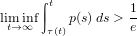
$$\begin{eqnarray}\liminf _{t\rightarrow \infty }\int _{{\it\tau}(t)}^{t}p(s)\,ds>\frac{1}{e}\end{eqnarray}$$
is not satisfied. An example illustrating the result is also given.

Information

Type
Research Article
Copyright
© The Author(s) 2016