


Hostname: page-component-7b7567c8c-fvjsw Total loading time: 0 Render date: 2026-11-12T09:20:03.462Z Has data issue: false hasContentIssue false

Using double integrals to solve single integrals

Published online by Cambridge University Press:  14 June 2016

G. J. O. Jameson*
Affiliation:
Dept. of Mathematics and Statistics, Lancaster University, Lancaster LA1 4YF e-mail: g.jameson@lancaster.ac.uk

Extract

Core share and HTML view are not available for this content. However, as you have access to this content, a full PDF is available via the 'Save PDF' action button.

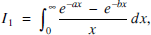
Consider the integral

where b > a > 0. First, let us clarify why it even exists. Of course, convergence at infinity is ensured by the exponential terms, but the integrals of and e–ax/x and e–bx/x, taken separately, are divergent at 0, since these integrands equate asymptotically to 1/x as x → 0. However,

so (e–ax – e–bx)/x tends to the finite limit b – a as x → 0 and there is no problem integrating it on intervals of the form [0, r].

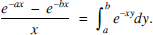
A neat way to evaluate I1 starts by expressing the integrand itself as an integral:

(1)

Inserting this into I1 converts it into a double integral.

Information

Type
Research Article
Copyright
Copyright © Mathematical Association 2016