




No CrossRef data available.
Core-preserving transformations of a vector space
Published online by Cambridge University Press: 24 October 2008
Extract
Core share and HTML view are not available for this content. However, as you have access to this content, a full PDF is available via the 'Save PDF' action button.
In the classical theory (3) due to Knopp, Agnew and others, the core K(x) of a sequence x = {ξn} of complex numbers is defined by 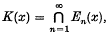 where En(x) is the smallest closed convex set containing all ξk with k ≥ n. A matrix transformation T is said to be a core-preserving transformation if

holds for all sequences x. T is core-preserving for bounded sequences if (1·1) holds for all bounded sequences x. It is readily proved that K(x) is the set of complex numbers ζ such that
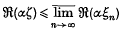
for all complex numbers α ( ). Now
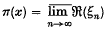 is a sub-additive, positive-homogeneous real-valued functional defined on the vector space of bounded complex sequences. This suggests the construction of an abstract theory on the following lines.
Information
- Type
- Research Article
- Information
- Mathematical Proceedings of the Cambridge Philosophical Society , Volume 49 , Issue 1 , January 1953, pp. 15 - 25
- Copyright
- Copyright © Cambridge Philosophical Society 1953
References
REFERENCES
(2)Bonsall, F. F. and Goldie, A. W.Algebras which represent their linear functionals. Proc. Camb. phil. Soc. 49 (1952), 1.CrossRefGoogle Scholar
(5)Stone, M. H.Linear transformations in Hilbert space and their applications to analysis (Colloq. Publ. Amer. math. Soc. no. 15, 1932), p. 130.Google Scholar
 You have Access