




No CrossRef data available.
Article contents
Transcendental syntax I: deterministic case
Published online by Cambridge University Press: 20 July 2015
Abstract
Core share and HTML view are not available for this content. However, as you have access to this content, a full PDF is available via the 'Save PDF' action button.
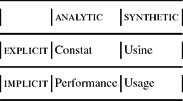
We study logic in the light of the Kantian distinction between analytic (untyped, meaningless, locative) answers and synthetic (typed, meaningful, spiritual) questions. Which is specially relevant to proof-theory: in a proof-net, the upper part is locative, whereas the lower part is spiritual: a posteriori (explicit) as far as correctness is concerned, a priori (implicit) for questions dealing with consequence, typically cut-elimination. The divides locative/spiritual and explicit/implicit give rise to four blocks which are enough to explain the whole logical activity.
Information
- Type
- Paper
- Information
- Copyright
- Copyright © Cambridge University Press 2015
References
Aubert, C., Bagnol, M., Pistone, P. and Seiller, T. (2014). Logic programming and logarithmic space. In: Garrigue (ed.) Proceedings of the 12th Asian Symposium APLAS. Springer Lecture Notes in Computer Science
8858
39–57.CrossRefGoogle Scholar
Danos, V. and Regnier, L. (1989). The structure of multiplicatives. Archive for Mathematical Logic
28
181–203.CrossRefGoogle Scholar
Girard, J.-Y. (1989). Geometry of interaction I: Interpretation of system F
. In: Ferro, R., Bonotto, C., Valentini, S. and Zanardo, A. (eds.) Logic Colloquium '88, Amsterdam, North-Holland
221–260.Google Scholar
Girard, J.-Y. (1995). Geometry of interaction III: Accommodating the additives. In: Girard, J.-Y., Lafont, Y. and Regnier, R. (eds.) Advances in Linear Logic, Cambridge, Cambridge University Press
329–389.Google Scholar
Girard, J.-Y. (2011a). Geometry of interaction V: Logic in the hyperfinite factor. Girard's Festschrift, Ehrhard, T., Faggian, C. and Laurent, O. (eds.) Theoretical Computer Science vol. 412
1860–1883.CrossRefGoogle Scholar
Girard, J.-Y. (2011b). The Blind Spot: Lectures on Logic, Zürich 550, European Mathematical Society.Google Scholar
Girard, J.-Y. (2012). Normativity in logic. In: Dyjber, P., Lindström, S., Palmgren, E. and Sundholm, G. (eds.) Epistemology vs. Ontology, Springer-Verlag
243–264.CrossRefGoogle Scholar
Girard, J.-Y. (2016). Transcendental syntax II: Non-deterministic case. Logical Methods in Computer Science, to appear.Google Scholar
Mogbil, V. and Jacobé de Naurois, P. (2011). Correctness of multiplicative additive proof-structures is NL-complete. Theoretical Computer Science
412
(20)
1941–1957.Google Scholar
Seiller, T. (2013). Interaction graphs: Exponentials. Computing Research Repository, abs/1312.1094, Available at: http://arxiv.org/abs/1312.1094.Google Scholar
 You have
Access
- 6
- Cited by