



No CrossRef data available.
Article contents
Incomplete Gauss sums
Published online by Cambridge University Press: 26 February 2010
Abstract
Let N be a positive integer. We are concerned with the sum
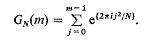
Thus GN(N) is the ordinary Gauss sum. Previous methods of estimating such exponential sums have not brought to light the peculiar behaviour of GN(m) for m < N/2, namely that, for almost all values of m, GN(m) is in the vicinity of the point  . A sharp estimate is given for max |GN(m)|, depending on the residue of N modulo 4. The results were suggested by graphs of GN(m) made for N near 1000. The analysis employs the Fresnel integrals and the Cornu spiral whose curvature is proportional to its arc length.
Information
- Type
- Research Article
- Information
- Copyright
- Copyright © University College London 1976
References
1.Hua, , Keng, Loo. “On exponential sums”, Sci. Record (new series), 1 (1957), 1–4 (Math. Revs. 20, 22).Google Scholar
2. An authoritative account of the Euler-Maclaurin summation formula will be found in Ostrowski, A. M., “On the remainder term of the Euler-Maclaurin formula”, Jn. Math, reine angew, 239-240 (1969), 268–286CrossRefGoogle Scholar
- 29
- Cited by