



No CrossRef data available.
Article contents
On the distribution of √p modulo one
Published online by Cambridge University Press: 26 February 2010
Extract
It was shown by Vinogradov (see Theorem 7, Chapter 4 of [18]) that, for ε > 0, there are infinitely many solutions in primes p of the inequality

where {x} denotes the fractional part of x and y = 0.1. The value of γ was improved to
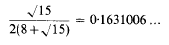
by Kaufman [9]. On the Riemann Hypothesis he showed that one can take γ =¼ The method used actually shows that, for any real β and any δ with 0 < 8 > 1, the number of primes p ≤ x satisfying
is 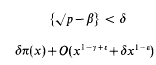
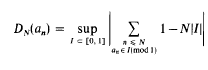
where π(x) denotes the number of primes not exceeding x. The sequence √p is, of course, a subsequence of the sequence n½ whose distribution modulo one has also been investigated (see Chapter 2, Section 3 of [10]: the argument for sequences nσ (0 < σ < 1) is entirely elementary). It is useful in this context to define the discrepancy (modulo one) of a sequence an by
Information
- Type
- Research Article
- Information
- Copyright
- Copyright © University College London 1983
References
2.Balog, A.. On the fractional part of pθ. Preprint of the Mathematical Institute of the Hungarian Academy of Sciences, Budapest, 1982.Google Scholar
4.Harman, G.. Diophantine approximation and prime numbers. Ph.D. Thesis. (London, 1982).Google Scholar
5.Harman, G.. On the distribution of xp modulo one. J. London Math. Soc. (2), 27 (1983), 9–18.CrossRefGoogle Scholar
6.Brown, D. R. Heath. Gaps between primes, and the pair correlation of zeros of the zeta-function. Acta Arithmetica, 41 (1982), 85–99.CrossRefGoogle Scholar
7.Brown, D. R. Heath. Prime numbers in short intervals and a generalized Vaughan identity. Can. J. Math., 34 (1982), 1365–1377.CrossRefGoogle Scholar
8.Iwaniec, H.. Almost-primes represented by quadratic polynomials. Invent. Math., 47 (1978), 171188.CrossRefGoogle Scholar
9.Kaufman, R. M.. The distribution of {√p} (Russian). Mat. Zam., 26 (1979), 497504. Corrections. Ibid., 29 (1981), 636.Google Scholar
10.Kuipers, L. and Niederreiter, H.. Uniform distribution of sequences (Wiley-Interscience, New York, 1974).Google Scholar
11.Mangoldt, H. von. Zu Riemanns Abhandlung ‘Ueber die Anzahl der Primzahlen unter einer gegeben Grosse’. Journal fiir die reine und angewandte Mathematik, 114 (1895), 255–305.Google Scholar
12.Montgomery, H. L.. Topics in multiplicative number theory (Springer-Verlag, Berlin, 1971).CrossRefGoogle Scholar
13.Rane, V. V.. On the mean square value of Dirichlet L-series. J. London Math. Soc. (2), 21 (1980), 203–215.CrossRefGoogle Scholar
14.Tchudakoff, N.. On Goldbach–Vinogradov's theorem. Annals of Mathematics, 48 (1947), 515545.CrossRefGoogle Scholar
15.Titchmarsh, E. C.. The theory of the Riemann Zeta–function (Clarendon, Oxford 1951).Google Scholar
16.Vaughan, R. C.. An elementary method in prime number theory. Acta Arithmetica, 37 (1980), 111115.CrossRefGoogle Scholar
17.Vinogradov, I. M.. The method of trigonometric sums in the theory of numbers (English translation by A. Davenport and K. F. Roth) (Wiley, New York, 1954).Google Scholar
18.Vinogradov, I. M.. Special variants of the method of trigonometric sums (Nauka, Moscow, 1976).Google Scholar
- 16
- Cited by