

Introduction
In 2021, amongst other ‘AI-powered features’, Google Photos launched ‘Little Patterns’. Based on a collection of photographs stored in users’ mobile phones, the application offers a sort of ‘proto-story’ in the form of a title (e.g. ‘Adventures of the orange backpack’Footnote 1) and an automated, algorithmically assembled album. Meanwhile, mnesic assistants such as Limitless, Omi, Plaud, and MemoroFootnote 2 provide the possibility to record a user’s sound environment and to capture conversations throughout the day to generate an automated synthesis of the user’s experience, ultimately producing memory. The Personal AI conversational agent goes even further, proposing a digital ‘twin’ of oneself that would be able to narrate one’s life story and memories, even after death.Footnote 3 We define these different and heterogenous applications as mnesic technologies, understood as digital technologies that offer and claim to manage users’ personal memories and/or produce memories from their data.Footnote 4 Capitalising on the accumulation of ‘real-time’ data, becoming potentially emotionally charged past data, these mnesic technologies transform the information stored in our clouds and on our devices into automated, curated, and fabricated memories; memories that then can potentially become forms of experience in the present. As such, they promise to create personalised memory narratives automatically.
They do this, on the one hand, by exploiting very large volumes of data in dynamic and recursive processes, recalling the reflections of Beer and Burrows (Reference Beer and Burrows2013) on the vitality of data, too often represented as dormant material (‘matériau “dormant”’) (Denis Reference Denis2018, 155). On the other hand, this is operated with specific markers or indicators based on an interpretation of the data by filtering what is ‘worthy’ of being remembered and what is not.
As Rik Smit (Reference Smit, Wang and Hoskins2024, 219) aptly explains, mnesic datafication and automation research has, thus far, primarily focussed on economic and political issues surrounding digital platforms. This paper explores another dimension of mnesic datafication and externalisation (Crozatier Reference Crozatier2026) by concentrating on the promotional discourses used by both large and small actors seeking to convert our recorded data into an automated memory experience with machine learning algorithms.Footnote 5 By promotional discourses, we refer to texts and images ‘depicting the subject in question in a favourable light’ (Erjavec Reference Erjavec2004, 558)Footnote 6 and also its social promotion, which ‘is not limited to commercial benefit’ (Erjavec Reference Erjavec2004, 576). Indeed, the analysed material sometimes covers other functions: it has informational value and often also plays a role in shaping the identity and brand image of the companies and projectFootnote 7 themselves (which is not surprising), and it also evolves around the never-ending loop of creating problems and offering solutions at the same time.
In particular, this paper focuses on the rhetoric of the promises made by these tech players regarding their promotional discourse around the mnesic technologies they develop. In other words, it explores the ways in which tech companies aim to shape personal memory, as well as the imaginaries surrounding its datafication. To understand some elements of these imaginaries of sociotechnological development (Flichy Reference Flichy2003; Gras Reference Gras2013; Jasanoff and Kim Reference Jasanoff and Kim2015; Crozatier Reference Crozatier2026), it is necessary to analyse specific objects of discourse: here, the promise constitutes an important rhetoric shape and act (Joly Reference Joly, Lesourne and Randet2013).
Literature, data selection, and methodology
To do so, the following analysis is situated at the intersection of two fields of research. Firstly, it is rooted in the critical theoretical approaches of both memory and media studies. Memory studies has become an increasingly interdisciplinary field that seeks a detailed understanding of the cognitive, technological, and cultural mechanisms of memory (and, all too rarely, of forgetting). This field looks not only at traumatic memory (Trigg Reference Trigg2009), but also, particularly at the context of datafication, the ecological challenges of data storage (Hogan Reference Hogan2024), and the activity of storing itself (Niemeyer and Schafer Reference Niemeyer and Schafer2022), the phenomena of increased reinvention of the past related to fake news (Schincariol et al. Reference Schincariol, Otgaar, Greene, Murphy, Riesthuis, Mangiulli and Battista2024), or at automated conversational agents (Hoskins Reference Hoskins2024) as well as the place of memory and remembering in a hyperconnected environment (Gomez-Mejia Reference Gomez-Mejia, Lamy and Carré2017; Wang and Hoskins Reference Wang and Hoskins2024; Crozatier Reference Crozatier2026). Memory studies also look at the industrialisation and commodification of personal memory. Although these are not new phenomena (Stiegler Reference Stiegler1991; Niemeyer and Keightley Reference Niemeyer and Keightley2020; Rouge Reference Rouge and George2019), the development of social online networks, digital storage tools, and increasingly complex algorithms, which rely on digital data and artificial intelligence (AI) technologies, in particular, has marked a significant shift in the production of memories (Wang and Hoskins Reference Wang and Hoskins2024).Footnote 8 Thus, part of our personal memory is not only being flattened (Smit Reference Smit, Wang and Hoskins2024), but, as we argue, also mined and exploited (mnesic data mining).
Secondly, this paper draws on certain definitions of the promise economy as discussed in francophone sociological studies of expectations to provide further reflection on mnesic datafication. Within the sociotechnical imaginary, the promise contributes to our expectations of technological development. Sociotechnical imaginaries carry axiological and normative dimensions, encoding visions of scientific and technological possibilities and standardizing prescriptions for how life should, or should not, be lived (Jasanoff and Kim Reference Jasanoff and Kim2015, 4). In this way, technoscientific promises contribute to shape these horizons of expectation, function as performative and, above all, as normative (Dandurand et al. Reference Dandurand, Lussier-Lejeune, Letendre and Meurs2022). This analysis focuses therefore on the ‘discursive dimension’ (Joly Reference Joly, Lesourne and Randet2013, 241) of technoscientific promisesFootnote 9:
the rhetoric of the technoscientific promise [forms] a set of means of expression that present technology as an inevitable solution to the challenges facing society. […] Addressing the rhetoric of promise allows us to question the communicative processes employed by the actors of innovation […] (Lussier-Lejeune Reference Lussier-Lejeune2022, 52–53).
More specifically, this paper focuses on the technomnesic promise where a double meaning of the term ‘mnesic’, is evoked. It can firstly be linked to the question of cognition – the cerebral and psychological functioning of memory, to the art of remembering through artefacts or to its involuntary processes – and secondly to memory technologies or to the storage of memory in terms of objects or data. In the case of our study, the companies claim to use the second to respond to the first, which is described by them as fallible. Moreover, in order to address this ‘fallibility’ of human memory, the technological ‘solutions’ promoted by tech companies actually refer to two distinct mnesic phenomena that will be discussed later: active recollection and evocation (or surfacing) of memory.
This framework underpins the subsequent research questions that inform our analysis: what technomnesic promises the companies and project examined in this study make to the users of their applications? How are representations of memory and personal data constructed and mobilised to produce a digital memory?
To provide a qualitative analysis of officially accessible documentation provided by Google, Apple, Memoro, and Personal AI (Human AI Labs) on their websites, various material (text, pictures, or videos) promoting AI or algorithms to offer mnesic technologies were collected through screenshots or downloads. The choice of these tech companies and project was made to collect data from different types of products offering different functionalities (pictures, audio, etc.): mnemonic assistants (Memoro, Personal AI), ‘intelligent’ photo albums (Apple Photos, Google Photos), and memory-related features (Apple Memories, Google Memories). The data collection is therefore composed of promotional documents produced by various organisations that develop technologies, which propose to manage personal memory using AI or datafication. In other words, our comparison is not based on the functional part of the technology itself but focuses on the discursive promises that are made in the promotional material for different type of technologies and applications. First, as the article shows, this heterogenous choice has made it possible to describe a more general promise associated with the use of these technologies and applications, contributing to the development of a technomnesic imaginary – datafication of the lived experience to avoid forgetting – that transcends the specifics characteristics of each product. Second, this choice to focus on heterogenous mnesic technologies has also been significant to distinguish what we call ‘sub-promises’. From tech giants’ products such as Google and Apple to Personal AI launched in 2021, and to Memoro – a 2024 university project that is not at this time commercialised – the analysed material covers material produced by organisations of very different kinds, whose products do not necessarily overlap. As such, the choice of data allows us to compare both the strategies of companies engaged in fierce competition over monopolistic control of personal data – studying Google and Apple allows us to grasp the nuances in their promotional discourse about similar productsFootnote 10 – and the strategies of players seeking to carve out a niche for themselves in the digital economy, such as Memoro. The following overview synthesises the respective technomnesic features.
The Google Photos ‘Memories’ feature (est. 2015)
All articles discussing the Google Photos product on the company’s websiteFootnote 11 were consulted: 57 articles published between the official launch of the product on 28 May 2015 and the most recent article published at the time this paper was written, on 6 December 2024. Totally, 15 articles, more directly related to the themes of this study, were analysed in greater depth.
The Apple Photos ‘Apple Memory’ feature (est. 2014, Apple) and visionOS 2
In order to access every document mentioning memory, a search query using the keyword ‘memory’ was carried out on the Apple website: 87 pages were displayed and the first two were Apple Photos and visionOS 2 (augmented experiences), followed by references to technical tools or increased memory and storage space. The first two web pages were therefore consulted in detail and downloaded, as they are the most relevant to our research questions. However, some of the hyperlinks in Apple Photos refer to features or storage space requirements and are mentioned in the findings section. Screenshots were taken to keep track of the layout of the page and of the sequence of statements and images.
Memoro (est. 2024, MIT)
The collected body of data includes the homepage of the Massachusetts Institute of Technology (MIT)Footnote 12 project from its launch in 2024, including presentation texts, visuals, and videos, as well as a scholarly article cowritten by the inventor of Memoro: Zulfikar et al. Reference Zulfikar, Chan and Maes2024. This material was published on the MIT Media Lab website in an accessible format for the larger technology-enthusiast community and presents the wearable memory assistant technology, which continuously listens to users and their surroundings, enabling queryless recall, ‘proactive reminders’, and ‘daily summaries’.Footnote 13
Given that Memoro has not yet been commercialized, we will analyse a promise still in its embryonic, project-based form. Promises characterize technological development across the entire spectrum: from initial projects (pitched to investors with assurances of innovation and enthusiastic user adoption) to the perpetually reinvented promises of industry tech giants who must continue selling aspirational visions to preserve their oligopolistic position.
Personal AI (est. 2021, Human AI Labs)
We consulted the project’s pages on the Personal AI website as of its launch in 2021, in particular those dedicated to the company’s ‘Thesis’,Footnote 14 its statement on memoryFootnote 15 and its documentation.Footnote 16 It should be noted that since its launch, Personal AI has undergone market repositioning and substantive transformation. The analysed material (2021–2022) corresponds to the initial iteration of the project, which emphasised the creation of conversational digital doubles and user memory preservation. Even if the shifting nature of these promises would prove equally worthy of analysis, we leave this consideration aside for the purposes of this paper. It could be addressed in a future study.
The overall analysis of these four players draws from collected data of promotional articles or web page content from the websites including visual, formal, and procedural (interactive) elements of the interfaces of these different technologies. This data collection is a heterogeneous material and cannot be easily compared. For this reason, the first step was to take a closer look at the vocabulary used to describe mnesic datafication by each selected company. The qualitative analysis applied is that of open sociosemiotics (Pailhes and Sapio Reference Pailhes and Sapio2022), which makes it possible to understand the social, economic, and cultural universe of the production and potential reception of these technologies in multimodal discourses (textual, visual, audiovisual, procedural). The material has been downloaded or archived via print screens. We analysed the different lexical fields used in the written documents or the photo and video texts: We also concentrated on the interconnection between photos/pictures and the link to the rest of the document if applicable. The main idea was to stress potential (not necessarily common) patterns of memory-related promises.
The following presentation of the results discusses the general promise of recording and automating our daily experiences in the form of digital data which, through storage and potential revival, ultimately becomes information for mnesic production. As we will see, the analysis of the material has also identified ‘sub-promises’, those of an ‘enhanced’ memory associated, on the one hand, with the classification of data and, on the other, with the production of ‘digital memories’. Finally, the promise of a sustained repetition of experience intended to ‘combat’ forgetting and the disappearance of the subject or the person.
The promise of automation: ‘problems’ and ‘solutions’
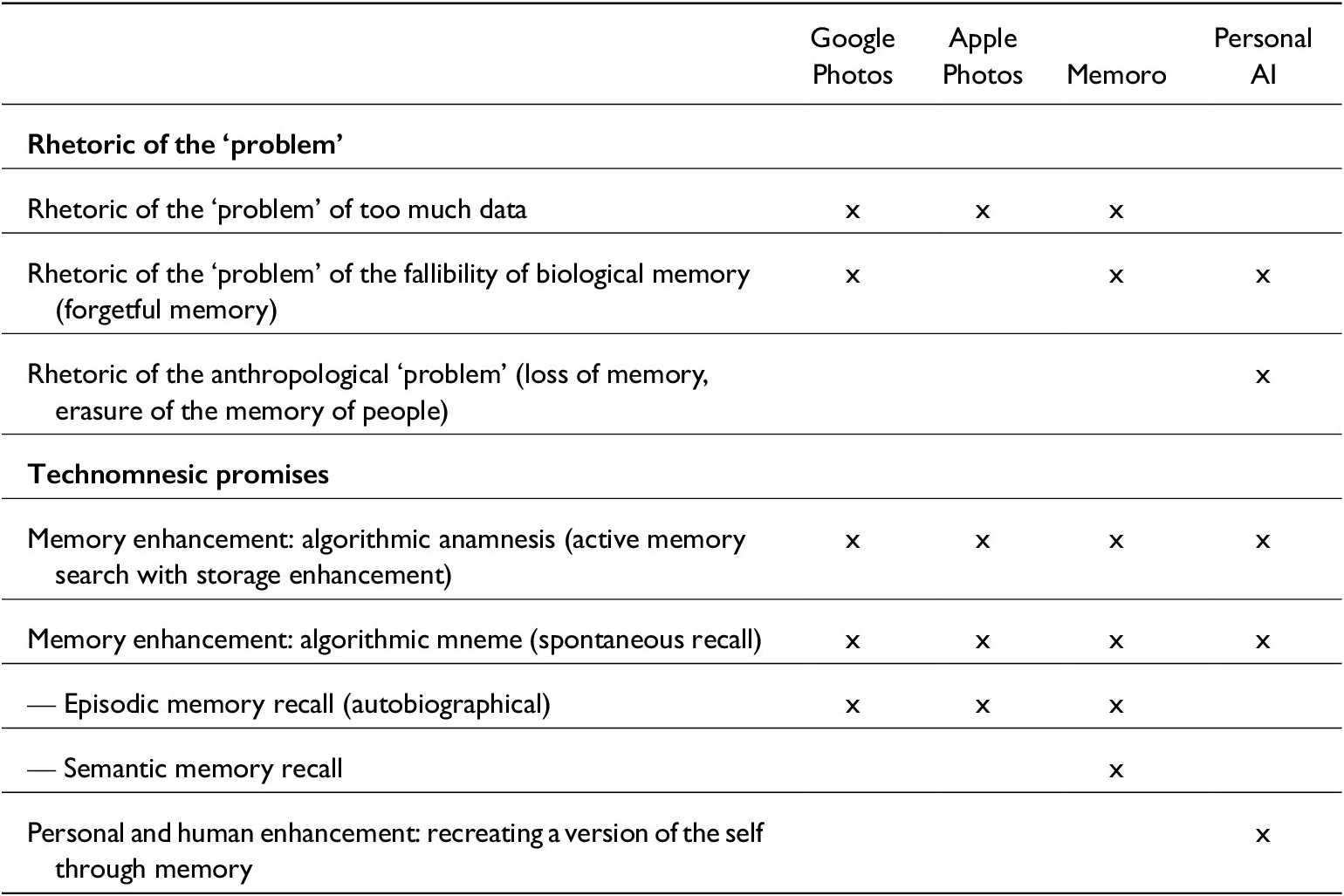
Despite the variety of technologies available, the companies and project studied here consistently construct user expectations (Rouge Reference Rouge2023) around the promise of automating mnesic processes. These expectations are driven by their promotional discourses that present their technologies and commercial applications as ‘both inevitable and fundamentally desirable’ (Compagnon and Saint-Martin Reference Compagnon and Saint-Martin2019, 7). This promise of the automated management of personal memory data is based on an implicit observation: with recent developments, particularly in the field of AI, a new era in the history of memory outsourcing (Crozatier Reference Crozatier2026) is emerging, characterised by the potential reduction of what constitutes human memory to a set of data that can be quantified and processed using algorithmic tools (Hoskins Reference Hoskins2024). Indeed, to guarantee the use of their applications, these tech players present their products as necessary and desirable ‘solutions’ to problems (table 1) they mostly create themselves and that are related to the inevitable transformation brought about by datafication. This is also how the mnesic technopromise is constructed by creating ‘problems’ (or expectations based on problems) to be solved (Joly Reference Joly, Lesourne and Randet2013, 236). These ‘problems’ take two different forms.
Overview of the rhetoric of problems and promises in the discourses of the companies and project studied

Table 1. Long description
The table consists of five columns. The first column lists rhetorical themes, while the subsequent four columns represent Google Photos, Apple Photos, Memoro, and Personal A I.
Under the section Rhetoric of the problem:
* Rhetoric of the problem of too much data: Marked for Google Photos, Apple Photos, and Memoro.
* Rhetoric of the problem of the fallibility of biological memory (forgetful memory): Marked for Google Photos, Memoro, and Personal A I.
* Rhetoric of the anthropological problem (loss of memory, erasure of the memory of people): Marked only for Personal A I.
Under the section Technomnesic promises:
* Memory enhancement: algorithmic anamnesis (active memory search with storage enhancement): Marked for all four entities.
* Memory enhancement: algorithmic mneme (spontaneous recall): Marked for all four entities.
* Episodic memory recall (autobiographical): Marked for Google Photos, Apple Photos, and Memoro.
* Semantic memory recall: Marked only for Memoro.
* Personal and human enhancement: recreating a version of the self through memory: Marked only for Personal A I.
Data overload
The first problem identified is that of the overwhelming amount of data confronting individuals in a digitised world. From this point of view, mnesic technologies can be seen as ‘solutions’ to this problem. In other words, it is a matter of determining what could meet the ‘needs’ of usersFootnote 17 to produce new features (or, alternatively, to establish which needs could be met by a feature that is being developed) in order to market the product as a necessary response to legitimate demands.Footnote 18
This argument forms the basis of the legitimisation strategy. The articles on Google Photos on the company’s websiteFootnote 19 very often focus on the fact that we have too many photos and videos which are difficult for us to manage. This justification appears in the very article announcing the launch of the product:
[…] the more moments we capture, the more challenging it becomes to relive those memories. Photos and videos become littered across mobile devices, old computers, hard drives and online services (which are constantly running out of space). […]
We wanted to do better. So today we’re introducing Google Photos – a new, standalone product that gives you a home for all your photos and videos, helps you organize and bring your moments to life, and lets you share and save what matters.Footnote 20
This argument is used on several occasions, either to justify a posteriori the decision to develop Google PhotosFootnote 21 or to legitimise the development of new features, as in the latest article highlighting the benefits of linking Google Photos with the company’s conversational robot, Gemini:
Often we snap photos to capture memories or save important details, but the information in those photos can get lost in the shuffle. […] Gemini’s multimodal capabilities can understand the context and subject of photos to pull out details.Footnote 22
This problem-solving rhetoric can also be found in the descriptions of Apple’s Photos and visionOS 2 applications. For example, when they advertise the preservation of precious family memories or the possibility of reliving those memories, the slogans are quickly accompanied by an announcement about the need to increase storage memory or to buy new accessories to access these new featuresFootnote 23 – a sort of two-fold imperative that combines the accumulation of data with the promise of a solution for the latter. Or again, when it comes to justifying the iCloud Shared Photo Library feature for sharing family memories in a single place: ‘Now family memories are in one place for everyone to enjoy’, says the website.Footnote 24
Intended as a response to the problem of data decentralisation, photo libraries are unified to become family or group memory, requiring the installation of applications and, therefore, the use of the same company’s products by multiple users.
The particularity of constructing the legitimacy of the product by packaging it as the solution to a problem is that the two terms, the problem and the solution, are of the same nature: they both derive from the datafication of our everyday experiences.Footnote 25 Even more significantly, the solution to the problem helps to maintain the problem, or at least to reproduce it: the use of products such as Google Photos or Apple Photos enables users to continue to accumulate ever more content, but engenders a form of dependency on these technological solutions, as illustrated by the following quote, taken from Google’s blog in 2015: ‘as you keep snapping photos and capturing videos, we’ll keep working on making them even easier to store, share and bring to life’.Footnote 26
To never forget
The other major ‘problem’ to which these technologies are intended to respond is that of the fallibility of human memory, which is perceived as functionally defective. This idea is explicitly stated by Personal AI in 2022 (Human AI Labs): ‘At its core, memory retention is a biological problem. But instead of focusing on fixing people with brain enhancement drugs or surgical implants, why not build a tool to solve the problem?’Footnote 27
Mnesic technologies are presented as the answer to this ‘problem’ of forgetfulness, not to mention the potential loss of personal memory, particularly after a person’s death. The passage of time obliterates memories, and with them individual memory. This narrative portrays technology as the ‘solution’ to a quasi-anthropological problem, as is evident from the explanation provided in the ‘Memory’ tab on the Personal AI website: ‘For all of human history, a person’s memory could be lost; now, in the digital age – and more specifically, in the AI age – your memory can be recalled and shared seamlessly’.Footnote 28
This rhetoric about fighting forgetting or even rejecting forgetting, even if it is essential to personal memory (Ricœur Reference Ricœur2004; Todorov Reference Todorov2004; Wang and Hoskins Reference Wang and Hoskins2024), can appear less conspicuous when the technology is presented as a tool to compensate for the normal ‘failures’ of the user’s memory in more ordinary situations, as proposed, for example, by Memoro. Memoro is a sound-based technology described as ‘a wearable AI memory assistant that continuously captures audio through a bone conduction headset, transforming everyday conversations into a structured, living memory’.Footnote 29 It is an everyday assistant that promises to infer or even anticipate users’ mnesic needs in real time, such as when they cannot remember the name of the person before them, specific information, or a grocery list. It is also designed to provide ‘daily summaries’ of user activity (Figure 1).
– Screenshot from the Memoro project page, April 2026 (https://www.media.mit.edu/projects/memoro/overview/ - CC - Credit: wz, sa).

Figure 1. Long description
A three-panel horizontal layout with a shared footer.
Left panel: Titled Recall Details with a magnifying glass icon. A man in a red shirt stands in a grocery store. A purple speech bubble from him asks, ’What did I need to buy?’ A blue speech bubble response from his earpiece says, ’You need to buy bananas...’
Center panel: Titled Proactive Reminders with a bell icon. A man in a black polo and flat cap stands outdoors. A blue speech bubble from his earpiece says, ’You wanted to buy a gift for your daughter’s graduation’.²
Right panel: Titled Daily Summaries with a document icon. A man sits on a couch looking at a smartphone. A blue speech bubble says, ’Today, you began by greeting John & Beth. Then you discussed about sale at the farmer’s market…’
Footer: A long white bar spanning all panels with a microphone icon and the text, Always-On Audio Recording.
The goal, then, is to compensate for deficiencies in so-called ‘semantic’ memory, which refers in particular to learned knowledge and general information about places and people:
People have to remember an ever-expanding volume of information. To help with this, we developed Memoro, a wearable and audio-based personal memory assistant that uses an AI agent. Memoro automatically captures real-world auditory interactions of the user and converts them into digital memories. During recall, the assistant can directly infer memory needs using context, search, and present minimal suggestions to weave into daily life and conversations.Footnote 30
Memoro approaches this ‘problem’ of memory fallibility through another technological paradigm than visual memory applications. Relying on audio recording of the user’s sonic environment, it expands the scope of datafied experience beyond the visual realm that dominates other mnesic technologies. The technology positions itself as a discreet, anticipatory assistant that whispers answers throughout the day when users struggle to recall semantic information such as names, facts, or details from recent conversations. This form of real-time mnesic compensation represents a kind of shift from retrospective memory curation to prospective memory ‘augmentation’. Unlike Google Photos or Apple Memories, which surface past content for reminiscence, Memoro intervenes in the present moment of forgetting, positioning itself as a seamless cognitive prosthetic. This promise of ‘queryless recall’ reframes the problem of forgetting not as something to be retrospectively addressed through organized archives, but as a continuous cognitive deficit requiring real-time algorithmic intervention.
It is interesting to note that, in its rhetoric, Memoro plays on the boundary between the medical and the extra-medical: the technology could help not only elderly people with memory loss, but also anyone who wants to benefit from a more ‘efficient’ memory. The technology promises increased self-confidence within a framework of social performance and efficiency that resonates with transhumanist idealsFootnote 31 as will be discussed later.
Although the theme of forgetting is less frequent in statements from Google Photos, it is still used, for example, to justify the development of a new feature, ‘Suggested Sharing’, which prevents us from forgetting to share our memories with our loved ones.Footnote 32
In all of these instances, datafication and algorithmic data processing are presented as inevitable solutions to a ‘problem’, whether technical (the digitisation of the world is leading to the ever-increasing production of data that is difficult to manage without technological assistance) or anthropological (the ‘failure’ of memory and forgetting as a necessary correlate of memory), which consists of attempting to automate mnesic processes.
Depending on what is being automated and the ‘problems’ such automation claims to resolve (in other words, depending on how and why the data produced is mobilised), different sub-promises are derived from this broader promise of automation. Each of these can be seen as a pretence to responding to these so-called ‘problems’.
The sub-promises of memory algorithmisation
The promise of memory automation takes different forms, which were not anticipated in the beginning of the research, claiming to replace a range of memory operations that reflect the variety of existing mnesic technologies. The following section explores how the promise of automation is accompanied by the idea of memory ‘enhancement’, which manifests in two different forms according to our analysis: anamnesis and mneme. The sub-promise of the repetition of everyday experience to generate memory and to ultimately ‘enhance’ the user is discussed at the end of this section.
Memory ‘enhancement’
The idea of ‘memory enhancement’ through technology is far from recent (Poitou Reference Poitou, Lenay and Havelange1999), but the examined material in this case studies hints new forms. This ‘enhancement’ of memory actually refers to two distinct mnesic phenomena, that of active recollection on the one hand, and that of the evocation of memory (in the sense of reminiscent content) on the other. This distinction overlaps with a much older one, found in Aristotle’s opposition between anamnesis and mneme, which is analysed at length by Paul Ricœur in Memory, History, Forgetting (Reference Ricœur2004). According to Ricœur’s interpretation, Aristotle distinguishes between two mnesic phenomena. Anamnesis refers to the work of remembering, which requires an active enquiry on the part of the subject, who retraces a given sequence of time according to a process of their own choosing. The other phenomenon, mneme, consists of the appearance of a memory under the effect of an affection, namely a change in awareness linked to an external cause. The memory emerges in the subject’s mind almost ‘passively’ (Ricœur Reference Ricœur2004, 4). Through their various functionalities, the technologies studied propose to enhance memory by addressing either one, the other or, in most cases, both of these phenomena.
Algorithmic anamnesis
Available in mobile phones and other types of wearable devices, mnesic features/technologies are emerging as ‘moving sites of memory’Footnote 33 (Niemeyer Reference Niemeyer2011, 315) of the twenty-first century. Powered by AI algorithms that claim to reproduce cognitive processes, but without revealing how they are trained and how they work,Footnote 34 these technologies aim to manage our memories instead of us. ‘Your memories, automatically organised’ is the promise made by Google Photos product manager Ben Greenwood in 2019.Footnote 35 Such automation is intended to facilitate the task of organising content for the purpose of remembering it, which is deemed laborious: ‘Smarter photo albums, without the work’, promised François de Halleux in 2016, a product manager at Google.Footnote 36
This algorithmic ‘curation’ of personal memory is based on a set of design choices that are more or less explicitly defined by the companies and project themselves. By assembling vast collections of content with mnesic potential, such technologies propose simplified navigation through a mass of stored content. Indexed in advance according to a variety of increasingly extensive criteria, users’ personal content is presented as easily accessible and retrievable, with the digitisation of content not only encouraging its preservation but also permitting its ‘searchability’. Closely linked, as Ben Jacobsen (Reference Jacobsen2020, 120) points out in his thesis, to the development of machine learning and the impetus to produce tools for navigating users’ archives, the searchability of content is an element very often highlighted in communications for mnesic technologies. There are numerous examples of this in articles about Google Photos on the company’s website, for example: ‘Google Photos was one of the first products we built with AI at the centre, giving you the ability to search your photos and videos for people, pets, places and more’.Footnote 37 This sub-promise is frequently used alongside claims about the time-saving benefits of searchability, which Jacobsen (Reference Jacobsen2020, 121) also highlights.
The ways in which content is organised and searched are thus built around the capabilities of the technologies used by these companies and project and the types of content supported by their features (Rouge Reference Rouge, Cormerais, Gilbert, Khatchatourov and Vignon2024), not around the needs or reference points used by users to recall their memories. While the processing of metadata makes it possible to organise and search content according to the date and place of capture, content search has been organised primarily around visual objects, while the tech players producing these mnesic technologies have also been developing increasingly sophisticated machine learning algorithms for visual recognition.Footnote 38 And, at a time when chatbots are enjoying considerable media popularity, chatbot-assisted search is now being promoted by Google Photos.Footnote 39
When framed in this way, it is as if the datafication of memory leads to a significant improvement in the user’s anamnesic experience. However, this is without considering the pre-determination of what constitutes the user’s memory, according to the properties and operations of the technologies in question. As explained in the next section, Google Photos and Apple Photos, as most of the products incorporating these features are primarily designed to manage visual content. In so doing, these technologies also promote a representation of personal memory as essentially visual and organize the promise of anamnesis around visual searchability and spatial–temporal metadata.
Memoro alternative model of algorithmic anamnesis based on conversational and contextual audio data plays between anamnesis and mneme with two interaction modes: a Query Mode, where the user asks contextual questions aloud, and a Queryless Mode, where the system provides predictive assistance on demand, without the user having to formulate an explicit query. Rather than requiring users to actively search through organised archives, Memoro promises to anticipate mnesic needs through continuous monitoring of the user’s auditory environment and inferring what information might be relevant in a given context. This represents a shift from deliberate recollection to ambient retrieval. In this case, the user does not need to make a search query or navigate through categorised content; instead, the algorithm proactively presents information it determines to be relevant based on real-time contextual analysis. Can we say that this fundamentally alters the nature of anamnesis? That is short-circuits anamnesis? From an active, intentional process of memory work to a passive reception of algorithmically selected information, the technology thus promises to eliminate not only the effort of remembering but also the effort of consciously seeking to remember. However, this ambient form of anamnesis raises distinct questions about agency and intentionality in memory practices. When anamnesis becomes fully automated and anticipatory, what remains of the subjective intentional dimension of recollection? This might be another interesting topic to study under the lens of cognitive sciences and memory studies.
Algorithmic mneme
The promotion of digital memories is part of another sub-set of discourses promoting a kind of automation of remembering, that of content produced by technologies designed to bring to mind particular events in daily experience (in other words, the ‘episodic’ memory of moments experienced by the user).
Here, algorithmic technologies play the role of memory conjurers: algorithms select, from a set of commands,Footnote 40 past data worthy of returning to a user’s present. This time, the problem of excessive content is solved by the revival of memories, as evidenced by various formulas from the Google Photos blog, for example in 2019: ‘You lose the warm and fuzzy nostalgic feeling when you have to scroll through hundreds of duplicate photos, so we are putting your memories front and centre in Google Photos’.Footnote 41 Or in 2021: ‘To make it easier to look back, we are using AI to power new features that resurface meaningful moments and bring your memories to life […]’.Footnote 42
Although companies do not reveal much about the criteria used to select ‘digital memories’,Footnote 43 their interfaces, as well as the published content, for example on the Google Photos blog, provide some useful insights into the matter.
The first observation to be drawn from a number of posts on the Google blog or on the Apple Photos web pages is that memories are photographic and videographic in nature, which a priori disadvantage content of a more textual nature. For example, a receipt or a document is described as unpleasant to see in a photo gallery presented as ‘home’ for our memories.Footnote 44 In the same way, a receipt, a movie ticket, or a recipe, even though they have been photographed and classified as such, are unlikely to be valid ‘memorabilia’ for Apple Photos.
Screenshots are also often taken as examples of content that is not worthy of the user’s recollection:
Our phones are filled with a growing number of photos and videos capturing everything from everyday moments to life milestones. But they’re also cluttered with duplicate images, screenshots, and blurry videos, making it hard to focus on the most meaningful moments.Footnote 45
In this context, screenshots are assigned a practical value as opposed to memories, which are characterised by their importance and affective value: ‘Google Photos is home for your memories. But we know your photo gallery can get cluttered with similar photos of a single moment or screenshots and documents you snapped for future reference’.Footnote 46 Moreover, the video/photographic nature of memories in Google Photos and Apple Photos implies selection criteria based on content quality. Blurry photos, duplicates, or those with subjects closing their eyes are also deemed by Google to be unworthy of user recollection, so much so that since 2024 the company has been offering a feature that lets users combine several shots to produce, artificially, the ‘right take’ (with a feature called ‘Best Take’),Footnote 47 incidentally revealing the reconstructed nature of the content produced.Footnote 48 Not only do these features favour visual content as memory material, they also product content that is visually legitimate to be recalled as memories.
Powered by facial recognition technologies, Google Photos’ algorithms favour not only good-quality photos, but also those in which the subjects are smiling: ‘We’re using machine learning to curate what appears in Memories, so you do not have to parse through many duplicate shots, and you can instead reflect on the best ones, where the photos have good quality and all the kids are smiling’.Footnote 49 The company’s 2024 retrospective highlights this feature, which has even become a measure of the quality of one’s experiences and relationships: on the page introducing this retrospective, an interactive visual depicts, amongst other things, a photo of two persons smiling with the text ‘You smiled most with Ellen, 251 smiles in 2024’.Footnote 50
This criterion reflects the belief of these companies’ executives that it is preferable and possible to highlight content that is likely to arouse positive emotions. In other words, for Google Photos, a ‘good memory’ is a positive memory (Rouge Reference Rouge2023, Reference Rouge, Cormerais, Gilbert, Khatchatourov and Vignon2024).
In addition, by mining the metadata associated with photos (Lee Reference Lee2020; Rouge Reference Rouge2023), Google Photos’ algorithms select content captured in places infrequently visited by the user, which are likely to be holiday destinations: ‘The holidays are always a great time to reflect on what really matters – for me, that’s my family, both near and back home in Europe. With Memories in Google Photos, I’m able to relive the moments – big and small – I’ve shared with my loved ones’.Footnote 51 This metadata can also be used to identify special dates, corresponding to important cultural events for different users.Footnote 52
Lastly, artificial intelligence technologies are used to produce assemblages of thematic content intended to represent memories associated with a type of activity, an object, or a place. Here, algorithms are trained to automatically spot regular patterns in even the most banal content, such as the presence of an orange backpack across multiple photos:
With Memories, you can already look back on important photos from years past, recent highlights, moments with your loved ones, your favorite activities and more. Using machine learning, we can now go beyond resurfacing photos based on themes to doing so based on not-so-obvious visual patterns in your photos. Starting later this summer, when we find a set of three or more photos that share things like shape or color, we’ll highlight these little patterns for you in your Memories. For example, one of our engineers received this collection featuring photos he snapped of his favorite orange backpack.Footnote 53
Apple Photos works in a relatively similar way: to become ‘memories’, images must have been classified according to a set of predefined categories: people’s first names, groups of people, animals (‘four-legged friends’), geolocated places (at home, shops or cafés, cities, countries), holidays, seasons and calendar events (summer, winter, Christmas, New Year’s Eve, etc.) or inferred events (‘first moments together’), scenes (‘snowy days’, ‘in nature’), and actions (‘exploration’). However, certain categories or sub-categories cannot be the subject of thematic memories, as was the case, for example, with Apple Photos with regard to places commemorating the Holocaust: the algorithm blocked photographs of sensitive places from its annual retrospectives or highlighted images (Vilvang Reference Vilvang2024).
According to the promotional materials for both Apple Photos and Google Photos, these criteria all contribute to producing ‘important’Footnote 54 and ‘meaningful’Footnote 55 memories – in other words, recalling ‘moments that matter’.Footnote 56 At Google, the importance of memories is associated with a supposedly heightened affectivity, reflected in the use of superlatives ‘best moments’, best memories’) and marked preferences (‘your favourite people, things and activities’Footnote 57). Of course, these mnesic suggestions can be entirely at odds with the user’s own experiences and recollections.
The value of memories, their weight, and their significance in a user’s experience is therefore calculated by the algorithms of these companies, which operate on the basis of normative criteria that reflect the capabilities of the technologies used rather than criteria established by users (Rouge Reference Rouge2023). This technological bias and its grip on users’ personal lives was also expressed by the vice-president of Google Photos in the oft-quoted post from 2021, when she announced the launch of ‘little patterns’, assemblages of photos compiled by identifying recurring patterns in user content: ‘On their own, these photos may not be the most meaningful, but when you see them all together, they tell a story – your story’.Footnote 58
Apple Photos, meanwhile, makes a completely unprecedented promise in the field of personal memory: Apple Memories promises users ‘fairness’.Footnote 59 For the company, ‘memories’ must be displayed with consideration for intersectional categories (ethno-racial, age, and gender) and algorithmic modelling must be ‘diverse, inclusive and balanced’.Footnote 60 The idea of associating personal memory with the criteria of equity is an entirely novel ideological orientation and rhetorical framing. The question of equity (or inequity) is generally linked to issues of collective memory (national, group or even family memory, for example), not to individual memory. It is also linked to cultural industries products and, more recently, to AI results. Beyond drawing on themes from cultural industries like the film industry, Apple uses distinctly cinematic vocabulary: the company foregrounds the ‘storyline’ of ‘Memory Movie’Footnote 61, for example, as if aiming to produce a cinema of memories. Still personal memory is not governed by principles of fairness, unlike, for example, contemporary collective memory policies, which are more inclusive, or state memory reparation policies aimed at rectifying the historical harm done to certain social groups. This promise to present personal memories equitably across social categories is clearly a commercial argument and an inevitable response to criticisms of algorithmic bias. Moreover, one could hypothesize that this is a way of positioning itself against its competitor Google who has been accused several times of producing racist results, including the Photos application.Footnote 62
By designing technologies that select which content is worthy of being remembered, these companies are not only devising a ‘memorability score’ (Jacobsen and Beer Reference Jacobsen and Beer2021, 40) but are also producing a feature that makes it possible for users to justify the value of the personal data they are collecting. This justification can take different forms, all of which insist on the quality of the memories produced, whether they are ‘meaningful’, ‘valid’, or ‘fair’. However, a common effect emerges from these different justifications: the criteria for reminiscence, based on technologies that capture and ‘interpret’ data, are rationalised. They no longer depend on a shared social construct, the randomness of everyday experience, or the whims of the senses, but on a set of algorithmic operations.
Here, Apple and Google converge: the argument of ‘fairness’, and the Best Take feature highlight that these technologies produce memories rather than merely preserve them, raising the question of the authenticity of the memories once again. A producing role often called ‘enhancement’.
Memory and user ‘enhancement’
The automated identification of the memorable is also often associated with a multimodal ‘enhancement’ of the algorithmic experience of reminiscence. Technologies such as Google Photos or visionOS 2 offer to enhance memories with visual and sound effects designed to make the experience of rediscovering this content more immersive: ‘Cinematic photos help you relive your memories in a way that feels more vivid and realistic – so you feel like you are transported back to that moment’Footnote 63 or ‘With just a tap, your memories are brought to life with natural-looking depth and dimension’.Footnote 64 VisionOS 2 also promises the possibility of ‘replaying’ experiences over and over again in any location using a virtual reality headset: ‘When you are on a FaceTime call with friends and family, you can all share and interact with spatial photos, videos and panoramas at life-size scale when everybody is using Apple Vision Pro. So you can relive memories – wherever you are’.Footnote 65 These enhanced images become experiences of the present once again, with the emphasis on enriching experiences yet to come. The memories that resurface through this algorithmic mneme are thereby newly enhanced, both by the algorithms and by a set of added multimodal effects.Footnote 66
From enhancing memory experiences…
During the last years, Google Photos and Apple Photos editing tools are presented as enhancing the user’s experience of their memories. Both Apple’s ‘Clean Up tool’ or Google ‘Magic Editor’ allow not only to adjust the contrast and brightness of photos and videos but also to relocate or remove people and things.
As if companies were aware of the criticism they face regarding fidelity to the lived experience, communication around these tools often emphasizes that this fidelity is preserved. Two types of arguments are used. Firstly, using oxymorons, they counterbalance the ‘enhanced’ aspect by emphasizing the fidelity, not of the real scene captured, but to the scene as perceived or intended by the user. For example, Apple assures that ‘the Clean Up tool gives users a way to remove distracting elements while staying true to the moment as they intended to capture it’.Footnote 67 Google describes the use of Magic Editor on a picture as ‘a stunning shot that captures the feeling of his big day’.Footnote 68 Lastly, they underpin the creative potential of these features (or future features of these technologies): ‘Apple Intelligence will add new ways for users to express themselves visually’,Footnote 69 assures Apple after presenting the Clean-up tool,Footnote 70 when Google explains that the use of its photos editor ‘perfectly reflects your own personal style’.Footnote 71 They thus make a shift that avoids the contradiction between fidelity to the scene and modification of its trace: authenticity is no longer to be found in the memory itself, but in what users express about themselves by modifying it. These rhetorical strategies aim to make two promises at once: to preserve and embellish memories and, inherent in the promise economy of the tech industry, to innovate technologically.
…To twinning
Ultimately, the distinction between anamnesis and mneme is useful for understanding the difference between the mnesic phenomena that technologies aim to enhance: on the one hand, technologies promising automated organisation and navigation of digital archives, a kind of anamnesis; on the other (and often associated with the former within the same product), technologies offering to automate the curation of memorable content by producing suggestions for digital memories. Apple’s advertising for the iPhone 7, and more specifically the ‘Memories’ feature, is perhaps the best example of this dual rhetoric of mneme and anamnesis. The latter is depicted by Apple (an old man who works in analogue archives cutting and preparing material for projection) to generate emotionally charged mnemes for people who use Memories.Footnote 72
Automating the recording of a vast set of traces in order to create a memory is linked to another set of promises that can be attributed to the phenomenon of lifelogging (Caccamo and al. Reference Caccamo, Gueret, Nguyen, Caccamo and Niemeyer2026). Firstly, this involves the production of a so-called datafied ‘twin’ of an individual’s lived experience. Ideally, with the objective of creating a sort of ‘total recall’ of everyday life, all the activities, interactions, actions, behaviours, and even thoughts of an individual would be put into data form so as to build up a substantial digital archive. This personal ‘mini big data’ (Gurrin et al. Reference Gurrin, Smeaton and Doherty2014) is no longer made up solely of photographs, but also of texts, conversations, statistics, metadata, and so on. This dataset can be used to recall fleeting or forgotten autobiographical moments or to cross-check information.Footnote 73 Ultimately, this vast dataset could be used to create a digital ‘twin’ of oneself, as promised by Personal AI, an exemplary case in point. Using this behavioural profile, the company promises its customers the ability to create artificial versions of themselves in the form of conversational robots; these personal AIs promise to behave in the same way as the human individuals they are designed to simulate, to work in their place and to continue interacting in the world after their death. It is no longer simply a question of these AIs claiming to copy certain mnesic phenomena such as those we mentioned earlier (anamnesis and mneme), but of making people believe that they can reproduce the functioning of a particular individual’s autobiographical memory and thus their personality in order to ‘enhance’ the individual, or even the human itself. Part of the emerging industry of the artificial reproduction of individuals (Öhman and Floridi Reference Öhman and Floridi2017; Caccamo Reference Caccamo2021) is based on the continuous, real-time datafication of everyday life, with the relatively voluntary participation of individuals.
We can observe a progression between the technologies offered by Google Photos and Apple Photos, a project such as Memoro and the future presented by Personal AI, where everything could potentially be datafied. These promises respond to the ‘problem’ of forgetting – the industry is largely fuelled by a discourse that rejects forgetting: ‘Your AI Never Forgets’Footnote 74 – and the loss of memory that is closely linked to the erasure of an individual. By discursively promoting the preservation of memory, this type of technology, which can be described as transhumanist, can appear more socially acceptable. Memory, or rather its production and preservation, is used here as a fundamental argument to legitimise the continuous datafication of everyday life. These promises are also bolstered by the well-known epistemic promise that ‘data’ is not a construct but a reflection of life as it has been ‘captured’. It is in this sense that Personal AI puts forward an ‘authenticity rating’ for AIs that attempt to copy the behaviours of source individuals: this argument, present in the interface’s discourse, aims to convince people of the legitimacy of these digital ‘twins’, to make them more ‘real’.
Conclusion
This paper expands on recent work on the automation, algorithmisation, and platformisation of memories and memory (Jacobsen and Beer Reference Jacobsen and Beer2021; Rouge Reference Rouge2023; Hoskins Reference Hoskins2024; Smit et al. Reference Smit, Jacobsen and Annabell2024), the role of AI-produced content in our everyday experience, as well as on the materiality of memory in a digital context. Through a critical examination of the technomnesic promises produced by promotional discourses, this paper has provided an account of the algorithmic modelling of memory using AI on which the mnesic promises made by the companies and project studied are based (table 1). The greater promise of memory automation is closely bound to the promise of memory enhancement. The latter is the subject of a variety of phased proposals: rationalised production, indexing and curation of digital memory (essentially visual and audiovisual), hierarchisation of the memorable in place of and for the benefit of individuals, response to alleged mnesic needs and, ultimately, the promise of a ‘quasi-absolute’ memory, which could pave the way for artificial versions of the self (personal AI) and post-mortem digital ‘life forms’.
Ultimately, this paper has shown that the promises of AI-produced memory and its automatically generated narratives come with the potential to transform users’ experiences into an infinite source of data (allegedly carefully preserved) that they are invited to hand over to the firms that produce these technologies in order to preserve and relive them in the form of memories. A past made up of datafied memories that is allegedly easily accessible, searchable, and can be (re)experienced in an enhanced way. Here is what these technologies promise and the expectations that the companies and project producing them seek to create. It will be necessary to see how people use these applications in practice, and whether they live up to their promises, but the discourses supporting these promises participate of a larger project to produce a ‘data-individual’ that lives in ‘a world without forgetting’ (Merzeau Reference Merzeau2013, 115).Footnote 75
It also appears that these promises result in a certain loss of agency for people in the shaping of their own life stories. In fact, these various mnesic technologies are based on the dream of a virtually exhaustive datafication of human experience and an efficient interpretation of this data by algorithms that are presented as being increasingly powerful, particularly through the development of machine learning. This machine-assisted curation of the digital personal content worthy of being remembered is based on a set of probabilistic calculations that transform human life into data and memory into statistical material, excluding those parts of the human experience which still escape datafication (smells, taste, touch and, more broadly, procedural memory are currently excluded from this all-visual or audiovisual algorithmic memory) and the sometimes insidious criteria that govern the persistence or occurrence of certain memories (an association of ideas, the taste of a madeleine dipped in a cup of herbal tea). While the metaphor of the black box is often used to describe the opacity of how algorithms work, we can contrast their statistical logic with another, more mysterious black box, that of human memory and forgetting.
This suggested and promised world of an almost total, sublimized and sanitized, joyful memory without forgetting does not only join the trend for wanting to keep and store all data ‘just in case’: it contributes widely to the ecological disaster the data centres of mostly big tech companies are responsible of (Hogan Reference Hogan2015, 2024; Brodie Reference Brodie2020), and it obstructs conflictual memories and forgetting to emerge.
Data availability statement
The data that support the findings of this study are publicly available from Google, Apple, and Personal AI websites.
Acknowledgements
An article based on this research and its results has also been submitted to a French-language journal. The authors would like to thank Leona Nikolić for her translation of the text originally written in French.
AI use: A professional did the initial translation (first submission) of the text, but AI tools (mostly DeepL) have been occasionally used to assist with the English translation of certain additions to this second version.
Funding statement
This work received no specific grant from any funding agency, commercial or not-for-profit sectors.
Competing interests
Rémi Rouge, Emmanuelle Caccamo, and Katharina Niemeyer declare none.
Emmanuelle Caccamo (UQTR) is a professor in the Department of Letters and Social Communication at Université du Québec à Trois-Rivières (Québec, Canada). In the field of semiotics of memory, she works on representations of memory and memories in fiction (science-fiction) as well as on the links between personal memory, emerging media, and new technologies.
Katharina Niemeyer (UQAM) is a media theorist, professor at the School of Media at the Université du Québec à Montréal, and director of CELAT-UQAM (Centre de recherche Cultures-Arts-Sociétés). Her research focuses on the relationships between media and (digital) technologies, temporalities, memory, and history, with a special focus on nostalgia.
Rémi Rouge (USPN) is a associate professor of communication studies at the Université de Sorbonne Paris Nord. His research focuses on the socio-technical and communicational construction of digital devices. He is the author of a doctoral thesis on entitled ‘Finding time again. The factory of digital memories grasped by its professionals’.


 Open access

