

Introduction
Dario Llinares and Neil Fox, who have been producing the podcast The Cinematologists since 2015, describe the medium as one that imbues them with the ‘enthusiasm of possibility’ (Llinares et al. Reference Llinares, Fox and Berry2018, 1). Possibility means different things to different people, and for disadvantaged communities such as refugees, podcasts open up the possibility of producing independent audio content even for those with no broadcasting background (Llinares et al. Reference Llinares, Fox and Berry2018). Although many media critics view podcasts as an extension of radio, they break away from the traditional gatekeepers who once held complete authority over the broadcast of audio content through radio channels. Podcasting is thus a bypass technology (Dearman and Galloway, Reference Dearman and Galloway2005) that helps independent artists produce and distribute audio content, circumventing the hegemony of the radio industry. Therefore, befittingly, Spinelli and Dann (Reference Spinelli and Dann2019) describe podcasting as an audio media revolution.
Despite its reputation as a new media, podcasting has already attained a mainstream status with an increasing number of users, creating a new asynchronous (Massarelli and Perrotta, Reference Massarelli, Perrotta, Föllmer and Thiermann2006) digitally mediated aural culture (Llinares et al. Reference Llinares, Fox and Berry2018), letting listeners choose what, how, and when they want to listen. Apart from being audio entertainment programmes, podcasts also serve as open platforms for marginalised communities who lack a stake in large broadcasting companies and can create subaltern archives that are ‘anti-elite, anti-colonial, and anti-essentialist’ (Nieves and Senier, Reference Nieves, Senier, Singh and Kim2016, 363). Podcasts have thus become a highly accessible form of popular media with the potential to host subaltern stories. Besides, podcasts are also widely believed to contribute to a participatory culture (Sharon, Reference Sharon2023), which can potentially lead to community building among listeners. Such outreach is potent, especially in mobilising refugee memories. Recently, there has been a rise in podcasts from refugee and diaspora communities, like Vietnamese Boat People (Nguyen Mang, Reference Nguyen Mang2018), PreOccupation (Abun-Nadi, Reference Abun-Nadi2021), Refugee Voices Stories (2021), Before Me (Phu, Reference Phu2022), and Hmonglish (2022), to name a few. These podcasts disseminate refugee histories; some of them work with the explicitly stated objective of refugee memory preservation. Such examples further highlight the importance of looking at podcasting as a mnemonic practice.
For this study, we included podcasts that explicitly identify as memorial projects:Footnote 1 Vietnamese Boat People (VBP) and Before Me (BM). The selected podcasts are examined to understand how they become effective media for memory work, a term we use in this article to refer to any practice that contributes to the preservation and transmission of memory. The study argues that podcasting produces an ecology of remembrance that can facilitate the linkage of smaller units of refugee remembrance, such as family, with larger spaces of remembrance, like digital spaces. By theoretically aligning our study with Andrew Hoskin’s concept of memory ecologies, we examine the conditions that podcasting provides to foster refugee memory preservation. Through this study, we intend to explore podcasts’ potential to form memory ecologies for communities such as refugees whose histories and stories are at risk of being lost due to a lack of documentation or erasure by autocracy, thereby helping to preserve and reclaim subaltern narratives.
The end of the Vietnam War in 1975 triggered one of the largest refugee exoduses of the twentieth century, as people from Vietnam, Cambodia, and Laos fled Southeast Asian regions due to volatile socio-political conditions and the spread of Communist autocracy. Many of these refugees left Southeast Asia in poorly-made wooden boats, and were commonly referred to as the ‘boat people’. They were later rehabilitated in Western countries like the United States of America (USA). The Western media marginalised and misrepresented Vietnamese experiences and homogenised all Southeast Asian refugees into Vietnamese, ignoring the nuanced experiences of Cambodian refugees who survived the Khmer Rouge’s genocide and the Hmong refugees from Laos who escaped persecution from the new Communist government backed by the Pathet Lao (Kiernan, Reference Kiernan2008; Evans, Reference Evans2011; Chiu, Reference Chiu, Pfeifer, Chiu and Yang2013; Nguyen et al. Reference Nguyen, Phu and Troeung2018). The media narratives at the time were discriminatory, misrepresentative, and exclusionary towards refugee experiences (Lowe, Reference Lowe1996; Sturken, Reference Sturken1997; Pelaud, Reference Pelaud2011; Bui, Reference Bui2018).
Consequently, the 1.5- and second-generation Southeast Asian Americans, who grew up as children of refugees, had to turn to their parents’ memories for knowledge about the lived experiences of their past. There is a significant intergenerational transfer of traumatic memories in Vietnamese, Cambodian, and Hmong refugee families (Lin and Suyemoto, Reference Lin and Suyemoto2016; Maffini and Pham, Reference Maffini and Pham2016; Sangalang and Vang, Reference Sangalang and Vang2017; Bloch, Reference Bloch2018), especially through storytelling (Tranguyen, Reference Tranguyen2002; Nguyen, Reference Nguyen2013). To lend greater permanence to these nascent memories within the familial space, the post-generation refugees are increasingly digitising parental and community memories. The rising number of nonprofit refugee digital memorial projects, such as The Stories We Carry, Laos in the House, The Refugee Archive, Missing Piece Project, and many more, attests to this. This preference for digital media is possibly because it is ‘less costly, globally connected, and reproducible across different media’ (Reading, Reference Reading, Neiger, Meyers and Zandberg2011, 242). Thus, VBP and BM, as digital nonprofit initiatives, can provide global accessibility to refugee stories without capitalistic mediations.
VBP and BM offer dialogues and perspectives on the Vietnam War refugee exodus. VBP, started by Tracey Nguyen Mang, a 1.5-generation Vietnamese American, has been on air since August 10, 2018, with 54 episodes,Footnote 2 each approximately 30 minutes long. VBP memorialises the stories of refugees who fled Vietnam in the years following the Fall of Saigon (1975–1992). The podcast episodes promote memory exchange through dialogue between first-, 1.5-, and second-generation Vietnamese refugees, providing a holistic perspective of the Vietnamese refugee experience in the USA.
BM is a limited-series podcast of five episodes that cover the life of a Cambodian woman over several decades, detailing her survival through genocide and her journey to America as a refugee. It is created by a second-generation Cambodian American, Lisa Phu, and she records her mother’s survival of the Khmer Rouge genocide and the journey from Cambodia to America as a refugee in the episodes. BM released episodes weekly from November 15, 2022, to December 27, 2022, for a total runtime of approximately 142 minutes. This series is produced by the independent production house Self Evident Media.
The study examines VBP and BM as sources of ethnographic insights because, like any subjects of ethnographic studies, they ‘tell social stories’ (Murthy, Reference Murthy2008, 838). These podcasts offer a highly intimate environment of active listening, reproducing particular (refugee) universes through interaction and conversations (Lundström and Lundström, Reference Lundström and Lundström2021). This study draws from netnography (Kozinets, Reference Kozinets2020) and podcast ethnography (Lundström and Lundström, Reference Lundström and Lundström2021), as well as qualitative research methods for studying online communities and their behaviours, in this case, the two podcast communities. As researchers, we position ourselves as reflective listeners, immersing ourselves in selected podcast conversations to identify the methods podcast creators use to mobilise memory.
Podcasts and memory
The study argues that podcasts such as VBP and BM could link private refugee memories with publicly accessible digital spaces, transforming fragmented refugee communicative memories (Assmann and Czaplicka, Reference Assmann and Czaplicka1995) into an organised collective memory (Halbwachs and Coser, Reference Halbwachs, Coser and Coser1992). In doing so, these podcasts resist the distinction between communicative memory and cultural memory (Assmann and Czaplicka, Reference Assmann and Czaplicka1995) by endorsing what Pentzold et al. (Reference Pentzold, Lohmeier and Birkner2023) term ‘interactional memory-making’ (2), in which the two bodies of memory ‘coexist synchronously’ (5). Traditionally, though, memory studies have upheld the distinction between communicative and cultural memory. Theoretically, Jan Assmann and Czaplicka’s (Reference Assmann and Czaplicka1995) distinction between communicative and cultural memory helps in efficiently categorising features of collective memory. In the age of the internet, however, considering them as contrasting bodies of memory problematises our understanding of the workings of collective memory. In digitally networked environments, this binary becomes obsolete (Pentzold et al. Reference Pentzold, Lohmeier and Birkner2023) because of what they term ‘the increasing penetration of all spheres of life and work contexts in and through media– the “mediation of everything”’ (9). Furthermore, as Marianne Hirsch (Reference Hirsch2012) argues, the distinction does not adequately address both the necessity and the challenges of connecting traumatic familial memories to public archives, as it fails to account for ruptures in inherited traumatic memories. Several recent interdisciplinary research studies in memory have focused on linking private archives of memory with the public, searching for and identifying multiple ways in which memories of subaltern groups make their way into the larger public sphere, and archiving them in digital spaces (Parui and Raj, Reference Parui and Raj2024; Bar-Gil, Reference Bar-Gil2025). Thus, in today’s technological climate, communicative and cultural memory connect and overlap as memory-making takes a ‘connective turn’ in the age of new media (Schacter and Welker, Reference Schacter and Welker2016).
Developing the connective turn further, Andrew Hoskins (Reference Hoskins2017) remarks that memory in the digital age shares many features with memory transmission in oral cultures based in communicative memory-making, such as immediacy and continuity, which existed prior to the electric age. When digitally mediated, communicative memory-making is no longer restricted to smaller social units like family and social gatherings and can now be a part of larger social networks due to increased accessibility. Karina Horsti’s (Reference Horsti2017) study on the formation of communicative memory through user-generated YouTube mixes demonstrates that, notwithstanding communicative memory’s hypertextuality, online media practices could help people link fragmented pieces of the past to one another, transforming memories into a culturally cohesive unit.
Online media practices like podcast memory projects digitally mediate memory across temporal and spatial dimensions. As Erll et al. (Reference Erll, Rigney, Basu and Bijl2009) argue, media, such as podcasts, are ‘agenda setters’ for collective memory-making because ‘the inter-medial reiteration…across different platforms’ (3) consolidates memory. Drawing on Bolter and Grusin’s Remediation: Understanding New Media (Reference Bolter and Grusin1999), Erll et al. (Reference Erll, Rigney, Basu and Bijl2009) term the repetitive mediations of memory across media and contexts as ‘remediations’ (3). Podcasts, we argue, are important technologies of remediation. Building on Jose van Dijck’s (Reference van Dijck2007) study on mediated memories, we argue that podcasts, as a mnemonic medium, are never passive containers of memories but actively negotiate how memory is recalled, narrated, or represented.
In the podcasts taken for our study, collective memory reconstruction happens through discursive and embodied recollection of past events within social and material environments and is driven by a community’s current needs. The community employs mnemonic strategies that ‘negotiate and synchronize representations about the experience’ to consolidate memories of individual members who have shared experiences and even those who possess similar memories (Bietti, Reference Bietti2012, 184). Collective memory-building is initiated by a speaker to meet the ‘social goals’ of a community, and the listeners’ reactions, questions, and validation influence how the group recalls the past (Harris et al. Reference Harris, Paterson and Kemp2008, 215). This kind of collective remembering is seen in refugee memorial podcasts like VBP and BM, where podcast hosts are vocal about their aim and strategies to preserve history through shared conversations. The podcasts also demonstrate three aspects of collaborative remembering as put forward by Meade et al. in Collaborative Remembering (Reference Meade, Harris, Van Bergen, Sutton and Barnier2017) – remembering in the presence of others, in direct collaboration with others and with an intended future audience in mind. Additionally, podcasts, like other digital media, help historically marginalised groups like refugees make cultural memories because they ‘constitute new spatial and temporal activities within which [colonial] power can be disaggregated and examined’ (Nieves and Senier, Reference Nieves, Senier, Singh and Kim2016, 363).
We thus posit podcasting as an interactive memory-making process that contributes to collective memory-building by having conversations with people who share or have similar memories. Podcasting prioritises the creation of communicative memories through conversations. However, podcasts, as a popular medium of communication and transmission, with the advantages of accessibility and connectivity, are also technologies of cultural memory, as indicated by this study. Podcasting is an online medium that can globalise embodied communicative memory through the internet, challenging the long-held distinction between communicative memory and cultural memory in memory studies. Additionally, through this study, we argue that podcasts can create memory ecologies (Hoskins, Reference Hoskins2016). Hoskins argues that digital hyperconnectivity has brought forth ‘a new memory ecology’ that becomes a strong determinant in what memory is remembered or forgotten. It influences the quality of memory recall and preservation by redefining the archive as a network that transforms memory into a multitude, as it ‘is difficult to reduce media and memory to a single or separate medium or individual’ (Hoskins, Reference Hoskins2011, 8). The new memory ecology, therefore, is an environment that facilitates or constrains the transmission and preservation of memory in a hyperconnective digital world (Hoskins, Reference Hoskins2016). In this sense, a podcast, while a technological tool or medium through which memories can be disseminated, is also a memory ecology in itself and can be a fecund space for mobilising and linking communicative memory to digital spaces.
Methodology
As researchers positioned outside the community, we owe our awareness of the discursive marginalisation of Vietnamese and Cambodian refugee memory in American public discourse to sustained scholarly engagement with this field. The first author’s doctoral research examines refugee memory in the cultural productions of the Vietnamese American diaspora, work carried out under the supervision of the corresponding author, and both authors have engaged extensively with the history of the Vietnam War and the refugee exodus it produced. This awareness has enabled us to identify, within these podcasts, refugee memories that remain marginal to dominant American public discourse.
As researchers based in India, we approach this study as outsiders to the Vietnamese and Cambodian American communities, a position that affords analytical distance from intra-community debates over how refugee memory ought to be preserved and represented. Aware, however, that this same distance risks misreading or overwriting community self-understandings, we were committed to grounding our interpretations in the narratives of the podcast participants themselves. Language competency did not pose a methodological challenge, as the podcasts used in the study are primarily English-language podcasts. In certain episodes where Vietnamese or Khmer words or phrases were used, we relied on the hosts’ voiceover translations in English.
Thus, when we assumed the role of what we would like to term reflective listeners, we were looking for personal refugee stories and memories that were absent from public archives and for how they could add to or deconstruct popular perceptions of Vietnam War refugees. Thus, the main research question we examined was: How did these podcasts transmit and preserve the memory of Vietnamese and Cambodian refugees?
Netnography is an ethnographic research method that involves participant observation conducted on publicly shared internet data (Kozinets, Reference Kozinets2020). Later, Lundström and Lundström (Reference Lundström and Lundström2021) extended Kozinets’ broader methodology to the study of podcasts in particular, proposing podcast ethnography as a methodology. Drawing on these methodologies, we employed a qualitative thematic analysis of the podcast transcripts, considering the emergent themes alongside our observations as reflective listeners.
In netnographic research, the idea of a field site is challenged because online communication occurs across different places and times, whereas in podcast ethnography, podcasts are considered field sites themselves (Lundström and Lundström, Reference Lundström and Lundström2021). Developing these ideas further, we consider the host websites of VBP and BM as our field sites, exploring not only the podcast conversations but also other initiatives of memory preservation promoted on these platforms.
Since both netnography and podcast ethnography highlight the importance of field notes, we prioritised taking them throughout this study. According to Kozinets (Reference Kozinets2020), netnography, which otherwise deals with interactions that are removed from real time, must contain elements of the personal. Thus, field notes are the means to infuse the researchers’ observations into a netnographic or podcast ethnographic study. Robin Ekelund (Reference Ekelund2025) also promotes a reflexive qualitative approach for the study of digital memory practices.
Our own listening experiences constitute a significant part of this study, particularly given our interest in the implications of podcasting for the future of refugee memory preservation. Thus, we began our study endorsing Forsey’s (Reference Forsey2010) understanding that ‘listening is…as significant as observation to ethnographers’ (560). Engaged listening can be as important as participant observation, especially in the case of secondary qualitative research like our study. Our study of VBP and BM is characterised by immersive listening, during which we took detailed written and voice notes across several distinct listening sessions. We subsequently compared and consolidated our independent observations, a process that allowed us to identify convergences and discrepancies in our interpretations and to develop a comprehensive account of the podcast conversations.
First, we examine the host websites of VBP and BM, treating them as virtual field sites, to analyse the strategies through which the podcasting ecologies preserve refugee memory. We then subject the podcast transcripts to a thematic analysis, examining how refugee memory is both disseminated and crystallised through the medium.
No transcripts were available for any of the 54 episodes of VBP. Therefore, transcripts were generated using the Microsoft Copilot transcription tool and subsequently revised through cross-verification against the audio via immersive listening. Edits and corrections were made to the transcripts wherever necessary. The transcripts for all five episodes of BM were available for public access on the website beforemepodcast.com. Grounding the study in the research question drawn from memory and podcast studies on refugee memory preservation, these transcripts were coded using the open-source qualitative data analysis software Taguette 1.4.1–60-ga73a5e2.
The study employed thematic analysis, based on Braun and Clarke’s (Reference Braun and Clarke2006) six-phase framework, across two podcast corpora, including all available episodes from both podcasts (54 episodes from VBP and 5 episodes from BM). However, the podcasts differ in scale and format: VBP is a long-running community podcast, while BM is a limited-series family podcast. Despite these differences, both podcasts address the transmission and preservation of South East Asian refugee memory, particularly through intergenerational conversations, making them analytically relevant to our research question. Each theme was first examined within each podcast, and similarities and differences were then identified through cross-podcast comparison. In doing so, our aim was to maintain the distinct features of the podcasts without diluting their particularities while understanding how, despite differences in scale and format, they share broader themes related to refugee memory transmission and preservation.
Into the podcasts: Podcasting as mnemonic practice
Refugee memory work on podcast websites
VBP is available for streaming on seven audio content platforms, namely Spotify, Amazon’s Audible and Music, Stitcher, Apple Podcasts, Pandora, and Podbean. It is hosted and also made available for streaming on the vietnameseboatpeople.org website. On the website, all episodes can be downloaded free of cost in the MP3 format and can be stored on any device for future listening, which is not an option on external host applications and websites, where the use of downloaded content is restricted to applications or platforms, and that too is subject to having a paid subscription to the streaming platforms. Thus, in addition to streaming the podcasts on several popular audio streaming platforms to disseminate and promote Vietnamese refugee memory, the website also provides free access to downloadable podcast content for listeners interested in learning more, potentially targeting refugee generations from similar backgrounds.
The website also serves as a platform for other memory work projects, such as Videocast (videos documenting VBP’s other memorial projects and live episodes), Journeys Map (an interactive, crowdsourced map created to encourage intergenerational dialogue within families to share stories and histories); Conversation Kit (a physical set of prompt cards designed to help families start difficult or long-avoided conversations), and Journal (a companion to the Conversation Kit); and the Our Journeys Exhibition 2025 (an in-person mobile exhibition extending the Journeys digital collection to public spaces), in addition to the podcast, which is arguably their most popular medium for memorialising refugee stories. The website also has affiliate links facilitating the purchase of the Conversation Kit and Conversation Journal.
While VBP is co-hosted with various other mnemonic initiatives of the Vietnamese Boat People organisation, beforemepodcast.com exclusively focuses on the podcast conversations, serving as an archive for future generations. The website offers transcripts for its five episodes with photographs of Lisa Phu and her family members to accompany each episode. It also has links to the three audio content platforms on which the podcast is available for streaming – Apple Podcasts, Pandora, and Spotify. Since the podcast is limited and has already concluded its broadcast, the website does not promote any memory-work initiatives. Even so, the website and the podcast extensively promote the production house, Self Evident, a media organisation that supports Asian American storytellers and their stories. In particular, it promotes Self Evident’s oral history programme initiatives, primarily its digital oral history toolkit, which aims to help refugee children record their parents’ testimonials.
The initiatives documented on the VBP and BM websites reinforced the understanding that the podcasts directed listeners to the memorial projects of the parent organisations, as these projects are extensively promoted in the episodes. For instance, we learned about these organisations’ additional efforts to mobilise and document the memories of Vietnamese and Cambodian refugees through the podcast. Alternatively, the websites could lead to the podcasts.
Podcasting, as evidenced by the cases above, thus creates a refugee memory ecology by promoting and guiding listeners toward broader, action-oriented refugee memory preservation. Beyond enabling refugee narratives to circulate within intimate listening spaces, these podcasts also function as conduits to larger practices of memory preservation. Initiatives like Conversation Kits and Oral History Toolkits are repeatedly promoted in the podcast episodes, directing listeners to the host websites for more information. These initiatives help listeners document their parents’ or relatives’ refugee stories by providing a step-by-step guide and suggested cue questions. Through podcasts, the hosts also publicise their calls for participatory and collaborative refugee memorial projects, such as Journeys Map and The Wall of Hope, which lead to crowd-created digital and physical memorials.
Qualitative coding of the podcast transcripts and subsequent observations
A qualitative coding of the podcasts’ transcripts with Taguette, along with engaged listening of podcast episodes, helped us categorise the podcast content into the following themes related to refugee memory dissemination and preservation: conversational memory-making, archiving subaltern refugee memory, spotlight on refugee works, businesses, and organisations, and refugee/diaspora collaboration. Table 1 shows the major themes with examples that emerged from the analysis.
Themes and examples

Table 1. Long description
The table identifies four major themes in VBP and BM. Conversational Memory-Making covers intergenerational family conversations, conversations as creative capital, and conversations with the second generation. Archiving Subaltern Refugee Memory addresses reeducation camps, boat journeys, refugee-camp life, and refugee rescue operations. Spotlight on Refugee/Diaspora Works, Businesses, and Organisations includes creative works, memoirs, films/documentaries, businesses, organisations, and podcasts. Refugee/Diaspora Participative and Collaborative Events includes logo competitions, podswaps, Story Slams, live episodes, guest hosts, and listening parties. Examples from VBP and BM episodes illustrate each theme and subtheme.
Conversational memory-making
The podcast episodes feature conversational memory-making, in which the host and guests recall memories related to refugee and diasporic experiences. The podcast conversations involve intergenerational and intragenerational discussions, providing an exhaustive picture of the predicament of the Vietnam War refugees. These conversations can potentially serve as a memory resource for 1.5- and second-generation Vietnamese and Cambodian Americans to understand their refugee past.
In VBP, the theme of conversational memory-making is expressed through curated versions of intergenerational familial conversations, discussions with creative artists who use stories of their refugee parents as creative capital for memoirs and historical fiction, and dialogues with second-generation refugees.
Six episodes of VBP are dedicated to host Tracey Mang’s conversations with her father, mother, and siblings – JoAnh, Steve, Chris, TuAnh, and Danny – about their lives after the fall of Saigon in Vietnam and their attempts to escape. In episode 2, Tracey asks her father, ‘What was the evacuation like?’ and he responds tremulously, pausing intermittently and repeating certain words for emphasis, ‘From that boat, the small boat, we get, try to get into the [sic], what they call, the country. Just like a platform […] I remember it take [sic] about an hour to move the whole family into one bed’ (Episode 2, 7:35–8:21). Here, he describes how difficult it was for his family to move from a small boat onto the large platform-like barges, where ladders led them up to a larger ship. Tracey’s conversation with her father illustrates one of the characteristics of Meade et al.’s (Reference Meade, Harris, Van Bergen, Sutton and Barnier2017) collaborative remembering – remembering in the presence of others – in which Tracey’s questions prompt her father to speak about their distressing refugee journey. VBP also demonstrates another characteristic of collaborative remembering – remembering in direct collaboration with others. In episode 3, Tracey and her sister JoAnh recall a memory where their family forgot JoAnh’s birthday. Tracey says, ‘And we have pictures of celebrating TuAnh’s birthday in May with you in the background crying, realising that we forgot your birthday…Everyone’s happy and blowing out candles. You were crying in the background.’ JoAnh responds, ‘I’m in the background crying because they skipped my birthday,’ with Tracey replying thus: ‘That’s pretty sad. It’s tormenting for kids at six, seven years old when your parents forgot your birthday, but understandable. If you have seven kids, it’s probably hard to remember’ (6:44–7:26). This is an instance where they collaboratively recall a personal memory. The recollection is prompted by a photograph, and each one adds their perspective to an event of the past.
In VBP, intergenerational conversations emerge as a dominant theme, even in episodes featuring guests who are not part of Tracey’s family. For instance, several episodes of VBP are conversations with writers, filmmakers, and entrepreneurs of Vietnamese refugee backgrounds, in which they talk about how the refugee memories received from their parents form a crucial part of their creative process. The works and writers featured in VBP memorialise the Vietnamese refugee and diaspora experiences. For instance, Amy Le, the author of the historical fiction Snow in Vietnam, based on her mother’s life as a refugee, asserts the significance of intergenerational stories as a refugee memory resource: ‘Listen to what your parents or your grandparents are saying. Listen to their stories and [sic] not forget them’ (Episode 22, 25:46).
In the episodes featuring second-generation Vietnamese Americans (Episodes 6, 7, 8, 11, 13, and 23), the guests discuss how their engagement with outreach initiatives from both the Vietnamese American community and the broader Asian American community, such as VBP, has prompted them to initiate conversations with their refugee parents about their journeys.
Intragenerational conversations in which children mediate conversations between parents as they recall their memories of wartime and later as refugees are also documented in the episodes. For instance, in episode 31, a second-generation refugee, Peter Trinh and VBP’s host, Tracey, join Peter’s parents in a conversation about their refugee journey. They talk about the harrowing yet inspiring story of Peter’s mother’s efforts to rescue her husband from a re-education camp and successfully make it out of post-war Vietnam.
Unlike VBP, BM is a podcast largely dedicated to intergenerational conversations between Lisa Phu and her mother, Lan. In fact, Lisa describes the podcast as ‘a long overdue conversation that helped us connect over our family’s history’ (Episode 1, 7:41). BM also features conversations with Lisa’s cousin Lynn Hsu, who accompanied Lan on her refugee journey, offering a conversational and discursive understanding of Lisa’s family’s journey from Cambodia to America. Lisa says that creating BM helped her ‘learn[ing] so much about my mom’s life through our conversations’ (Episode 5, 2:51).
BM was five years in the making, a product of over 100 hours of recorded conversations with her mother. The intimacy between Lisa and Lan is reflected in their conversations. In an illustration of such affinity, Lisa asks, ‘Was it stressful to have kids while you were… being a refugee?’ and Lan responds, ‘Of course. We didn’t have birth control or anything…I didn’t want kids during the war. I was so young, and… But it just happened’ (Episode 2, 6:18). Lisa says that she chose podcasting to share her mother’s stories because she saw it as a medium that captures ‘the intimacy of someone’s voice’ (VBP episode 47, 6:35).
Although Lan’s reluctance to discuss her past left Lisa feeling uncertain for many years, the familial conversations archived in BM have presently become a significant source of knowledge about her Cambodian refugee history; she says that she recorded these conversations with her mother while she still had the opportunity (Episode 5), explicitly defining BM as a memorial project from the beginning.
Observations
Since much of refugee memory exists in private spaces like families (Lacroix and Fiddian-Qasmiyeh, Reference Lacroix and Fiddian-Qasmiyeh2013; Bloch, Reference Bloch2018; Dellios, Reference Dellios2018), these podcast conversations extend intimate and organic familial conversations into the public space. However, despite their spontaneous appearance, these conversations are cropped, edited, and curated from longer recorded conversations. Tracey says that her aim with VBP was to present Vietnamese refugee stories in a short 30-minute format, which was quite challenging given the length of the original recorded conversations (VBP episode 29). Even though Tracey’s conversations with her father lasted more than six hours, she was able to curate them to fit into two episodes. Similarly, Lisa Phu had to edit and curate ‘hundreds of hours of recordings’ (VBP episode 47, 3:50) to create the BM podcast. Conversations with first-generation refugees in Vietnamese or Cambodian also have voiceover interjections from the host, translating these into English. These edits make way for a lucid podcast listening experience.
Since the original conversations were recorded in private spaces, they retain semblances of affinity and spontaneity, even in the edited versions aired as podcast episodes. Thus, the podcasts link communicative memory of private spaces to public spaces, enabling a paradoxical form of privacy engendered by an intense readiness for immediate communication (MacDougall, Reference MacDougall2011). The podcasts also acknowledge listeners as participants in these conversations by thanking them at the end of each episode.
Additionally, the conversations in the podcasts’ episodes differ from a structured interview with pre-prepared questions, and family members lead the conversations through their recollections, making the dialogues ‘very organic’ (VBP episode 47, 22:02). The episodes thus appear as a microcosm of familial memory-making, where intimacy and an organic flow of conversations emerge as key features.
Archiving subaltern refugee memory
The podcasts capture intricate details of the Vietnamese and Cambodian refugee experience, offering little-known information about their journeys. Since the mainstream global media often portrays the refugee figure in an objectified manner, exploiting it for political manoeuvres and bureaucratic advantages (Espiritu et al. Reference Espiritu, Duong, Vang, Bascara, Um, Sharif and Hatton2022), these podcasts offer fresh perspectives about the harrowing and, at the same time, inspiring refugee experiences.
VBP conversations reveal many details about the conditions of people, especially former South Vietnamese army men, sent to the re-education camps in post-war Vietnam. Often, people were asked to register for a routine skills assessment test but were actually taken to re-education camps, located in discreet, faraway locations (VBP episode 4). In certain episodes, listeners get to listen to what life in re-education camps was like, how the men were starved and overworked (VBP episodes 24 and 31), and how sometimes men never made it back (VBP episode 4). Tracey’s conversations with her brothers Steve, Chris, and Danny (VBP episodes 4, 5, and 24) reveal how the newly formed communist government confiscated the money and properties of South Vietnamese people, forcing them to work on agricultural fields in the countryside. Chris’s account lets the listeners know how the frequent currency reforms by the government led to the rise of gold as a stable new currency, explaining why, in many of the conversations with the boat people on VBP, women recall selling their gold to secure seats for their family on escape boats.
Many refugees embarked on dangerous journeys, fearing capture and imprisonment during escape from post-War Vietnam. Tracey’s brother Chris, only a teenager at the time, was jailed for attempting to escape (VBP episode 5). For most Vietnamese people, it took multiple attempts to escape the country (VBP episodes 22, 24 and 25) and involved bribing officials (VBP episodes 5 and 24) and getting to escape boats as separate groups to avoid suspicion. It was a rare privilege for families to flee together, and often, people escaped in odd groups, many reuniting after years either in camps or in host countries (VBP episodes 5, 9, 10, 43, and 47). But there were also people like Jolie Phuong, who had lost her father and baby sister on the boat journey (VBP episode 37). At times, parents could only afford to place their children on boats, reflecting the despair of the Vietnamese under the new regime (VBP episode 10). At sea, the refugees faced storms, hunger, and the brutality of Thai pirates (VBP episode 9). Sometimes, the boat people were refused help by ships and pushed out by neighbouring countries.
The conversations also went on to discuss refugee camps scattered across Southeast Asia, where the boat people were temporarily lodged before their resettlement. Major refugee camps at Pulau Bidong in Indonesia, Palawan in the Philippines, Galang in Indonesia, and Hawkins Road in Singapore are repeatedly mentioned in the episodes. Episodes 8 and 9 of VBP offer an outside perspective on what these refugee camps were like by having conversations with Meredith Kennedy and Nesta Morgan, who did volunteer work at the refugee camp in Hawkins Road, Singapore. Though meant to be a transit space, many boat people stayed in camps for years before they were sponsored, and so some people even started small-scale businesses on the camp premises (VBP episode 33).
VBP also touches on several operations involving Vietnamese refugees, such as Operation Babylift (Episode 27), Operation New Life (Episode 21), and the Orderly Departure Program (Episode 36). The stories of Amerasians, children born of Vietnamese women and American soldiers, and their repatriation through the Amerasian Homecoming Act (1989) also feature in the podcast episodes (Episodes 6, 27, and 32). VBP thus has stories spanning multiple aspects of the refugee crisis, giving its listeners access to Vietnamese refugee experiences that go undocumented in other public spaces.
BM, on the other hand, shares memories that localise a violence that scholarship has acknowledged in broader terms. For instance, though it is widely believed that the Khmer Rouge’s brutality began in 1975 after their ascension to power, Lisa’s mother Lan, mentions in the episodes that they began much before. Lan says that the Khmer Rouge attacked villages and bombed houses even in 1974, leading to a gradual migration of Cambodian residents across the border (Episodes 1 and 2).
Lan says, ‘When the Khmer Rouge came at night, slaughtered people, people, they just take [sic] the risk and drove to [sic] Vietnam border. Because at that point, they’d rather die in Vietnam than get slaughtered’ (Episode 2, 4:58). According to Lan, across the border in Vietnam, the Khmer Rouge made covert attacks and raids on people in the borderlands. They robbed the settled migrants and burned houses (Episode 2). The Khmer Rouge were killing Vietnamese people as well, but the news never got out because they used knives and not guns and never went large-scale with their attacks. Lisa also interviews Nayan Chanda, who was posted as the Indochina correspondent for the Far Eastern Economic Review, who testifies that the Khmer Rouge was attacking Vietnam covertly in the early 1970s, which was much like an ‘unpublicized war’ (Episode 2, 11:45).
BM also tells the story of loss: Lynn, Lisa’s cousin, witnessed her father’s death when the Khmer Rouge bombed their house, and Lan lost her first daughter, Lisa’s older sister, just six years old at the time, to the Khmer Rouge’s slaughter (Episode 1). Lisa asks, ‘Do you remember what she was wearing when you last saw her?’, and Lan responds, choked up, ‘The favorite color I gave her, a little pinkish. A pinkish shirt’, (15:48) and starts to cry.
BM throws light on the Cambodian boat people who were trying to reach refugee camps in Thailand, Malaysia, or Singapore. Through Lan’s story, listeners also learn about the Laem Singh camp in Thailand. The refugees received only two-day rations twice a week due to food scarcity. The boats that came into the camp contained mutilated bodies, raped women, and traumatised children (Episode 4). At sea, the boat people faced storms and the attacks of the Thai pirates. Lan’s testimony reveals that the women on the boats used black oil to make themselves unattractive to escape rape by the pirates (Episode 4).
While Western media often categorise all boat people as Vietnamese, obscuring the complexity of refugee experiences (Nguyen et al. Reference Nguyen, Phu and Troeung2018), BM offers new perspectives on the Vietnam War refugee crisis by recording a Cambodian boat person’s story.
Observations
These histories are affective, a sharp contrast to the depersonalised discourses on the Vietnam War in the USA (Sturken, Reference Sturken1997; Pelaud, Reference Pelaud2011; Bui, Reference Bui2018). Refugee experiences are accepted, acknowledged, and commemorated in these emotionally charged podcast conversations. While the Vietnam War refugees have always been ‘archival others’ (Bui, Reference Bui2018), these podcast conversations offer rich ethnographic insights, thereby transforming them into subaltern refugee archives.
The podcasts can be considered postmemorial projects that try ‘to reactivate and re-embody more distant political and cultural memorial structures by reinvesting them with resonant individual and familial forms of mediation and aesthetic expression’ (Hirsch, Reference Hirsch2012, 33). These podcasts, started by 1.5- and second-generation refugees, work through intimate conversations about refugee trauma and imbue distant Vietnam War narratives with embodied memories. Postmemory is often mediated by different technologies, and by encapsulating refugee memory in audio format accessible to the general public, podcasts seem adequately equipped to work as a postmemorial medium or technology.
As listeners, we felt drawn to the narrative world of the refugees due to the immersive listening of the podcast. It helped us engage with a past we are not experientially related to. The immersive listening experience provided us an ethnographic window into the Vietnamese and Cambodian refugee worlds despite our positionality as researchers from outside the community.
Spotlight on refugee/diaspora works, businesses, and organisations
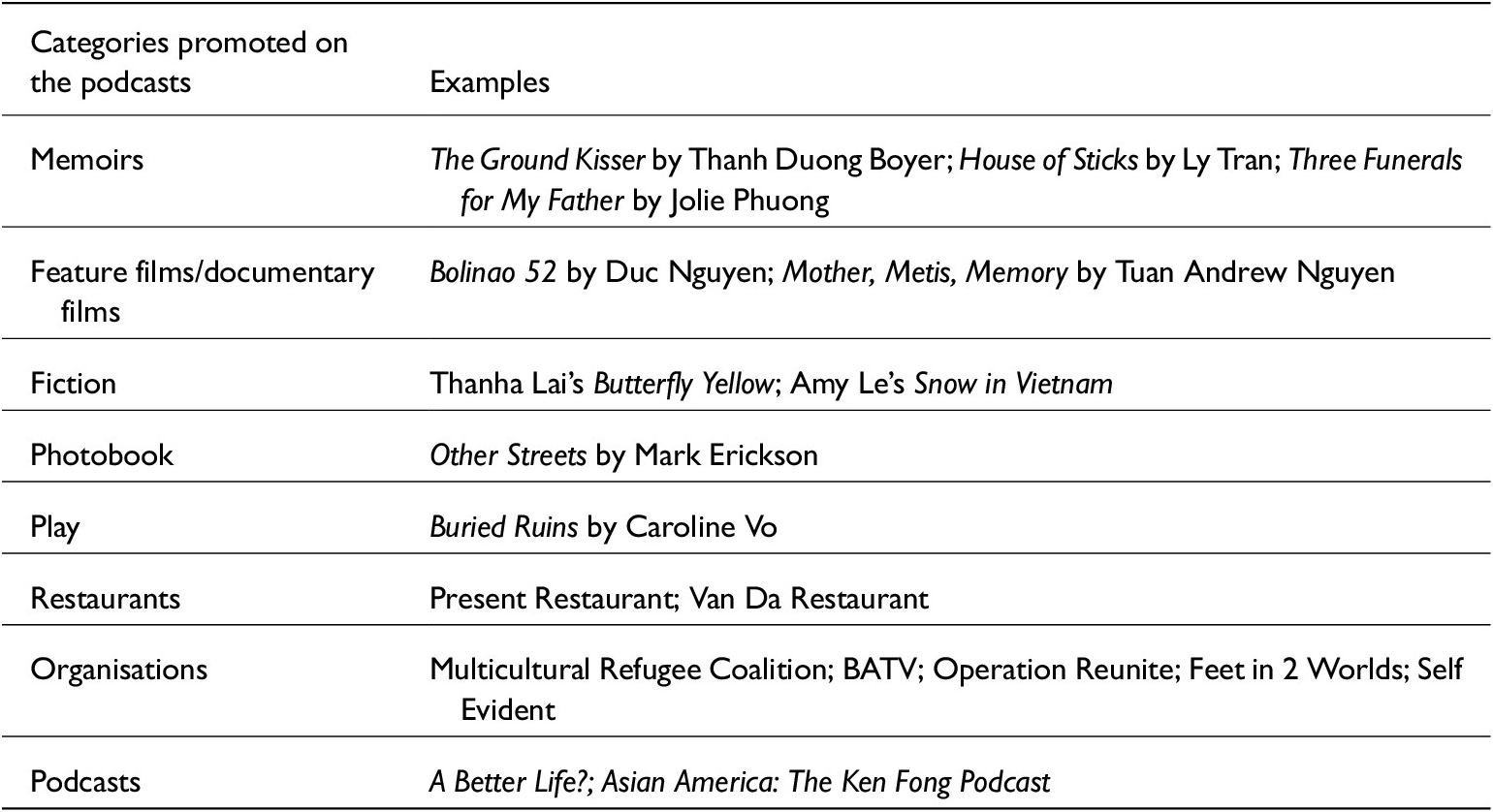
The podcasts actively promote Asian American refugee/diaspora works, businesses, and organisations in their episodes, contributing to community building by spreading awareness about communal activities within Asian diasporas in America. Twenty-two out of the fifty-four episodes of VBP are full-episode promotions of refugee/diaspora endeavours. Three of the five episodes of BM feature spotlights on refugee/diasporic works. Table 2 displays the different types of works, businesses, and organisations promoted on the podcasts.
Types of works, businesses, and organisations promoted on the podcasts
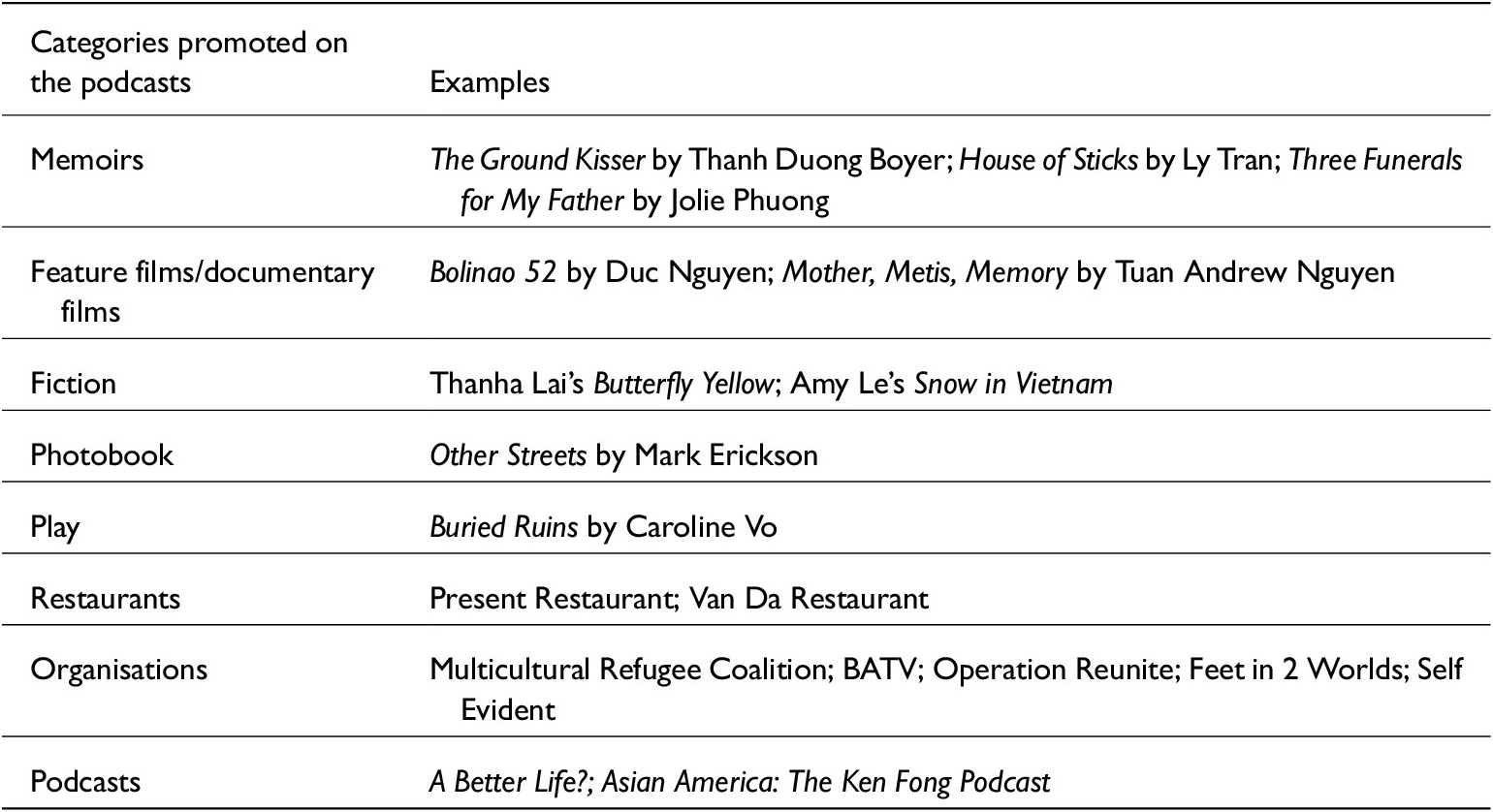
Table 2. Long description
The table lists works, businesses, organisations, and podcasts promoted on VBP and BM. Categories include memoirs, films and documentary films, fiction, a photobook, a play, restaurants, organisations, and podcasts. Examples include works by Thanh Duong Boyer, Ly Tran, Jolie Phuong, Duc Nguyen, Tuan Andrew Nguyen, Thanha Lai, Amy Le, Mark Erickson, and Caroline Vo, alongside community organisations, restaurants, and other podcasts.
Observations
The promotions on the podcasts offer visibility to refugee endeavours centred around the community’s collective historical identity and memory as the boat people. The promotions thus are wrapped in anecdotes connected to the collective refugee past and diaspora experiences. They are organic and part of the main narrative, unlike traditional advertisements or commercials. In VBP, promotions are often in full-length episode format, accompanied by interviews, stories, and snippets about the promotional subject. Although BM is a limited podcast series with little space to highlight many works, it promotes several refugee and diaspora projects and organisations in its episodes. The promotions happen at the beginning, in between acts, or at the end of each episode.
Social visibility is significant in the effective permeation of memory work and lies at the intersection of power and perception (Brighenti, Reference Brighenti2007). Building a collective refugee memory is therefore fraught with challenges, such as skewed power dynamics between refugees and the host culture that impair refugees’ social visibility (Massari, Reference Massari2021). As historically marginalised groups, refugees often encounter negative visibility (Mitra and Şahin-Mencütek, Reference Mitra and Şahin-Mencütek2024) in host countries along with pressure to integrate and assimilate seamlessly into new societies (Strang and Ager, Reference Strang and Ager2010; Phillimore, Reference Phillimore2011; Hynie, Reference Hynie2018). In the context of declining social acceptance of migrants and refugees in the USA in the aftermath of Donald Trump’s ascent to presidency in 2017 and return to power in 2025 (Scribner, Reference Scribner2017; Kerwin et al. Reference Kerwin, Carlson and Wheeler2026), these promotions in VBP and BM could act as community-building strategies to not only offer digital visibility to cultural and mnemonic community endeavours among the Vietnamese and Cambodian American communities but also neutralise and negate the refugees’ negative visibility, rampant on social media platforms (Aldamen, Reference Aldamen2023), which may be detrimental to the social acceptance of refugee stories and memories.
Additionally, promotions can lead to network building by raising awareness of refugee initiatives, thus creating digital social capital (Coleman, Reference Coleman1990; Putnam, Reference Putnam, Crothers and Lockhart2000; Ragnedda, Reference Ragnedda2018) that can be used to build networks and support memory preservation in Vietnamese and Cambodian American communities.
Refugee/diaspora participative and collaborative events
Collaboration is a distinctive characteristic of the podcasts, especially VBP, considering its seasonal nature. BM is collaborative but much less overtly so than VBP. Nevertheless, both podcasts draw their verve from participative acts of remembrance and conversations. Figure 1 illustrates the collaborative and participative initiatives of VBP.
Collaborative and participative events of VBP.

The VBP organisation conducted a nationwide competition for college students to select a logo for the podcast. Instead of hiring professionals, the creators took a participatory approach, providing opportunities for young Vietnamese American artists to partake in the memorial projects. The submissions were posted on Instagram for voting to select a logo for the People’s Choice award, resulting in social media marketing and promotion. Subsequently, VBP also interviewed the winner and runner-up of the logo competition in episodes 7 and 6, respectively.
VBP conducts a storytelling event for Vietnamese Americans, titled ‘My Viet Story Slam’, where they can express themselves creatively through poetry, art, music, monologues, and more. The event invites submissions in the form of a video recording through a nationwide open call. To date, there have been four editions of the competition. Every season, the event is live-streamed on YouTube in May, which is also Asian American and Pacific Islander Heritage Month. Since it is streamed live, several viewers also take part in the event through live comments, ensuring a huge participant pool. The event becomes the podcast’s largest participative memory-making event, involving the hosts, participants, listeners, and live viewers.
Similarly, VBP features live episodes that consist of conversations Tracey has with writers and artists in front of a live audience. There are also episodes with guest hosts. Episode 44, titled ‘Listening Party’, had several members of the podcast’s creative team meet virtually to listen to and discuss an episode of VBP.
VBP further promotes the collaborative ethos of its work through podswaps. Podswap is a collaborative initiative in which VBP airs episodes of other refugee/diaspora podcasts to promote refugee storytelling. BM has collaborated with VBP by participating in podswaps to promote each other’s content. BM has also promoted VBP in episode 2.
Collaboration is a significant theme in the podcasts, and incidentally, Critical Refugee Studies (CRS) deems collaboration a defining trait of refugees, who are ‘empowered by a sense of community’, helping them ‘think expansively about survival and sustenance in the long term’ (Espiritu et al. Reference Espiritu, Duong, Vang, Bascara, Um, Sharif and Hatton2022, 24). So, it is only fitting that these podcasts, as refugee cultural productions, depend on collaboration to consolidate refugee memory and archive refugee narratives.
Observations
Participation is a prominent aspect of memory work in the Internet age (Hoskins and Halstead, Reference Hoskins and Halstead2021). In accordance with this idea, VBP and BM promote a participatory culture (Jenkins, Reference Jenkins2009) centred on memory. Participative memory-making through technological media can amplify refugee voices through creative dialogic engagements around collective memories (Kambunga et al. Reference Kambunga, Smith, Winschiers-Theophilus and Otto2023). Moreover, collaborative retrieval of memories, as exhibited in these podcasts, plays a significant role in the formation and consolidation of collective refugee memory (Greeley and Rajaram, Reference Greeley and Rajaram2023).
Collaborative memory work on these podcasts is not an accidental byproduct of conversations; it is successful because the podcasts operate with a clear and conscious memory preservation goal and strategy that helps consolidate refugee memory. VBP extends the boundaries of normative podcasting by airing episodes from other podcasts or inviting guest hosts, and this approach works because the second-generation of refugees ‘have a group identity to maintain and common group goals to achieve’ (Harris et al. Reference Harris, Paterson and Kemp2008, 226).
In live episodes, they are able to engage with a live audience, and by rebroadcasting these live events as podcast episodes, they also engage with unknown podcast listeners. Thus, by combining synchronous and asynchronous communication, these podcasts ensure a large listening community. Ensuring a large participant pool in the memory-building process is a significant step toward developing a strong refugee collective memory.
VBP’s nationwide competitions, from logo selection to storytelling slams that are later transformed into podcast content, mobilise the community by making the members active participants in the production and dissemination of refugee narratives. This participatory dynamic sustains the podcast’s refugee memory ecology.
Discussion: Podcasts as refugee memory ecologies
Throughout this study, we explored how VBP and BM captured refugee memories with affective immediacy. As reflective listeners, we were drawn into the refugees’ worlds by the moving testimonies in these podcasts, as well as by the podcasts themselves, which made listening engaging and participatory. This study helped us draw out broader understandings of VBP and BM as refugee memory ecologies.
Conversation-based mnemonic capital for refugees
Based on our experience of having listened to the podcasts reflectively, we argue that the conversational style of the podcasts created an accessible listening experience. Further, we argue that these podcasts are able to make their way into intimate personal spaces through a choice-based selection (McHugh, Reference McHugh2016), offering rich ethnographic and mnemonic information. In VBP and BM, the hosts largely ceded narrative control to the guests, yielding anecdotes and details typically circulated only within family or community settings and rarely becoming part of public or historical records. In doing so, VBP and BM contribute to the development and consolidation of refugee mnemonic capital for current and future generations. VBP and BM broadcast intergenerational and intragenerational remembrance in a short format, with Really Simple Syndication (RSS)-based technology aiding notification-based access. These podcasts are edited and curated from long intergenerational conversations about loss, survival, and trauma into platform-optimised episodes, thereby expanding the mnemonic capital these conversations generate beyond the family circles in which they originated.
Spaces of belonging
VBP and BM serve as comfortable spaces for refugees and their children, largely because of the communal, collaborative, and conversational ecology they have created. The podcast’s informal and conversational format encourages spontaneous storytelling, allowing guests space to share rare and perhaps forgotten memories that took shape not as solitary recollections or testimony but as collaborative dialogue between themselves and the host. In VBP and BM episodes, guests were willing to be vulnerable, and sharing stories seemed to build a sense of belonging in refugees, centred around the universality of the refugee journey, despite the particularities. The hosts, who belonged either to the same family or community, were successful in eliciting stories from the guests. Knowingly or unknowingly, the podcast space became a therapeutic space (Peterson, Reference Peterson2023; Karathanasopoulou and Williams, Reference Karathanasopoulou and Williams2023) where considerable healing seemed to happen.
Democratic potential
VBP and BM demonstrate the potential of podcasts to function as democratic memory media that can mobilise refugee and diaspora communities by engaging in participatory memory-making, collaborating with other podcasts, and promoting refugee endeavours through the dissemination of stories and creative works, as well as businesses and organisations. They demonstrate mutual support by promoting each other, broadcasting episodes from other podcasts, and letting guest hosts take over the podcasts for some episodes. VBP and BM perform memory work by instilling a sense of community through collaboration and participation, which could, in turn, lead to effective collective memory-building. These podcasts may be easily accessible to people who are aware of such podcasting initiatives and have access to free or low-cost internet.
Limitations
The findings of the study must be understood within the scope of the selected podcasts, VBP and BM. They were chosen for the distinctive ways in which they mediate and disseminate Southeast Asian refugee memory. While VBP and BM provided us with rich ethnographic and mnemonic insights, they might not represent the full diversity of refugee podcasting practices or experiences across different geographical, political, social, and cultural contexts. Even though podcasts such as VBP and BM can be democratic, the resources to create, sustain, or listen to these podcasts may not be available to all communities, especially the digitally marginalised sections of society (Wilson-Menzfeld et al. Reference Wilson-Menzfeld, Erfani, Young-Murphy, Charlton, De Luca, Brittain and Steven2025; Fung et al. Reference Fung, Lai, Hung, Yu and He2025; Heeks, Reference Heeks2022). While we argue that VBP and BM ascribe visibility to refugee and diaspora initiatives, it is contingent on platform-based algorithms. Unless actively sought out, VBP and BM may not be suggested on any audio entertainment platforms due to platform-centric market concentration (van Dijck, Reference van Dijck2021), thereby limiting visibility to certain podcasts. When edited and curated into a quick-consumption format, VBP and BM are susceptible to the pitfalls of commercialisation, including the risk of diluting refugee experiences. Additionally, as English-language podcasts, they might not appeal to non-English-speaking populations.
Conclusion: Possibilities and challenges of podcast memorials
We propose the term podcast memorials for oral history projects like VBP and BM that were started specifically with the intent of memory preservation. From our study, podcasts emerge as an apropos medium for archiving oral history due to their conversational format that encourages spontaneity, shorter duration, and incorporation of voiceovers, editing, curation, and background score. Podcasts can be made available on various audio entertainment platforms for streaming and embedded on websites. Additionally, listeners are drawn to participate in the memorialisation, as podcasts acknowledge them at the beginning and end of every episode, positioning them as active participants in memory-making. Podcasts also provide notifications via RSS feeds, making them active and dynamic sources of refugee anecdotes, accessible at your virtual doorstep.
Podcast memorials, however, have their limitations. A language divide could restrict podcast memorials to specific linguistic groups. Similarly, a digital divide would mean only a few people can create or access these memorials, pointing to inequalities in digital access or literacy, which are often a reflection of social inequalities based on age, demography, education, and income (Martin et al. Reference Martin, Ceviker and Gezer2026; van Deursen and van Dijk, Reference van Deursen and van Dijk2011; Engen and McGarr, Reference Engen and McGarr2026). Moreover, podcasts streamed on external platforms can be subject to platform governance, censorship, or invisibility, as with other digital media, because, as José van Dijck (Reference van Dijck2009) contends, user agency in digitally networked environments is questionable, as user participation is liable to manipulation by algorithmic ‘rankings and ratings’ (45). Thus, if podcast memorials feature heavily edited and curated content, aggressive promotion, or excessive commercialisation, they risk becoming what Nieborg and Poell (Reference Nieborg and Poell2018) term ‘contingent commodities’. Such podcasts could become dependent on powerful platforms that may make them ‘malleable’ and ‘open to constant revision and recirculation’ (Nieborg and Poell, Reference Nieborg and Poell2018, 4726). Illustrating the contingency of podcasts hosted on external platforms, Morris and Hoyt (Reference Morris and Hoyt2021) point out that a small change to Dropbox’s features in 2017 led to the disappearance of many podcasts from users’ feeds. Podcasts could also be subject to state regulation on external platforms. In November 2024, Apple restricted access to several independent Russian-language news podcasts, including What Happened, The Insider, and Echo of Moscow, for users in Russia, following directives from Roskomnadzor, reflecting Russia’s measures to control the domestic circulation of news amid its ongoing invasion of Ukraine.
Even when podcasts have their own websites, permanence is not guaranteed, as they are vulnerable to domain expiry (Lauinger et al. Reference Lauinger, Onarlioglu, Chaabane, Robertson and Kirda2016), link decay (Hennessey and Ge, Reference Hennessey and Ge2013), and the digital decay of online content (Chapekis et al. Reference Chapekis, Bestvater, Remy and Rivero2024). While domains can be renewed, this does not provide a solution for long-term preservation unless supported by institutional or community stewardship to ensure domain registrations and associated hosting services are maintained over time. Permalinks can reduce link decay to some extent, but only if domains are sustained; when moved to a new website, permalinks must have proper redirects to work.
Nonetheless, podcasters can take a step towards preserving their podcasts by storing their content on multiple storage devices through a 3–2-1 data backup strategy. Using nonprofit digital archives, such as the Internet Archive (IA), for long-term preservation could help sustain the podcasts. IA has an archive of podcasts; anyone with an account can upload audio, and it supports all common audio formats with no file size restrictions. There are also projects like Preserve This Podcast (PTP), funded by an Andrew W Mellon grant at the Metropolitan New York Library Council, that guide podcasters in preservation techniques to combat digital decay. PTP offers a workbook and a 5-part podcast series and has conducted a series of travelling workshops that taught podcasters how to archive podcasts between 2018 and 2020. Similarly, at UW-Madison, a team led by Jeremy Morris and Eric Hoyt developed PodcastRE, a large database of over 2.5 million archived podcasts that aids in searching and analysing podcasts. PodcastRE has a Submit a Podcast option on its website; however, unlike in IA, submitters do not upload audio files themselves; instead, they share the RSS feed link, and PodcastRE handles the archiving. Even public institutions are stepping into the podcast preservation scene; according to the PTP assessment report (Mink, Reference Mink2020), public institutions such as the Library of Congress and the British Library’s UK National Sound Archive have begun acquiring podcasts for preservation, but these efforts may be subject to collection bias. Therefore, while podcasters have options to preserve their podcasts, these options are limited, and some come with obvious pitfalls.
In conclusion, while the emergence of podcast memorials aligns with the needs of the digital society as it moves towards accessible, consumable, engaging, and participatory resources of memory, it also comes with challenges. Podcast memorials demonstrate potential as a mnemonic ecology for communities whose memories are largely underrepresented or misrepresented in public media and archives, as they offer an open opportunity to create, disseminate, and archive their stories with minimal resources and relatively fewer institutional constraints. But they are viable only if creators can manage the restrictions imposed by platformisation, commercialisation, and digital inaccessibility while also finding a holistic solution to preserve podcasts for posterity.
Supplementary material
The supplementary material for this article can be found at http://doi.org/10.1017/mem.2026.10059.
Data availability statement
The data that support the findings of this study are openly available on vietnameseboatpeople.org and beforemepodcast.com, as well as on the following audio entertainment platforms: Amazon Music, Audible, Spotify, Pandora, Apple Podcasts, Stitcher, and Podbean. Lisa Phu has granted us copyright permission to reproduce Before Me’s episode transcripts.
Acknowledgements
We thank the Memory Studies Association (MSA) for providing us with the opportunity to present this research at the MSA Forward (Lima) 2024 and the MSA 9th Annual Conference (Prague) 2025, Beyond Crises: Resilience and (In)stability.
Funding statement
This work received no specific grant from any funding agency, commercial or not-for-profit sector.
Competing interests
The authors declare none.
Aparna Mohan is a research scholar at the Department of Humanities, Arts, and Social Sciences, National Institute of Technology Calicut, India. Her areas of research interest include memory studies and media studies. She is a recipient of the Government of India’s exclusive research grant for PhD fellows, the Senior Research Fellowship (SRF).
Vrinda Varma is an assistant professor of English at National Institute of Technology Calicut, India. Her research areas include gender studies, memory studies, and digital humanities. She was a Fulbright-Nehru doctoral fellow at Boston University in 2015. She is also a practising translator and is the recipient of the PEN/Heim Translation Grant 2024.



 Open access

