Introduction
Developing materials for nuclear applications is an endeavor recognized for formidable scientific challenges leading to significant societal benefits. It is also a field where the connection between the “push” of fundamental science to higher length scales and the “pull” of applied technology from lower length scales is notoriously difficult. The fundamental scientific challenges in materials research for advanced nuclear energy systems have been recently prioritized; see, for example, the DOE-BES (Department of Energy-Basic Energy Sciences) workshop report in 2006Reference Roberto and De La Rubia1 and a collection of overviews.Reference Allen, Burlet, Nanstad, Samaras and Ukai2–Reference Misra and Thilly5 Briefly they may be stated as: “Understand, model, and control chemical and physical phenomena in multi-component systems across multiple length/time scales by developing mechanism-based materials models for use in Integrated Performance and Safety Codes validated for temperatures to 1000°C and radiation doses to hundreds of displacements per atom.”Reference Roberto and De La Rubia1 The statement inherently requires bridging the so-called “valley of death,” or gap between the micro- and the macroscales. It is also a grand challenge in the sense of convincing the regulators and industry to regard the solutions as worthy of significant investment.
In 2008, the Idaho National Laboratory (INL) began development of the Multiphysics Object Oriented Simulation Environment (MOOSE) framework for the rapid development of massively parallel simulation tools.Reference Gaston, Newman, Hansen and Lebrun-Grandié6 MOOSE has matured to include many advanced capabilities, including the ability to perform coupled multiscale simulationsReference Tonks, Gaston, Millet, Andrs and Paul7 and full reactor core analysis.Reference Gaston and Permann8 In 2010, the first Energy Innovation Hub, an alliance of national laboratories, universities, and the nuclear power industry in the United States, was established by the US DOE with the goal of creating a predictive capability for a full virtual nuclear reactor.9 Among the industrial challenge problems targeted by this Hub, the Consortium for Advanced Simulation of Light Water Reactors (CASL), are the consequences of nuclear corrosion deposits, known as CRUD (Chalk River unidentified deposits, after the location of its first discovery, Chalk River, Canada).Reference Deshon, Hussey, Kendrick, McGurk, Secker and Short10 (Note: The structure and effects of CRUD will be discussed in greater detail in the next section.) A MOOSE-based simulation tool, known as MAMBA-BDMFootnote * (materials performance and optimization advanced materials/boron analyzer-boron deposition model),Reference Short, Hussey, Kendrick, Besmann, Stanek and Yip11 was developed as part of CASL efforts to model the micro/mesoscale evolution of CRUD.
In this perspective, we examine two aspects of the ongoing study of CRUD to identify the elements that illustrate current progress toward achieving scientific advances that have technological impact. First is the formulation of a microstructure-based description of heat conduction through porous CRUD, which improves upon previous treatments by including mechanistic, microstructure-dependent materials models. This development draws attention to important details of heat transport in CRUD that are currently missing. The second element deals with bringing improved materials science understanding to the system level by implementing a mesoscale model to track the accumulation of boron- and lithium-bearing species in CRUD over time scales from seconds to years. The validation of this integration directly against plant-level nuclear reactor data would be a significant illustration of technology impact. With CRUD as an illustrative example, we point to other nuclear materials phenomena such as radiation-accelerated corrosion,Reference Adamson, Garzarolli, Cox and Strasser12 stress corrosion cracking,13 void swelling,Reference Garner and Gelles14 and irradiation creep,Reference Garner and Konings15 all possessing common underlying elements, as compelling problems for research at the mesoscale frontier.Reference Yip and Short16
The origins of CRUD
CRUD is the term for the particular phenomenon of corrosion deposits that form on the upper spans of nuclear fuel rods in nuclear reactors. Photographs, micrographs, and a schematic of CRUD explaining its origin and preferential deposition in a nuclear plant are shown in Figure 1. During operation of the reactor, corrosion products are formed at reactor internal surfaces, particularly in the steam generators, internal piping, and valves.17 These components form passive oxide films, typically composed of Fe, Ni, and Cr oxides, that release soluble cations and particulates into the water coolant,Reference Combrade, Scott, Foucault, Andrieu and Marcus18,Reference Yeon, Choi, Park, Kwon and Song19 the latter being strikingly similar to the oxide particles found in studies of the corrosion of reactor internal alloys outside of power plants.Reference Combrade, Scott, Foucault, Andrieu and Marcus18,Reference Neves, Alvial, Schvartzman, Alves and Paula20 The soluble cations and particulates are then carried toward the fuel rods, where typically high heat fluxes can give rise to sub-cooled boiling, a phenomenon occurring when bubbles form on a superheated surface and collapse as they enter a liquid below the boiling temperature. As bubbles form and collapse on the cladding surface, typically in the upper regions of the core, the solutes in the liquid trapped underneath the bubbles precipitate outReference Bindra and Jones21 to form a porous network of boiling pathways, seen in Figure 1b.
(a) Image of CRUD (Chalk River unidentified deposits) (dark areas) on a pressurized water reactor (PWR) fuel assembly,Reference Wells22 (b) cross-section of CRUD showing a network of boiling pathways and characteristic porosity,46 and (c) scanning electron microscopy micrograph of particles comprising CRUD in an operating PWR.Reference Yeon, Choi, Park, Kwon and Song19 The multiscale heterogeneous nature of CRUD is responsible for its deleterious effects on light water reactors, allowing boron compounds to accumulate and cause CRUD-induced power shift, and degrading heat transfer to induce CRUD-induced localized corrosion. PWR schematic courtesy of the European Commission. Information provided courtesy of EPRI.

CRUD’s effects on power plants
While the materials science aspects of the formation and growth of CRUD lie at the microscale, the technological impacts of the effects of CRUD manifest themselves at the macroscale or system (plant) level. Two system-level effects of CRUD— CRUD-induced localized corrosion (CILC) and CRUD-induced power shift (CIPS)—can affect reactor operation and safety and are of primary concern. CILC occurs locally underneath the CRUD, where high concentrations of metallic and oxide impurities and ionic speciesReference Wells22 accumulate via boiling and deposition.Reference Deshon, Hussey, Kendrick, McGurk, Secker and Short10 Fractions of a percent of boric acid (H3BO3) and parts per million of lithium hydroxide (LiOH) are present in the coolant (light water), while metal and oxide impurities originate at the internal surfaces of the reactor. The local concentrations of these species, along with the locations of hot spots caused by growing CRUD, are responsible for pinhole leaks that are exceedingly difficult to mitigate. CIPS involves the shift of the axial power level downwards in the core, away from regions where CRUD forms. It also occurs due to the concentration of species in the CRUD, particularly those containing boron, which is a strong neutron absorber. Because CRUD forms preferentially on the upper regions of fuel rods, the accumulation of boron-bearing compounds locally depresses the neutron flux near the top of the core, causing the power spectrum to shift downward, away from the CRUD, across the entire length of the fuel assemblies. This axial distortion is a problem in reactor control and safety, especially during an accident, since the control rods (in pressurized water reactors) are inserted from the top of the reactor. For safety reasons, if distortion exceeds a certain magnitude, the reactor is required to reduce its power rating, in some cases by as much as 15–20%.Reference Henshaw, McGurk, Sims, Tuson, Dickinson and Deshon23 This is due to the flux depression at the top of the core removing the ability of the control rods, known as “control rod worth,” to quickly shut down the reactor in the case of an accident.
Materials property challenge: Thermal conductivity of CRUD
Previous efforts to model the thermal behavior of CRUDReference Wells22,24–Reference Pan, Jones and Machiels26 have been mostly empirical, justifiable up to now because the macroscale impact on the power plant was of more concern than the microscale materials science of CRUD. As a result, the microstructure and functional behavior of CRUD have not been investigated in sufficient detail.
Part of the science-based knowledge currently lacking is information on the thermal conductivity of CRUD. For a highly porous, tortuous network of pores, particles, and precipitates, the thermal conductivity cannot be expected to be a simple material property adequately described by a single constant. Yet experimental measurements of CRUD’s effective thermal conductivity have been treated as if CRUD were a uniform solid.Footnote †27 This assumption is valid, at best, over a limited set of conditions. Clearly, it does not allow for the highly heterogeneous structure of the porous deposit to be taken into consideration. Several previous modelsReference Cohen25,Reference Pan, Jones and Machiels26 have assumed that CRUD has an effective thermal conductivity as measured in macroscale experiments.Reference Haq, Cinosi, Bluck, Hewitt and Walker27,28 Neglecting microscale effects makes it difficult to compare and cross-check different models. An example of an attempt at science-based modeling is to treat CRUD as a self-similar, fractal-like network of pores containing single or two-phase fluids.Reference Short, Hussey, Kendrick, Besmann, Stanek and Yip11 This model calculates the intrinsic thermal conductivity of CRUD rather than fitting it to a measurement. In this way, one can probe the key factors governing CRUD growth, such as whether the fluid dries out in the CRUD, whether the materials properties are modeled consistently, and whether any fundamental data are missing in the description.
In implementing the MOOSE-based simulation tool MAMBA-BDM, it was realized that the thermal conductivity of trevorite, the most common phase in CRUD,Footnote ‡ had never been measured, while a value of 8 W/mK for trevorite had been assumed based on data for similar spinel compounds.Reference Uhle29 Subsequently, single-crystal specimens were prepared, and a thermal conductivity of 3.5–4.5 W/mK was measured in the temperature range of interest.Reference Kingery, Francl, Coble and Vasilos30 This finding significantly lowered the simulated value of CRUD’s thermal conductivity, placing it closer to experimental results. Before one can make meaningful simulations that approach realistic agreement with actual CRUD measurements, it will be necessary to consider the effects of a heterogeneous microstructure and the mechanism of thermal transport, still a work in progress. A particularly relevant challenge is the understanding of dry-out conditions in the pores, which can significantly affect the heat transport.
System integration challenge: Full-core CIPS validation
Modeling the effects of CRUD at the level of a full reactor core with enough resolution to distinguish mesoscale processes, in this case beyond the length scale of CRUD’s constituent particles (100s of nm to microns), has thus far proved to be intractable for lack of massively parallel computational capabilities.Reference Gaston and Permann8 On the other hand, this is the kind of demonstration that would be effective in convincing the nuclear technology community of the unique impact of computational science.31,32 Recent initial successes have focused on both utilization of high-performance computing and approaching the CRUD problem with a new modeling framework to reach this goal.
MAMBA-BDM has been written in MOOSEReference Gaston, Newman, Hansen and Lebrun-Grandié6 to take advantage of a multiphysics simulation framework that is highly abstracted, extendable, and dimension agnostic. This framework is built on an existing platform of numerical solution tools for finite element problems (LibMesh for meshing,33 PETSc [the Portable, Extensible Toolkit for Scientific Computing] for numerical solversReference Kirk, Peterson, Stogner and Carey34), which makes it generally applicable to problems at many length scales, from the plant level all the way down to the microscale, using the same constitutive models. In the present instance, one is able to build nested simulations, each of which explores phenomena in a certain domain of length and time, to approach the level of a full-core simulation. By enabling the choice of length and time scales at each stage, one can optimize the tradeoff between simulation fidelity and computational execution time. This capability presents a quantifiable path to validate the simulation with measurements observable in a plant, as illustrated in Figure 2.
Path to technological impact in the prediction of CRUD-induced power shift (CIPS). (a) Full-core, multiscale simulations of coupled neutron transport, thermal transport, and CRUD buildup with its resultant boron accumulationReference Gaston and Permann8 produce a curve of boron mass versus burnup (b) (in effect, boron mass versus time for this simulation), while (c) ex-core plant measurements of CIPS versus burnup17 were obtained by measuring neutron flux levels at different heights along the core and can be converted into a matching curve of boron mass versus burnup (b). The red curve in (a) is a plot of axially averaged fission power versus height in the reactor core. Upon startup, this profile was quite symmetric about the mid-plane of the reactor. After CRUD growth and boron deposition, one can note how the power spectrum shifts downward, away from the right-adjacent 3D plot of boron concentration in the core. BISON45 is a fuel performance code written in Idaho National Laboratory’s MOOSE code. RELAP-7 is a 1D nodal full-plant fluid flow model, also written in MOOSE. The temperature color legend is in K. Note: CRUD, Chalk River unidentified deposits; MOOSE, multiphysics object oriented simulation environment; RELAP, reactor excursion and leak analysis program; PWR, pressurized water reactor. Information provided courtesy of EPRI.
Figure 2 shows a recent MOOSE-based multiscale, full-core reactor simulation achieved by simultaneously solving a problem that involves neutron transportReference Balay, Brown, Buschelman, Eijkhout, Gropp, Kaushik, Knepley, Curfman McInnes, Smith and Zhang35 and thermal-fluidsReference Wang36 analyses that explicitly consider over 3000 fuel rods,Reference Zhang, Zou, Andrs, Zhao and Martineau37 each with six MAMBA-BDM simulations run at different heights up each fuel rod to calculate the axially dependent CRUD buildup and boron accumulation on each fuel rod. The development of CRUD thicknesses over time was prescribed based on values taken from the literature.Reference Williamson, Hales, Novascone, Tonks, Gaston, Permann, Andrs and Martineau38 Boron levels in the CRUD were fed back to the neutronics calculation to change the neutron flux, while the thermal resistance of the CRUD formed a boundary condition on the outside of the fuel cladding, and the local coolant temperatures and clad heat fluxes were fed back to each simulation of MAMBA-BDM. This coupled process was repeated at each variable-length time step for a full fuel cycle (18 months), resulting in an axial profile of the reactor power. A volume integrating postprocessor was used to compute the total amount of boron in the core as a function of time. This curve, combined with the power profile versus time in the simulation and the mass of fissile material in the core, yields a curve of boron versus burnup. Here, “burnup” refers to the measure of energy released per mass of fissile metal, measured in gigawatt-days per metric ton of metal (GWd/tHM). Figure 2c shows measurements from a nuclear power plant in percent CIPS as a function of burnup. The mass of boron responsible for the power shift can be calculated from these data, yielding an analogous curve of boron mass versus burnup as the full-core simulation. The direct comparison of the multiphysics, multiscale calculations just described with burnup data recorded at a particular power plant is shown in Figure 2b. To our knowledge, this is one of the first direct methods to explicitly confront model-based simulations and plant measurements made possible by post-processing existing data.
In this illustration, Figure 2b is a comparison not commonly seen or discussed. It is significant because it demonstrates what is involved in understanding the performance of an actual nuclear power plant in terms of model developments and large-scale computations. The discrepancy seen between the reference calculations and actual data in Figure 2b is actually encouraging, because there are mesoscale and macroscale effects that have not yet been properly taken into account in the models. Two such effects that should be noted are, first, the preferential transmutation of 10B (the cross-section of this isotope is 1000x larger) in the CRUD, and second, the amount of boric acid in the coolant that decreases with time during a fuel cycle. (In the calculations, a constant boron concentration in the coolant was assumed.) Both depletion effects would cause a reduction in the initial boron accumulation as well as in its eventual downturn.
It should be noted that the effects of CRUD stem directly from the mesoscale features of the simulation. Sensitivity to a lower-length scale parameter, such as CRUD thermal conductivity or method of permeability calculation, can be studied and the full comparison repeated. Using this framework, the synergistic mesoscale effects at the engineering scale of CRUD can be systematically isolated and analyzed. This capability may be regarded as a science-based technological impact. It would allow reactor operators to potentially predict the effects of different CRUD parameters, fuel loading patterns, reactor water chemistry, and other plant variables in evaluating CIPS risk.
To develop the capability for full-core simulation using mesoscale models is a formidable challenge. The complexities are not unique to the study of CRUD. The interplay between different phenomena in physics, chemistry, mechanics, and materials plus the effects of radiation demand a suite of integrated models, experiments, and plant measurements to be used in an iterated fashion. Arguments could be made for either improving the physics understanding or improving the computational approach to empirically model such complex phenomena. Here, we are suggesting a mix of both is needed.
Nuclear materials’ aging problems at the mesoscale science frontier
Our foregoing discussions of the complexities of CRUD at both the materials property level and the system integration level bring out broad underlying elements common to other materials problems, nuclear or otherwise, that offer science challenges and prospects of technology breakthroughs. Last year, a concerted effort was made by the DOE Office of Science to engage the scientific community in exploring research opportunities at the frontiers of mesoscale science.Reference Walter, Collins, Petrov, Kendrick, Manera and Downar39,40 At the outset, it was understood that mesoscale science is an open concept, the frontiers of which the scientific community at-large should collectively define through specific studies.Reference Yip and Short16,40,Reference Crabtree and Sarrao41 Within this broad scope, the problem of CRUD may be seen as a worthy representative of nuclear materials in terms of its dual complexity—corrosion impact through CILC and neutronic impact through CIPS. Thus, the progress we have discussed could serve to illustrate potential opportunities provided by mesoscale science research.
The fundamental physical phenomenon underlying CRUD and other similar problems is the evolution kinetics of the mesoscale structure.Reference Short, Hussey, Kendrick, Besmann, Stanek and Yip11 By this we mean the time-dependent relationship between the evolving “defect” configurations on the mesoscale (e.g., CRUD thickness, composition, and morphology) and the corresponding functional properties (thermal conductivity and effects on the reactor power distribution) at the macroscale. This relation is an extension of the familiar structure-property correlation, a longstanding concept in materials science. Here, because of the complexity of the phenomena, one is concerned with cross correlations, the linking of different sets of degrees of freedom, or variables associated with different spatial and temporal scales. We therefore define the “mesoscale” as it applies to the problem of CRUD as integrated transport, chemical, and geometrical properties larger than those of individual phase constituents of CRUD but smaller than the length scale of a single fuel pin.
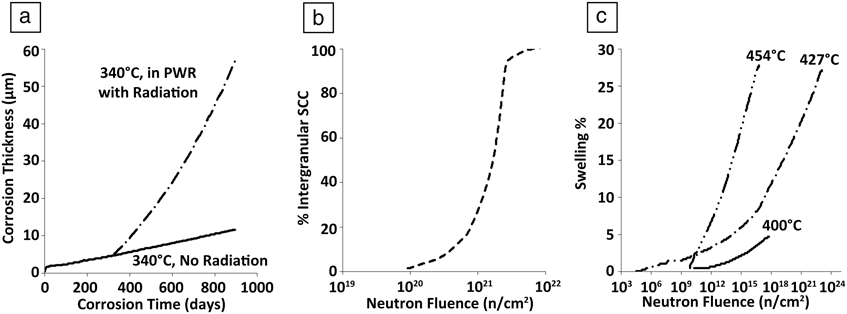
To give a quick illustration of the considerable challenge involved, one can turn to a number of longstanding problems in nuclear materials where an upturn (kink) in the critical functional behavior clearly calls for resolution in terms of underlying mechanisms. The common feature in the examples shown in Figure 3 is the impact of radiation on the temporal response at the system level, whether it is in corrosion of the cladding,Reference Adamson, Garzarolli, Cox and Strasser12 irradiation-assisted stress corrosion cracking,Reference Laughlin, Pines, Schmalian, Stojkovic and Wolynes42 or radiation-induced swelling.Reference Garner and Gelles14 In corrosion, radiation causes a sudden acceleration compared to corrosion without radiation at the same temperature. Neutron fluence is also a strong factor in determining when intergranular stress corrosion cracking takes off. Finally, the combined effects of radiation and temperature can be seen in the changes in radiation void swelling versus temperature of 316 L stainless steel, where an expression to determine the time and magnitude of the upturn for swelling is not yet known. Returning to CRUD, incorporation of the specific effects of radiation on CRUD’s boron levels and microstructure are the most promising routes to bringing simulations and experiments into closer agreement. This path could also improve the understanding of other CRUD effects on power plants, such as CILC, CRUD radioactivity levels, and the effects of radiolysis chemistry on the formation and growth of CRUD.
Examples of upturn behavior in functional responses of nuclear materials, pointing to the need for understanding of underlying mechanisms at the mesoscale. (a) Runaway zirconium corrosion caused by irradiation (adapted from Reference 44). (b) Sudden upturn in intergranular stress corrosion cracking (SCC) failure with increasing neutron fluence (adapted from Reference 43). (c) Rapid onset of swelling of 316 L stainless steel in the EBR-II (Experimental Breeder Reactor) as a function of temperature (adapted from Reference 14). Note: PWR, pressurized water reactor.
It seems appropriate that mesoscale science should play a key role in the quest for coupling scientific advances with technological impact. We see the further development of this concept as essential to the success of strategic alliances, especially where the reliability and optimization of materials are involved. In fact, this concept should be applicable to practically any field, where scientific foundations and practical applications lie at the microscale and macroscale, respectively, because the gap between science push and technology pull is inherent to scientific exploration and discovery.
Summary
We envision a multiphysics and multiscale computational approach to the longstanding problem of Chalk River unidentified deposits (CRUD) in nuclear reactors, encompassing relevant length scales from atomistic and thermodynamic simulations to micro/mesoscale simulations of localized effects. The goal is to estimate full-plant performance with direct links to phenomena occurring at the lower length scales. A first attempt at reconciling a coupled simulation of CRUD at the current limits of computational capabilities with reactor-plant measurements provides a reference basis for understanding the time-dependent effects of boron accumulation and depletion during reactor operation. Opportunities for understanding materials phenomena at the mesoscale in the broad fields of corrosion and radiation damage in nuclear systems are noted.
Acknowledgments
The authors acknowledge funding from the Consortium for Advanced Simulation of LWRs (CASL) and laboratory directed research and development (LDRD) funding from the Idaho National Laboratory (INL). Thanks are due to Yaqi Wang and Andrew Slaughter for preparing calculations related to the full-core simulation. The work would also not have been possible without the insight and technical expertise of Cody Permann, David Andrs, Rich Williamson, Richard Martineau (INL), David Andersson and Brian Kendrick (LANL), Brian Wirth (U. Tennessee), Don Brenner and Chris O’Brien (NCSU), Dennis Hussey (EPRI), and Zeses Karoutas and Jeff Secker (Westinghouse).
Michael P. Short is an assistant professor in the Department of Nuclear Science and Engineering at the Massachusetts Institute of Technology (MIT). He received his MS degree in materials science and engineering and his PhD degree in nuclear science and engineering (2010), both from MIT. Short has worked in the area of experimental nuclear materials for 11 years, studying composite alloy production and corrosion resistance in lead-bismuth, liquid metal attack of ceramics, and, most recently, the simulation and experimental prevention of CRUD in LWRs. In addition, he is a member of ANS, TMS, and MRS-Singapore. Short can be reached at MIT, Cambridge, MA; tel. 617-347-7763; and email hereiam@mit.edu.
Derek Gaston leads the Computational Frameworks Group within the Fuel Modeling and Simulation Department at Idaho National Laboratory. He received his BS degree in computer science from the University of Missouri at Rolla (2004) and his MS degree in computational applied mathematics from the University of Texas at Austin (2006). His background is in enabling large-scale, parallel, scientific simulation. Areas of research include generic frameworks for mesh adaptivity, error estimation, code verification and validation, scale bridging, fluid simulation, and fully implicit contact. Gaston has several publications on numerical framework development and applications to various areas of computational science and engineering. He has received multiple Laboratory Director Awards, and received the 2011 PECASE Award. Gaston can be reached at the Idaho National Laboratory; tel. 208-526-6842; and email derek.gaston@inl.gov.
Christopher R. Stanek is a staff scientist at Los Alamos National Laboratory. He received his BS degree in materials science and engineering from Cornell University (1999) and his PhD degree in materials from Imperial College London (2003). His research interests focus on the interaction between multidimensional defects in ceramics, primarily via atomistic simulation. He is particularly interested in materials for nuclear energy, including oxide fuels, crystalline waste forms, and scintillator radiation detectors. Currently, Stanek is the Materials Performance Optimization focus area lead of the Consortium for Advanced Simulation of Light Water Reactors (CASL) Energy Innovation Hub. He has more than 60 publications related to defect behavior in ceramics. He also is a member of MRS and TMS. Stanek can be reached at the Materials Science and Technology Division, Los Alamos National Laboratory; tel. 505-664-0361; and email stanek@lanl.gov.
Sidney Yip is a professor emeritus in the Department of Nuclear Science and Engineering and the Department of Materials Science and Engineering at the Massachusetts Institute of Technology. He received his MS degree in nuclear engineering (1959) and his PhD degree in nuclear engineering (1962), both from the University of Michigan. Yip has worked in the areas of statistical physics and transport theory, atomistic simulations of materials properties and behavior, and in multiscale materials modeling. He is a member of APS and MRS. Yip can be reached at MIT, Cambridge, MA; tel. 617-253-3809; and email syip@mit.edu.