




No CrossRef data available.
Article contents
Solute trapping in rapid solidification
Published online by Cambridge University Press: 10 November 2020
Abstract
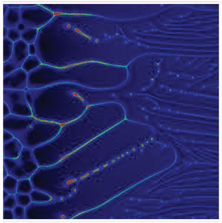
Rapid solidification gives rise to solute trapping, which decreases solute partitioning and alters equilibrium solidification velocity-undercooling relationships. These effects influence microsegregation, solidification morphology, and the emergent microstructure length scales. Here, we review solute trapping and solute drag in rapid solidification in terms of theory, simulation methods, and experimental techniques. The basic theory to describe solute trapping is contained in the continuous growth model. This model breaks down at high solidification velocities, where solidification transitions abruptly to complete trapping, a limit that can be captured with the local nonequilibrium model. Solute trapping theories contain unknown parameters. Their determination from atomistic simulations or pulsed laser melting experiments is discussed. Microstructural evolution in rapid solidification can be readily investigated with the phase-field method, various alternatives of which are presented here. Uncertainties related to kinetic parameters and heat transfer during rapid solidification can be studied by comparing phase-field simulations to dynamic transmission electron microscopy observations.
Information
- Type
- Processing Metallic Materials Far from Equilibrium
- Information
- MRS Bulletin , Volume 45 , Issue 11: Processing Metallic Materials Far from Equilibrium , November 2020 , pp. 910 - 915
- Copyright
- Copyright © The Author(s), 2020, published on behalf of Materials Research Society by Cambridge University Press
References
Aziz, M.J., Boettinger, W., Acta Metall. Mater. 42, 527 (1994).10.1016/0956-7151(94)90507-XCrossRefGoogle Scholar
Trivedi, R., Kurz, W., Acta Metall. Mater. 42, 15 (1994).10.1016/0956-7151(94)90044-2CrossRefGoogle Scholar
Lavernia, E.J., Srivatsan, T.S., J. Mater. Sci. 45, 287 (2010).10.1007/s10853-009-3995-5CrossRefGoogle Scholar
David, S.A., Babu, S.S., Vitek, J.M., JOM 55, 14 (2003).10.1007/s11837-003-0134-7CrossRefGoogle Scholar
DebRoy, T., Wei, H.L., Zuback, J., Mukherjee, T., Elmer, J., Milewski, J., Beese, A., Wilson-Heid, A., De, A., Zhang, W., Prog. Mater Sci. 92, 112 (2018).10.1016/j.pmatsci.2017.10.001CrossRefGoogle Scholar
Jackson, K.A., Beatty, K.M., Gudgel, K.A., J. Cryst. Growth 271, 481 (2004).10.1016/j.jcrysgro.2004.07.073CrossRefGoogle Scholar
Hillert, M., Sundman, B., Acta Metall. 25, 11 (1977).10.1016/0001-6160(77)90240-1CrossRefGoogle Scholar
Aziz, M.J., Kaplan, T., Acta Metall. 36, 2335 (1988).10.1016/0001-6160(88)90333-1CrossRefGoogle Scholar
Yang, Y., Humadi, H., Buta, D., Laird, B.B., Sun, D., Hoyt, J.J., Asta, M., Phys. Rev. Lett. 107, 025505 (2011).10.1103/PhysRevLett.107.025505CrossRefGoogle Scholar
Raman, S., Hoyt, J.J., Saidi, P., Asta, M., Comput. Mater. Sci. 182, 109773 (2020).10.1016/j.commatsci.2020.109773CrossRefGoogle Scholar
Kittl, J., Sanders, P.G., Aziz, M.J., Brunco, D.P., Thompson, M.O., Acta Mater. 48, 4797 (2000).10.1016/S1359-6454(00)00276-7CrossRefGoogle Scholar
Humadi, H., Hoyt, J.J., Provatas, N., Phys. Rev. E 87, 022404 (2013).10.1103/PhysRevE.87.022404CrossRefGoogle Scholar
Ahmad, N.A., Wheeler, A.A., Boettinger, W.J., McFadden, G.B., Phys. Rev. E 58, 3436 (1998).10.1103/PhysRevE.58.3436CrossRefGoogle Scholar
Galenko, P.K., Sobolev, S., Phys. Rev. E 55, 343 (1997).10.1103/PhysRevE.55.343CrossRefGoogle Scholar
Galenko, P.K., Jou, D., Phys. Rep. 818, 1 (2019).10.1016/j.physrep.2019.06.002CrossRefGoogle Scholar
Steinbach, I., Model. Simul. Mater. Sci. Eng. 17, 073001 (2009).10.1088/0965-0393/17/7/073001CrossRefGoogle Scholar
Provatas, N., Elder, K., Phase-Field Methods in Materials Science and Engineering (Wiley, Weinheim, Germany, 2011).10.1002/9783527631520CrossRefGoogle Scholar
Echebarria, B., Folch, R., Karma, A., Plapp, M., Phys. Rev. E 70, 061604 (2004).10.1103/PhysRevE.70.061604CrossRefGoogle Scholar
Pinomaa, T., Provatas, N., Acta Mater. 168, 167 (2019).10.1016/j.actamat.2019.02.009CrossRefGoogle Scholar
Steinbach, I., Zhang, L., Plapp, M., Acta Mater. 60, 2689 (2012).10.1016/j.actamat.2012.01.035CrossRefGoogle Scholar
Kurz, W., Trivedi, R., Metall. Mater. Trans. A 27, 625 (1996).10.1007/BF02648951CrossRefGoogle Scholar
Asta, M., Beckermann, C., Karma, A., Kurz, W., Napolitano, R., Plapp, M., Purdy, G., Rappaz, M., Trivedi, R., Acta Mater. 57, 941 (2009).10.1016/j.actamat.2008.10.020CrossRefGoogle Scholar
Kurz, W., Trivedi, R., Metall. Mater. Trans. A 27, 625 (1996).10.1007/BF02648951CrossRefGoogle Scholar
McKeown, J., Kulovits, A., Liu, C., Zweiacker, K., Reed, B., LaGrange, T., Wiezorek, J.M., Campbell, G., Acta Mater. 65, 56 (2014).10.1016/j.actamat.2013.11.046CrossRefGoogle Scholar
Bathula, V., Liu, C., Zweiacker, K., McKeown, J., Wiezorek, J., Acta Mater. 195, 341 (2020).10.1016/j.actamat.2020.04.006CrossRefGoogle Scholar
Pinomaa, T., McKeown, J.T., Wiezorek, J.M., Provatas, N., Laukkanen, A., Suhonen, T., J. Cryst. Growth 532, 125418 (2020).10.1016/j.jcrysgro.2019.125418CrossRefGoogle Scholar
- 56
- Cited by