

Introduction
Agriculture is one of the most important and strategic resources in the United States. In addition to providing food, agriculture is viewed as a renewable and sustainable resource that can be further utilized to help counter the growing global dependence on petroleum products. Developing more bioproducts based on agricultural feedstock is a critical step in achieving greater sustainability. Starch is the major component of cereal grains and other commodities such as potatoes and cassava.Reference Le Corre, Bras and Dufresne1, Reference Ellis, Cochrane, Dale, Duffus, Lynn, Morrison, Prentice, Swanston and Tiller2 It is the lowest priced and most abundant food commodity in the world.Reference Whistler, Whistler, Bemiller and Paschall3
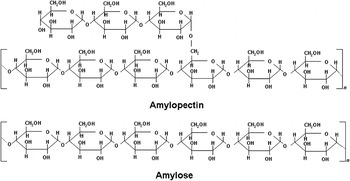
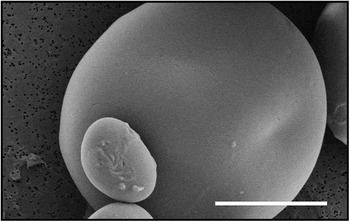
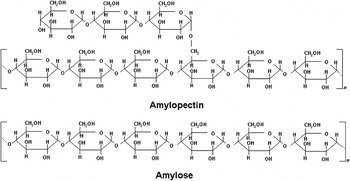
Starch is a semi-crystalline polymer composed of amylose and amylopectin molecules. Amylose is primarily a linear polymer composed of about 1,000 (1–4) linked α-D-glucopyranosyl units.Reference French, Whistler, Bemiller and Paschall4 Amylopectin is a very large molecule (105–106 glucose units) made up of (1–4) linked α-D-glucopyranose chains with α-(1–6) branchesReference French, Whistler, Bemiller and Paschall4 (see Figure 1). Starch is produced in many plant organs but, in cultivated crops, it primarily accumulates in seeds, roots, and tubers. It is synthesized in small amounts in leaves but forms into small (2–100 μm) water insoluble granules in specialized cellular organelles called amyloplasts (Figure 2). The small granules can, in some crops, be particularly simple to extract and dry into a relatively pure, white powder. Over 80% of commercial starch supplies come from corn, while wheat, potato, and cassava starches make up nearly all of the remaining fraction.Reference Le Corre, Bras and Dufresne1, Reference Ellis, Cochrane, Dale, Duffus, Lynn, Morrison, Prentice, Swanston and Tiller2
Chemical structure of starch constituents, amylose and amylopectin.
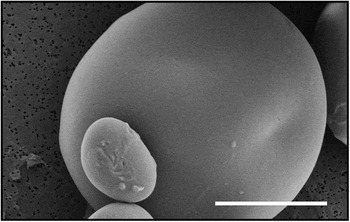
Scanning electron micrograph of native starch granules from wheat starch (scale bar = 10 μm).Reference Glenn, Klamczynski, Chiou, Orts, Imam and Wood58
Millions of metric tons of starch are used annually as an ingredient for making non-food products, including sizing for paper and textiles. Sizing is used to coat paper and textile fibers to modify their adsorption and wear properties. Starch is also used extensively for adhesives and gypsum wall board.Reference Whistler, Whistler, Bemiller and Paschall3 Starch is used increasingly as a fermentation feedstock for ethanol, bioplastics (such as polylactic acid and polyhydroxyalkanoates), and other bioproducts.Reference Huang, Duan, Huang and Chen5–7 Starch itself continues to be extensively investigated as a replacement for plastics used in single-use food and beverage containers because of its compatibility with the environment.Reference Shogren, Fanta and Doane8–Reference Guzman, Gnutek and Janik10 It is a renewable resource that degrades readily in composting conditions and in many landscape and aquatic environments. It is easily metabolized by micro-organisms and mammals alike and therefore does not accumulate in the food chain the same way as plastics, especially in marine environments.Reference Thompson, Olsen, Mitchell, Davis, Rowland, John, McGonigle and Russell11, Reference Law, Morét-Ferguson, Maximenko, Proskurowski, Peacock, Hafner and Reddy12
Plastic foam is being used for many applications where its unique properties such as lightweight, excellent thermal and/or acoustical insulation, and cushion protection are of value. Perhaps nothing has come to represent the squander and misuse of nonrenewable resources from the public perspective more than the use of polystyrene foam in single-use food and beverage containers. The functional life of such containers may be less than the time required for a hot food item or beverage to grow cold, but once discarded, they may exist in the environment for hundreds of years. The U.S. Environmental Protection Agency (EPA) reported that in 2009, 0.82 million metric tons of plastic plates, cups, glasses, dishes and bowls, and hinged containers primarily made of polystyrene were disposed as waste in the United States.13 Although recycling efforts have been very successful for paper and metal packaging, recycling of plastic packaging has lagged behind.13 Virtually no significant (<1%) recycling of polystyrene food service items was reported in 2009.13 Meanwhile, municipalities concerned over the litter of polystyrene foam food containers on beaches, in waterways, and in the landscape have taken action to ban the use of polystyrene food service items.
Using starch as a substitute for plastic is challenging because, unlike plastic, starch is hydrophilic and requires a water barrier coating if it is to meet functional requirements of many products.Reference Guzman, Gnutek and Janik10 Furthermore, as a matrix material, starch tends to become brittle with age due to dehydration and free volume relaxation. Nevertheless, by combining starch with other biodegradable components, starch-based composites with excellent functional properties have been developed.Reference Shogren, Fanta and Doane8, Reference Guzman, Gnutek and Janik10 Many starch-based foam products have been designed for the food industry using a wide array of foaming processes. Other foaming processes for starch products have been developed more recently for industrial products. These technologies produce starch-based foam materials that may appear very similar to polystyrene foam. Some of these starch-based foam processes are described herein along with a discussion of the effect of reinforcing agents on the properties of composite materials.
Heat expansion
Processing and material costs are two criteria important to manufacturers in considering alternative materials for making food containers. Processing costs can be minimized by using a “drop-in” replacement that can be processed with existing equipment. Expanded-bead polystyrene (EPS) is one of the common foaming technologies used for food and beverage containers. EPS is made by first equilibrating polystyrene resin beads in pentane that is used as a blowing agent.Reference Horvath14 The beads are then pre-expanded by heating them in a fluidized bed drier between 80 and 110°C with hot air, which causes a solvent (blowing agent) within the bead to volatilize into a gas and form bubbles or cells within the beads. The beads may expand up to 50 times during the pre-expansion process.Reference Whistler, Whistler, Bemiller and Paschall3 The beads are then conditioned and conveyed into molds where they are further expanded with steam and fused into a molded, water-tight article.
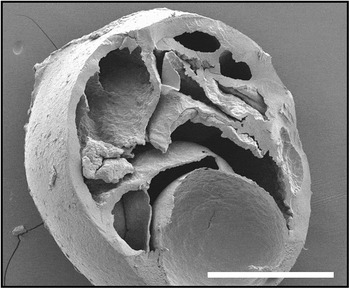
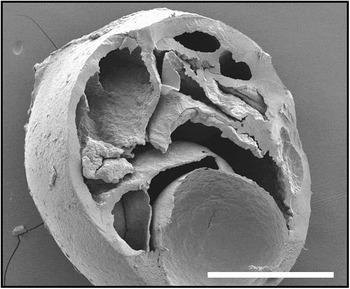
Starch softens and expands into a foam product similar to EPS. Water that is absorbed into the starch matrix acts as a blowing agent. Typically, this is accomplished by heating the starch in a pressurized vessel to soften the starch matrix and superheat the moisture.Reference Mariotti, Alamprese, Pagani and Lucisano15 Puffing or foaming occurs when the pressure is explosively released, and moisture within the starch matrix instantaneously expands into steam and creates a foam product. However, starch can also be converted to a foam product at atmospheric pressure if it is heated quickly enough to prevent the sample from becoming too dry due to evaporation of moisture.Reference Mariotti, Alamprese, Pagani and Lucisano15, Reference Glenn, Klamczynski, Holtman, Shey, Chiou, Berrios, Wood, Orts and Imam16 In one example, starch beads containing plasticizers and polymer additives were prepared by extrusion and pelletization and then conditioned to 15% moisture content.Reference Glenn, Klamczynski, Holtman, Shey, Chiou, Berrios, Wood, Orts and Imam16 The beads were heated in a fluidized bed drier (170–240°C) until they expanded (about 25 sec). The foam structure was composed of only a few very large, closed cells with thick walls (Figure 3). The pre-expanded starch beads were conveyed to an EPS molding machine similar to pre-expanded EPS beads. However, the structure of the starch foam beads was destroyed by the steam injection step due to their moisture sensitivity.Reference Glenn, Klamczynski, Holtman, Shey, Chiou, Berrios, Wood, Orts and Imam16 Using a dry heat source in place of steam injection enabled the starch beads to be fused into a molded article.Reference Glenn, Klamczynski, Holtman, Shey, Chiou, Berrios, Wood, Orts and Imam16 However, the quality of the finished product was poor, and further development is needed to better adapt the EPS process for making molded starch foam products.
Scanning electron micrograph of the cross-section of a heat-expanded starch foam bead (scale bar = 0.5 mm).
Extrusion processing
Extrusion is another processing technology that is used for making polystyrene foam containers. Extrusion is a continuous process whereby polystyrene beads containing a blowing agent are conveyed into a heated barrel by a rotating screw. The material is melted and pressurized within the extruder barrel and instantaneously expanded into a foam product as it exits the barrel die. This process is used to make loose-fill polystyrene packaging products by using a rod die. Sheets of extruded polystyrene foam are made by extruding the polystyrene and blowing agent through an annular die. The polystyrene foam exits the die and forms a hollow foam tube that can then be sliced, opened flat, and rolled onto a spool. Food containers are thermoformed and trimmed from the foam sheets using a post-extrusion process.
Extrusion processing of starch-based materials has been used commercially in the food industry for several decades.Reference Shogren, Fanta and Doane8, Reference Wiedmann and Strobel17, Reference Lai and Kokini18 Extrusion is an energy-efficient cooking system able to breakdown the starch granule structure through a combination of high shear, temperature, and pressure. High amylose starches extruded with 13–19% moisture and at temperatures of 160–210°C form a closed cell foam similar to polystyrene foam.Reference Lacourse and Altieri19 Chemically modifying the starch with propylene oxide to produce starch ethers improves the expansion and resiliency of the extruded product.Reference Lacourse and Altieri19 This technology has been used to commercially produce starch-based loose-fill packing material as a replacement for polystyrene loose-fill. More recently, starch-based foam sheets have been made for packing and cushion applications using a similar technology to extrude starch foam through an annular die.Reference Nabar, Ramani and Schindler20
One way to increase the strength and resiliency of extruded starch-based foam products without chemically modifying the starch is by incorporating pulped cellulose fiber as a reinforcing agent.Reference Glenn, Klamczynski, Holtman, Chiou, Orts and Wood21 Starch-based foam/fiber composites were made by uniformly dispersing fiber in a viscous, gelatinous starch melt before mixing in other additives. The mixed ingredients were pelletized and either extruded into a foam directly or after a compounding step using twin-screw extrusion.Reference Glenn, Klamczynski, Holtman, Chiou, Orts and Wood21 The compounding step improved the expansion of the foam and reduced density. The fiber had little effect on foam density but increased the tensile strength and modulus and helped prevent embrittlement with age that is commonly observed in starch-based products. The samples largely biodegraded within 40 days under composting conditions.Reference Glenn, Klamczynski, Holtman, Chiou, Orts and Wood21
Baking process
A baking process for making molded starch-based foam products similar to that used for making wafer cookies and ice cream cones has been developed.Reference Tiefenbacher22, Reference Andersen and Hodson23 While the baking process, which is not used in the plastic process, does not afford the advantages of a “drop-in” replacement that utilizes existing plastic processing equipment, it exploits technology developed in the food industry and has been adapted for making food containers. The process involves baking an aqueous starch slurry in a compression mold. Steam vents are machined along the seam where upper and lower halves of the mold join together. The cycle starts by depositing a measured amount of a starch slurry in the mold that is then closed. The slurry rapidly heats and becomes a viscous, molten liquid foam that expands as steam forms. A skin forms against the inner mold surfaces as the molten starch completely fills the mold cavity. Steam formed within the molten core forges its way through the molten mass enroute to the vents, thereby creating an irregular foam core structure consisting of channels and voids. The starch foam is baked until the skin and porous core structure completely solidify (ca. 5% moisture content). The baked product is then removed from the mold but is still not well suited for use as food containers because of its moisture sensitivity and brittleness.Reference Tiefenbacher22–Reference Andersen and Hodson26
The flexibility and strength of the baked starch-based materials are improved by reinforcing the starch matrix with cellulose fibers. Natural fibers such as pulped softwood fibers that have a fiber length greater than 2 mm and an aspect ratio greater than 25 are effective in reinforcing the starch matrix as long as the fibers are well dispersed.Reference Andersen and Hodson26 Poor fiber dispersion can lead to clumping and segregation from the starch slurry, resulting in little or no improvement in the strength or flexibility of the finished product. A well-dispersed starch/fiber composite is made by applying a high shear stress to the starch/fiber slurry composite. The starch matrix, which adheres well to both the fibers and the mixer components, tends to create sufficient drag to pull individual fibers apart during rigorous mixing.Reference Andersen and Hodson26, Reference Glenn, Orts and Nobes27 Once the fiber is well dispersed in the viscous starch matrix, other ingredients and additives such as rheology modifiers, inorganic fillers, and mold-release agents can be added to improve the processing and quality of the finished molded article.
Research efforts to improve baked starch-based containers have focused on reducing cost and improving quality and performance. Among the common starches, potato starch provides the optimum melt flow properties and viscosity for the baking process compared to cereal starches.Reference Glenn, Orts and Nobes27 Potato starch is known to gelatinize faster and at lower temperatures and has a much higher peak paste viscosity than cereal starches.Reference Mishra and Rai28 These attributes may help explain why potato starch performs better than normal cereal starches in making baked articles. Less expensive starches such as cassava and waxy maize also show promise in making suitable baked containers. Both these starches have higher peak viscosities and gelatinize faster and at lower temperatures than the more common cereal starches.Reference Mishra and Rai28, Reference Yoo and Jane29
The baked starch/fiber foam composites are inherently moisture sensitive and require either a polymer additive or protective coating to provide the moisture stability required for food service packaging. Poly(vinyl alcohol) (PVOH) is a hydrophilic synthetic polymer that biodegrades at a slower rate and is compatible with starch.Reference Chen, Imam, Gordon and Greene30 The addition of aqueous PVOH to the starch slurry preparation increases the strength, flexibility, and water resistance of baked articles.Reference Shogren, Lawton, Tiefenbacher and Chen31 Further improvements in mechanical strength and moisture resistance could perhaps be attained by using a cross-linking agent such as hexamethoxymethylmelamine. However, such treatments reduce the rate of biodegradability.Reference Chen, Imam, Gordon and Greene30, Reference Shogren, Lawton, Tiefenbacher and Chen31 Natural rubber latex was tested as an additive to the starch-based formulation.Reference Shey, Imam, Glenn and Orts32 The latex improved flexibility and moisture resistance but also increased the density of the foam product.
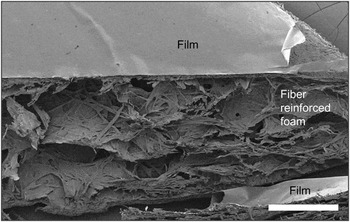
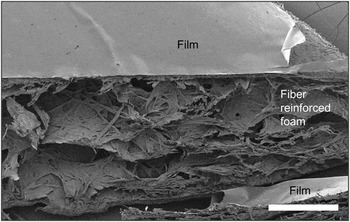
The preferred method, to date, of providing moisture resistance to baked starch-based food containers is to laminate the starch composite material with a biodegradable polyester film.Reference Andersen and Hodson23, Reference Glenn, Orts, Nobes and Gray33 The film is applied in a separate, post-processing step.Reference Andersen and Hodson23 The film not only acts as a vapor barrier but also improves the strength and flexibility of the finished product. Efforts to combine the baking step and the lamination step into a single step were tested in an in situ lamination process.Reference Glenn, Orts, Nobes and Gray33 The procedure involves depositing the starch slurry in a heated mold between two sheets of laminate (Figure 4). The starch foam slurry quickly heats, expands, and forces the laminate film outward and against the mold surfaces. The laminate film adheres well to the starch substrate while providing moisture resistance. Laminate materials successfully tested include aluminum foil, polyvinyl alcohol film, and various paper products. The laminated foams generally had a higher density, tensile strength, elongation to break, and flexural strength than non-laminated samples. All the laminate materials showed decreased water vapor permeance. Foam samples laminated with the foil had the lowest water permeance values and had mechanical properties in the same range as those of commercial containers made of EPS or coated paperboard.Reference Glenn, Orts, Nobes and Gray33
Scanning electron micrograph of the cross-section of a cellulose fiber reinforced foam that was laminated in situ between two sheets of film (scale bar = 1 mm).Reference Glenn, Orts, Nobes and Gray33
Bowls and plates made by the baking process and subsequently laminated with a biodegradable polyester film function well as single-use food service containers and are currently being marketed in the United States. These products appear similar to polystyrene foam containers but degrade in about 45 days in a composting facility.Reference Green, Millner, Green, Townsend, Reynnells, Millner and Bailey34 Further improvements in the baking technology and reduction in product costs will help baked starch-based foam products gain more of the single-use foam food container market. Production costs could be reduced by developing starch slurries with less expensive materials (i.e., cheaper starches) or by developing formulations with lower moisture content. Reducing the moisture content of the slurries would reduce energy costs associated with the baking process and would allow higher production rates by decreasing baking time.Reference Andersen and Hodson26
Puffing process
Other food processing technologies that could be adapted to making starch-based foam composites include explosion puffing. As described earlier, this process involves equilibrating a starch material to a moisture content of 15–20%, pressurizing the starch while heating, then explosively releasing the pressure to allow the steam release to expand the molten starch matrix into a foam product. Puffed starch-based foam consists of small, closed cells with thin walls that resemble the structure of polystyrene foam.Reference Hoseney, Zeleznak and Abdelrahman35 Puffing or popping machines have been developed in the food industry that consist of a pressurized vessel, a heat source, and a valve that can explosively release internal pressures. While this technology is generally not well suited to making molded foam products, rice cake popping machines may be the exception. This two-step process involves loading a sample of rice grains in a cylinder and compressing it between opposing heated pistons. After holding a few seconds for heat transfer to occur, the cylinders retract and explosively release the air/steam pressure built up within the cylinder. The sample is immediately compressed again to a standard thickness while the puffed rice grains are still hot and pliable. The process fuses the individual rice grains into a molded product.Reference Huff, Hsieh and Peng36, Reference Klamczynski, Knuckles and Glenn37
A variation of this process was tested for molding extruded starch pellets into a molded foam product.Reference Glenn and Orts38 The pellets were formed from wheat, corn, and potato starch, conditioned to moisture levels ranging from 8–20%, and loaded in a heated compression mold. The samples were compressed and quickly decompressed, resulting in an explosive release of steam.Reference Glenn and Orts38 The starch foam that resulted had the appearance of polystyrene foam and was composed of closed cells with thin walls. Further mold design modifications, such as using a vented mold in conjunction with a pressurized jacket, could lead to improvements in the finish and quality of puffed starch-based foam articles.
Starch xerogel foam
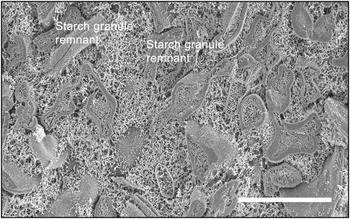
Another type of starch foam called xerogel is made from starch gels. The properties of starch gels are influenced by the starch source and the degree of starch granule destructurization during gelatinization. Starch granules are insoluble in cold water, but when aqueous starch suspensions are heated, the granules swell, and the viscosity of the suspension increases. At the same time, smaller molecular weight amylose molecules diffuse out of the granules and form a matrix material in which remnants of starch granules remain interspersedReference Atkin, Abeysekera, Cheng and Robards39 (Figure 5). When a gelatinous starch paste is cooled, the starch molecules in the matrix interact in a process known as retrogradation, wherein an elastic gel is formed.Reference Richardson, Kidman, Langton and Hermansson40 The gel structure is a three-dimensional network of mostly amylose molecules with uniformly dispersed starch remnants.Reference Richardson, Kidman, Langton and Hermansson40 The gel structure can be somewhat preserved by first dehydrating using a solvent exchange process followed by a drying process.Reference Glenn and Irving41 The solvent exchange process involves equilibrating the starch gel in several baths of ethanol of increasing concentration to remove water and then air drying to remove the solvent. The product that results from this process is a white, lightweight xerogel or microcellular foam that appears very similar to polystyrene foam. Porous starch-based xerogels can be made into blocks, panels, beads, or powders depending on the desired application.Reference Glenn, Klamczynski, Woods, Chiou, Orts and Imam42 Blocks of this lightweight foam are moisture sensitive and brittle but have proven to have excellent compressive strength and thermal insulation properties that are comparable to polystyrene foam.
Scanning electron micrograph of the cross-section of a starch foam (xerogel). Note the presence of starch granule remnants or ghosts interspersed throughout the starch matrix (scale bar = 20 μm).Reference Glenn, Klamczynski, Chiou, Orts, Imam and Wood58

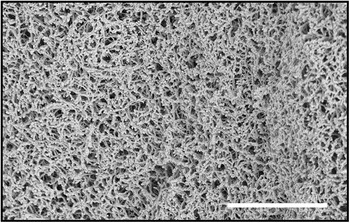
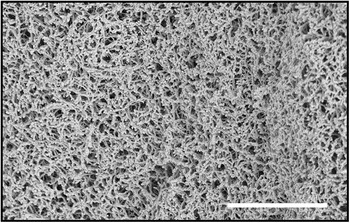
Beads of starch xerogel appear similar to polystyrene beads, but their processing properties are very different. In contrast to EPS beads, starch xerogel beads have an open cell structure and do not expand when exposed to heat and are not well suited to molding by heat-induced expansion or packaging applications. Nevertheless, starch xerogels continue to be of interest for other applications, including as a whitening pigment substitute for titanium dioxide,Reference El-Tahlawy, Venditti and Pawlak43, Reference Bolivar, Venditti, Pawlak and El-Tahlawy44 chemical encapsulation, and column chromatography.Reference Glenn, Klamczynski, Ludvik, Shey, Imam, Chiou, McHugh, DeGrandi-Hoffman, Orts, Wood and Offeman45 Scanning electron micrographs show that the xerogel matrix consists of pores smaller than 2 μm (Figure 6). Pore size measurements indicated a significant number of pores in the range of 5–14 angstroms.Reference Buttery, Glenn and Stern46 The starch xerogel is effective in sorbing many volatile compounds in a manner similar to other microcavity sorbants, such as charcoal. The compounds are released again by adding water to disrupt the xerogel. The starch xerogels could be effective as flavor/chemical encapsulants for dry foods.Reference Buttery, Glenn and Stern46 Starch xerogels could also be useful in reservoir-type biodegradable control-release devices and personal hygiene products due to their ability to absorb and hold several times their weight of various solvents.Reference Glenn, Klamczynski, Ludvik, Shey, Imam, Chiou, McHugh, DeGrandi-Hoffman, Orts, Wood and Offeman45, Reference Glenn and Stern47, Reference Glenn, Klamczynski, Woods, Chiou, Orts and Imam48
Scanning electron micrograph of a xerogel prepared from a high amylose corn starch gel (scale bar = 5 μm).Reference Glenn, Klamczynski, Chiou, Orts, Imam and Wood58
Starch nanocomposites
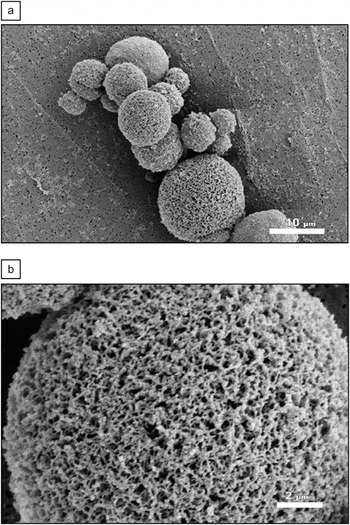
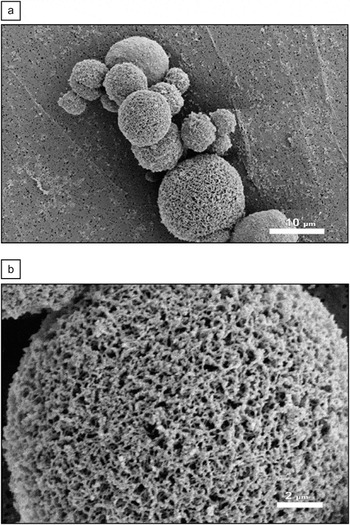
Early efforts to incorporate starch into plastics included adding native starch granules as a filler in a plastic matrix.Reference Griffin49 Although adding starch as a filler increased the renewable content, the mechanical properties of these plastic composites were inferior.Reference Griffin49, Reference Lim, Jane, Rajagopalan and Seib50 Nanoparticle fillers are known to improve the mechanical properties of plastics and enhance physical properties such as gas or solvent permeability. The effectiveness of nanoparticle fillers has been attributed, in part, to their high surface area compared to typical fillers. Starch nanocrystals have been made by acid hydrolysis using HCl or H2SO4.Reference Le Corre, Bras and Dufresne1 The nanocrystals are about 45% crystalline, depending on the botanical source, and may increase the tensile strength and elastic modulus of nanocomposite materials by more than twofold, depending on the matrix material.Reference Le Corre, Bras and Dufresne1, Reference Dufresne, Cavaille and Helbert51 Some reports indicate that water vapor permeability decreases by incorporating starch nanocrystals in composite materials.Reference Angellier, Molina-Boisseau, Lebrun and Dufresne52 Starch xerogel beads have been made into porous beads with diameters from 2–10 μm (Figure 7). The beads were prepared by atomizing a gelatinized starch melt and using an air-classification method to select for the smallest particles.Reference Glenn, Klamczynski, Woods, Chiou, Orts and Imam48 This process involves pumping a starch melt through an atomizing nozzle to create a mist of droplets suspended in the air. The larger, heavier droplets quickly fall, while the smallest droplets remain suspended and are drawn into a separate collector using vacuum.Reference Glenn, Klamczynski, Woods, Chiou, Orts and Imam48 Although the starch beads were prepared for other bioproduct applications, they could also be effective as nanofillers in plastic composite materials because of their high surface area. The surface area of the porous microbeads is very high due to the distribution of nano-sized pores and interconnecting matrix materials.
Scanning electron micrographs of starch foam spheres from xerogels. Microspheres ranged from 1–10 μm (a). Many of the pores and matrix structures were in the nanometer size range (b).Reference Glenn, Klamczynski, Woods, Chiou, Orts and Imam42
Other starch nanocomposites have been made using starch as the matrix material and incorporating nanoparticles from other sources. Starch composites made with only 5% montmorillonite clays as a nanoparticle filler have higher dynamic elastic moduli and tensile strength.Reference Park, Lee, Park, Cho and Ha53 Even more surprising is that the water vapor transmission rate was lowered by nearly one half.Reference Park, Lee, Park, Cho and Ha53 This is thought to be due to the tortuous diffusion pathway formed as the stacked platelets that form each clay particle become intercalated and dispersed in the matrix material.Reference Angellier, Molina-Boisseau, Lebrun and Dufresne52, Reference Chiou, Yee, Glenn and Orts54 Starch nanocomposites have also been made using cellulose microfibrils.Reference Orts, Shey, Imam, Glenn, Guttman and Revol55 Cellulose microfibrils are long crystalline particles with diameters from 10 to 20 nm and aspect ratios from 20 to100.Reference Orts, Shey, Imam, Glenn, Guttman and Revol55, Reference Dufresne, Dupeyre and Vignon56 Starch plastic composites reinforced with 10% cellulose microfibrils derived from cotton had a fivefold increase in Young’s modulus compared to control samples without microfibrils.Reference Orts, Shey, Imam, Glenn, Guttman and Revol55 Potato starch plastics reinforced with microfibrils had improved thermomechanical properties and lowered water sensitivity.Reference Dufresne, Dupeyre and Vignon56, Reference Dufresne and Vignon57 The use of starch nanocomposites for improving starch-based foams and plastics where starch comprises either the nanoparticles or the matrix material remains very promising.
Conclusions
The use of starch in industrial products will continue to grow as long as it continues to be an abundant, inexpensive, and renewable feedstock. New bioproducts from starch-based foam and foam composite materials, including nanocomposites, provide viable alternatives for some petroleum-based products such as single-use foam food containers. Further development of mechanical and chemical processes and composite materials will help improve the performance of starch-based bioproducts and make them more effective replacements for petroleum-based products.