


Hostname: page-component-7b7567c8c-wxvwp Total loading time: 0 Render date: 2026-11-16T16:45:56.852Z Has data issue: false hasContentIssue false

Nanoscale TiO2 coating improves water stability of Cs2SnCl6

Published online by Cambridge University Press:  12 November 2020

Yachun Wang
Affiliation:
Department of Mechanical, Aerospace, and Nuclear Engineering, Rensselaer Polytechnic Institute, Troy, NY 12180, USA
Weiguang Zhu
Affiliation:
Department of Mechanical, Aerospace, and Nuclear Engineering, Rensselaer Polytechnic Institute, Troy, NY 12180, USA
Tiankai Yao
Affiliation:
Department of Mechanical, Aerospace, and Nuclear Engineering, Rensselaer Polytechnic Institute, Troy, NY 12180, USA
Xiaolei Guo
Affiliation:
Fontana Corrosion Center, Department of Materials Science and Engineering, Ohio State University, Columbus, OH 43210, USA
Gerald S. Frankel
Affiliation:
Fontana Corrosion Center, Department of Materials Science and Engineering, Ohio State University, Columbus, OH 43210, USA
Jie Lian*
Affiliation:
Department of Mechanical, Aerospace, and Nuclear Engineering, Rensselaer Polytechnic Institute, Troy, NY 12180, USA
*
Address all correspondence to Jie Lian at lianj@rpi.edu
Get access

Abstract

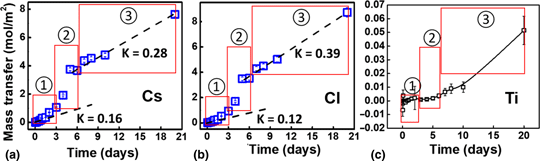
To improve the stability of Cs2SnCl6 under aqueous/moisture environments, we applied a concept of artificial passivation by depositing a protective TiO2 coating of 10 nm on the surface of Cs2SnCl6. Static leaching experiments results indicate that the initial release rates of Cs+ and Cl− are decreased by 20–30 times with TiO2 coating, suggesting its possibility to improve the short-term water/environmental stability of Cs2SnCl6. An amorphous-to-crystalline phase transition in TiO2 film was observed, possibly resulting in degradation of Cs2SnCl6. However, the crystalline TiO2 film still remains after 21 days water exposure and can still act as an effective passivation layer to reduce the release rates of Cs+ and Cl- by as much as about 17 and 7 times, respectively, relative to static leaching without artificial coatings. Therefore, the water/environmental stability of metal halide perovskite Cs2SnCl6, which is a highly soluble molecular salt, can be enhanced by the nanoscale TiO2 coating as an artificial passivation film.

Information

Type
Research Letters
Copyright
Copyright © The Author(s), 2020, published on behalf of Materials Research Society by Cambridge University Press

Access options

Get access to the full version of this content by using one of the access options below. (Log in options will check for institutional or personal access. Content may require purchase if you do not have access.)

Article purchase

Temporarily unavailable

Supplementary material: File

Wang et al. supplementary material

Figure S1

Download Wang et al. supplementary material(File)
File 410.9 KB