Introduction
Current energy consumption/production that relies on combustion of fossil fuels and other human activities are having a great detrimental impact on the global ecology and economy as reported by the United Nations Intergovernmental Panel on Climate Change.[Reference Stocker, Qin, Plattner, Tignor, Allen, Boschung, Nauels, Xia, Bex and Midgley1] Several propositions including alternative renewable energy sources are at the forefront in addressing these eminent global warming challenges. However, the power delivered by most of these renewable energy sources can be intermittent, and thus, electrochemical energy storage and conversions systems that are designed to be more sustainable and environmentally benign are likely to have a particular value towards enhancing the power output from these intermittent renewable resources and in maintaining stability in the electrical power systems.
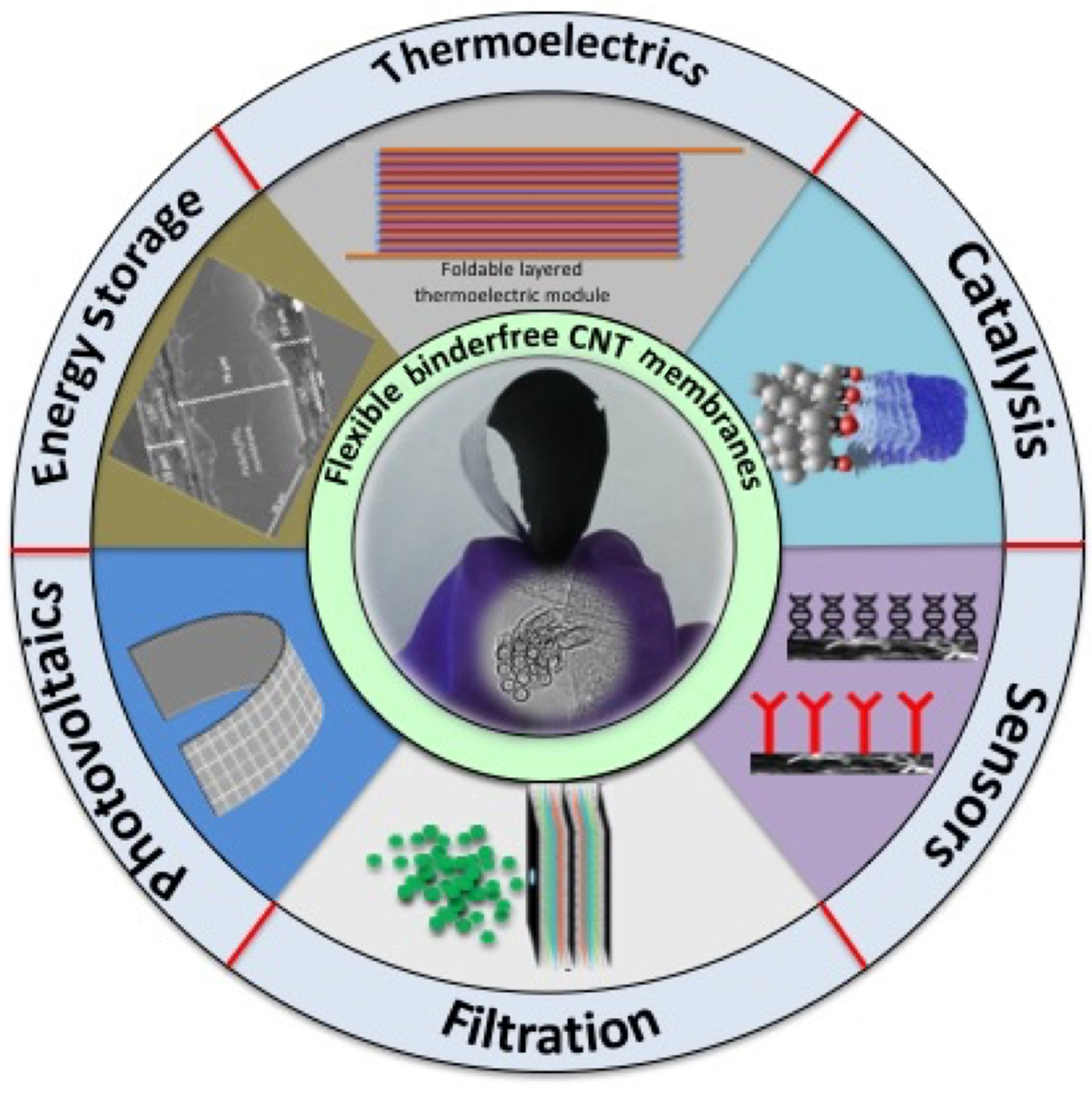
Furthermore, the emerging advances in electronic technologies have created a strong interest in ultrathin, flexible, safe energy storage devices to meet the various design and power needs of flexible devices. To build fully flexible, robust and multi-faceted electrochemical energy storage and conversion system, multiple components with specific electrochemical and interfacial properties need to be integrated into a single unit. One of the critical components in these electrochemical energy storage and conversion system is the electrode material. Low-dimensional nanostructures such as nanotubes, nanowires, nanoparticles, nano-onions, graphene, and transition metal dichalcogenide are aggressively been pursued as viable candidates. Electrode design is seen as one of the ways to achieve high energy/power in electrochemical energy storage and conversion systems. Ideally, the electrode should be a highly conducting high surface area material that exhibits good corrosive resistance, temperature stability, fast ionic kinetics (low ionic diffusion resistance), minimal interfacial resistance between electrode material and current collector, easily processable, compatible with other components, and relatively cheap to produce. Carbon nanostructures such as carbon nanotubes (CNTs) are leading materials for electrode application in electrochemical energy storage and conversion systems. Since the discovery of CNT in almost three decades ago,[Reference Iijima2] it has been demonstrated for many applications, few of these applications are shown in Fig. 1. This is mainly due to the unique physico-chemical properties including high tensile strength (~100 GPa)[Reference Dai, Javey, Pop, Mann and Kim3,Reference Pop, Mann, Wang, Goodson and Dai4] and elastic modulus (~1.0 TPa),[Reference Ruoff, Qian and Liu5,Reference Baughman, Zakhidov and de Heer6] high electrical (~10–30 kS/cm)[Reference Dai, Javey, Pop, Mann and Kim3] and thermal (~1500 W/mK)[Reference Pop, Mann, Wang, Goodson and Dai4,Reference Yu, Shi, Yao, Li and Majumdar7,Reference Kim, Shi, Majumdar and McEuen8] conductivities, ballistic transport,[Reference Dai, Javey, Pop, Mann and Kim3,Reference Baughman, Zakhidov and de Heer6] stability at moderate temperatures, light weight, high aspect ratio and high surface area with no bulk atoms (only surface atoms).[Reference Ng, Wang, Guo, Chen, Wang and Liu9–Reference Dresselhaus, Dresselhaus and Eklund11] The monolayer atomic structure and accessibility of both external and internal pores provide additional channels to modify the CNT properties by either coating the surface with metal or metal oxide nanoparticles,[Reference Jiang and Zhang12–Reference Rakhi, Sethupathi and Ramaprabhu15] non-covalent attachment of molecules or polymers to the surface,[Reference Snow and Perkins16–Reference Chen, Zhang, Wang and Dai18] or infiltrating the inner pores with other chemicals.[Reference Xu, Qiao, Zhou and Chen19] These structural varieties and the unique intrinsic properties of CNTs have made them a promising candidate for numerous applications in the emerging nanotechnologies (Fig. 1).
Some potential applications of CNT membranes.

However, one of the greatest challenges has been the processing of the CNTs into highly dense robust binder-free flexible membrane that retains the unique and intrinsic properties. While the liquid phase assembly of CNTs seems promising, there are major limitations (such as scalability, damage to the CNT structure, deterioration of the desired properties, etc.) that are further exacerbated by the van der waal interactive force (0.5 eV/nm). For a scalable and commercially feasible process, the post-synthesis self-assembly technique has to overcome the limitations, while simultaneously maintaining the unique structural and physico-chemical properties of the CNTs. We use a charge transfer mechanism to process the CNTs in liquid phase into highly dense flexible robust binder-free membrane that has potential applications in several fields, especially in the energy storage and conversion systems.
Experimental details
We use a charge transfer mechanism to induce the self-assembly of the CNTs into an interwoven binder-free flexible membrane. The CNT power is dispersed in a liquid such as bromine by continuously stirring until the CNTs are uniformly dispersed in the bromine. It is transferred into a petri dish and the excess bromine is removed by cryogenic trapping, leading to the formation of a randomly woven densely packed CNT membrane. The membrane is treated at high temperature with mixed gases (5% H2,95%Ar or He) to remove any residual bromine.
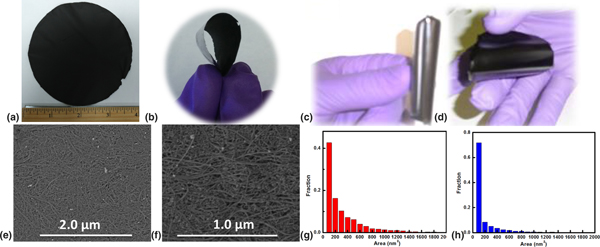
The FEI Nano SEM-630 was used to collect the high-resolution SEM images of the membranes. This scope uses a high-resolution field emission source and column, along with a monopole magnetic field immersion. In Fig. 2 we show optical images of several flexible binder-free CNT membranes [Figs. 2(a)–2(d)], SEM images of the bottom [Fig. 2(e)] and top [Fig. 2(f)] surfaces of the CNT membranes and the respective void analysis of the surfaces [Figs. 2(g)–2(h)]. A white light scanning interferometer instrument, the Zygo NV7300 Profilometer was used to determine the thicknesses of the membranes. In Fig. 3 we show (a) a 3-dimension, (b) a 2-dimension, (c) a line profile, and (d) a comparison of three different membrane thicknesses.
(a-d) Flexible binder free CNT membranes. SEM images of bottom (e) and top (f) surfaces of a membrane and the corresponding distribution of voids (g, h) on the surfaces, respectively.

(a) 3-dimensional image, (b) 2-dimensional image, (c) line profile, and (d) 3-dimensional images of membranes of 3 different thicknesses.

To prepare the solid-state separator of a PVA-H3PO4 blend membranes, 1 g of PVA (purchased from Sigma-Aldrich Inc., St. Louis, Missouri, USA) was added to 10 mL deionized water. The solution was stirred using magnetic bar at 90 °C for 45 min in order to dissolve the PVA completely. The homogeneous, transparent mixture was then allowed to cool down to room temperature and a desired amount of phosphoric acid was added. The solution was stirred for 12 hrs at room temperature before 10 µL of Gluteraldehyde solution (Sigma-Aldrich, 50 wt.%) was added as cross-linking agent. The stirred solution was casted on a flat and smooth polypropylene sheet using a doctor blade. The casted membrane was allowed to dry for 3 days, after which it was covered by another polypropylene sheet and was stored under dry atmosphere. A stacked CNT capacitor was assembled using either grafoil or tantalum foil as bipolar current collector. Three cells were stacked in series and were pressed together using hydraulic press. The electrochemical performance of the stacked cells was then tested using a Reference 3000 Gamry Potentiostat/Galvanostat.
Results and discussion
In assembling the CNTs into membranes, the structural and chemical properties of the CNT vis-a-vis the chemical properties of the liquid are critical. CNTs are mostly bundled due to the van der waals interactive force (0.5 eV/nm). They exist as either metallic or semiconducting with broad diameter distribution, high aspect ratio (~≥500) and true density ranging between 1.3 and 2.6 g/cm3. Bromine on the other hand, has high electron affinity (electron accepter) that can easily induce charge transfer and density, 3.1 g/cm3. The charge transfer property of bromine is the key to the formation of the membranes. It is well known that when bromine interacts with CNTs, it transfers electrons from the carbon π states, creating a partial charge transfer between the CNT and the bromine.[Reference Rao, Bandow, Richter and Eklund20]
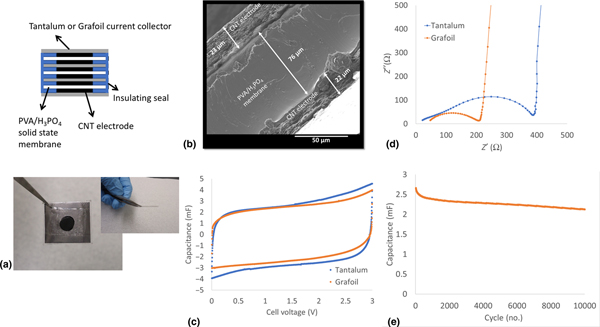
The charge on the CNT weakens the van der waals interactive force between the CNTs that allows uniform dispersion of the CNTs in the liquid bromine. The high aspect ratio of the CNT, in addition to the weakened van der Waal forces and the density of bromine facilitate the random interwoven assembly of the CNTs. Post-processing treatment at high temperature under different gas environments is used to further remove residual bromine and metal catalyst to ppm level concentration. Our CNT membranes exhibit micro-, meso- and macro-pore structures.[Reference Adu, Ma, Wang, Spencer, Rajagopalan, Wang and Randall21] We have used it to demonstrate symmetric, oxidized, and micro (interdigitated) solid-state ultra-capacitors with time constants (~32 ms) and specific capacitance of ~50 F/g.[Reference Adu, Ma, Wang, Spencer, Rajagopalan, Wang and Randall21] In Fig. 4(a), we demonstrate bipolar construction of three CNT capacitors in series that can be cycled up to 3 V. Figure 4(b) shows the SEM cross-section image of all the solid-state capacitor made using PVA-H3PO4 membrane as solid electrolyte. The performance of the CNT capacitor in stacked cell is dependent on the choice of current collector. We chose grafoil and tantalum foil as current collector due to their good stability in acidic conditions. Figure 4(c) shows the cyclic voltammogram of stacked cells made using the two current collectors. The capacitance of 3 V stacked cell was ~2.5 mF. Nyquist plot of the stacked capacitor showed that the passivation of tantalum current collector resulted in twofold increase in the interfacial resistance as shown in Fig. 4(d). The grafoil current collector-based CNT stacked capacitor when cycled between 0 and 3 V at 70 °C showed 80% capacitance retention after 10,000 cycles as shown in Fig. 4(e).
(a) top: Schematics of stacked CNT-based solid state capacitor, bottom: actual device, (b) Cross-sectional SEM micrograph of a single cell CNT capacitor, (c) Cyclic voltammogram of stacked CNT capacitor made using grafoil and tantalum as bipolar current collectors cycled between 0 and 3 V at 10 mV/s, (d) Nyquist plot of CNT stacked capacitors and (e) Long-term cycling stability of grafoil-based CNT stack capacitor cycled between 0 and 3 V at 70 °C.

Over the years, CNT-based symmetric capacitors have demonstrated specific capacitance ranging as low as 20 F/g to 207 F/g[S1]. Several strategies that include activation of CNTs using chemical activating agent such as KOH, HNO3, Oxygen plasma and ammonia plasma have been attempted [S1]. For the most part, CNT capacitors in non-aqueous electrolytes that are based on acetonitrile and propylene carbonate as solvent are primarily based on double layer charge storage as seen from specific capacitance per unit area which ranges from 6 to 10 μF/cm2[S1]. However, in the case of aqueous electrolytes, pseudocapacitance plays a major role with specific capacitance per unit area ranging from 20 to 240 µF/cm2[S1]. Ammonia plasma treated CNT capacitor in 6 M KOH demonstrated 207 F/g, which is one of the highest specific capacitance reported so far. Similar pseudocapacitance response was also seen in neat ionic liquid such as EMIMBF4 which demonstrated 38.5 µF/cm2[S1]. A better understanding of the role of surface treatment of CNTs and its relationship to pseudocapacitance will result in further improving the energy and power density performance of CNT capacitors in aqueous and ionic liquid-based electrolytes.
CNT electrodes have also been used as a scaffold to fabricate asymmetric capacitors. Metal oxides that include InO2, Fe2O3, MnO2, RuO2 and conducting polymers such as PANI have been deposited onto CNT electrodes in order to boost the pseudocapacitive interactions [S2]. Predominantly, the asymmetric capacitor design is based on aqueous electrolytes that are capable of providing a cell voltage in the range of 1.5–2 V[S2]. More recently, a lithium ion hybrid capacitor with a cell voltage of 4 V has been demonstrated using RuO2-MWNT as anode. The assembled hybrid capacitor demonstrated a maximum energy density of 146 Wh/kg[S2]. CNT electrodes are very attractive for asymmetric designs as they provide high surface area and very high electrical conductivity that can help achieve the best performance from pseudocapacitive materials. CNT scaffolds are also best suited for design of asymmetric solid-state capacitors as they provide high interfacial area and promote flexible electrode designs. Our binder-free CNT membrane could be a promising candidate as a scaffold in these applications
Conclusion
We have demonstrated the potential application of the flexible CNT membrane as an electrode in a stacked bipolar all solid-state supercapacitors. We observed a twofold increase in surface resistance in tantalum compared to grafoil as current collector. The supercapacitor retained 80% of its capacitance after 10,000 cycles at 70 °C. The CNT membranes could have potential applications in catalysis, photovoltaic, thermoelectric, and many other applications.
Acknowledgment
The authors thank Penn State Altoona-College Office of Research and Sponsored Programs, Penn State Materials Research Institute, and Penn State Multi-Campus Research Experience for Undergraduates for the support of the undergraduate student and the entire research.