Introduction
Material design has traditionally taken an experimental trial and error approach where a researcher selects a fabrication technique and feedstocks, makes materials, and compares materials' performance in a selected application. Even in simple materials systems, such as designing biomass-based activated carbons (ACs) for adsorption, this is a daunting task.[Reference Işıtan, Ceylan, Topcu, Hintz, Tefft, Chellappa, Guo and Goldfarb1] However, many materials systems of interest in the medical, energy, electronics, and other fields involve integrating complex structures, composites, and active sites to achieve a desired performance. Material structure ranges from atomic to the macro-scale, and features at each level are critically important in heterogeneous hierarchical materials systems where reactive mass transport through the structure is central to performance.[Reference Parlett, Wilson and Lee2] Atomic and molecular structure is integral to material properties and behavior, including catalytic activity,[Reference Siankevich, Savoglidis, Fei, Laurenczy, Alexander, Yan and Dyson3] and has been a central area of research in materials science.[Reference Samassekou, Alkabsh, Stiwinter, Khatri and Mazumdar4] Meso- and macro-scale structures consider the “physical” description of the material, describing porosity, surface area, and the atomic/molecular-scale materials' locations on the porous scaffold material. Hierarchical materials are deployed in electrochemical systems,[Reference Wang, Cao, Liu, Zhu and Obrovac5,Reference Yuan, Chen, Zhang, Liu, Liu, Yu, Wang, Sun and Wang6] synthetic biology,[Reference Maneerung, Tokura and Rujiravanit7] sensor design,[Reference Uzunoglu, Kose, Kose, Gokmese and Gokmese8,Reference ElMekawy, Hegab, Pant and Saint9] fuel processing,[Reference Mallikarjuna, Sushma, Reddy, Narasimha, Deva and Raju10,Reference Ji, Chen, Duan and Zhu11] and many other fields. For instance, in battery systems electrodes are typically porous materials. In these materials systems, the transport of electrons through the solid material is critical to battery performance, while the transport of species in the liquid electrolyte to reactive sites drives the electrochemistry of the battery.[Reference Hofmann, Fronczek and Bessler12–Reference Ryan and Mukherjee14] Designing porous structures for such applications requires optimizing transport across phases in conjunction with materials selection. There has been some recent work in batteries to make these property–structure relations.[Reference Mistry and Mukherjee15–Reference Stein, Mistry and Mukherjee20] In this paper, we lay out an integrated computational–statistical–experimental approach for designing heterogeneous hierarchical materials systems that considers both materials and their structure.
While experimental investigations can provide information about the performance of a material under targeted conditions, a more practical and efficient approach is to combine these with computational and statistical methods. This enables a more thorough exploration of the parameter space in a shorter time and at a lower cost. Computational methods are able to resolve the chemical–physical processes occurring within a complex system and monitor how changes to the material and structural properties affect performance.[Reference El-Qanni, Nassar and Vitale21] Statistical methods can be used to efficiently sample the parameter space based on a Design of Experiments (DOE) approach.[Reference Weissman and Anderson22] In turn, experiments can be used to validate and refine computational models in an iterative loop.
In this study, we combine computational models of an AC system with statistical DOE and optimization to design a fixed bed system for the adsorption of toluene in the vapor phase. Experimental testing and characterization are conducted to both calibrate and verify computational models and to inform the computational–statistical optimization approach. The performance of the system is based on input parameters including the choice of AC materials, which affects the microporosity, affinity of the adsorbate, and adsorption capacity of the bed, and the operating conditions of the bed, such as flow rate, inlet toluene concentration, temperature, etc.[Reference Lillo-Ródenas, Fletcher, Thomas, Cazorla-Amorós and Linares-Solano23,Reference Lillo-Ródenas, Cazorla-Amorós and Linares-Solano24] Details on the computational, statistical, and experimental methods are provided in this paper along with discussion of their integration to form a holistic design paradigm for designing and evaluating materials systems.
Design approach
To design heterogeneous hierarchical porous materials, it is critical to consider the material and structural properties of the system. This produces a large parameter space for design, which includes material properties (chemical, mechanical, electrical, etc.) and structural properties such as porosity, surface area, and particle size. Evaluation of such materials further widens the experimental scope; performance assessment must span a range of conditions relevant to the application at hand. This design space – including multiple rounds of trial and error variations of fabrication parameters, and analysis of the material properties and performance after each variation – is simply too large to explore through traditional trial-and-error experimental approaches. We utilize computational and statistical methods to explore areas of the parameter space, and couple that with experiments to validate the approach and parameterize the models to demonstrate a more efficient approach to materials design for complex systems.
In this work, computational modeling of the physical phenomena is used to predict the performance of the material system. Mesoscale computational methods are able to explicitly resolve the porous microstructure and explore the reactive transport in a system to understand how the structure affects the advection and diffusion of species and how the material properties affect reactions.[Reference Ryan and Mukherjee14] However, even the computational methods used to resolve the mesoscale physics of porous materials are computationally expensive and require high-performance computing to run simulations. Simulations can take several hours to run. With the prevalence of high-performance computing systems, this does not provide a research challenge; however, it does limit the number of cases that can be simulated and limits the ability of using purely physical models to optimize a material system. Resolving material performance in complex systems is therefore hampered by both experimental and computational resource limitations.
Our holistic design approach mediates these experimental and computational limitations by using statistical tools to calibrate the computational model with limited experimental data and to efficiently sample the design space. The calibration phase is treated as a statistical optimization problem, enabling the conversion of attainable experimental values to the required computational model inputs. This is a common challenge in computational–experimental research and is an ongoing area of research.[Reference Oakley and O'Hagan25] Often as in this work, the measured experimental parameters are not directly aligned with necessary computational parameters or outputs and some translation is needed to integrate experimental data into computational models and quantitatively compare the results of each. This can include calibration of model parameters to match experimental data, as done here, or also the use of reduced order models to obtain computational results at the correct resolution and scale for comparison with measurable experimental parameters.
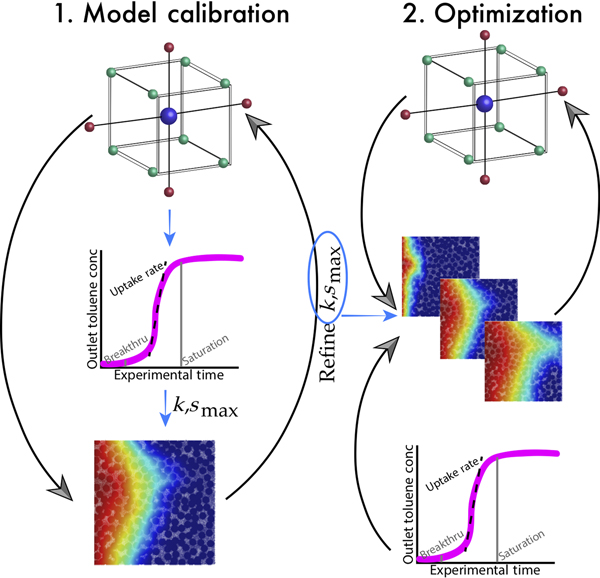
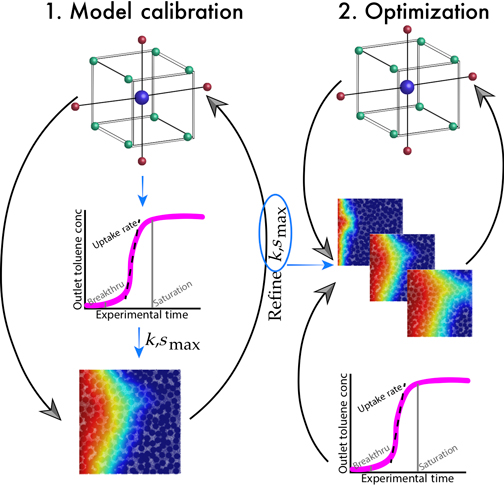
Performance optimization of the computational model is guided by statistical methods such as response surface optimization[Reference Myers, Montgomery and Anderson-Cook26] or Bayesian optimization.[Reference Shahriari, Swersky and Wang27,Reference Frazier, Wang, Lookman, Alexander and Rajan28] The goal is to come up with an efficient sampling of the design space that takes the computational cost of sampling into account. Figure 1 depicts the way in which these areas were coupled in an experimentally informed and verified computational–statistical feedback loop.
Integrated experimental, computational, and statistical approach to resource-constrained complex materials system design.

This approach is intended, ultimately, to be used for the design of heterogeneous hierarchical porous materials for complex systems. The study presented here was used as a benchmark to bring together three disparate research groups to explore how each other's skillset could be used to provide insight into the broad design space. For this initial application, we focused our efforts on understanding how one could optimize an AC adsorption bed for removal of a volatile organic compound (VOC) from a flowing gas stream. While future efforts will explore the design and manufacture of materials, the current work used commercially available ACs with varying properties to explore the application-based design space. We turn to physical experiments for material characterization, model calibration, and model verification. For the chosen AC system, each experimental trial requires 15–35 h of experimental time in addition to the cost of materials. The experimental cost of a full DOE optimization (to select a specific AC and operating conditions that maximize capacity and uptake rate) of this type would be overwhelming in terms of both time and materials, including ACs, model flue gases (toluene in N2), lab supplies, and instrumentation use and maintenance. However, if intermediate optimization iterations can be run computationally and then verified experimentally, the cost (time and materials) of such an optimization can be reduced drastically. Computational trials can be concluded in closer to 3 h and multiple trials can be run simultaneously. This seemingly simple example underscores the necessity of collaboration between computational, experimental, and statistical methods to reduce the expense and time required to design complex materials systems.
Applying the design approach: adsorption of toluene onto activated carbon
The design approach outlined in the section “Design approach” was applied to the adsorption of toluene, a VOC, from a flowing gas stream onto a fixed bed of AC. Such systems are widely used for flue gas capture of VOCs, mercury, sulfur, and CO2.[Reference Rubahamya, Kumar Reddy, Prabhu, Al Shoaibi and Srinivasakannan29,Reference Tseng, Wey, Liang and Chen30] Three different commercial AC materials (having a range of surface areas, porosities, particle sizes, and preparation methods, as described in the Supplemental Information), and three operating parameters (flow rate, bed packing, and inlet toluene concentration) were considered in the optimization. While these are far from the only variables that impact adsorption system performance, they are thought to be the dominant factors.[Reference Lillo-Ródenas, Fletcher, Thomas, Cazorla-Amorós and Linares-Solano23,Reference Li, Quinlivan and Knappe31]
Given the prohibitive cost of physical experimentation, a computational approach was used to search the parameter space for optimum performance. The computational model, however, needed to be calibrated to experimental data to be a reliable guide for optimization. A fractional factorial [Reference Montgomery32] design was employed to obtain experimental values over a wide range of the parameter space to: (1) limit the number of physical experiments and (2) ensure that sampling of the parameter space does not introduce unintended and unwanted bias against any of the parameters. The alternative is a full factorial design, where experimentation at all combinations of high- and low-parameter values are considered, requiring significantly more experiments. A fractional factorial design corresponds to a carefully selected subset of all experiments that, as specified above, does not introduce unintended and unwanted bias against any of the parameters.
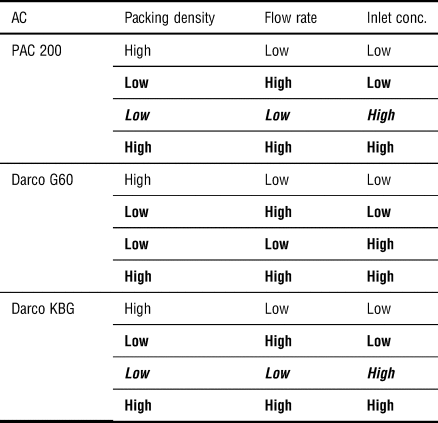
In our investigation of the adsorption of VOCs by ACs, the type of AC used is a categorical parameter, while the other three parameters (gas flow rate, bed packing, and inlet toluene concentration) can be varied continuously. As a result, the three ACs were considered separately, and a three-dimensional parameter space was defined for each. For each continuous parameter, two levels (low and high) were selected based on the range of feasible values for physical experiments. For each material, a separate 23−1 fractional factorial design was proposed, as shown in Table I. However, to ensure reproducibility some experiments were replicated, such that resource constraints (both time and availability/cost of specialty calibration gases) resulted in no runs for the high-packing density, low-flow rate, low-toluene concentration (HLL) sample set.
Fractional factorial design for model calibration

Experiments in bold were run at least once and in bold italics at least twice.
The physical experiments flowed a mixture of toluene in N2 gas (ultra-high purity nitrogen gas at 20 ppm or 200 ppm, Airgas Inc.) through a packed bed of AC, as shown in Fig. 2. The packing density of the AC-packed beds, the flow rate of the mixed gas, and the concentration of toluene in N2 gas were varied according to the DOE matrix of Table I. Commercially available ACs PAC 200, Darco G60, and DARCO KBG were provided by Cabot Corporation (additional information is available in the Supplemental Information). The three ACs have varying properties, including surface areas, porosities, compositions and, presumably, adsorption capacities. Each AC-packed bed contained between 0.018 and 0.023 g for low-bed packing and 0.032 and 0.052 g for high-bed packing of the selected AC. Toluene in nitrogen gas at 20 or 200 ppm (low- or high-inlet concentration) was passed through the AC at 30 or 40 mL/min (low- or high-flow rate). Outlet gas was monitored using a mass spectrometer (Extorr XT Series RGA XT300M) at an m/z of 91 and breakthrough curves were collected for each sample representing how the concentration of toluene in the outflow gas changes with respect to time. Uptake rates and uptake capacities of each AC were calculated from these data and used to calibrate the computational model.
Schematic of packed bed containing AC.

A multi-scale computational model of the AC-packed bed was simulated based on the DOE of Table I. The model simulated the gas flow through the packed bed and the adsorption of toluene onto the AC. The model explicitly simulated the macroporous region around the AC particles and included the reactive transport within the porous AC particles through an ad hoc model.[Reference Battiato, Tartakovsky, Tartakovsky and Scheibe33] The smooth particle hydrodynamics (SPH) method was used to model the system in LAMMPS – Large-scale Atomic/Molecular Massively Parallel Simulator.[Reference Plimpton34] The computational model was based on previous SPH models of reactive transport in porous media;[Reference Ryan and Tartakovsky35–Reference Meakin and Tartakovsky37] details of the model and its implementation are provided in the Supplemental Information. The choice of the numerical method is strongly dependent on the physical system being solved, and several factors would favor one candidate over others. For our problem, numerical methods relying on discretizing the simulation domains into meshes (i.e., finite element methods, finite volume methods, etc.) require extreme care to maintain the quality of the mesh. Methods that “break” the domain into smaller particles handle these boundaries more naturally, and since SPH belongs to this class, it has been chosen for this system.
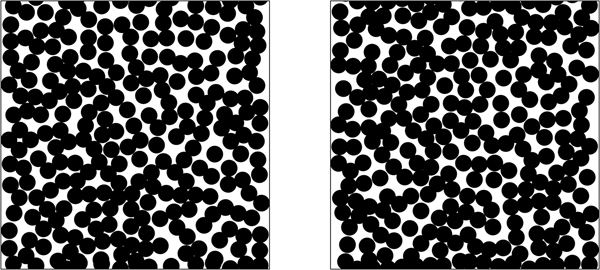
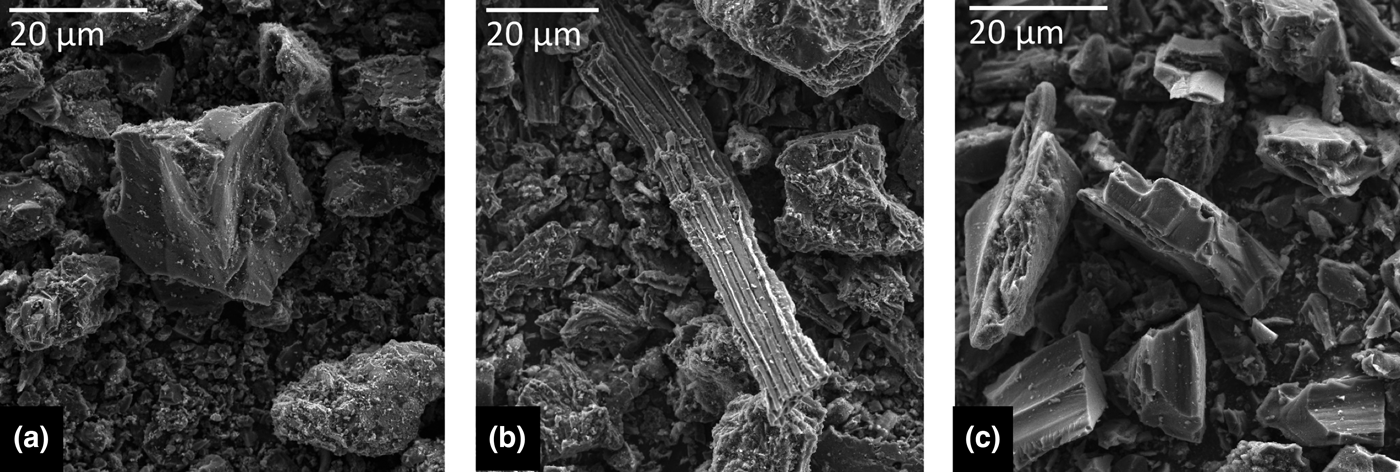
Ideally, physical properties used in a computational model are based directly on the physical experiments. However, the data collected experimentally do not always align with the input parameters required in computational models. While it is straightforward to match the flow rate and the inlet concentration to experimental conditions, determining the correct computational inputs for experimental factors that cannot be directly measured is less straightforward. For instance, the computational model explicitly simulates the packed bed microstructure by considering the AC particles to be perfectly spherical and homogeneous, as shown in Fig. 3. Experimentally we know that the actual bed holds a distribution of particle sizes and shapes (Fig. 4; additional characterization is given in the Supplemental Information) but we could not determine the exact microstructure for a given bed nor account for microstructural heterogeneities in actual-packed samples. The placement of AC particles in the computational model can have a significant effect on the predicted breakthrough of toluene depending on the tortuosity of flow paths through the bed. This is due to the size of the simulation domain, which is chosen to be much smaller than the representative volume for the system. The use of a fine-scale simulation enables us to consider complex geometry and other important factors, which are normally overlooked or cannot be captured via numerical models of a coarser scale.
Computational domains to simulate PAC 200 with high-packing density.

Scanning electron microscopy imaging of each AC: (a) PAC 200, (b) Darco KBG, and (c) Darco G60. The scale bar represents 20 µm.

In addition to the unknown packing configuration of the fixed bed, several parameters required in the computational model cannot be measured by direct experimentation. The computational model simulated the adsorption of toluene via a Langmuir adsorption model, which depends on the adsorption rate of toluene onto the AC and the maximum concentration of toluene on the surface of the AC. Experimentally it is possible to determine an uptake rate and uptake capacity for the packed bed. However, the experimental data are based on the overall bed adsorption and conflates the adsorption rate and surface capacity of toluene with the local mass transfer in the bed. It is not possible, with such bulk experimental data, to differentiate the surface level adsorption rate and capacity of the AC for direct use in the computational model.
To overcome this challenge, we utilized statistical calibration, defined as an optimization problem. Based on the experimental capacities, and the reported breakthrough curves, we determine appropriate adsorption rates and surface capacities for each material. For calibration, we used a machine learning-based optimization method called Bayesian optimization using Gaussian processes.[Reference Shahriari, Swersky and Wang27,Reference Frazier, Wang, Lookman, Alexander and Rajan28] Bayesian optimization is a technique for efficiently sampling the parameter space in order to find the optimum of a response function that is computationally or experimentally expensive to evaluate. An alternative optimization approach that could be used is the response surface methodology (RSM)[Reference Myers, Montgomery and Anderson-Cook26] with an appropriate DOE method. Unlike Bayesian optimization that globally samples the parameter space in search of the optimum, RSM moves locally toward the optimum and often requires larger numbers of samples. Considering the limited computational budget for calibration, Bayesian optimization was employed to search the parameter space.
Bayesian optimization consists of two main components that are deployed in a sequential scheme. First, a probabilistic surrogate model was built to approximate the disparity between the computational and experimental results. The surrogate provides a stochastic assessment of the disparity between the computational and experimental results as the values of the adsorption rate and surface capacity parameters are varied. Then, using the surrogate, an acquisition function was defined in order to determine where to sample next. This is one iteration of the Bayesian optimization algorithm. These steps are repeated until the budget (i.e., feasible or budgeted number of simulations) is finished or the optimum point does not change after some iterations, i.e., the optimization problem converges to a set value for adsorption rate and capacity. Additional information is available in the Supplemental Information.
Once calibration was complete, the computational model was run with the new adsorption rate and capacity values to ensure that it accurately captured the experimental breakthrough curves. Breakthrough curves were calculated from the computational simulations by plotting the average toluene leaving the simulation domain over time. This validation provided confidence that the model predicts the physical experiments with a reasonable accuracy. As discussed previously, the physical experiments are expensive (time and cost); while the computational model is relatively inexpensive to run. The calibrated computational model could then be used to optimize the AC-fixed bed system to maximize the performance. To determine the optimized system both the uptake rate and capacity need to be considered in a multi-objective optimization problem. These two factors determine how much toluene the bed can adsorb and how often the bed will need to be refreshed.
Results and discussion
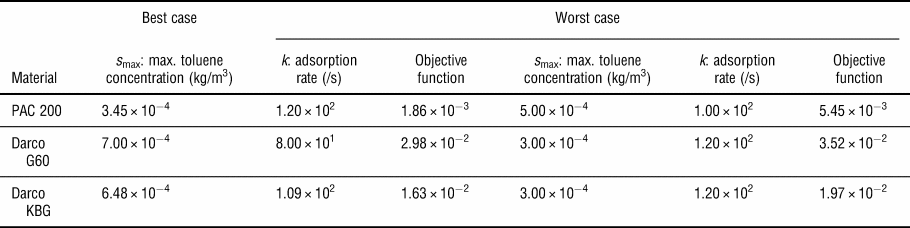
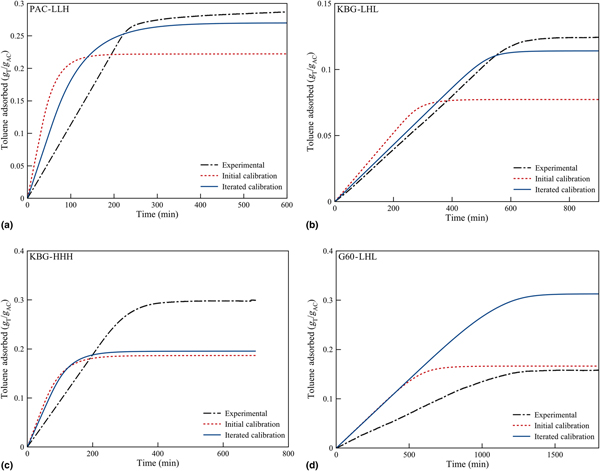
Nine physical experiments were run based on the conditions shown in Table I. The experimental data from these cases were used in the calibration of the reaction parameters used in the computational model. The adsorption reaction depends on the rate of adsorption (k, unit per time), and the maximum surface concentration of toluene (s max, unit species mass per surface area), which is the surface capacity of the AC. Details on the mathematical formulation of the computational model are given in the Supplemental Information. In the calibration process, the computational model was run and its output was compared against the experimental data for uptake capacity. Based on the error between the model predictions and experimental data, a new set of model parameters (adsorption rate and maximum toluene surface concentration) were chosen and the simulation was rerun. The calibration continued until there was sufficient agreement between the model predictions and the experimental data on uptake capacity. The calibration process was then iterated over for each of the three materials to minimize the error between the computational model predictions and the experimental data for the uptake capacity. Error across all three DOE cases was considered simultaneously. The best and worst calibrated cases are shown in Table II with examples in Fig. 5. As seen in Figs. 5(a) and 5(b), as the calibration error, defined as the squared error between the computed value and the experimental value, is minimized (best case) the computational model accurately predicts the experimental uptake capacity. When the calibration error is high, the error between the computational model and experimental data increases, as seen in Figs. 5(c) and 5(d).
Calibration results for “best” and worse” case scenarios for three ACs

Note that the parameters lists here relate to the calibration process and the computational model.
Computational and experimental breakthrough curves for example AC and flow conditions showing initial and final iterated calibrations; note that “best” and “worst” cases from Table II are not necessarily run first and last. (a) PAC 200 for LLH conditions showing successful model calibration. (b) Darco KBG for LHL conditions showing successful model calibration. (c) Darco KBG for HHH conditions showing poor model calibration. (d) Darco G60 for LHL conditions showing poor model calibration.
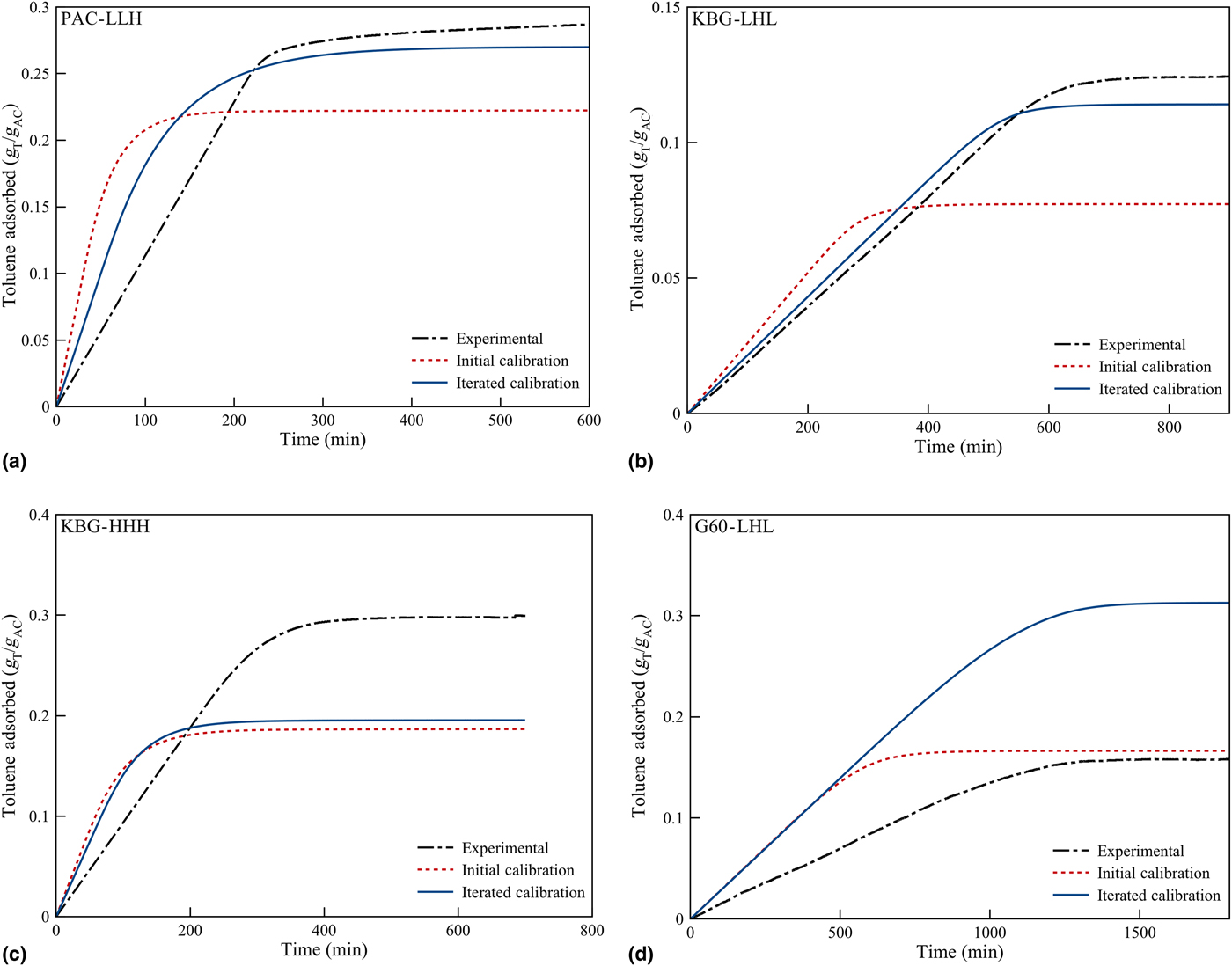
Full details on all of the calibration cases are given in the Supplemental Information, including the computational models, simulation data, and the calibration iterations. The calibration procedure attempts to optimize the model parameters based on all the operating conditions of the cases in Table I for each material. This leads to a variation in how well the calibrated model captures the physics of the AC system. In this initial case, the calibrations shown in Fig. 5 were optimized based on adsorption capacity alone for each material regardless of flow conditions. This leads to two potential model issues. First, the uptake rates may or may not be well captured by the model. Second, we found that when materials initially had an “extreme” data point in one direction [e.g., Darco G60 was initially a good estimation in terms of capacity for LHL (low-packing density, high-flow rate, and low-inlet concentration) conditions [Fig. 5(d)], but very low for HHH (high-packing density, high-flow rate, and high-inlet concentration), and LLH (low-packing density, low-flow rate and high-inlet concentration - not shown)], such that upon correction the HHH was almost exactly matched, but the LHL resulted in too high of a modeled capacity and the LLH was improved but still low. As discussed in the Introduction, adsorption behavior is a function of material properties and processing conditions. It is possible that low packings and inlet concentrations exposed to high-flow rates (LHL cases) are more sensitive to microstructure of the packed bed than to values of the reaction parameters as the high-flow rate and low-toluene concentration provides a weak driving force for the adsorption reactions. This is not captured by the calibration process as it does not account for the physical system, and only considers the mathematics of the optimization problem. Future work will explore approaches for optimization of the calibration conditions that have covariant dependencies.
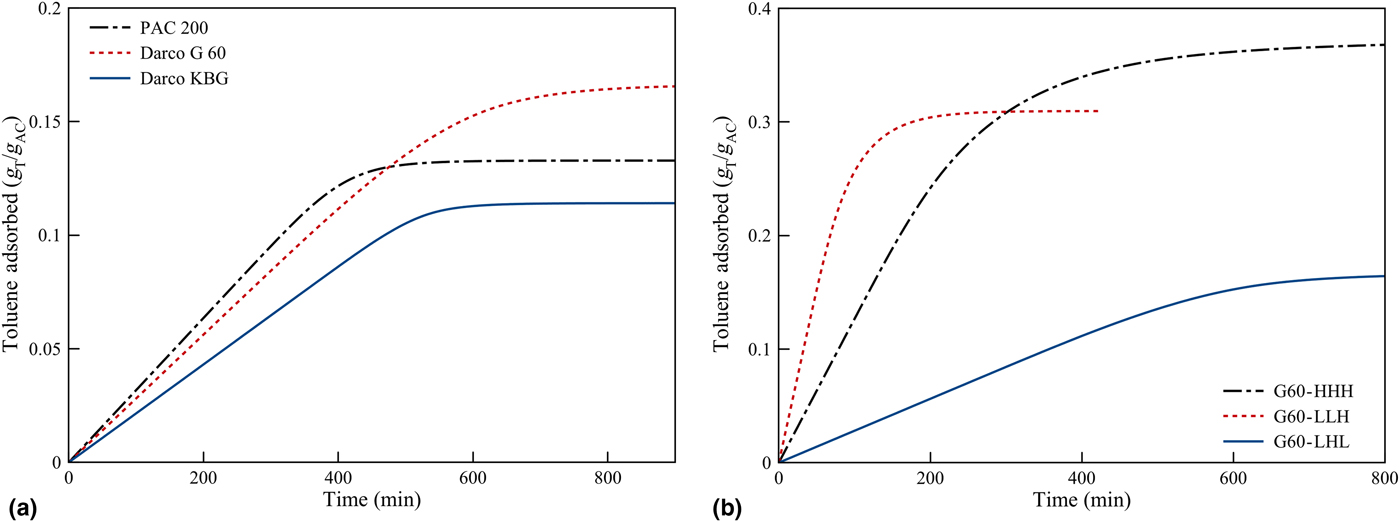
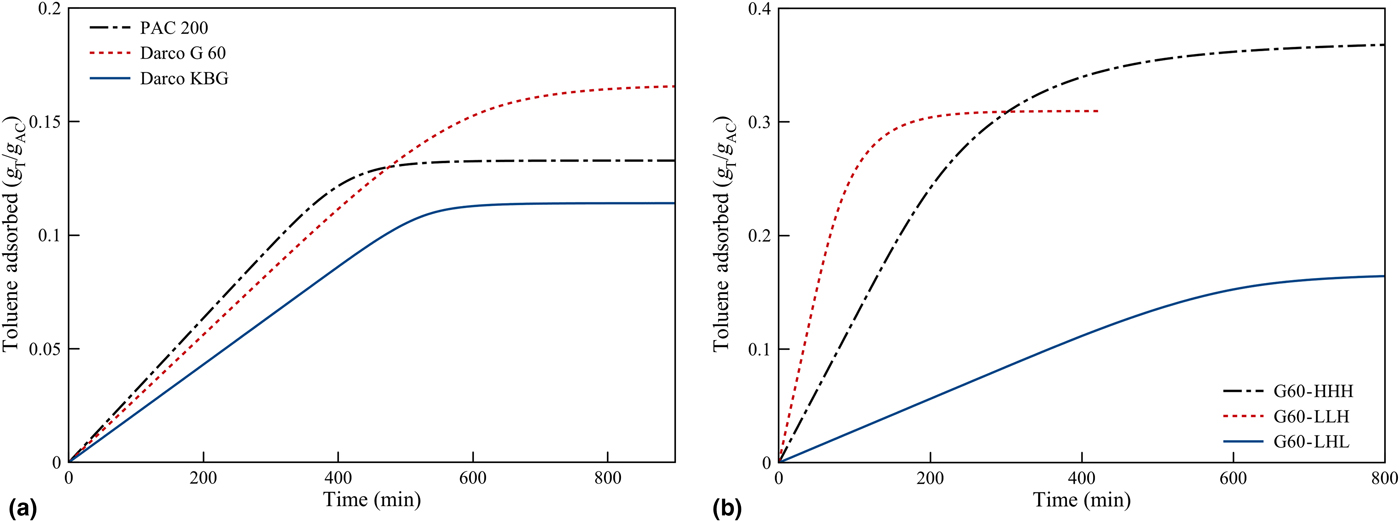
After further iterations and calibrations, the calibrated model can be used to optimize the material and operational parameters of the AC-fixed bed for toluene adsorption. Optimization includes both the material and structural properties of the AC and the operating conditions for the bed including high- and low-flow rates and bed packing. The computational model can be run over a larger parameter space compared with the physical experiments in a shorter amount of time and at a lower cost. The results of the computational optimization can then be used to design a smaller subset of physical experiments for validation of the computational optimization. An example of this optimization is given in Fig. 6. Under constant flow conditions [LHL shown in Fig. 6(b)], PAC200 has a modestly faster adsorption uptake rate than the other two ACs, but Darco G60 has a significantly higher uptake capacity for the toluene. Figure 6(b) shows the impact of adsorption conditions on the performance of the Darco G60. Low-packing conditions decrease capacity (on a g toluene/g AC basis) of the packed bed. This decrease in capacity is exacerbated by having low-inlet concentration, likely, because the driving force (concentration gradient) for toluene between the solid and flowing stream is lower, especially as the surface fills with toluene particles. While this is a first round of DOE-CFD, it shows the potential for DOE to refine the exploration space to optimize both materials selection and processing conditions. This is an ongoing area of research.
Example of how DOE can be used with experimentally-validated CFD to explore materials selection and flow conditions for an optimized adsorption system. (a) Adsorption of toluene by all three ACs at LHL conditions. (b) Adsorption of toluene by Darco G60 under three processing conditions.
Conclusions
When designing complex materials systems, a holistic approach that considers both the material and structural aspects of heterogeneous, hierarchical materials must be taken. This work demonstrates how integrating experimental, computational, and statistical approaches could lead to the optimization of a material system – in terms of both materials selection and process parameters – for a specific application. In this work, the approach was applied to an AC system for toluene adsorption. We show that experimental and statistical routines can be coupled to calibrate a computational model, and then the model was used to optimize the resulting system. Designing this type of AC system via experimental studies alone would be costly and time consuming. This would most likely lead to specific aspects of the design not being considered due to these constraints. By integrating the experimental studies with computational and statistical techniques, we are able to explore a larger design space that would be inaccessible to experiments alone.
The results of this work show the potential of statistical calibration, optimization, and DOE to accelerate materials development. The results also show the importance of close interactions and iterations between the various disciplines. As discussed in the “Results and discussion” section the calibrated model is unable to accurately predict the uptake capacity of the three materials for cases specific to each material. The calibration procedure initially used here focused on the reaction term of the computational model; in cases with low-packing density and low-inlet concentration, system performance is likely dominated by the mass transport, not by concentration gradient. A more holistic calibration would be needed to capture these aspects and would most likely over fit the computational model to the experimental data.
The AC system investigated here was chosen due to its relative ease of modeling and experimentation, so that research could focus on the integration of the statistical methods with the computational and experimental approaches. The framework laid out here has the potential to be applied to less well-known systems where the physics is not as straightforward. In fact this systematic method for exploring materials systems could help in understanding the complex physics occurring within a hierarchical porous media.
Supplementary material
The supplementary material for this article can be found at https://doi.org/10.1557/mrc.2019.60
Acknowledgments
Research presented was supported by the National Science Foundation through grant 1727316. This work made use of the Cornell Center for Materials Research Shared Facilities, which are supported through the NSF MRSEC program (DMR-1719875). This work used the Extreme Science and Engineering Discovery Environment (XSEDE), which is supported by the National Science Foundation grant number ACI-1548562 through STAMPEDE2 at the Texas Advanced Computing Center through allocation TG-CCR180027. The authors thank Cabot Corporation for supplying the activated carbons used in this work, and Ian Miller for running preliminary experiments as part of his Undergraduate Research coursework at the Pennsylvania State University.