


Hostname: page-component-7b7567c8c-slfcl Total loading time: 0 Render date: 2026-11-19T14:11:10.784Z Has data issue: false hasContentIssue false

Electrocardiogram measurements in water using poly(3,4-ethylene dioxythiophene):poly(styrene sulfonate) nanosheets waterproofed by polyurethane film

Published online by Cambridge University Press:  01 October 2020

Sho Mihara
Affiliation:
Graduate School of Advanced Science and Engineering, Waseda University, Tokyo 162-8480, JapanWaseda Research Institute for Science and Engineering, Waseda University, Tokyo 169-8555, Japan
Hui-Lin Lee
Affiliation:
School of Chemical & Life Sciences, Singapore Polytechnic, 500 Dover Road, Singapore 139651, Singapore
Shinji Takeoka*
Affiliation:
Waseda Research Institute for Science and Engineering, Waseda University, Tokyo 169-8555, JapanFaculty of Science and Engineering, Waseda University, Tokyo 169-8555, Japan
*
Address all correspondence to Shinji Takeoka at takeoka@waseda.jp
Get access

Abstract

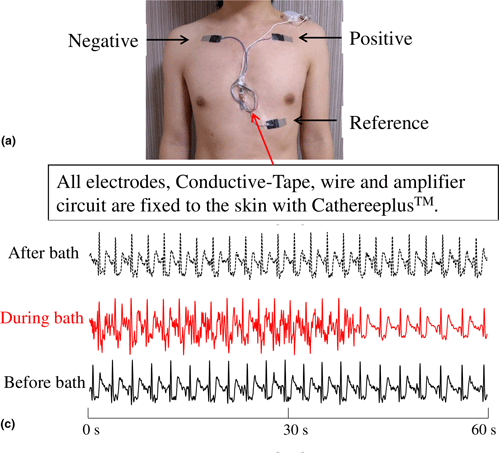
Waterproof bioelectrodes enable long-term biological monitoring and the assessment of performances of athletes in water. Existing gel electrodes change their electrical properties even when covered with a waterproof film. Here, the authors present the poly(3,4-ethylene dioxythiophene):poly(styrene sulfonate) (PEDOT:PSS)/poly(styrene-butadiene-styrene) (SBS) bi-layer nanosheet and waterproof film for a comfortable waterproof bioelectrode. PEDOT:PSS/SBS is fully foldable with a conductivity loss of only 5%. This foldable nanosheet electrode provides a reliable electrical connection between the skin and the wire. The waterproof film-covered bioelectrode enables continuous monitoring of electrocardiograms in water, showing a signal-to-noise ratio of 21.5 dB for the R wave and 17.5 dB for the T wave, comparable to atmospheric measurements, and sensing a change in heart rate from 79 to 131 bpm during bathing.

Information

Type
Research Letters
Copyright
Copyright © The Author(s), 2020, published on behalf of Materials Research Society by Cambridge University Press

Access options

Get access to the full version of this content by using one of the access options below. (Log in options will check for institutional or personal access. Content may require purchase if you do not have access.)

Article purchase

Temporarily unavailable