




No CrossRef data available.
Article contents
N-dimensional optics with natural materials
Published online by Cambridge University Press: 22 April 2020
Abstract
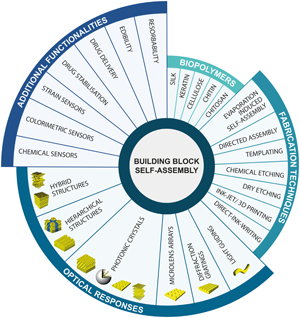
Natural systems displaying optical properties have for long been an inspiration for new classes of optical constructs. Using the same families of materials employed by Nature in combination with their directed assembly allows access to n-dimensions of control to, ultimately, generate optical systems with multiple coexisting functions. This review provides an overview of lab-made optical systems made of protein and polysaccharide-derived materials found in naturally occurring optical systems. Recent advances in optical biomimicry and bioinspired, polyfunctional optical structures are presented, addressing attributes such as sensing, edible devices, biologically activity, and resorbable optical formats.
Information
- Type
- Prospective Articles
- Information
- Copyright
- Copyright © Materials Research Society 2020
References
1.Vogel, N., Utech, S., England, G.T., Shirman, T., Phillips, K.R., Koay, N., Burgess, I.B., Kolle, M., Weitz, D.A., and Aizenberg, J.: Color from hierarchy: diverse optical properties of micron-sized spherical colloidal assemblies. Proc. Natl. Acad. Sci. USA 112, 10845–10850 (2015).CrossRefGoogle ScholarPubMed
2.Yang, S., Chen, G., Megens, M., Ullal, C.K., Han, Y.-J., Rapaport, R., Thomas, E.L., and Aizenberg, J.: Functional biomimetic microlens arrays with integrated pores. Adv. Mater. 17, 435–438 (2005).CrossRefGoogle Scholar
3.Kolle, M., Lethbridge, A., Kreysing, M., Baumberg, J.J., Aizenberg, J., and Vukusic, P.: Bio-inspired band-gap tunable elastic optical multilayer fibers. Adv. Mater. 25, 2239–2245 (2013).CrossRefGoogle ScholarPubMed
4.Potyrailo, R.A., Bonam, R.K., Hartley, J.G., Starkey, T.A., Vukusic, P., Vasudev, M., Bunning, T., Naik, R.R., Tang, Z., Palacios, M.A., Larsen, M., Le Tarte, L.A., Grande, J.C., Zhong, S., and Deng, T.: Towards outperforming conventional sensor arrays with fabricated individual photonic vapour sensors inspired by Morpho butterflies. Nat. Commun. 6, 1–12 (2015).CrossRefGoogle ScholarPubMed
5.Chou, H.H., Nguyen, A., Chortos, A., To, J.W.F., Lu, C., Mei, J., Kurosawa, T., Bae, W.G., Tok, J.B.H., and Bao, Z.: A chameleon-inspired stretchable electronic skin with interactive colour changing controlled by tactile sensing. Nat. Commun. 6, 1–10 (2015).CrossRefGoogle ScholarPubMed
6.Yu, C., Li, Y., Zhang, X., Huang, X., Malyarchuk, V., Wang, S., Shi, Y., Gao, L., Su, Y., Zhang, Y., Xu, H., Hanlon, R.T., Huang, Y., and Rogers, J.A.: Adaptive optoelectronic camouflage systems with designs inspired by cephalopod skins. Proc. Natl. Acad. Sci. USA 111, 12998–13003 (2014).CrossRefGoogle ScholarPubMed
7.Walish, J.J., Kang, Y., Mickiewicz, R.A., and Thomas, E.L.: Bioinspired electrochemically tunable block copolymer full color pixels. Adv. Mater. 21, 3078–3081 (2009).CrossRefGoogle Scholar
8.Huang, J., Wang, X., and Wang, Z.L.: Bio-inspired fabrication of antireflection nanostructures by replicating fly eyes. Nanotechnology 19, 1–6 (2008).CrossRefGoogle ScholarPubMed
9.Finnemore, A., Cunha, P., Shean, T., Vignolini, S., Guldin, S., Oyen, M., and Steiner, U.: Biomimetic layer-by-layer assembly of artificial nacre. Nat. Commun. 3, 1–6 (2012).CrossRefGoogle ScholarPubMed
10.Ashby, M.F.: Materials Selection in Mechanical Design. (Elsevier, Oxford, UK, 2005).Google Scholar
11.Omenetto, F.G. and Kaplan, D.L.: New opportunities for an ancient material. Science 329(5991), 528–531 (2010).CrossRefGoogle ScholarPubMed
12.Wang, B., Yang, W., McKittrick, J., and Meyers, M.A.: Keratin: structure, mechanical properties, occurrence in biological organisms, and efforts at bioinspiration. Prog. Mater. Sci. 76, 229–318 (2016).CrossRefGoogle Scholar
13.McKittrick, J., Chen, P.Y., Bodde, S.G., Yang, W., Novitskaya, E.E., and Meyers, M.A.: The structure, functions, and mechanical properties of keratin. JOM 64, 449–468 (2012).CrossRefGoogle Scholar
14.Ravi Kumar, M.N.: A review of chitin and chitosan applications. React. Funct. Polym. 46, 1–27 (2000).CrossRefGoogle Scholar
15.Moon, R.J., Martini, A., Nairn, J., Simonsen, J., and Youngblood, J.: Cellulose nanomaterials review: structure, properties and nanocomposites. Chem. Soc. Rev. 40, 3941–3994 (2011).CrossRefGoogle ScholarPubMed
16.Knight, D.P. and Vollrath, F.: Liquid crystalline spinning of spider silk. Nature 410, 541–548 (2001).Google Scholar
17.Jin, H.J. and Kaplan, D.L.: Mechanism of silk processing in insects and spiders. Nature 424, 1057–1061 (2003).CrossRefGoogle ScholarPubMed
18.Pereira, R.F.P., Silva, M.M., and De Zea Bermudez, V.: Bombyx mori silk fibers: an outstanding family of materials. Macromol. Mater. Eng. 300(12), 1171–1198 (2015).CrossRefGoogle Scholar
19.Bouligand, Y.: Twisted fibrous arrangements in biological materials and cholesteric mesophases. Tissue Cell 4, 189–217 (1972).CrossRefGoogle ScholarPubMed
20.Vignolini, S., Rudall, P.J., Rowland, A.V., Reed, A., Moyroud, E., Faden, R.B., Baumberg, J.J., Glover, B.J., and Steiner, U.: Pointillist structural color in Pollia fruit. Proc. Natl. Acad. Sci. USA 109(39), 15712–15715 (2012).CrossRefGoogle ScholarPubMed
21.Lawrence, B.D., Cronin-Golomb, M., Georgakoudi, I., Kaplan, D.L., and Omenetto, F.G.: Bioactive silk protein biomaterial systems for optical devices. Biomacromolecules 9, 1214–1220 (2008).CrossRefGoogle ScholarPubMed
22.Cronin-Golomb, M., Murphy, A.R., Mondia, J.P., Kaplan, D.L., and Omenetto, F.G.: Optically induced birefringence and holography in silk. J. Polym. Sci. B Polym. Phys. 50(4), 257–262 (2011).CrossRefGoogle Scholar
23.Marelli, B. and Omenetto, F.G.: Cashmere-derived keratin for device manufacturing on the micro- and nanoscale. J. Mater. Chem. C 3, 2783–2787 (2015).CrossRefGoogle Scholar
24.Fraser, R.D.B.: Birefringence and elasticity in keratin fibres. Nature 172, 675–676 (1953).CrossRefGoogle ScholarPubMed
25.Hermans, P.H.: Contribution to the Physics of Cellulose Fibres: A Study of Sorption, Density, Refractive Power and Orientation (Elsevier Publishing Company Inc., Amsterdam, The Netherlands, 1946).Google Scholar
26.Leertouwer, H.L., Wilts, B.D., and Stavenga, D.G.: Refractive index and dispersion of butterfly chitin and bird keratin measured by polarizing interference microscopy. Opt. Express 19, 24061 (2011).CrossRefGoogle ScholarPubMed
27.Mendoza-Galván, A., Muñoz-Pineda, E., Järrendahl, K., and Arwin, H.: Birefringence of nanocrystalline chitin films studied by Mueller-matrix spectroscopic ellipsometry. Opt. Mater. Express 6, 671 (2016).CrossRefGoogle Scholar
28.Marchessault, R.H., Morehead, F.F., and Walter, N.M.: Liquid crystals systems from fibrillar polysaccharides. Nature 184, 632–633 (1959).CrossRefGoogle Scholar
29.Revol, J.-F., Godbout, D.L., and Gray, D.G.: Solidified liquid crystals of cellulose with optically variable properties. U.S. Patent No. 5,629,055 28, September, 1997.Google Scholar
30.Revol, J.F. and Marchessault, R.H.: In vitro chiral nematic ordering of chitin crystallites. Int. J. Biol. Macromol. 15, 329–335 (1993).CrossRefGoogle ScholarPubMed
31.Parker, R.M., Guidetti, G., Williams, C.A., Zhao, T., Narkevicius, A., Vignolini, S., and Frka-Petesic, B.: The self-assembly of cellulose nanocrystals: hierarchical design of visual appearance. Adv. Mater. 30, 1–13 (2018).CrossRefGoogle ScholarPubMed
32.Zhao, T.H., Parker, R.M., Williams, C.A., Lim, K.T.P., Frka-Petesic, B., and Vignolini, S.: Printing of responsive photonic cellulose nanocrystal microfilm arrays. Adv. Funct. Mater. 29, 1804531 (2019).CrossRefGoogle Scholar
33.Parker, R.M., Frka-petesic, B., Guidetti, G., Kamita, G., Consani, G., Abell, C., and Vignolini, S.: Hierarchical self-assembly of cellulose nanocrystals in a confined geometry. ACS Nano 10, 8443–8449 (2016).CrossRefGoogle Scholar
34.Marelli, B., Patel, N., Duggan, T., Perotto, G., Shirman, E., Li, C., Kaplan, D.L., and Omenetto, F.: Programming function into mechanical forms by directed assembly of silk bulk materials. Proc. Natl. Acad. Sci. USA 114, 451–456 (2017).CrossRefGoogle ScholarPubMed
35.Kinoshita, S.: Structural Colors in the Realm of Nature. (World Scientific Publishing Company, 2010). doi:10.1142/9789812709752Google Scholar
36.Wilts, B.D., Michielsen, K., De Raedt, H., and Stavenga, D.G.: Sparkling feather reflections of a bird-of-paradise explained by finite-difference time-domain modeling. Proc. Natl. Acad. Sci. USA 111(12), 4363–4368 (2014).CrossRefGoogle ScholarPubMed
37.Seago, A.E., Brady, P., Vigneron, J.P., and Schultz, T.D.: Gold bugs and beyond: a review of iridescence and structural colour mechanisms in beetles (Coleoptera). J. R. Soc. Interface 6 (2009).CrossRefGoogle Scholar
38.Thomas, K.R., Kolle, M., Whitney, H.M., Glover, B.J., and Steiner, U.: Function of blue iridescence in tropical understorey plants. J. R. Soc. Interface 7, 1699–1707 (2010).CrossRefGoogle ScholarPubMed
39.Kolle, M. and Lee, S.: Progress and opportunities in soft photonics and biologically inspired optics. Adv. Mater. 30, 1702669 (2018).CrossRefGoogle ScholarPubMed
40.Grunenfelder, L.K., Suksangpanya, N., Salinas, C., Milliron, G., Yaraghi, N., Herrera, S., Evans-Lutterodt, K., Nutt, S.R., Zavattieri, P., and Kisailus, D.: Bio-inspired impact-resistant composites. Acta Biomater. 10, 3997–4008 (2014).CrossRefGoogle ScholarPubMed
41.Neville, S. and Levy, A.C.: Biochemistry of plant cell walls. Plant Cell Environ. 9(1), (1986).Google Scholar
42.Wang, P.-X., Hamad, W.Y., and MacLachlan, M.J.: Structure and transformation of tactoids in cellulose nanocrystal suspensions. Nat. Commun. 7, 11515 (2016).CrossRefGoogle ScholarPubMed
43.Frka-Petesic, B., Radavidson, H., Jean, B., and Heux, L.: Dynamically controlled iridescence of cholesteric cellulose nanocrystal suspensions using electric fields. Adv. Mater. 29, 1606208 (2017).CrossRefGoogle ScholarPubMed
44.Frka-Petesic, B., Guidetti, G., Kamita, G., and Vignolini, S.: Controlling the photonic properties of cholesteric cellulose nanocrystal films with magnets. Adv. Mater. 29, 1–7 (2017).CrossRefGoogle ScholarPubMed
45.Li, Y., Jun-Yan Suen, J., Prince, E., Larin, E.M., Klinkova, A., Thérien-Aubin, H., Zhu, S., Yang, B., Helmy, A.S., Lavrentovich, O.D., and Kumacheva, E.: Colloidal cholesteric liquid crystal in spherical confinement. Nat. Commun. 7, 12520 (2016).CrossRefGoogle ScholarPubMed
46.Wilts, B.D., Whitney, H.M., Glover, B.J., Steiner, U., and Vignolini, S.: Natural helicoidal structures: morphology, self-assembly and optical properties. Mater. Today Proc. 1, 177–185 (2014).CrossRefGoogle Scholar
47.Vignolini, S., Gregory, T., Kolle, M., Lethbridge, A., Moyroud, E., Steiner, U., Glover, B.J., Vukusic, P., and Rudall, P.J.: Structural colour from helicoidal cell-wall architecture in fruits of Margaritaria nobilis. J. R. Soc. Interface 13(124), 20160645 (2016).CrossRefGoogle ScholarPubMed
48.Steiner, L.M., Ogawa, Y., Johansen, V.E., Lundquist, C.R., Whitney, H., Vignolini, S., and Johansen, V.E.: Structural colours in the frond of Microsorum thailandicum. Interface Focus 9(1), 20180055 (2018).CrossRefGoogle ScholarPubMed
49.Li, J., Revol, J.-F., and Marchessault, R.H.: Effect of degree of deacetylation of chitin on the properties of chitin crystallites. J. Appl. Polym. Sci. 65, 373–380 (1997).3.0.CO;2-0>CrossRefGoogle Scholar
50.Frka-Petesic, B., Kamita, G., Guidetti, G., and Vignolini, S.: Angular optical response of cellulose nanocrystal films explained by the distortion of the arrested suspension upon drying. Phys. Rev. Mater. 3, 045601 (2019).CrossRefGoogle Scholar
51.Narkevicius, A., Steiner, L.M., Parker, R.M., Ogawa, Y., Frka-Petesic, B., and Vignolini, S.: Controlling the self-assembly behavior of aqueous chitin nanocrystal suspensions. Biomacromolecules (2019). doi:10.1021/acs.biomac.9b00589.CrossRefGoogle ScholarPubMed
52.Wang, P.-X., Hamad, W.Y., and MacLachlan, M.J.: Polymer and mesoporous silica microspheres with chiral nematic order from cellulose nanocrystals. Angew. Chem. Int. Ed. 55(40), 12460–12464 (2016).CrossRefGoogle ScholarPubMed
53.Fernandes, S.N., Geng, Y., Vignolini, S., Glover, B.J., Trindade, A.C., Canejo, J.P., Almeida, P.L., Brogueira, P., and Godinho, M.H.: Structural color and iridescence in transparent sheared cellulosic films. Macromol. Chem. Phys. 214, 25–32 (2013).CrossRefGoogle Scholar
54.Chu, G., Camposeo, A., Vilensky, R., Vasilyev, G., Martin, P., Pisignano, D., and Zussman, E.: Printing flowers? Custom-tailored photonic cellulose films with engineered surface topography. SSRN Electron. J. (2019). doi:10.2139/ssrn.3318943.Google Scholar
56.Saranathan, V., Forster, J.D., Noh, H., Liew, S.-F., Mochrie, S.G.J., Cao, H., Dufresne, E.R., and Prum, R.O.: Structure and optical function of amorphous photonic nanostructures from avian feather barbs: a comparative small angle X-ray scattering (SAXS) analysis of 230 bird species. doi:10.1098/rsif.2012.0191CrossRefGoogle Scholar
57.Xiao, M., Li, Y., Zhao, J., Wang, Z., Gao, M., Gianneschi, N.C., Dhinojwala, A., and Shawkey, M.D.: Stimuli-responsive structurally colored films from bioinspired synthetic melanin nanoparticles. Chem. Mater. 28, 5516–5521 (2016).CrossRefGoogle Scholar
58.Xiao, M., Hu, Z., Wang, Z., Li, Y., Tormo, A.D., Le Thomas, N., Wang, B., Gianneschi, N.C., Shawkey, M.D., and Dhinojwala, A.: Bioinspired bright noniridescent photonic melanin supraballs. Sci. Adv. 3 (2017).CrossRefGoogle ScholarPubMed
59.Xiao, M., Li, Y., Allen, M.C., Deheyn, D.D., Yue, X., Zhao, J., Gianneschi, N.C., Shawkey, M.D., and Dhinojwala, A.: Bio-inspired structural colors produced via self-assembly of synthetic melanin nanoparticles. ACS Nano 9, 5454–5460 (2015).CrossRefGoogle ScholarPubMed
60.Wu, T.-F. and Hong, J.-D.: Dopamine-melanin nanofilms for biomimetic structural coloration. Biomacromolecules 16, 660–666 (2015).CrossRefGoogle ScholarPubMed
61.Kohri, M., Nannichi, Y., Taniguchi, T., and Kishikawa, K.: Biomimetic non-iridescent structural color materials from polydopamine black particles that mimic melanin granules. J. Mater. Chem. C 3, 720–724 (2015).CrossRefGoogle Scholar
62.Shi, N.N., Tsai, C.C., Carter, M.J., Mandal, J., Overvig, A.C., Sfeir, M.Y., Lu, M., Craig, C.L., Bernard, G.D., Yang, Y., and Yu, N.: Nanostructured fibers as a versatile photonic platform: Radiative cooling and waveguiding through transverse Anderson localization. Light Sci. Appl. 7, 2047–7538 (2018).CrossRefGoogle ScholarPubMed
63.Kujala, S., Mannila, A., Karvonen, L., Kieu, K., and Sun, Z.: Natural silk as a photonics component: a study on its light guiding and nonlinear optical properties. Sci. Rep. 6 (2016).CrossRefGoogle Scholar
64.Parker, S.T., Domachuk, P., Amsden, J., Bressner, J., Lewis, J.A., Kaplan, D.L., and Omenetto, F.C.: Biocompatible silk printed optical waveguides. Adv. Mater. 21, 2411–2415 (2009).CrossRefGoogle Scholar
65.Willot, Q., Simonis, P., Vigneron, J.P., and Aron, S.: Total internal reflection accounts for the bright color of the saharan silver ant. PLoS One 11 (2016).CrossRefGoogle ScholarPubMed
66.Choi, S.H., Kim, S.W., Ku, Z., Visbal-Onufrak, M.A., Kim, S.R., Choi, K.H., Ko, H., Choi, W., Urbas, A.M., Goo, T.W., and Kim, Y.L.: Anderson light localization in biological nanostructures of native silk. Nat. Commun. 9(1), 452 (2018).CrossRefGoogle ScholarPubMed
67.Huby, N., Vié, V., Renault, A., Beaufils, S., Lefèvre, T., Paquet-Mercier, F., Pézolet, M., and Bêche, B.: Native spider silk as a biological optical fiber. Appl. Phys. Lett. 102, 123702 (2013).CrossRefGoogle Scholar
68.Hey Tow, K., Chow, D.M., Vollrath, F., Dicaire, I., Gheysens, T., and Thevenaz, L.: Exploring the use of native spider silk as an optical fiber for chemical sensing. J. Light Technol. 36(4), 1138–1144 (2018).CrossRefGoogle Scholar
69.Applegate, M.B., Perotto, G., Kaplan, D.L., and Omenetto, F.G.: Biocompatible silk step-index optical waveguides. Biomed. Opt. Express 6, 4221 (2015).CrossRefGoogle ScholarPubMed
70.Shimanovich, U., Pinotsi, D., Shimanovich, K., Yu, N., Bolisetty, S., Adamcik, J., Mezzenga, R., Charmet, J., Vollrath, F., Gazit, E., Dobson, C.M., Schierle, G.K., Holland, C., Kaminski, C.F., and Knowles, T.P.J.: Biophotonics of native silk fibrils. Macromol. Biosci. 18, 1700295 (2018).CrossRefGoogle ScholarPubMed
71.Rice, W.L., Firdous, S., Gupta, S., Hunter, M., Foo, C.W.P., Wang, Y., Kim, H.J., Kaplan, D.L., and Georgakoudi, I.: Non-invasive characterization of structure and morphology of silk fibroin biomaterials using non-linear microscopy. Biomaterials 29, 2015–2024 (2008).CrossRefGoogle ScholarPubMed
72.Georgakoudi, I., Tsai, I., Greiner, C., Wong, C., DeFelice, J. and Kaplan, D.: Intrinsic fluorescence changes associated with the conformational state of silk fibroin in biomaterial matrices. Opt. Express 15, 1043 (2007).CrossRefGoogle ScholarPubMed
73.Espinha, A., Dore, C., Matricardi, C., Alonso, M.I., Goñi, A.R., and Mihi, A.: Hydroxypropyl cellulose photonic architectures by soft nanoimprinting lithography. Nat. Photonics 12, 343–348 (2018).CrossRefGoogle ScholarPubMed
74.Kim, S., Marelli, B., Brenckle, M.A., Mitropoulos, A.N., Gil, E.S., Tsioris, K., Tao, H., Kaplan, D.L., and Omenett, F.G.: All-water-based electron-beam lithography using silk as a resist. Nat. Nanotechnol. 9, 306–310 (2014).CrossRefGoogle Scholar
75.Kim, S., Mitropoulos, A.N., Spitzberg, J.D., Tao, H., Kaplan, D.L., and Omenetto, F.G.: Silk inverse opals. Nat. Photonics 6, 818–823 (2012).CrossRefGoogle Scholar
76.Chen, C., Liu, Y., Wang, H., Chen, G., Wu, X., Ren, J., Zhang, H., and Zhao, Y.: Multifunctional chitosan inverse opal particles for wound healing. ACS Nano 12, 54 (2018).CrossRefGoogle ScholarPubMed
77.Wang, Y., Li, M., Colusso, E., Li, W., and Omenetto, F.G.: Designing the iridescences of biopolymers by assembly of photonic crystal superlattices. Adv. Opt. Mater. 6, 1–7 (2018).Google Scholar
78.Wang, Y., Aurelio, D., Li, W., Tseng, P., Zheng, Z., Li, M., Kaplan, D.L., Liscidini, M., and Omenetto, F.G.: Modulation of multiscale 3D lattices through conformational control: painting silk inverse opals with water and light. Adv. Mater. 29, 1–9 (2017).CrossRefGoogle ScholarPubMed
79.Querejeta-Fernández, A., Chauve, G., Methot, M., Bouchard, J. and Kumacheva, E.: Chiral plasmonic films formed by gold nanorods and cellulose nanocrystals. J. Am. Chem. Soc. 136, 4788–4793 (2014).CrossRefGoogle ScholarPubMed
80.Kim, S., Mitropoulos, A.N., Spitzberg, J.D., Kaplan, D.L., and Omenetto, F.G.: Silk protein based hybrid photonic-plasmonic crystal. Opt. Express 21, 8897 (2013).CrossRefGoogle ScholarPubMed
81.Wang, Y., Li, W., Li, M., Zhao, S., De Ferrari, F., Liscidini, M., and Omenetto, F.G.: Biomaterial-based “structured opals” with programmable combination of diffractive optical elements and photonic bandgap effects. Adv. Mater. 31(5), 1805312 (2019).CrossRefGoogle ScholarPubMed
82.Min, K., Kim, S., and Kim, S.: Deformable and conformal silk hydrogel inverse opal. Proc. Natl. Acad. Sci. USA 114, 6185–6190 (2017).CrossRefGoogle ScholarPubMed
83.Jiang, Y., Sun, W., Wang, Y., Wang, L., Zhou, L., Gao, J., He, Y., Ma, L., and Zhang, X.: Protein-based inverse opals: a novel support for enzyme immobilization. Enzyme Microbiol. Technol. 96, 42–46 (2017).CrossRefGoogle ScholarPubMed
84.Xu, H., Fei Lu, Y., Xin Xiang, J., Kun Zhang, M., Jin Zhao, Y., Ying Xie, Z., and Ze Gu, Z.: A multifunctional wearable sensor based on a graphene/inverse opal cellulose film for simultaneous, in situ monitoring of human motion and sweat. Nanoscale 10, 2090 (2018).CrossRefGoogle ScholarPubMed
85.Li, W., Wang, Y., Li, M., Garbarini, L.P., and Omenetto, F.G.: Inkjet printing of patterned, multispectral, and biocompatible photonic crystals. Adv. Mater. 31(36), 1901036 (2019). doi:10.1002/adma.201901036.CrossRefGoogle ScholarPubMed
86.Van Rie, J. and Thielemans, W.: Cellulose-gold nanoparticle hybrid materials. Nanoscale 9, 8525 (2017).CrossRefGoogle ScholarPubMed
87.Shopsowitz, K.E., Qi, H., Hamad, W.Y., and MacLachlan, M.J.: Free-standing mesoporous silica films with tunable chiral nematic structures. Nature 468, 422–425 (2010).CrossRefGoogle ScholarPubMed
88.Shopsowitz, K.E., Stahl, A., Hamad, W.Y., and MacLachlan, M.J.: Hard templating of nanocrystalline titanium dioxide with chiral nematic ordering. Angew. Chem. Int. Ed. 51(28), 6886–6890 (2012).CrossRefGoogle ScholarPubMed
89.Shopsowitz, K.E., Hamad, W.Y., and MacLachlan, M.J.: Chiral nematic mesoporous carbon derived from nanocrystalline cellulose. Angew. Chem. Int. Ed. 50(46), 10991–10995 (2011).CrossRefGoogle ScholarPubMed
90.Nguyen, T.-D., Shopsowitz, K.E., and MacLachlan, M.J.: Mesoporous silica and organosilica films templated by nanocrystalline chitin. Chemistry 19(45), 15148–15154 (2013).CrossRefGoogle ScholarPubMed
91.Lu, S., Wang, X., Lu, Q., Hu, X., Uppal, N., Omenetto, F.G., and Kaplan, D.L.: Stabilization of enzymes in silk films. Biomacromolecules 10, 1032–1042 (2009).CrossRefGoogle ScholarPubMed
92.Domachuk, P., Perry, H., Amsden, J.J., Kaplan, D.L., and Omenetto, F.G.: Bioactive ‘self-sensing’ optical systems. Appl. Phys. Lett. 95, 253702 (2009).CrossRefGoogle ScholarPubMed
93.Tao, H., Kainerstorfer, J.M., Siebert, S.M., Pritchard, E.M., Sassaroli, A., Panilaitis, B.J.B., Brenckle, M.A., Amsden, J.J., Levitt, J., Fantini, S., Kaplan, D.L., and Omenetto, F.G.: Implantable, multifunctional, bioresorbable optics. Proc. Natl. Acad. Sci. USA 109(48), 19584–19589 (2012).CrossRefGoogle ScholarPubMed
94.Anbukarasu, P., Martínez-Tobón, D.I., Sauvageau, D., and Elias, A.L.: A diffraction-based degradation sensor for polymer thin films. Polym. Degrad. Stab. 142, 102–110 (2017).CrossRefGoogle Scholar
95.Kamita, G., Frka-Petesic, B., Allard, A., Dargaud, M., King, K., Dumanli, A.G., and Vignolini, S.: Biocompatible and sustainable optical strain sensors for large-area applications. Adv. Opt. Mater. 4, 1950–1954 (2016).CrossRefGoogle Scholar
96.Liang, H.L., Bay, M.M., Vadrucci, R., Barty-King, C.H., Peng, J., Baumberg, J.J., De Volder, M.F.L., and Vignolini, S.: Roll-to-roll fabrication of touch-responsive cellulose photonic laminates. Nat. Commun. 9(1), 1–7 (2018).CrossRefGoogle ScholarPubMed
97.Gur, D., Palmer, B.A., Weiner, S., and Addadi, L.: Light manipulation by guanine crystals in organisms: biogenic scatterers, mirrors, multilayer reflectors and photonic crystals. Adv. Funct. Mater. 27, 1603514 (2017).CrossRefGoogle Scholar
98.Johansen, V.E., Catón, L., Hamidjaja, R., Oosterink, E., Wilts, B.D., Rasmussen, T.S., Sherlock, M.M., Ingham, C.J., and Vignolini, S.: Genetic manipulation of structural color in bacterial colonies. Proc. Natl. Acad. Sci. USA 115, 2652–2657 (2018).CrossRefGoogle ScholarPubMed
99.Reid, M.S., Villalobos, M., and Cranston, E.D.: Benchmarking cellulose nanocrystals: from the laboratory to industrial production. Langmuir 33, 1583–1598 (2017).CrossRefGoogle ScholarPubMed
100.Karthik, T. and Rathinamoorthy, R.: Sustainable silk production. In Sustainable Fibres and Textiles (Elsevier Inc., 2017), pp. 135–170. doi:10.1016/B978-0-08-102041-8.00006-8CrossRefGoogle Scholar
101.Deptuch, T. and Dams-Kozlowska, H.: Silk materials functionalized via Genetic engineering for biomedical applications. Materials 10, 1417 (2017).CrossRefGoogle ScholarPubMed
102.Dinjaski, N. and Kaplan, D.L.: Recombinant protein blends: silk beyond natural design. Curr. Opin. Biotechnol. 39, 1–7 (2016).CrossRefGoogle ScholarPubMed