




No CrossRef data available.
Article contents
Relating nanoscale structure to optoelectronic functionality in multiphase donor–acceptor nanoparticles for printed electronics applications
Published online by Cambridge University Press: 05 October 2020
Abstract
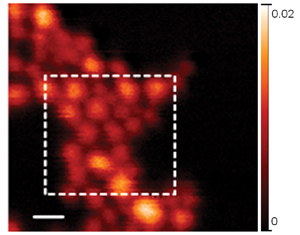
This work investigated the photophysical pathways for light absorption, charge generation, and charge separation in donor–acceptor nanoparticle blends of poly(3-hexylthiophene) and indene-C60-bisadduct. Optical modeling combined with steady-state and time-resolved optoelectronic characterization revealed that the nanoparticle blends experience a photocurrent limited to 60% of a bulk solution mixture. This discrepancy resulted from imperfect free charge generation inside the nanoparticles. High-resolution transmission electron microscopy and chemically resolved X-ray mapping showed that enhanced miscibility of materials did improve the donor–acceptor blending at the center of the nanoparticles; however, a residual shell of almost pure donor still restricted energy generation from these nanoparticles.
Information
- Type
- Research Letters
- Information
- Copyright
- Copyright © The Author(s), 2020, published on behalf of Materials Research Society by Cambridge University Press
References
Griffith, M.J., Cooling, N.A., Vaughan, B., Elkington, D.C., Hart, A.S., Lyons, A.G., Qureshi, S., Belcher, W.J., and Dastoor, P.C.: Combining printing, coating and vacuum deposition on the roll-to-roll scale: a hybrid organic photovoltaics fabrication. In IEEE Journal of Selected Topics in Quantum Electronics, Vol. 22, pp. 1–14 (2016).Google Scholar
Forrest, S.R.: The path to ubiquitous and low-cost organic electronic appliances on plastic. Nat. Commun. 428, 911–918 (2004).10.1038/nature02498CrossRefGoogle Scholar
Griffith, M.J., Cooling, N.A., Vaughan, B., O'Donnell, K.M., Al-Mudhaffer, M.F., Al-Ahmad, A., Noori, M., Almyahi, F., Belcher, W.J., and Dastoor, P.C.: Roll-to-roll sputter coating of aluminum cathodes for large-scale fabrication of organic photovoltaic devices. Energy Technol. 3, 428–436 (2015).10.1002/ente.201402174CrossRefGoogle Scholar
Jeevanandam, J., Barhoum, A., Chan, Y.S., Dufresne, A., and Danquah, M.K.: Review on nanoparticles and nanostructured materials: history, sources, toxicity and regulations. Beilstein J. Nanotech. 9, 1050–1074 (2018).CrossRefGoogle ScholarPubMed
Yin, Y. and Talapin, D.: The chemistry of functional nanomaterials. Chem. Soc. Rev. 42, 2484–2487 (2013).CrossRefGoogle ScholarPubMed
Gleiter, H.: Nanostructured materials: basic concepts and microstructure. Acta Mater. 48, 1–29 (2000).CrossRefGoogle Scholar
Li, Z., Xu, X., Zhang, W., Meng, X., Ma, W., Yartsev, A., Inganas, O., Andersson, M.R., Janssen, R.A., and Wang, E.: High performance all-polymer solar cells by synergistic effects of fine-tuned crystallinity and solvent annealing. J. Am. Chem. Soc. 138, 10935–10944 (2016).CrossRefGoogle ScholarPubMed
Griffith, M.J., Holmes, N.P., Elkington, D.C., Cottam, S., Stamenkovic, J., Kilcoyne, A.L.D., and Andersen, T.R.: Manipulating nanoscale structure to control functionality in printed organic photovoltaic, transistor and bioelectronic devices. Nanotechnology 31, 092002 (2019).CrossRefGoogle ScholarPubMed
Brabec, C.J., Zerza, G., Cerullo, G., De Silvestri, S., Luzzati, S., Hummelen, J.C., and Sariciftci, S.: Tracing photoinduced electron transfer process in conjugated polymer/fullerene bulk heterojunctions in real time. Chem. Phys. Lett. 340, 232–236 (2001).CrossRefGoogle Scholar
Hoppe, H. and Sariciftci, N.S.: Morphology of polymer/fullerene bulk heterojunction solar cells. J. Mater. Chem. 16, 45–61 (2006).CrossRefGoogle Scholar
Luber, E.J. and Buriak, J.M.: Reporting performance in organic photovoltaic devices. ACS Nano 7, 4708–4714 (2013).CrossRefGoogle ScholarPubMed
Delgado, J.L., Bouit, P.-A., Filippone, S., Herranz, MÁ, and Martín, N.: Organic photovoltaics: a chemical approach. Chem. Commun. 46, 4853–4865 (2010).CrossRefGoogle ScholarPubMed
Holmes, N.P., Marks, M., Cave, J.M., Feron, K., Barr, M.G., Fahy, A., Sharma, A., Pan, X., Kilcoyne, D.A.L., Zhou, X., Lewis, D.A., Andersson, M.R., van Stam, J., Walker, A.B., Moons, E., Belcher, W.J., and Dastoor, P.C.: Engineering two-phase and three-phase microstructures from water-based dispersions of nanoparticles for eco-friendly polymer solar cell applications. Chem. Mater. 30, 6521–6531 (2018).10.1021/acs.chemmater.8b03222CrossRefGoogle Scholar
Sankaran, S., Glaser, K., Gärtner, S., Rödlmeier, T., Sudau, K., Hernandez-Sosa, G., and Colsmann, A.: Fabrication of polymer solar cells from organic nanoparticle dispersions by doctor blading or ink-jet printing. Org. Electron 28, 118–122 (2016).CrossRefGoogle Scholar
Xie, C., Tang, X., Berlinghof, M., Langner, S., Chen, S., Spath, A., Li, N., Fink, R.H., Unruh, T., and Brabec, C.J.: Robot-based high-throughput engineering of alcoholic polymer: fullerene nanoparticle inks for an eco-friendly processing of organic solar cells. ACS Appl. Mater. Interfaces 10, 23225–23234 (2018).10.1021/acsami.8b03621CrossRefGoogle ScholarPubMed
Darwis, D., Holmes, N., Elkington, D., David Kilcoyne, A.L., Bryant, G., Zhou, X., Dastoor, P., and Belcher, W.: Surfactant-free nanoparticulate organic photovoltaics. Solar Energy Mater. Solar Cells 121, 99–107 (2014).CrossRefGoogle Scholar
Xie, C., Heumuller, T., Gruber, W., Tang, X., Classen, A., Schuldes, I., Bidwell, M., Spath, A., Fink, R.H., Unruh, T., McCulloch, I., Li, N., and Brabec, C.J.: Overcoming efficiency and stability limits in water-processing nanoparticular organic photovoltaics by minimizing microstructure defects. Nat. Commun. 9, 5335 (2018).CrossRefGoogle ScholarPubMed
Holmes, N.P., Vaughan, B., Williams, E.L., Kroon, R., Anderrson, M.R., Kilcoyne, A.L.D., Sonar, P., Zhou, X., Dastoor, P.C., and Belcher, W.J.: Diketopyrrolopyrrole-based polymer:fullerene nanoparticle films with thermally stable morphology for organic photovoltaic applications. MRS Commun. 7, 67–73 (2017).CrossRefGoogle Scholar
Richards, J.J., Whittle, C.L., Shao, G., and Pozzo, L.D.: Correlating structure and photocurrent for composite semiconducting nanoparticles with contrast variation small-angle neutron scattering and photoconductive atomic force microscopy. ACS Nano 8, 4313–4324 (2014).CrossRefGoogle ScholarPubMed
Marks, M., Holmes, N.P., Sharma, A., Pan, X., Chowdhury, R., Barr, M.G., Fenn, C., Griffith, M.J., Feron, K., Kilcoyne, A.L.D., Lewis, D.A., Andersson, M.R., Belcher, W.J., and Dastoor, P.C.: Building intermixed donor-acceptor architectures for water-processable organic photovoltaics. Phys. Chem. Chem. Phys. 21, 5705–5715 (2019).CrossRefGoogle ScholarPubMed
Millstone, J.E., Kavulak, D.F.J., Woo, C.H., Holcombe, T.W., Westling, E.J., Briseno, A.L., Toney, M.F., and Fréchet, J.M.J.: Synthesis, properties, and electronic applications of size-controlled poly(3-hexylthiophene) nanoparticles. Langmuir 26, 13056–13061 (2010).10.1021/la1022938CrossRefGoogle ScholarPubMed
Al-Mudhaffer, M.F., Griffith, M.J., Feron, K., Nicolaidis, N.C., Cooling, N.A., Zhou, X., Holdsworth, J., Belcher, W.J., and Dastoor, P.C.: The origin of performance limitations in miniemulsion nanoparticulate organic photovoltaic devices. Solar Energy Mater. Solar Cells 175, 77–88 (2018).CrossRefGoogle Scholar
Ameri, M., Al-Mudhaffer, M., Almyahi, F., Fardell, G.C., Marks, M., Al-Ahmad, A., Fahy, A., Andersen, T., Elkington, D.C., Feron, K., Dastoor, P.C., and Griffith, M.J.: The role of stabilizing surfactant on capacitance, charge and ion transport in organic nanoparticle-based photdiodes. ACS Appl. Mater. Interfaces 11, 10074–10088 (2019).CrossRefGoogle Scholar
Holmes, N.P., Burke, K.B., Sista, P., Barr, M., Magurudeniya, H.D., Stefan, Mihaela C., Kilcoyne, A.L. D., Zhou, X., Dastoor, P. C. and Belcher, W.J.: Nano-domain behaviour in P3HT:PCBM nanoparticles, relating material properties to morphological changes. Solar Energy Mater. Solar Cells 117, 437–445 (2013).10.1016/j.solmat.2013.06.003CrossRefGoogle Scholar
Nicolaidis, N.C., Routley, B.S., Holdsworth, J.L., Belcher, W.J., Zhou, X., and Dastoor, P.C.: Fullerene contribution to photocurrent generation in organic photovoltaic cells. J. Phys. Chem. C 115, 7801–7805 (2011).CrossRefGoogle Scholar
Hoppe, H., Arnold, N., Meissner, D., and Sariciftci, N.S.: Modeling of optical absorption in conjugated polymer/fullerene bulk-heterojunction plastic solar cells. Thin Solid Films 451–452, 589–592 (2004).CrossRefGoogle Scholar
Armin, A., Velusamy, M., Wolfer, P., Zhang, Y., Burn, P.L., Meredith, P., and Pivrikas, A.: Quantum efficiency of organic solar cells: electro-optical cavity considerations. ACS Photonics 1, 173–181 (2014).CrossRefGoogle Scholar
Holliday, S., Ashraf, R.S., Wadsworth, A., Baran, D., Yousaf, S.A., Nielsen, C.B., Tan, C.H., Dimitrov, S.D., Shang, Z., Gasparini, N., Alamoudi, M., Laquai, F., Brabec, C.J., Salleo, A., Durrant, J.R., and McCulloch, I.: High-efficiency and air-stable P3HT-based polymer solar cells with a new non-fullerene acceptor. Nat. Commun. 7, 11585 (2016).CrossRefGoogle ScholarPubMed
Griffith, M.J., Willis, M., Kumar, P., Holdsworth, J.L., Bezuidenhout, H., Zhou, X., Belcher, W.J., and Dastoor, P.C.: Activation of organic photovoltaic light detectors using bend leakage from optical fibres. ACS Appl. Mater. Interfaces 8, 7926–7937 (2016).10.1021/acsami.5b12373CrossRefGoogle Scholar
Holmes, N.P., Nicolaidis, N., Feron, K., Barr, M., Burke, K.B., Al-Mudhaffer, M., Sista, P., Kilcoyne, A.L.D., Stefan, M.C., Zhou, X., Dastoor, P.C., and Belcher, W.J.: Probing the origin of photocurrent in nanoparticulate organic photovoltaics. Solar Energy Mater. Solar Cells 140, 412–421 (2015).CrossRefGoogle Scholar
Holmes, N.P., Marks, M., Kumar, P., Kroon, R., Barr, M.G., Nicolaidis, N., Feron, K., Pivrikas, A., Fahy, A., Mendaza, A., Kilcoyne, A.L.D., Müller, C., Zhou, X., Andersson, M.R., Dastoor, P.C., and Belcher, W.J.: Nano-pathways: bridging the divide between water-processable nanoparticulate and bulk heterojunction organic photovoltaics. Nano Energy 19, 495–510 (2016).CrossRefGoogle Scholar

Al-Mudhaffer et al. Supplementary Materials
Al-Mudhaffer et al. Supplementary Materials

File
955.1 KB
- 7
- Cited by