


Hostname: page-component-7b7567c8c-7pwfn Total loading time: 0 Render date: 2026-11-16T11:52:33.628Z Has data issue: false hasContentIssue false

Building better dual-ion batteries

Published online by Cambridge University Press:  20 October 2020

Kostiantyn V. Kravchyk*
Affiliation:
Laboratory for Thin Films and Photovoltaics, Empa – Swiss Federal Laboratories for Materials Science and Technology, Überlandstrasse 129, Dübendorf CH-8600, SwitzerlandLaboratory of Inorganic Chemistry, Department of Chemistry and Applied Biosciences, ETH Zürich, Vladimir-Prelog-Weg 1, Zürich CH-8093, Switzerland
Maksym V. Kovalenko*
Affiliation:
Laboratory for Thin Films and Photovoltaics, Empa – Swiss Federal Laboratories for Materials Science and Technology, Überlandstrasse 129, Dübendorf CH-8600, SwitzerlandLaboratory of Inorganic Chemistry, Department of Chemistry and Applied Biosciences, ETH Zürich, Vladimir-Prelog-Weg 1, Zürich CH-8093, Switzerland
*
Address all correspondence to Kostiantyn V. Kravchyk at kravchyk@inorg.chem.ethz.ch and Maksym V. Kovalenko at mvkovalenko@ethz.ch
Get access

Abstract

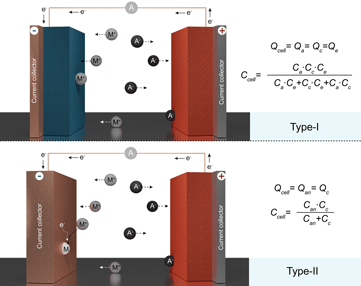
This perspective article summarizes the operational principles of dual-ion batteries and highlights the main issues in the interpretation and reporting of their electrochemical performance.

Secondary dual-ion batteries (DIBs) are emerging stationary energy storage systems that have been actively explored in view of their low cost, high energy efficiency, power density, and long cycling life. Nevertheless, a critical assessment of the literature in this field points to numerous inaccuracies and inconsistencies in reported performance, primarily caused by the exclusion of the capacity of used electrolytes and the use of non-charge-balanced batteries. Ultimately, these omissions have a direct impact on the assessment of the energy and power density of DIBs. Aiming to secure further advancement of DIBs, in this work, we critically review current research pursuits and summarize the operational mechanisms of such batteries. The particular focus of this perspective is put on highlighting the main issues in the interpretation and reporting of the electrochemical performance of DIBs. To this end, we survey the prospects of these stationary storage systems, emphasizing the practical hurdles that remain to be addressed.

Information

Type
Perspective
Copyright
Copyright © The Author(s), 2020, published on behalf of Materials Research Society by Cambridge University Press

Access options

Get access to the full version of this content by using one of the access options below. (Log in options will check for institutional or personal access. Content may require purchase if you do not have access.)

Article purchase

Temporarily unavailable

Supplementary material: File

Kravchyk and Kovalenko supplementary material

Kravchyk and Kovalenko supplementary material

Download Kravchyk and Kovalenko supplementary material(File)
File 124.1 KB