

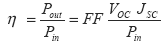
 where Pout
is the output electrical power of the device under illumination, Pin
is the light intensity incident on the device, VOC
is the open-circuit voltage, and JSC
is the short-circuit current density. FF is the fill factor, given by
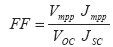 where Vmpp
and Jmpp
are the voltage and current density at the maximum power point, respectively.

Crossref Citations

This article has been cited by the following publications. This list is generated based on data provided by Crossref.
Hoppe, Harald
and
Sariciftci, N. Serdar
2007.
Photoresponsive Polymers II.
p.
1.
Li, LiGui
Lu, GuangHao
Yang, XiaoNiu
and
Zhou, EnLe
2007.
Progress in polymer solar cell.
Chinese Science Bulletin,
Vol. 52,
Issue. 2,
p.
145.
Torabi, Solmaz
Liu, Jian
Gordiichuk, Pavlo
Herrmann, Andreas
Qiu, Li
Jahani, Fatemeh
Hummelen, Jan C.
and
Koster, L. Jan Anton
2016.
Deposition of LiF onto Films of Fullerene Derivatives Leads to Bulk Doping.
ACS Applied Materials & Interfaces,
Vol. 8,
Issue. 34,
p.
22623.