

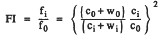
 where fi is the calculated strength, ci is the Portland cement volume, and wi is the water volume in the test (i-th) mix; and f0, c0, w0 are the corresponding values in the control (i.e., no pozzolan) mix at the same age. See reference 21 for more details.

Crossref Citations

This article has been cited by the following publications. This list is generated based on data provided by Crossref.
Mostafa, N.Y.
El-Hemaly, S.A.S.
Al-Wakeel, E.I.
El-Korashy, S.A.
and
Brown, P.W.
2001.
Characterization and evaluation of the pozzolanic activity of Egyptian industrial by-products.
Cement and Concrete Research,
Vol. 31,
Issue. 3,
p.
467.
Shi, Caijun
and
Day, Robert L
2001.
Comparison of different methods for enhancing reactivity of pozzolans.
Cement and Concrete Research,
Vol. 31,
Issue. 5,
p.
813.
Shi, Caijun
2001.
An overview on the activation of reactivity of natural pozzolans.
Canadian Journal of Civil Engineering,
Vol. 28,
Issue. 5,
p.
778.
Sarkar, A.
Rano, Ruma
Udaybhanu, G.
and
Basu, A.K.
2006.
A comprehensive characterisation of fly ash from a thermal power plant in Eastern India.
Fuel Processing Technology,
Vol. 87,
Issue. 3,
p.
259.
Pyatina, Tatiana
Sugama, Toshifumi
Ronne, Arthur
and
Trabits, George
2018.
Self-repairing properties of OPC clinker/natural zeolite blend in water and alkali carbonate environments at 270°C.
Advances in Cement Research,
Vol. 30,
Issue. 1,
p.
8.
Chervonnyi, A. D.
Chukanov, N. V.
and
Pekov, I. V.
2018.
Synthetic Calcium Aluminosilicate Monolith: Transformations in an Aqueous Medium.
Russian Journal of Inorganic Chemistry,
Vol. 63,
Issue. 4,
p.
530.
Pacaña, Mona Lisa C.
Ranay, Kathleen A.
Tabelin, Carlito B.
Alorro, Richard D.
and
Resabal, Vannie Joy T.
2025.
Optimization of Mixed Mineral–Organic Acid Leaching for Critical Rare Earth Element Extraction from Philippine Coal Fly Ash.
Sustainability,
Vol. 17,
Issue. 24,
p.
11076.