




No CrossRef data available.
Article contents
Hyperbolic affine hyperspheres
Published online by Cambridge University Press: 22 January 2016
Extract
Core share and HTML view are not available for this content. However, as you have access to this content, a full PDF is available via the 'Save PDF' action button.
A locally strongly convex hypersurface in the affine space Rn + 1 is called an affine hypersphere if the affine normals (§ 1) through each point of the hypersurface either all intersect at one point, called its center, or else are all mutually parallel. It is called elliptic, parabolic or hyperbolic according to whether the center is, respectively, on the concave side of the hypersurface, at infinity or on the convex side. This class of hypersurfaces was first studied systematically by W. Blaschke ([1]) in the frame of affine geometry. In his paper [3] E. Calabi redefined it and proposed a problem of determining all complete hyperbolic affine hyperspheres and raised a conjecture that these hypersurfaces are asymptotic to the boundary of a convex cone and every non-degenerate cone V determines a hyperbolic affine hypersphere, asymptotic to the boundary of V, uniquely by the value of its mean curvature.
Information
- Type
- Research Article
- Information
- Copyright
- Copyright © Editorial Board of Nagoya Mathematical Journal 1980
References
[2]
Bochner, S., Group invariance of Cauchy’s formula in several variables, Ann. of Math., 45 (1944), 686–707.Google Scholar
[4]
Cheng, S. Y. and Yau, S. T., On the regularity of the Monge-Ampère equation det
 Comm. on pure and appl. Math., 30 (1977), 41–68.Google Scholar
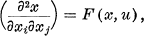 Comm. on pure and appl. Math., 30 (1977), 41–68.Google Scholar
[5]
Cheng, S. Y. and Yau, S. T., Complete affine hypersurfaces, Part I. The completeness of affine metrics, Preprint.Google Scholar
[6]
Flanders, H., Local theory of affine hypersurfaces, J. D’Analyse Math., 15 (1965), 353–387.CrossRefGoogle Scholar
[7]
Kaneyuki, S. and Tsuji, T., Classification of homogeneous bounded domains of lower dimension, Nagoya Math. J., 53 (1974), 1–46.Google Scholar
[9]
Loewner, C. and Nirenberg, L., Partial differential equations invariant under conformal or projective transformations, Contributions to Analysis, 1974, Academic Press, 245–272.CrossRefGoogle Scholar
[10]
Protter, M. H. and Weinberger, H. F., Maximum principles in differential equations, Prentice-Hall, 1967.Google Scholar
[12]
Rothaus, O. S., Domains of positivity, Abh. Math. Sem. Univ. Hamburg, 24 (1960), 189–235.CrossRefGoogle Scholar
[13]
Rothaus, O. S., The construction of homogeneous convex cones, Ann. of Math., 83 (1966), 358–376.CrossRefGoogle Scholar
[14]
Sacksteder, R., On hypersurfaces with nonnegative sectional curvatures, Amer. J. Math., 82 (1960), 609–630.CrossRefGoogle Scholar
[15]
Tsuji, T., Classification of homogeneous Siegel domains of type II of dimensions 9 and 10, Proc. of Japan Acad., 49 (1973), 394–396.Google Scholar
[16]
Vinberg, E. B., The theory of convex homogeneous cones, Trans. Moscow Math. Soc., 12 (1963), 340–403.Google Scholar
[17]
Wu, H., The spherical images of convex hypersurfaces, J. Diff. Geom., 9 (1974), 279–290.Google Scholar
 You have
Access
- 36
- Cited by