Contents
Research Article
Expansive flows and their centralizers
-
- Published online by Cambridge University Press:
- 22 January 2016, pp. 1-15
-
- Article
-
- You have access
- Export citation
Differential equations and an analog of the Paley-Wiener theorem for linear semisimple Lie groups
-
- Published online by Cambridge University Press:
- 22 January 2016, pp. 17-29
-
- Article
-
- You have access
- Export citation
On a certain type of vector bundles over an abelian variety
-
- Published online by Cambridge University Press:
- 22 January 2016, pp. 31-45
-
- Article
-
- You have access
- Export citation
Character formulas for discrete series on semisimple Lie groups
-
- Published online by Cambridge University Press:
- 22 January 2016, pp. 47-61
-
- Article
-
- You have access
- Export citation
-
Let G be a connected, semisimple real Lie group with finite center, K a maximal compact subgroup of G. Assume rank G = rank K. Let
 be the Lie algebra of G,
 its complexification. If Gc is the simplyconnected complex analytic group corresponding to assume G is the real analytic subgroup of Gc corresponding to .
 be the Lie algebra of G,
 its complexification. If G
Congruences between cusp forms and linear representations of the Galois group*)
-
- Published online by Cambridge University Press:
- 22 January 2016, pp. 63-85
-
- Article
-
- You have access
- Export citation
-
Let f(z) be a cusp form of type (l,ε) on Γ0(N) which is a common eigenfunction of all Hecke operators. For such f(z), Deligne and Serre [1] proved that there exists a linear representation

such that the Artin L-function for p is equal to the L-function associated to f(z).
On p-adic properties of the Eichler-Selberg trace formula II
-
- Published online by Cambridge University Press:
- 22 January 2016, pp. 87-96
-
- Article
-
- You have access
- Export citation
-
Let
 be the space of cusp forms of weight k with respect to SL(2, Z). Let p be a prime number and let Tk(p) be the Hecke operator of degree p acting on as a linear endomorphism. Put Hk(X) = det (I – Tk(p)X + pk-lX2I), where I is the identity operator on . Hk(X) is a polynomial with coefficients of rational integers, which is called the Hecke polynomial.
 be the space of cusp forms of weight k with respect to SL(2, Z). Let p be a prime number and let T
On the generalized Teichmüller spaces and differential equations
-
- Published online by Cambridge University Press:
- 22 January 2016, pp. 97-115
-
- Article
-
- You have access
- Export citation
-
It is well known that for the family F of Riemann surfaces {R(z)} defined by the equations y2 = x(x — l)(x — z), zεC — {0,1}, we have one independent abelian differential ω = y−1dx on each R(z) and if we consider z as a parameter on C — {0,1}, the integrals
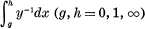 are solutions of the Gauss’s differential equation

 are solutions of the Gauss’s differential equation
A uniqueness theorem of algebraically non-degenerate meromorphic maps into PN(C)
-
- Published online by Cambridge University Press:
- 22 January 2016, pp. 117-147
-
- Article
-
- You have access
- Export citation
On some analogues of Titchmarsh divisor problem
-
- Published online by Cambridge University Press:
- 22 January 2016, pp. 149-158
-
- Article
-
- You have access
- Export citation
-
In [15] Titchmarsh posed and solved under the generalized Riemann Hypothesis, the problem of an asymptotic behavior of the number of the solutions of the equation 1 = p — n1n2 for a prime p ≦ x and natural numbers n1 and n2. When we put
 then the above problem is to get an asymptotic law for the sum

 then the above problem is to get an asymptotic law for the sum

Holomorphic mappings into a compact quotient of symmetric bounded domain
-
- Published online by Cambridge University Press:
- 22 January 2016, pp. 159-175
-
- Article
-
- You have access
- Export citation
-
In this paper, we shall be concerned with the finiteness property of certain holomorphic mappings into a compact quotient of symmetric bounded domain.
Let
 be a symmetric bounded domain in n-dimensional complex Euclidean space Cn and Γ\ be a compact quotient of S by a torsion free discrete subgroup Γ of automorphism group of . Further, we denote by l() the maximum value of dimension of proper boundary component of , which is less than n (=dim).
 be a symmetric bounded domain in n-dimensional complex Euclidean space C
Front Matter
NMJ volume 64 Cover and Front matter
-
- Published online by Cambridge University Press:
- 22 January 2016, pp. f1-f5
-
- Article
-
- You have access
- Export citation
Back Matter
NMJ volume 64 Cover and Back matter
-
- Published online by Cambridge University Press:
- 22 January 2016, pp. b1-b2
-
- Article
-
- You have access
- Export citation