Contents
Research Article
Galois theory of aigebraic and differential equations
-
- Published online by Cambridge University Press:
- 22 January 2016, pp. 1-58
-
- Article
-
- You have access
- Export citation
Differential Galois theory of infinite dimension
-
- Published online by Cambridge University Press:
- 22 January 2016, pp. 59-135
-
- Article
-
- You have access
- Export citation
Exponential asymptotics in the small parameter exit problem
-
- Published online by Cambridge University Press:
- 22 January 2016, pp. 137-154
-
- Article
-
- You have access
- Export citation
-
Let M be a d-dimensional Riemannian manifold of class C∞ with Riemannian metric
 and let D be a connected domain in M having a non-empty smooth boundary
 and a compact closure
 . Suppose that

 are given and that
 converges uniformly to
 on D′ as
 for some neighborhood D′ of D. Consider the diffusion process
 on D′ with a small parameter
 generated by
(1.1)

 and let D be a connected domain in M having a non-empty smooth boundary
 and a compact closure
 . Suppose that

 are given and that
 converges uniformly to
 on D′ as
 for some neighborhood D′ of D. Consider the diffusion process
 on D′ with a small parameter
 generated by

On p-adic Dedekind sums
-
- Published online by Cambridge University Press:
- 22 January 2016, pp. 155-170
-
- Article
-
- You have access
- Export citation
-
For positive integers h, k and m, the higher-order Dedekind sums are definedby


A note on characteristic equation of Toeplitz operators on the spaces Ak
-
- Published online by Cambridge University Press:
- 22 January 2016, pp. 171-177
-
- Article
-
- You have access
- Export citation
-
Let k be any integer, k > 0. The k-th Bergman measure on unit ball B of Cn, μk , is given by


Hyponormal Toeplitz operators on H2(T) with polynomial symbols
-
- Published online by Cambridge University Press:
- 22 January 2016, pp. 179-182
-
- Article
-
- You have access
- Export citation
-
Let T be the unit circle on the complex plane, H2(T) be the usual Hardy space on T, Tø be the Toeplitz operator with symbol
 Cowen showed that if f1 and f2 are functions in H such that
 is in Lø , then Tf is hyponormal if and only if
 for some constant c and some function g in H∞ with
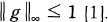 Using it, T. Nakazi and K. Takahashi showed that the symbol of hyponormal Toeplitz operator Tø satisfies
 and
 and they described the ø solving the functional equation above. Both of their conditions are hard to check, T. Nakazi and K. Takahashi remarked that even “the question about polynomials is still open” [2]. Kehe Zhu gave a computing process by way of Schur’s functions so that we can determine any given polynomial ø such that Tø is hyponormal [3]. Since no closed-form for the general Schur’s function is known, it is still valuable to find an explicit expression for the condition of a polynomial á such that Tø is hyponormal and depends only on the coefficients of ø, here we have one, it is elementary and relatively easy to check. We begin with the most general case and the following Lemma is essential.
 Cowen showed that if f
 is in L
 for some constant c and some function g in H
 Using it, T. Nakazi and K. Takahashi showed that the symbol of hyponormal Toeplitz operator T
 and
 and they described the ø solving the functional equation above. Both of their conditions are hard to check, T. Nakazi and K. Takahashi remarked that even “the question about polynomials is still open” [2]. Kehe Zhu gave a computing process by way of Schur’s functions so that we can determine any given polynomial ø such that Tø is hyponormal [3]. Since no closed-form for the general Schur’s function is known, it is still valuable to find an explicit expression for the condition of a polynomial á such that T
Front Matter
NMJ volume 144 Cover and Front matter
-
- Published online by Cambridge University Press:
- 22 January 2016, pp. f1-f5
-
- Article
-
- You have access
- Export citation
Back Matter
NMJ volume 144 Cover and Back matter
-
- Published online by Cambridge University Press:
- 22 January 2016, pp. b1-b2
-
- Article
-
- You have access
- Export citation